



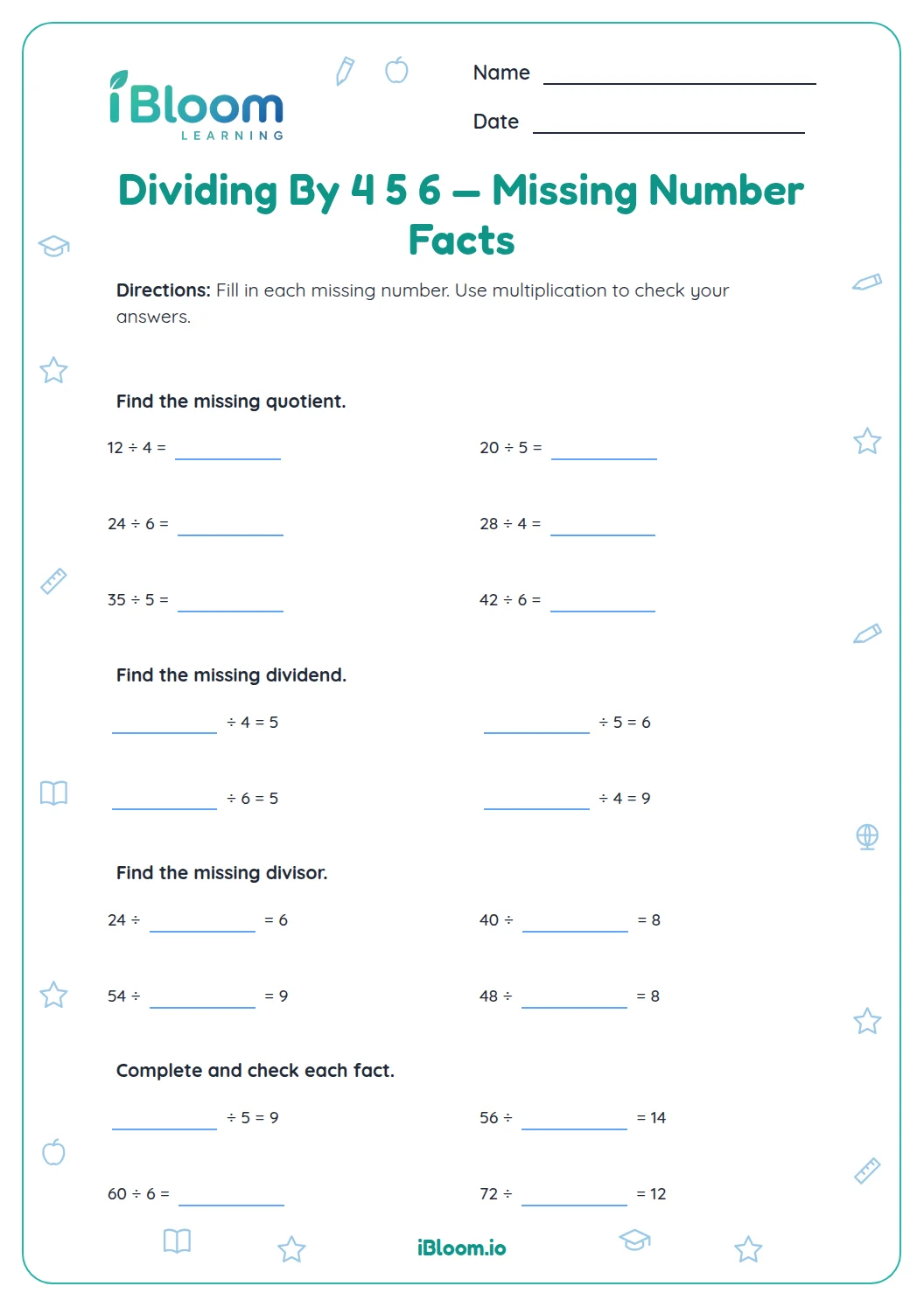
About this worksheet
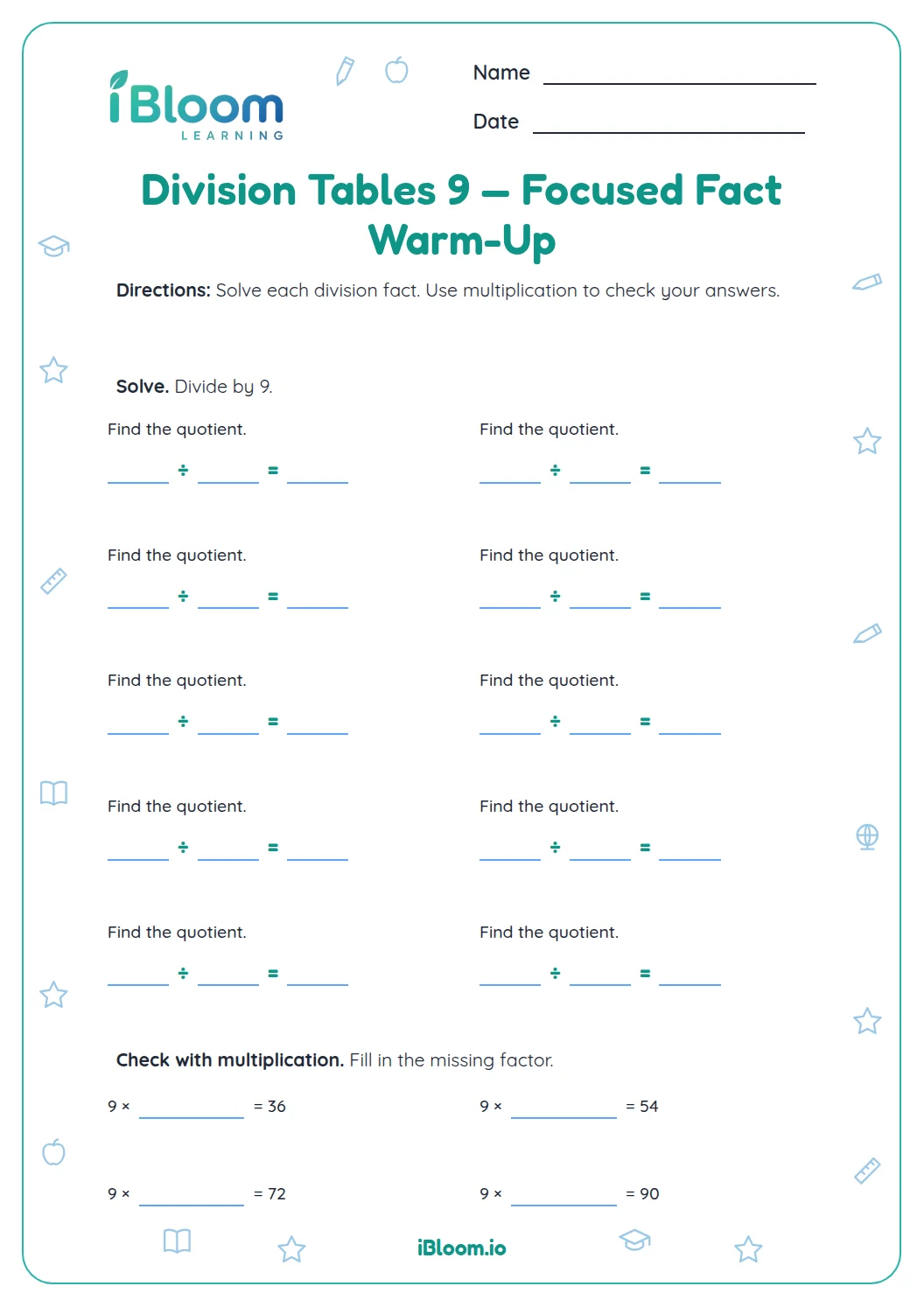
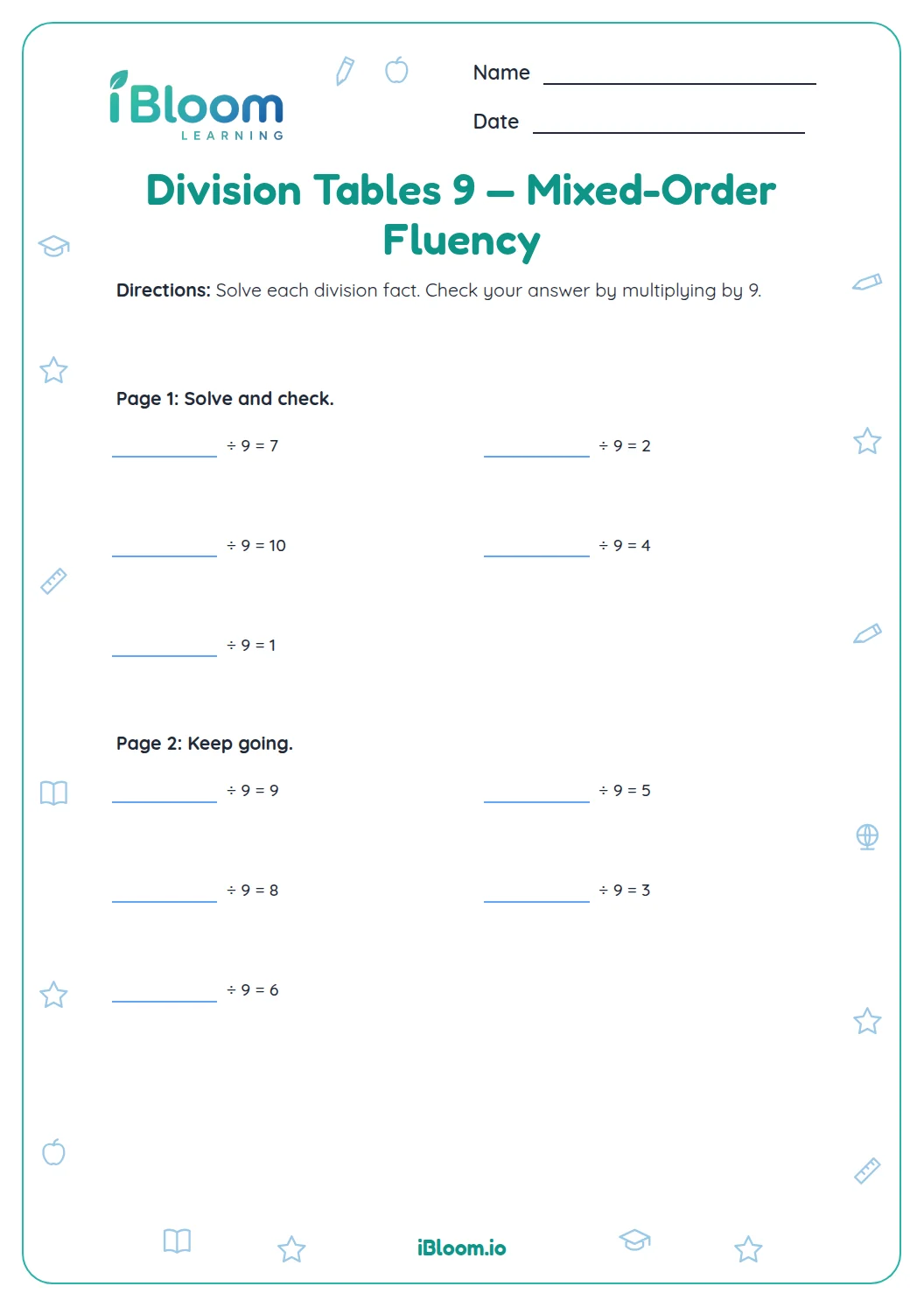
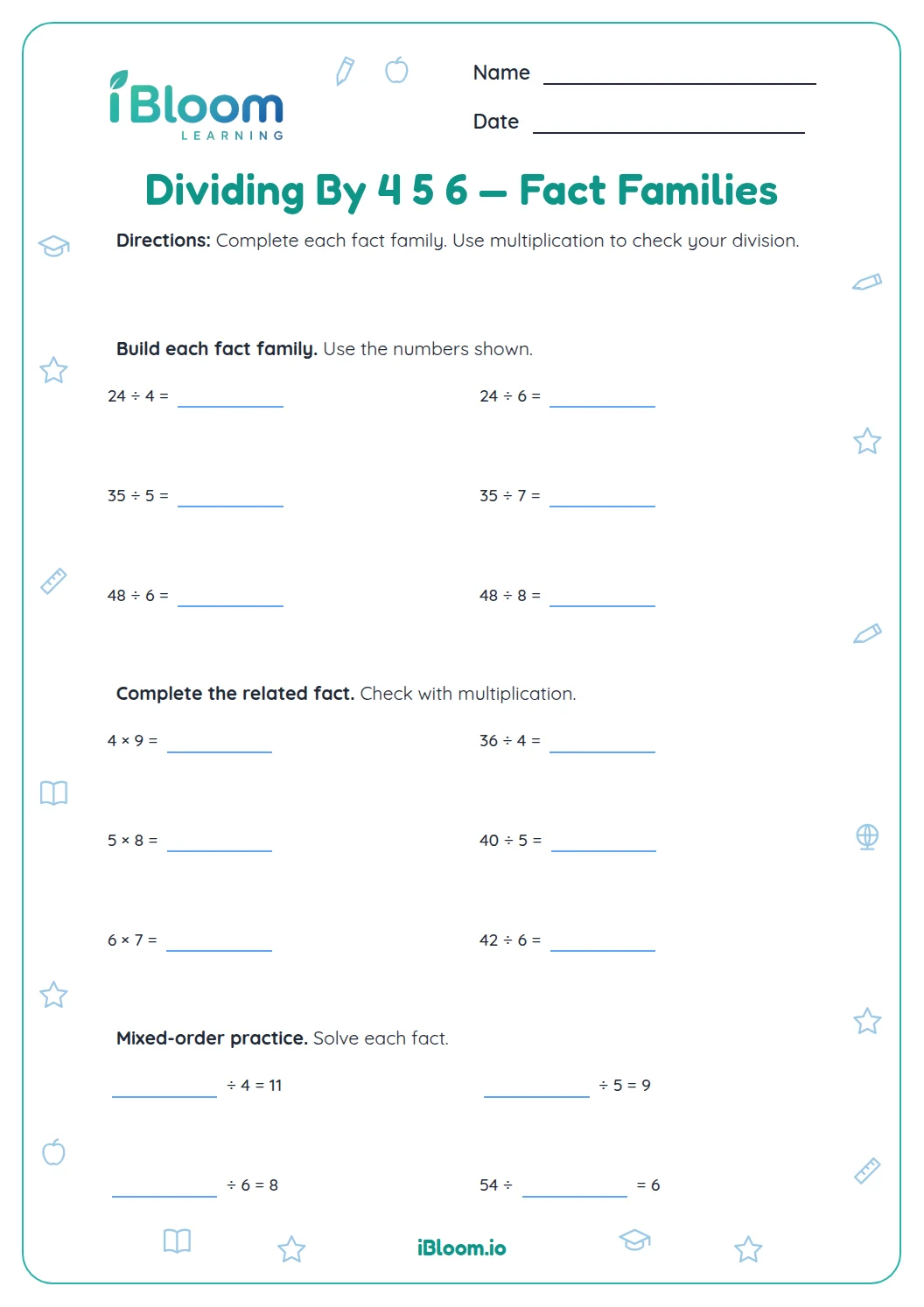
This printable Grade 3 math worksheet practices division facts for 9. It practices the 9s family by moving the blank between divisor and dividend. It includes 16 questions: 8 missing divisors and 8 missing dividends and a separate answer key. The work aligns with CCSS 3.OA.C.7.
How do I work with division facts for 9?
It practices the 9s family by moving the blank between divisor and dividend.
Use multiplication to check each division fact.
- 136 ÷ ___ = 4
- 2Think: 4 × 9 = 36
- 3The missing divisor is 9.
What practice is included?
16 questions: 8 missing divisors and 8 missing dividends. The questions move from direct practice to applying the same idea.
How to use this worksheet
- 1Read the full division equation.
- 2Name the number that is missing.
- 3Use the matching 9s multiplication fact.
- 4Substitute your answer and check the equation.
Common mistakes and quick fixes
The mistake
Putting the quotient in the divisor blank.
The fix
Multiply the known quotient by the missing divisor to recover the dividend.
The mistake
Using the dividend as the quotient.
The fix
Check which number appears before ÷ and which follows =.
The mistake
Forgetting a missing dividend is a multiple of 9.
The fix
Multiply the divisor by 9, then divide to check.
What to practice next
Make more practice
Further reading
Questions parents and teachers ask
How many questions are included?
The worksheet has 16 equations: eight ask for a missing divisor and eight ask for a missing dividend. Each equation uses a division fact from the 9s family. A separate answer key lists all 16 answers. Point to the blank before answering, then verify the completed fact by multiplying the divisor and quotient.
How do children find a missing divisor?
Use the dividend and quotient to think of a multiplication fact. For 36 ÷ ___ = 4, ask what number multiplied by 4 equals 36. The missing divisor is 9, and 36 ÷ 9 checks to 4. Point to the blank before answering, then verify the completed fact by multiplying the divisor and quotient.
How do children find a missing dividend?
Multiply the divisor by the quotient. For ___ ÷ 7 = 9, calculate 7 × 9 = 63. Then check that 63 ÷ 7 = 9. Point to the blank before answering, then verify the completed fact by multiplying the divisor and quotient.
Are all the missing numbers less than 10?
No. Missing divisors are single-digit numbers, but missing dividends are multiples of 9. For example, the blank in ___ ÷ 8 = 9 is 72. Point to the blank before answering, then verify the completed fact by multiplying the divisor and quotient.
Can multiplication check each answer?
Yes. Multiplication and division are inverse operations. Multiply the divisor by the quotient; the product should equal the dividend in the equation. Point to the blank before answering, then verify the completed fact by multiplying the divisor and quotient. Ask the learner to explain one answer using the pictured word or stated values.
Does the printable include an answer key?
Yes. The answer key is a separate page and gives the missing number for each of the 16 equations. Point to the blank before answering, then verify the completed fact by multiplying the divisor and quotient. Ask the learner to explain one answer using the pictured word or stated values.