




About this worksheet
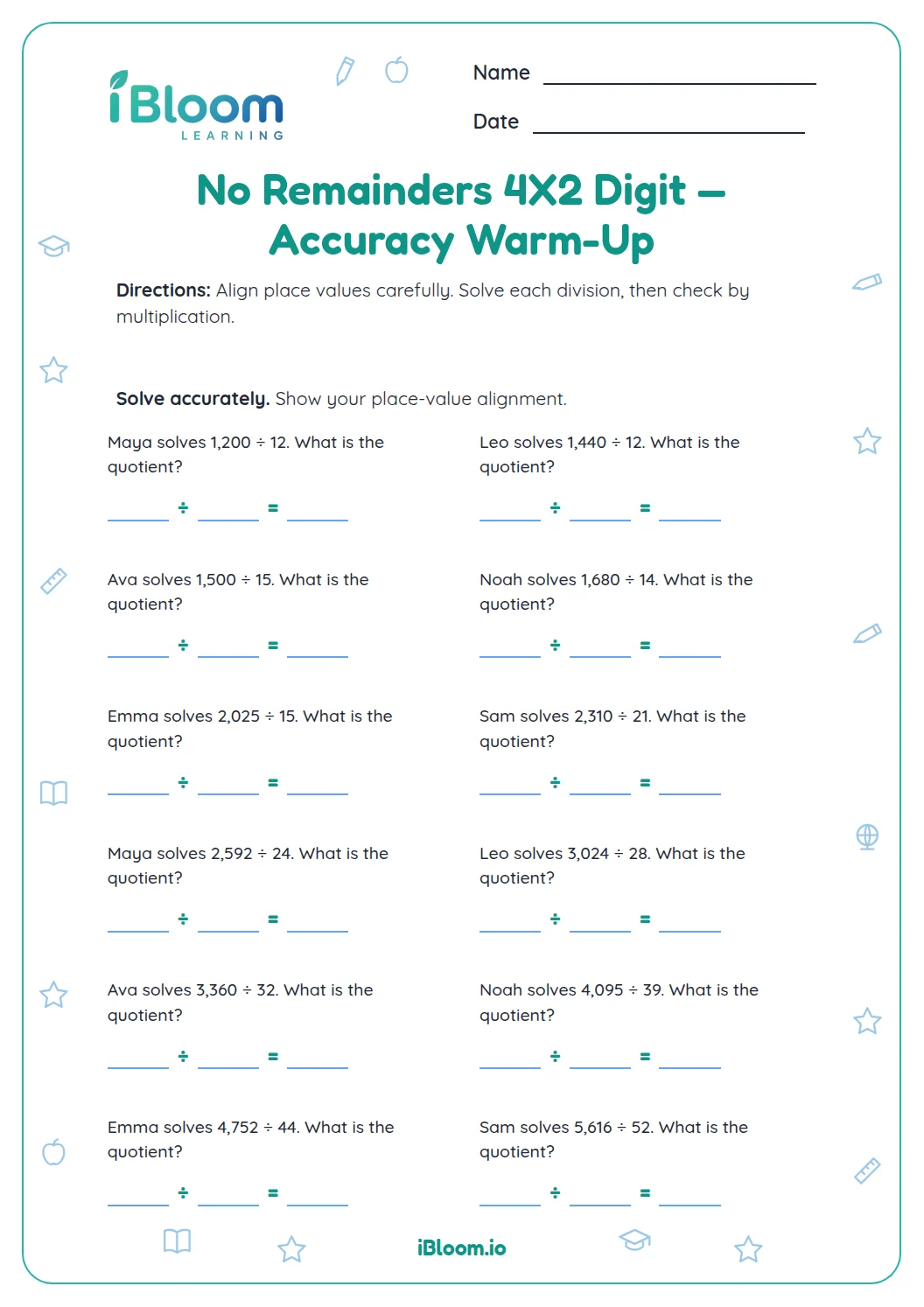
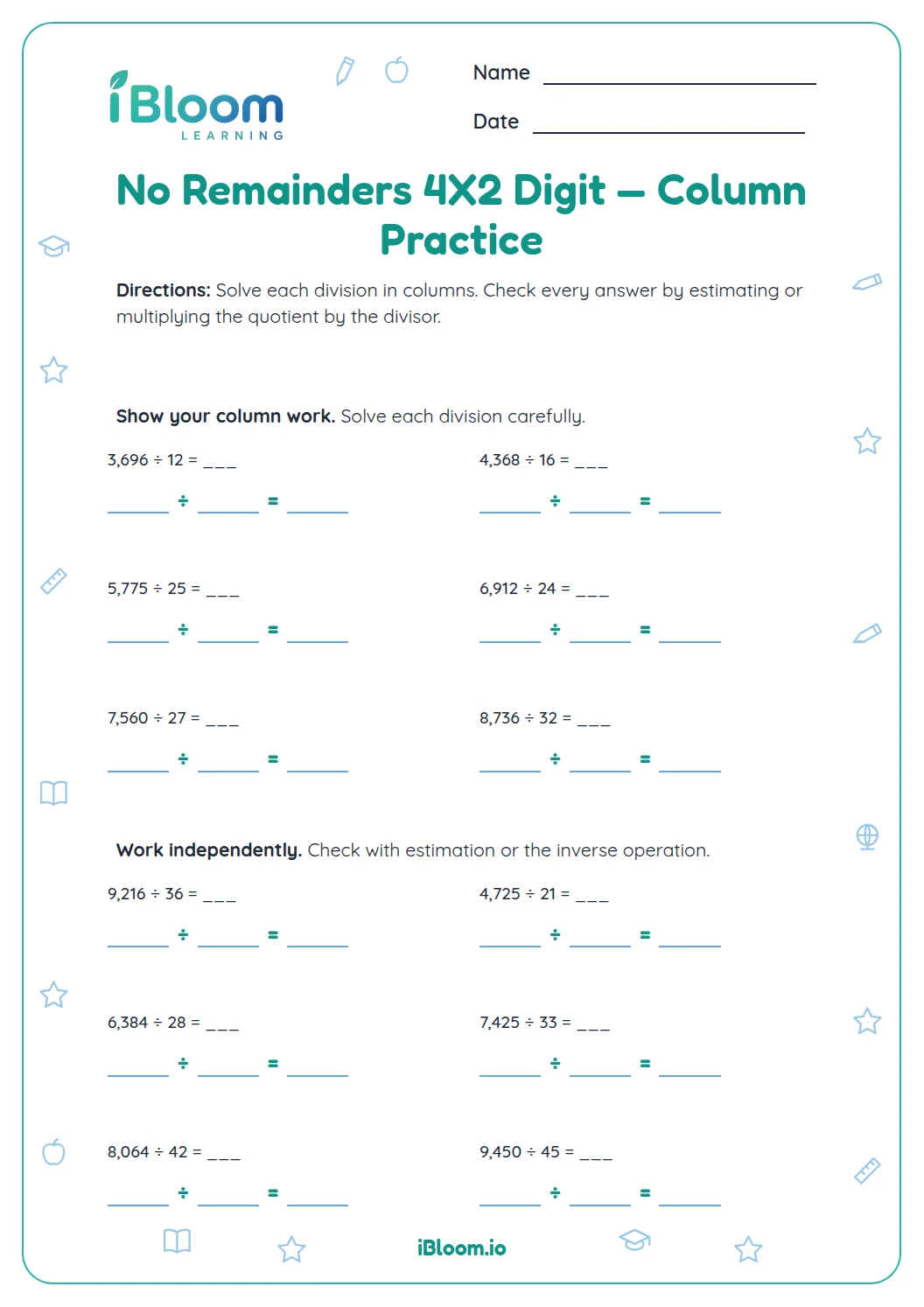
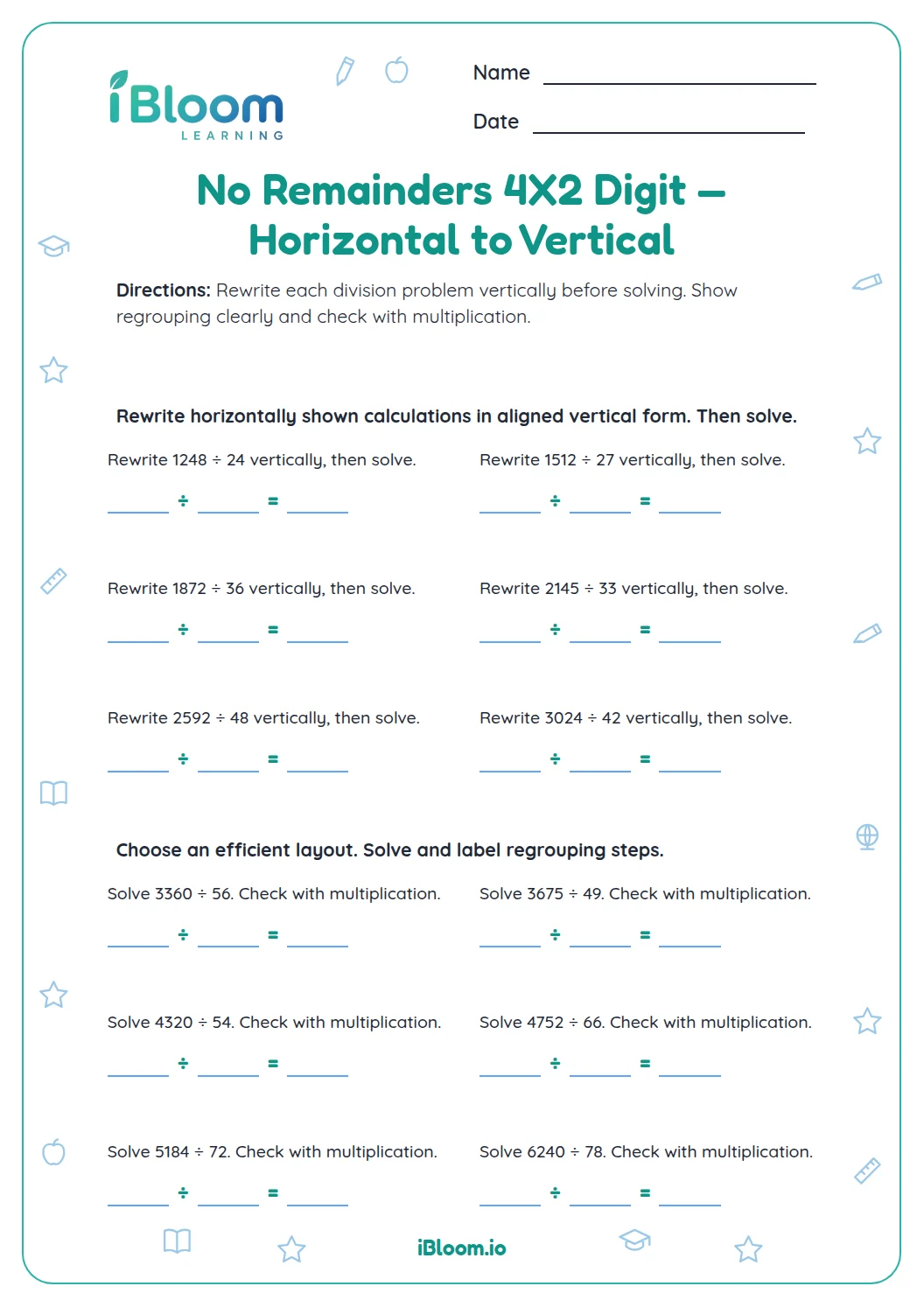
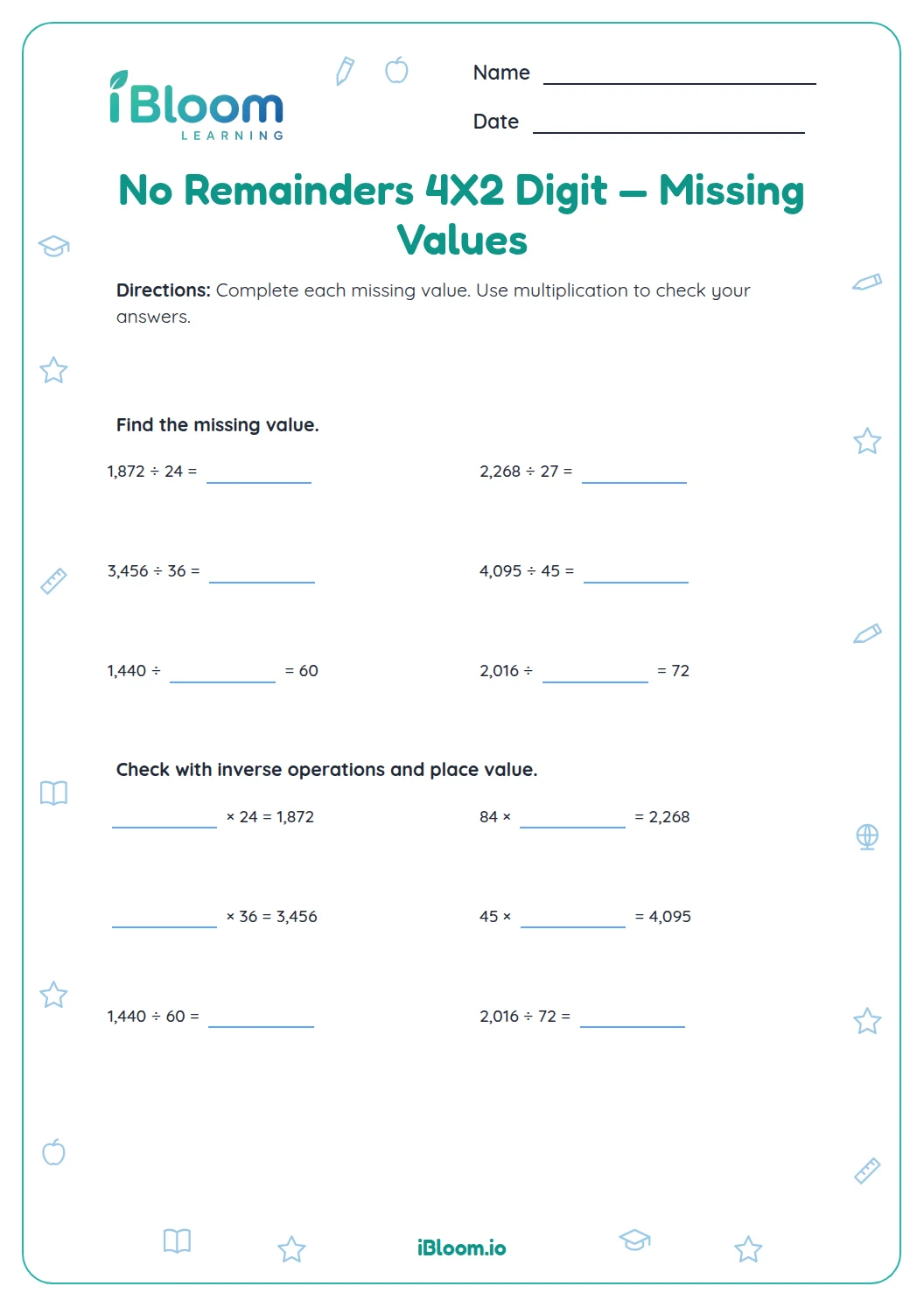
This Grade 5 worksheet combines division error analysis with exact-quotient practice for three-digit dividends and two-digit divisors. Learners correct reported quotient, remainder, and multiplication errors before solving new divisions and checking with multiplication. The separate key shows the corrected answers.
Aligned to 5.NBT.B.6
What errors will learners inspect?
The first part includes incorrect quotients, remainders, or products. Learners choose the correction that makes the division or multiplication relationship work.
How does multiplication check division?
Multiply the divisor by the proposed quotient. If the product equals the dividend, the quotient is exact; if it does not, inspect the quotient and place value.
How can a learner check 812 ÷ 29?
The quotient is 28 because 29 × 28 = 812. The product matches the dividend, so the division has no remainder.
How to use this worksheet
- 1Estimate the quotient before calculating.
- 2Check a proposed quotient by multiplying by the divisor.
- 3For an error, identify the value that must change.
- 4Solve each exact division and verify the product.
Common mistakes and quick fixes
The mistake
Keeping a remainder equal to the divisor.
The fix
Trade one full divisor for one more unit in the quotient.
The mistake
Multiplying with a place-value error.
The fix
Write partial products carefully and add them to check.
The mistake
Accepting a quotient without checking it.
The fix
Multiply divisor by quotient and compare the product with the dividend.
Curriculum alignment
This worksheet practices the stated skill through focused questions.
Divide multi-digit whole numbers using place value and multiplication.
On this sheet: Learners check exact division with a two-digit divisor by multiplying quotient and divisor and diagnosing an incorrect quotient or product.
Show the official wordingHide the official wording
Find whole-number quotients of whole numbers with up to four-digit dividends and two-digit divisors, using strategies based on place value, the properties of operations, and/or the relationship between multiplication and division.
What to practice next
Make more practice
Further reading
Questions parents and teachers ask
How can multiplication check a division answer?
Multiply the divisor by the proposed quotient. For 812 ÷ 29, 29 × 28 = 812, so 28 is the exact quotient. If the product differs from the dividend, review the calculation. Have the learner multiply the divisor and quotient, then compare that product with the stated dividend before accepting the result.
What error appears when a remainder equals the divisor?
A remainder must be smaller than the divisor. If it equals the divisor, one more group fits, so increase the quotient by one and reduce the remainder by one divisor. Have the learner multiply the divisor and quotient, then compare that product with the stated dividend before accepting the result.
What is in the first part?
The first seven questions ask learners to correct reported division or multiplication errors. Some focus on a quotient or remainder; others ask how far a product is from the correct value. Have the learner multiply the divisor and quotient, then compare that product with the stated dividend before accepting the result.
What is in the second part?
The final seven items are exact divisions with three-digit dividends and two-digit divisors. Find each quotient and verify it by multiplying by its divisor. Have the learner multiply the divisor and quotient, then compare that product with the stated dividend before accepting the result.
Should learners show long-division steps?
The printed second part provides space for answers and the directions ask learners to verify with multiplication. Learners can use scratch work to divide and check, then write the quotient in the answer space. Have the learner multiply the divisor and quotient, then compare that product with the stated dividend before accepting the result.