






About this worksheet
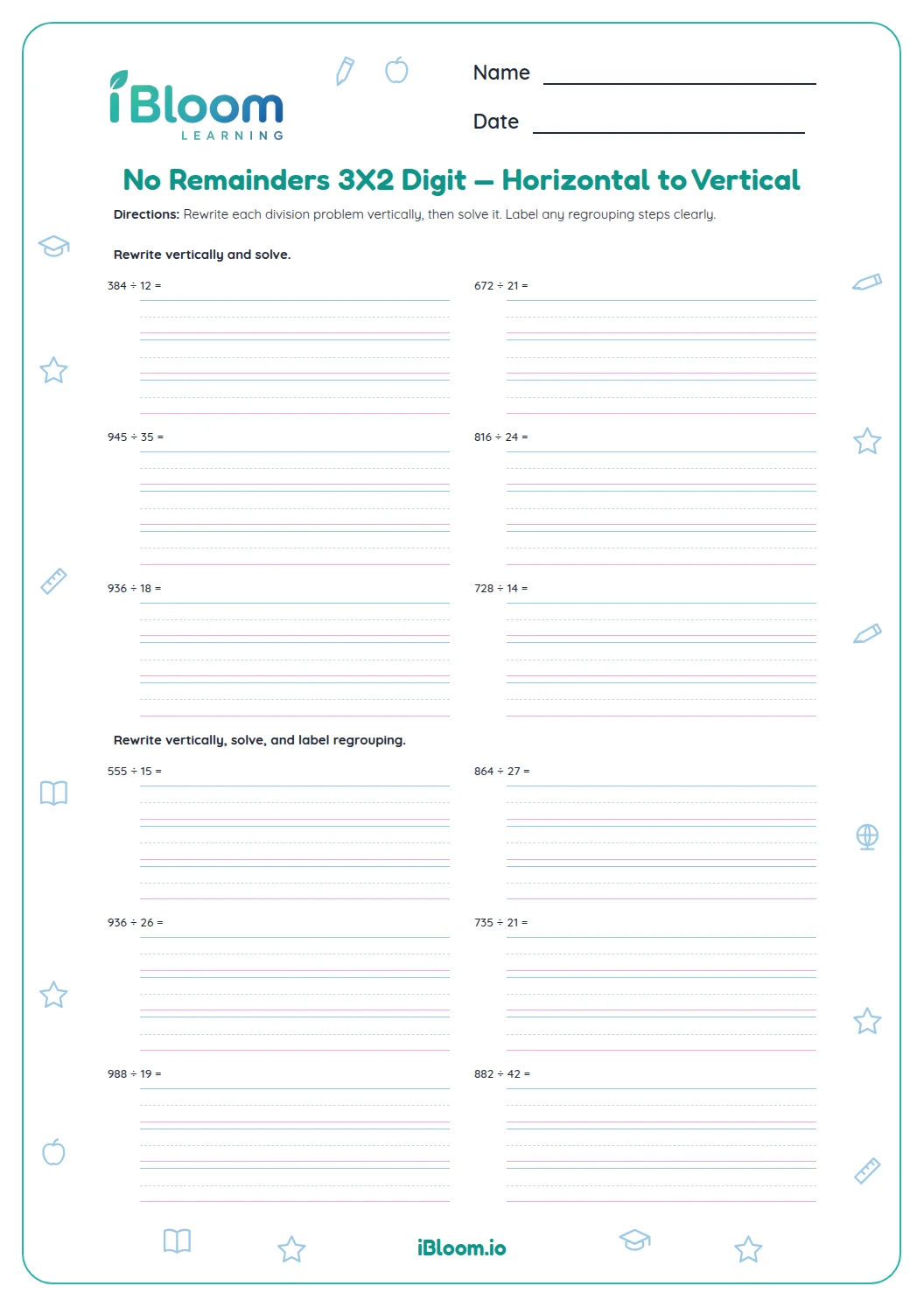
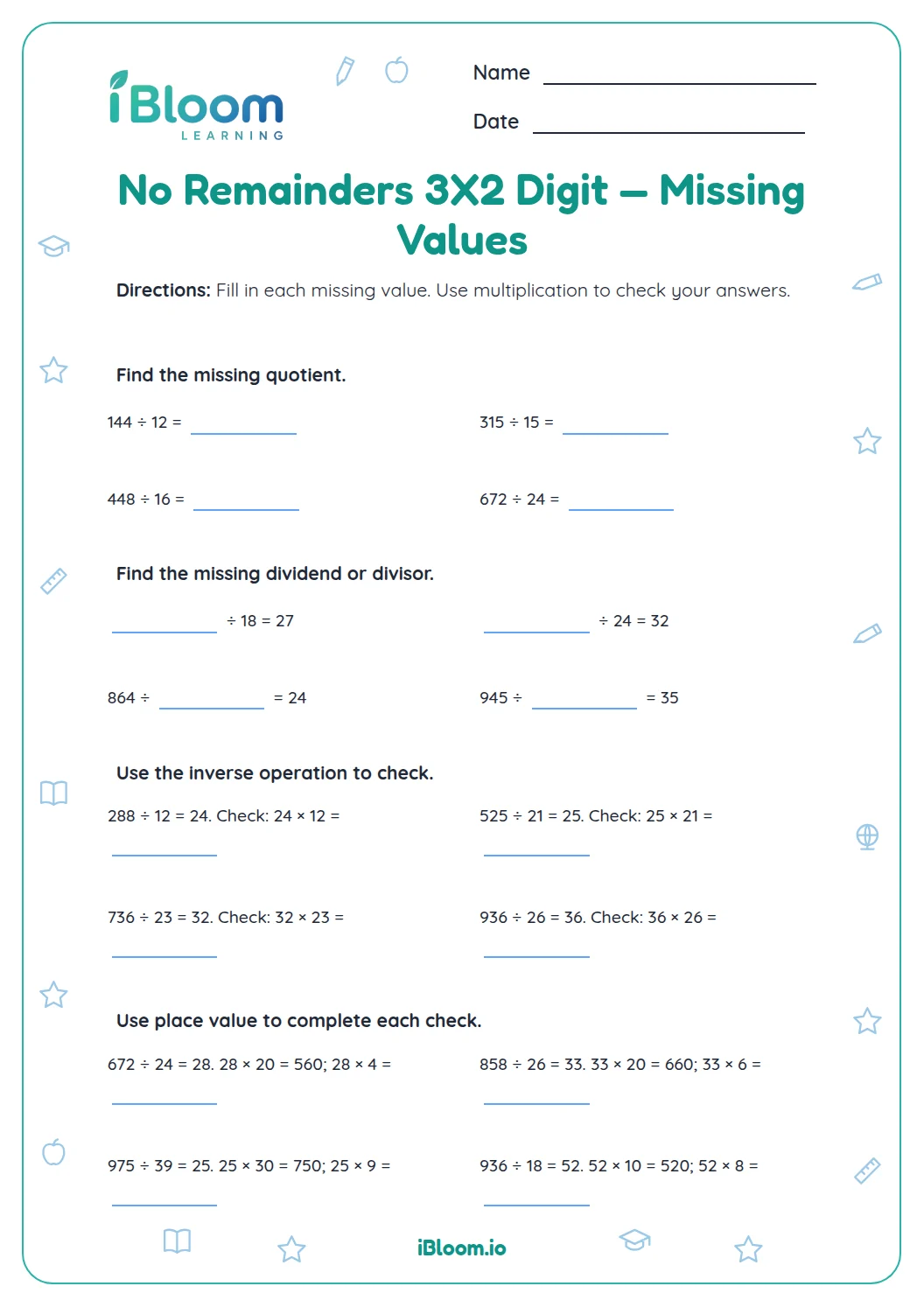
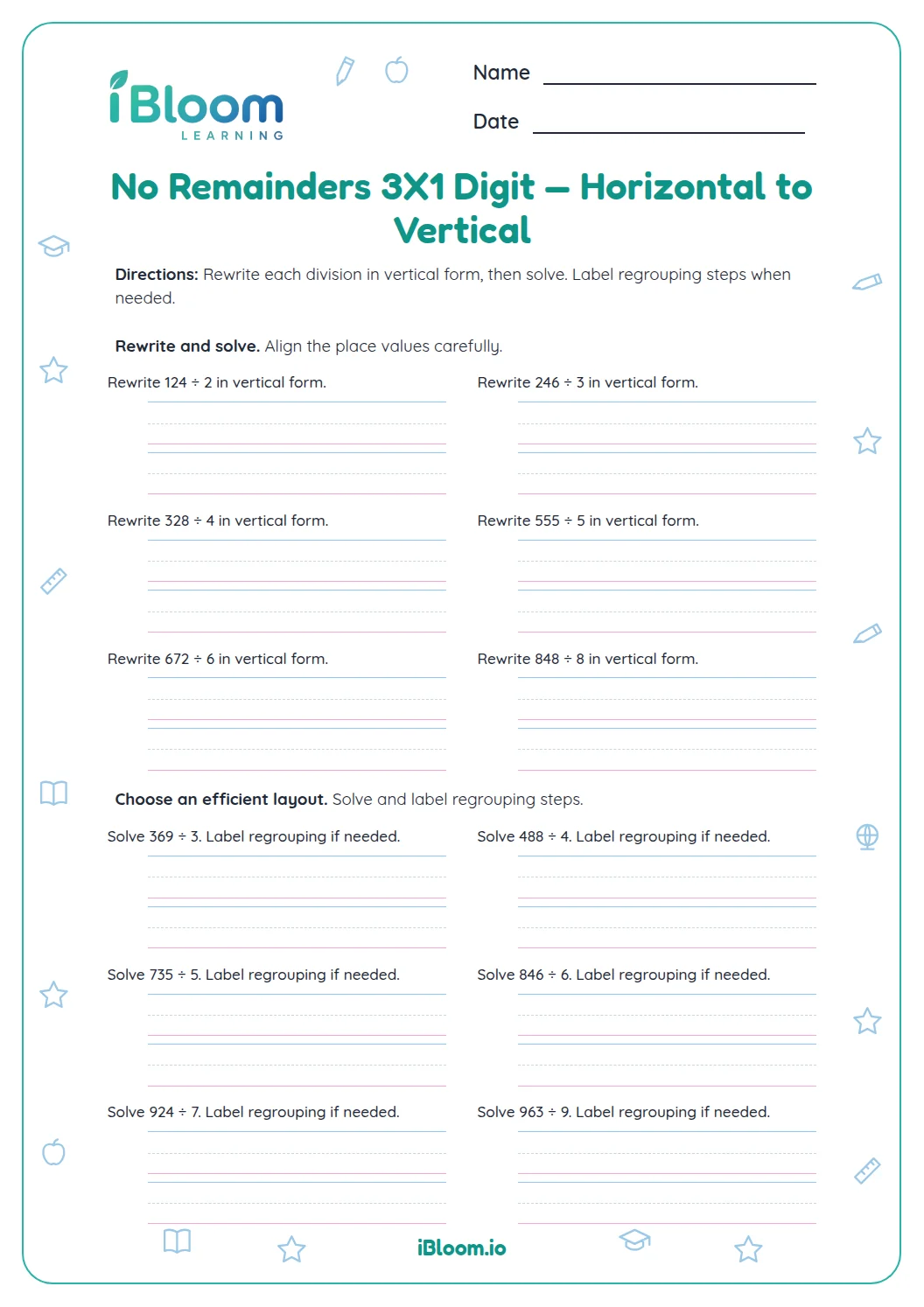
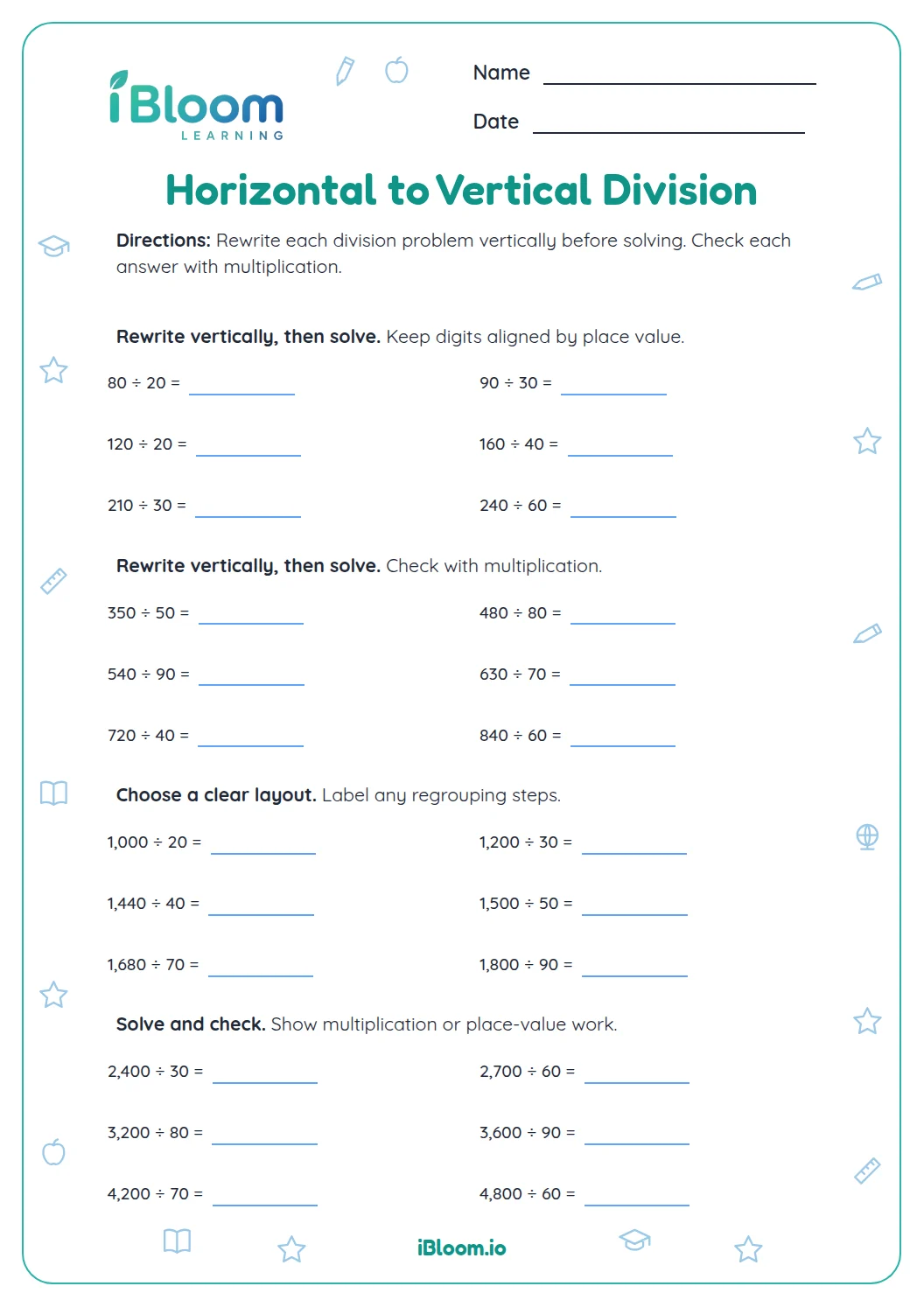
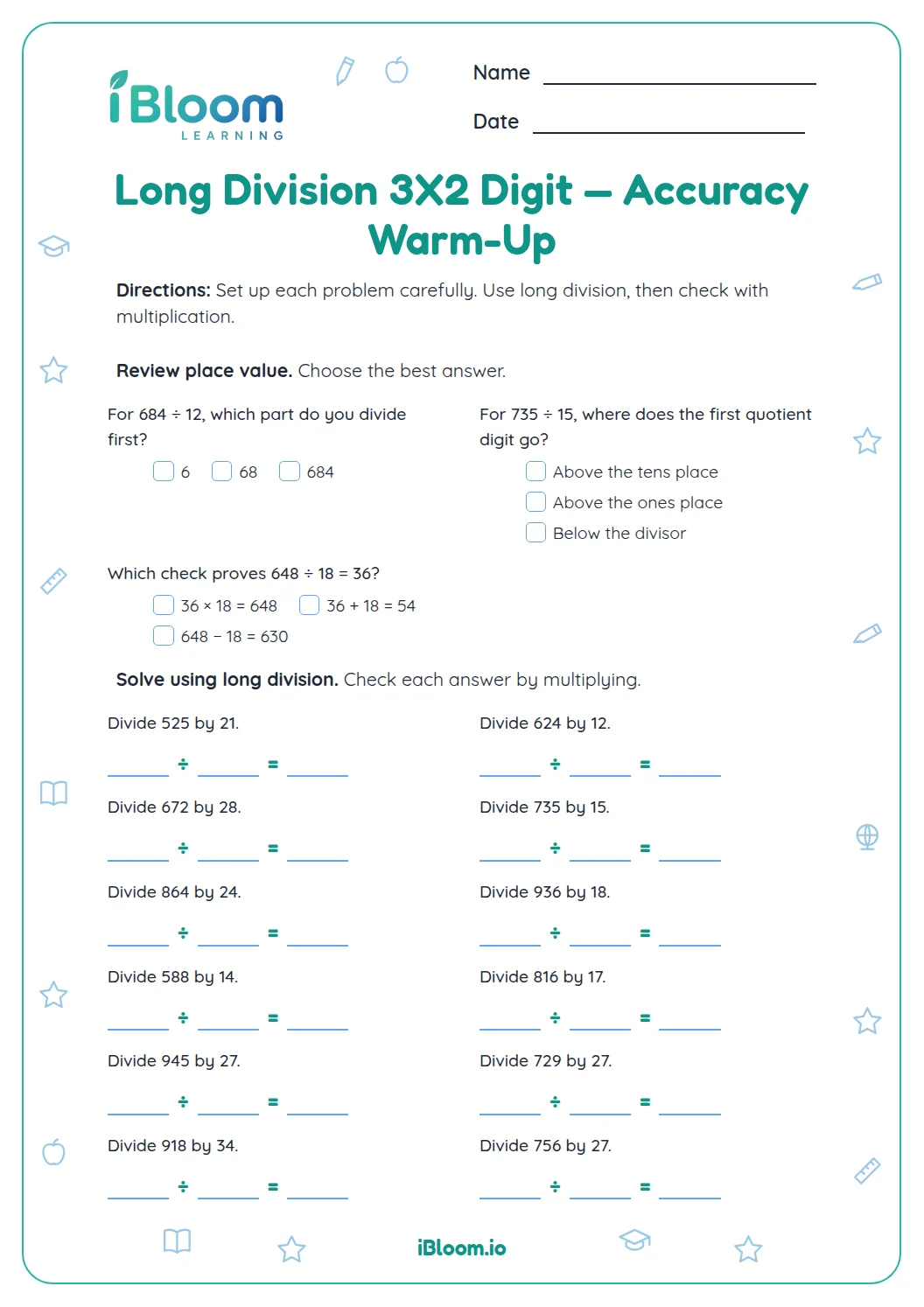
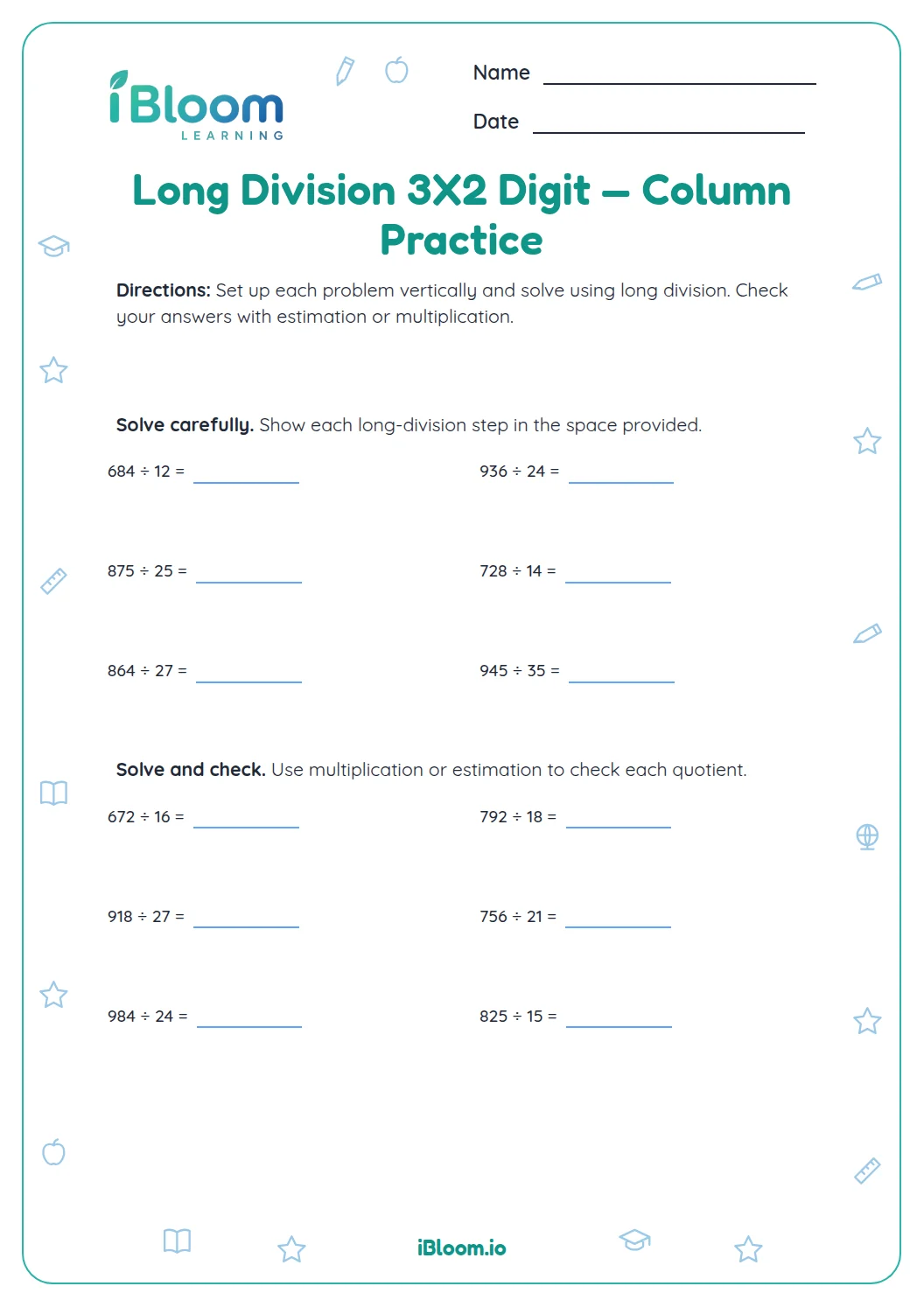
This free division drill is for students in Grades 4–6 practicing three-digit dividends divided by two-digit divisors. Every underlying division has a whole-number quotient with no remainder. Part A has eight calculations, Part B has four missing values, Part C has four estimates to the nearest ten, and Part D has two incorrect quotients to check. The eighteen problems practice Common Core 5.NBT.B.6 through place value and the multiplication–division relationship. Students show division steps and multiplication checks on scratch paper. A separate answer key gives every answer. Any timing goal is optional.
Aligned to 5.NBT.B.6
How can students estimate a two-digit quotient?
Use a nearby multiple of the divisor to decide how many tens belong in the quotient. For 504 ÷ 24, twenty groups of 24 use 480. That leaves 24, which is one more group, giving 21 groups altogether.
For Part A, use scratch paper for long division or partial-quotient equations. Keep each subtraction aligned and verify that the final remainder is zero. In Part C, choose the nearest ten instead of recording the exact quotient.
- 1504 ÷ 24
- 224 × 20 = 480
- 3504 − 480 = 24
- 424 × 1 = 24
- 520 + 1 = 21; check 24 × 21 = 504.
How do the missing values change the task?
Part B alternates missing dividends and missing divisors. For ___ ÷ 18 = 32, multiply 18 by 32 to recover 576. For 816 ÷ ___ = 24, divide 816 by 24 to recover 34.
Before calculating, students should identify whether the blank is the starting total or the number being divided by. Substituting the answer into the original equation checks both the arithmetic and the choice of operation.
How do students estimate to the nearest ten?
Use nearby multiples of the divisor to bracket the dividend. For question 13, 19 × 30 = 570 and 19 × 40 = 760. Since 684 is closer to 760, the quotient is closer to 40 than to 30. Choose 40.
The exact quotient is 36, which rounds to 40. All four estimation problems also divide evenly; their instructions ask for the nearest ten. An estimate checks the size of an answer without replacing the exact calculation in Parts A and B.
What should students notice in the error checks?
Part D shows 756 ÷ 21 = 306 and 864 ÷ 32 = 207. Both incorrect claims have a misplaced zero that makes the quotient much too large. Students choose the correct quotient after recalculating or checking by multiplication.
The correct answers are 36 and 27. In 756 ÷ 21, the first quotient digit represents three tens; after subtracting 63 from 75 and bringing down 6, the next quotient digit is 6. No extra zero belongs between them.
How to use this worksheet
- 1Confirm that students can identify the dividend, divisor, and quotient.
- 2Have them estimate each Part A quotient before calculating.
- 3Record division steps and multiplication checks on scratch paper for Part A.
- 4In Part B, identify the role of the blank before choosing an operation.
- 5Choose the nearest ten in Part C; check the incorrect claims in Part D by multiplication.
- 6Review the key and redo any missed calculation without a timer.
Mistakes to check and how to fix them
The mistake
Putting an extra zero inside the quotient, as in 756 ÷ 21 = 306.
The fix
Track one quotient digit for each division step; 21 × 36 = 756.
The mistake
Using 24 as the divisor in 816 ÷ ___ = 24.
The fix
The printed 24 is the quotient; calculate 816 ÷ 24 to recover the missing divisor, 34.
The mistake
Stopping after the first partial quotient in 504 ÷ 24.
The fix
Twenty groups leave 24; include one more group to reach 21 with remainder zero.
Common Core alignment
Find exact quotients with two-digit divisors and use multiplication to verify them.
On this sheet: Students calculate exact quotients, show checking equations on scratch paper, estimate, and correct errors.
Show the official wordingHide the official wording
Find whole-number quotients of whole numbers with up to four-digit dividends and two-digit divisors, using strategies based on place value, the properties of operations, and/or the relationship between multiplication and division. Illustrate and explain the calculation by using equations, rectangular arrays, and/or area models.
What to practice next
Make more practice
Further reading
Questions parents and teachers ask
Are all the completed problems three-digit by two-digit division?
Yes. Each division has a three-digit dividend and a two-digit divisor, including the missing-value questions. For example, question 9 becomes 576 ÷ 18 = 32. The estimation and error-check questions use the same number sizes, keeping the entire drill focused on this division pattern.
Do any correct answers have remainders?
No. All eighteen underlying divisions have whole-number quotients with remainder zero. Part C asks for estimates to the nearest ten, so its answers are rounded values. For an exact calculation, multiplying the quotient by the divisor should reproduce the original dividend; use scratch paper to check.
How is this a mixed mastery drill?
The sheet changes the task while keeping the number sizes consistent. Students calculate eight quotients, recover four missing values, estimate four quotients to the nearest ten, and correct two wrong claims. This mix practices accurate division, the multiplication–division relationship, and judging the size of an answer.
Does my child need to use a timer?
No. Start with untimed work so your child can record clear calculations and check each result. If you later choose a timing goal, use it after the method is secure. On this sheet, an accurate equation and a multiplication check are more useful than rushing through blanks.
How can I check the error-analysis answers?
The correct choices are 36 for 756 ÷ 21 and 27 for 864 ÷ 32. Multiply 21 × 36 to get 756, and 32 × 27 to get 864. Ask students why the printed answers with extra zeros would make the products too large.