




About this worksheet
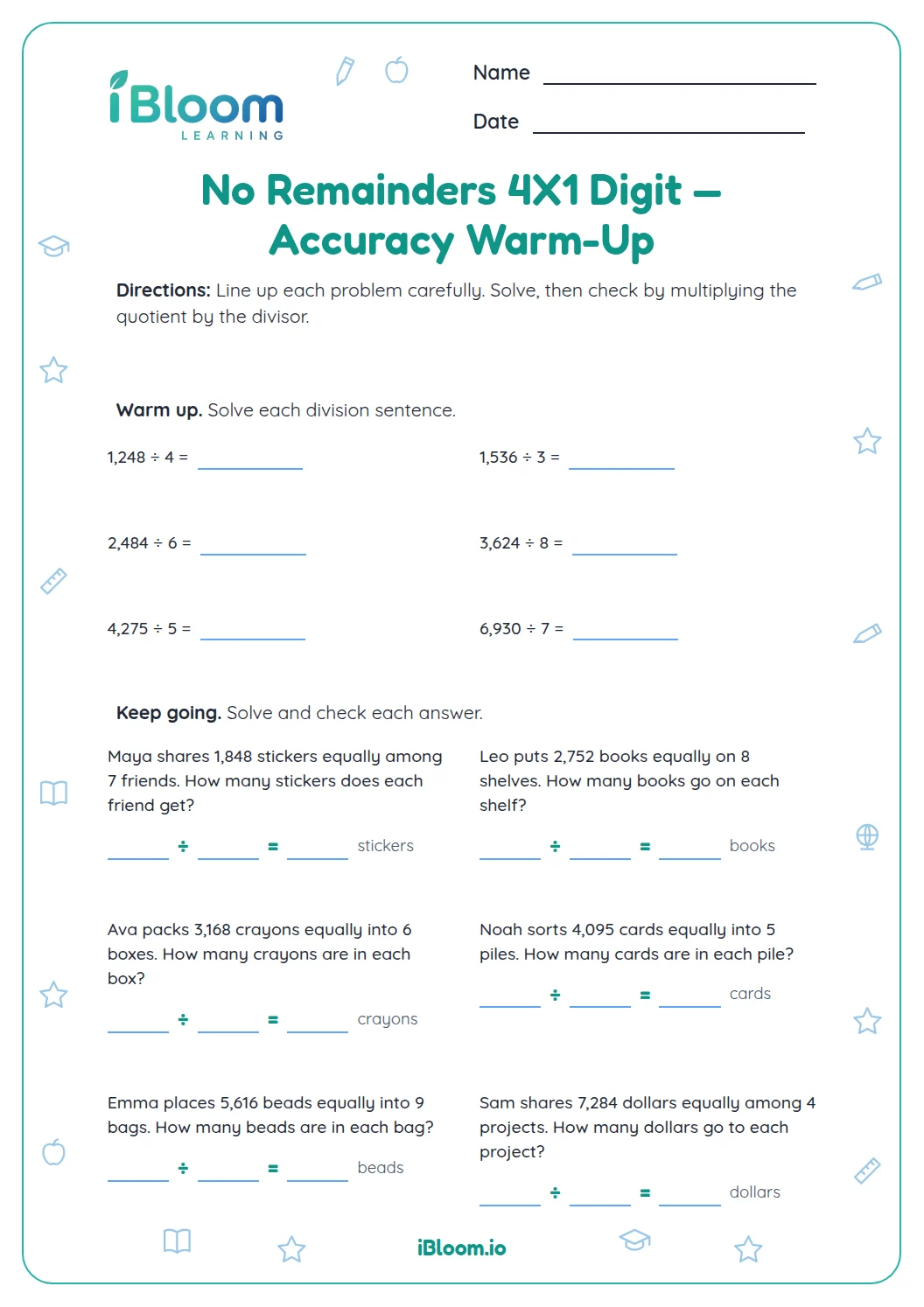
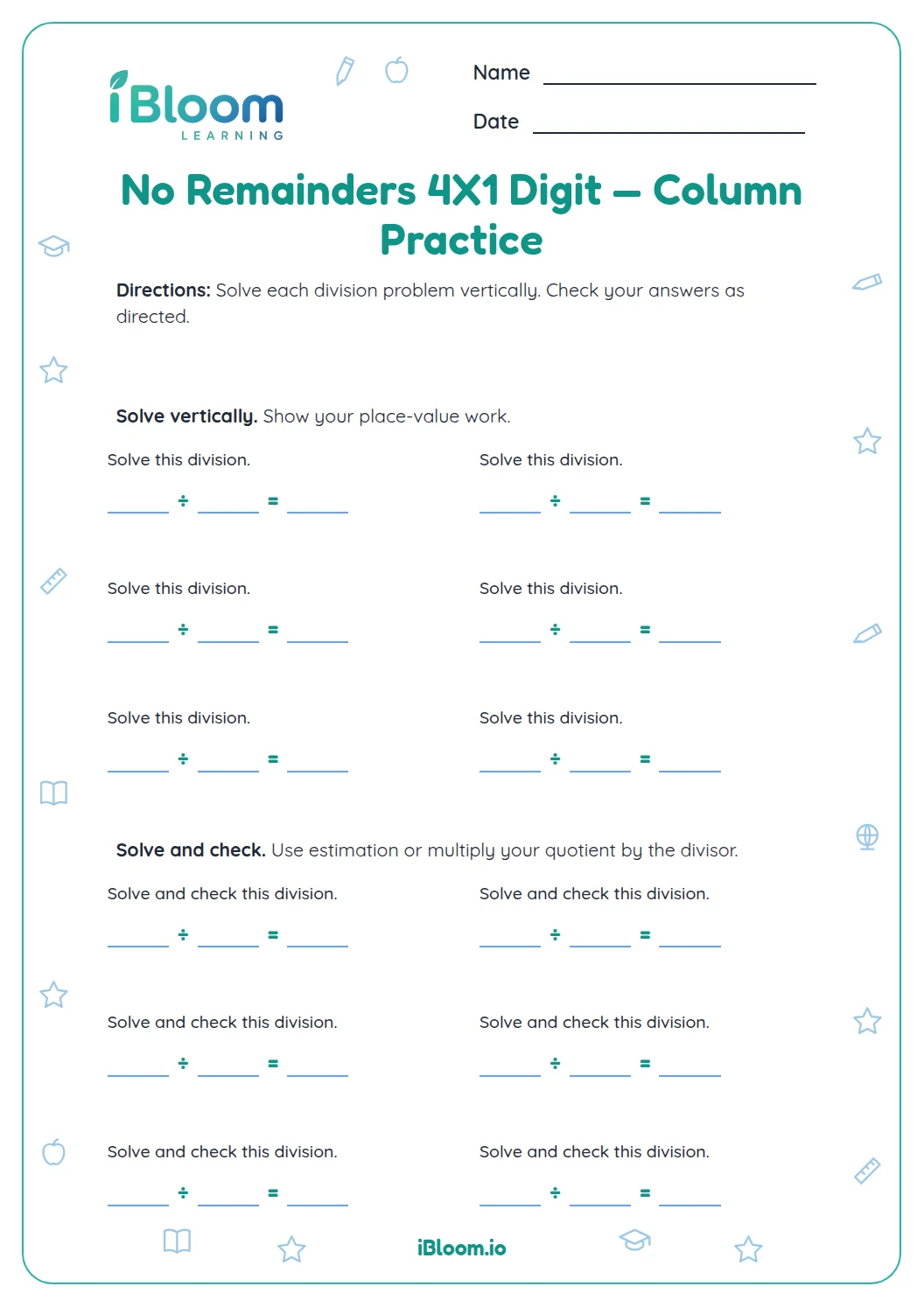
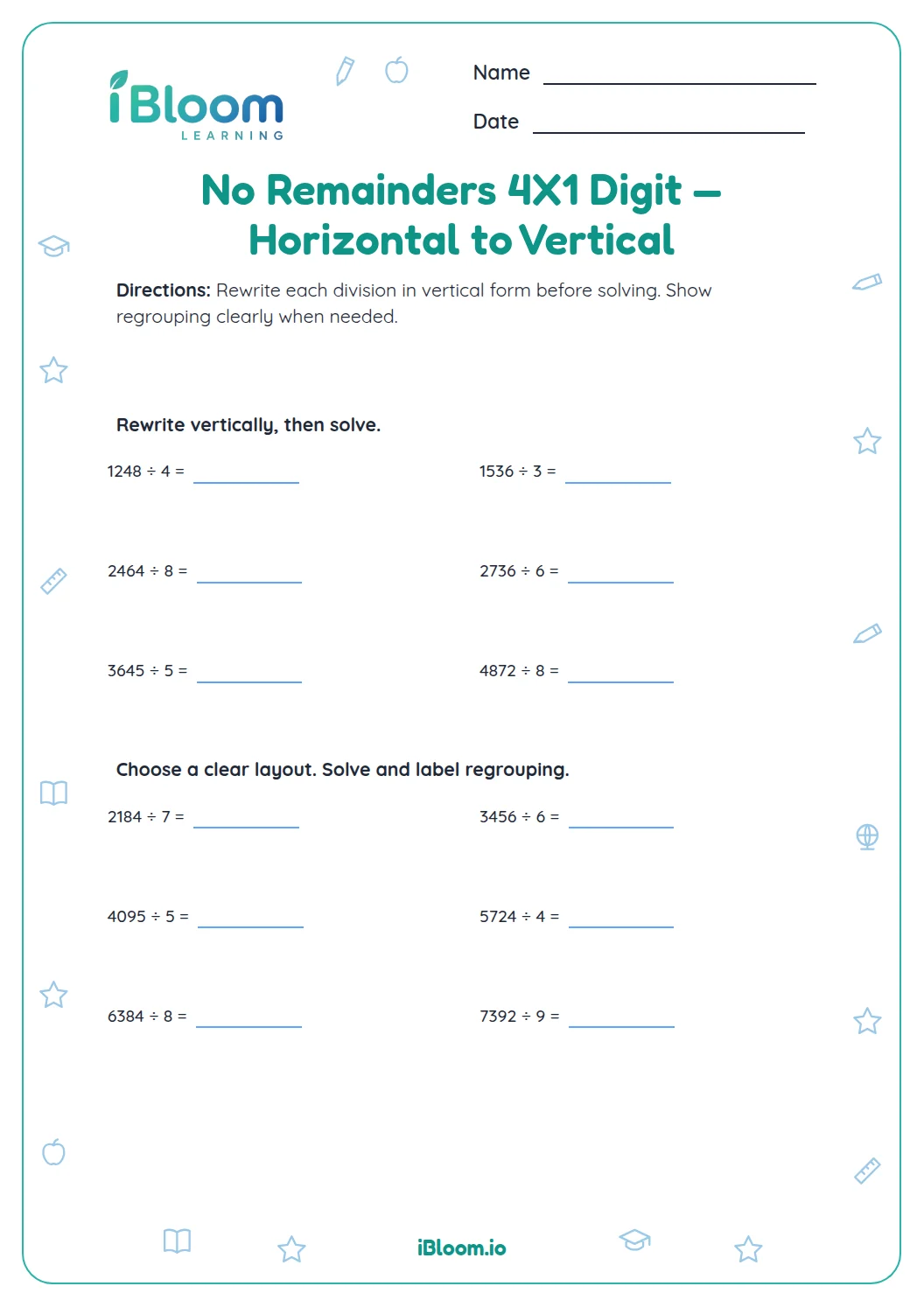
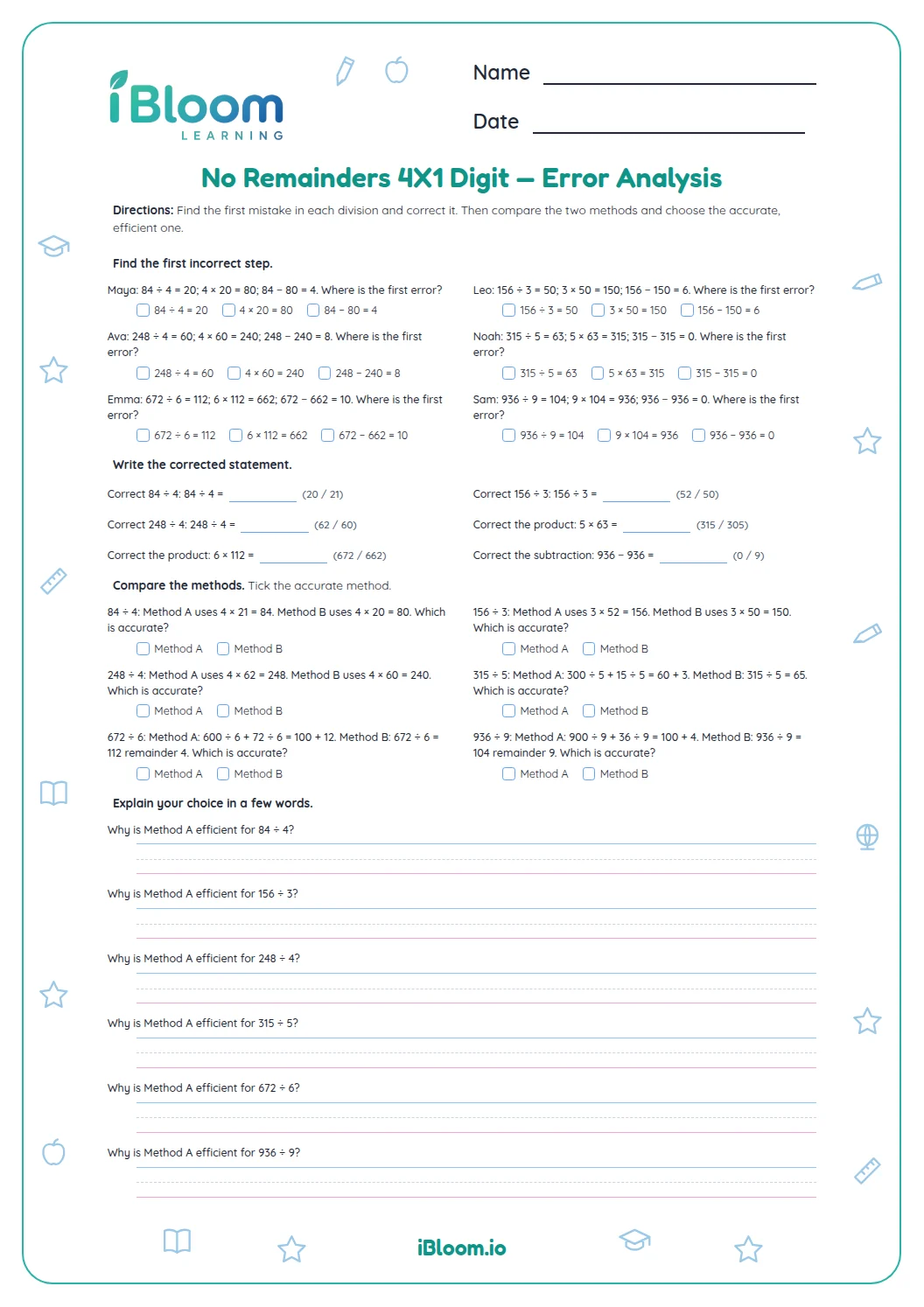
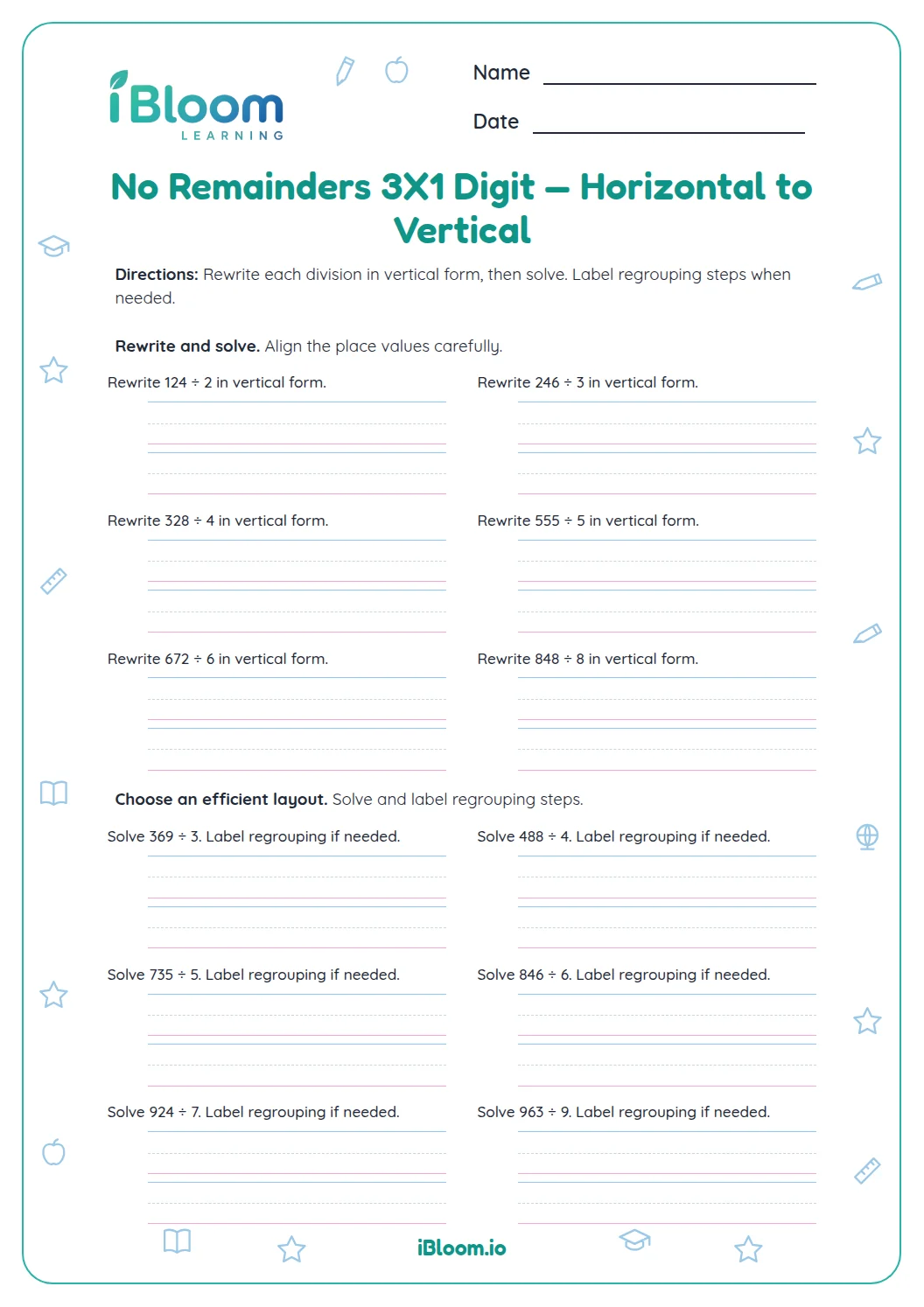
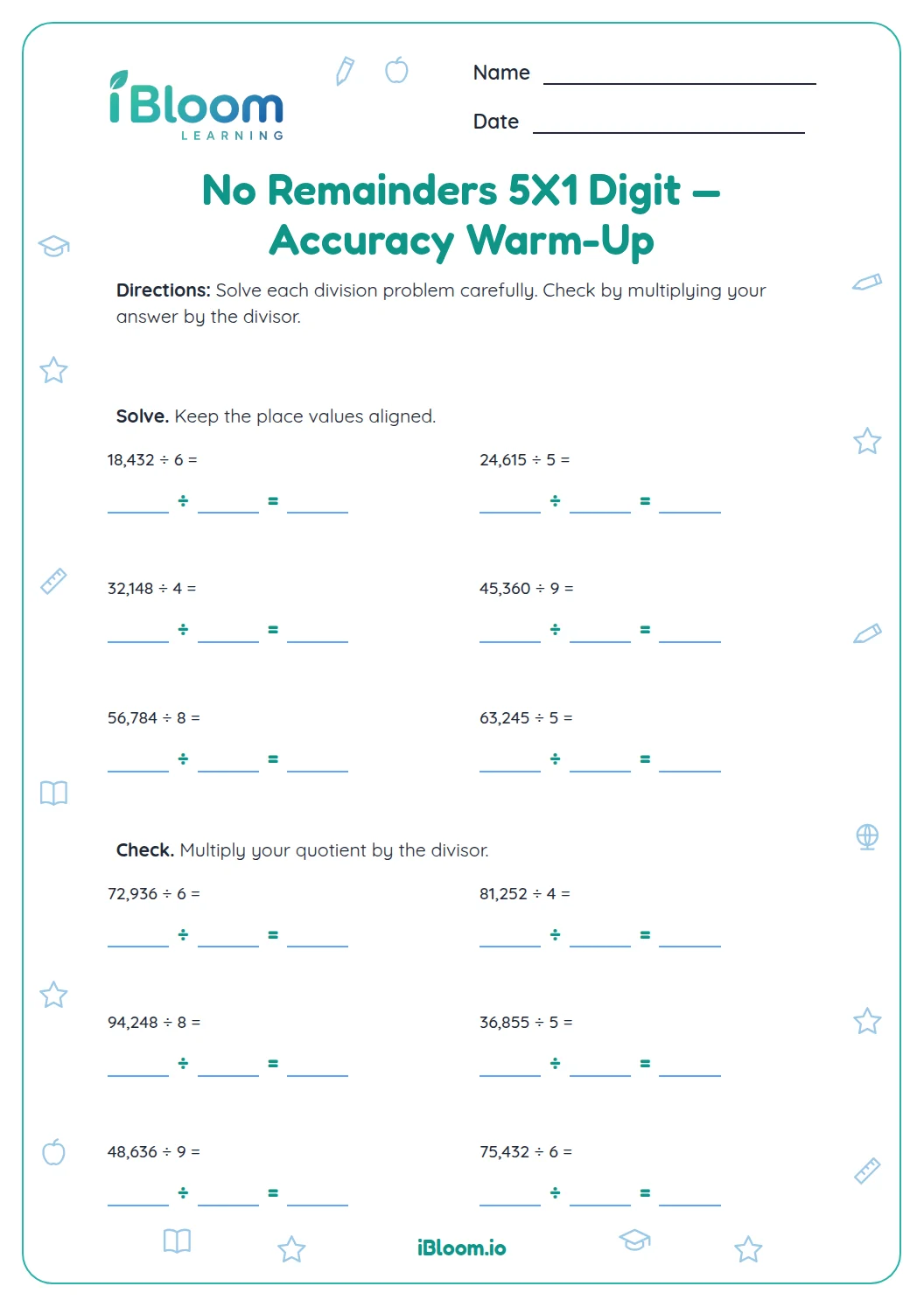
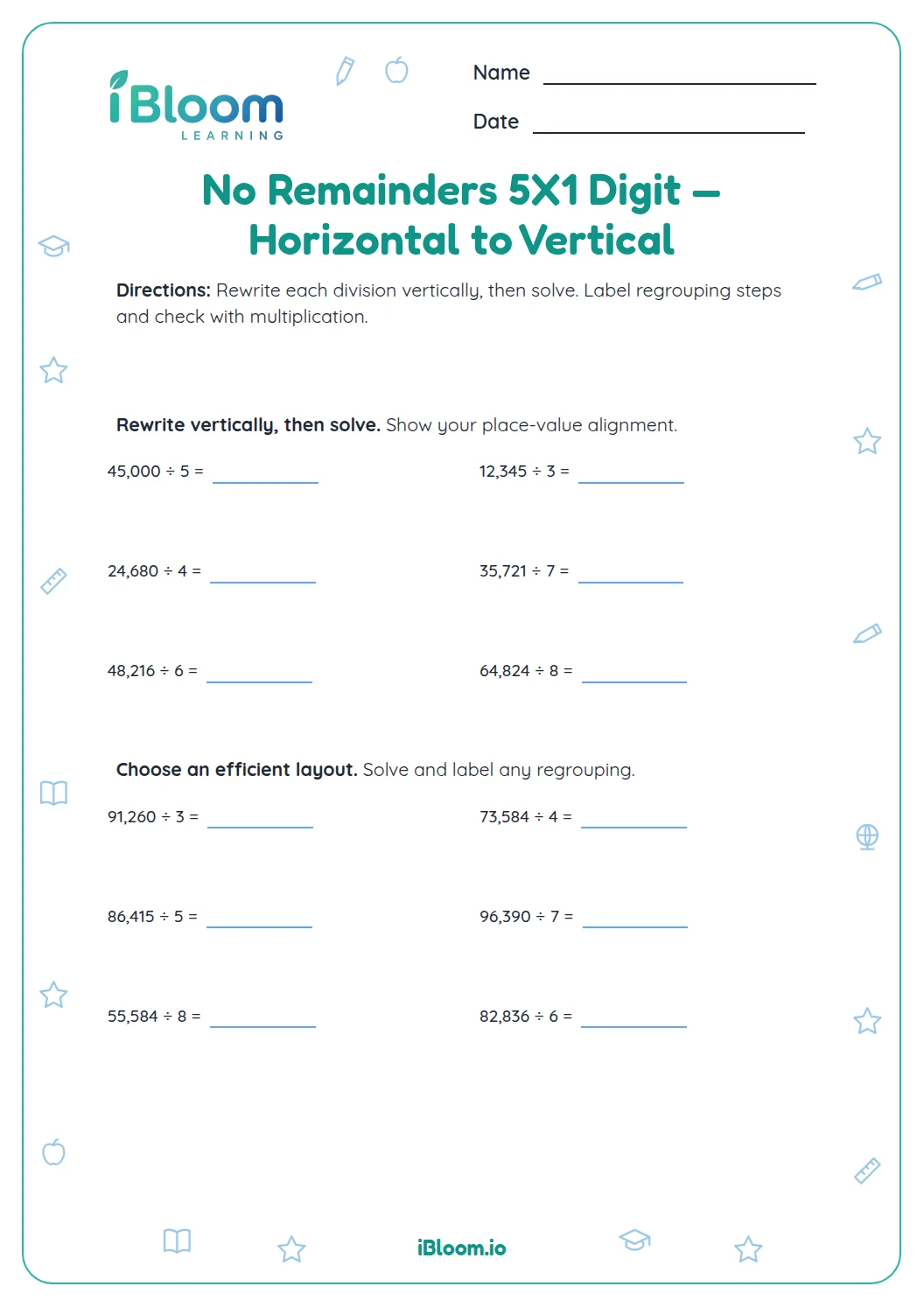
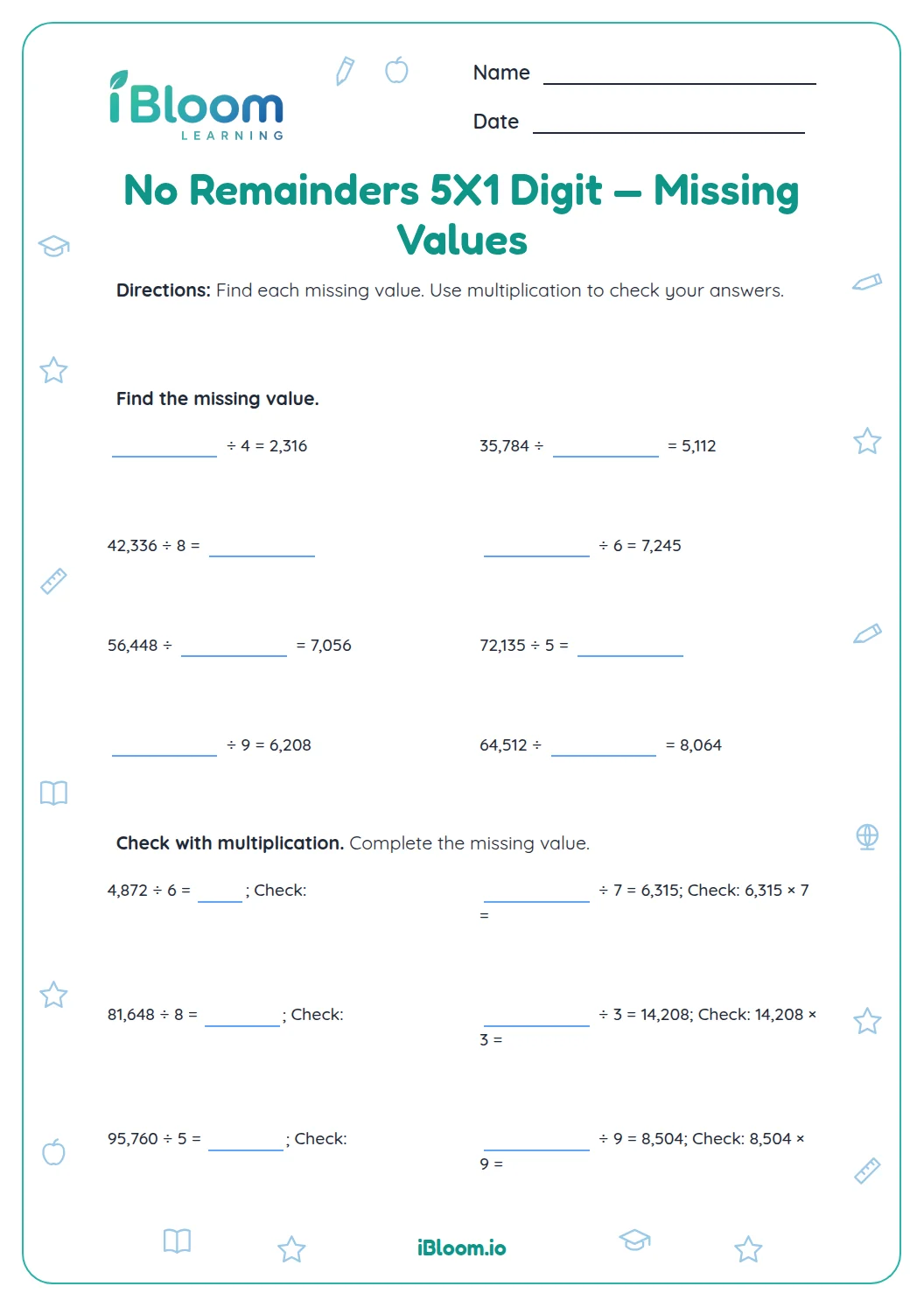
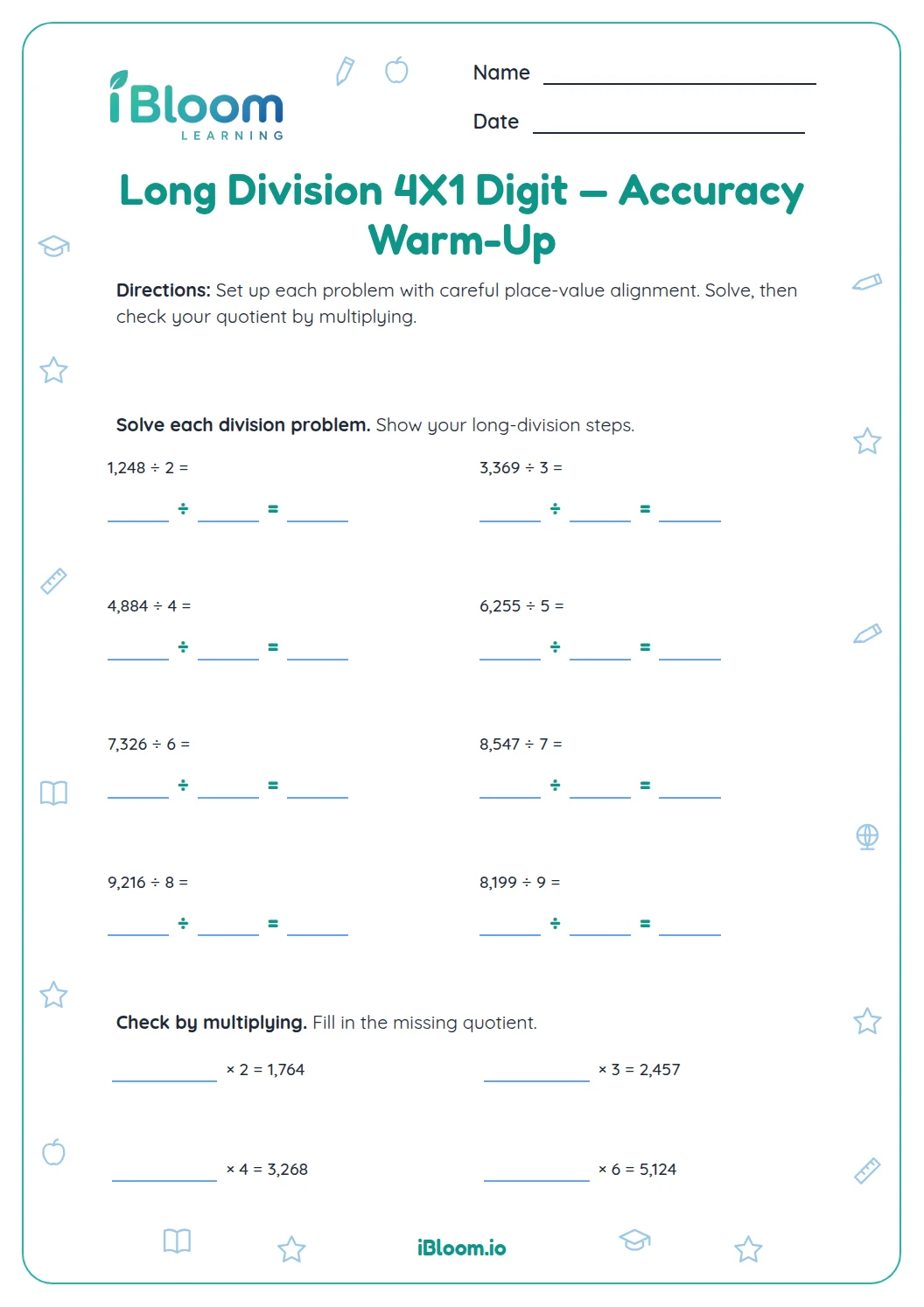
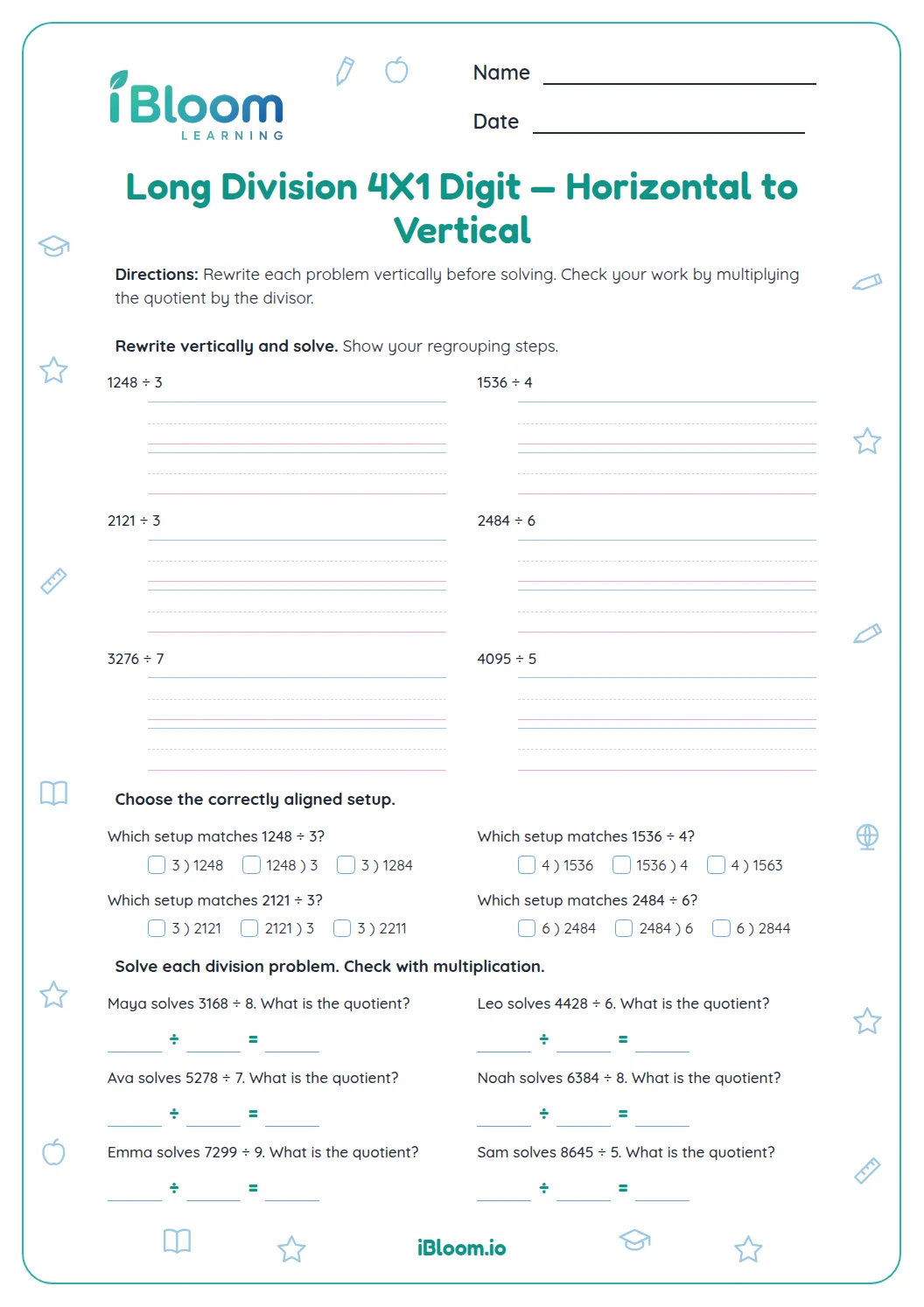
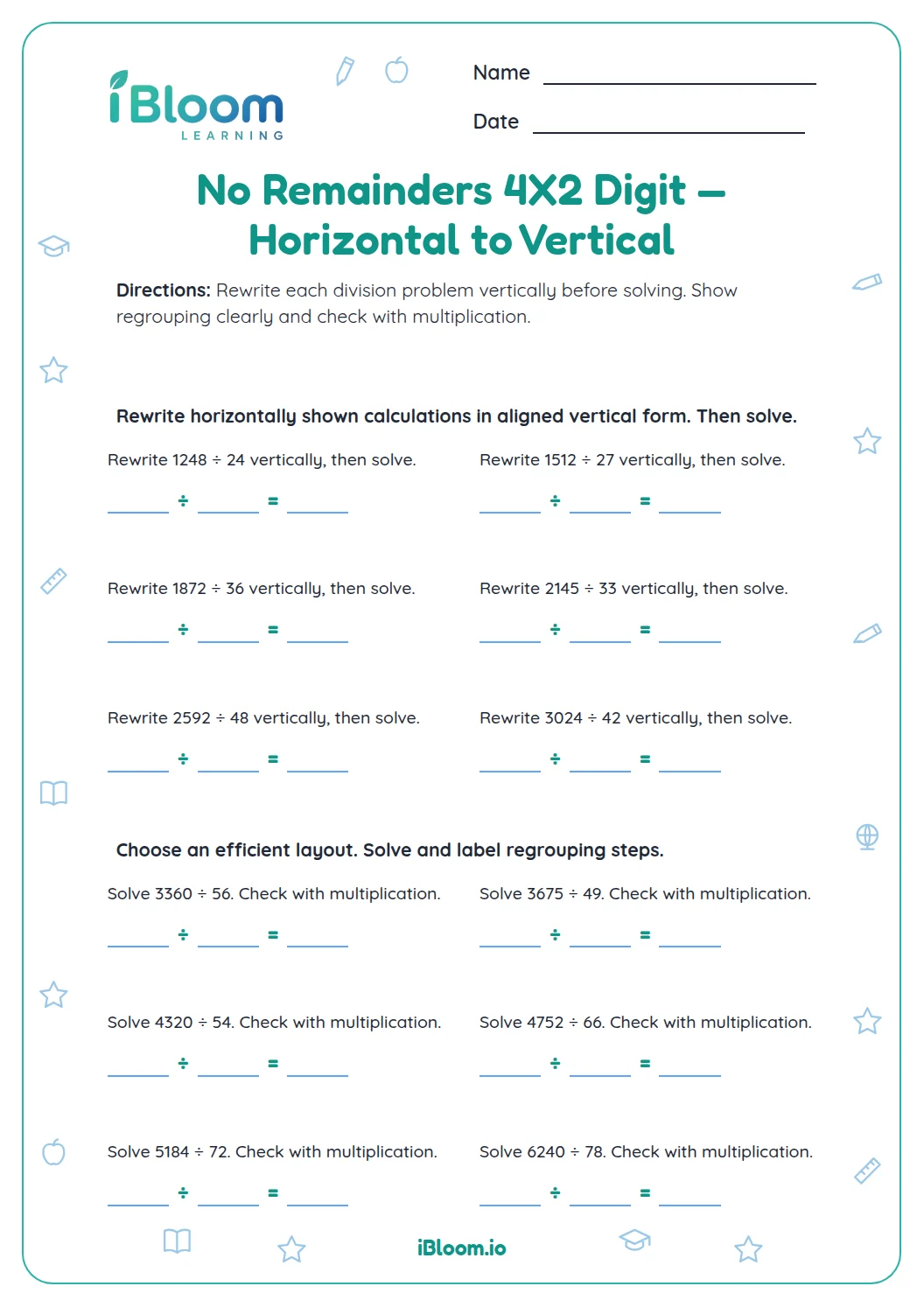
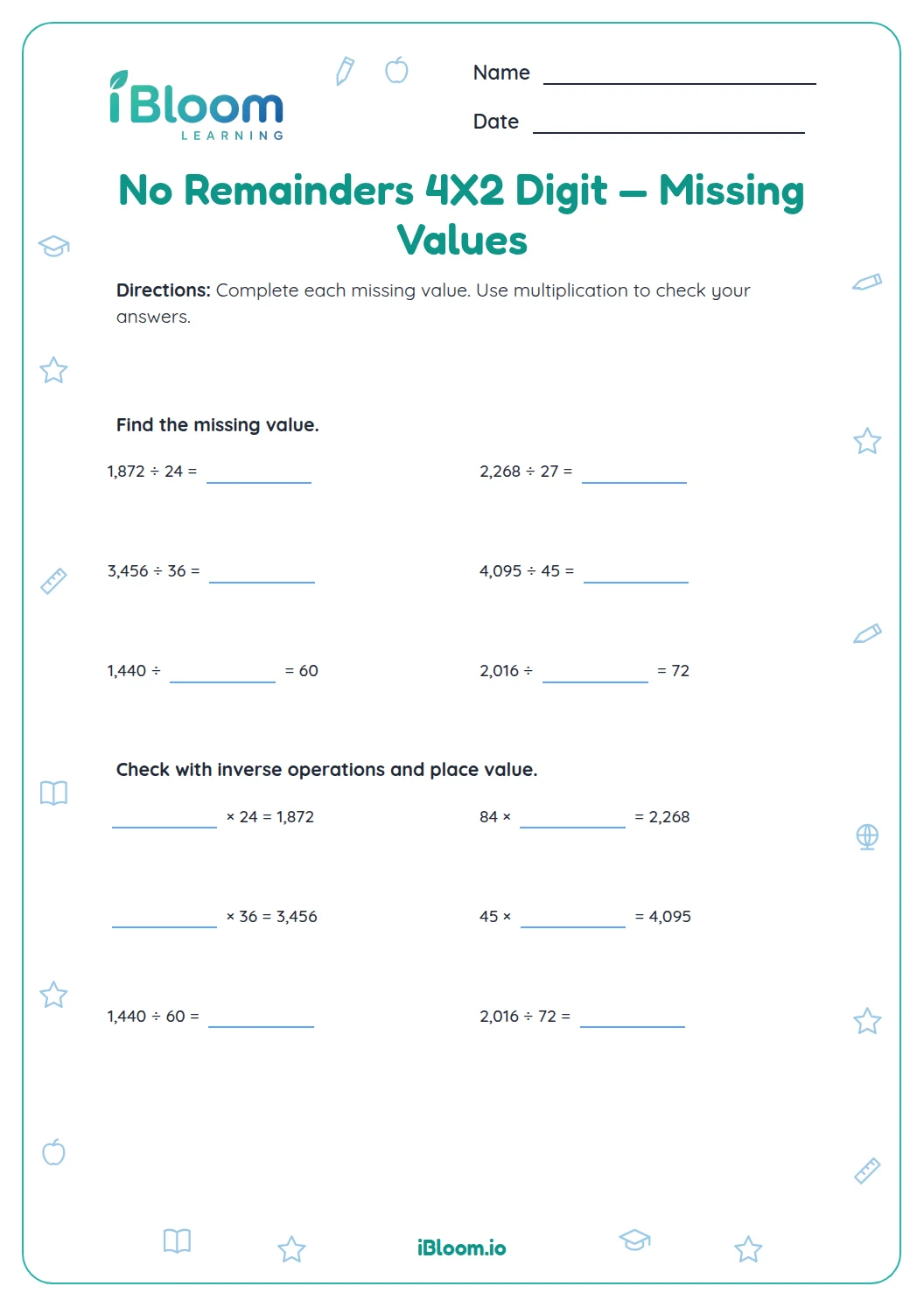
This mixed division drill offers 16 exact-division questions with four-digit dividends and one-digit divisors. Part A asks for quotients, Part B uses multiplication to recover missing dividends, and Part C applies division to equal-sharing situations. The answer key lists every quotient and missing value. The numerical work aligns with Common Core 4.NBT.B.6, which includes whole-number quotients with up to four-digit dividends and one-digit divisors.
Aligned to 4.NBT.B.6
How can multiplication help find a quotient?
Think of the divisor as the number of equal groups and the quotient as the size of each group. Multiplying the divisor by a possible quotient should return the dividend.
- 1For 8,244 ÷ 4, use 4 × 2,061 = 8,244 to check the quotient.
How do you find a missing dividend?
When the divisor and quotient are known, multiply them. The product is the missing dividend because dividend ÷ divisor = quotient.
- 1For ___ ÷ 4 = 1,836, calculate 1,836 × 4 = 7,344.
How does division describe equal sharing?
The total is divided into the stated number of equal groups. The quotient tells how many objects go in each group. Include the object name in the answer.
- 16,384 stickers split among 4 classes gives 1,596 stickers per class.
How to use this worksheet
- 1In Part A, divide from the greatest place and record the quotient.
- 2Check each quotient by multiplying it by the divisor.
- 3In Part B, multiply the given quotient by the divisor to find the missing dividend.
- 4In Part C, identify the total and number of equal groups before dividing.
- 5Write the unit named in each sharing question.
Mistakes to watch for
The mistake
Using the dividend as the number of groups
The fix
The divisor gives the number of groups; the quotient gives the amount in each.
The mistake
Dividing instead of multiplying for a missing dividend
The fix
Multiply the known quotient by the divisor to recover the dividend.
The mistake
Leaving off the object name in a story answer
The fix
Write the count and its unit, such as “1,596 stickers per class.”
Common Core alignment
This page gives focused practice with the skill named in each standard.
Find whole-number quotients and use multiplication to check division.
On this sheet: Students solve four-digit by one-digit quotients and apply division to equal-sharing problems.
Show the official wordingHide the official wording
Find whole-number quotients and remainders with up to four-digit dividends and one-digit divisors, using strategies based on place value, the properties of operations, and/or the relationship between multiplication and division. Illustrate and explain the calculation by using equations, rectangular arrays, and/or area models.
What to practice next
Make more practice
Further reading
Questions parents and teachers ask
Are all the division answers whole numbers?
Yes. Each dividend is chosen as an exact multiple of its one-digit divisor. That means the quotient is a whole number and there is no remainder. The answer key lists all 16 results so students can check their work. Check that the product matches the dividend before moving on.
How do students find a missing dividend?
Multiply the divisor by the given quotient. For example, if the problem is ___ ÷ 4 = 1,836, calculate 1,836 × 4 to get the missing dividend, 7,344. Multiplication reverses the division relationship. Then check that the product matches the number that was missing.
What does equal sharing mean in Part C?
Equal sharing means dividing a total into the same number of objects in each group. The question tells how many classes, shelves, groups or boxes share the total; the quotient tells how many objects each group receives. For example, 6,384 stickers shared by 4 classes gives 1,596 stickers per class.
Why should a word-problem answer include a unit?
The unit names what the number counts. “1,596” alone is less clear than “1,596 stickers per class.” Adding the unit connects the quotient back to the story and makes the answer complete. The worksheet asks for stickers per class, books per shelf, tickets per group, and pencils per box.
How can a student check a division answer?
Multiply the quotient by the divisor and compare the product with the starting dividend. If the two numbers match, the answer is correct. This check also works when a question asks you to find a missing dividend. For instance, 1,596 × 4 = 6,384, which returns the original total.
What practice follows this mixed drill?
The five-digit no-remainder page increases the size of the dividends. A long-division page can add more attention to recording each partial quotient and subtraction step, while keeping one-digit divisors. The next page practices exact division with five-digit dividends and one-digit divisors.