




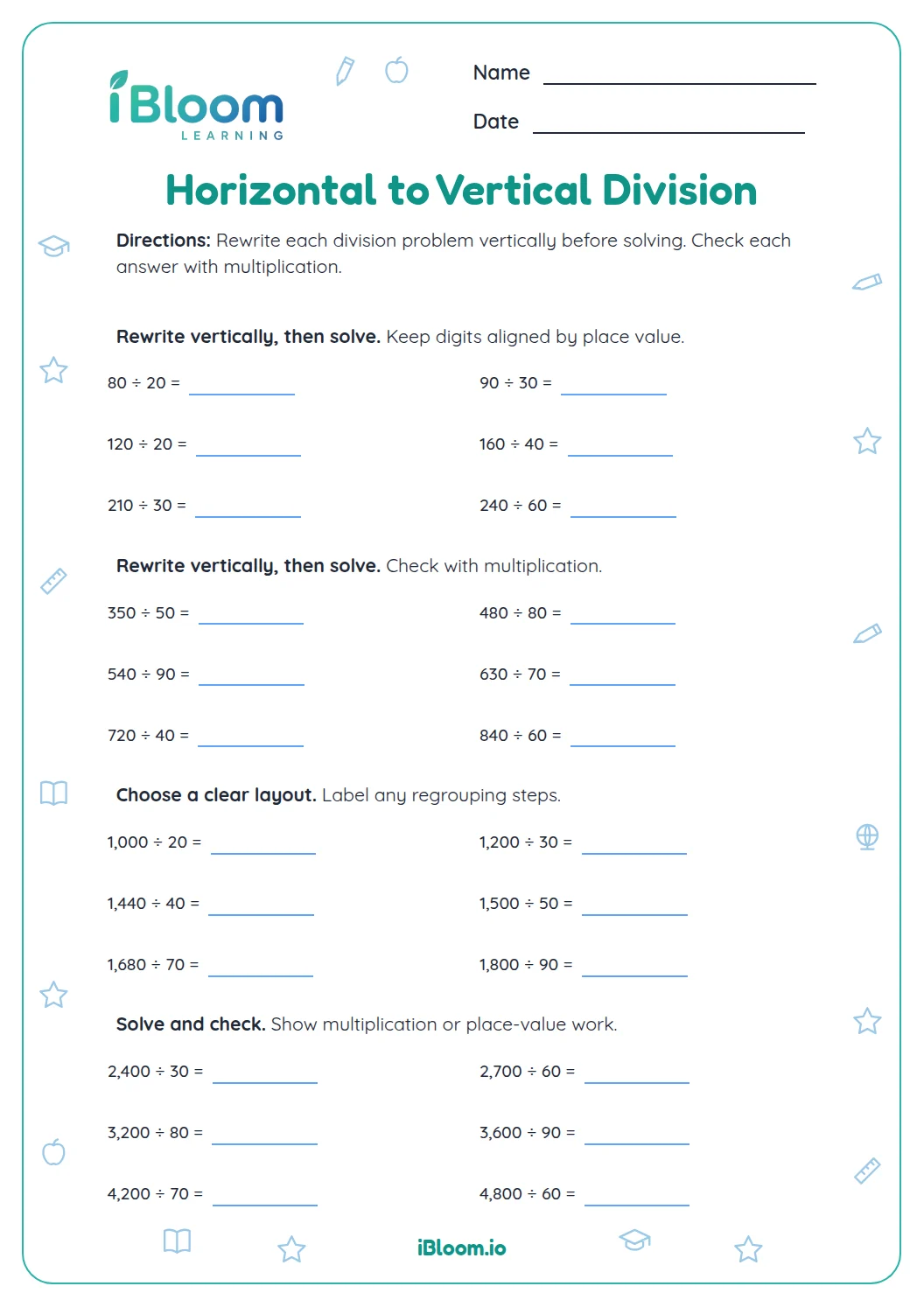

About this worksheet
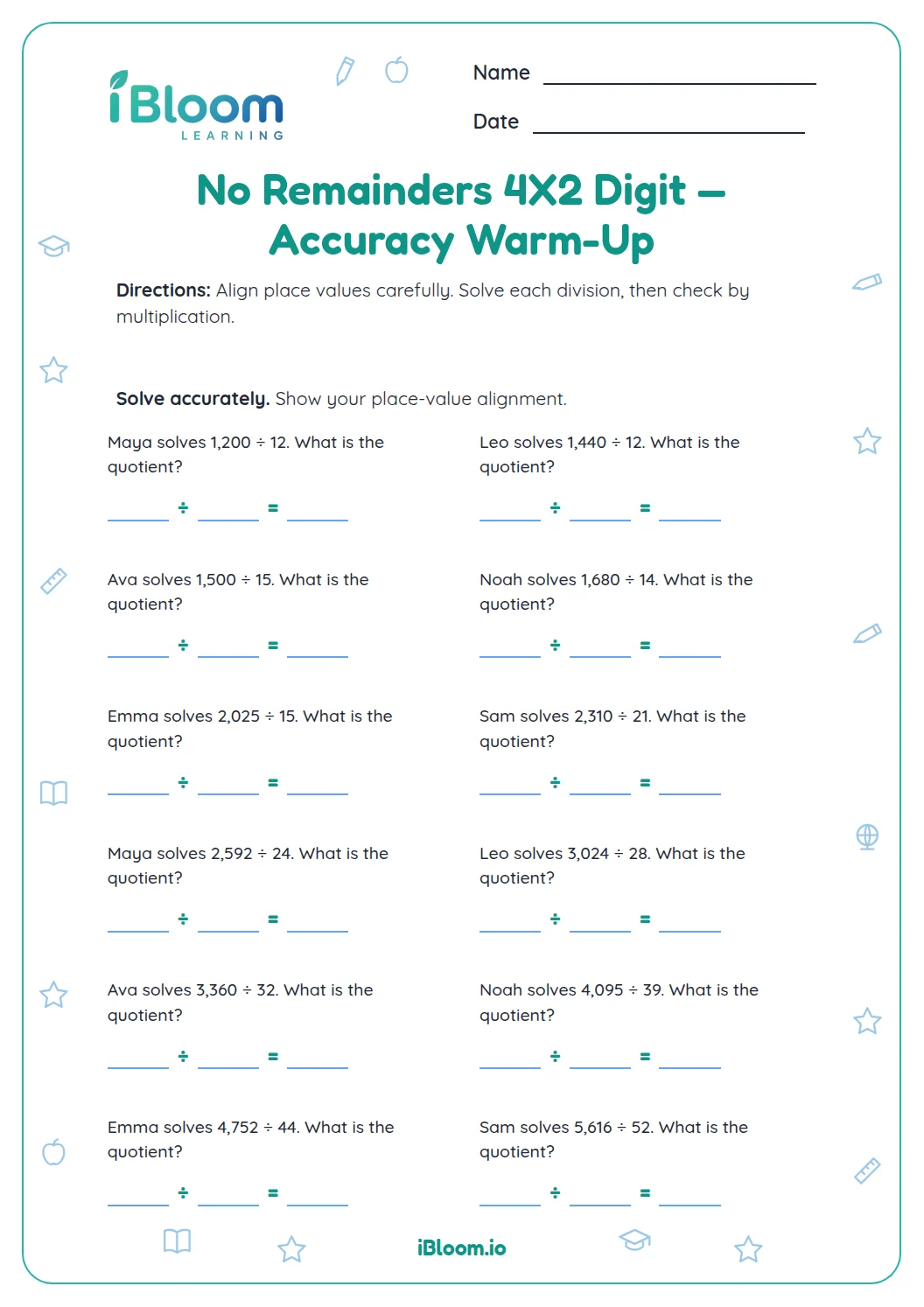
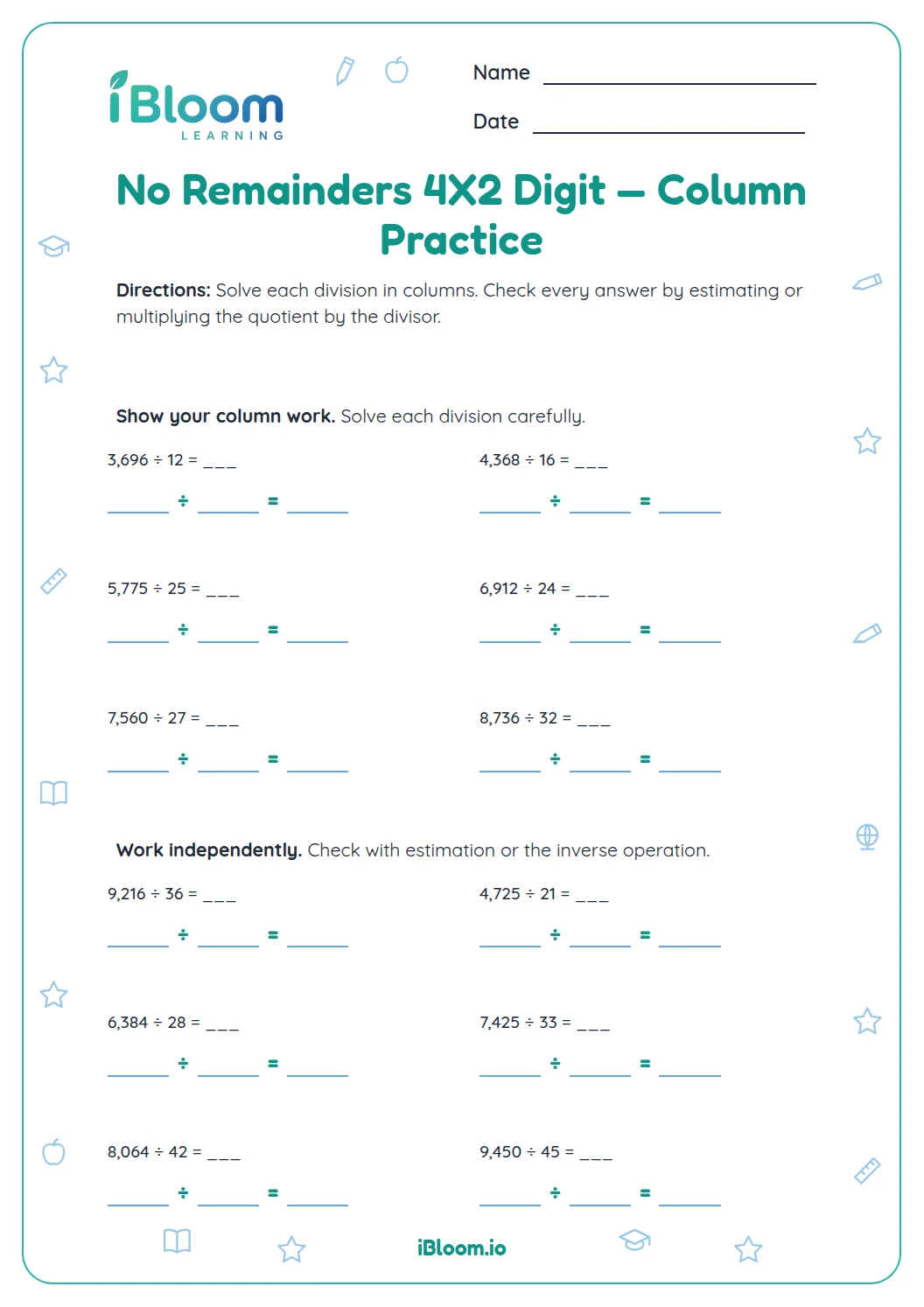
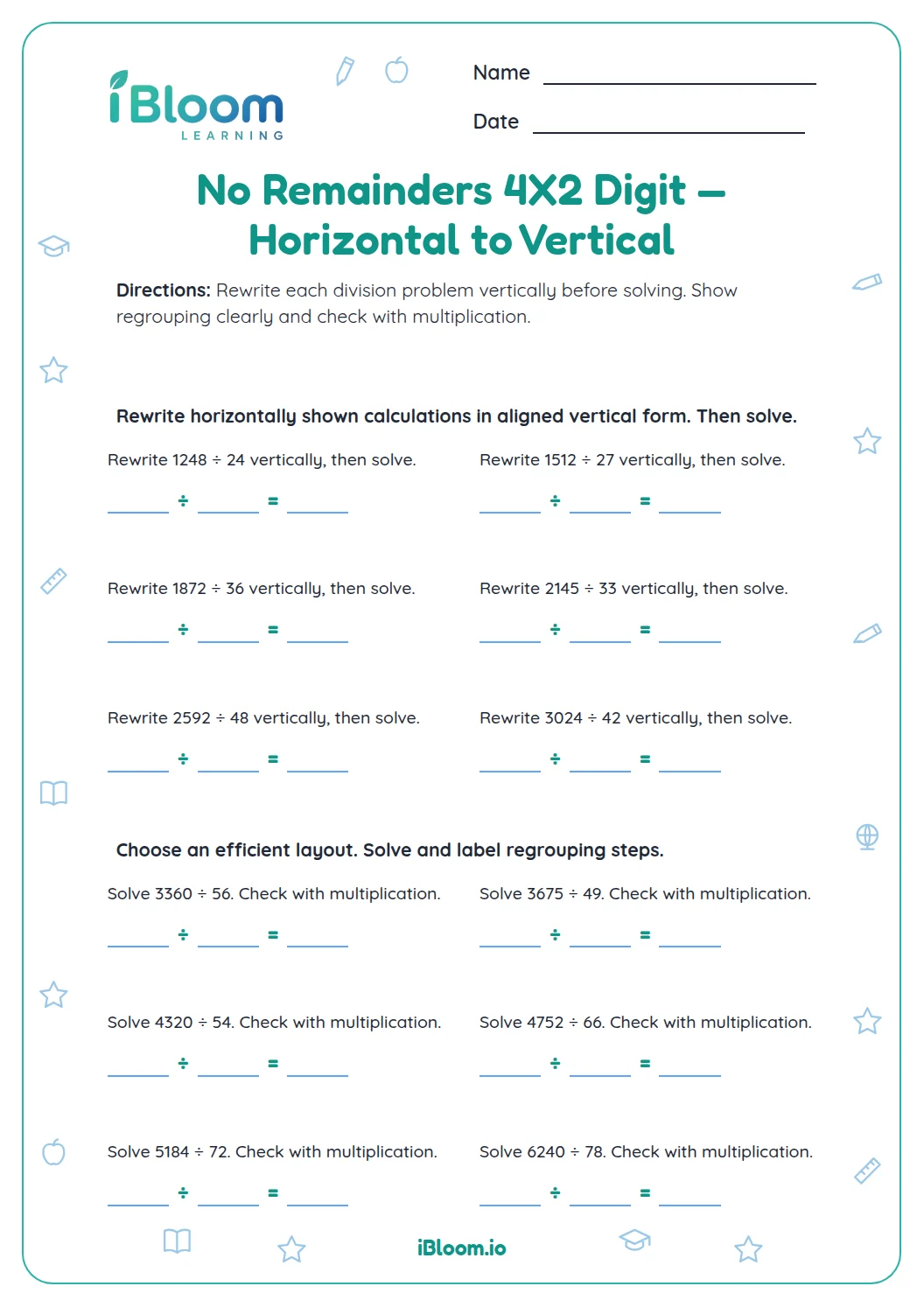
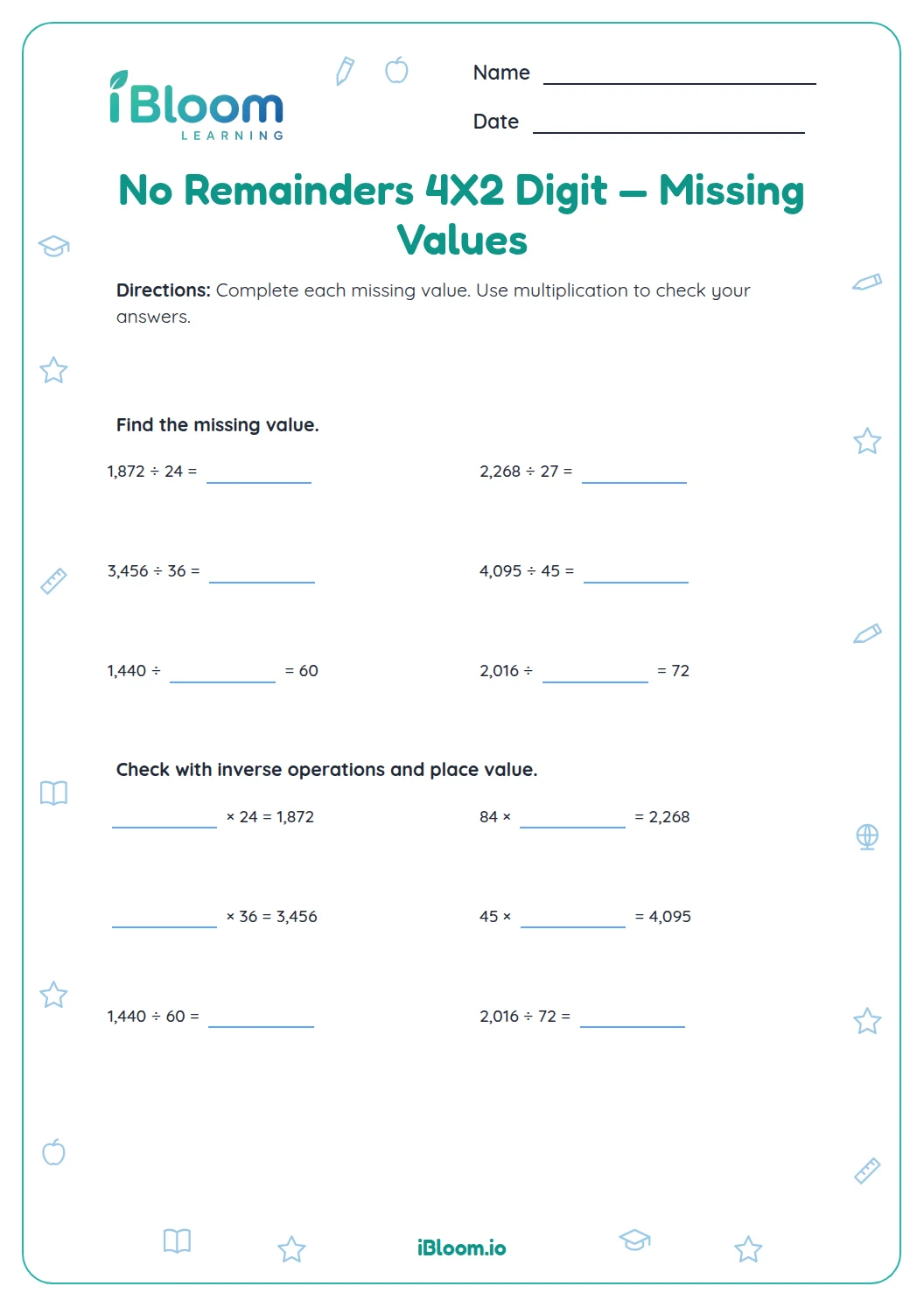
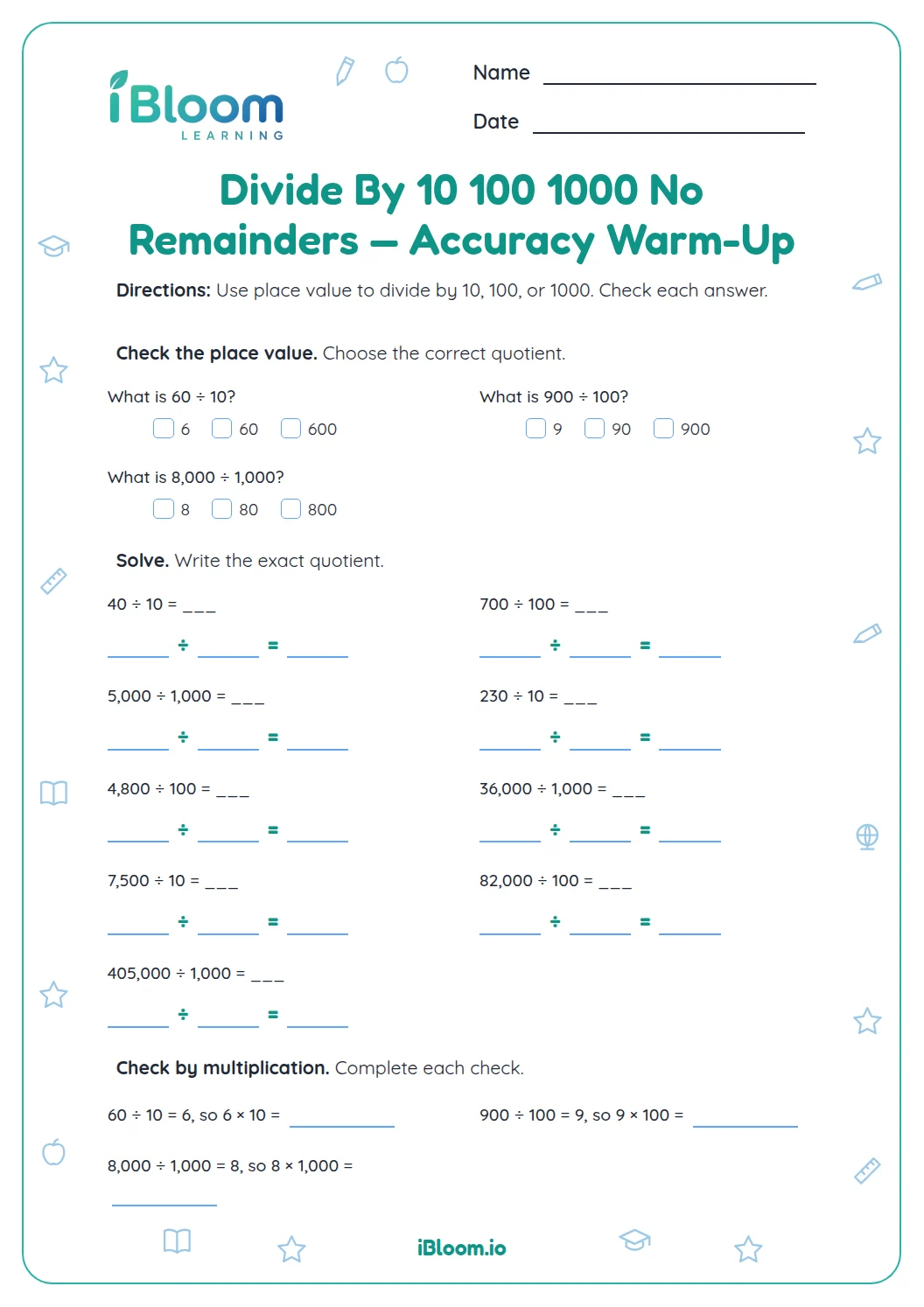
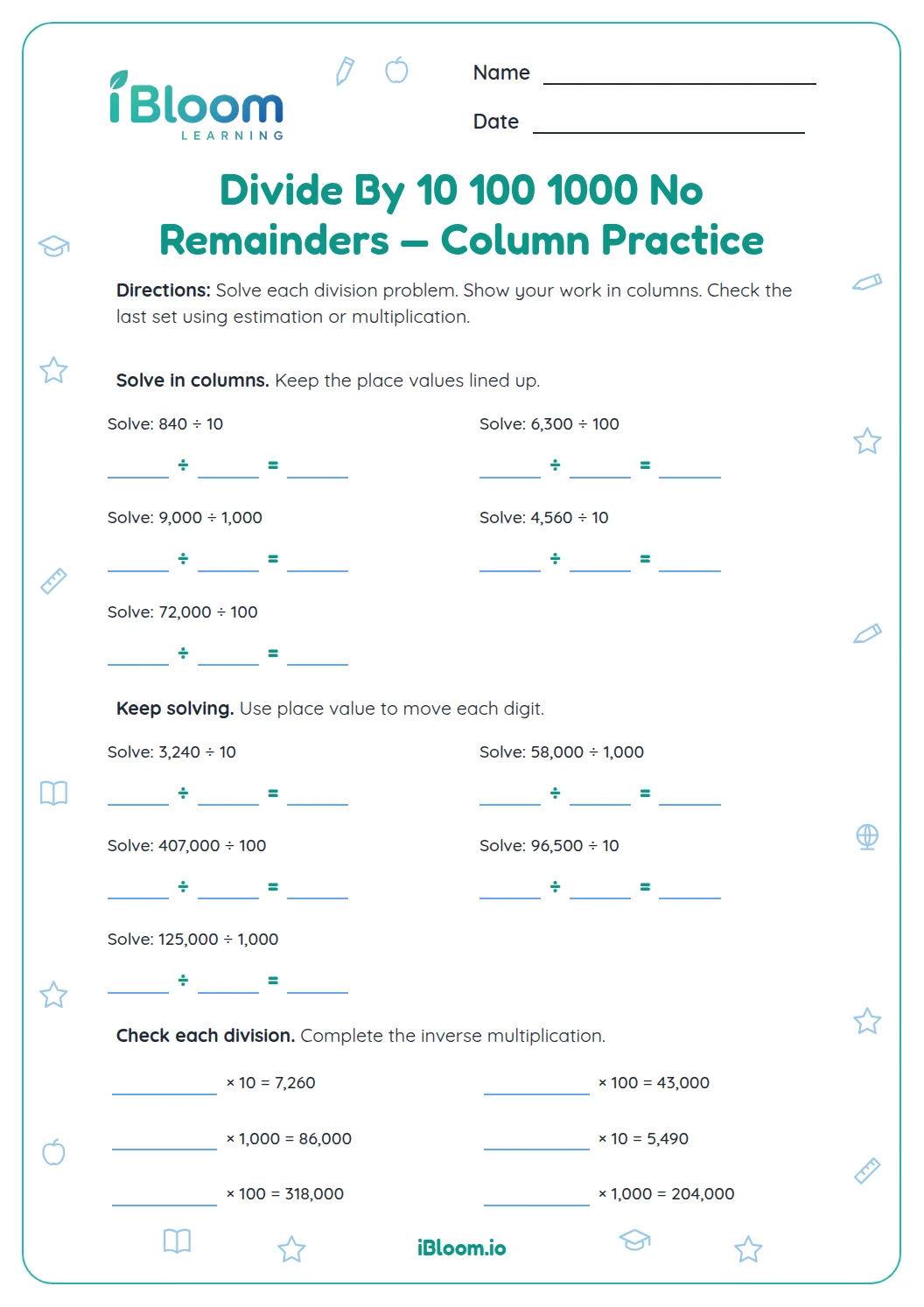
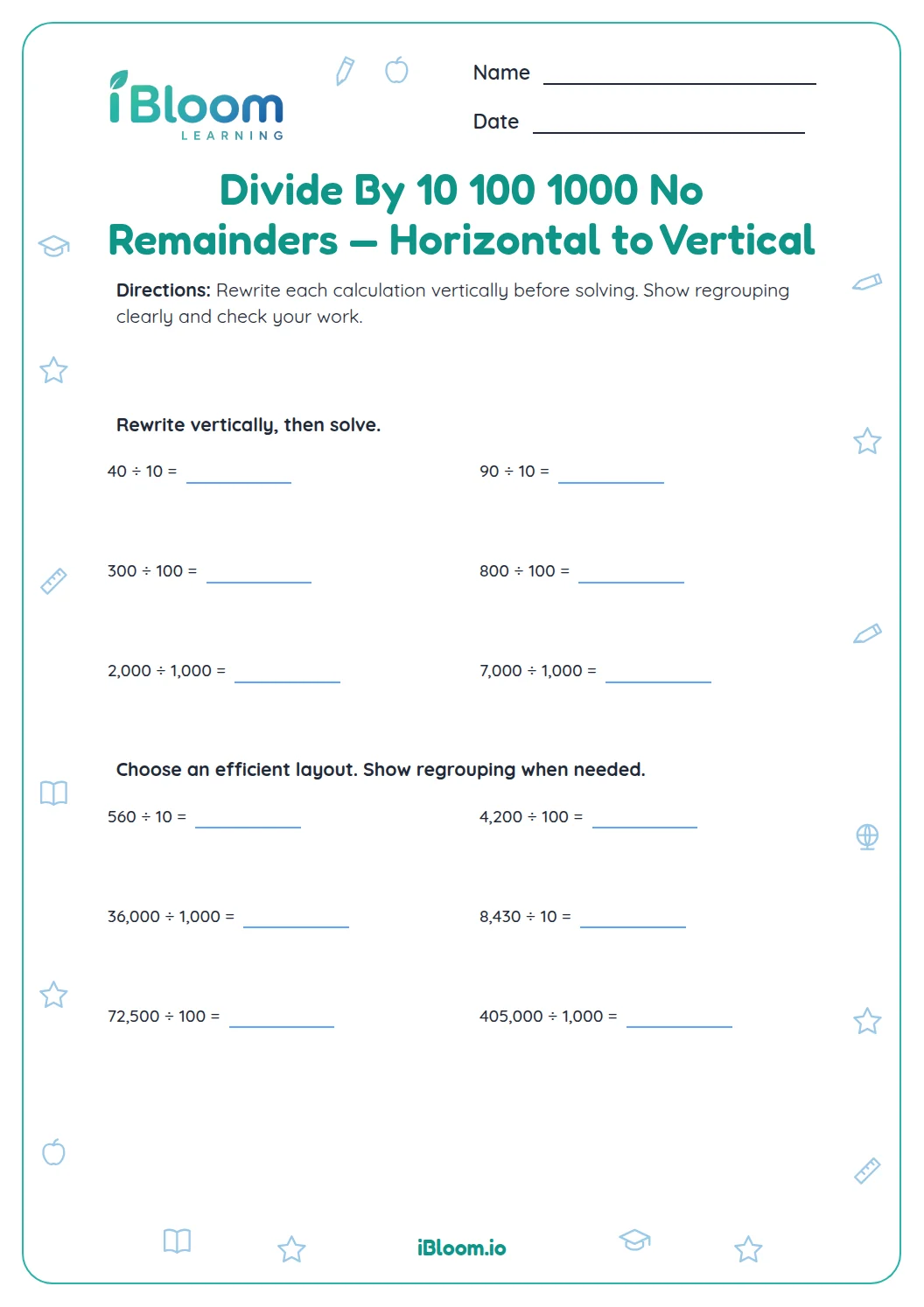
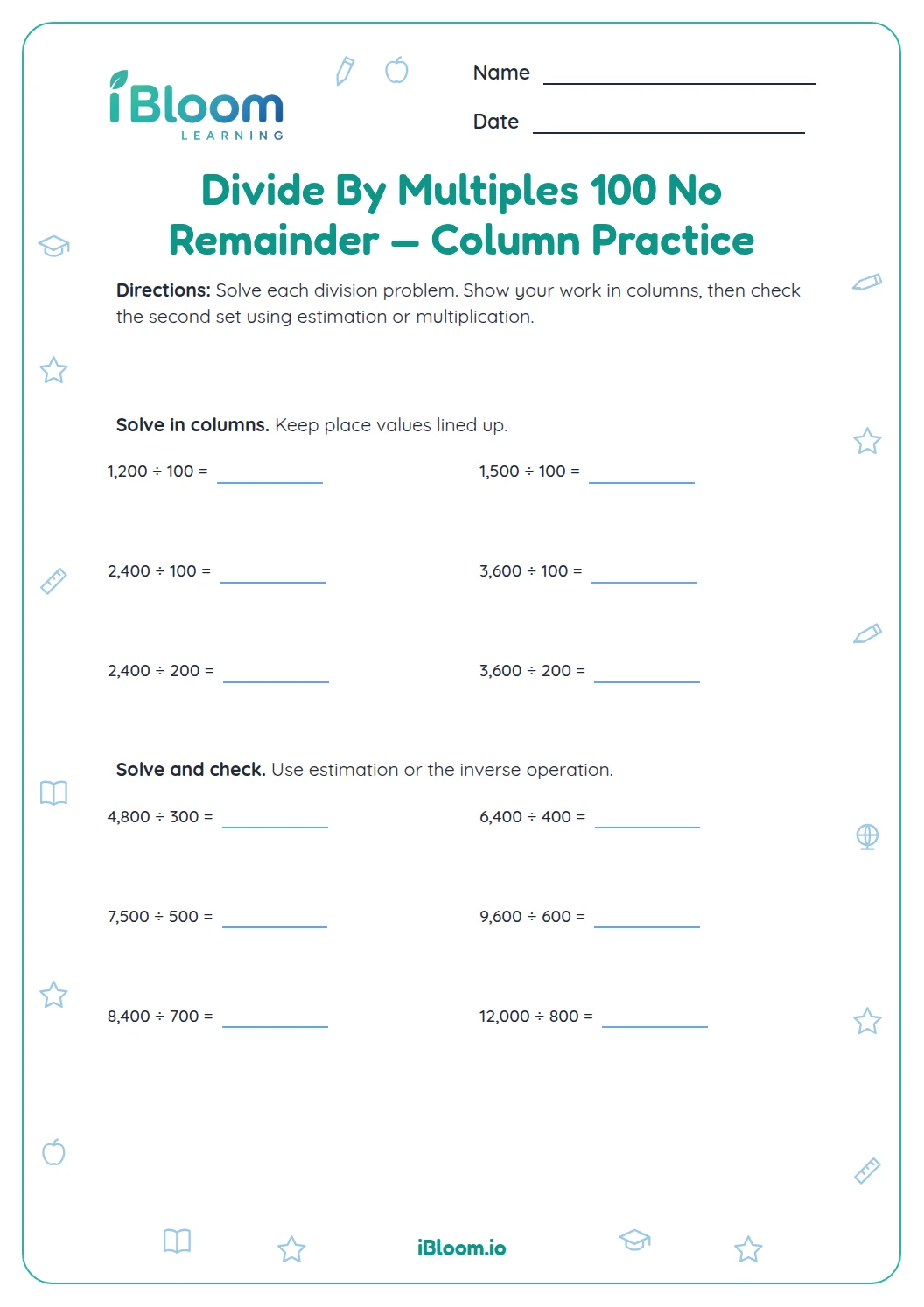
This error analysis drill practices exact division with four-digit dividends and two-digit divisors. Students verify answers and correct place-value errors such as missing zeros.
Aligned to 5.NBT.B.6
How does the drill build division accuracy?
Part A builds accuracy with four-digit dividends and two-digit divisors. Part B presents plausible quotient errors, including missing place-value zeros. Part C gives a mixed set for independent practice.
For every item, multiplication provides a fast check: divisor times quotient should equal the dividend. This catches both computation slips and missing digits in a quotient.
- 11,248 ÷ 12 = 104
- 2Check: 104 × 12 = 1,248, so the quotient is exact.
- Part A: solve and verify exact quotients
- Part B: diagnose place-value and computation errors
- Part C: complete a mixed no-remainder drill
Why do zero placeholders matter?
In 1,632 ÷ 16, the quotient is 102. The zero shows there are no tens in the quotient; leaving it out changes 102 to 12. Track each place as you divide, then multiply to verify the full result.
How does multiplication check a quotient?
Multiply the divisor by the quotient. For an exact division problem, the product must equal the dividend. This check catches a calculation error and a missing zero in the quotient.
How to use this worksheet
- 1Read the short direction at the start of each part.
- 2Solve each item and keep units or operation signs with the values.
- 3For reasoning questions, use the evidence named in the prompt.
- 4Check calculations against the separate answer key.
Common mistakes and quick fixes
The mistake
Writing 12 for 1632 ÷ 16 after dividing the first digits, then forgetting place-value zeros.
The fix
Use the quotient positions for hundreds, tens and ones; 16 × 102 = 1,632.
The mistake
Accepting a quotient without checking it.
The fix
Multiply the proposed quotient by the divisor. The product must equal the dividend.
The mistake
Stopping the division before placing a zero in the quotient.
The fix
Keep each place-value position in the quotient; multiply the quotient by the divisor to check.
Curriculum alignment
This worksheet gives students practice with the cited Common Core skill.
Find whole-number quotients of whole numbers with up to four-digit dividends and two-digit divisors.
On this sheet: The problems use four-digit dividends and two-digit divisors, with place-value reasoning and multiplication checks.
Show the official wordingHide the official wording
Find whole-number quotients of whole numbers with up to four-digit dividends and two-digit divisors, using strategies based on place value, the properties of operations, and/or the relationship between multiplication and division. Illustrate and explain the calculation by using equations, rectangular arrays, and/or area models.
What to practice next
Make more practice
Further reading
Questions parents and teachers ask
How can multiplication reveal a division error?
Multiply the proposed quotient by the divisor. The product should equal the dividend when the division has no remainder. If it does not, the quotient needs another look. This check can reveal a calculation error or a missing place-value zero.
Why can a quotient need a zero in the middle?
A zero holds a place when that place contains no groups of the divisor. For example, 1,632 ÷ 16 is 102, not 12. The zero keeps the hundreds and ones in their correct places, and multiplying 102 by 16 confirms the quotient.
What does “no remainder” mean in these problems?
The divisor divides the dividend evenly, leaving nothing over. The quotient is a whole number, and multiplying it by the divisor gives the original dividend exactly. Every problem on this page has an exact whole-number quotient, so students can check each answer with multiplication.
How should students approach the error analysis section?
Check the proposed answer by multiplying it by the divisor, then compare the product with the dividend. If the product is too small or too large, find the quotient place where the work went wrong. Explain the corrected quotient and verify it again.
How can a student check an answer on this sheet?
Multiply the quotient by the divisor. For these no-remainder problems, that product should equal the dividend exactly. The answer key provides the quotient or correction for each question, making it easy to locate a place-value or calculation slip and correct it.