
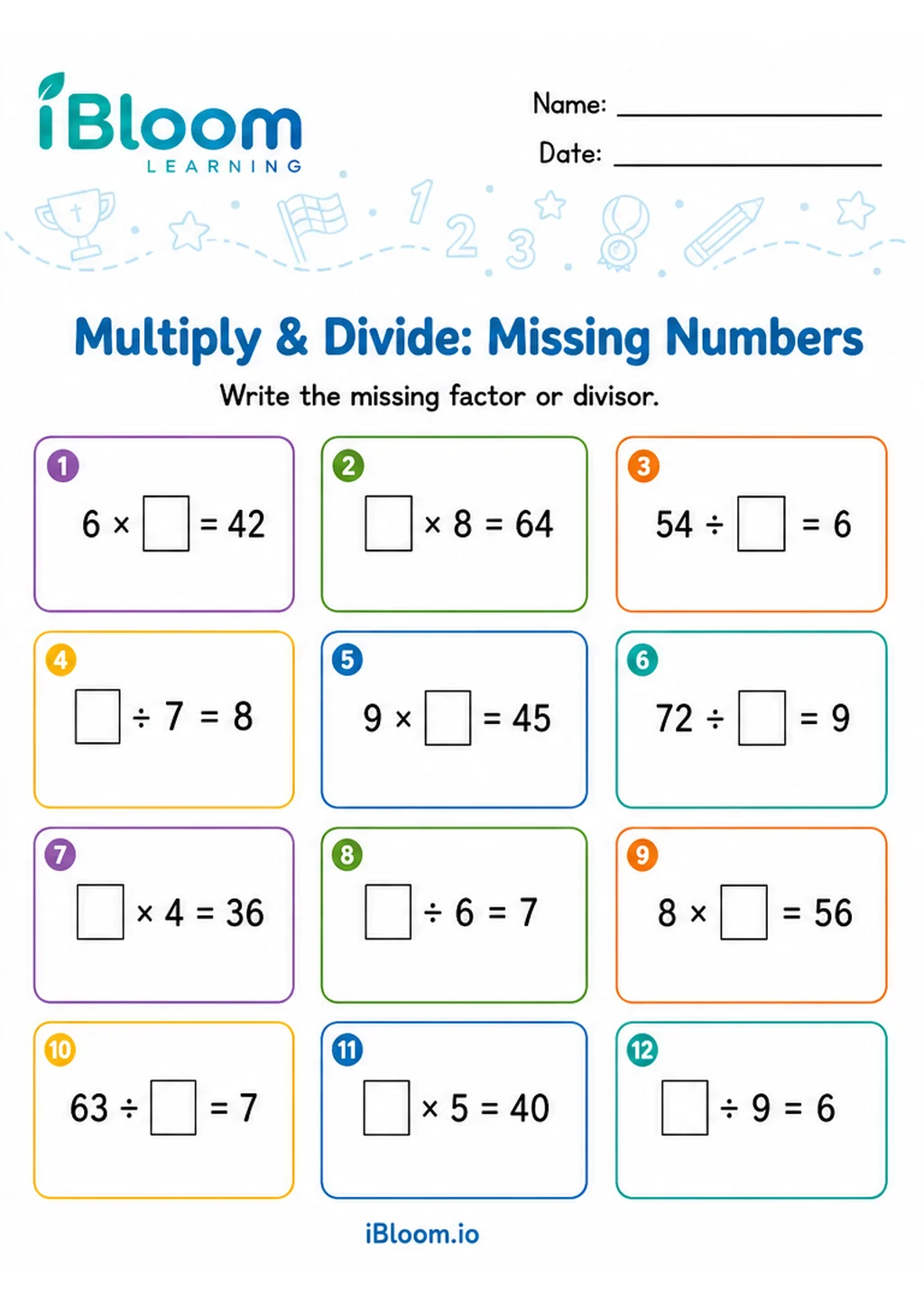
About this worksheet
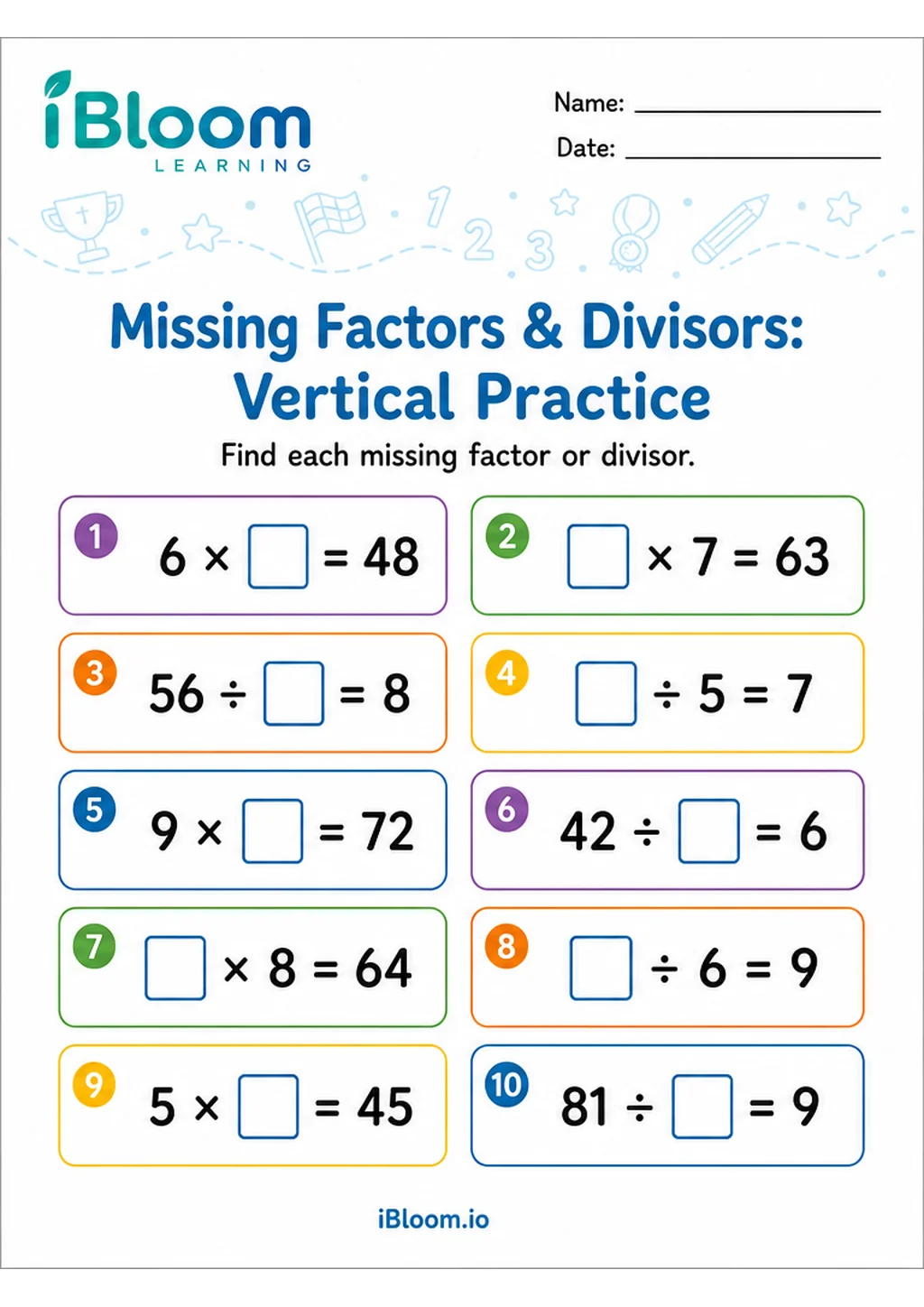
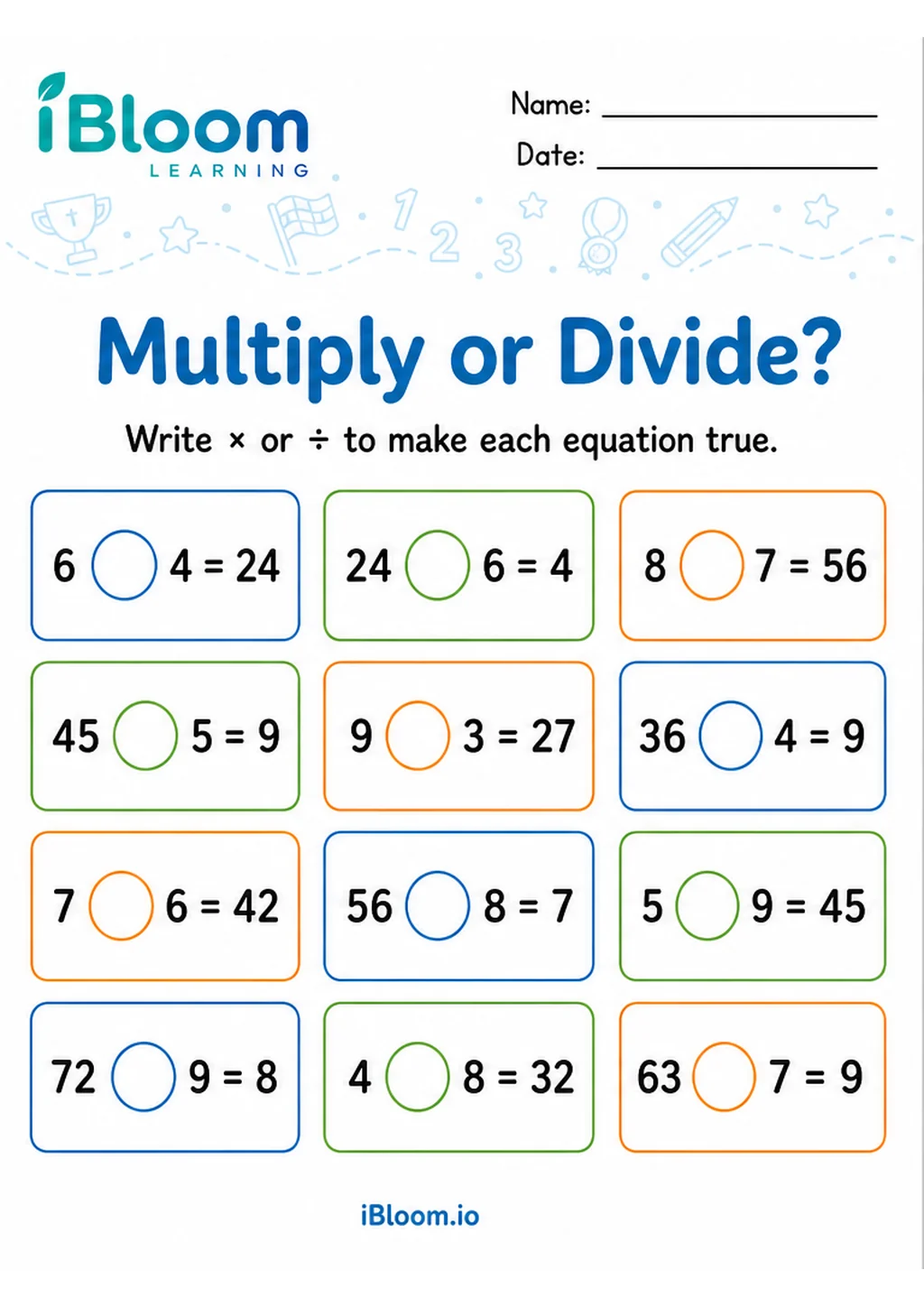
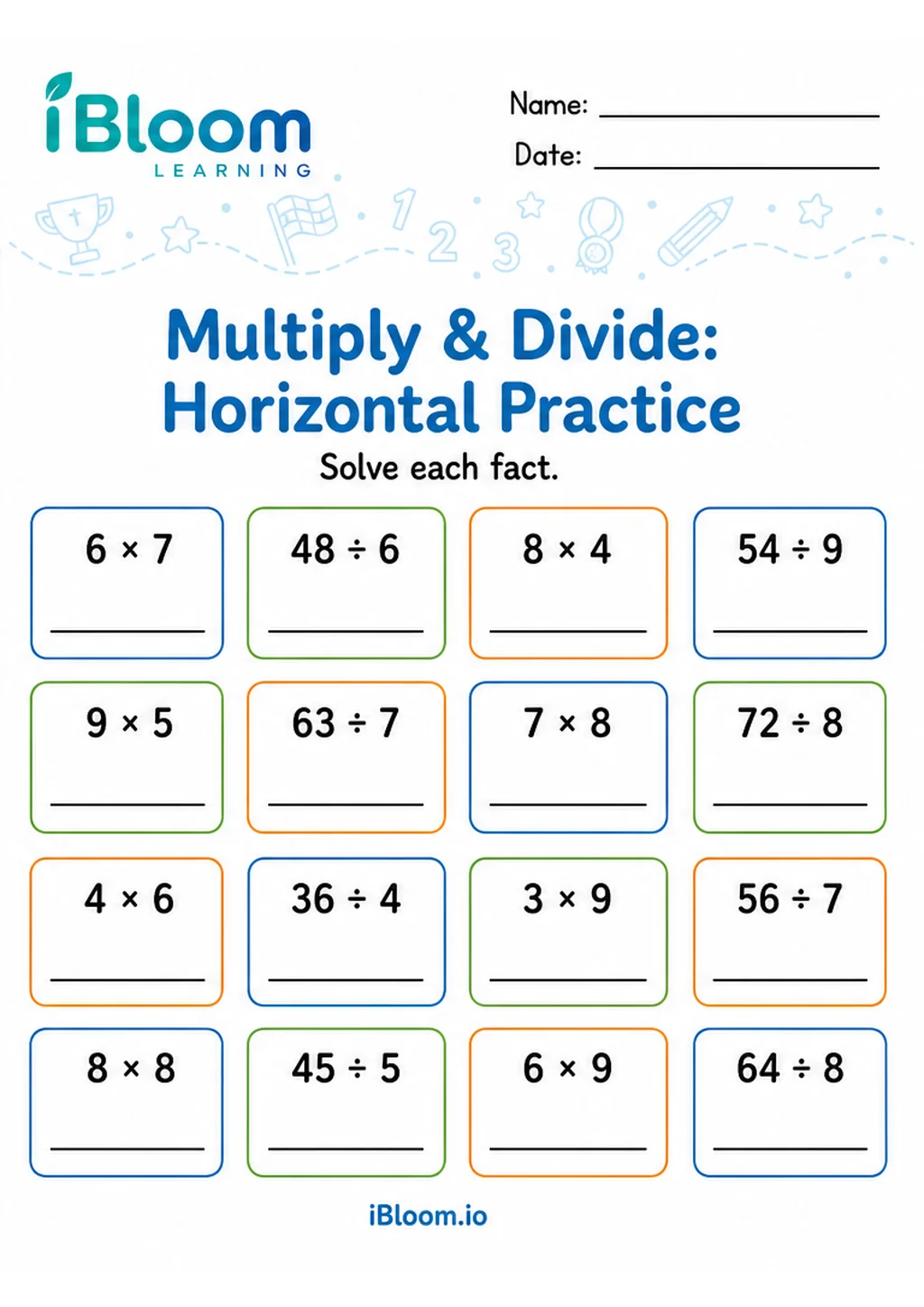
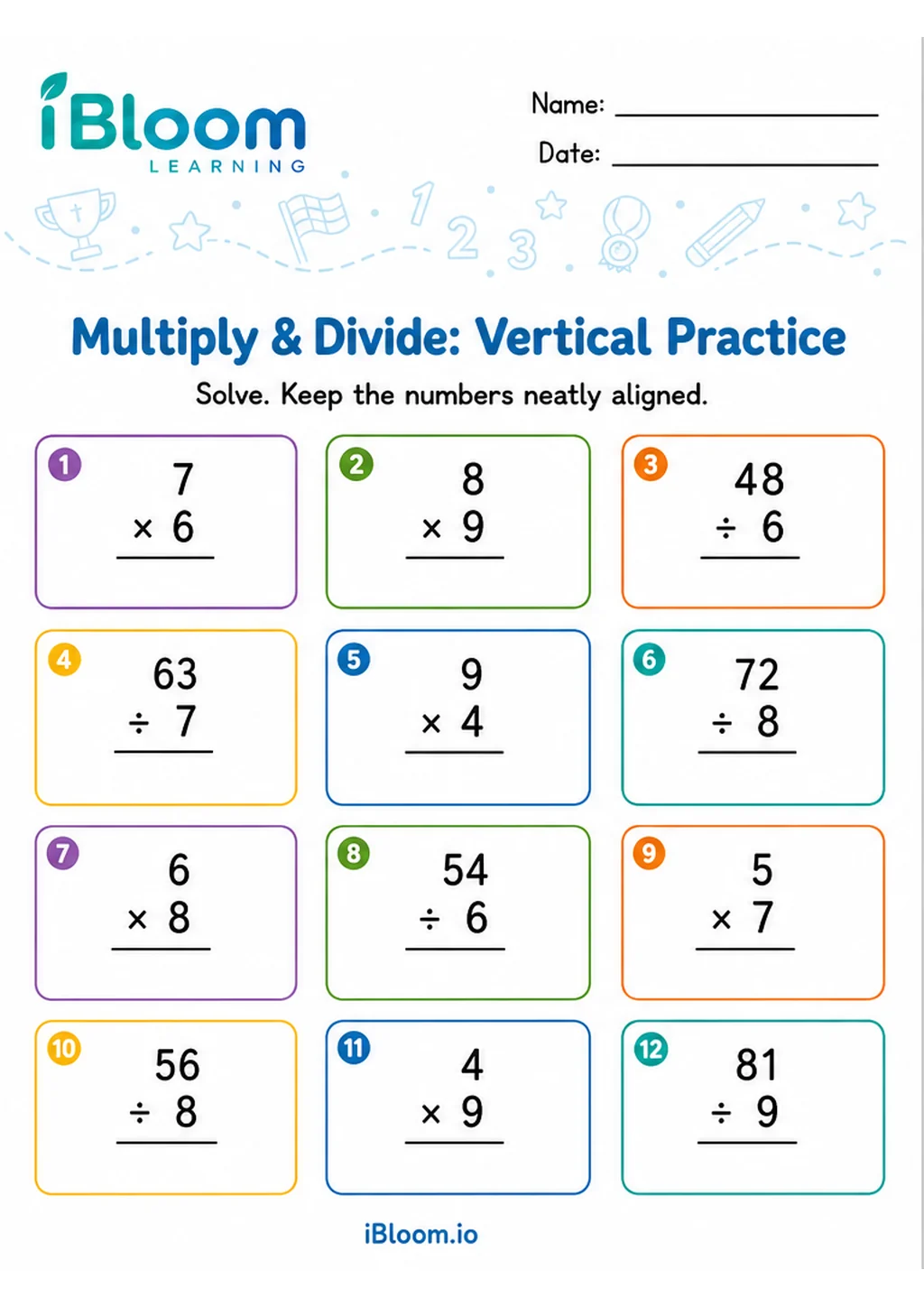
This printable gives students 18 mixed multiplication and division problems organized around related fact families. Ten equations build fluency with known facts and missing factors; eight equal-group situations apply those relationships in context. Problems use whole-number facts within 100, aligning with Common Core 3.OA.C.7. The answer key lists each value.
Aligned to 3.OA.C.7
What makes three facts a family?
A multiplication equation names a product, and division can use that product to find a missing factor. The numbers 7, 6 and 42 belong together because 7 × 6 = 42, 42 ÷ 7 = 6 and 42 ÷ 6 = 7.
- 17 × 6 = 42
- 242 ÷ 7 = 6
- 342 ÷ 6 = 7
How can you find a missing factor or divisor?
Ask what number completes the multiplication fact first. If ___ × 8 = 40, think “40 split into groups of 8” or recall 5 × 8 = 40. For 40 ÷ ___ = 8, ask which divisor makes the related multiplication fact true. Multiply the quotient by that divisor to check.
How can the inverse operation check an answer?
Multiply a quotient by its divisor to see whether it returns the dividend. For 56 ÷ 8 = 7, check 7 × 8 = 56. For 9 × 6 = 54, check 54 ÷ 6 = 9. The same check works for each story problem.
How to use this worksheet
- 1Complete the first section without a timer so attention stays on the fact relationships.
- 2For each division question, say the matching multiplication fact aloud.
- 3For a missing factor, rewrite the numbers as a known multiplication fact.
- 4After solving, check each result with its inverse operation.
- 5Use the key to compare answers and revisit any family whose facts do not match.
Common mistakes and quick fixes
The mistake
Dividing the divisor by the dividend.
The fix
Check the order by multiplying quotient × divisor; it should equal the dividend.
The mistake
Treating a missing factor like a sum.
The fix
Use multiplication facts or the related division equation to find the factor.
The mistake
Changing a fact-family number when switching operations.
The fix
Keep the same three numbers together and change only the operation and the position being solved.
Common Core alignment
This worksheet practices the relationship between multiplication and division facts.
Build fluency with multiplication and division facts within 100.
On this sheet: Ten equations and eight equal-group problems use related facts within 100.
Show the official wordingHide the official wording
Fluently multiply and divide within 100, using strategies such as the relationship between multiplication and division (e.g., knowing that 8 × 5 = 40, one knows 40 ÷ 5 = 8) or properties of operations. By the end of Grade 3, know from memory all products of two one-digit numbers.
What to practice next
Make more practice
Further reading
Questions parents and teachers ask
What is a multiplication and division fact family?
It is a group of related equations using the same three numbers. If 7 × 6 = 42, then 42 ÷ 7 = 6 and 42 ÷ 6 = 7. Students use this relationship to solve and check related multiplication and division facts.
What should my child do when a factor is missing?
Think of the multiplication equation as a known fact with one part hidden. For ___ × 8 = 40, ask what number times 8 makes 40. The matching division fact, 40 ÷ 8, gives the missing factor. Then use the product to check the completed equation.
How can students check a division answer?
Multiply the quotient by the divisor. For example, if 56 ÷ 8 = 7, multiply 7 × 8 and confirm that the product is 56. This inverse check uses the same family and can reveal an arithmetic slip. It also checks the story problems.
How many questions are included?
The sheet contains 18 problems: ten fact equations and eight equal-group stories. The first ten include complete facts and missing factors or divisors, while the stories ask students to multiply or divide. Every answer uses whole numbers, and the separate answer key lists each result.
What grades can use the worksheet?
The source page is labeled for Grades 3–6. The equations use familiar multiplication and division facts within 100, so a teacher or caregiver can choose a section for review or fluency practice. Students can take time to identify the related fact before filling each blank.