
About this worksheet
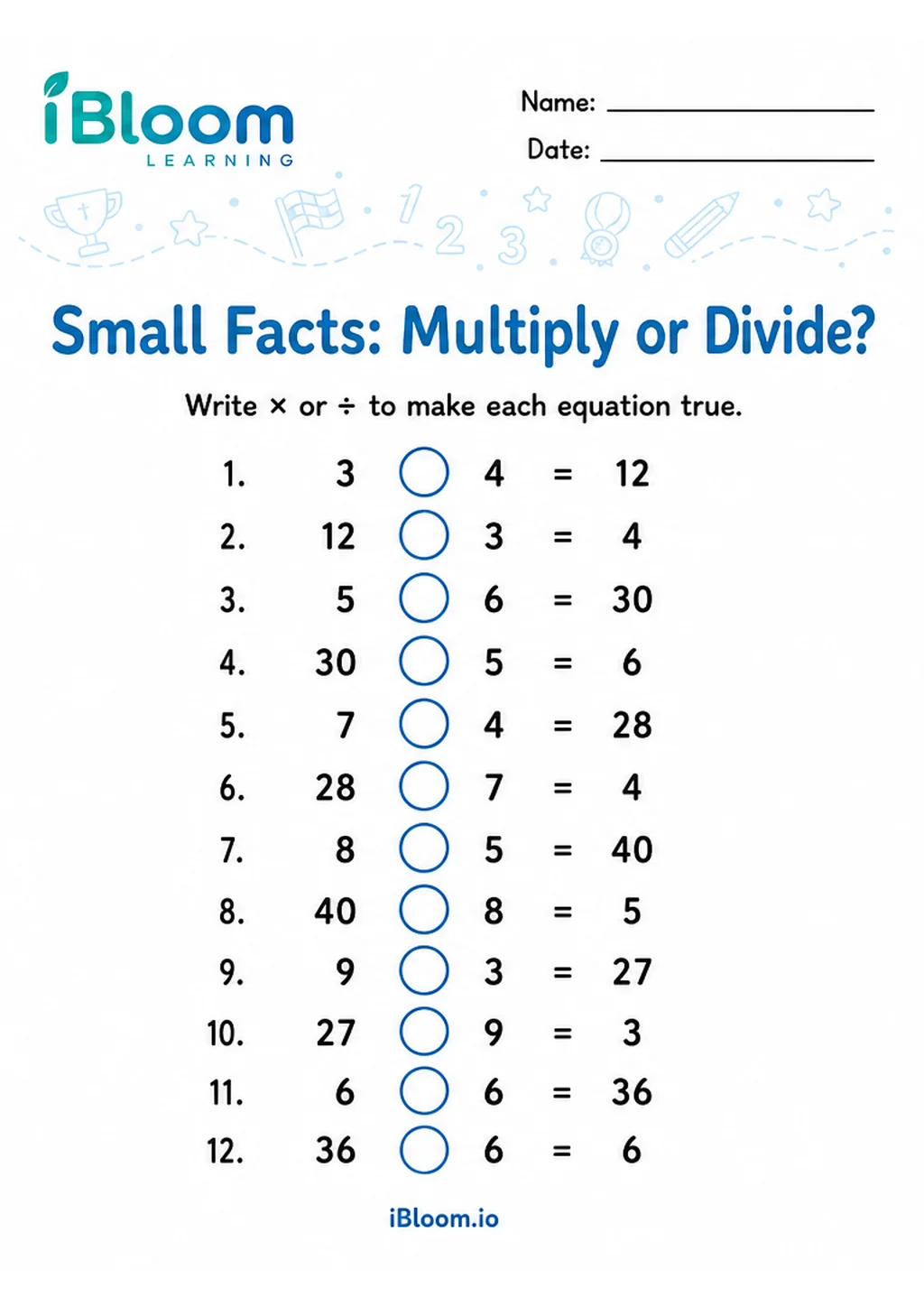
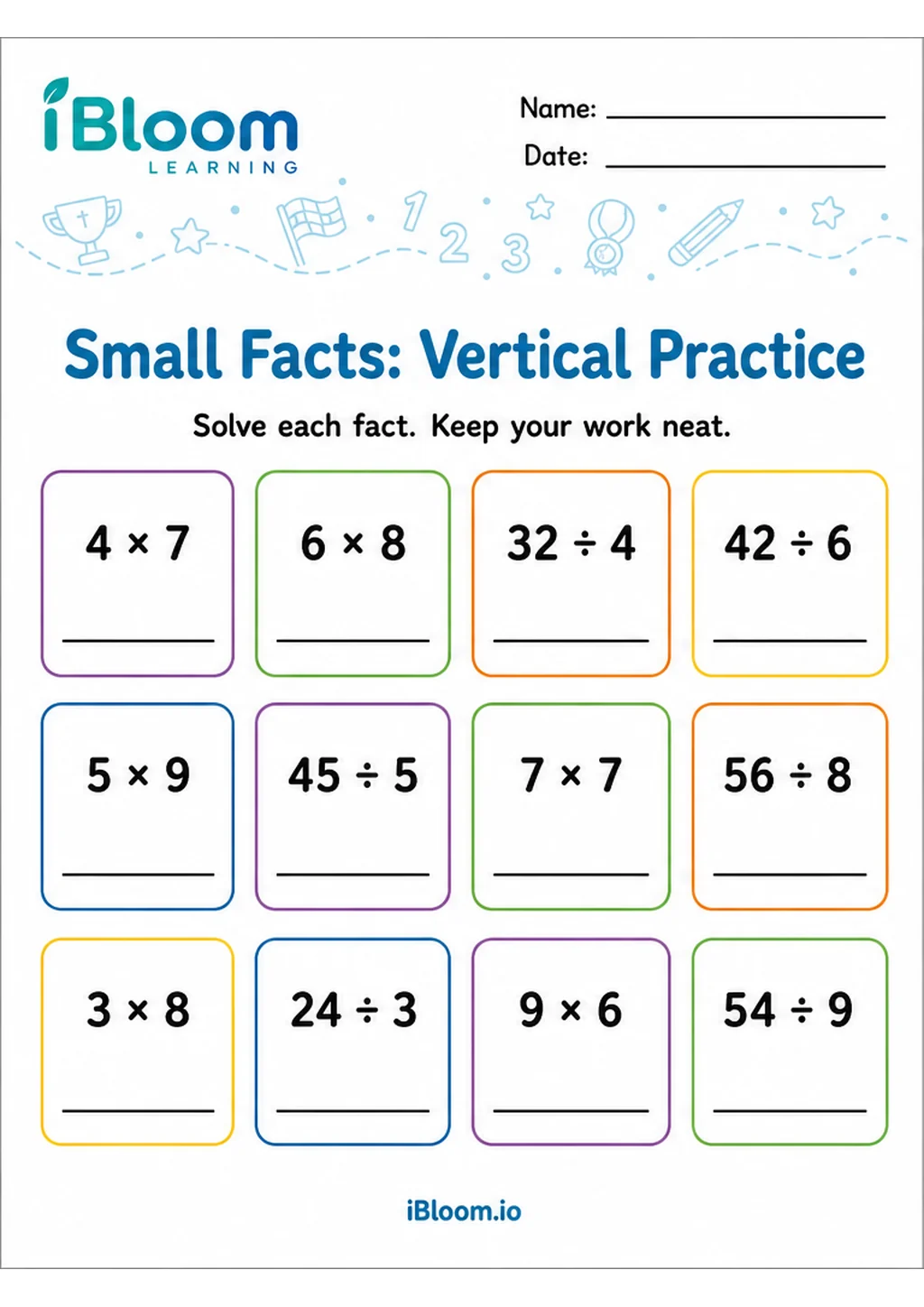
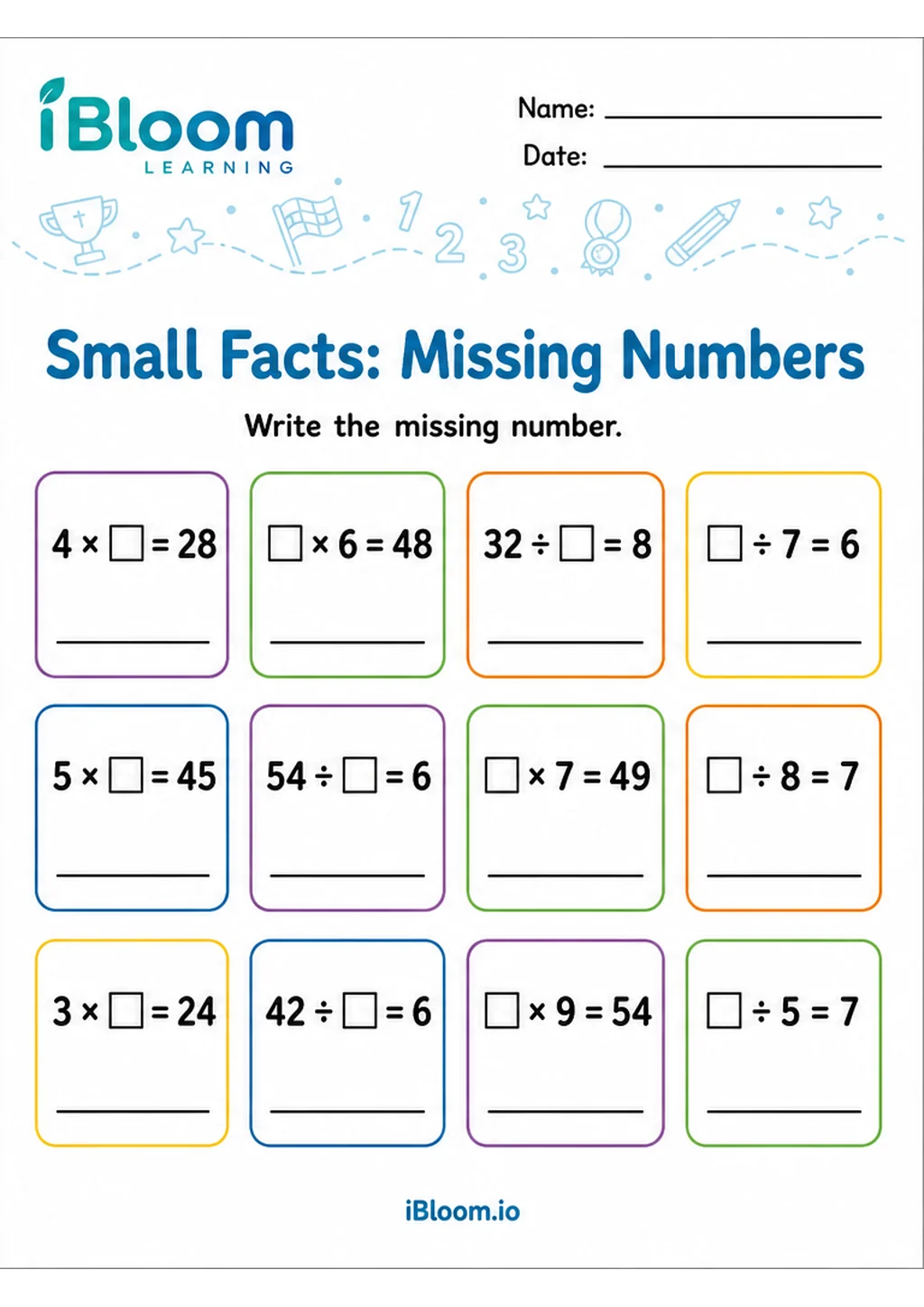
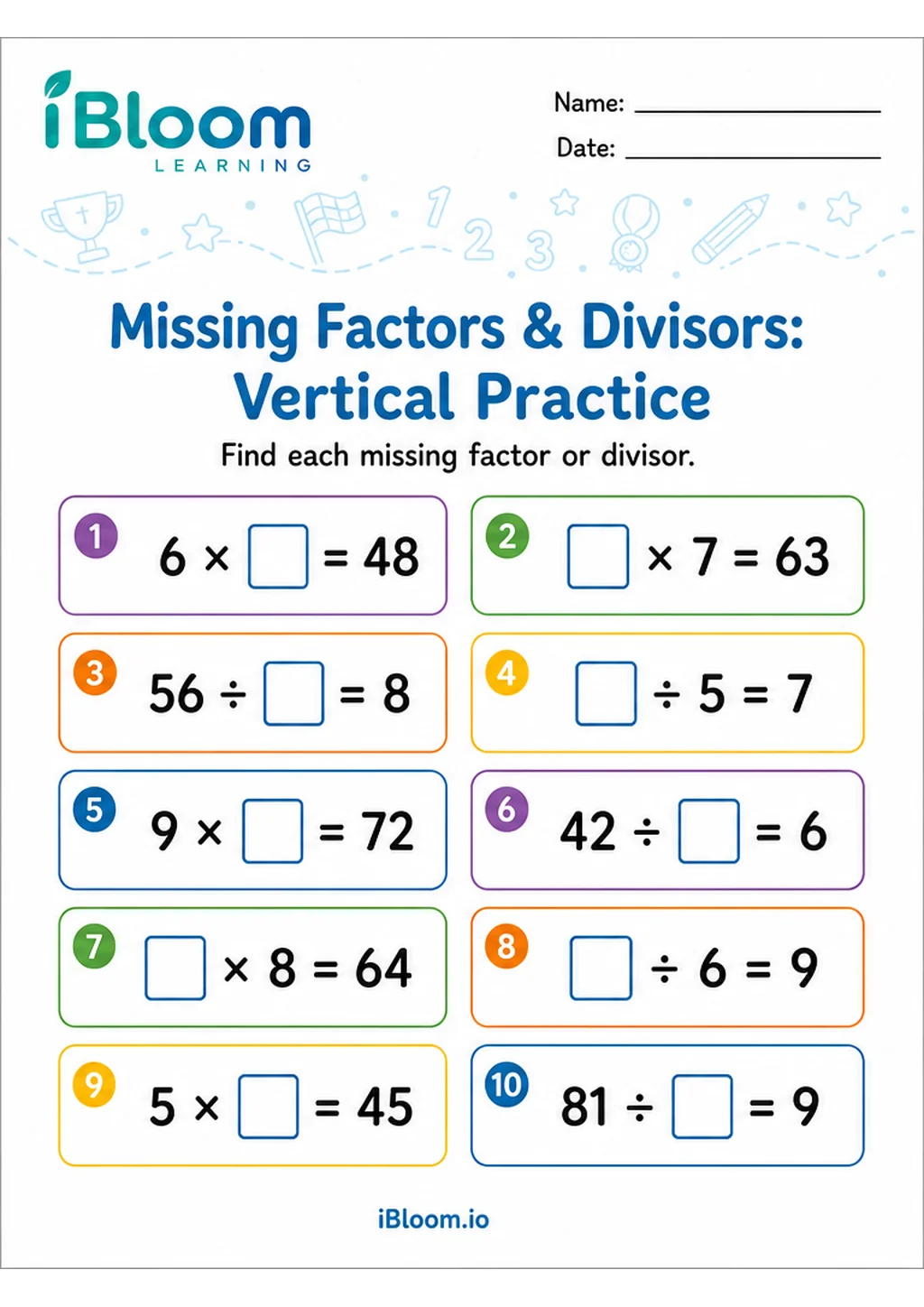
This free fact-family worksheet asks students to decide whether multiplication or division makes an equation true. It suits Grades 3–6 learners reviewing the relationship between a product and its two factors. Part A checks six equations, Part B fills six missing operation signs, and Part C repairs four incorrect signs while keeping the numbers in place. The practice supports CCSS 3.OA.B.6: use a known multiplication relationship to understand division. Products stay within 100, and the separate answer key shows every choice, sign, and corrected equation.
Aligned to 3.OA.B.6
What makes multiplication and division a fact family?
Three related numbers can form multiplication and division equations. For 5, 7, and 35, the two factors are 5 and 7, and the product is 35. The equations 5 × 7 = 35, 7 × 5 = 35, 35 ÷ 5 = 7, and 35 ÷ 7 = 5 all use that relationship.
Ask students to find the multiplication fact first when division feels uncertain. To evaluate 35 ÷ 5, ask “Five times what makes thirty-five?” The missing factor is 7.
How do students find the wrong sign?
Part A mixes true equations with equations whose operation sign is wrong. A No answer means the printed equation is false. Students can confirm this by naming the family and saying the correct equation aloud.
The numbers stay fixed in Part C. That constraint helps students focus on the operation instead of replacing an answer to make the original calculation work.
- 1Printed: 35 × 5 = 7
- 2Known fact: 5 × 7 = 35
- 3To find the missing factor, divide the product by 5.
- 4Correct equation: 35 ÷ 5 = 7
- 5Part A answer: No.
What should students write in each part?
In Part A, choose Yes or No for each of six equations. In Part B, write only × or ÷ in the six blanks. In Part C, rewrite each of four equations with its sign corrected; every number keeps its original position.
The last part includes two equations that need multiplication and two that need division. Before checking the key, students can read each repaired equation aloud and connect it to a second fact from the same family.
How to use this worksheet
- 1Name the factors and product in 4 × 6 = 24 before starting.
- 2For Part A, test the printed sign and choose Yes or No.
- 3After a No answer, say which sign would make the same numbers work.
- 4In Part B, try a multiplication fact to help decide between × and ÷.
- 5Rewrite each Part C equation, then verify it using the related operation.
Mistakes to notice and how to help
The mistake
Choosing Yes because all three numbers belong to a familiar family.
The fix
Check their positions and the sign: 35 × 5 = 7 uses family numbers but is still false.
The mistake
Treating division as if its numbers can switch places freely.
The fix
Begin with the product when writing a whole-number division fact from these families.
The mistake
Changing 7 to 175 to repair 35 × 5 = 7.
The fix
Keep the numbers fixed for this activity; change × to ÷ so the family relationship remains visible.
Common Core alignment
Use a known multiplication fact to identify the correct division relationship.
On this sheet: Students test and repair division equations by identifying the factor that completes the related multiplication fact.
Show the official wordingHide the official wording
Understand division as an unknown-factor problem. For example, find 32 ÷ 8 by finding the number that makes 32 when multiplied by 8.
What to practice next
Make more practice
Further reading
Questions parents and teachers ask
What does a No answer mean in Part A?
No means the equation as printed is false. Every false equation in this part can be fixed by changing its operation sign while keeping the numbers in place. For example, 35 × 5 = 7 becomes true when the multiplication sign changes to division: 35 ÷ 5 = 7.
Should students write a number or a sign in Part B?
They should write an operation sign: either × or ÷. The numbers and answers are already supplied, so the job is to connect them correctly. In 24 ___ 8 = 3, division works because 8 × 3 = 24. Multiplication would produce a much larger number.
Why can’t students switch the numbers in Part C?
Keeping the numbers in place makes the task specifically about choosing the operation. Students rewrite the whole equation but change only its sign. For 6 ÷ 7 = 42, the required repair is 6 × 7 = 42; using different numbers would avoid identifying the incorrect sign.
How can a child check division without guessing?
Use the related multiplication fact to check the missing factor. For 42 ÷ 6 = 7, think 6 × 7 = 42. The same family also gives 42 ÷ 7 = 6. Saying both facts helps connect the quotient to the factor needed in multiplication.
Is this worksheet meant to be timed?
It can be used without a timer so students can explain their choices. The sheet has 16 items in three parts and takes about 15 minutes, including checking. If a child finishes quickly, ask for a related fact for each repaired equation instead of focusing only on speed.