





About this worksheet
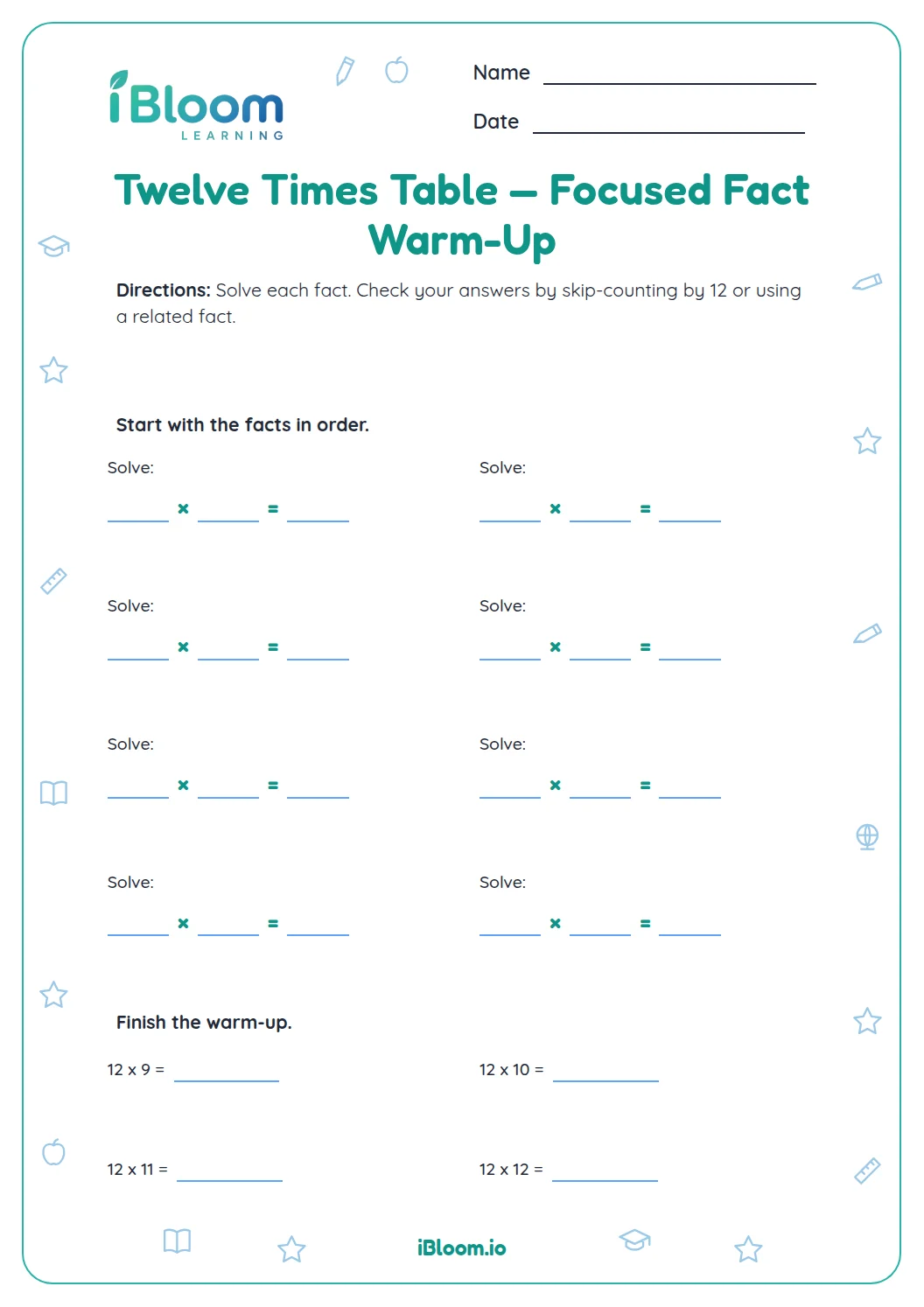
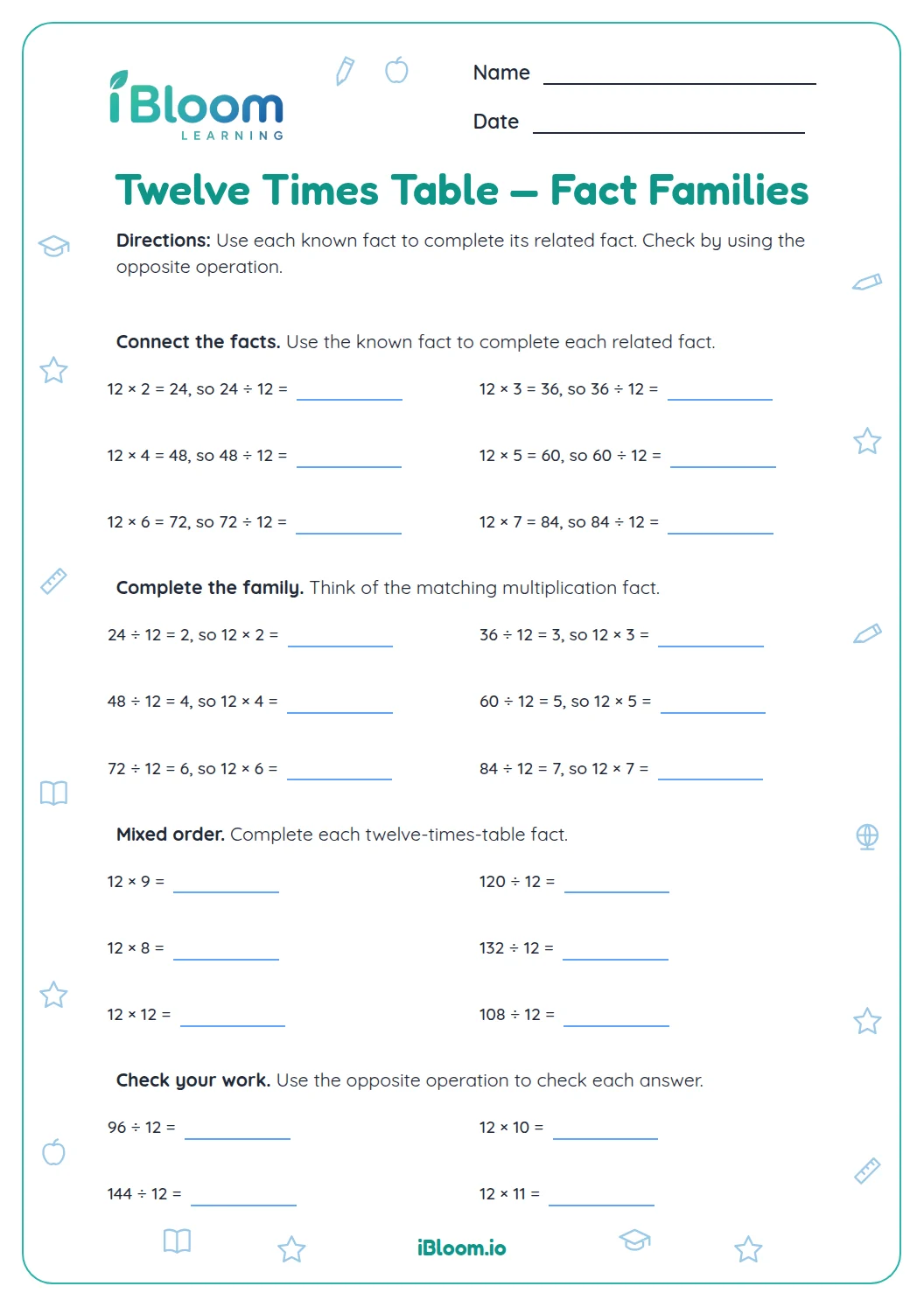
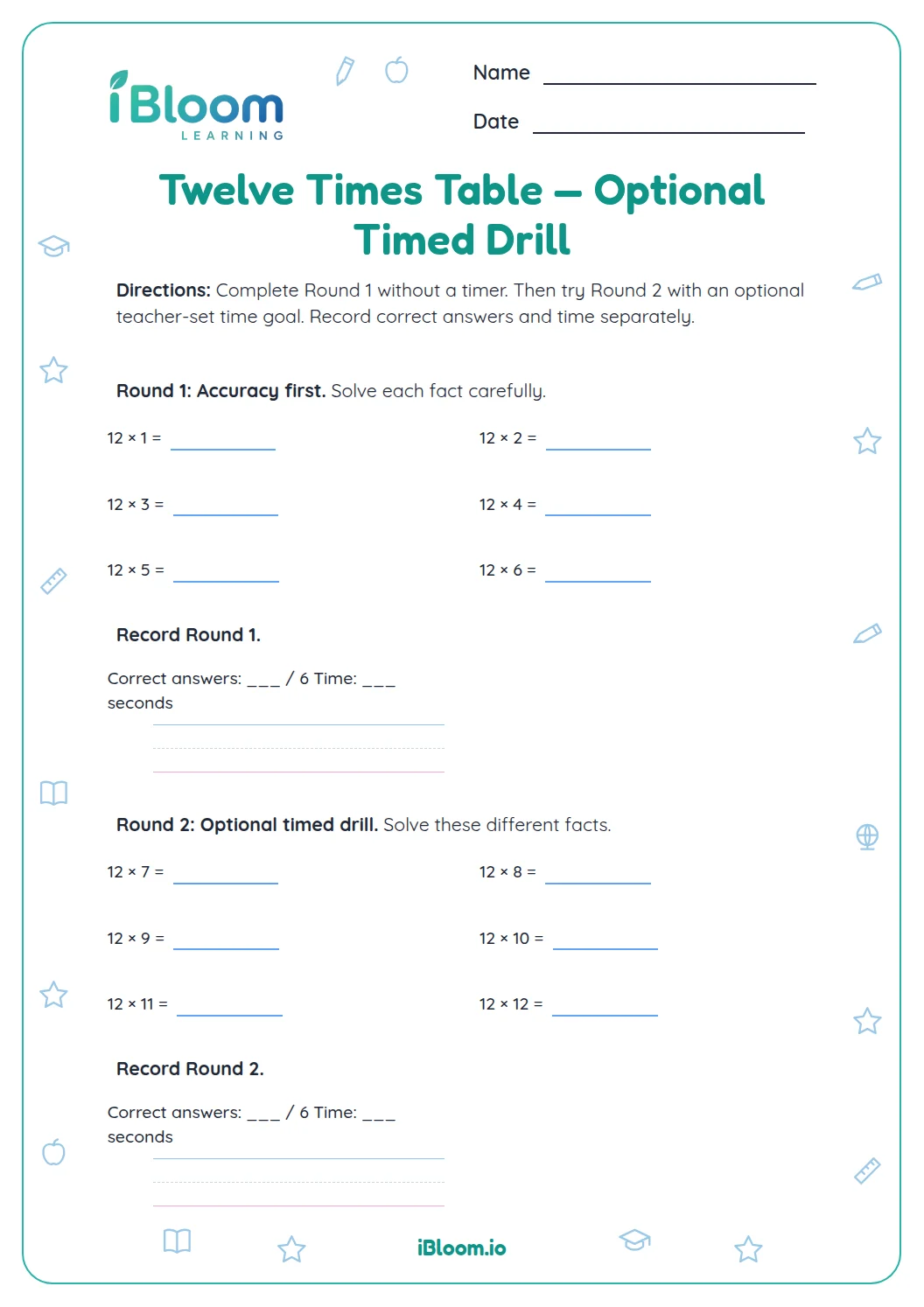
This free printable twelve times table mastery check is for Grade 3 and Grade 4 students who have practiced multiplying by 12. Its 18 questions cover every factor from 1 through 12, mixing direct products with missing factors. Students then correct two believable mistakes and use tens-and-twos or doubling strategies to finish two short answers. The worksheet practices Common Core 3.OA.A.4 and 3.OA.B.5 through unknown numbers and properties of multiplication. A separate answer key supports review. Use it without a timer so the child has room to check any uncertain fact.
Aligned to 3.OA.A.4 and 3.OA.B.5
Which multiplication facts does the check include?
Part A asks for eight products in mixed order. Part B includes missing factors for 84, 108, 132 and 144, then revisits 60 and 96 with 12 as the first factor. Together, these parts check 12 multiplied by every whole number from 1 through 12.
Part C revisits 12 × 5 and 12 × 7 through error correction. Part D asks students to use two strategies on 12 × 9 and 12 × 11. Repeated facts appear in a different form so the child has to make a connection.
How does the tens-and-twos strategy work?
Split 12 into 10 + 2. Multiply each part by the other factor, then add the two products. This gives a checkable route to a fact that a student cannot yet recall.
- 112 × 9 = (10 × 9) + (2 × 9)
- 210 × 9 = 90 and 2 × 9 = 18
- 390 + 18 = 108
What should an adult look for when checking answers?
Notice whether a mistake concerns a product, a missing factor or a strategy. A child who writes 84 in the blank before × 12 has found a product but has not identified the number of groups. Ask which number times 12 makes 84.
For the final two answers, check the calculation as well as the total. Question 17 should combine 90 and 18; question 18 should double 66. The key gives one correct calculation for each.
How to use this worksheet
- 1Have the child complete Part A in the printed mixed order.
- 2In Part B, read each equation aloud with “what number” in the blank.
- 3For Part C, decide what group or partial product was left out.
- 4Write the two strategy calculations in Part D.
- 5Check with the key and mark the facts that need another practice round.
Mistakes to notice and fix
The mistake
Writing 12 × 5 = 50.
The fix
Ten fives make 50, but two more fives add 10. The product is 60.
The mistake
Writing 12 × 7 = 72.
The fix
72 is six groups of 12. Add one more group of 12 to make 84.
The mistake
Splitting 12 × 9 into 90 + 2.
The fix
Both parts of 12 must be multiplied by 9: 90 + 18 = 108.
Common Core alignment
Find missing products and factors in equations with 12.
On this sheet: Parts A and B ask students to complete twelve-times-table equations.
Show the official wordingHide the official wording
Determine the unknown whole number in a multiplication or division equation relating three whole numbers. For example, determine the unknown number that makes the equation true in each of the equations 8 × ? = 48, 5 = _ ÷ 3, 6 × 6 = ?
Use tens and twos, or groups of six, to work out products with 12.
On this sheet: The final questions check distributive and associative multiplication strategies.
Show the official wordingHide the official wording
Apply properties of operations as strategies to multiply and divide.
What to practice next
Make more practice
Further reading
Questions parents and teachers ask
Does this worksheet include the whole twelve times table?
Yes, the first twelve questions cover every factor from 1 through 12. Eight ask for a product, and four ask for a missing factor. Two more missing-factor questions revisit 60 and 96. The last four questions check error correction and strategies, connecting recall with an understanding of how facts relate.
Should I time the mastery check?
You can use this worksheet without a timer. Give the child time to complete the facts and show the two strategy calculations, then review accuracy and reasoning together. If you record a completion time, compare it only with that child’s later work while continuing to prioritize correct answers.
Why is 12 × 9 equal to 108?
Twelve nines can be split into ten nines and two nines. Ten nines make 90, and two nines make 18; adding them gives 108. Question 17 asks students to record that addition fact, connecting the answer to multiplication facts they may already know well.
What does a correct missing-factor answer look like?
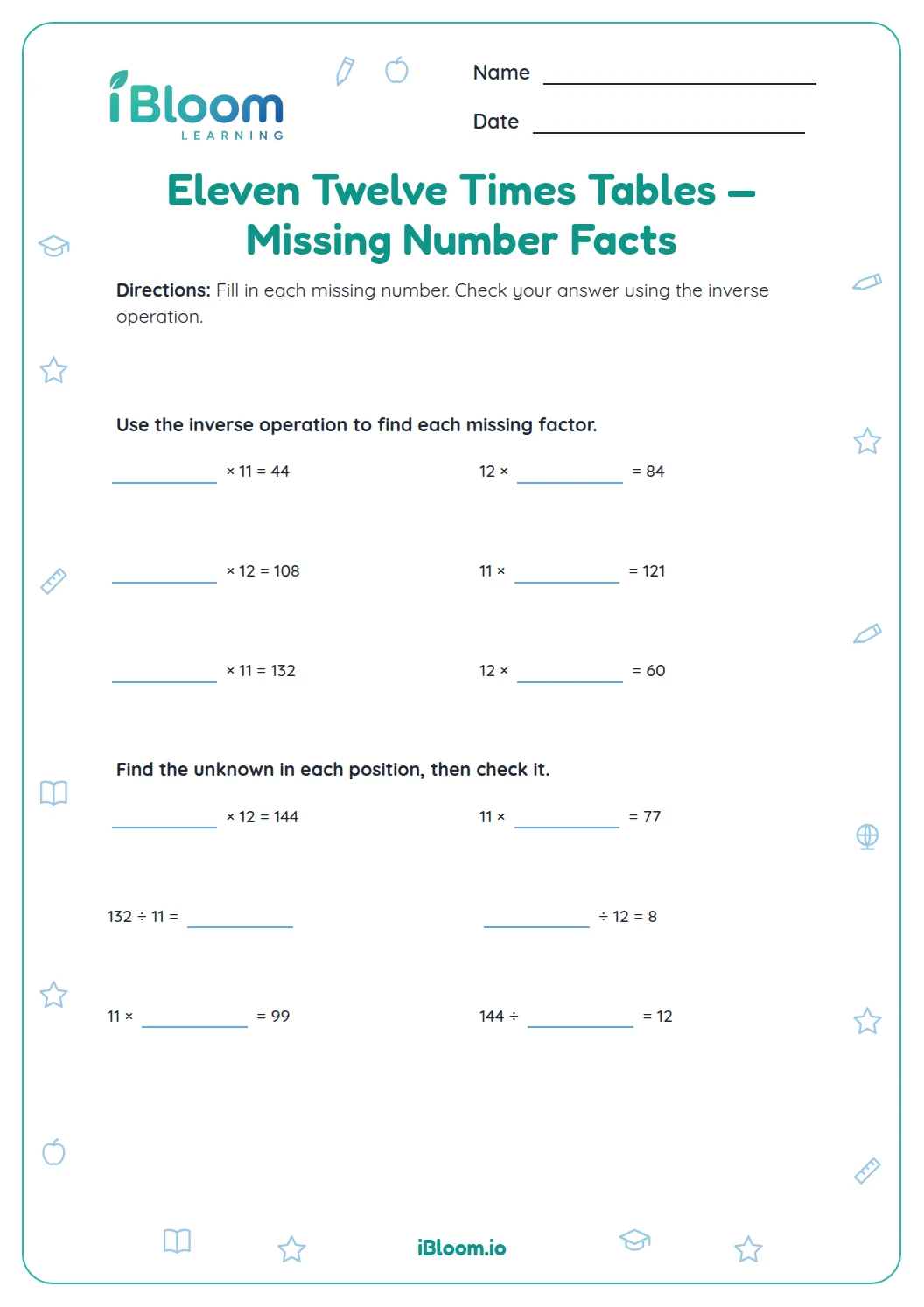
The answer is the number that belongs in the blank, such as 7 in ___ × 12 = 84. Check it by multiplying 7 by 12 to recover 84. The key lists 7, 9, 11, 12, 5 and 8 for Part B, matching its six printed equations.
What should we practice after this check?
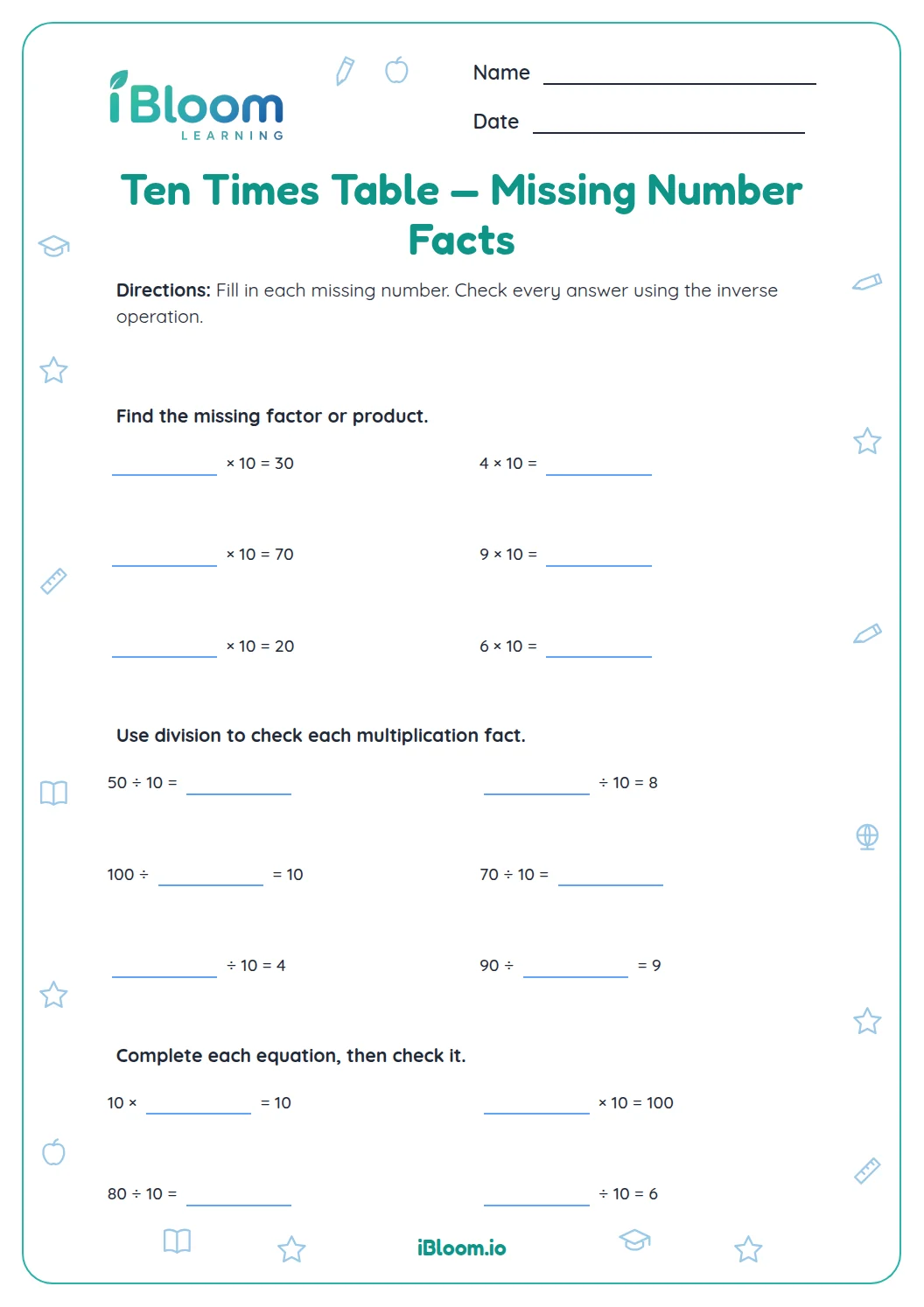
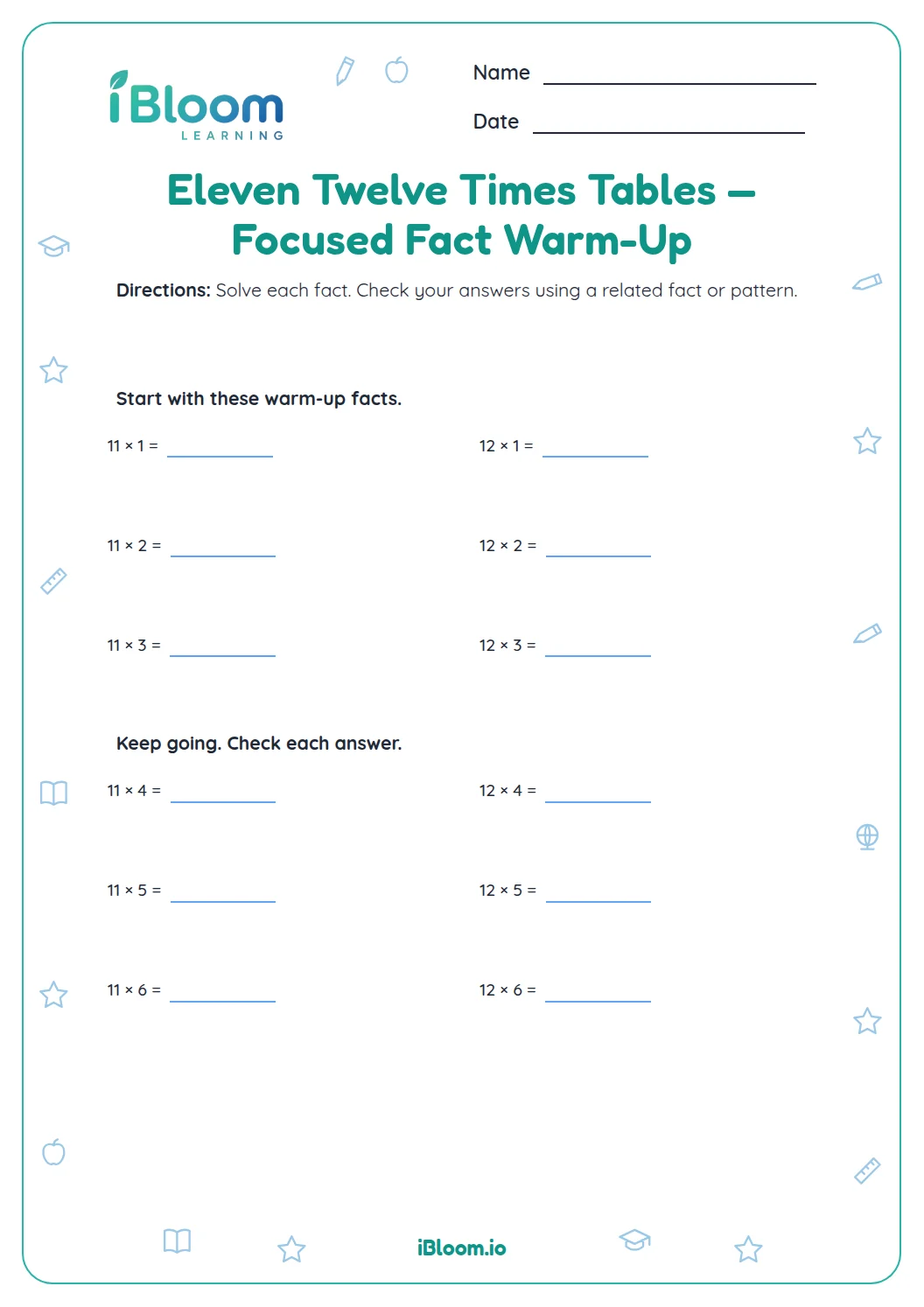
Practice the specific facts the child missed, using a strategy that fits each one. The six times table helps with doubling, and the ten times table helps with splitting twelve into ten and two. Then try mixed eleven-and-twelve facts or more missing-factor equations from the linked worksheet collections.