




About this worksheet
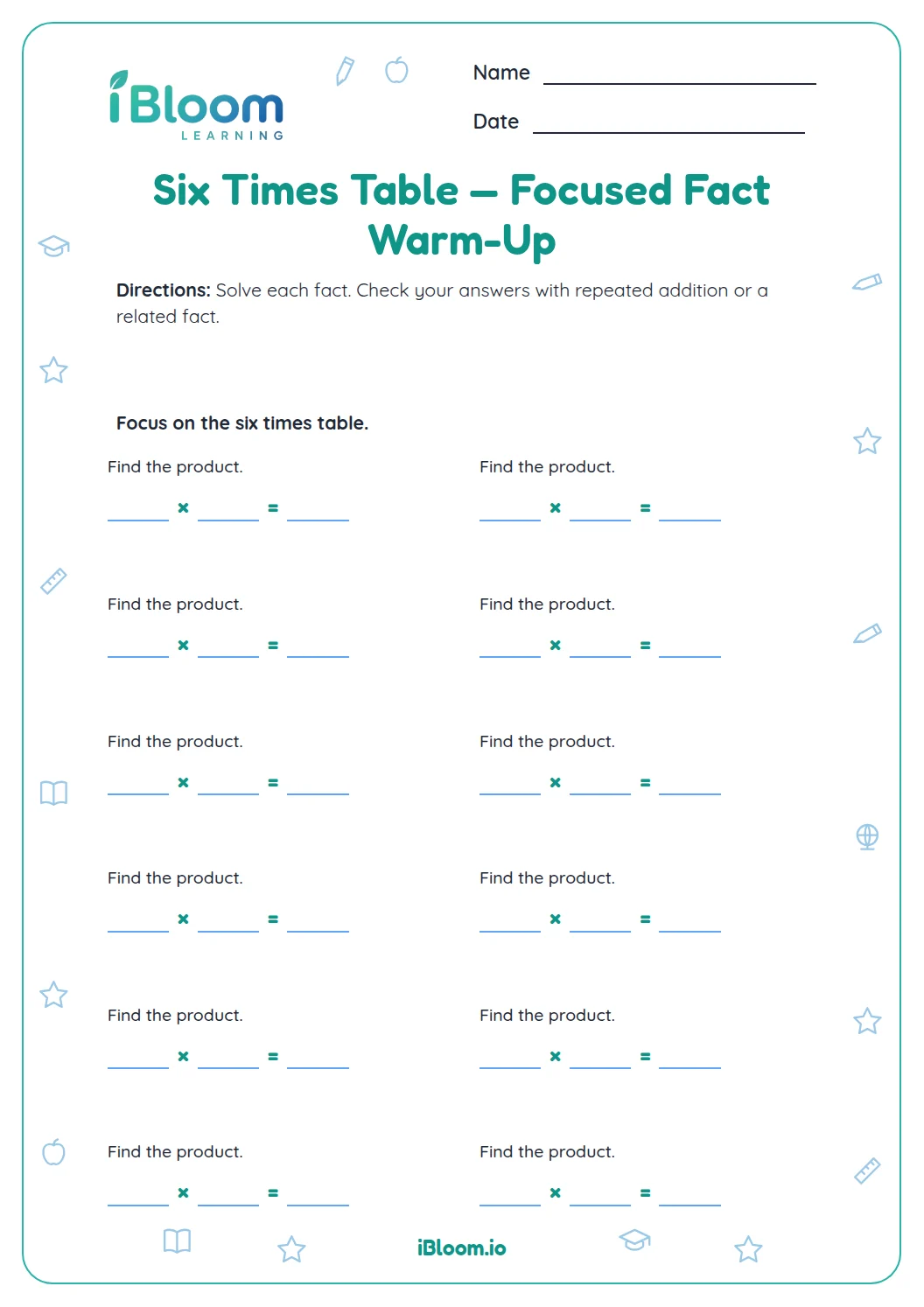
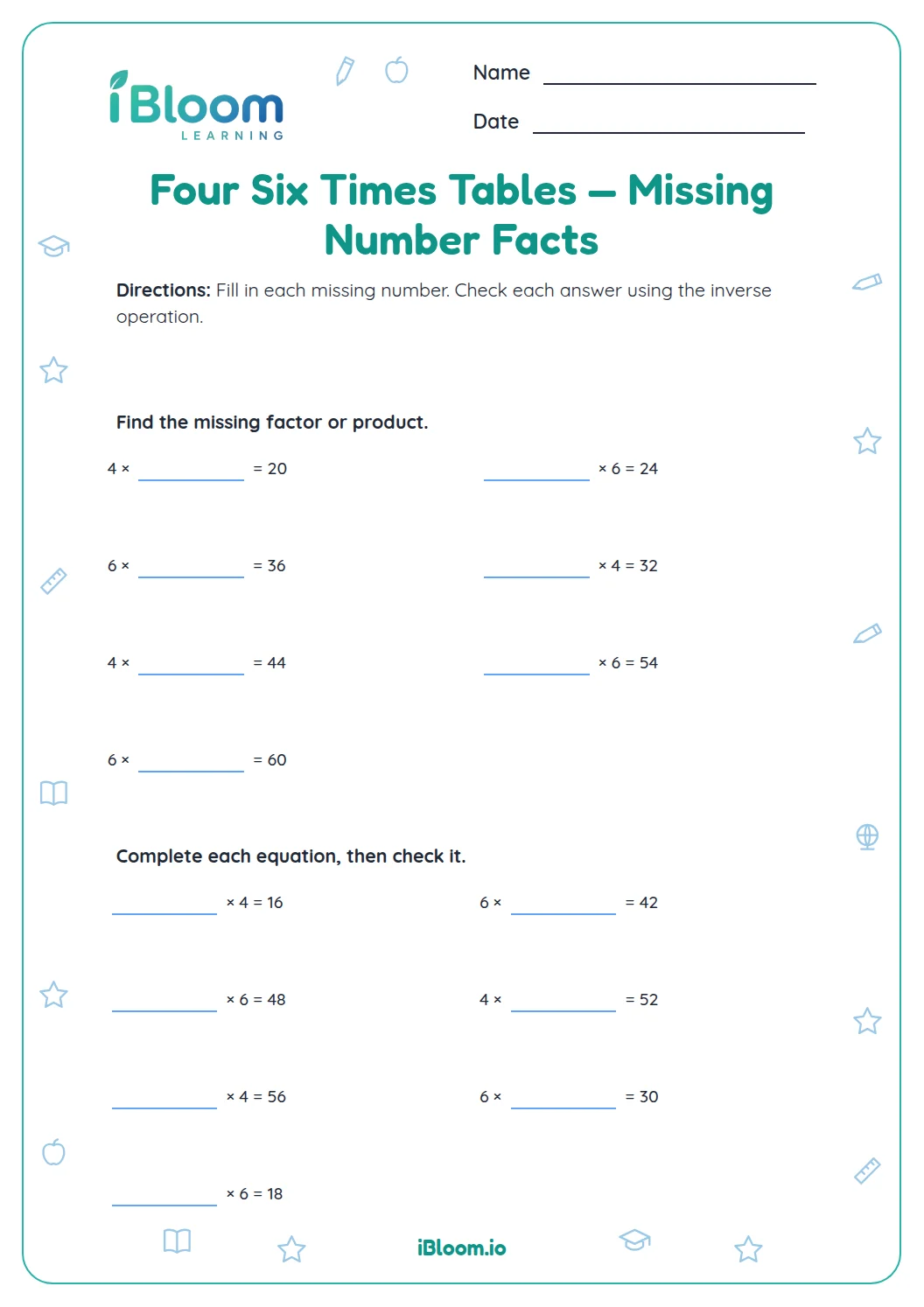
This free six times table worksheet gives Grade 3 and Grade 4 students 16 equations with different missing numbers. Part A starts with four missing products. Part B asks for eight missing factors, including equations with the product on the left of the equals sign. Part C reaches 6 × 12 and connects multiplication with three division facts. The sheet covers every multiplier from 0 through 12 and practices Common Core 3.OA.A.4, finding an unknown whole number in multiplication or division. A separate answer key supplies every missing number.
Aligned to 3.OA.A.4
Why does the blank move around?
Moving the blank changes what students need to find. In 6 × 2 = ___, the answer is the total. In 6 × ___ = 24, the total is already given and the missing number tells how many groups of six are needed.
Part B also places two products before the equals sign. Reading 42 = 6 × ___ as “42 is the same amount as six times something” keeps attention on equality.
How can a known fact help with an unknown factor?
Use a multiplication fact you know or count groups of six until you reach the product. For 54, nine groups of six make the total. The blank’s position does not change that relationship.
- 154 = ___ × 6
- 2Recall 9 × 6 = 54.
- 3Write 9, then read 54 = 9 × 6.
- 4Both sides equal 54.
How does division connect to the six times table?
Part C asks students to use the same facts in division equations. If 6 × 7 = 42, then 42 ÷ 6 = 7. That identifies the missing starting number in question 14.
For question 15, the blank is the divisor: 54 ÷ ___ = 6. Nine is the missing number because six groups of nine make 54. Read the complete equation after filling the blank to avoid answering with the quotient already printed.
How to use this worksheet
- 1Review a few multiples of six aloud before beginning.
- 2Complete Part A and identify each blank as a missing product.
- 3For Part B, name the product first, then find its missing factor.
- 4Use related multiplication facts to solve the three division questions.
- 5Substitute each answer into its equation, then check with the related operation: 6 × 4 = 24 checks as 24 ÷ 6 = 4.
Mistakes to check and ways to help
The mistake
Writing 24 in the blank in 6 × ___ = 24.
The fix
The product is already printed. Ask which factor multiplied by 6 makes 24.
The mistake
Treating 42 = 6 × ___ as an equation written the wrong way.
The fix
Read the equals sign as “has the same value as.” Both orders describe the same fact.
The mistake
Putting 6 into 54 ÷ ___ = 6.
The fix
The quotient is already 6. Use divisor × quotient = dividend: 9 × 6 = 54, so the divisor is 9.
Common Core alignment
Find unknown whole numbers in six-times multiplication and related division equations.
On this sheet: Every question asks for a missing product, factor, dividend, divisor, or quotient.
Show the official wordingHide the official wording
Determine the unknown whole number in a multiplication or division equation relating three whole numbers. For example, determine the unknown number that makes the equation true in each of the equations 8 × ? = 48, 5 = _ ÷ 3, 6 × 6 = ?
What to practice next
Make more practice
Further reading
Questions parents and teachers ask
Which six-times facts appear on the worksheet?
The worksheet includes every multiplier from 0 through 12, plus three related division equations. The first four questions find products for 0 through 3. The next eight find factors from 4 through 11, and question 13 asks for the product of 6 and 12.
Why is 6 × 0 equal to zero?
Six multiplied by zero equals zero because zero groups of six contain no objects. Question 1 checks this fact before moving to one, two, and three groups. Ask the student to compare zero groups with one group of six to keep those first two answers distinct.
What does a product before the equals sign mean?
A product before the equals sign has the same meaning as a product after it: both sides must have equal value. In question 8, 42 = 6 × ___ asks for 7. Students can read it aloud or reverse the whole equation to check their thinking.
Is this a timed drill?
You can use this worksheet without a timer. Ask students to work carefully and check every completed equation first. If they need a counting strategy, let them use it and discuss which facts helped. The three parts make it easy to pause and review one kind of blank.
How should I review an incorrect division answer?
Read the completed division equation and turn it into a multiplication check. For question 15, 54 ÷ 9 = 6 checks as 6 × 9 = 54. If the proposed divisor does not multiply by the quotient to give 54, return to the six-times facts.