


About this worksheet
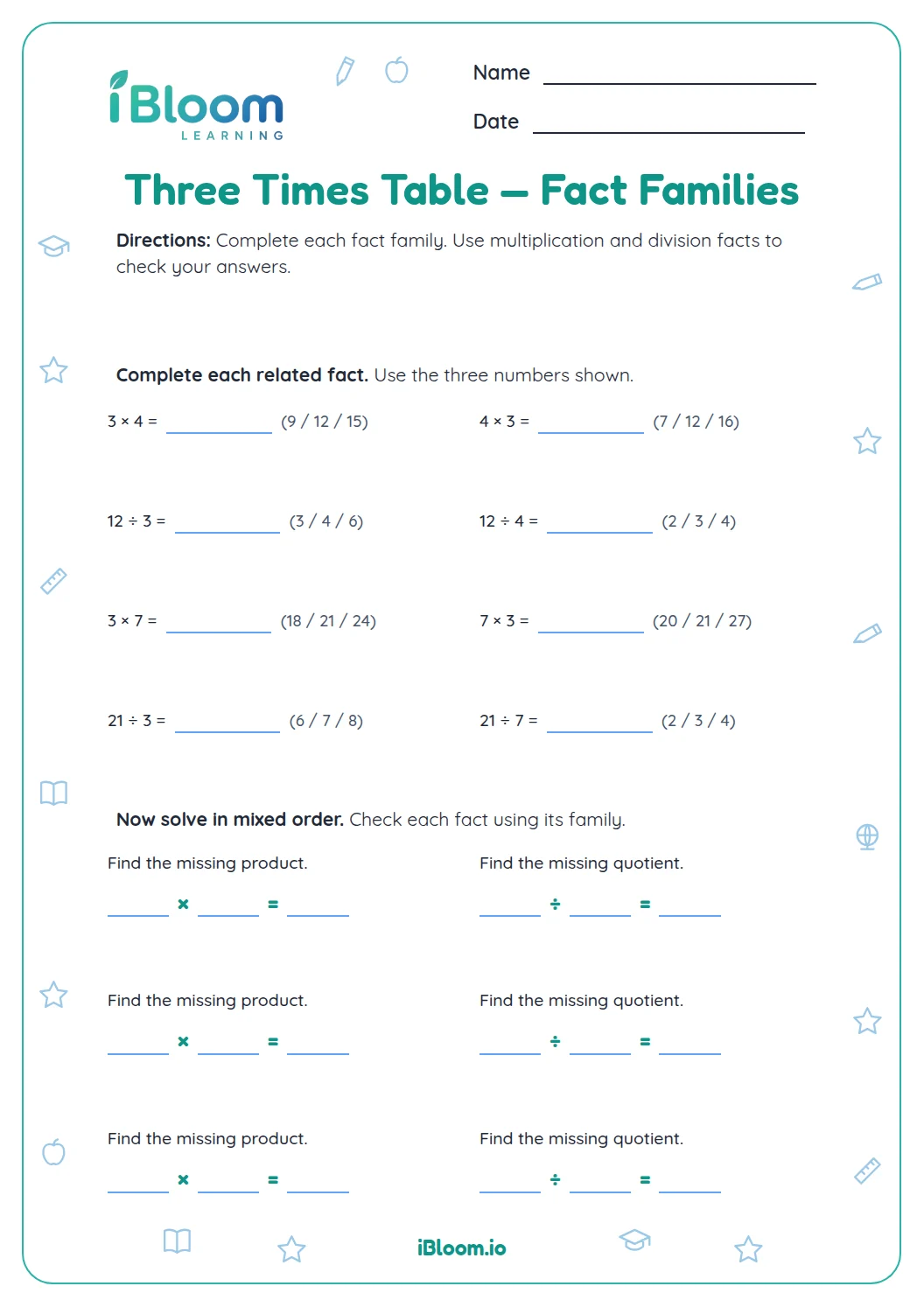
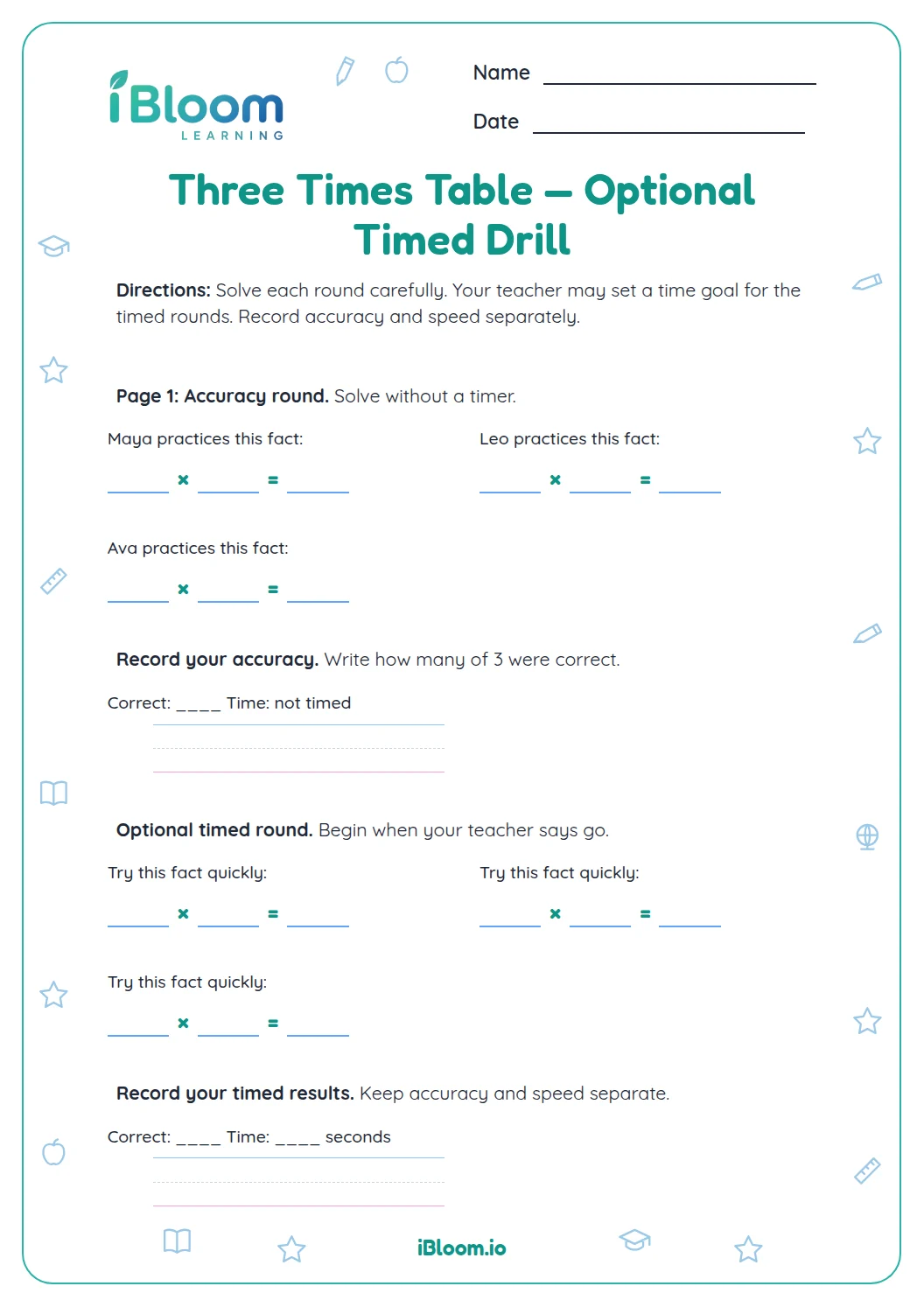
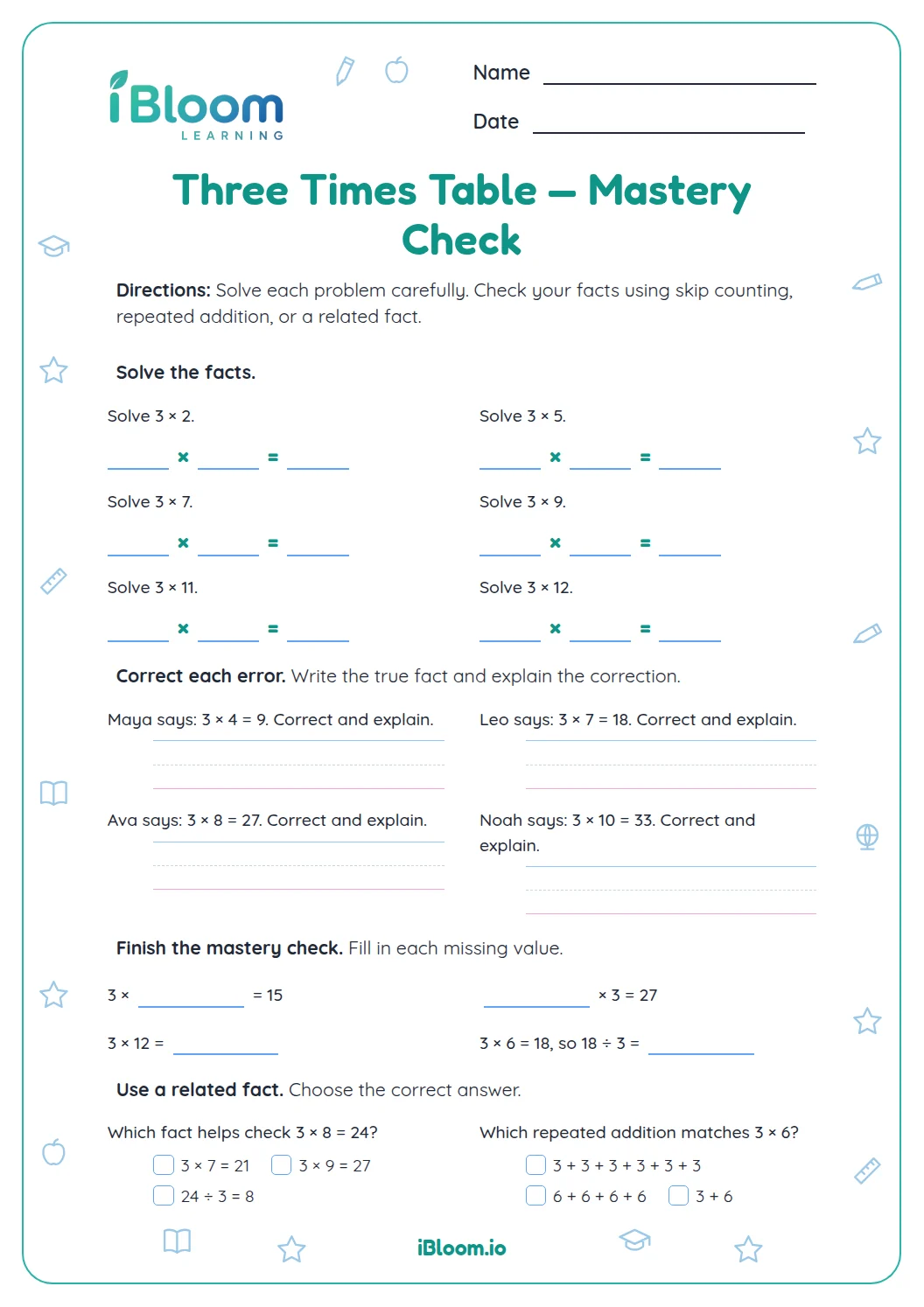
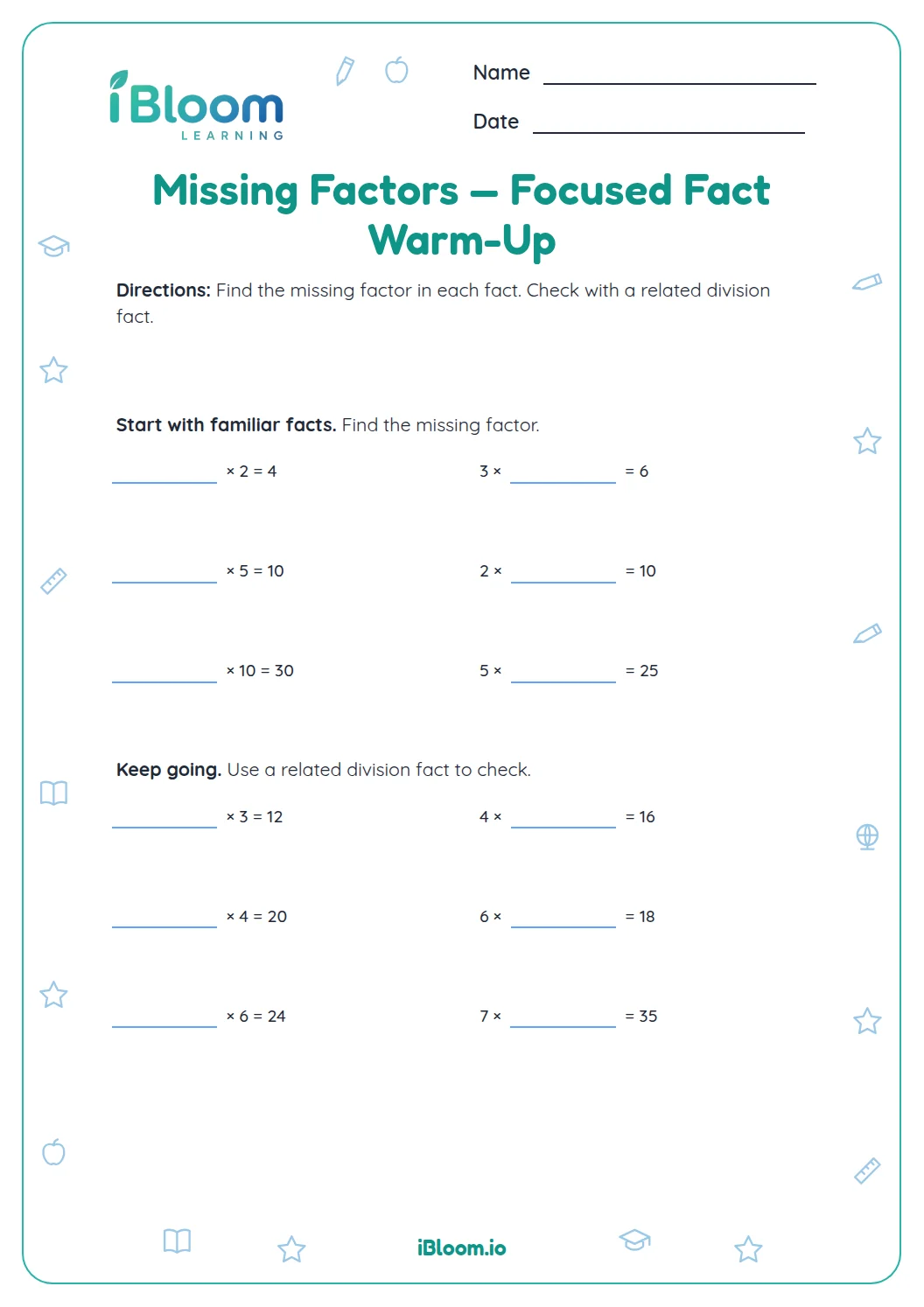
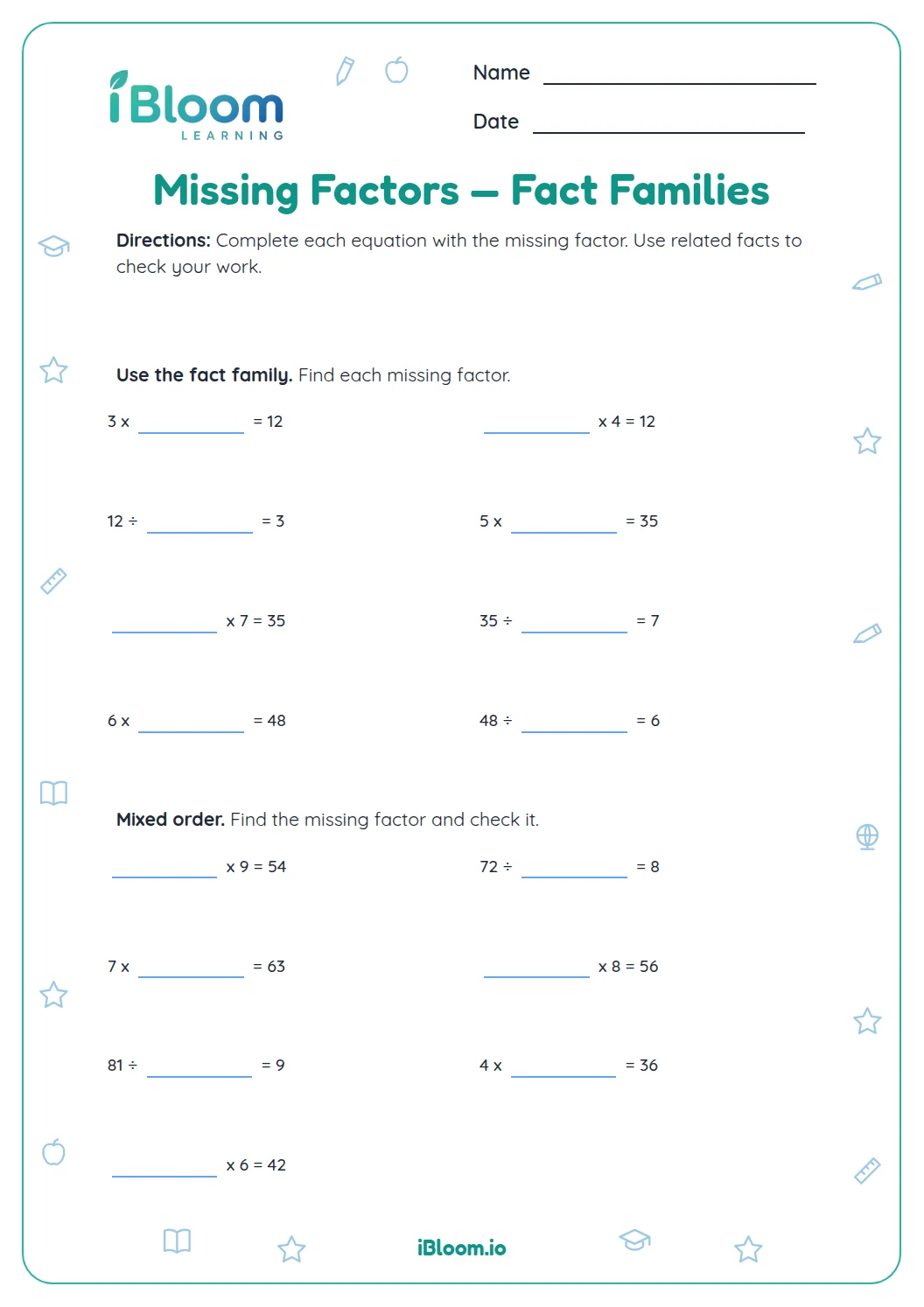
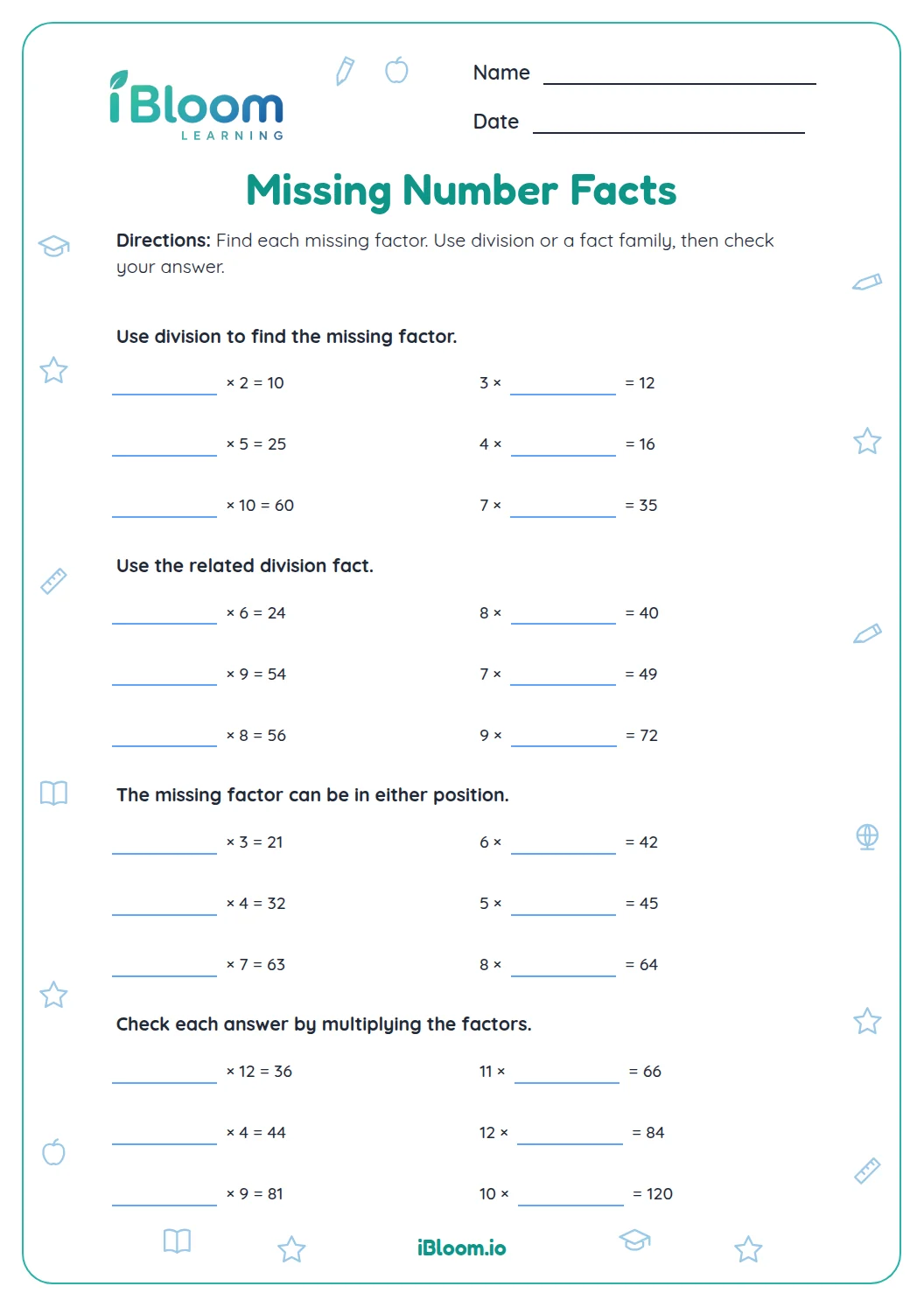
This two-page Grade 3 practice sheet focuses on the three times table and its related division facts. Learners find missing factors in either factor position, complete products, and use division to check multiplication. All factors are one-digit numbers. It practices CCSS 3.OA.C.7, and the separate key shows each answer.
Aligned to 3.OA.C.7
What kinds of facts are on the sheet?
Part A asks for missing factors in multiplication equations. Part B uses related division equations, and Part C asks for products. Every multiplication fact uses 3 and a one-digit factor.
- Part A: find a missing factor
- Part B: use division to check a fact family
- Part C: complete products
How can a learner find a missing factor?
Use the known product and divide by the known factor. Then multiply to check.
- 13 × ___ = 24
- 224 ÷ 3 = 8
- 3Check: 3 × 8 = 24
How can an adult support practice?
Ask the learner to name the known factor and product, then describe how division can reveal the missing factor. Use the answer key after the learner has completed the equations.
How to use this worksheet
- 1Read the operation sign before solving.
- 2For a missing factor, divide the product by the known factor.
- 3For division, use the related multiplication fact.
- 4Check each completed equation with the answer key.
Common slips and quick fixes
The mistake
Writing the product in a factor blank.
The fix
The product comes after the equals sign; the missing factor is multiplied by 3.
The mistake
Dividing by the product instead of the known factor.
The fix
Use product ÷ known factor to find the missing factor.
The mistake
Changing the operation sign while checking.
The fix
Read the sign again and use the inverse operation only as a check.
Common Core alignment
Recall single-digit multiplication facts and use related division facts.
On this sheet: The questions directly practice this skill.
Show the official wordingHide the official wording
Fluently multiply and divide within 100, using strategies such as the relationship between multiplication and division (e.g., knowing that 8 × 5 = 40, one knows 40 ÷ 5 = 8) or properties of operations. By the end of Grade 3, know from memory all products of two one-digit numbers.
What to practice next
Make more practice
Further reading
Questions parents and teachers ask
How do you find a missing factor?
Divide the product by the known factor. In 3 × ___ = 24, calculate 24 ÷ 3 to find 8, then check that 3 × 8 equals 24. The key includes the missing factors and completed products so learners can check each equation after they finish.
Why are division facts on this sheet?
Division reverses multiplication, so it can help find or check a missing factor. For example, 21 ÷ 3 = 7 is related to 3 × 7 = 21. Part B uses these related facts alongside multiplication equations, and the answer key shows each quotient.
Which factors appear in the multiplication problems?
Each multiplication equation uses 3 and a one-digit factor. The products stay within 30, so the sheet provides focused practice with three-times-table facts and related division. Learners also see the factor in either position in the missing-factor part. This part reinforces fact-family thinking.
How many questions are on the worksheet?
There are 16 equations in three parts: six missing-factor problems, five related division problems, and five product problems. The answer key is printed separately across two pages. Each part uses the same three-times-table fact family in a different way. The problems are grouped by skill in the printed order.
How should a learner check an answer?
Substitute the answer into the original equation and work it out. For a missing factor, multiplication should make the given product. For a division fact, multiply the quotient by the divisor to recover the dividend, then compare with the original equation.