


About this worksheet
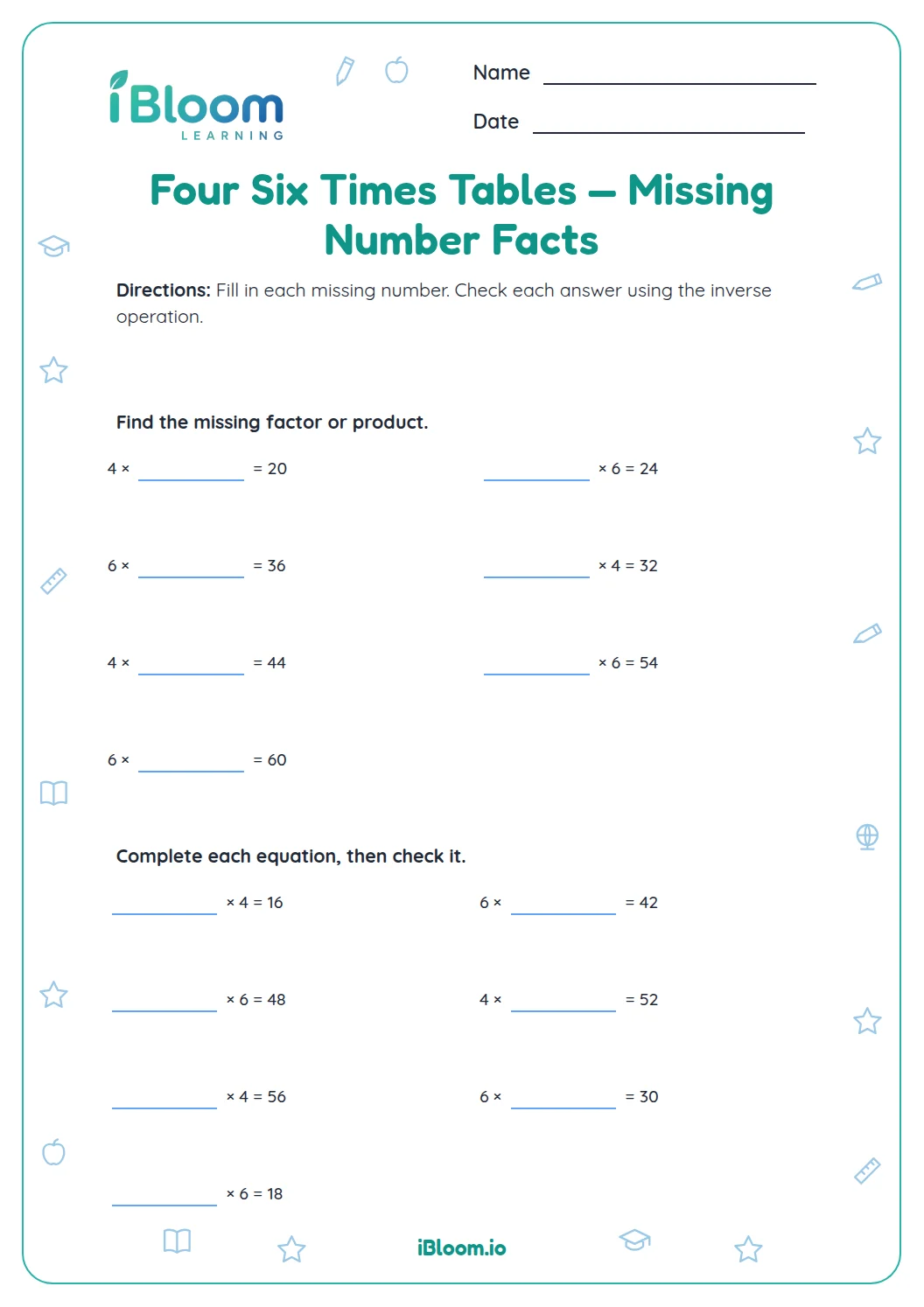
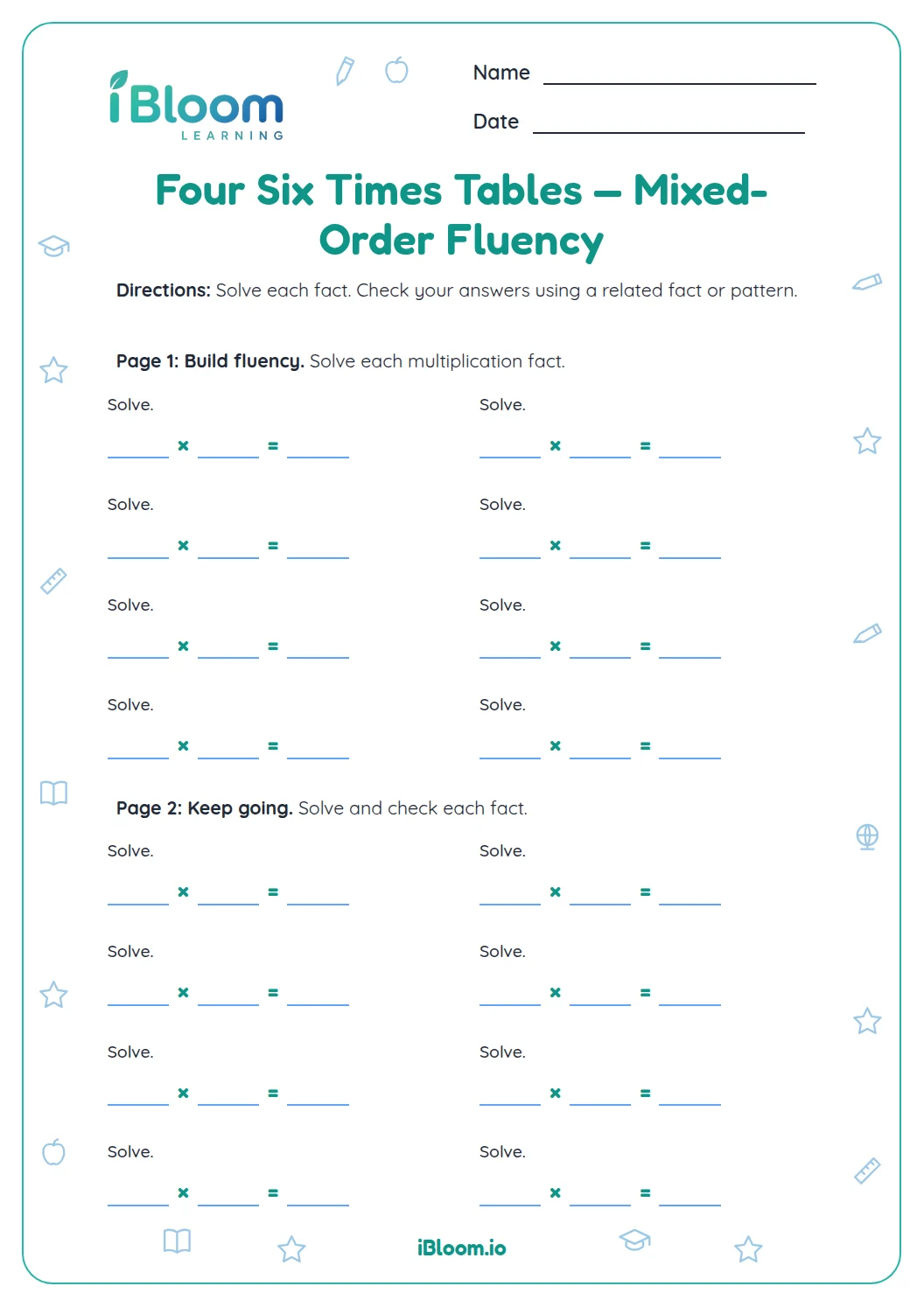
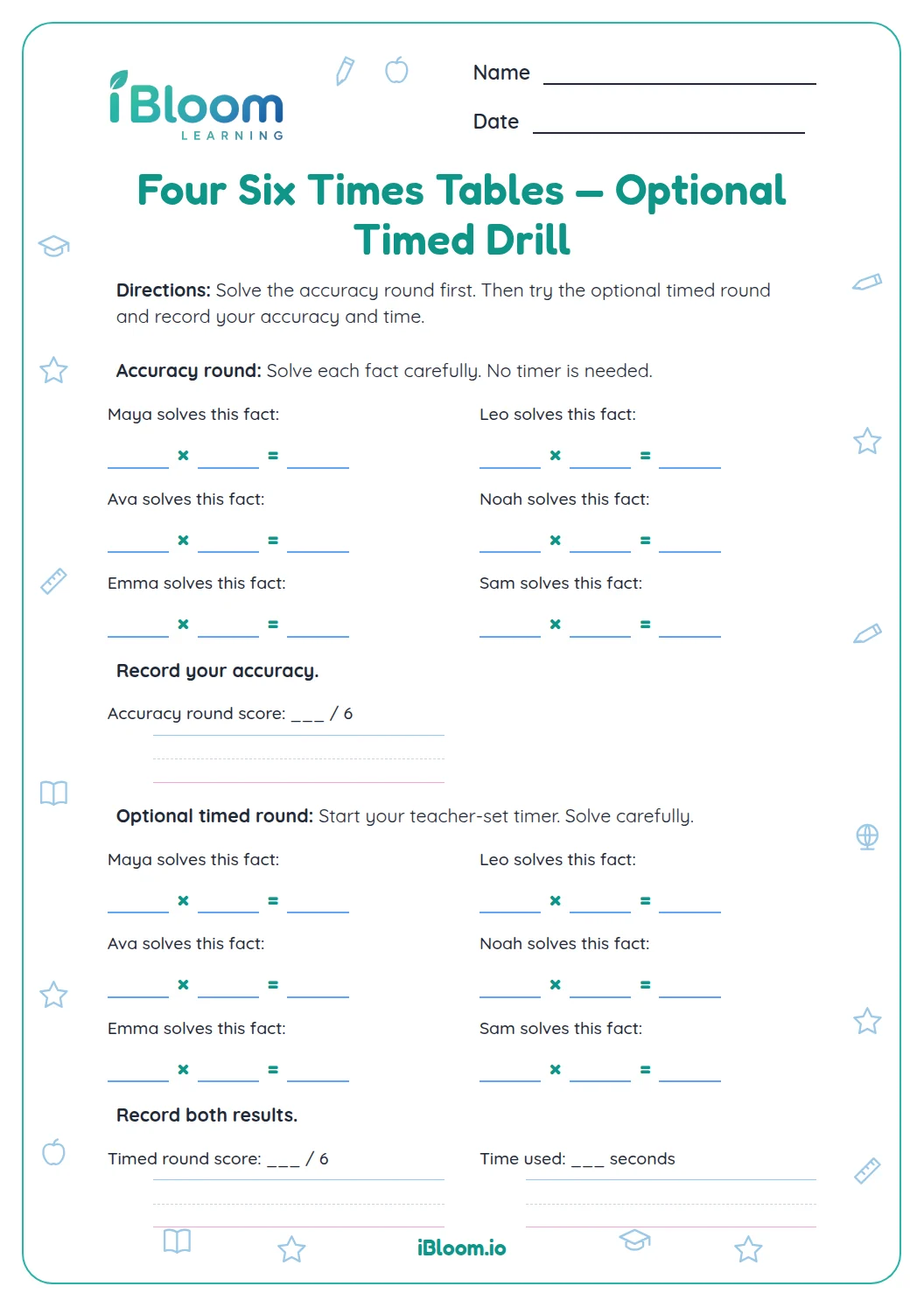
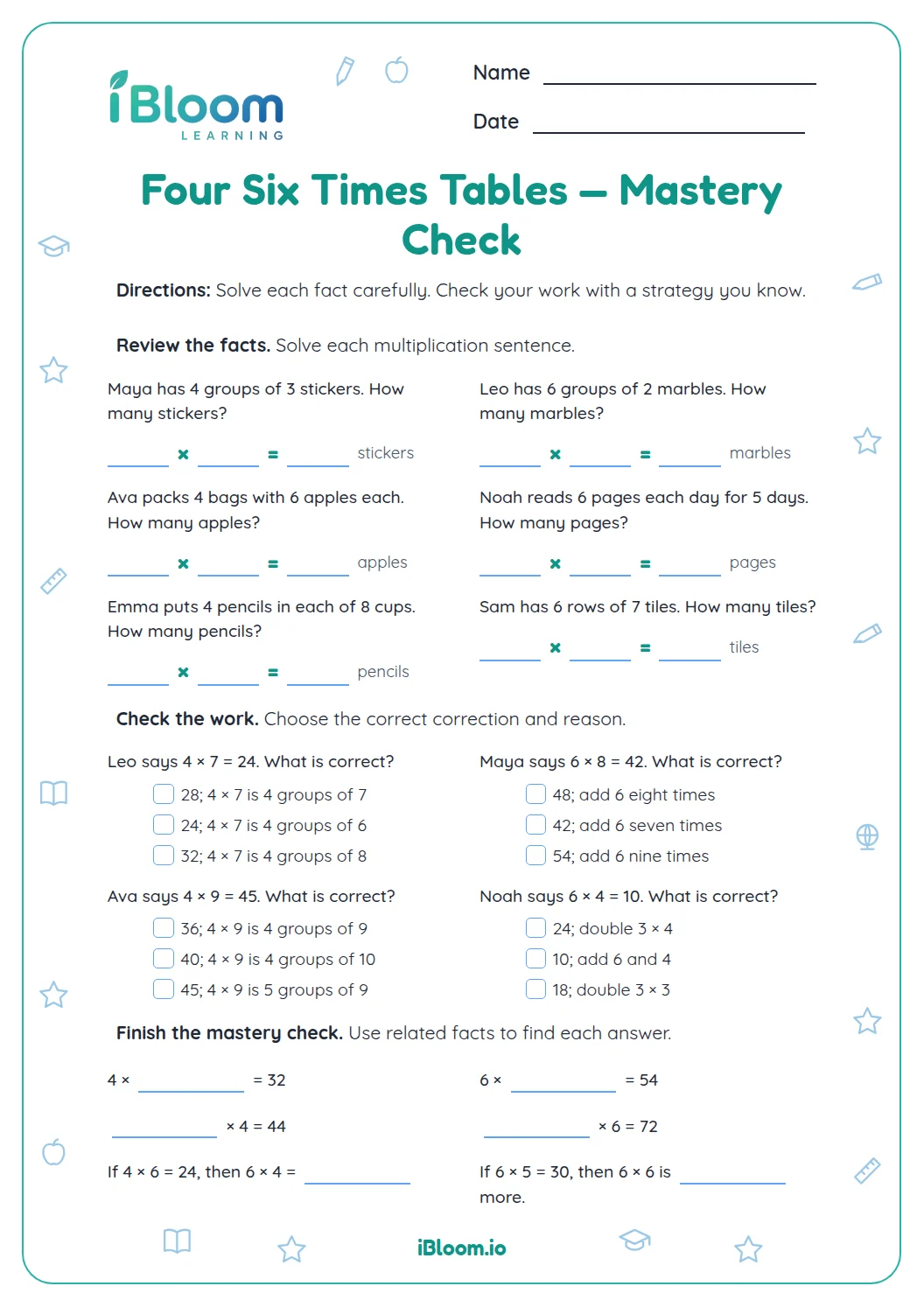
This Grade 3–4 math printable has 16 mixed-order multiplication facts from the 4 and 6 times tables, followed by four strategy questions. Students find products, use repeated addition or a related fact, and solve a rows-of-muffins problem. The separate answer key includes sample responses for the strategy items. The fact practice supports CCSS 3.OA.C.7.
Aligned to 3.OA.C.7
What does a multiplication fact mean?
A multiplication fact names equal groups. For example, 4 × 7 means 4 groups of 7, or 7 groups of 4; both give 28.
- 14 × 7 = ___
- 2Count four groups of seven: 7, 14, 21, 28. The product is 28.
How can I use a nearby fact?
For a 4 fact, double the matching 2 fact: 4 × 9 is double 2 × 9. For a 6 fact, use five groups plus one more group: 6 × 8 = 5 × 8 + 8.
How do I keep a mixed drill accurate?
After the 16 facts, four questions ask for repeated addition, a related fact, a comparison of 4 × 7 and 7 × 4, and the number of muffins in six rows of four.
How to use this worksheet
- 1Read both factors and the × sign.
- 2Choose a strategy: skip-count, equal groups, or a related fact.
- 3Write one product in the blank.
- 4Check the fact belongs to the 4 or 6 table.
- 5Use the answer key after completing the page.
Common mistakes and quick fixes
The mistake
Adding the factors instead of multiplying; 4 × 7 means four equal groups of seven.
The fix
Pause and use the clue in the sentence or model to check: adding the factors instead of multiplying.
The mistake
Skipping one count when skip-counting by sixes; say each multiple aloud.
The fix
Pause and use the clue in the sentence or model to check: skipping one count when skip-counting by sixes.
The mistake
Copying the previous product on a mixed drill; reread both factors for every item.
The fix
Pause and use the clue in the sentence or model to check: copying the previous product on a mixed drill.
Curriculum alignment
This worksheet connects focused practice to the following standard.
Recall products of single-digit factors.
On this sheet: Students practice multiplication facts in the 4 and 6 tables.
Show the official wordingHide the official wording
Fluently multiply and divide within 100, using strategies such as the relationship between multiplication and division (e.g., knowing that 8 × 5 = 40, one knows 40 ÷ 5 = 8) or properties of operations.
What to practice next
Make more practice
Further reading
Questions parents and teachers ask
How can I warm up with 4 and 6 facts?
Solve each fact with equal groups, skip-counting, or a related fact. The first 16 questions mix products from the 4 and 6 tables; four more ask students to show a strategy or solve a rows-of-muffins problem. A separate key gives products and sample responses.
How many questions are on the printable?
There are 20 questions across three parts. The first 16 are mixed facts from the 4 and 6 tables, followed by four strategy applications. The separate answer key lists each product and sample responses for written work. Products stay within the basic fact range.
What should I have ready?
Have a pencil and the printed worksheet ready. Read both factors and the operation sign before solving each fact. The final four questions invite a related addition sentence or brief explanation, so a student may want extra space to think.
How can I check the answers?
Use the separate answer key after the student finishes each part. The first 16 answers are exact products; the last strategy questions include sample responses, so another clear method that reaches the same product is acceptable. Accept another clear strategy if it shows the same fact and product.
Can this be used for class or home practice?
The first two parts provide mixed facts from the 4 and 6 tables. The last part asks students to use repeated addition, a related fact, explain a fact relationship, and solve a row problem. It can be used for a classroom warm-up or home review.