


About this worksheet
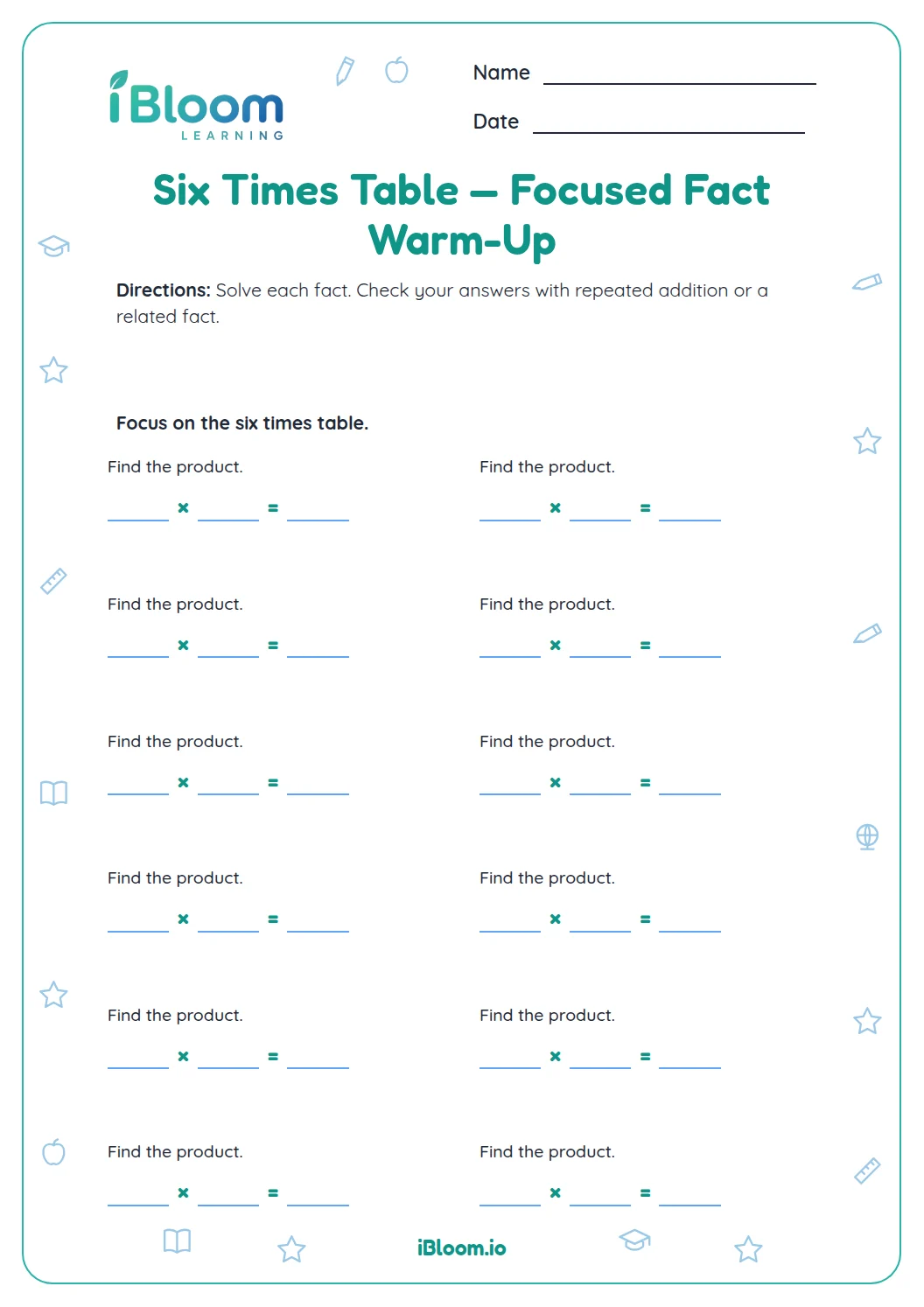
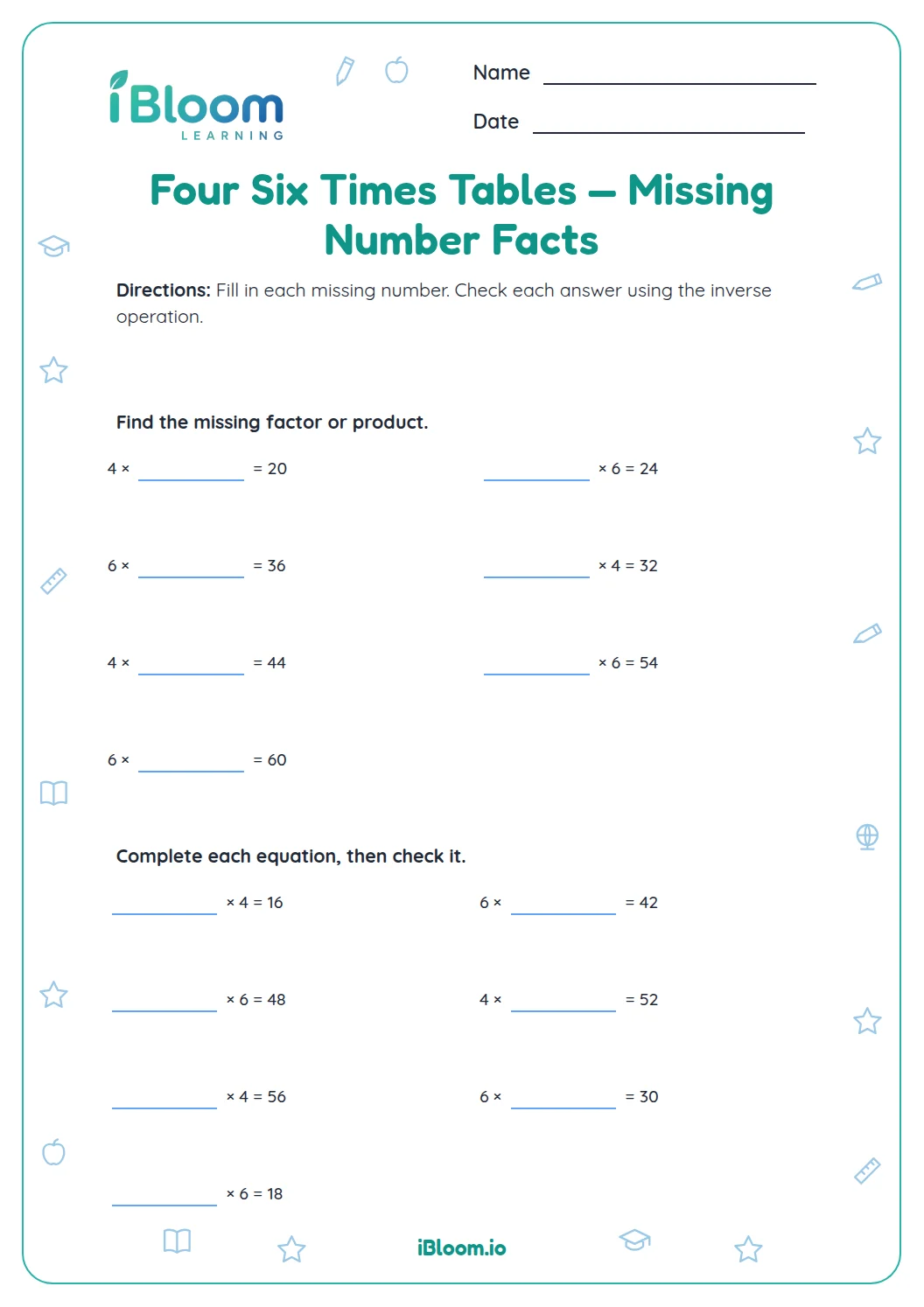
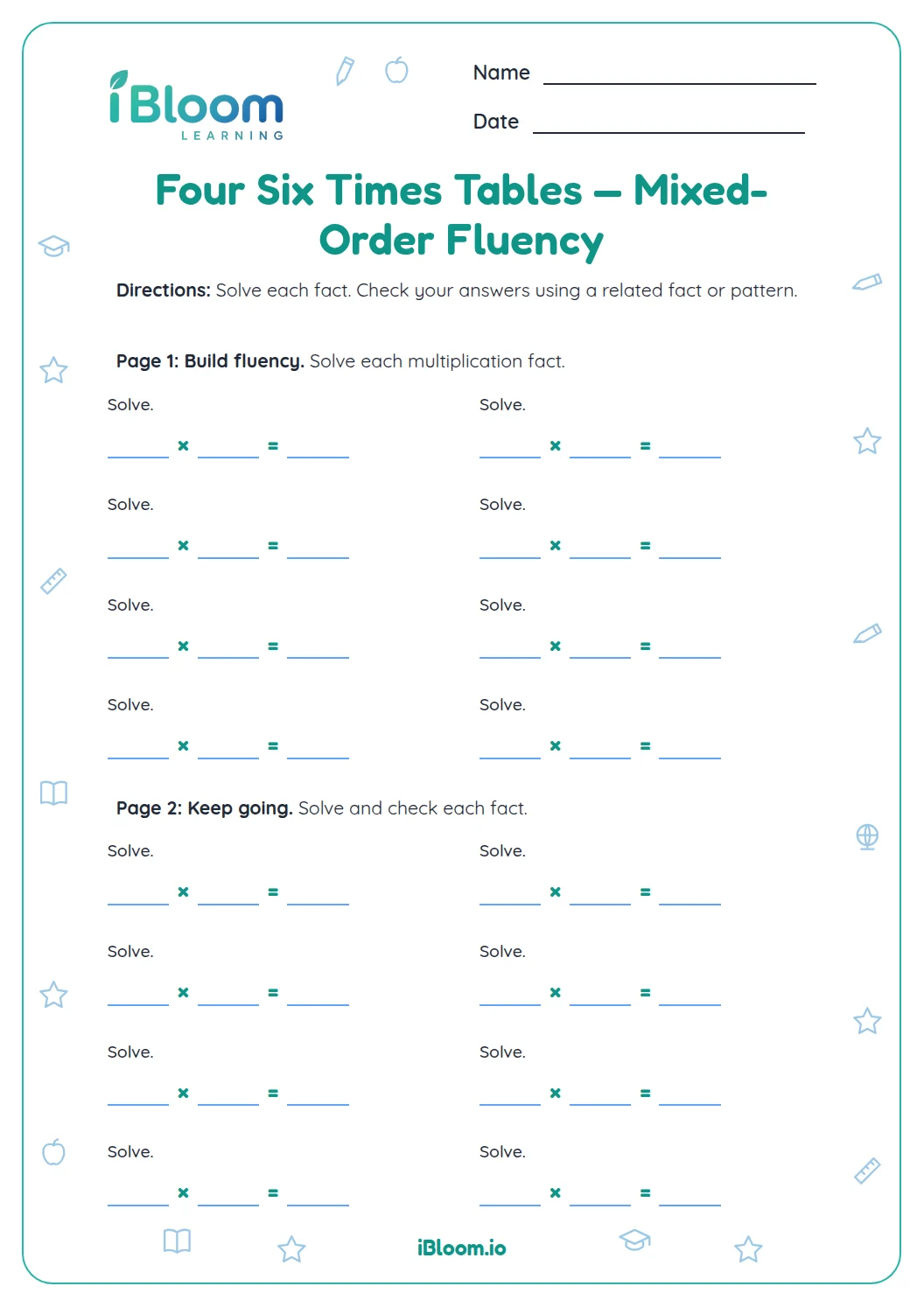
This free printable multiplication worksheet gives Grade 3 and Grade 4 students mixed-order practice with the six times table. Part A mixes the order of the factors, Part B asks students to fill a missing factor or product, and Part C uses sixes in everyday equal-group situations. All products stay within 100. The page supports CCSS 3.OA.C.7, which calls for fluent multiplication and division within 100.
Aligned to 3.OA.C.7
How should I solve a six fact quickly?
Recall the product for the two factors, then check that it makes sense as six equal groups. The factors are mixed so the six may come first or second.
For instance, 6 × 7 = 42. If you know 6 × 5 = 30, adding two more groups of 6 gives 42.
- 16 × 7 = 42
- 2Six groups of seven have 42 items total.
What if one factor is missing?
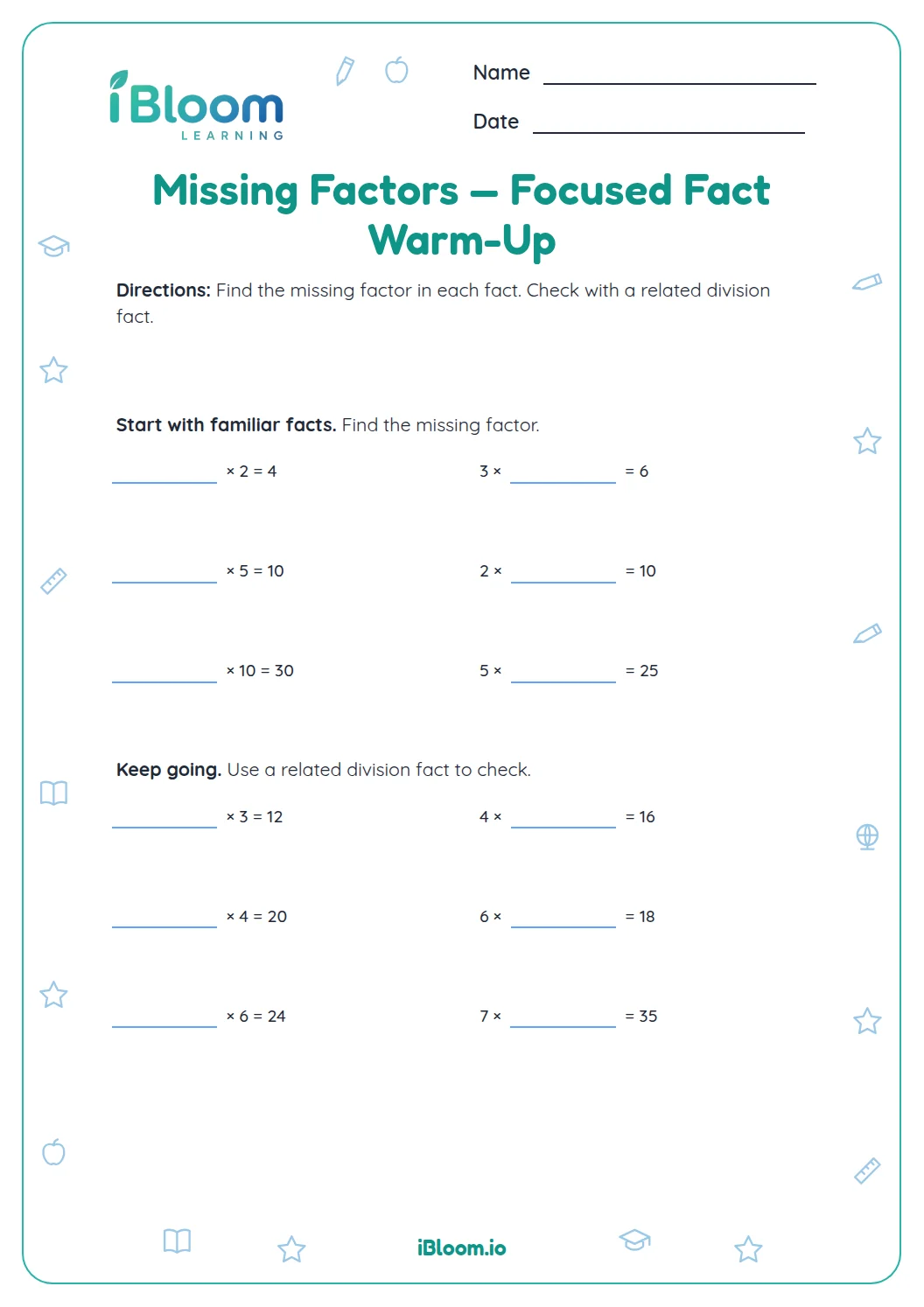
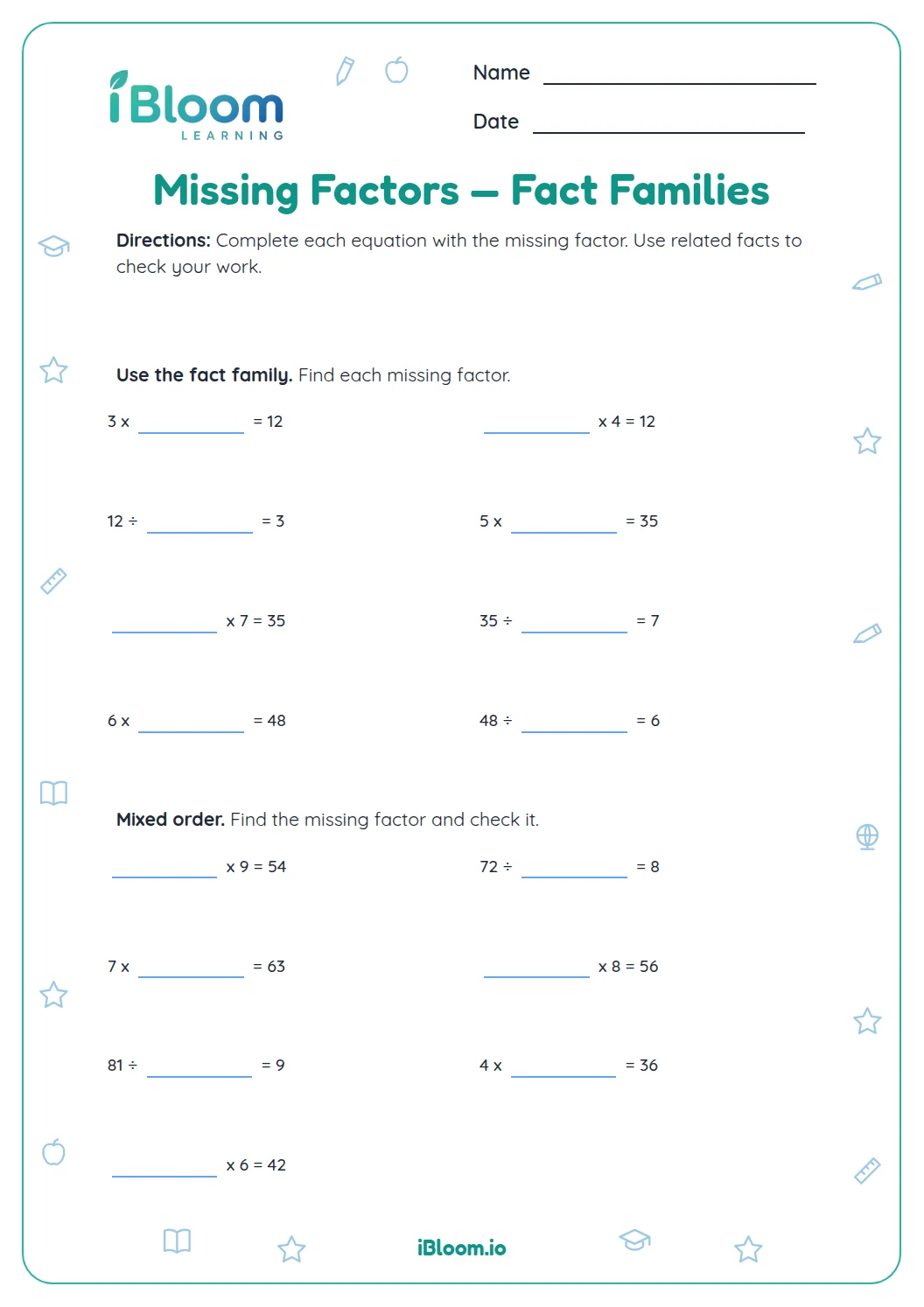
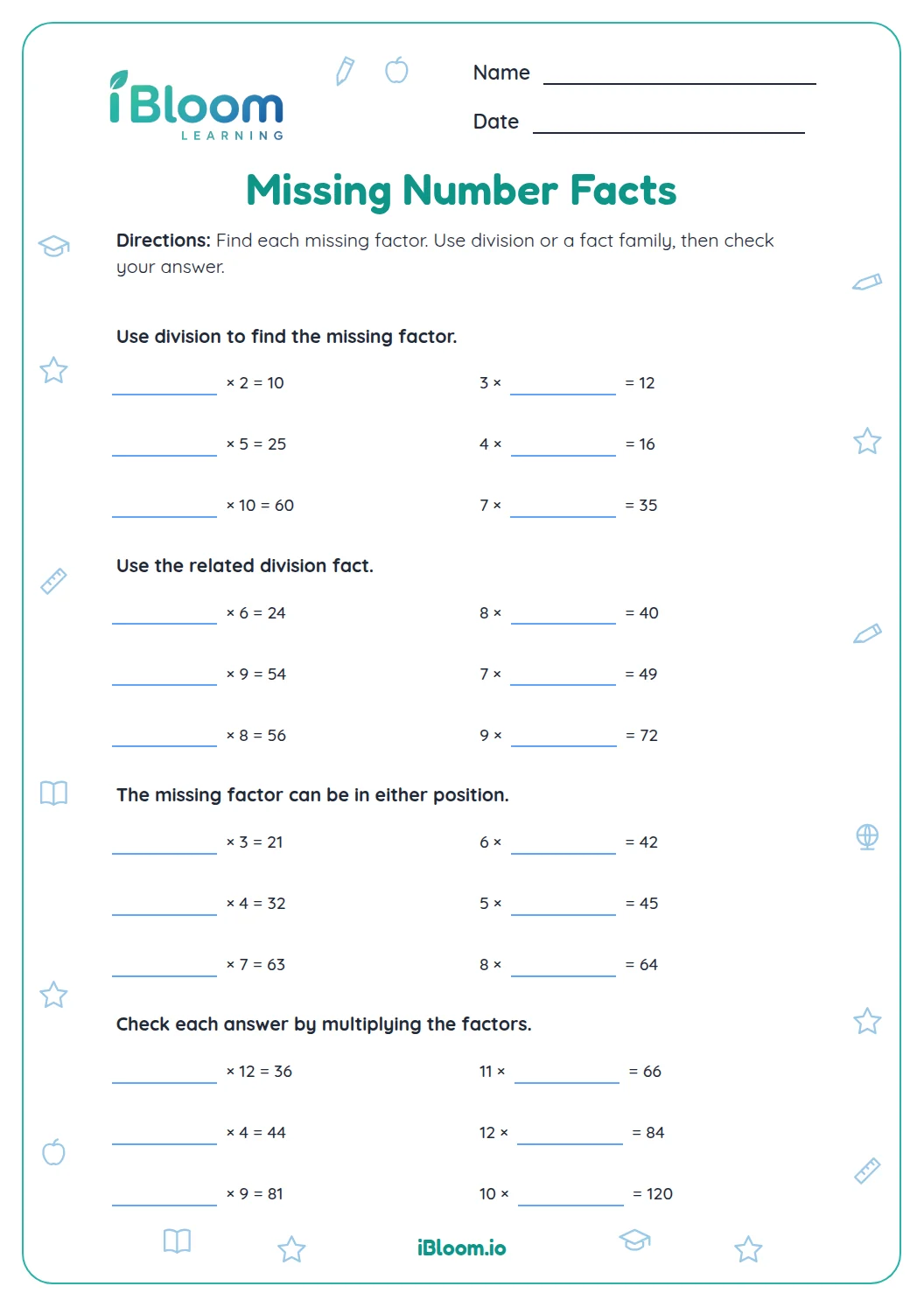
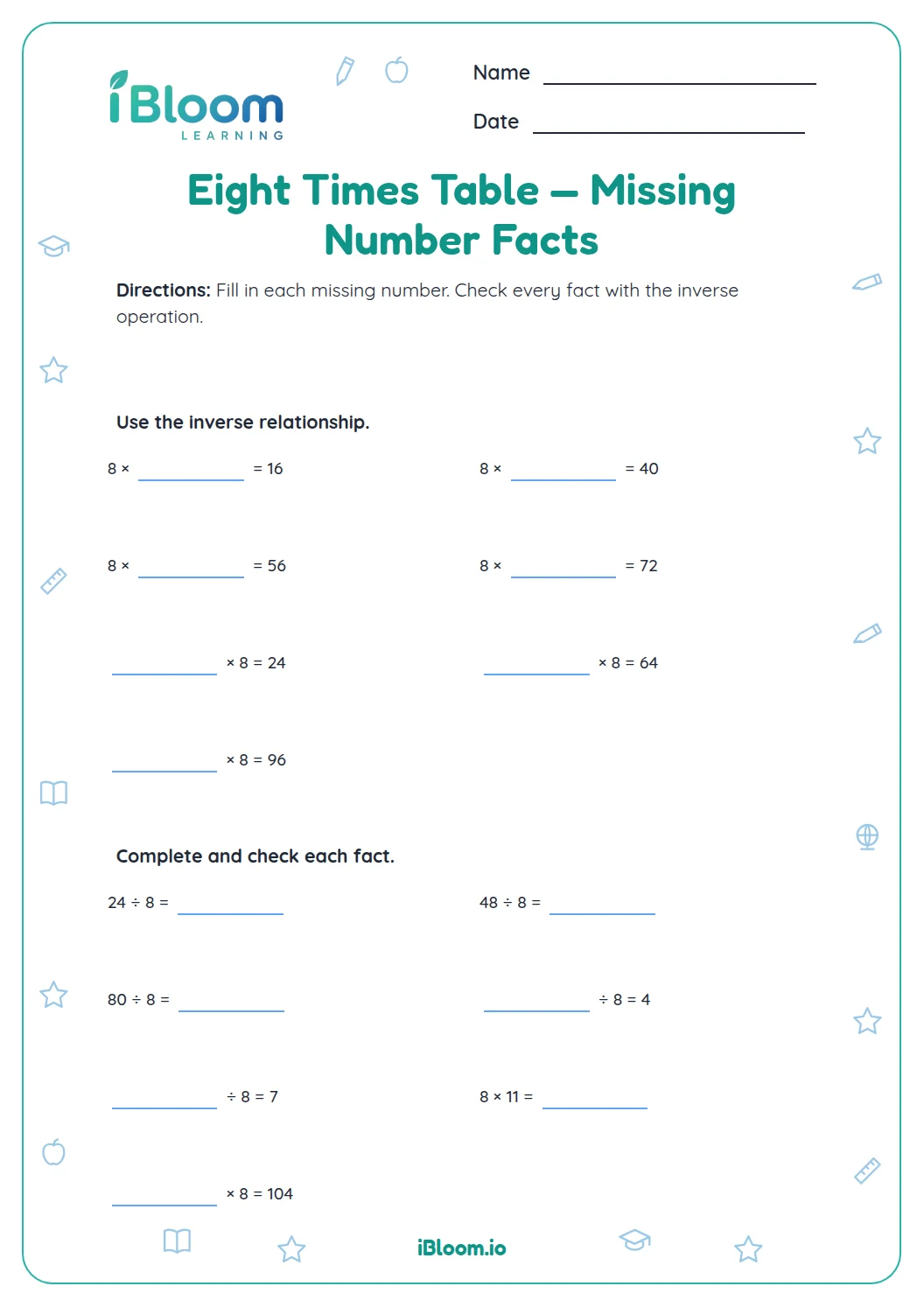
Use the product as a clue and ask which six fact reaches it. In 6 × ___ = 42, recall 6 × 7 = 42, so the blank is 7. Keep the factors in the same multiplication sentence while checking.
How do equal-group stories become multiplication?
Find the amount in one group and the number of groups. Multiply those two numbers and include the requested unit in the answer. For chairs in rows, groups of markers, or rolls on trays, the total is the product.
How to use this worksheet
- 1Solve each equation and say the six fact aloud once.
- 2For a blank factor, use the product to recall the matching six fact.
- 3In each story, underline the amount in one group and the number of groups.
- 4Multiply, then write the unit requested in the question.
- 5Use the answer key to check each product and total.
Common mistakes and quick fixes
The mistake
Switching the factor order changes the product.
The fix
Multiplication order can switch: 6 × 4 and 4 × 6 both equal 24.
The mistake
Using the product as the missing factor.
The fix
Check by multiplying the missing number by 6.
The mistake
Leaving off the unit in a story answer.
The fix
Reread the question and include chairs, markers, rolls, or players.
Curriculum alignment
This worksheet practices Grade 3 multiplication fluency with products below 100.
Build quick recall of six facts and apply products within 100.
On this sheet: The drill practices six-times products within 100, including unknown factors and equal groups.
Show the official wordingHide the official wording
Fluently multiply and divide within 100, using strategies such as the relationship between multiplication and division (e.g., knowing that 8 × 5 = 40, one knows 40 ÷ 5 = 8) or properties of operations.
What to practice next
Make more practice
Further reading
Questions parents and teachers ask
How does mixed-order practice work?
The six fact appears in different positions, such as 6 × 7 and 3 × 6. Students cannot rely on a single count-up sequence; they practice recalling the product for a shuffled factor pair. The multiplication facts in Part A all use six and have products below 100.
How do I find a missing factor?
Think of a known six fact that makes the product. For question 9, 6 × ___ = 42, ask which number multiplied by 6 equals 42. Since 6 × 7 = 42, the missing factor is 7. Multiply your choice by 6 to check that it returns to the product in the equation.
What should a student do on the story problems?
Each story describes equal groups. Multiply the number in one group by the number of groups. For example, 6 chairs in each of 3 rows means 6 × 3, or 18 chairs. Write the unit named in the question so the total is clear.
How many questions are on the page?
There are 16 questions: eight direct facts, four missing-factor or product items, and four short equal-group problems. The separate answer key lists a product or total for every item. Students can use it to check both the multiplication and any units in their story answers.
Should students be timed?
The page is for accuracy and fluency practice, and it does not set a required time. A student can solve the facts carefully first, check the key, and repeat the page later to notice whether recall feels smoother.
What comes after the six times table?
Students can mix six facts with the four times table, practice missing factors across several tables, or move to another single table such as the eight times table. The linked pages keep the same multiplication practice format and let students choose a next step that fits their current practice.