

About this worksheet
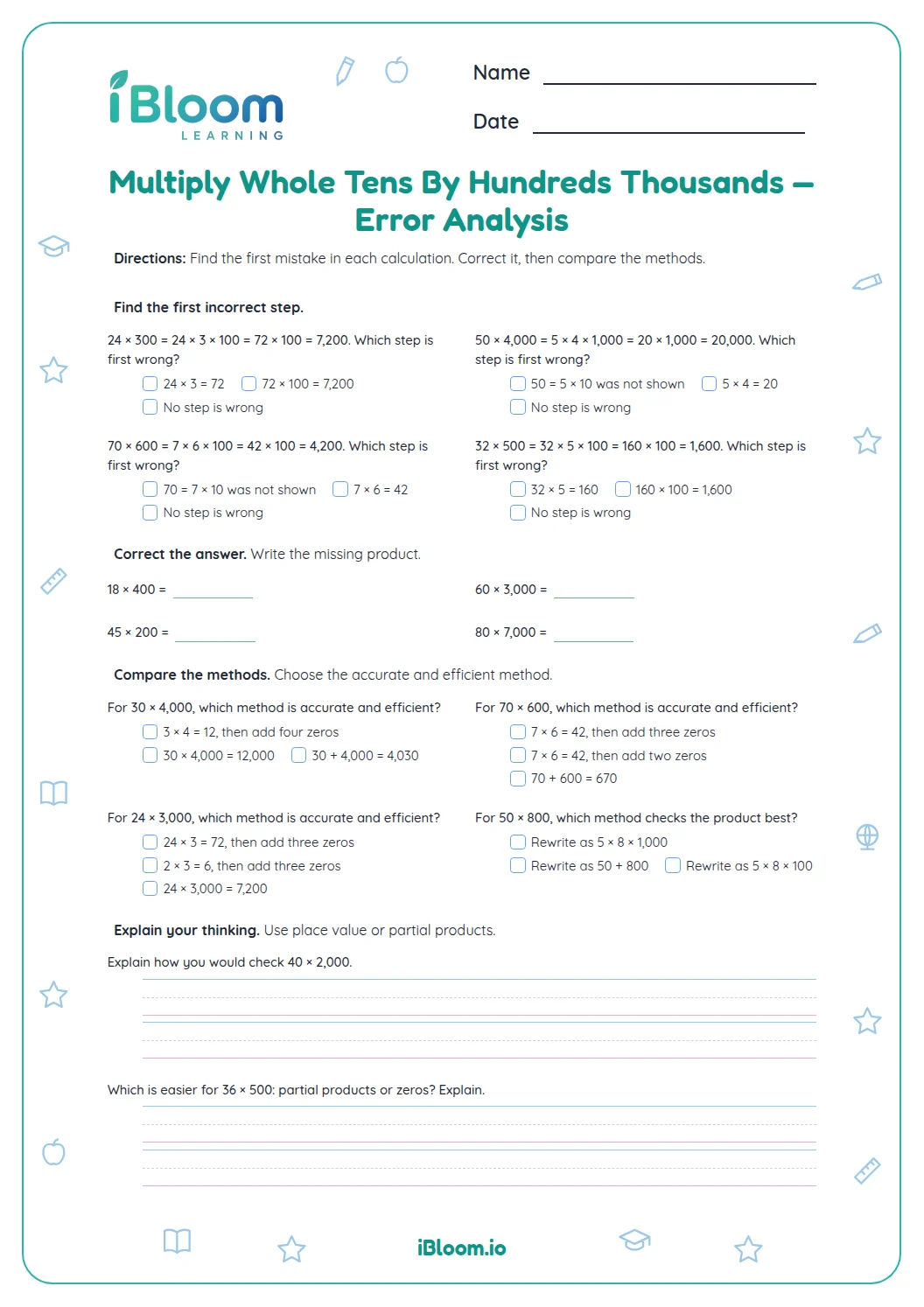
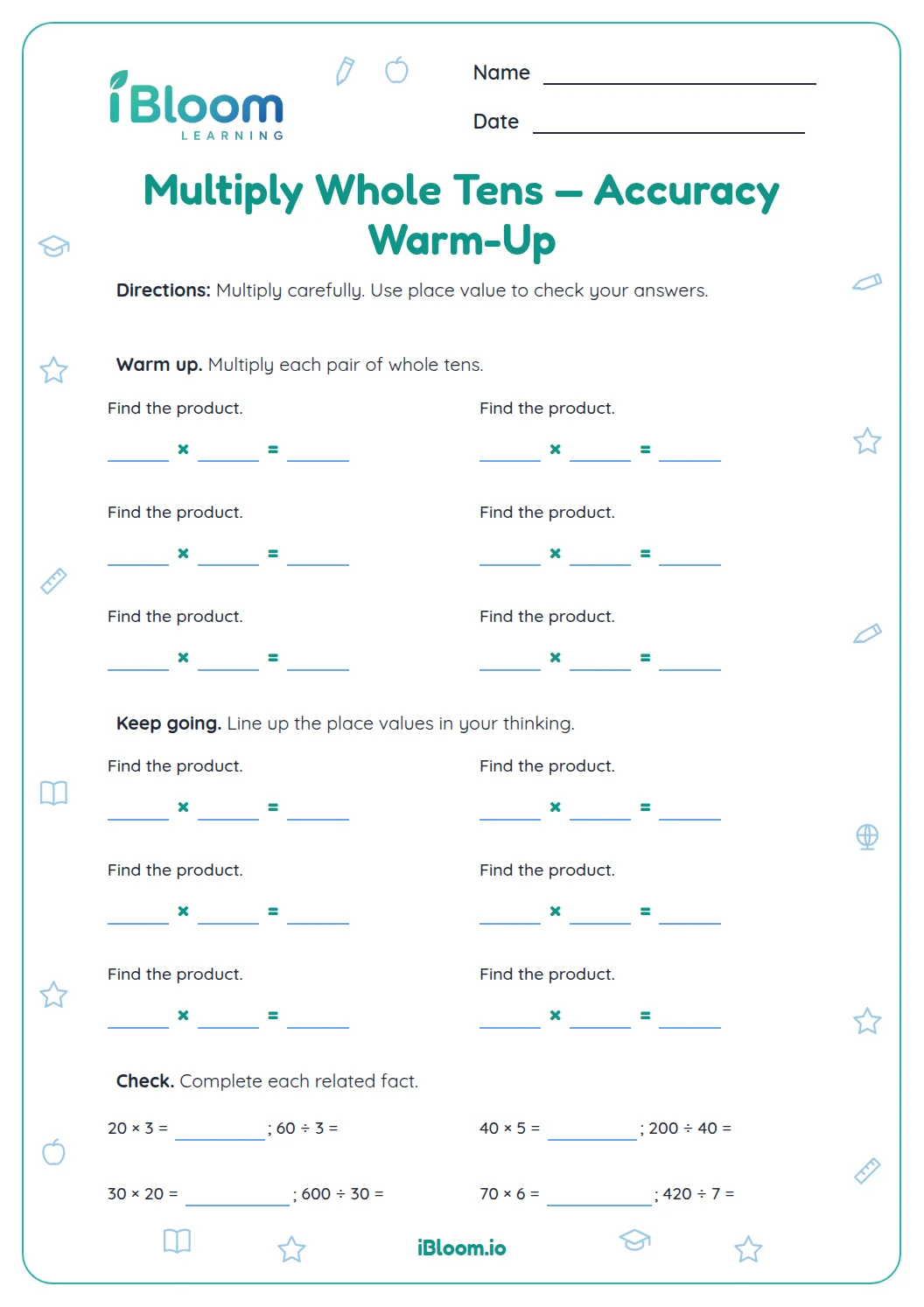
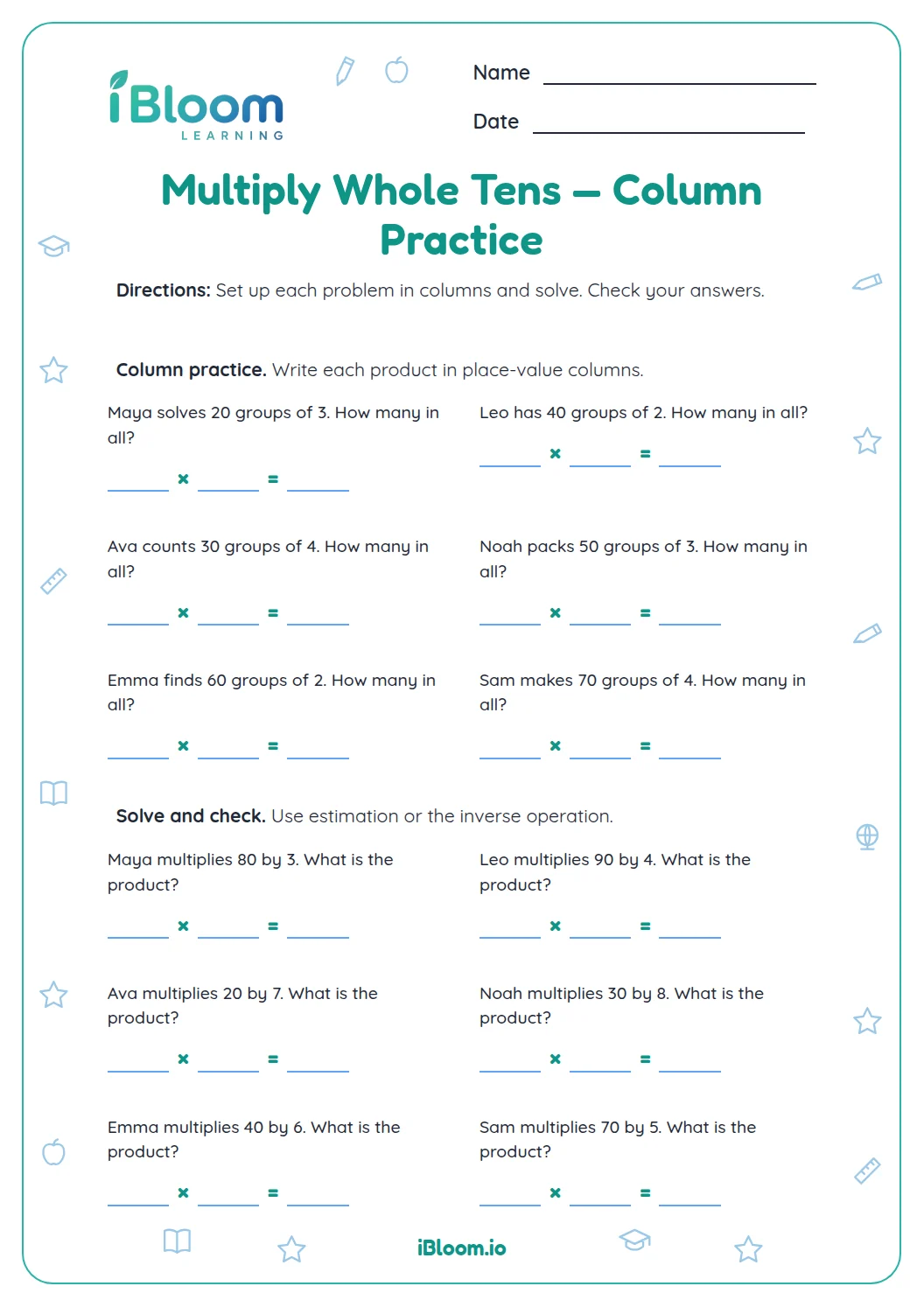
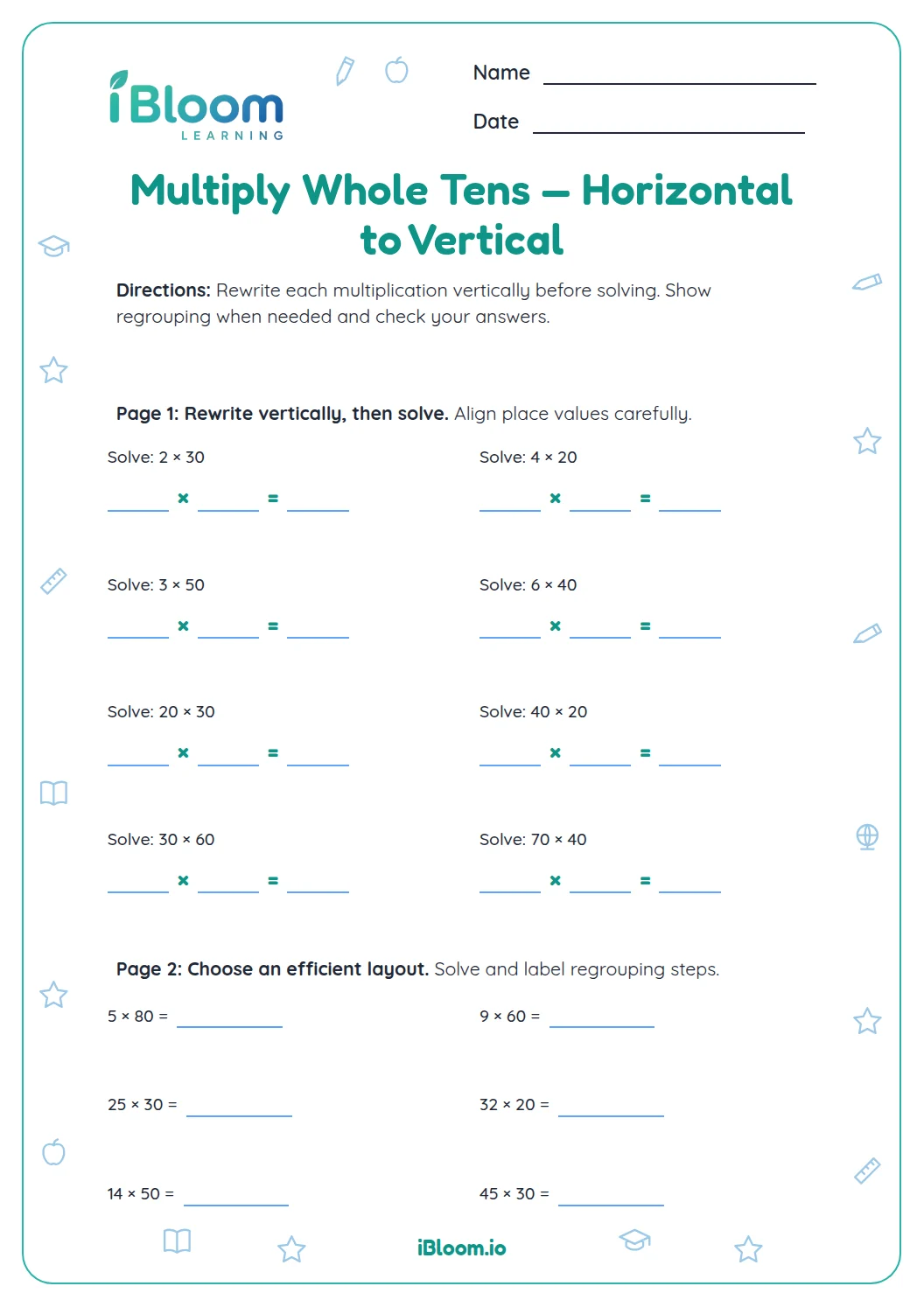
This free multiplication worksheet keeps the earlier sheet’s whole-tens-by-hundreds-and-thousands skill and its mix of product practice, checks, and word problems. Fourteen items ask students to find products, estimate or use inverse facts, judge a multiplication claim, and solve short situations with groups of hundreds or thousands. Students can break each factor into its nonzero digits and place-value units. A separate answer key lists the products and story units.
Aligned to 4.NBT.B.5
How do whole tens and hundreds affect a product?
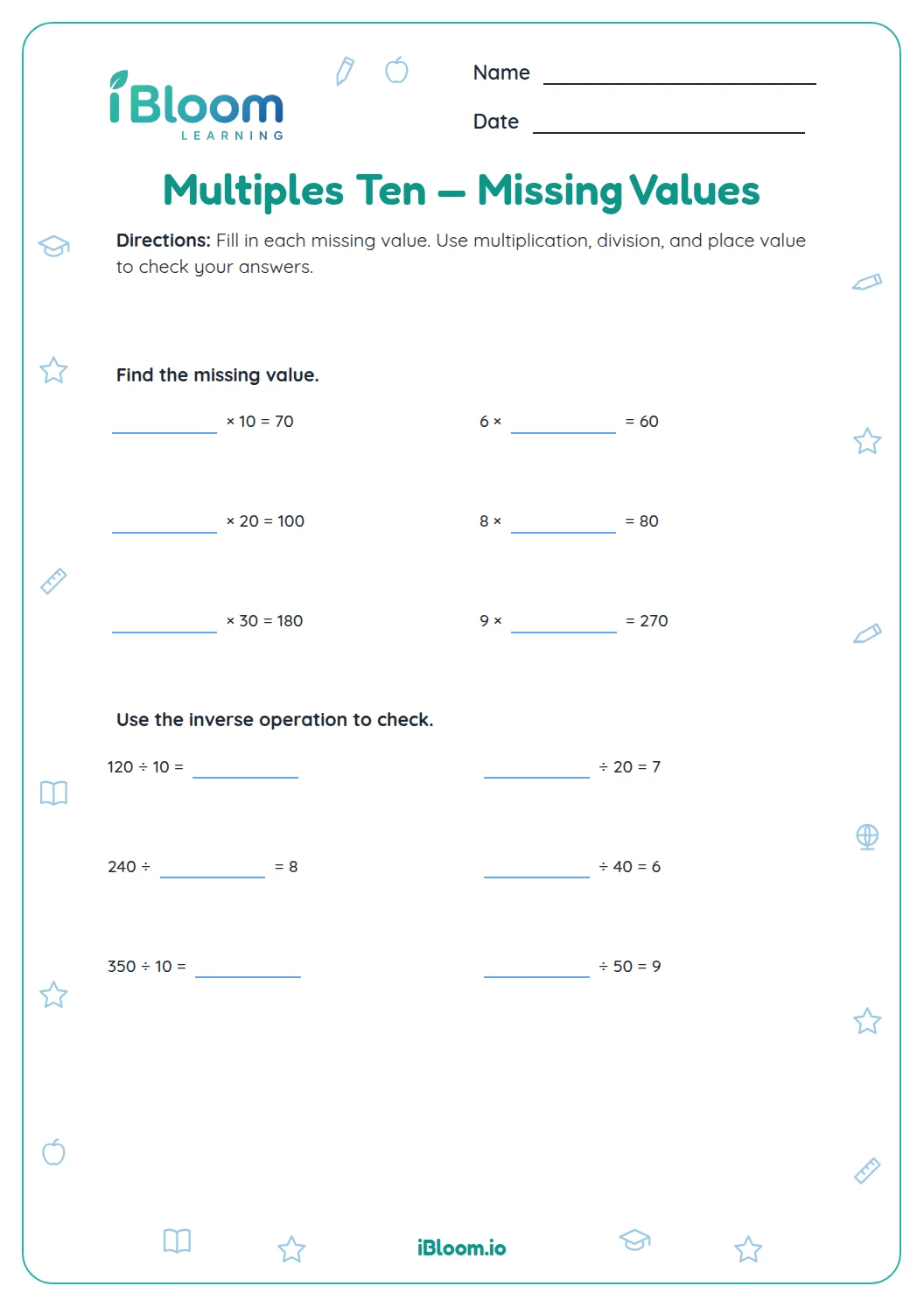
Multiply the nonzero digits, then account for each factor’s place value. For example, 20 × 300 is 2 × 3 × 10 × 100, or 6,000.
How can an estimate or inverse check catch an error?
For 40 × 300, 4 × 3 = 12 and the factors contain three zeros, so the product is 12,000. Question 8 also asks students to use division: 48,000 ÷ 600 = 80.
How do the story problems represent multiplication?
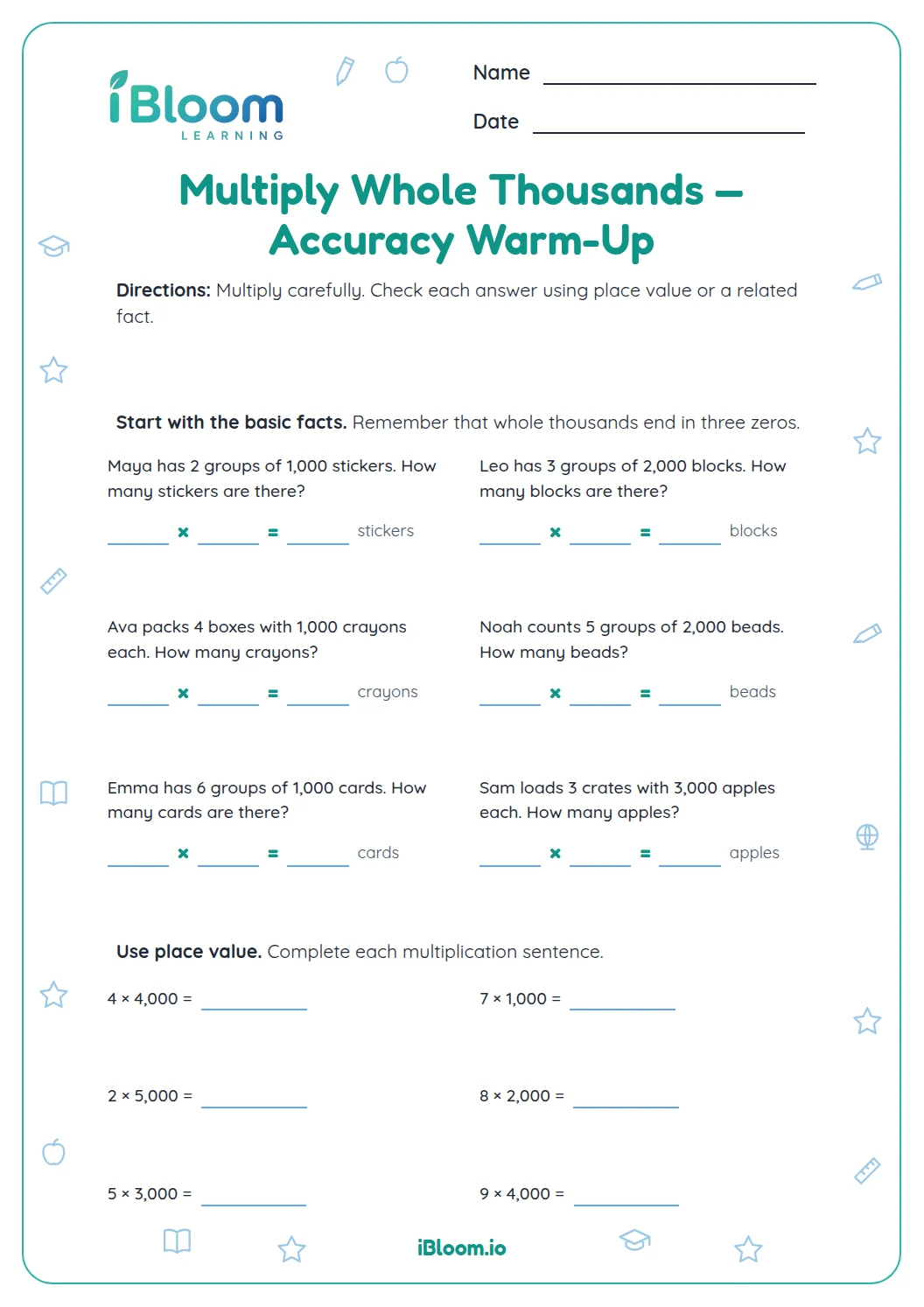
Each story names equal groups, such as 80 boxes with 300 pencils in each. Multiply the number of groups by the amount in each group, then label the total with the item.
How to use this worksheet
- 1Solve the direct products by multiplying the nonzero digits first.
- 2Count the place-value zeros in both factors before writing the product.
- 3Use an estimate or inverse fact for the check questions.
- 4In each story, identify the number of groups and the amount in each group.
- 5Write a multiplication equation and include the item name in the answer.
Common mistakes and quick fixes
The mistake
Forgetting a zero from one of the factors.
The fix
Count the place-value zeros in both factors and compare the result with an estimate.
The mistake
Adding the factors instead of multiplying equal groups.
The fix
Identify how many groups there are and how much each group contains.
The mistake
Accepting a product that fails the inverse check.
The fix
Divide the product by one factor and see whether the other factor returns.
Common Core alignment
The listed standard describes the reading, writing, or math work students practice on this page.
Use place-value strategies to multiply whole numbers.
On this sheet: The sheet decomposes products of multiples of ten, hundred, and thousand into small digit products and place-value shifts.
Show the official wordingHide the official wording
Multiply a whole number of up to four digits by a one-digit whole number, and multiply two two-digit numbers, using strategies based on place value and the properties of operations.
What to practice next
Make more practice
Further reading
Questions parents and teachers ask
What kinds of problems are included?
The worksheet has fourteen items: six direct products, two estimates, one inverse check, one claim to judge, and four word problems. All use whole tens paired with hundreds or thousands, as in the earlier drill. Part A starts with products; the remaining items apply the same place-value idea.
What does place value have to do with these products?
A whole ten, hundred, or thousand represents a digit multiplied by a place-value unit. Students multiply the nonzero digits and then account for the tens, hundreds, and thousands in the factors. Keeping those place values straight helps prevent extra or missing zeros.
How can students check 40 × 300?
Multiply 4 × 3 to get 12, then account for three zeros from 40 and 300. The product is 12,000. An estimate also shows the answer should be near twelve thousand, so a product with too few zeros is easy to catch.
What is an inverse check?
An inverse check uses division to test a multiplication product. One item asks for the missing number in ___ ÷ 600 = 80. The missing number is 48,000 because 48,000 divided by 600 returns 80 again, confirming the related product.
What should students write for the word problems?
Write a multiplication equation using the number of groups and the amount in each group, then give the total with its unit. For 80 boxes with 300 pencils each, multiply 80 by 300 and write 24,000 pencils. Include commas in large totals so the digits are easy to read.