

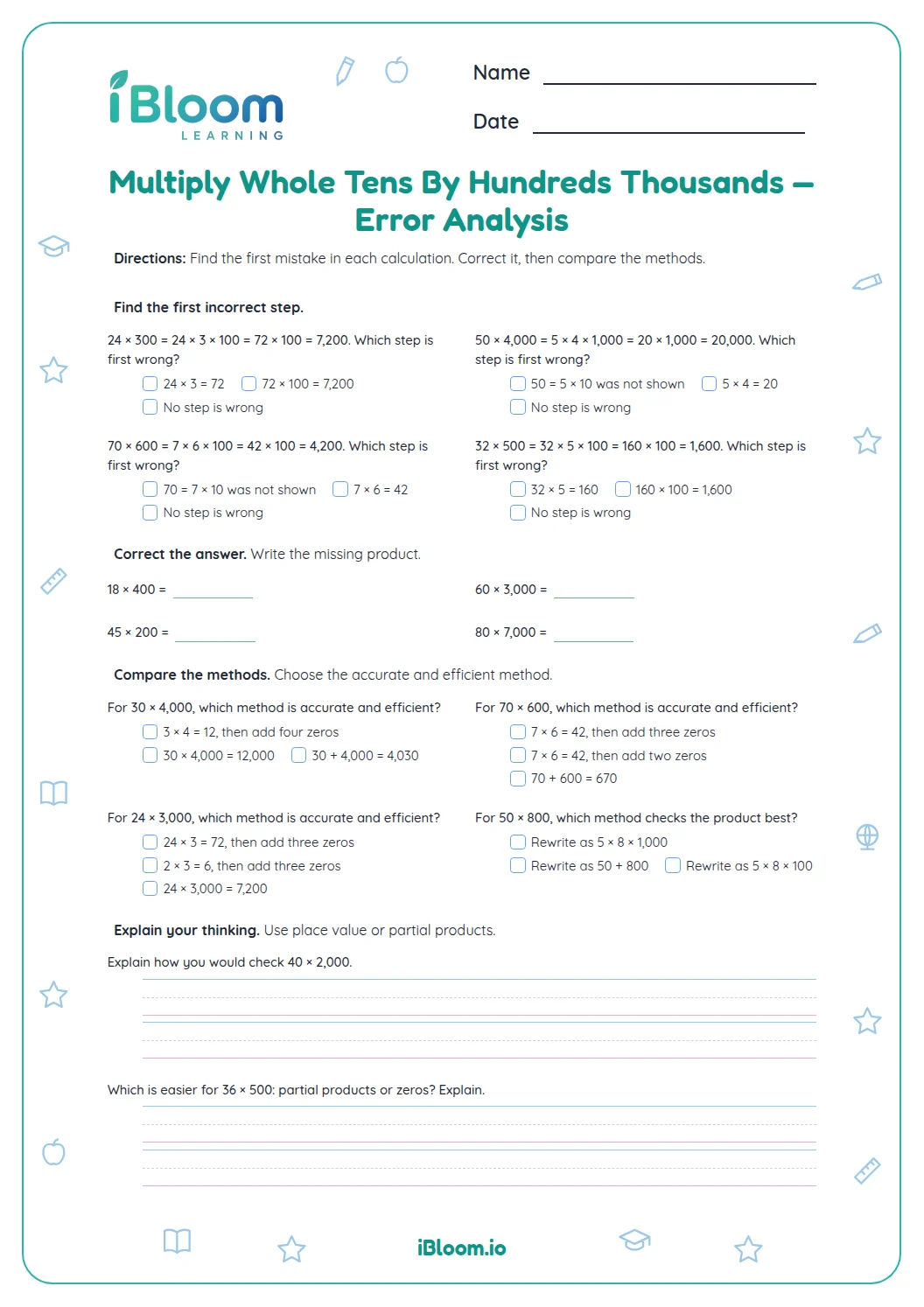
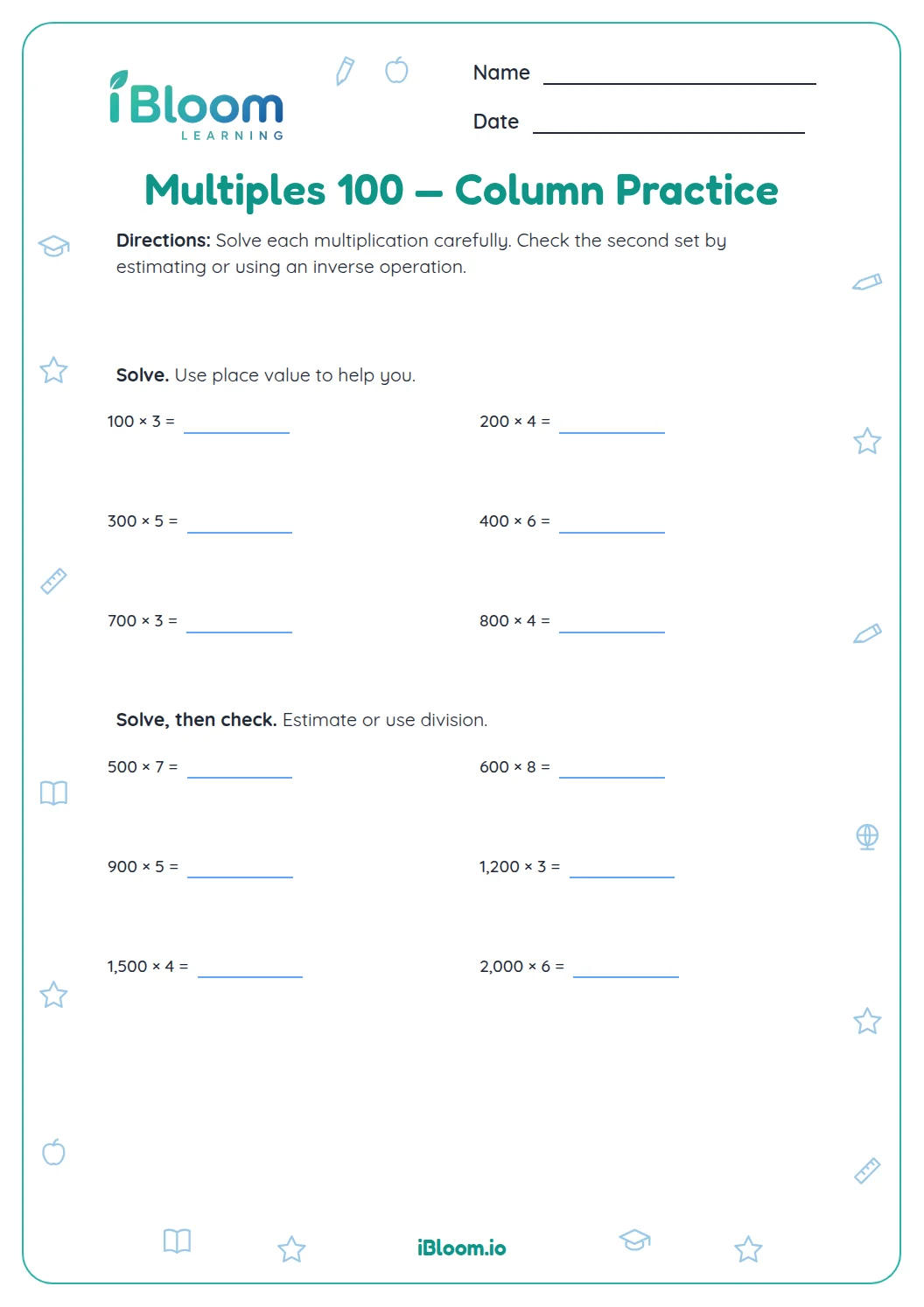
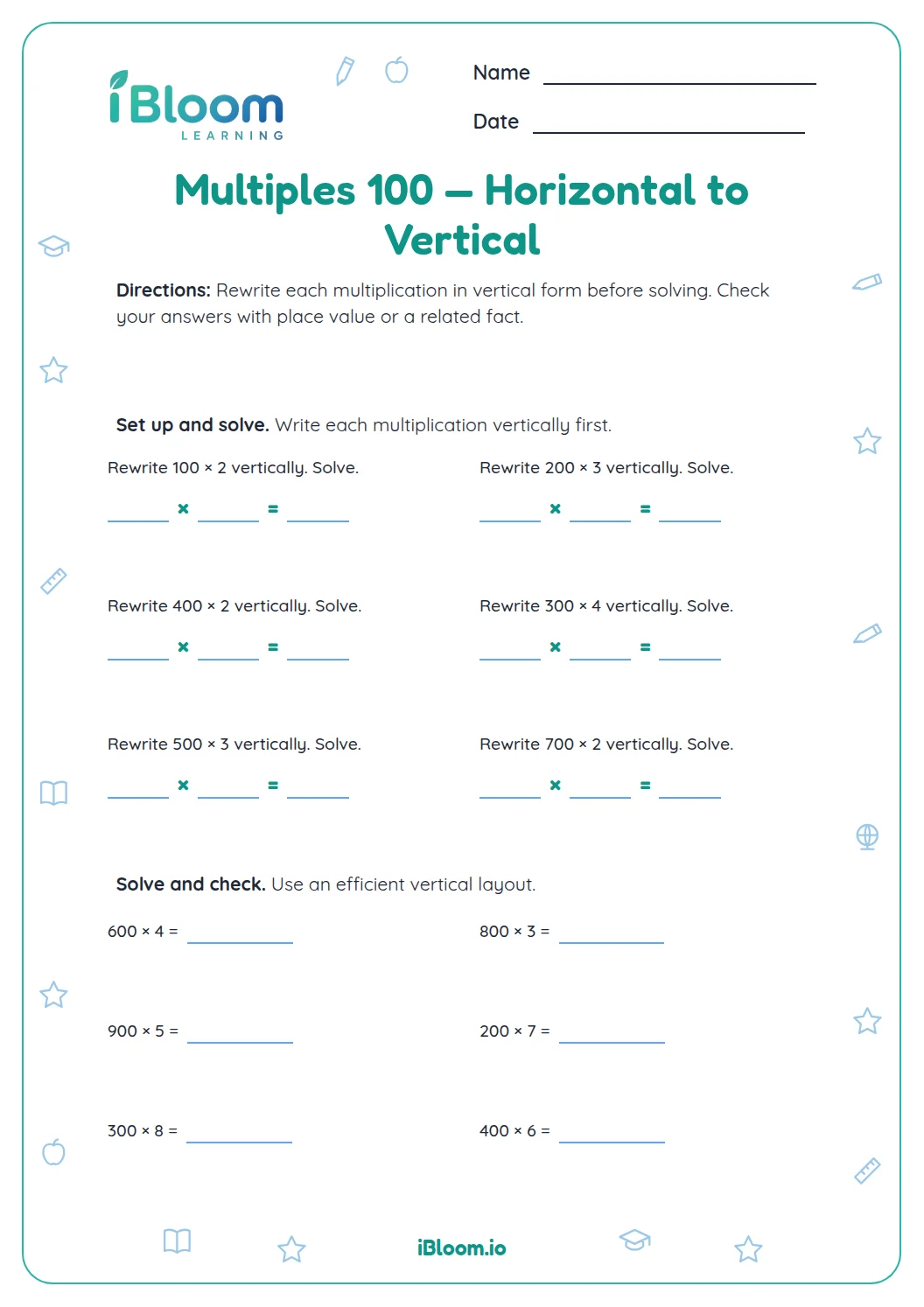
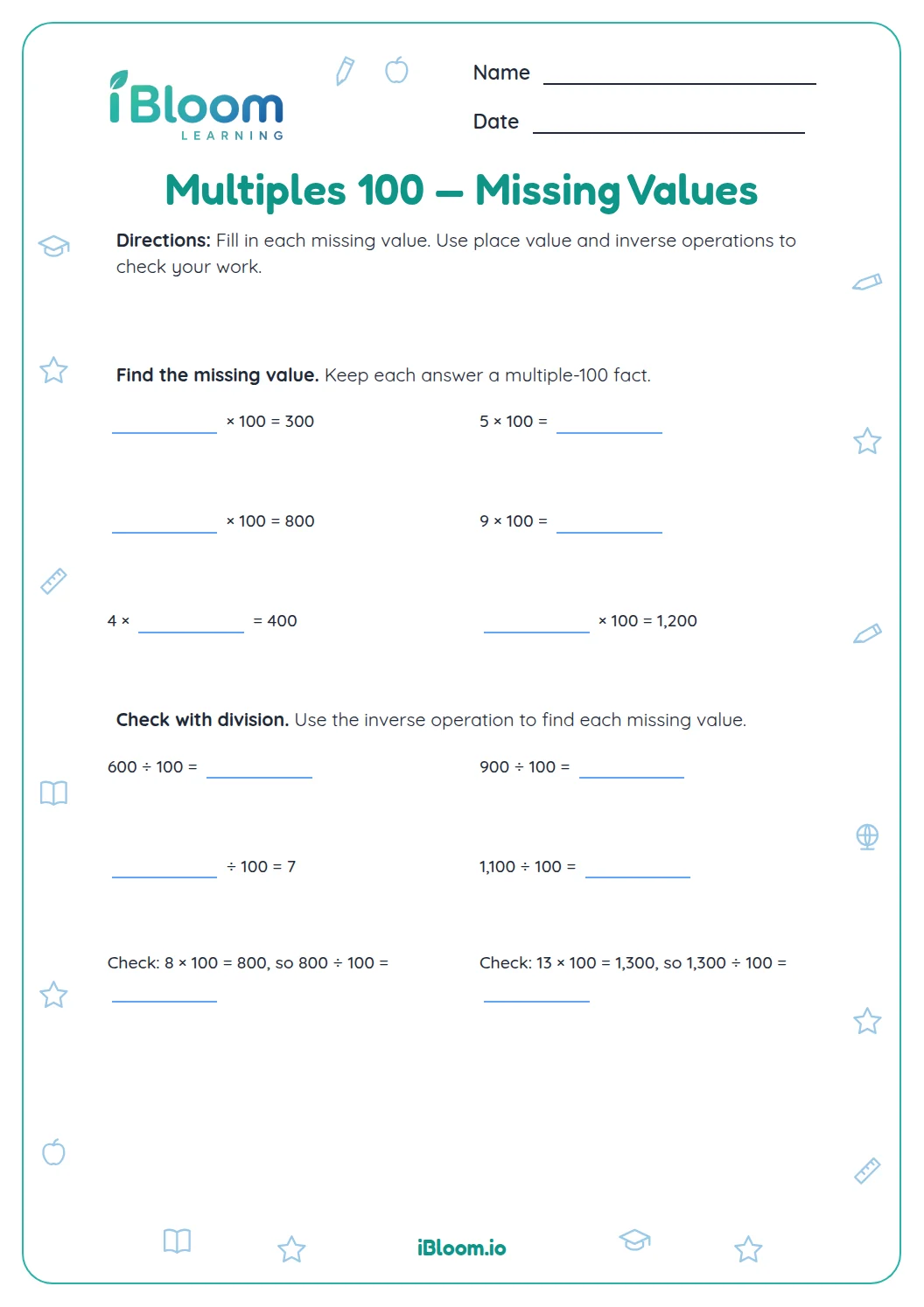

About this worksheet
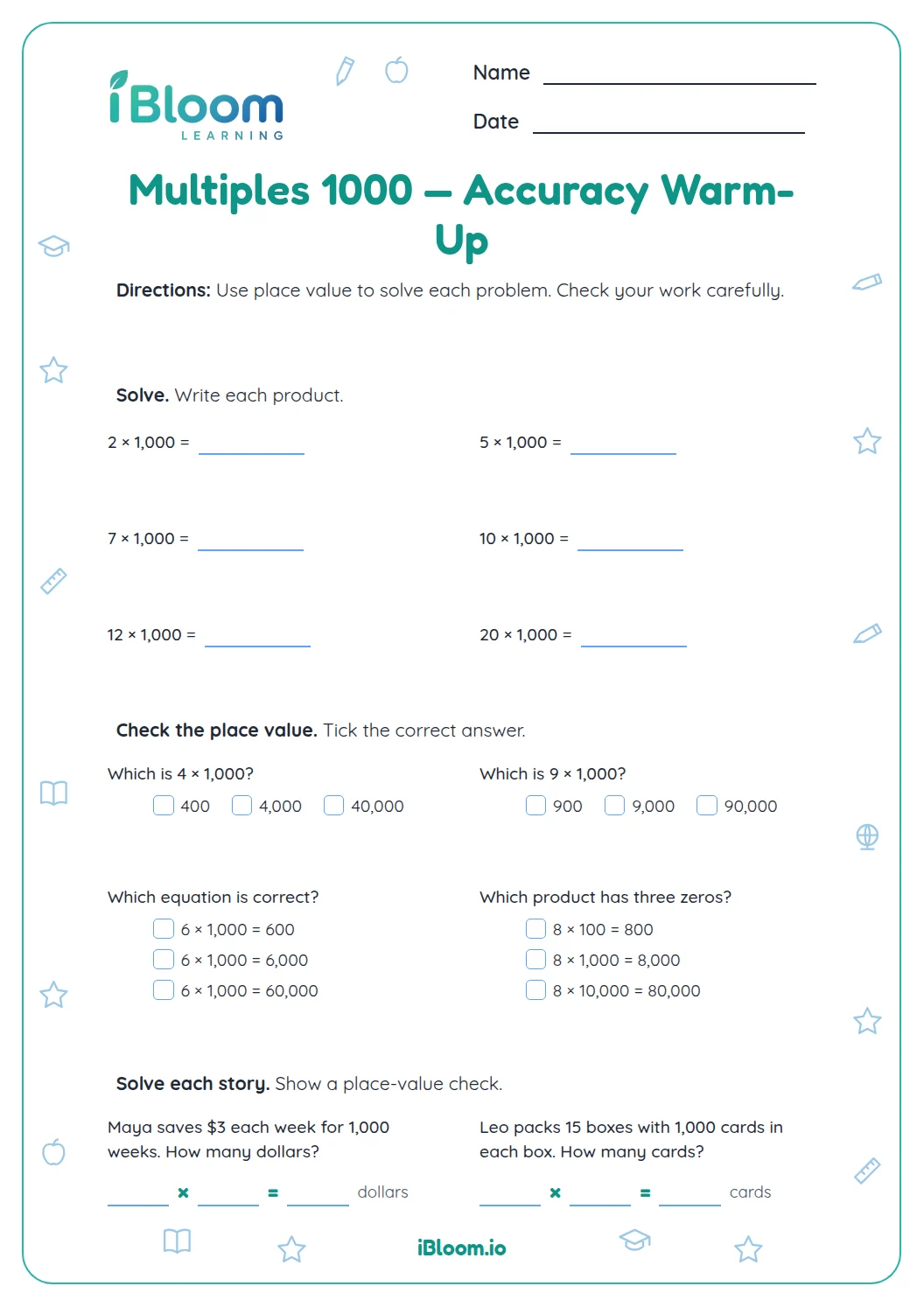
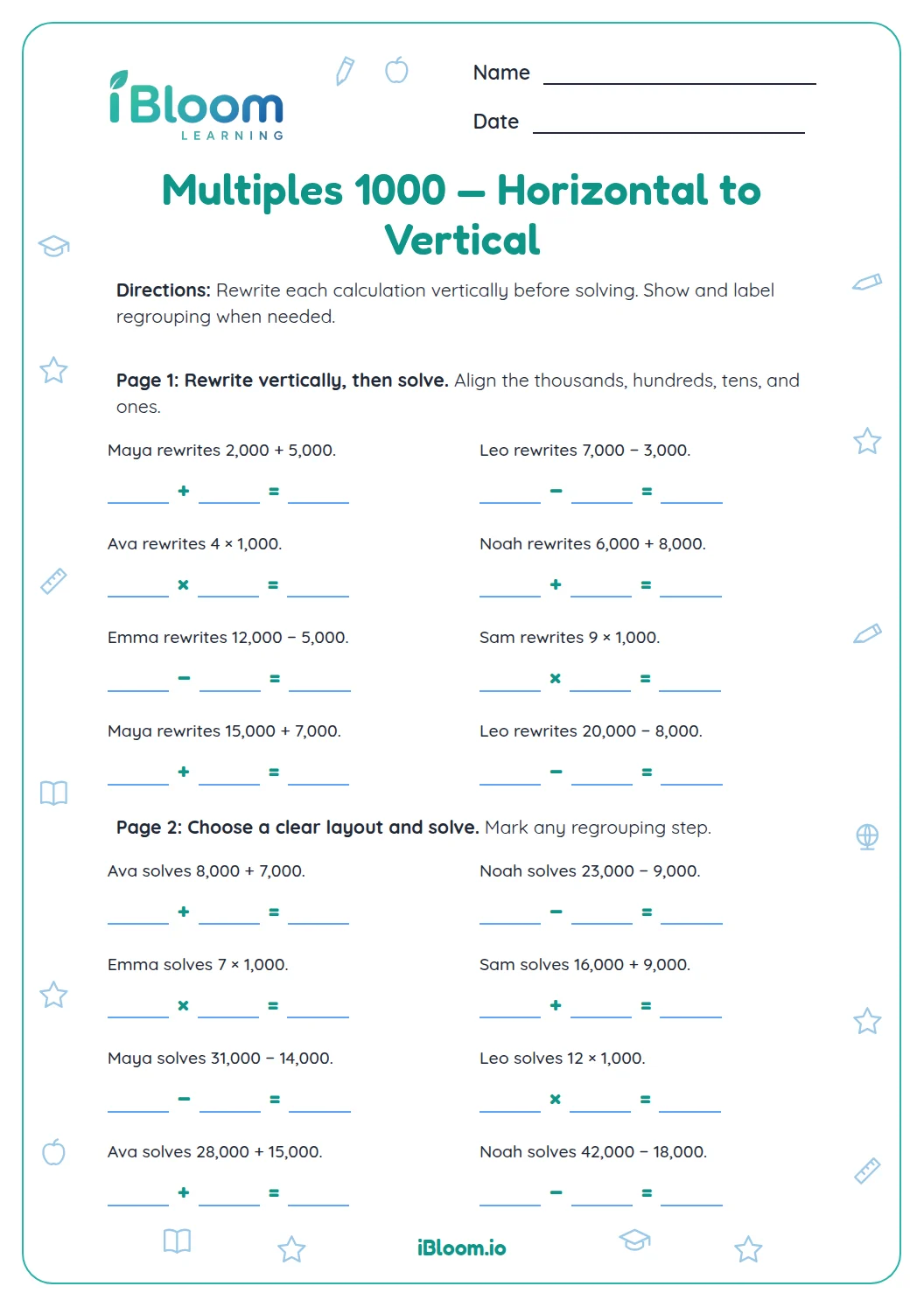
This free printable gives students 16 problems multiplying whole tens by hundreds and thousands. Learners rewrite each horizontal equation vertically, multiply the nonzero digits, and use place value to check the zeros. The separate answer key lists each product.
Why rewrite a horizontal problem vertically?
A vertical layout lines up the factors and makes the multiplication step clear. For question 1, 20 × 300 becomes 2 × 3 with three place-value zeros, so the product is 6,000.
How does place value affect the product?
The place-value units explain the scale of the answer. A factor of 20 is 2 tens and 300 is 3 hundreds, so 2 × 3 is 6 and the product is 6,000.
How can you check a large product?
Estimate with the nonzero digits, then count the zeros in the factors. For question 10, 30 × 2,000 is 3 × 2 = 6 and four zeros, or 60,000.
How to use this worksheet
- 1Copy the first factor above the second factor in a vertical layout.
- 2Line up the place values before multiplying.
- 3Multiply the nonzero digits.
- 4Use the tens, hundreds, or thousands in both factors to place zeros.
- 5Estimate the size of the product and check it against the answer key.
Common mistakes and quick fixes
The mistake
Multiplying only the visible nonzero digits and stopping.
The fix
After multiplying, account for the tens, hundreds, or thousands in both factors.
The mistake
Writing too few or too many zeros.
The fix
Circle the place-value zeros in each factor and count them before writing the product.
The mistake
Misreading 300 as 30.
The fix
Name each factor by its place value before multiplying.
What to practice next
Make more practice
Further reading
Questions parents and teachers ask
How should a student solve 20 × 300?
Rewrite the factors vertically, then use their place values. Two tens times three hundreds equals six thousands, so the product is 6,000. Multiplying 2 × 3 gives the basic 6; the units explain why it is six thousand. Place value determines the final product.
Why are there two groups of problems?
The first eight products multiply whole tens by hundreds; the next eight use thousands. Students rewrite every horizontal problem vertically before solving, with room to show the place-value work for each product. This makes place-value comparison easier for students. here.
Should children count zeros or use place value?
Place value explains why the zeros belong, while counting them can be a useful check. Name the units in each factor, multiply the nonzero digits, and record the resulting value. For example, tens times hundreds produce thousands. The unit names keep the calculation connected to the size of each factor.
What is a good way to check a product?
Multiply the nonzero digits again and estimate the size of the answer. A product of 20 and 300 should be in the thousands, so 600 or 60,000 would signal a place-value error. Then compare the exact result with the key.
What does “horizontal to vertical” mean here?
The printed problems begin across the page. Students rewrite each multiplication problem vertically, align the factors, and solve it. The answer key lists the products, while the page explanation shows how place value determines the scale of the result. The same rewrite applies to every item in the drill.