



About this worksheet
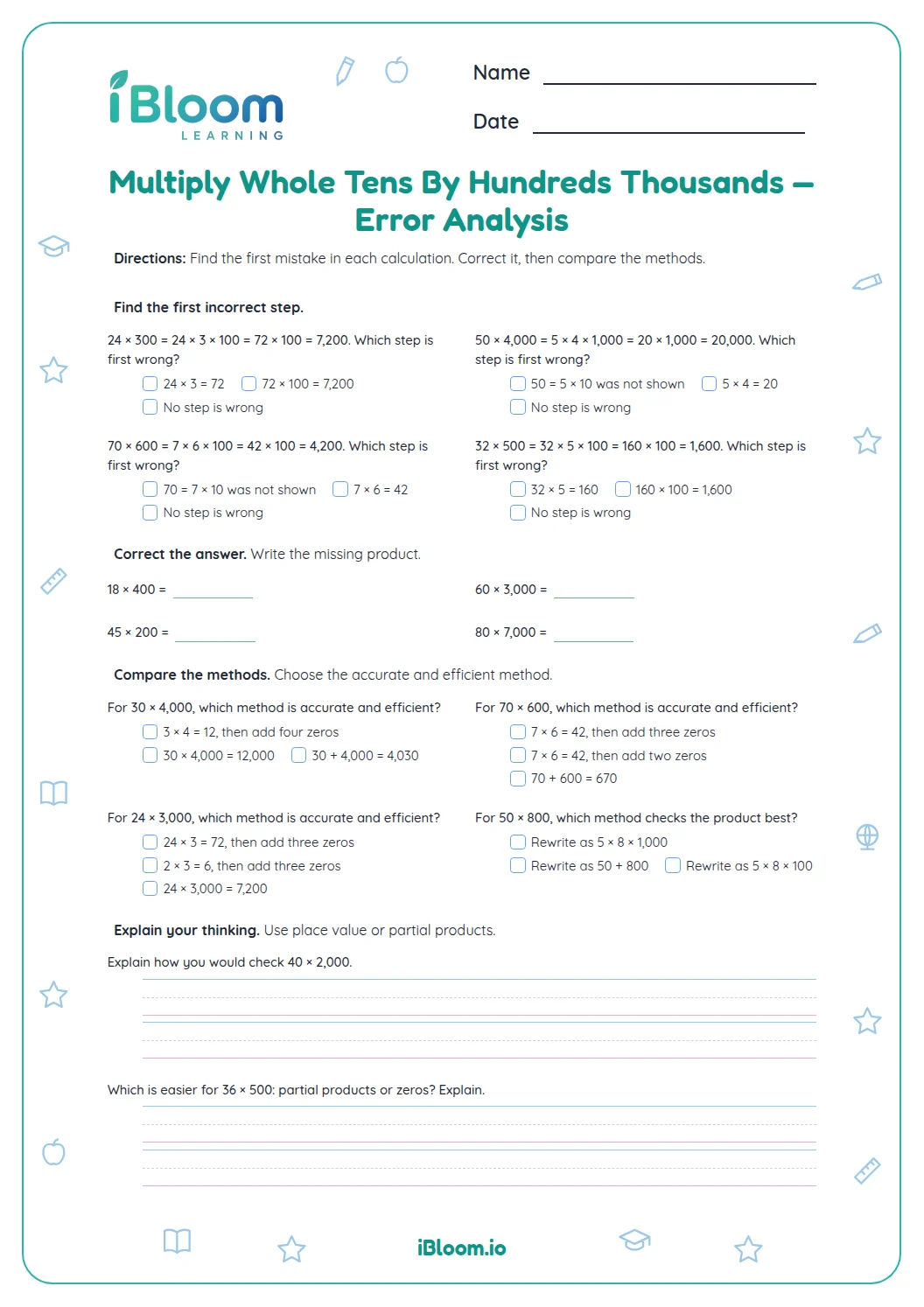
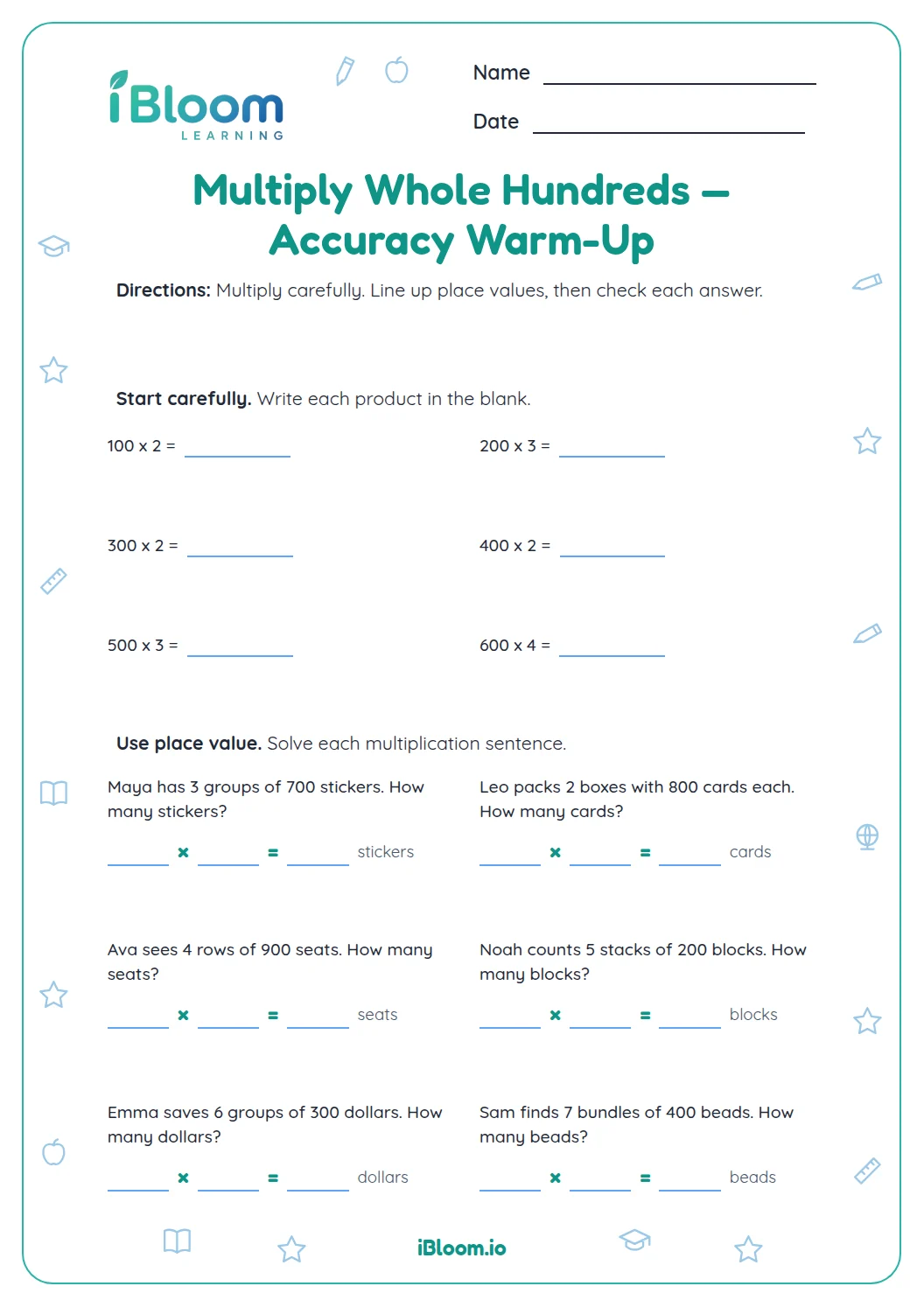
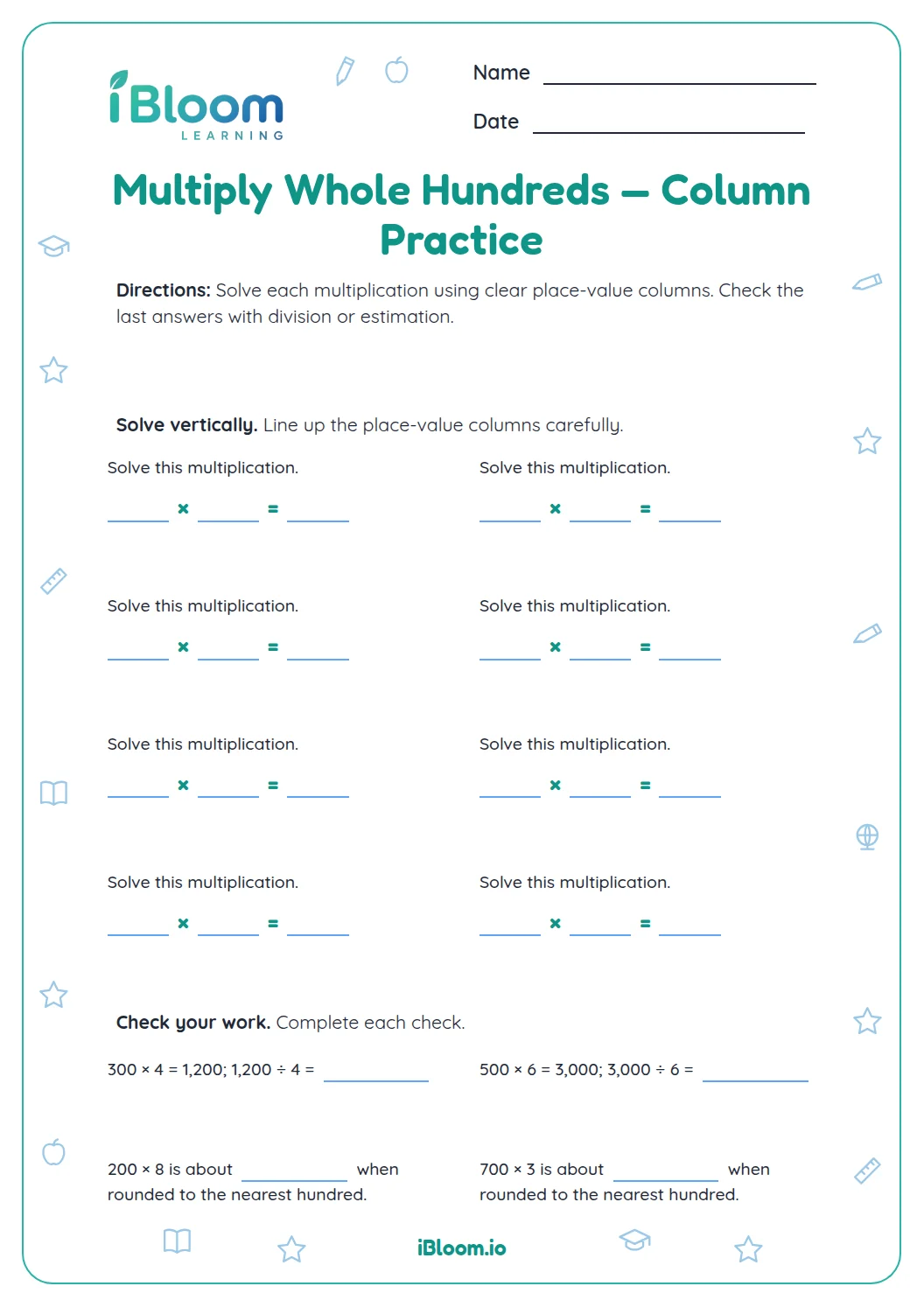
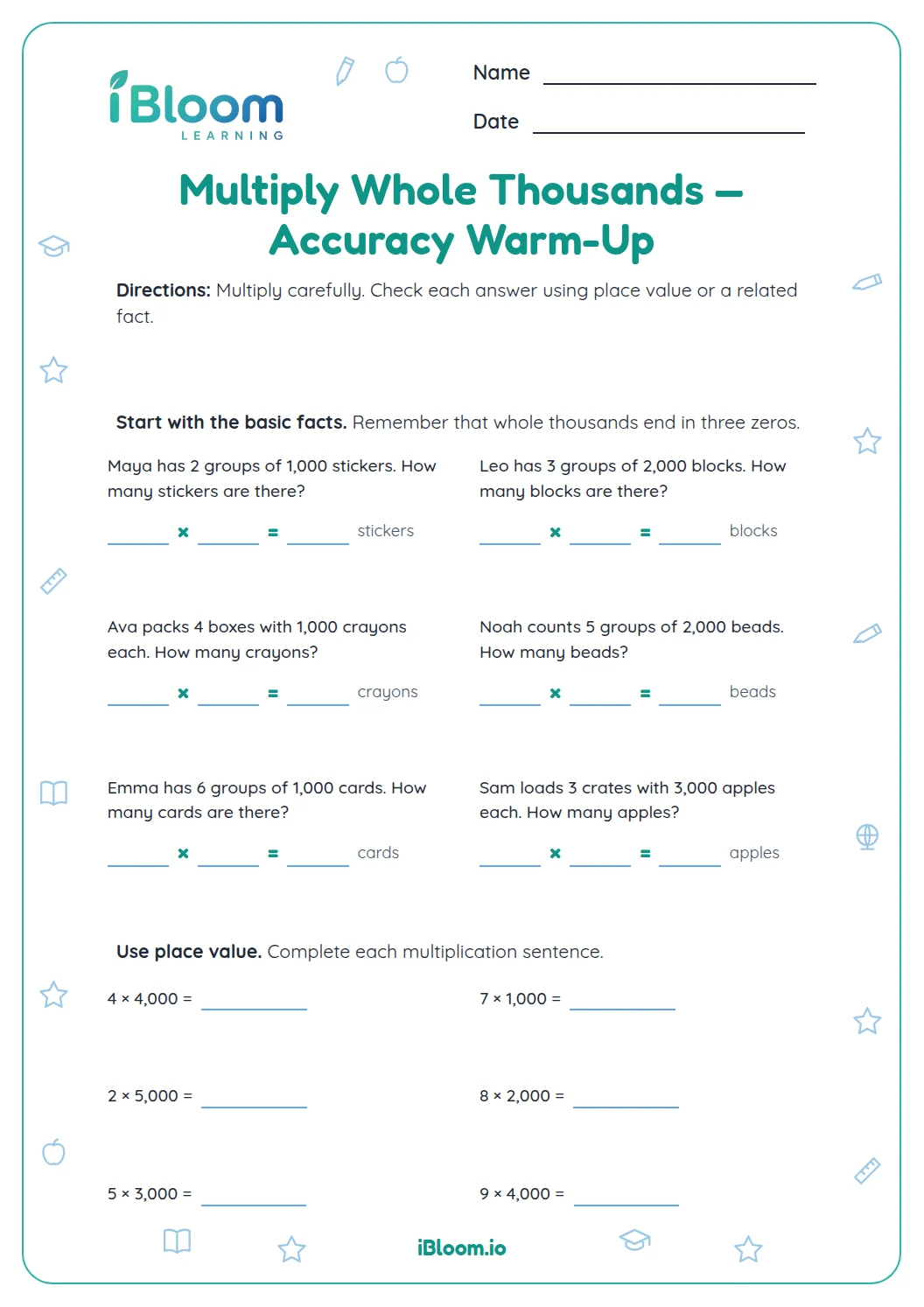
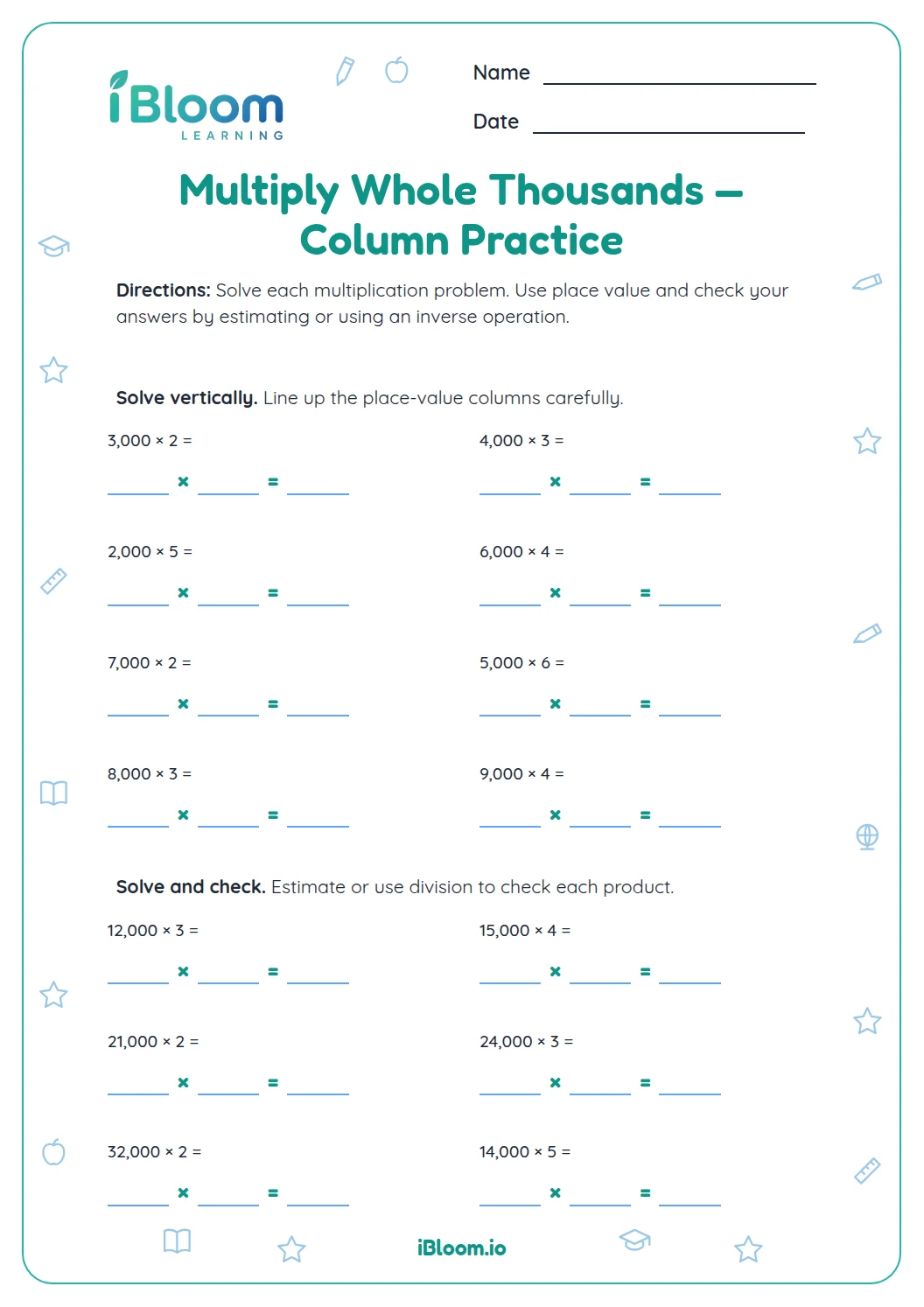
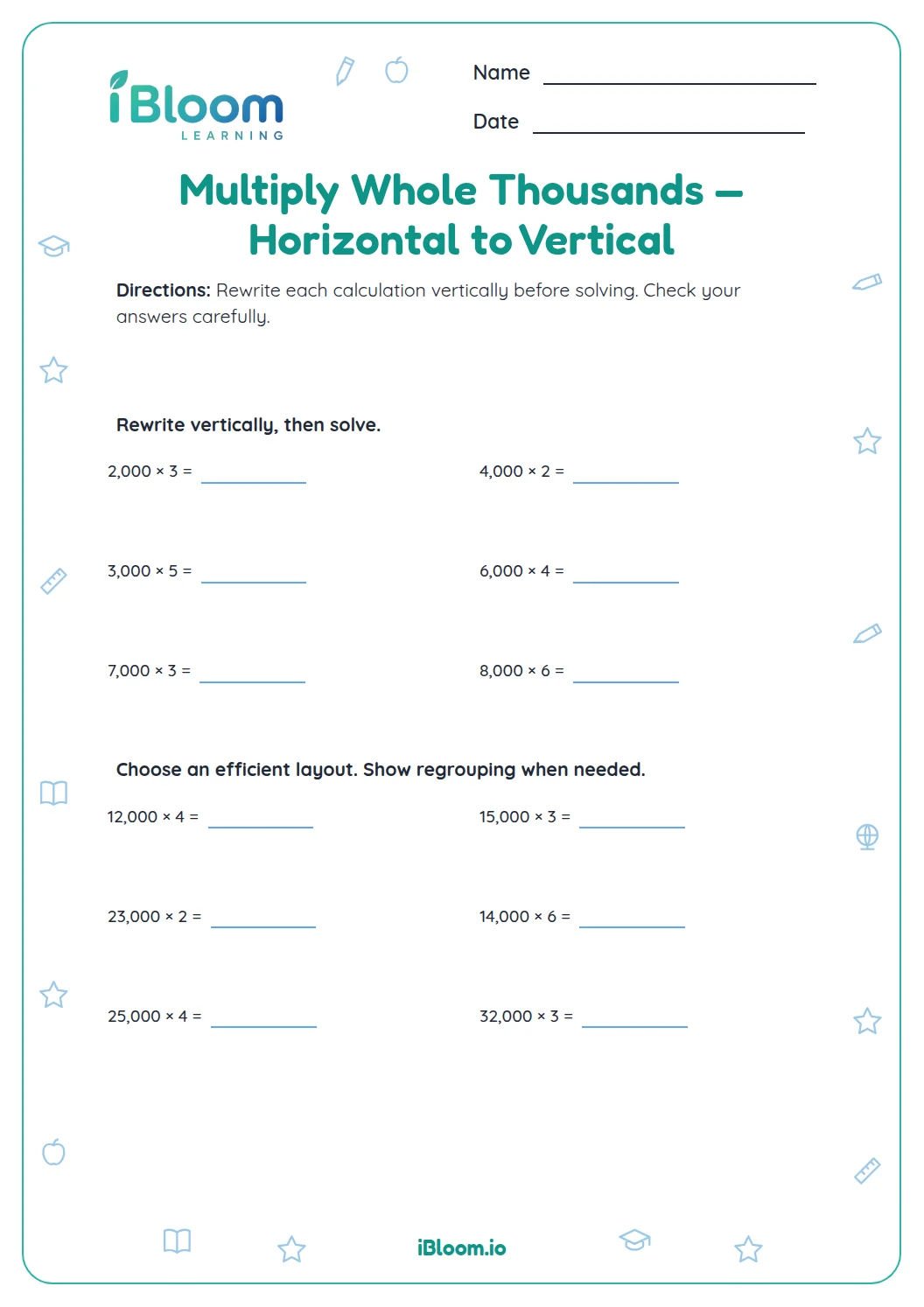
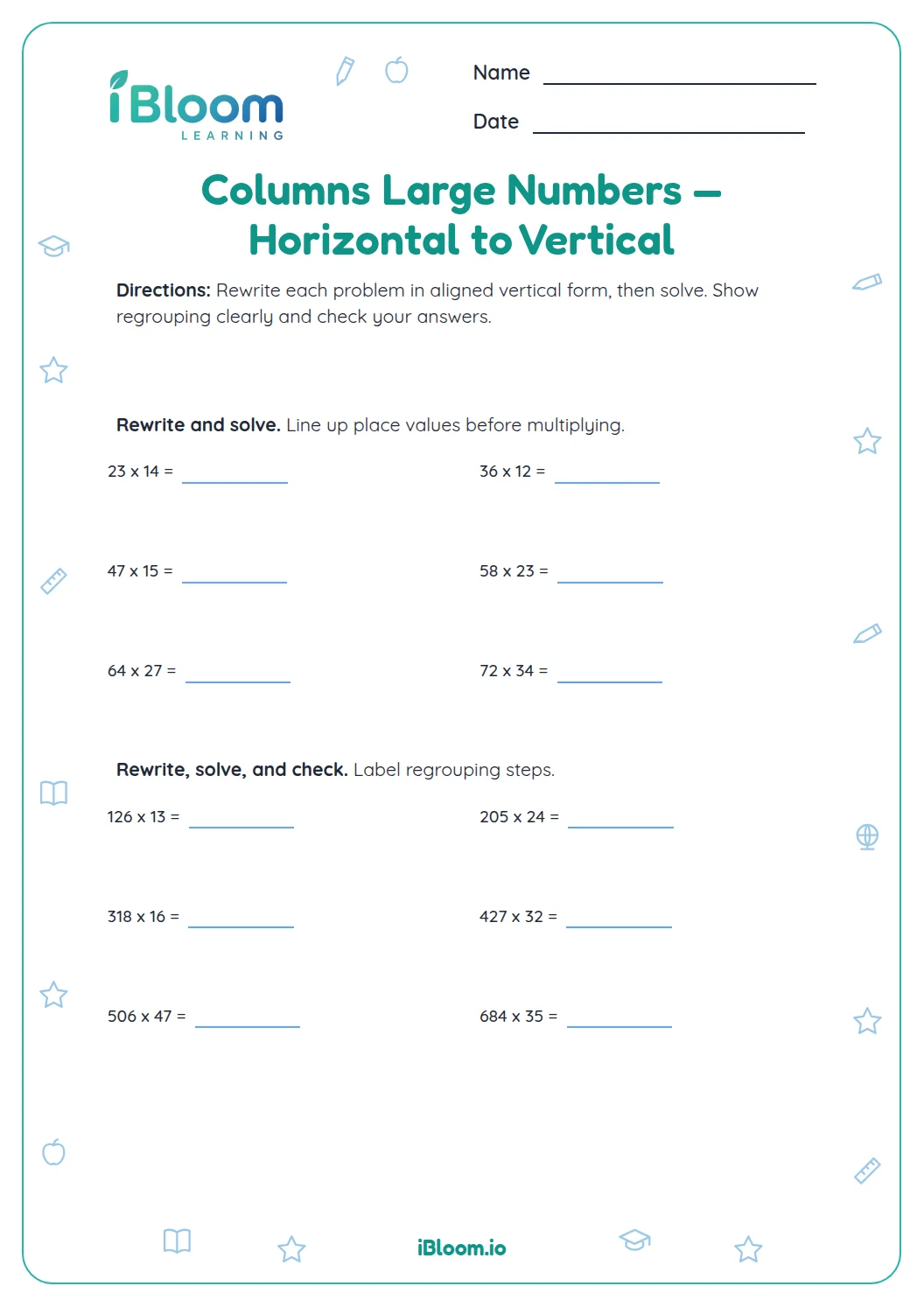
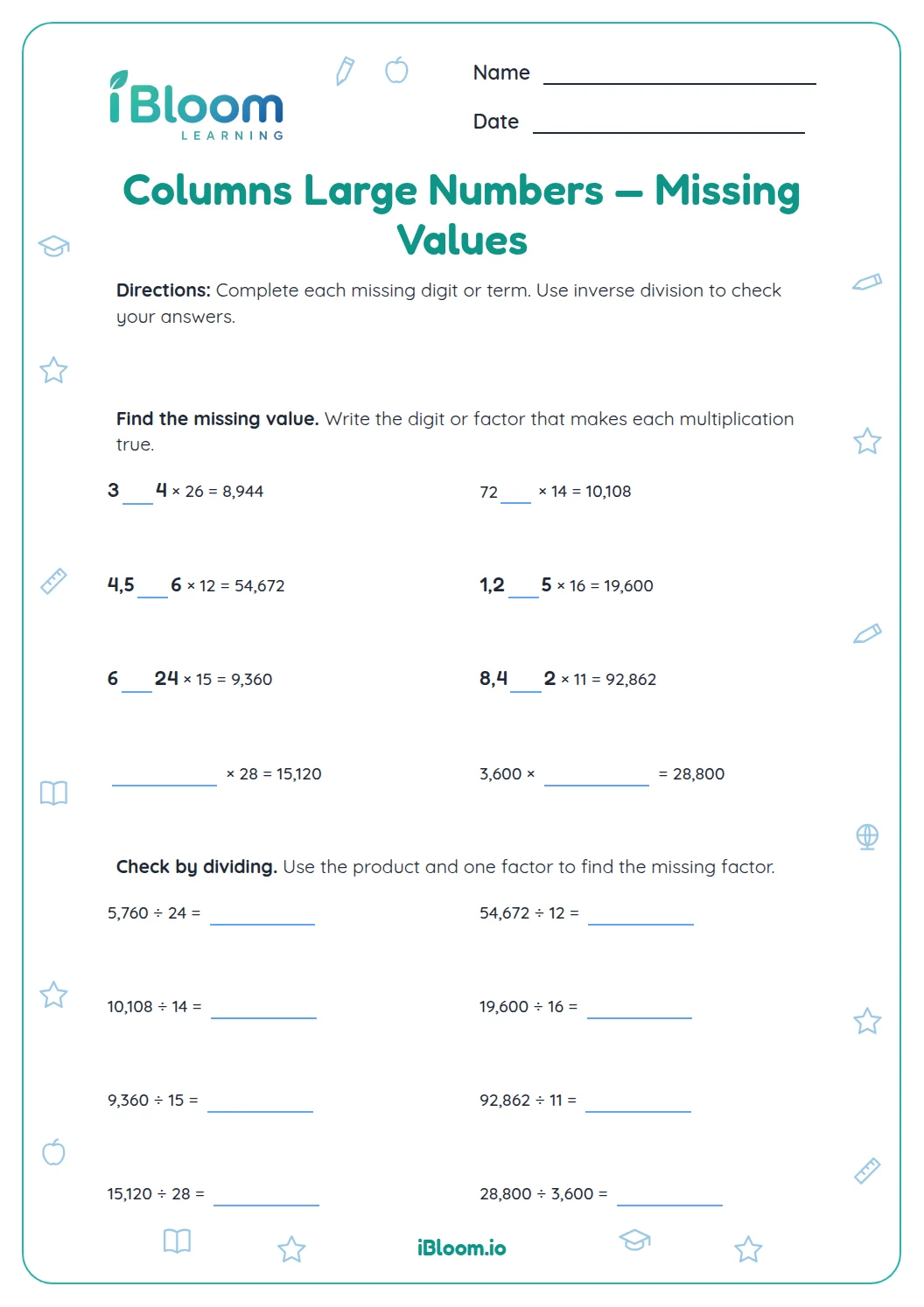
This printable multiplication drill gives students practice multiplying whole tens by hundreds and thousands. Set up each of the 16 products vertically in the provided work space, solve, and check the place values. The problems build on the base-ten pattern in Common Core 4.NBT.A.1: a digit’s value is ten times its value one place to the right. A separate answer key is included.
Aligned to 4.NBT.A.1
How do you multiply whole tens by hundreds?
Break each factor into its nonzero digit and its place value. For 30 × 200, calculate 3 × 2 = 6 and then account for the three total zeros: 6,000.
What changes when the second factor is thousands?
The same strategy works with thousands. For 20 × 3,000, multiply 2 × 3, then account for four zeros to get 60,000. Estimate the size before writing the exact product.
- 120 × 3,000
- 22 × 3 = 6
- 3There are four place-value zeros in the factors.
- 4Answer: 60,000
How can you check a product?
Use the nonzero digits to estimate, then count the place-value zeros. The product should be larger than either factor and have the expected size.
How to use this worksheet at home or in class
- 1Multiply the nonzero digits.
- 2Count the zeros in both factors.
- 3Write the product with those place values.
- 4Estimate to check the size.
- 5Recalculate if the product is smaller than a factor or has the wrong number of zeros.
Common mistakes and quick fixes
The mistake
Counting only the zeros in one factor.
The fix
Count zeros from both whole-number factors.
The mistake
Writing 30 × 200 as 600.
The fix
Use 3 × 2 = 6, then restore three zeros: 6,000.
The mistake
Multiplying the trailing zeros instead of the nonzero digits.
The fix
Multiply 3 × 2 first, then use place value to set the product.
Common Core alignment
This worksheet gives focused practice with a grade-level skill named in the Common Core standards.
Recognize that each place to the left is ten times the value of the place to its right.
On this sheet: The products use factors that are multiples of ten and require tracking each factor’s place value.
Show the official wordingHide the official wording
Recognize that in a multi-digit whole number, a digit in one place represents ten times what it represents in the place to its right.
What to practice next
Make more practice
Further reading
Questions parents and teachers ask
How do you multiply 30 by 200?
Multiply the nonzero digits, 3 × 2 = 6, then account for the three zeros across the factors. The product is 6,000. Estimating first helps check whether the answer is the right size and whether the zeros are in the correct places.
Why does the product have zeros?
Each factor is a multiple of ten, so its zero records a place-value scale. Multiply the nonzero digits first, then account for the place value in both factors. For example, 30 × 200 is 3 × 2 with three zeros, or 6,000.
Is an answer key included?
Yes. The separate key lists all 16 products in the hundreds and thousands groups. Compare each answer after finishing, then revisit the multiplication or place-value step if a product does not match. The worksheet leaves room to set up each product vertically.
How can students check a product?
Estimate the product using the leading digits, then verify the multiplication and place-value zeros. The product should be larger than either positive factor and close to the estimate. A second multiplication check can confirm the exact result. Repeating the estimate can catch a misplaced zero.
Does this sheet give space for vertical work?
Yes. Each problem includes a work area where students can write the factors in a column, multiply the nonzero digits, and track place value. The printed prompts are horizontal so the full factors remain clear, while the workspace supports a vertical setup.