



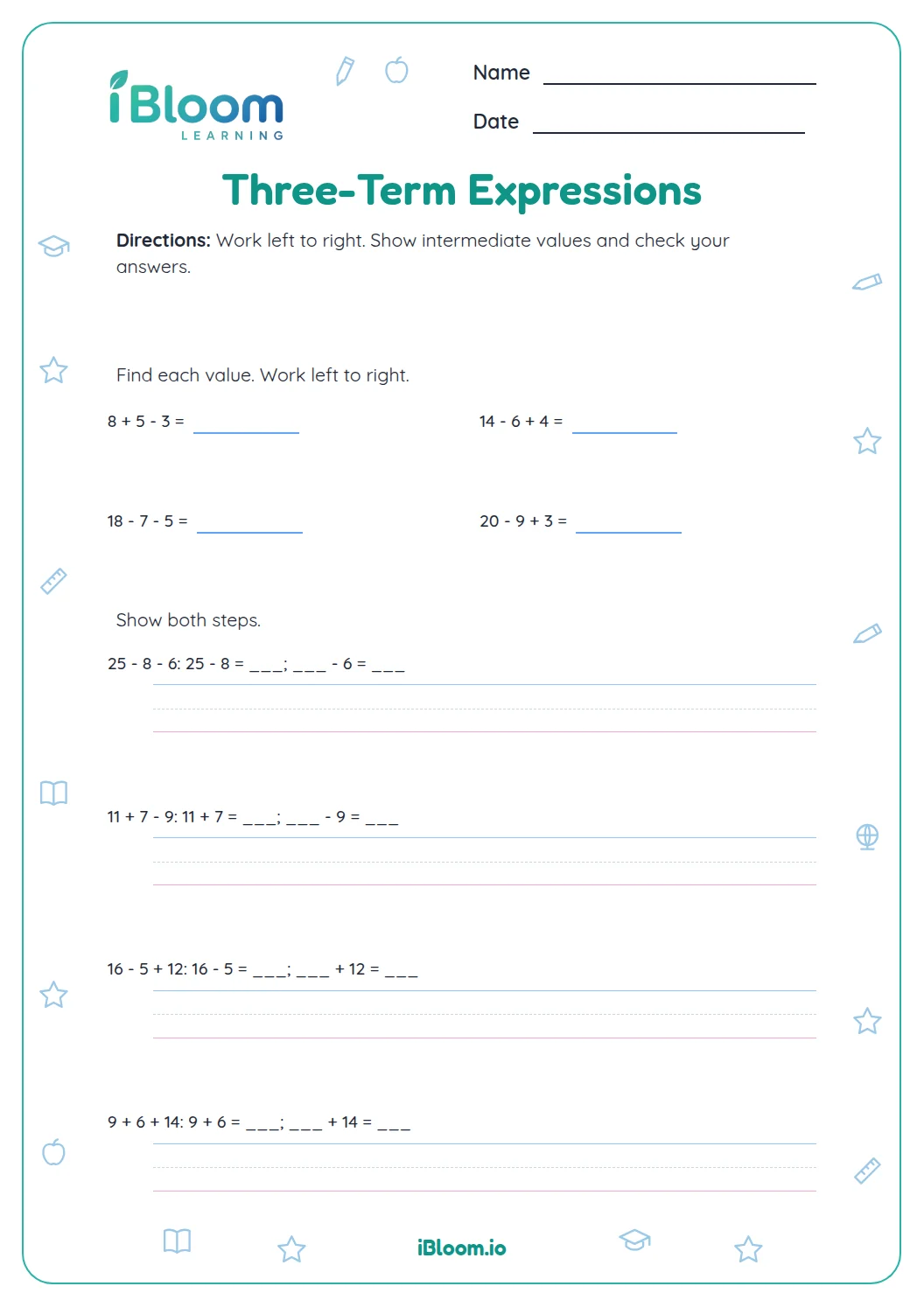
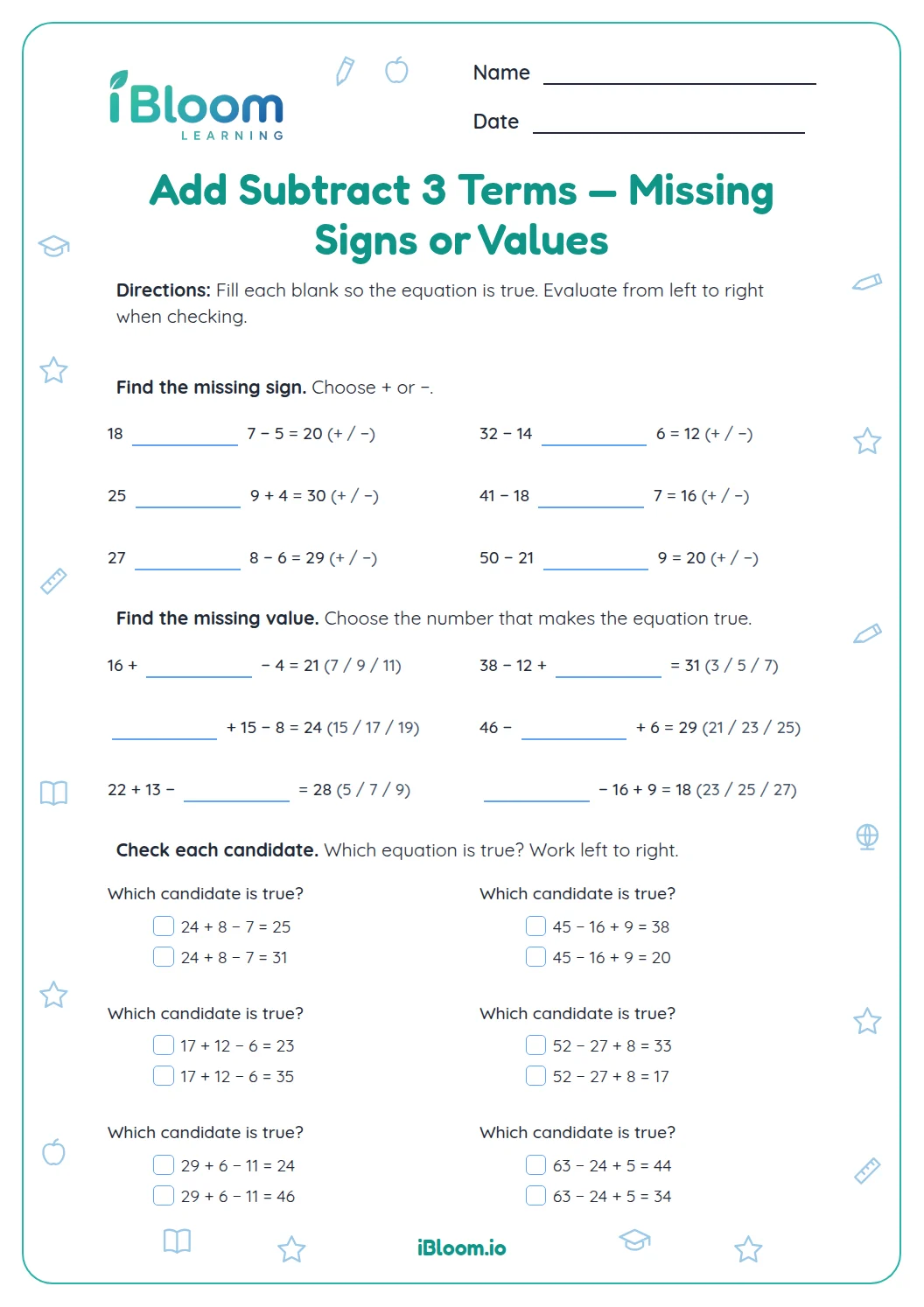
About this worksheet
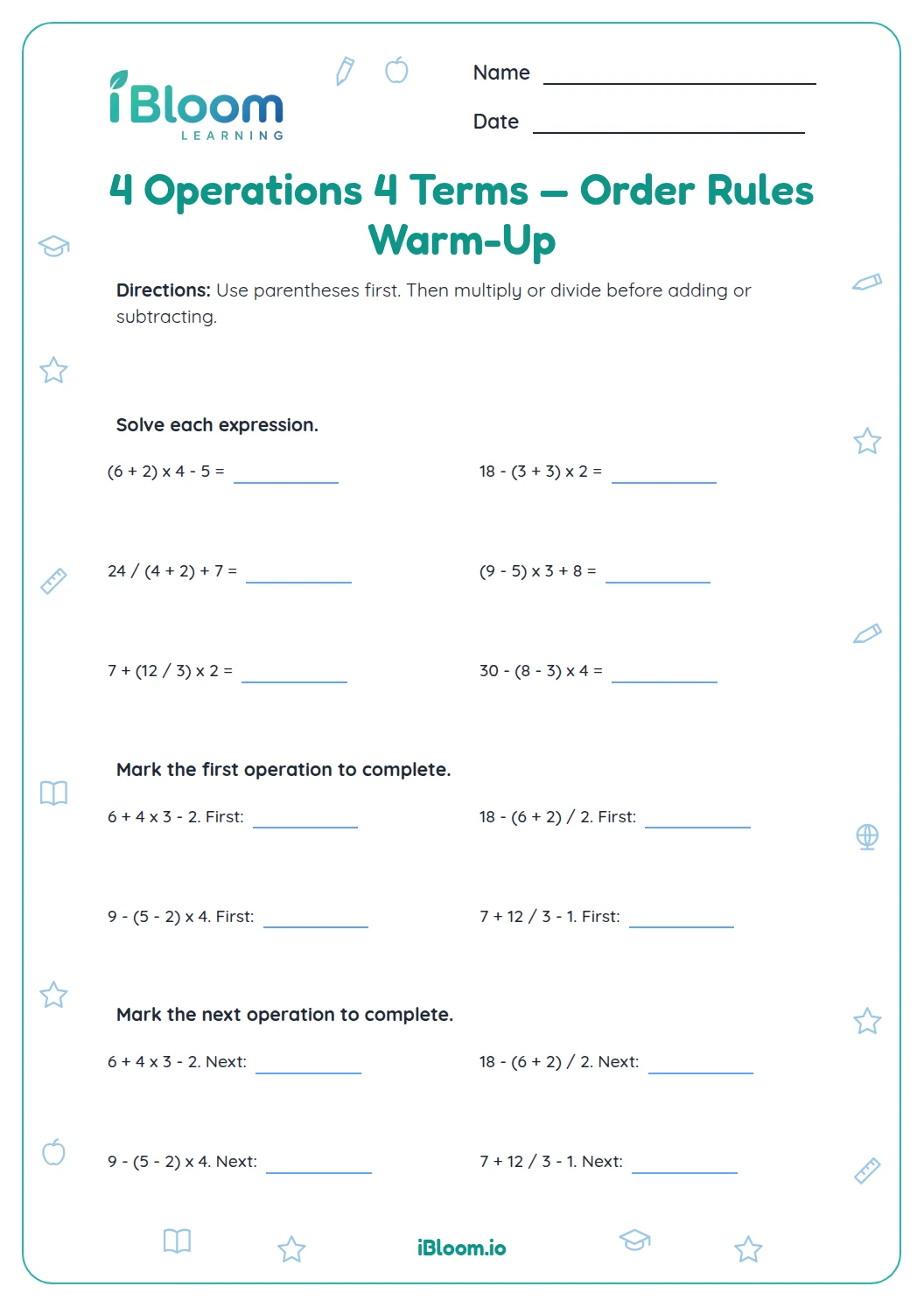
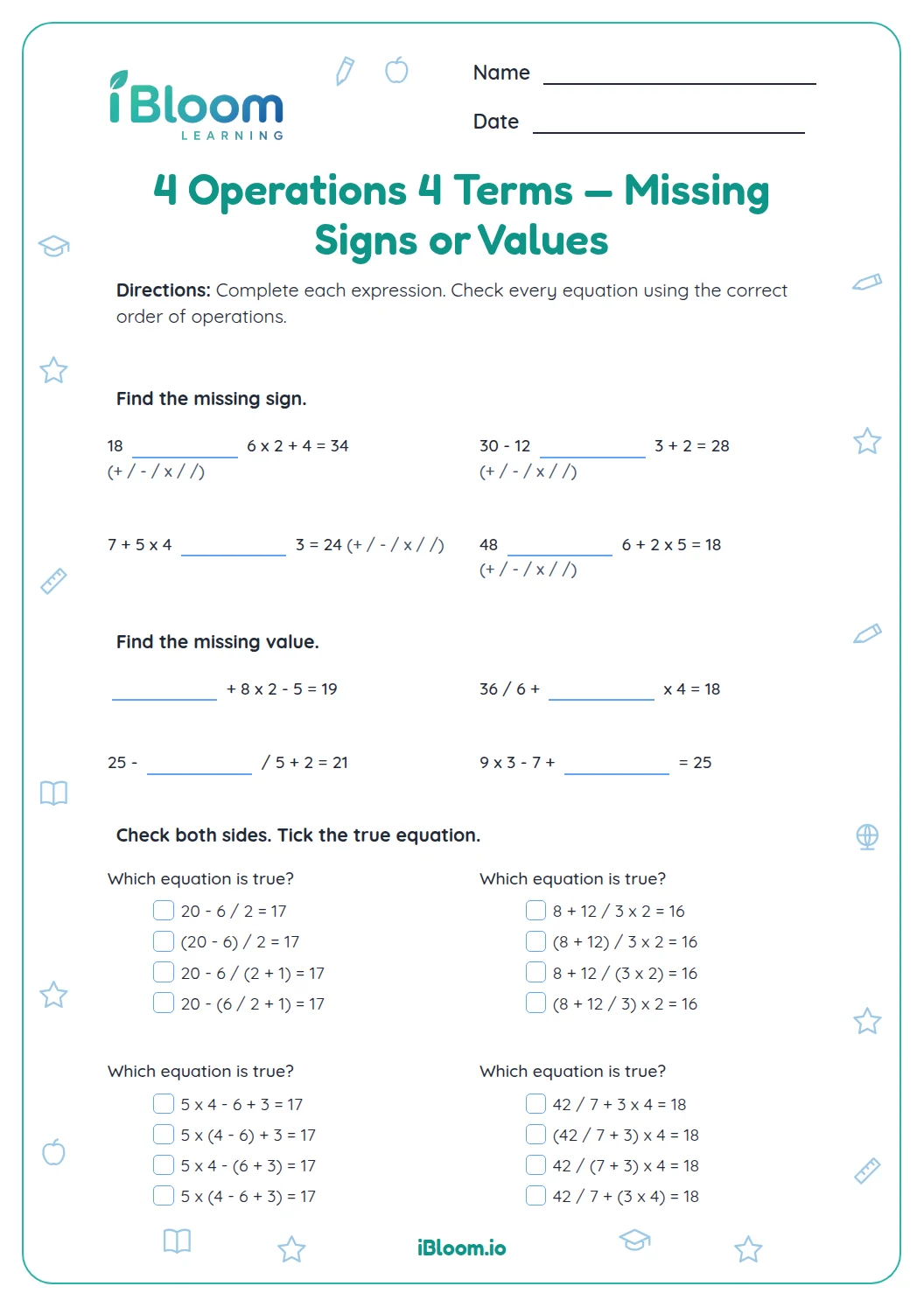
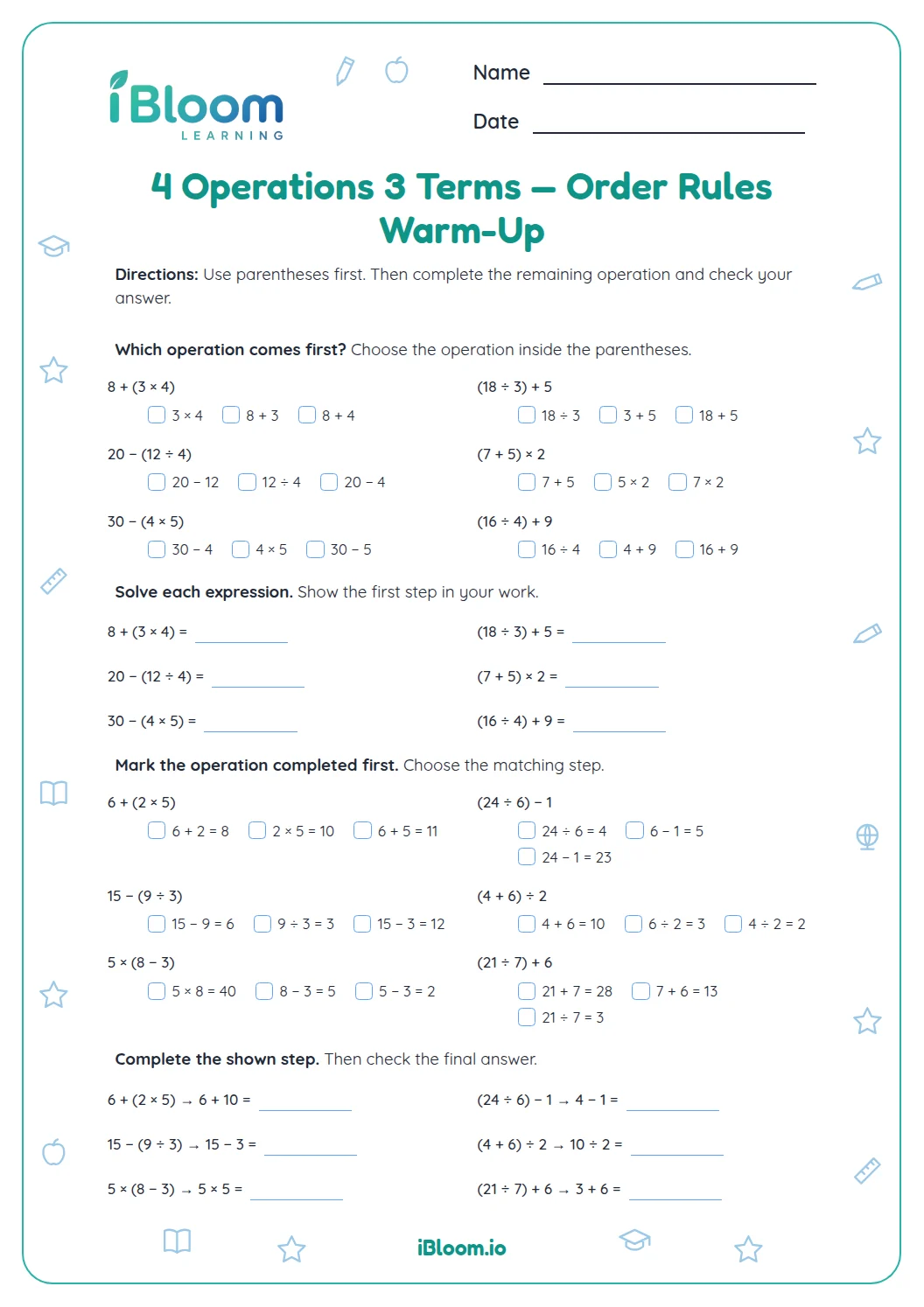
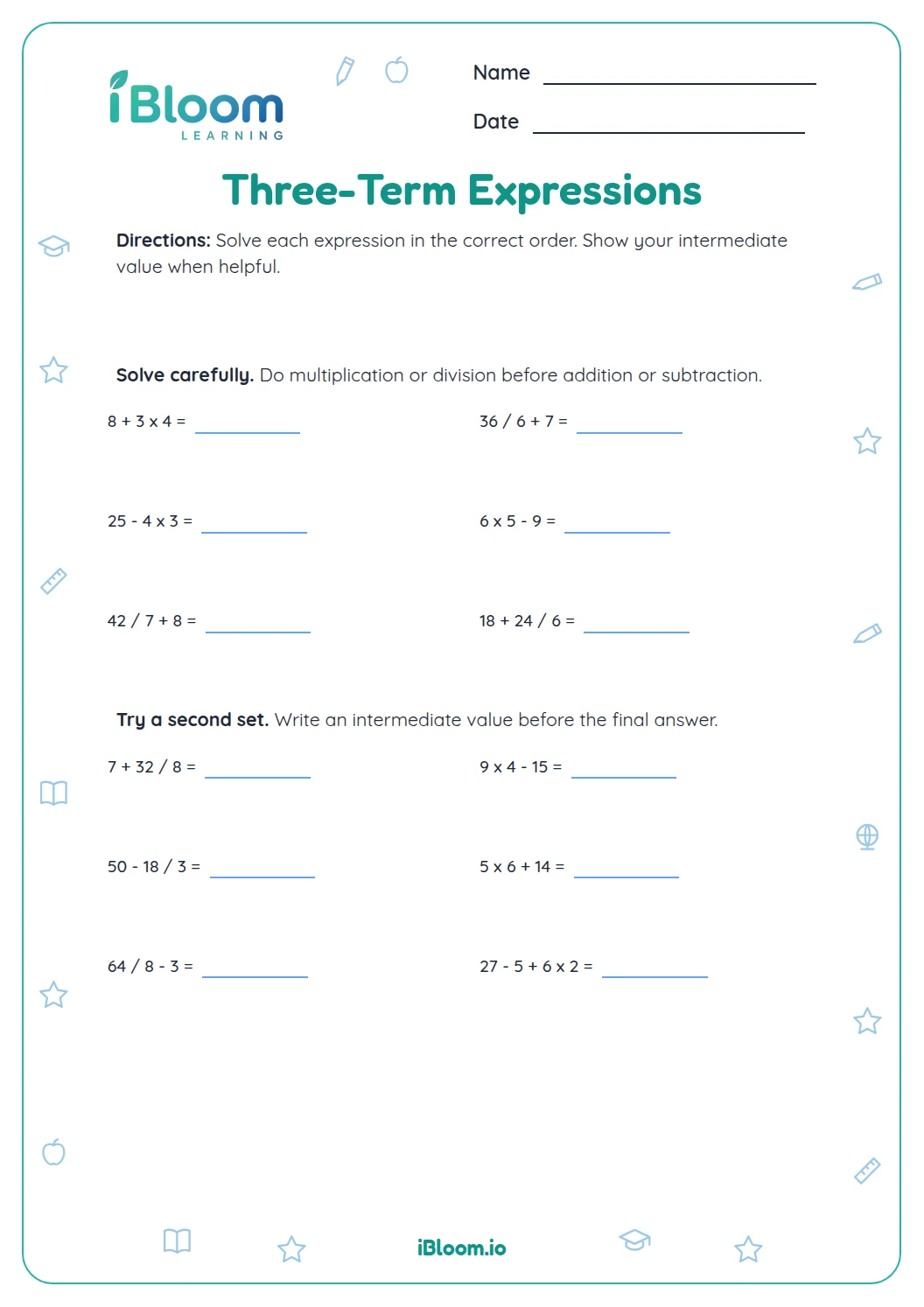
Students evaluate four-operation expressions, compare how parentheses affect the result, and explain common order of operations errors.
Aligned to 5.OA.A.1 and 5.OA.A.2
What kinds of expressions will students solve?
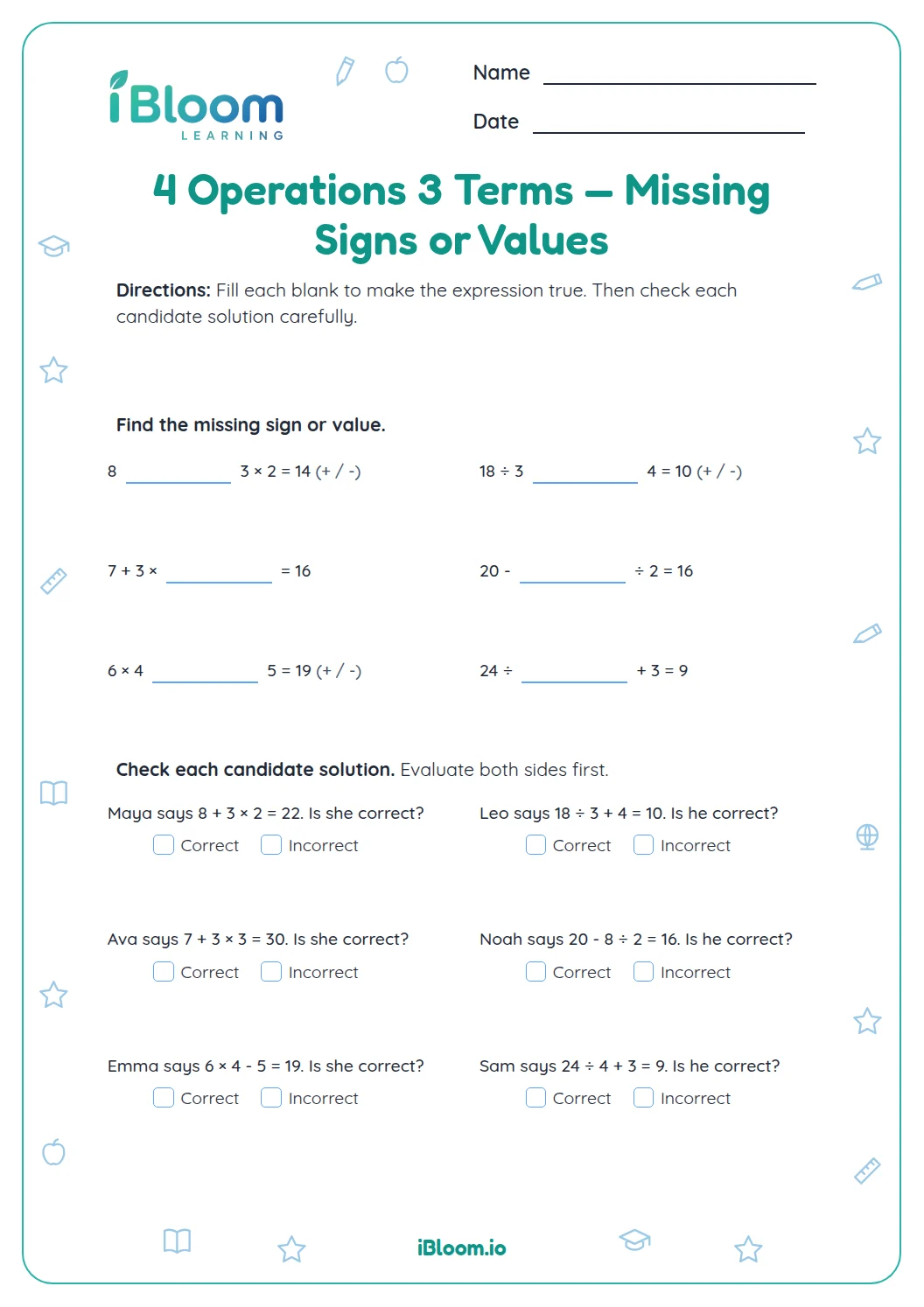
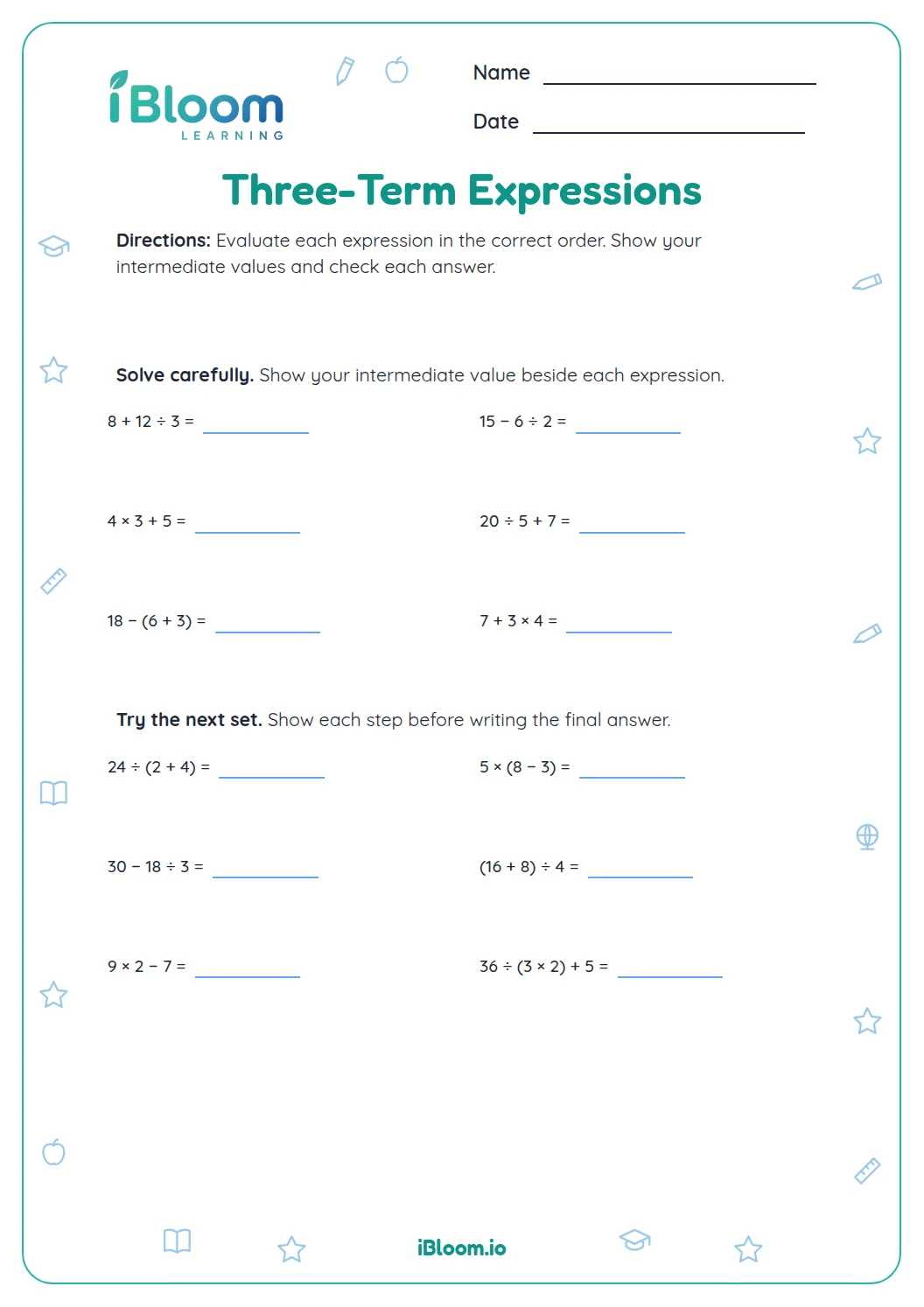
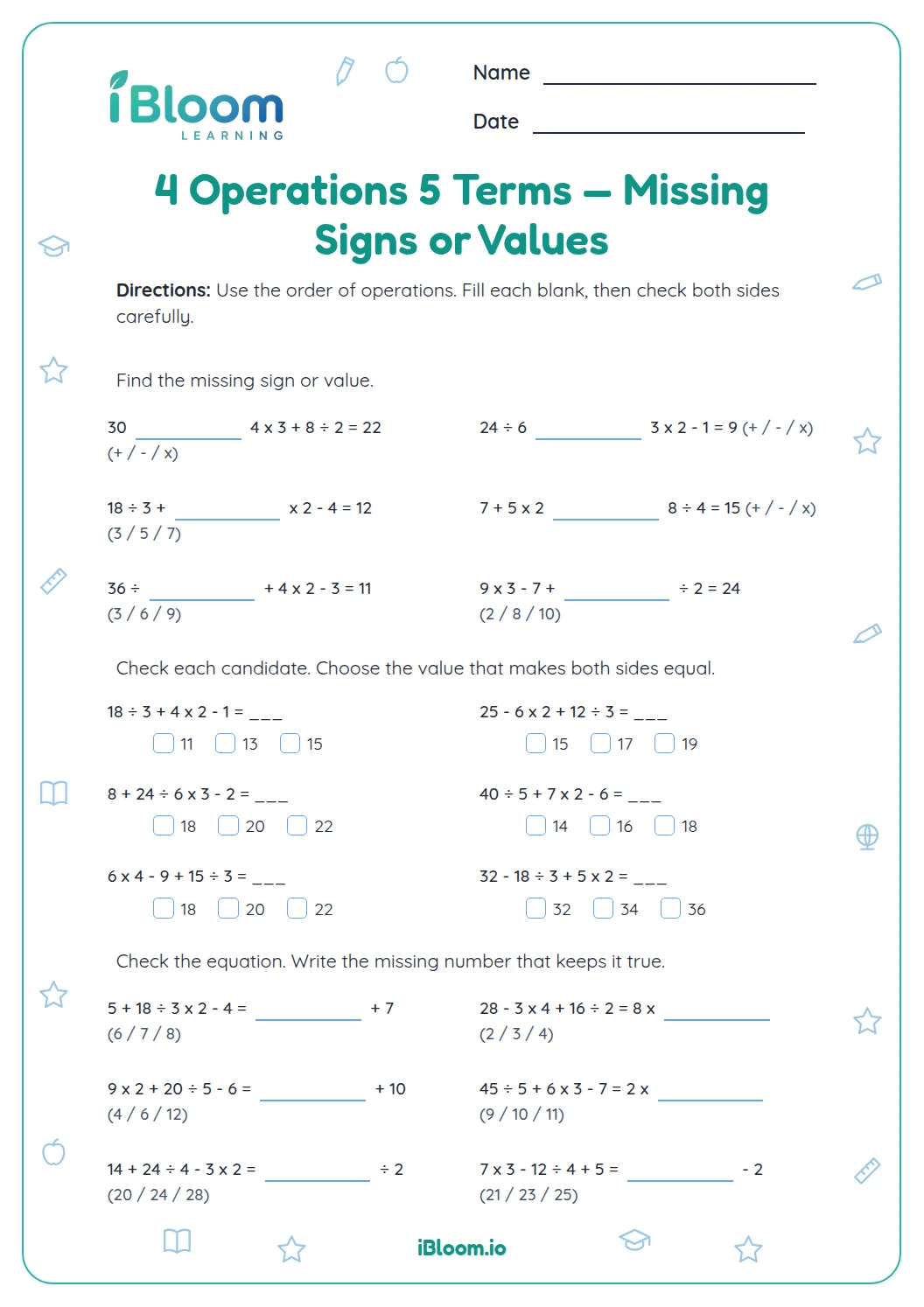
Part A mixes multiplication and division with addition and subtraction. Students evaluate multiplication and division first, then finish the remaining operations from left to right.
Part B adds parentheses, which can change the order and the value. Part C asks students to diagnose a slip or create an expression that meets a target.
- 124 ÷ 6 × 3 + 2
- 2Work left to right for division and multiplication: 4 × 3 + 2 = 14.
- Part A: mixed four-operation expressions
- Part B: expressions with parentheses
- Part C: error analysis and expression building
When do you work from left to right?
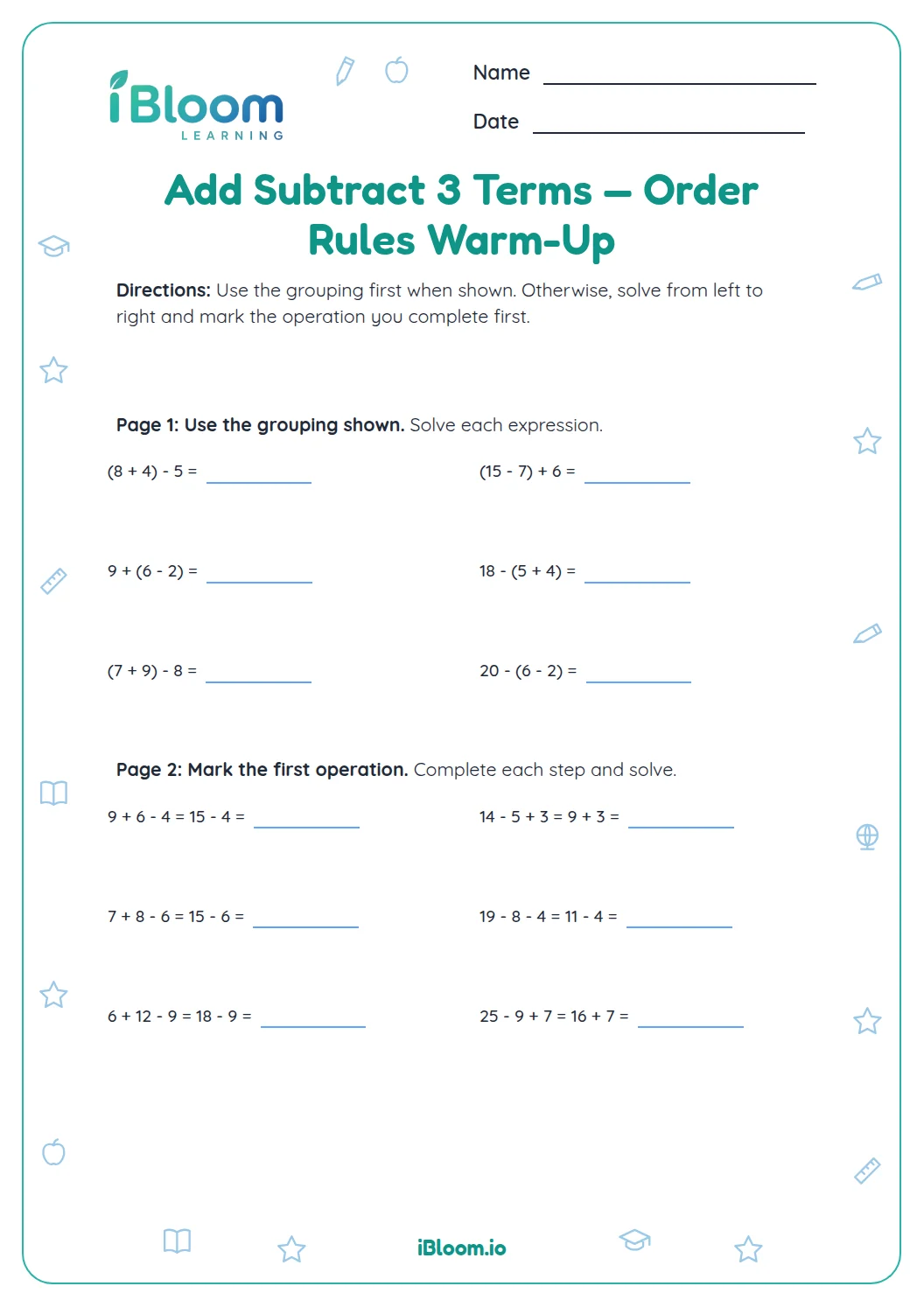
Multiplication and division share the same priority. Addition and subtraction also share a priority. Within either pair, calculate in the order the operations appear. Parentheses are evaluated first.
What changes when parentheses are added?
Parentheses set the first calculation. In 7 + 3 × 4, multiply first to get 19. In (7 + 3) × 4, add first to get 40. Check the grouping before calculating.
How to use this worksheet
- 1Read the short direction at the start of each part.
- 2Solve each item and keep units or operation signs with the values.
- 3For reasoning questions, use the evidence named in the prompt.
- 4Check calculations against the separate answer key.
Common mistakes and quick fixes
The mistake
Adding before multiplying in 6 + 5 × 3 − 4.
The fix
Multiply first: 5 × 3 = 15, then work left to right: 6 + 15 − 4 = 17.
The mistake
Always doing multiplication before division, even when division appears first.
The fix
Multiplication and division have equal priority; evaluate them from left to right.
The mistake
Doing all multiplication before any division.
The fix
Multiplication and division have equal priority; work from left to right.
Curriculum alignment
This worksheet gives students practice with the cited Common Core skill.
Use parentheses, brackets or braces in numerical expressions and evaluate expressions with them.
On this sheet: Parts B and C use parentheses in numerical expressions and ask students to evaluate or create expressions.
Show the official wordingHide the official wording
Use parentheses, brackets, or braces in numerical expressions, and evaluate expressions with these symbols.
Write and interpret numerical expressions without evaluating them.
On this sheet: Part C asks students to construct expressions that meet a stated value.
Show the official wordingHide the official wording
Write simple expressions that record calculations with numbers, and interpret numerical expressions without evaluating them.
What to practice next
Make more practice
Further reading
Questions parents and teachers ask
Do you always multiply before dividing?
No. Multiplication and division have equal priority, so solve them from left to right unless parentheses change the order. For example, 24 ÷ 6 × 3 means divide 24 by 6 first, then multiply that result by 3. The same left-to-right rule applies to addition and subtraction.
Why do parentheses change the value of an expression?
Parentheses tell you to calculate the grouped part first. In 7 + 3 × 4, multiplication happens before addition and the value is 19. In (7 + 3) × 4, the sum is calculated first and the value is 40. The grouping changes the order.
How can a student check an order of operations answer?
Show one clear step at a time. First evaluate parentheses, then multiplication or division from left to right, and finally addition or subtraction from left to right. Re-read the expression after each step to make sure no operation or number was skipped.
What does the error analysis part ask students to do?
Students read a worked answer, identify the operation that should have come first, and calculate the correct value. Explaining the first step helps uncover whether the mistake came from ignoring operation priority or from working multiplication and division in the wrong order.
How can a student check an answer on this sheet?
Substitute the value back into the expression and recompute in the correct order. For an expression-building item, apply the parentheses and then evaluate. The answer key shows the expected value or grouping, so students can find where their order changed.