





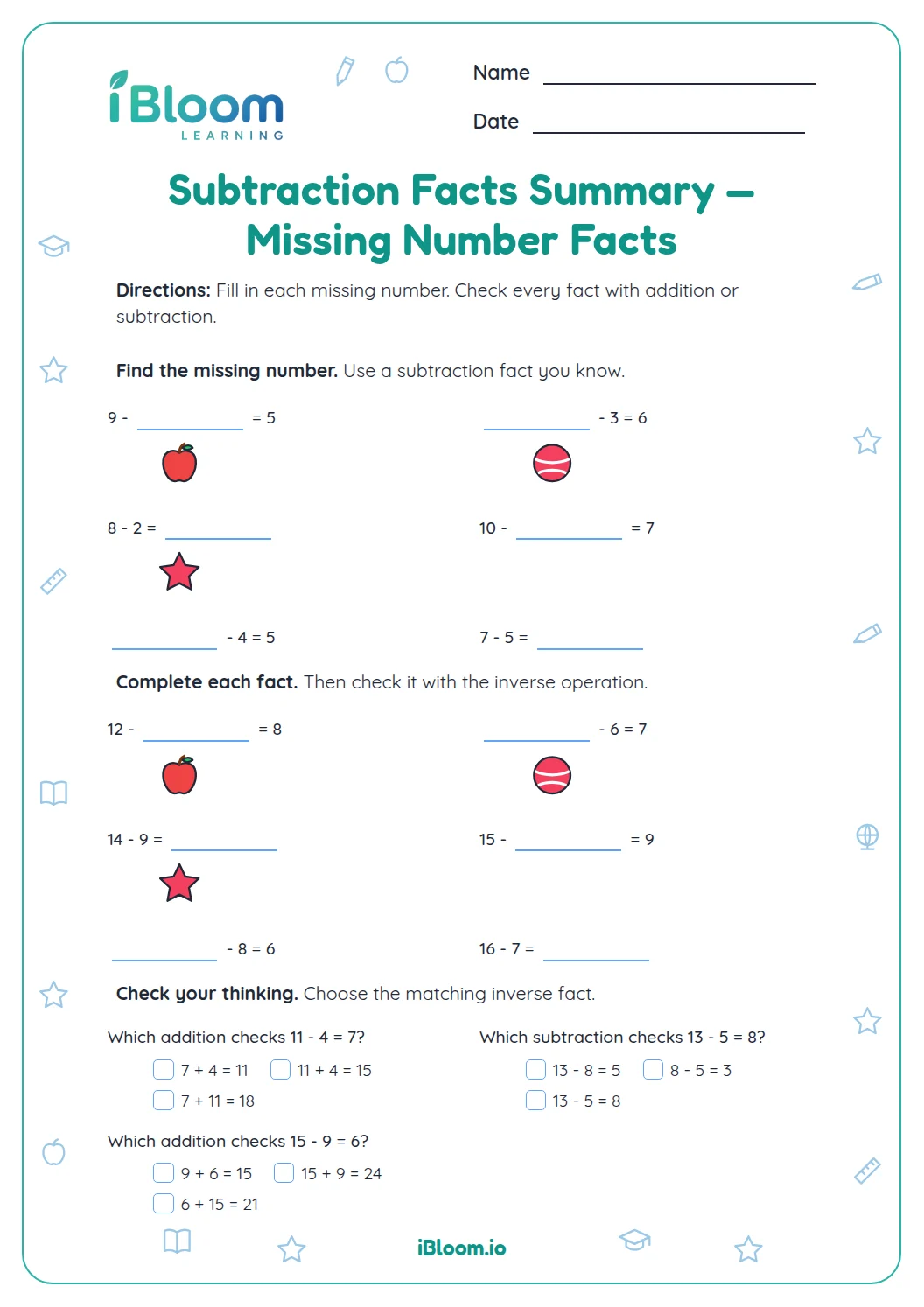
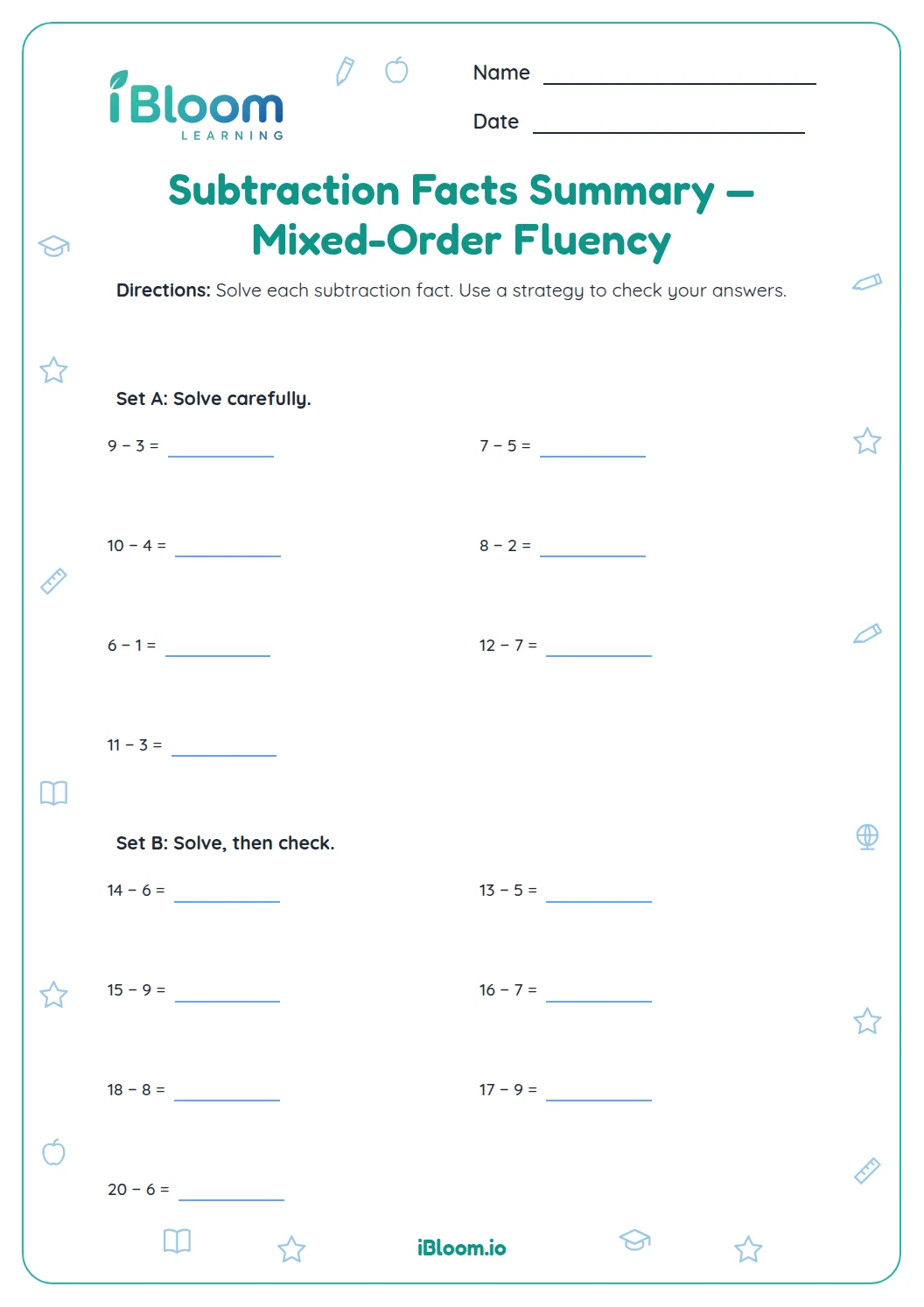
About this worksheet
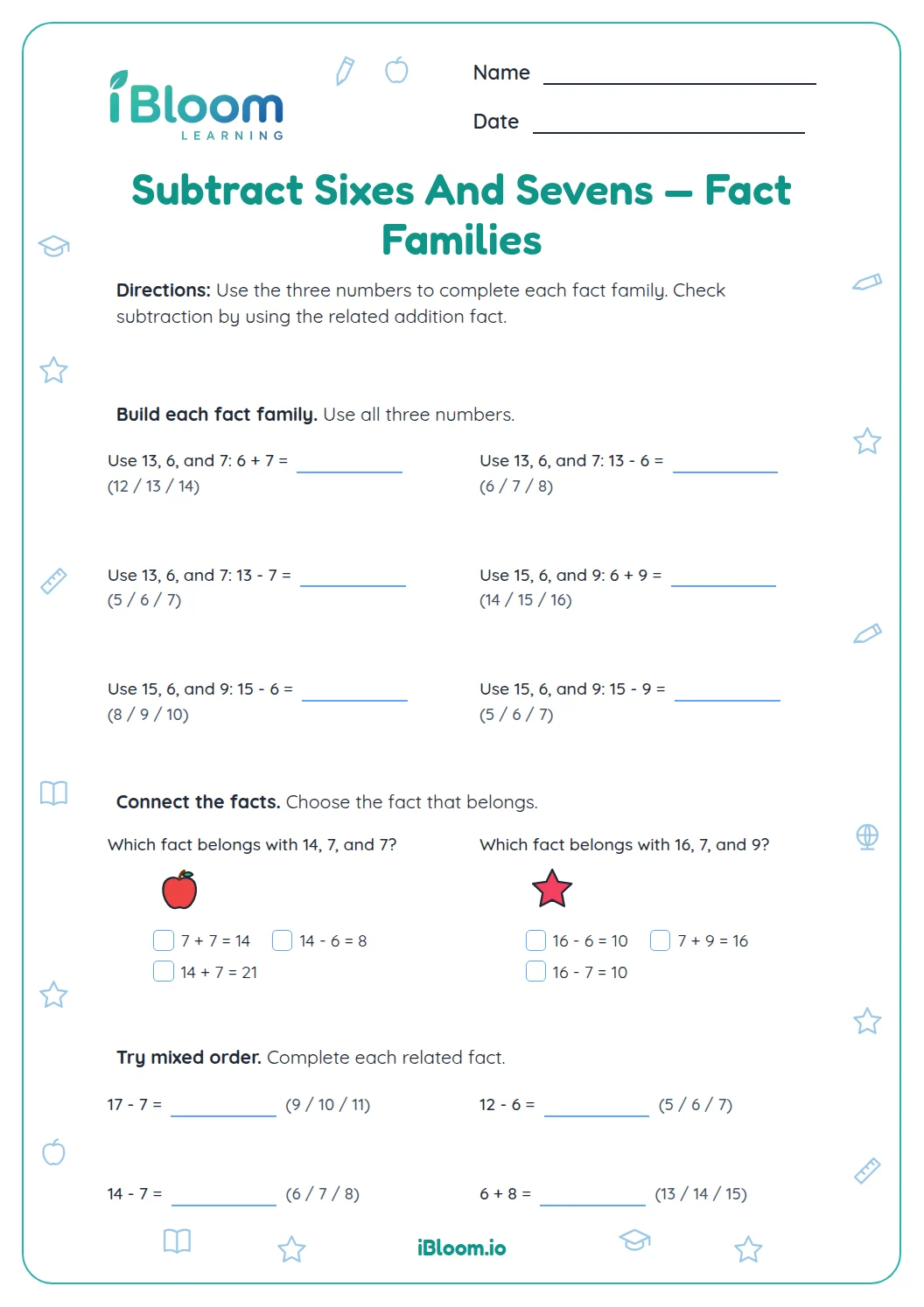
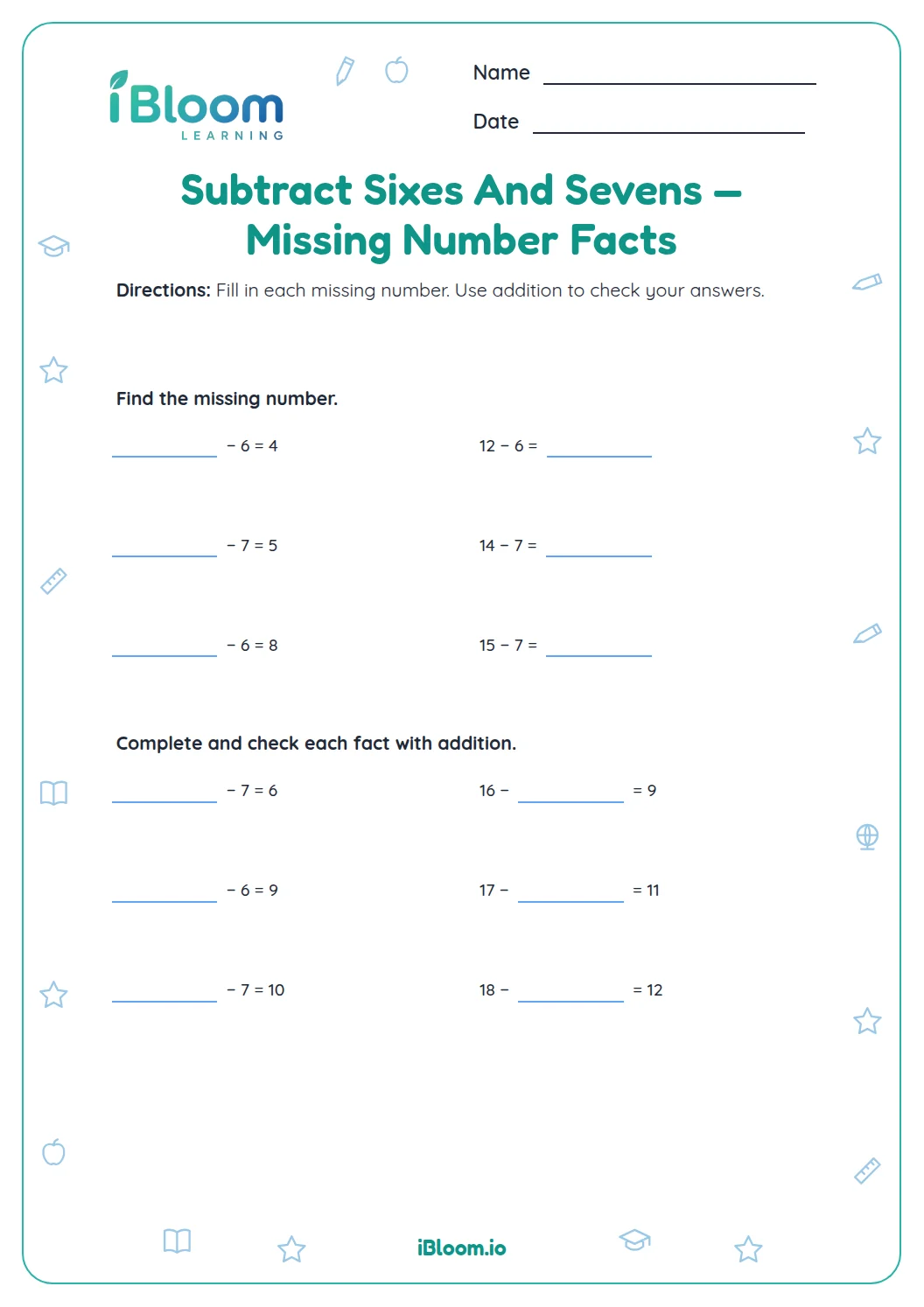
This free printable subtraction drill gives Grades 1–2 students 16 facts that subtract 6 or 7. Part A is an eight-question accuracy round. Part B mixes eight more facts and can be completed with or without a timer. Every starting number is within 20, and the answers include zero. The practice supports Common Core 2.OA.B.2 through mental subtraction strategies. Use the separate answer key to check accuracy before discussing the optional elapsed time.
Aligned to 2.OA.B.2
How should the two rounds be used?
Complete Part A without timing and check all eight answers. Part B is also a full practice round; an adult and child can choose to record elapsed time if the child wants to. There is no required time limit.
If you use a timer, start it at the first Part B fact and stop after the eighth. Record the elapsed time in the top margin and record correct answers separately, out of eight.
How does making ten help with 13 − 6?
Split the amount being taken away, not the starting number’s digits. Question 3 begins at 13, so take away 3 to reach 10. There are still 3 of the original 6 to subtract.
- 113 − 6
- 26 = 3 + 3
- 313 − 3 = 10
- 410 − 3 = 7
- 5Check: 7 + 6 = 13.
How do students check a subtraction fact?
Add the answer back to the number taken away. For 14 − 7 = 7, checking 7 + 7 = 14 confirms the result. For 7 − 7 = 0, the check is 0 + 7 = 7.
Both rounds mix subtract-six and subtract-seven facts. Students should read the second number every time instead of continuing the operation from the previous row.
How to use this worksheet
- 1Read the directions and agree that timing is optional.
- 2Complete the eight Part A facts without a timer.
- 3Check Part A with the key and revisit any uncertain facts.
- 4Complete Part B, recording elapsed time in the top margin only if chosen.
- 5Count correct Part B answers out of eight and review each mistake with addition.
Mistakes to look for
The mistake
Answering 13 − 6 as 8 after counting back only five steps.
The fix
Check with addition: 8 + 6 is 14, so try 7 + 6 = 13.
The mistake
Subtracting 6 on a row that asks for 7.
The fix
Point to the subtraction sign and second number before answering each row.
The mistake
Writing 1 for 7 − 7.
The fix
Taking away the whole amount leaves zero; check 0 + 7 = 7.
Common Core alignment
Use mental strategies to subtract 6 and 7 within 20.
On this sheet: Both rounds practice subtraction within 20, with addition facts available as checks.
Show the official wordingHide the official wording
Fluently add and subtract within 20 using mental strategies. By end of Grade 2, know from memory all sums of two one-digit numbers.
What to practice next
Make more practice
Further reading
Questions parents and teachers ask
Is a timer required for the second round?
No, timing is optional for Part B. Students can complete all 16 facts as ordinary practice. If you choose to time the second round, record elapsed time after finishing and check the eight answers separately. This keeps the accuracy result clear even when the pace changes.
How many facts subtract six and how many subtract seven?
There are eight facts subtracting six and eight subtracting seven. Each round contains four of each, arranged in mixed order. This gives equal attention to both subtrahends and asks students to reread the second number instead of assuming that every problem in a row works the same way.
Can students use fingers or counters?
Yes, a student can use fingers or counters to work out an uncertain fact. Ask them to explain the subtraction afterward and check it with addition. Once the eight accuracy-round answers make sense, they can try the second round mentally, using support again whenever they need it.
Why are zero answers included?
Zero answers show what happens when the whole starting amount is taken away. The facts 6 − 6 and 7 − 7 both equal zero. Checking with addition, such as 0 + 6 = 6, connects these facts to the same checking method used throughout the sheet.
What should I do with a missed fact?
Return to that fact without timing and ask the child to explain a strategy. For 13 − 6, a move to ten uses 3 and then 3 more. After correcting it, ask for the matching addition fact so the child has a second way to verify the answer.