






About this worksheet
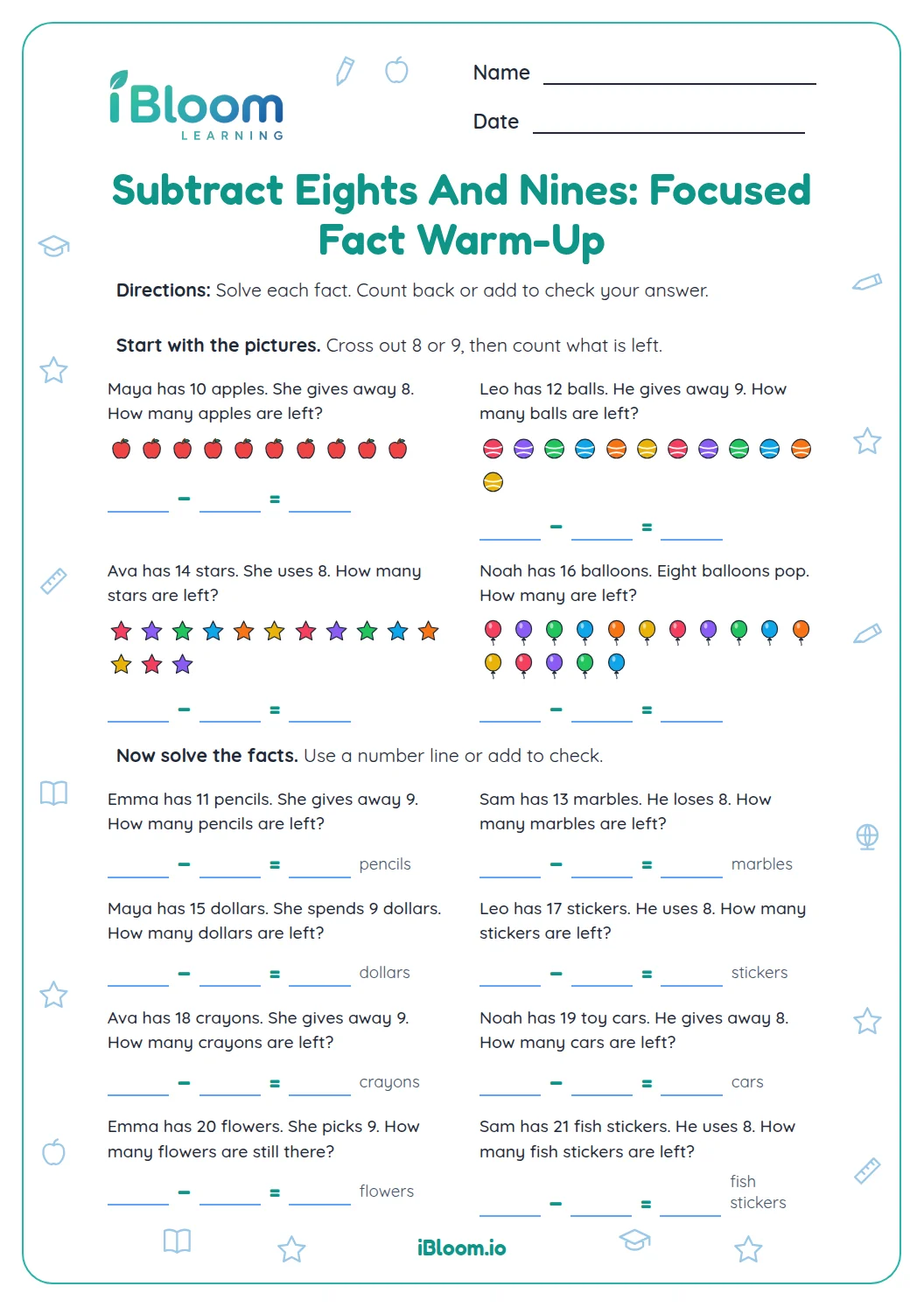
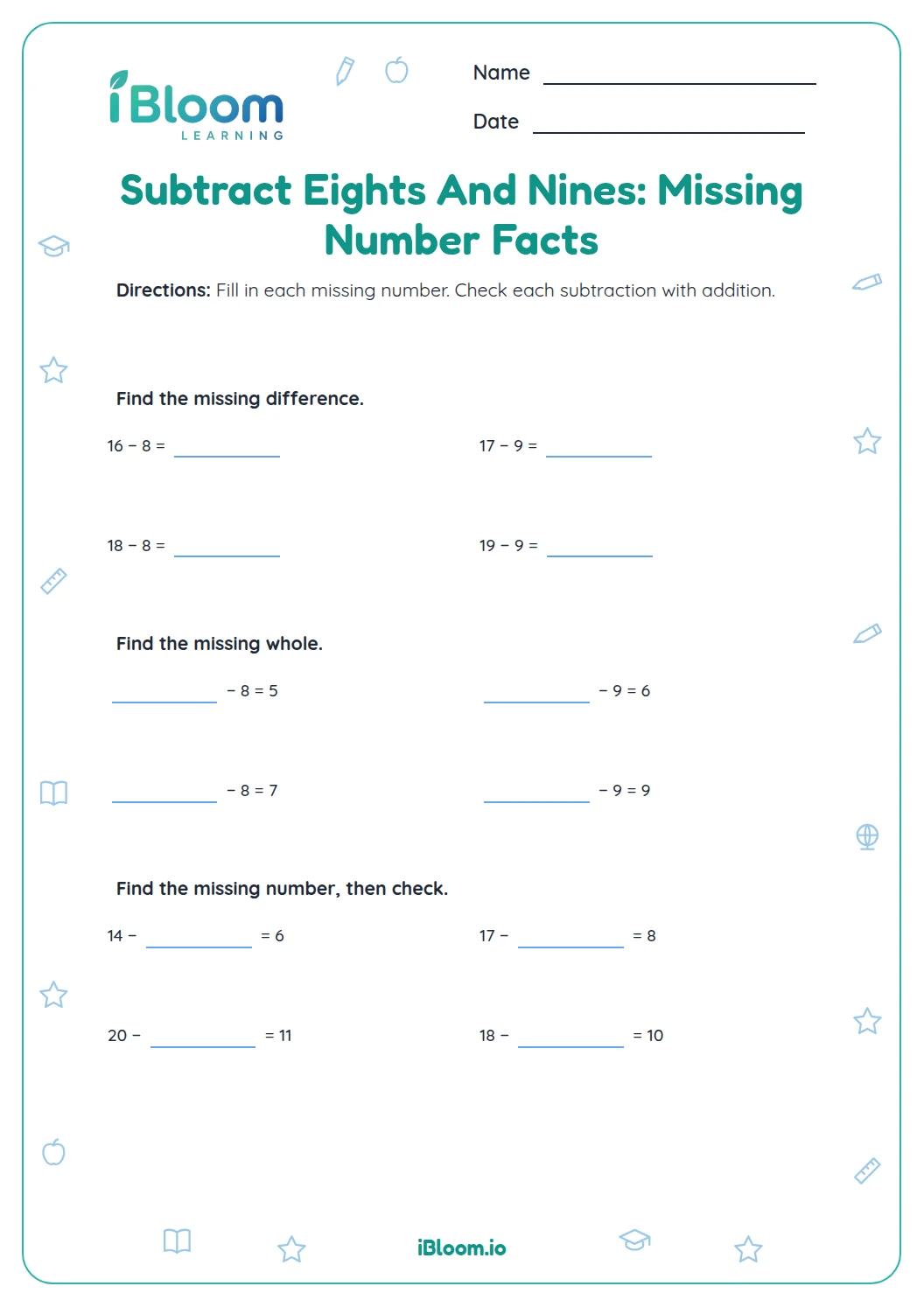
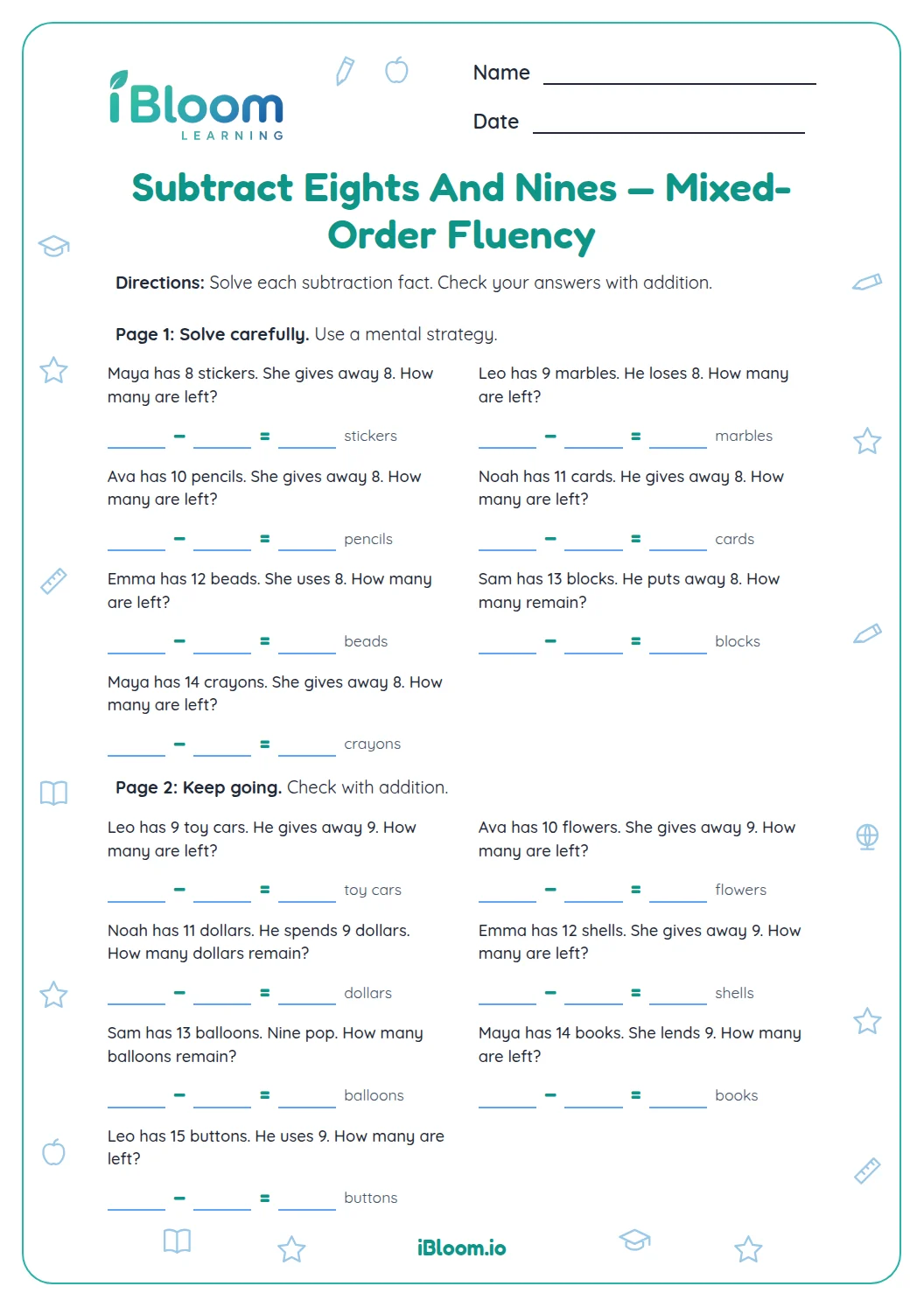
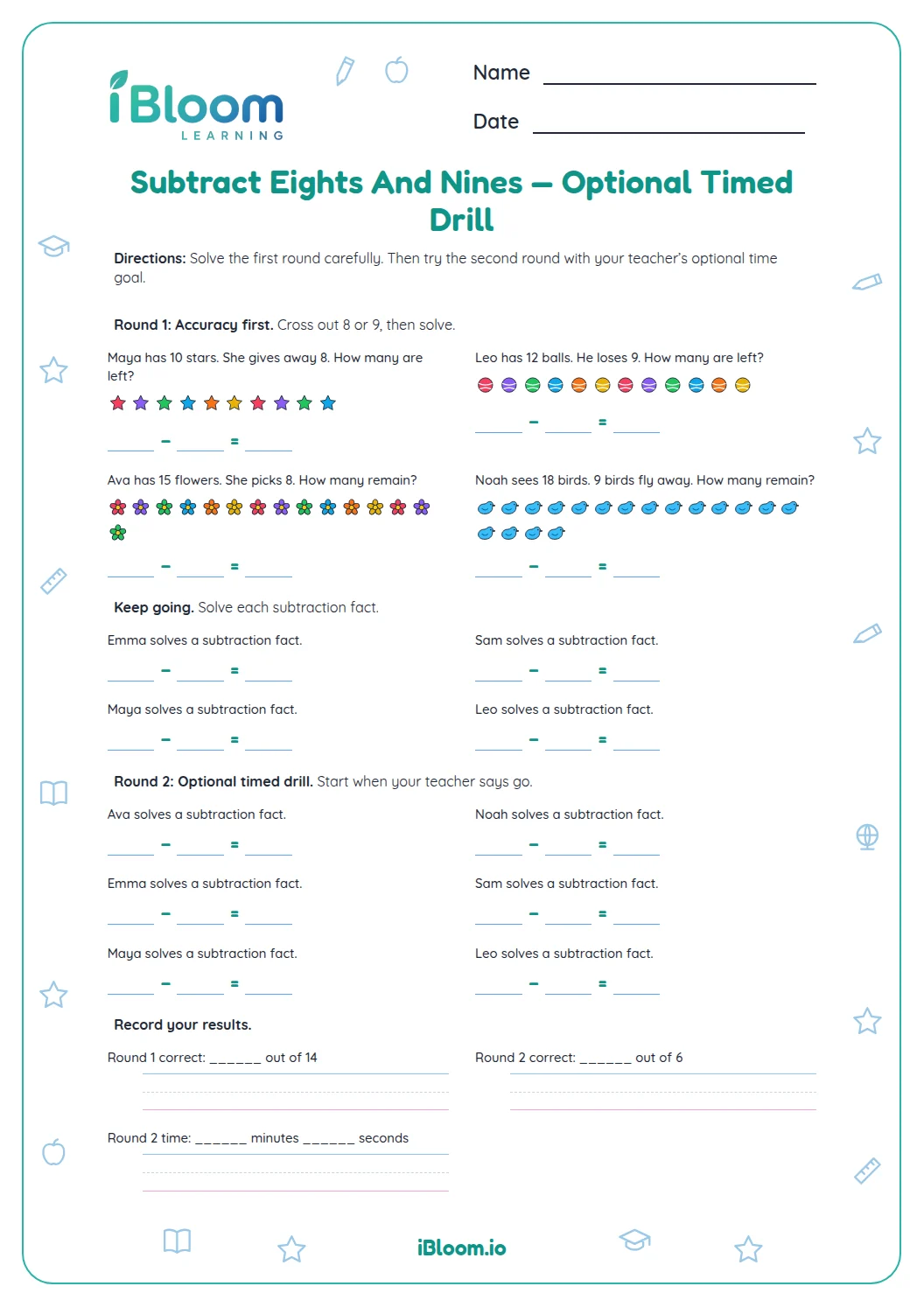
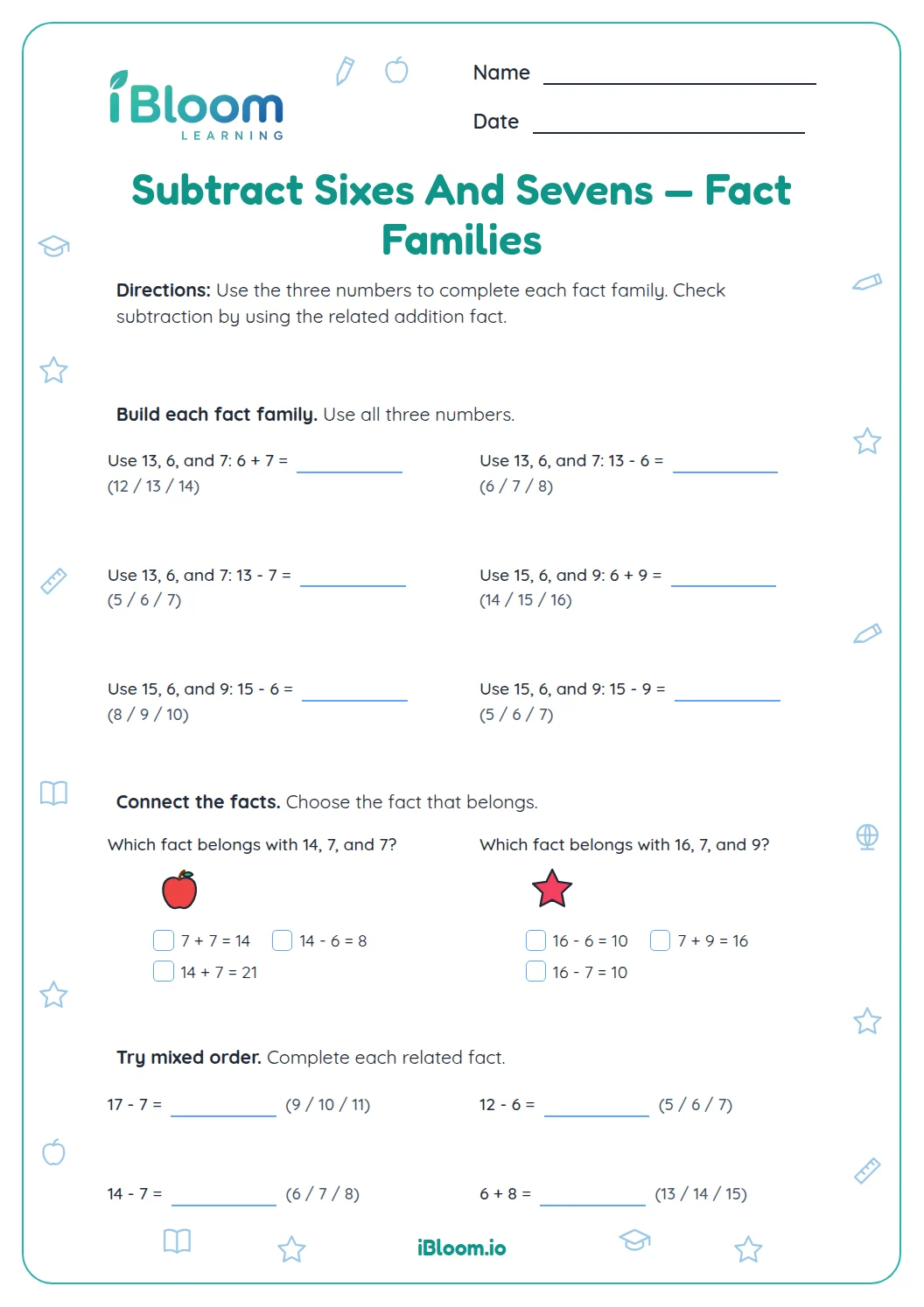
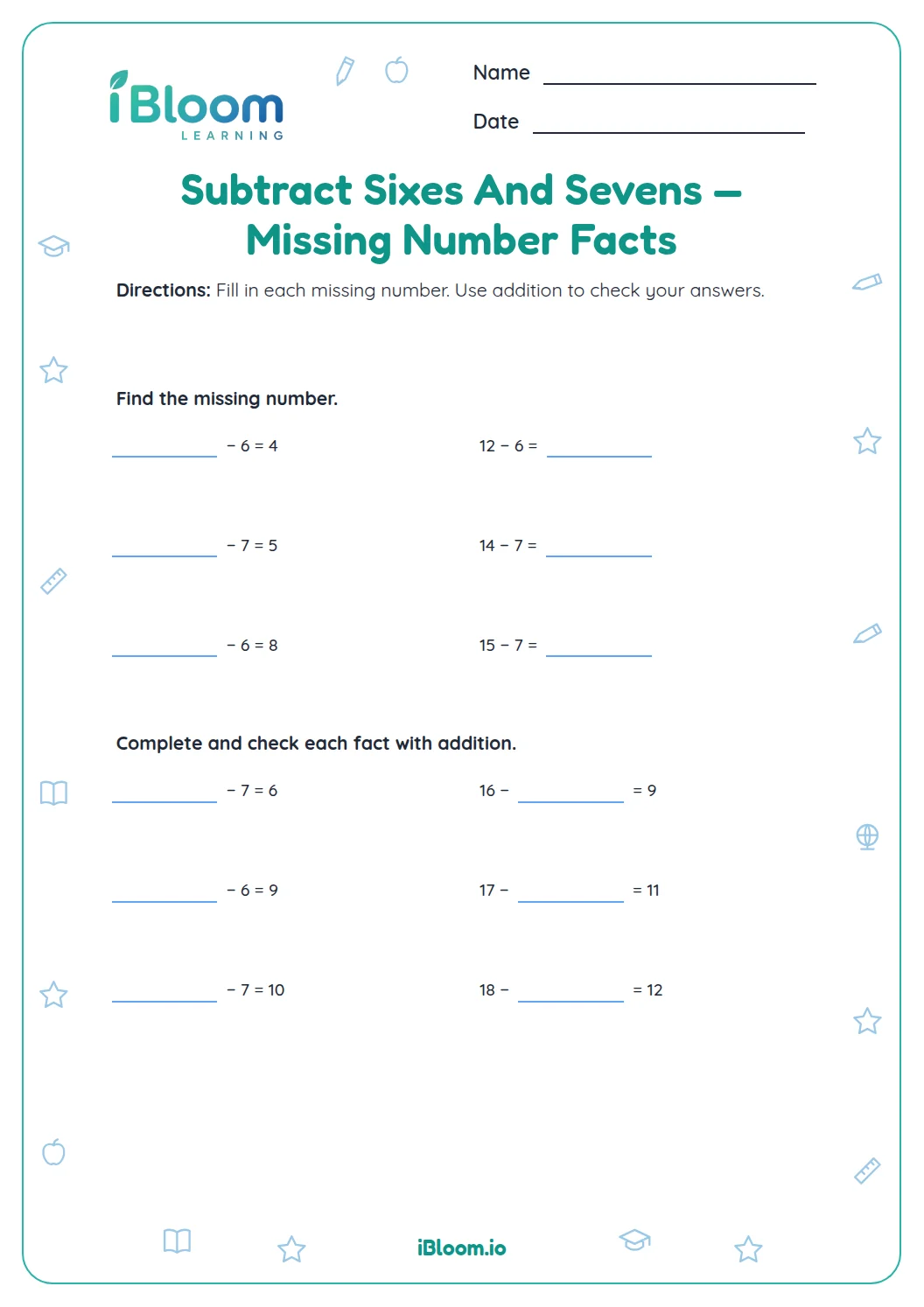
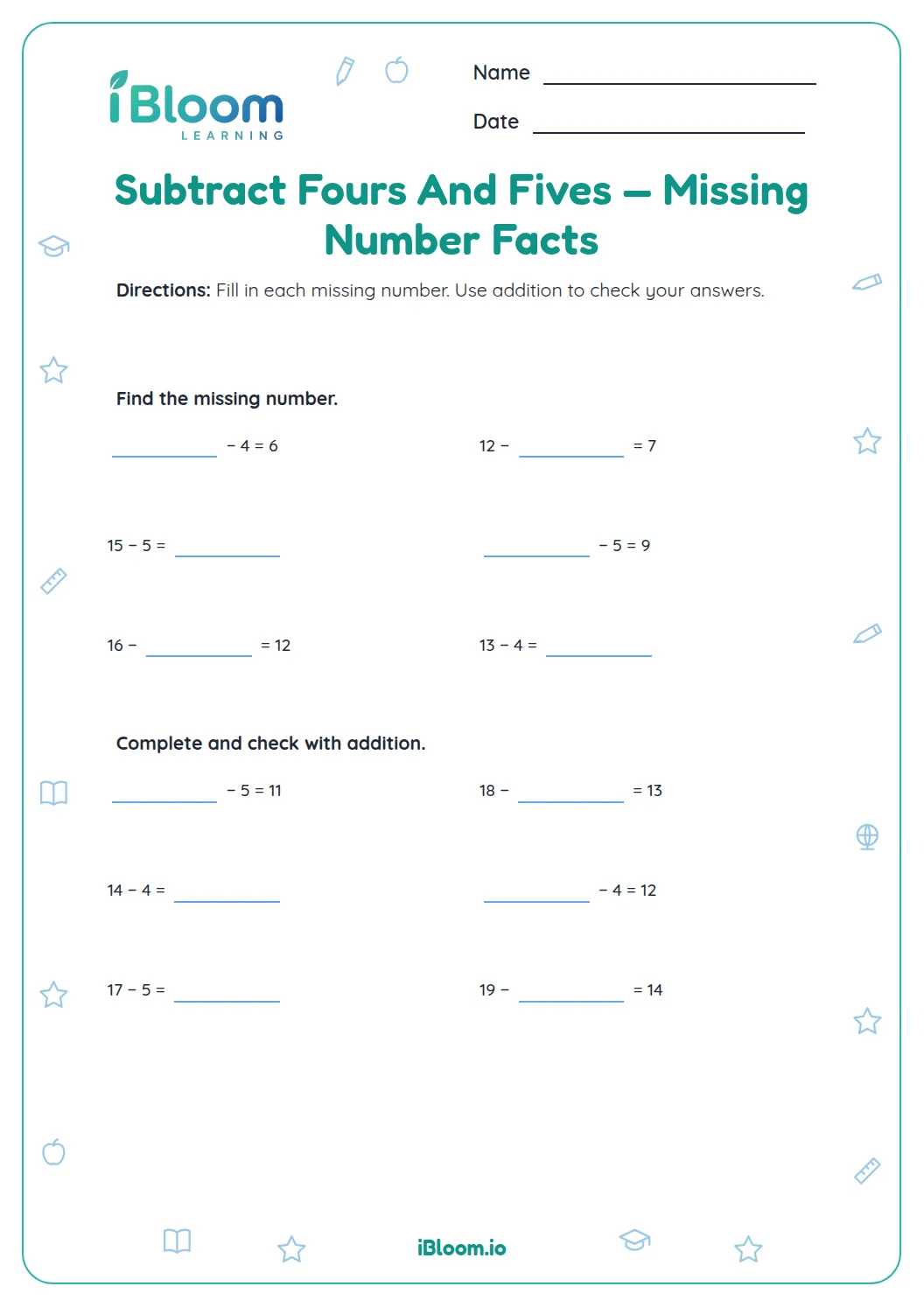
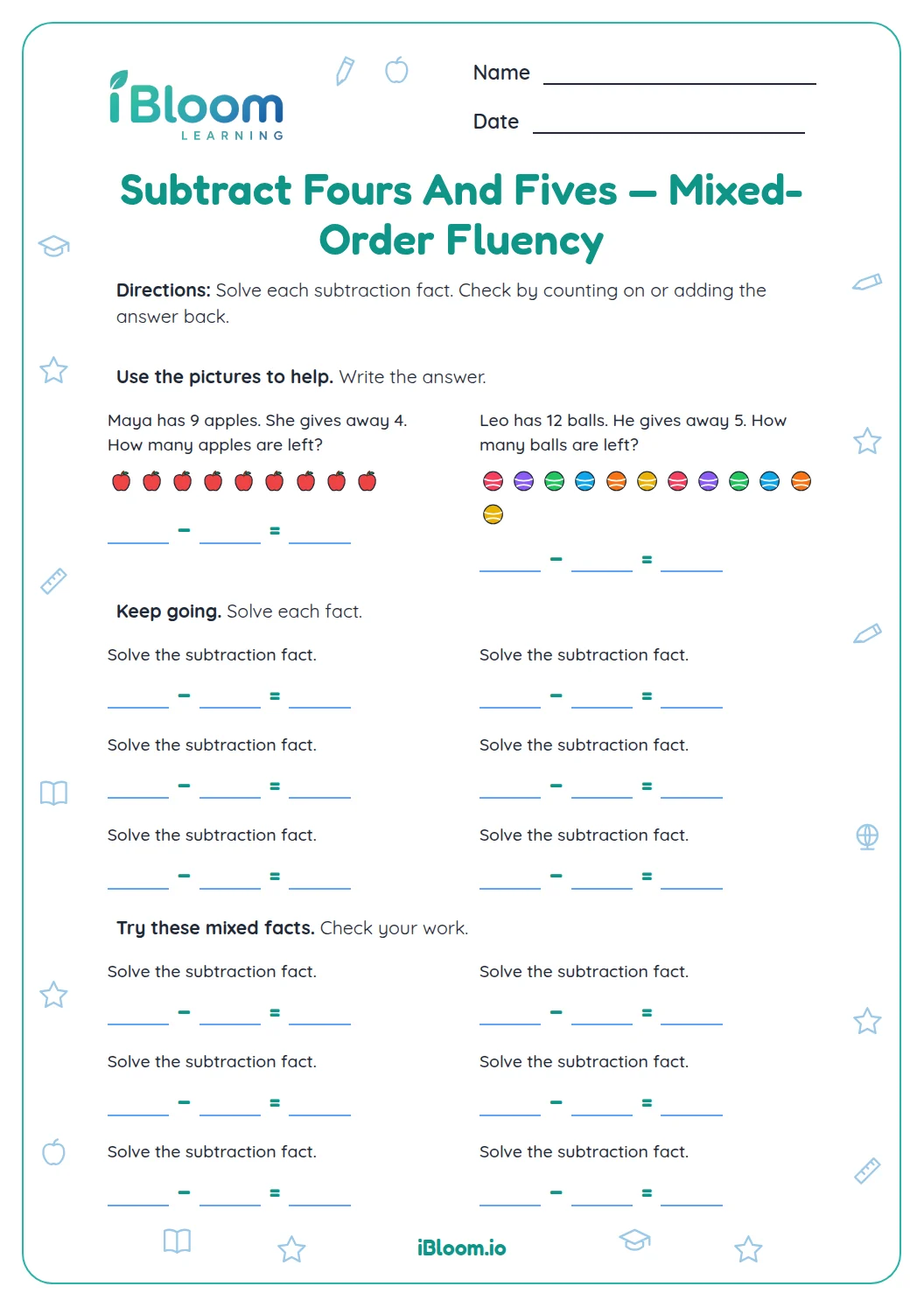
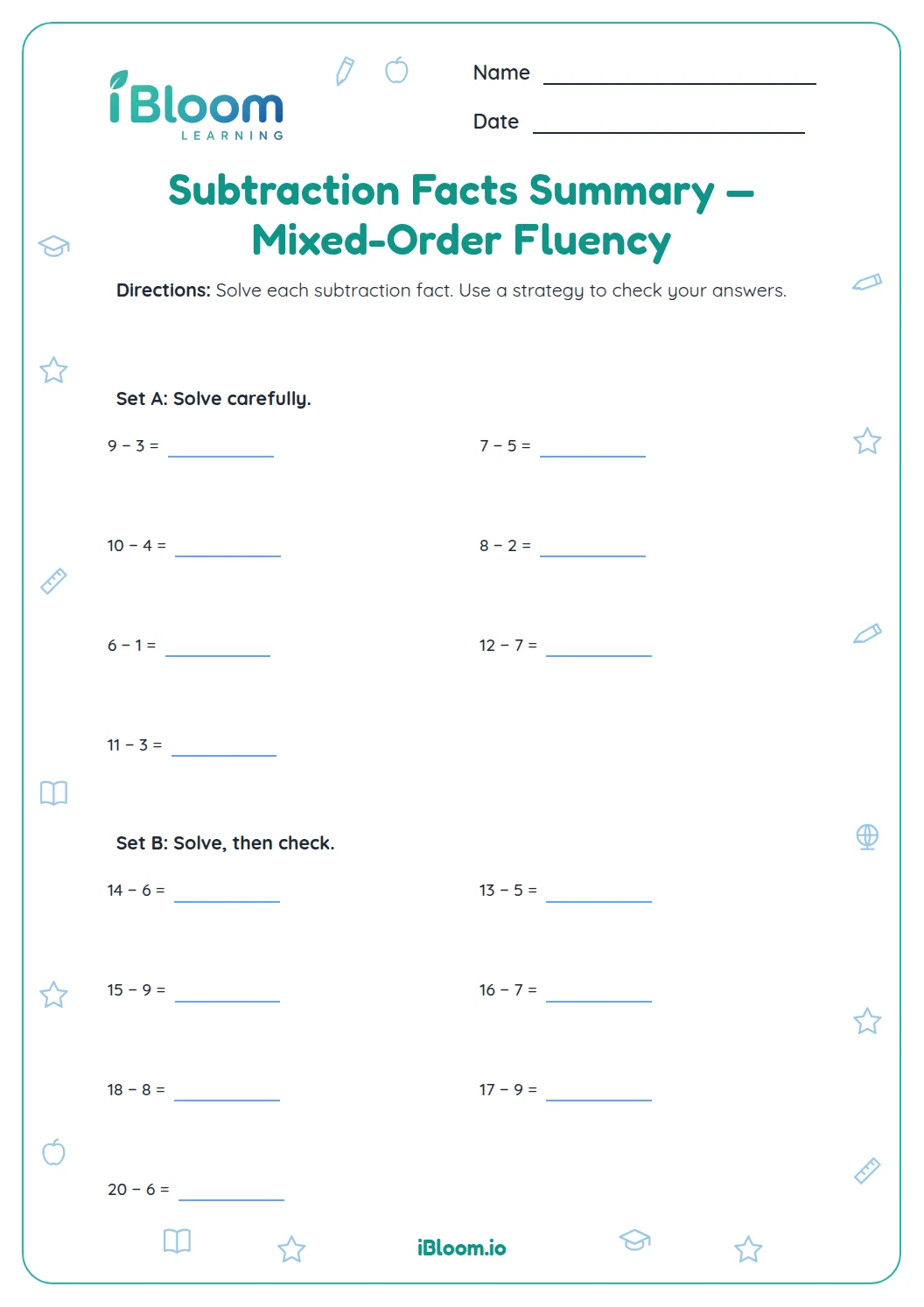
This free printable gives Grades 1–2 practice with subtraction facts that use 8 and 9. Learners find differences, missing minuends, and true equations in related fact families. The 19 questions stay within 20 and use the same three-number relationships, with a separate answer key.
Aligned to 2.OA.B.2
How can addition help with subtracting 8 or 9?
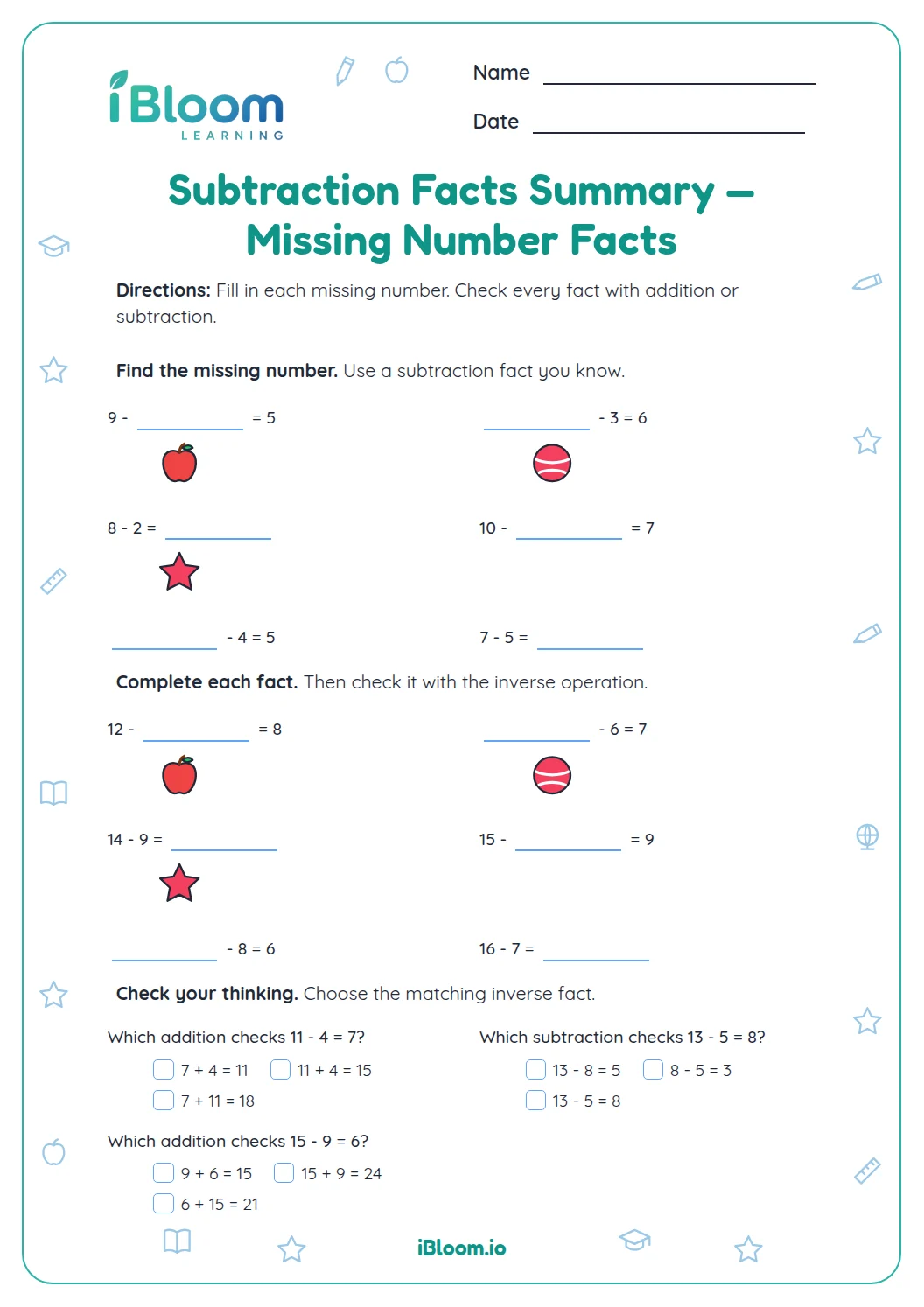
A subtraction fact can be checked with addition: difference + subtrahend = minuend. For question 2, 13 − 8 = 5 because 8 + 5 = 13. This related fact can also help a student find a difference without counting backward one number at a time.
- 113 − 8 = ___
- 2Think: 8 + what number makes 13?
- 38 + 5 = 13, so 13 − 8 = 5.
- Part A: subtract 8 or 9 (1–6)
- Part B: find a missing starting number (7–11)
- Part C: recognize and complete related facts (12–18)
How do you find a missing starting number?
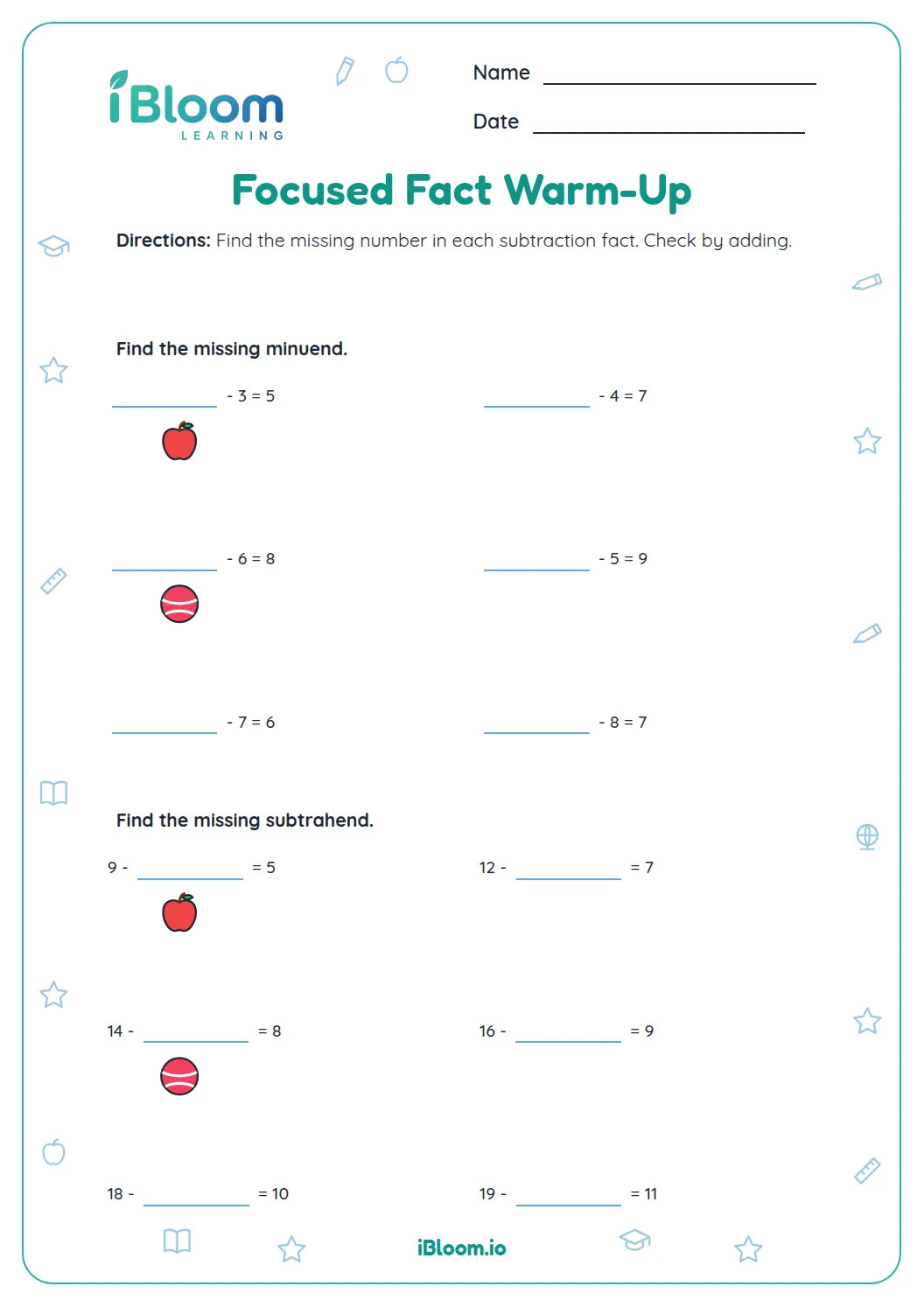
When the first number is missing, add the number being subtracted and the difference. In question 7, ___ − 8 = 5, combine 8 and 5 to find 13. Check by subtracting: 13 − 8 returns 5.
- 1___ − 8 = 5
- 28 + 5 = 13
- 3The missing minuend is 13.
Which equations belong to one fact family?
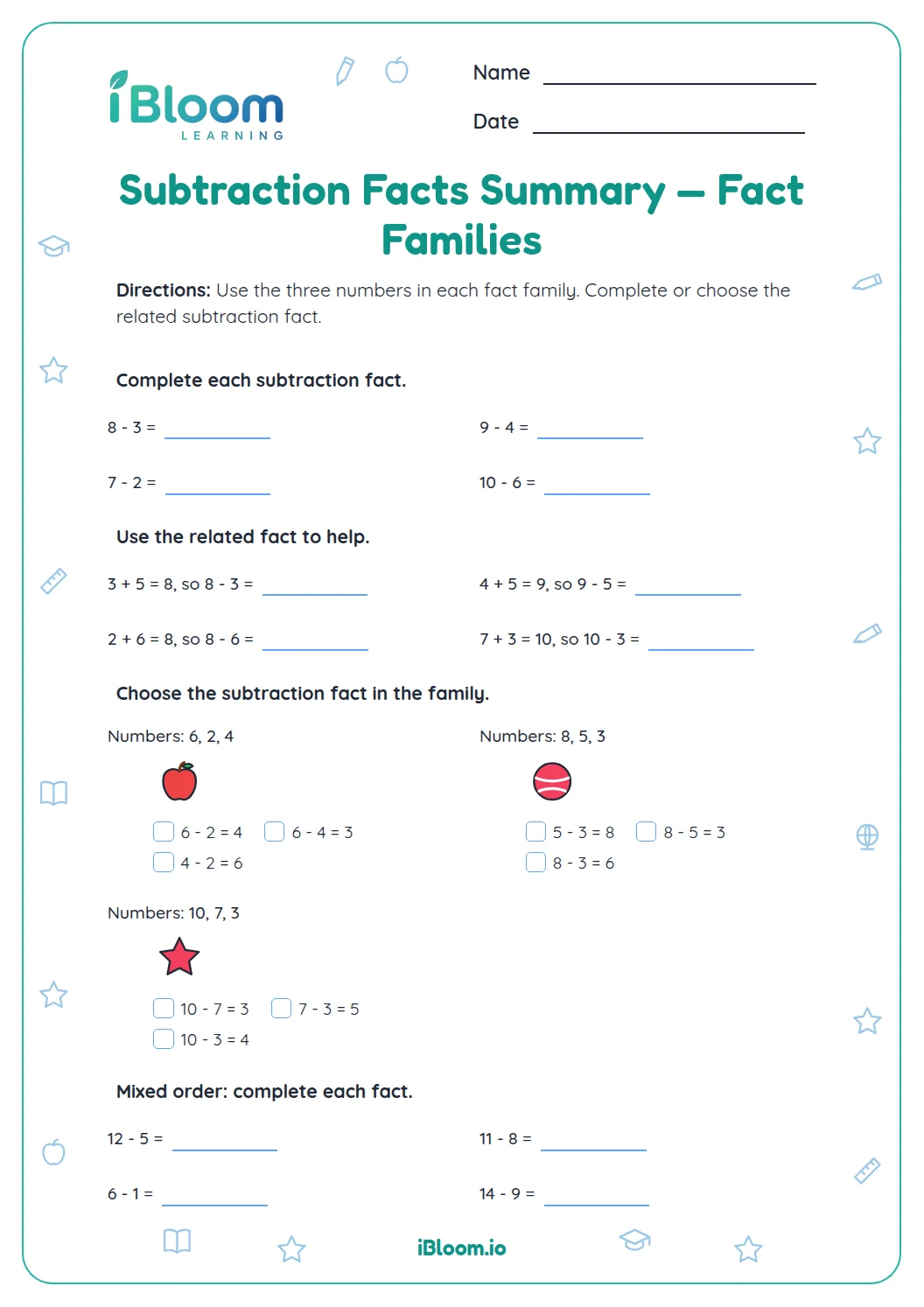
A fact family keeps the same three numbers and changes the operation or order. With 8, 7 and 15, addition makes 15 from 8 and 7; subtraction starts at 15 and removes one part. Check that every choice uses those same numbers and is true.
How to use the fact-family worksheet
- 1Read the operation sign and identify the number being subtracted.
- 2For a difference, ask what number plus the subtrahend makes the minuend.
- 3For a missing minuend, add the two known numbers.
- 4In a fact-family choice, check both the numbers and the equation.
- 5Use the related addition fact to check each subtraction answer.
Common mistakes and quick fixes
The mistake
Subtracting 9 when the equation says subtract 8.
The fix
Point to the minus sign and the number after it before solving; then use that same number in the addition check.
The mistake
Writing the difference as the missing minuend.
The fix
For ___ − 8 = 5, add 8 + 5 to find the starting number, 13.
The mistake
Choosing a family equation that looks familiar but uses a different number.
The fix
Check all three family numbers first, then verify the operation. A related fact must use the same whole and both parts.
Common Core alignment
Use mental strategies to add and subtract within 20.
On this sheet: The 18 equations practice subtraction facts with 8 and 9 and their related addition facts within 20.
Show the official wordingHide the official wording
Fluently add and subtract within 20 using mental strategies. By end of Grade 2, know from memory all sums of two one-digit numbers.
What to practice next
Make more practice
Further reading
Questions parents and teachers ask
How does a subtraction fact family work?
A fact family uses the same three numbers in addition and subtraction equations. For 15, 8 and 7, the facts include 8 + 7 = 15, 15 − 8 = 7 and 15 − 7 = 8. Questions 12–15 ask learners to identify a true equation using the named family.
Why does the worksheet focus on 8 and 9?
The first facts practice subtracting 8 or 9 from a number no greater than 18. Later questions use those numbers in related facts, so students can connect a subtraction result to an addition fact they may already know. Each part includes a different kind of check.
What is a missing minuend?
The minuend is the number a subtraction problem starts with. In question 7, ___ − 8 = 5, the missing whole is 13 because 13 − 8 = 5. Addition provides a check: 8 + 5 = 13. This is why adding can help solve subtraction.
How can my child check a subtraction answer?
Add the difference to the number being subtracted. If 16 − 8 = 8, then 8 + 8 must equal 16. Questions 16–19 state a related fact and ask for the missing number, giving practice moving between the two operations.
How many questions are on the fact-family sheet?
There are 19 questions in four parts: six subtraction facts, five missing minuends, four choices about a fact family, and four related-fact blanks. The printable includes a separate answer key so each equation can be checked quickly, with related addition facts shown in the key.