




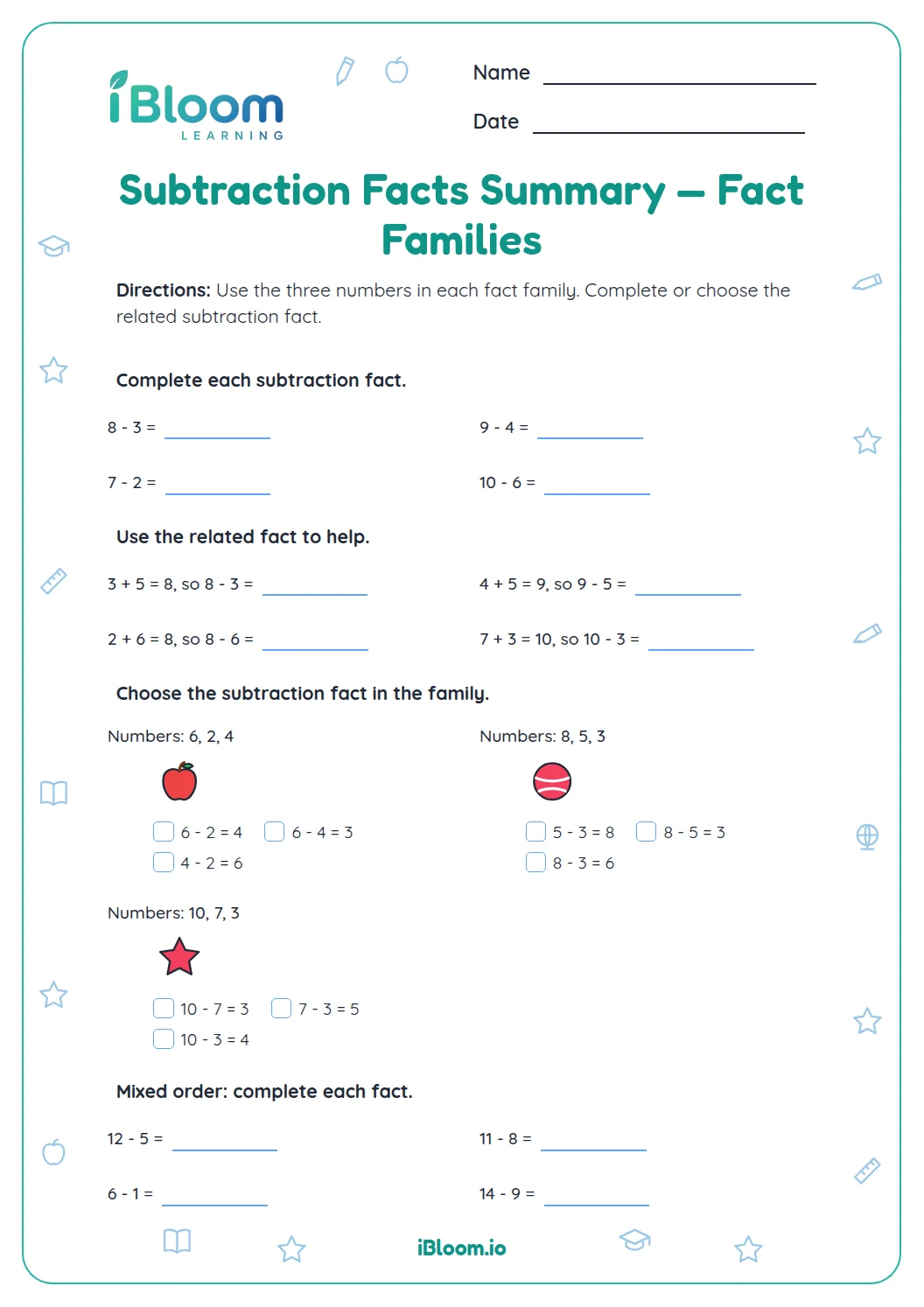
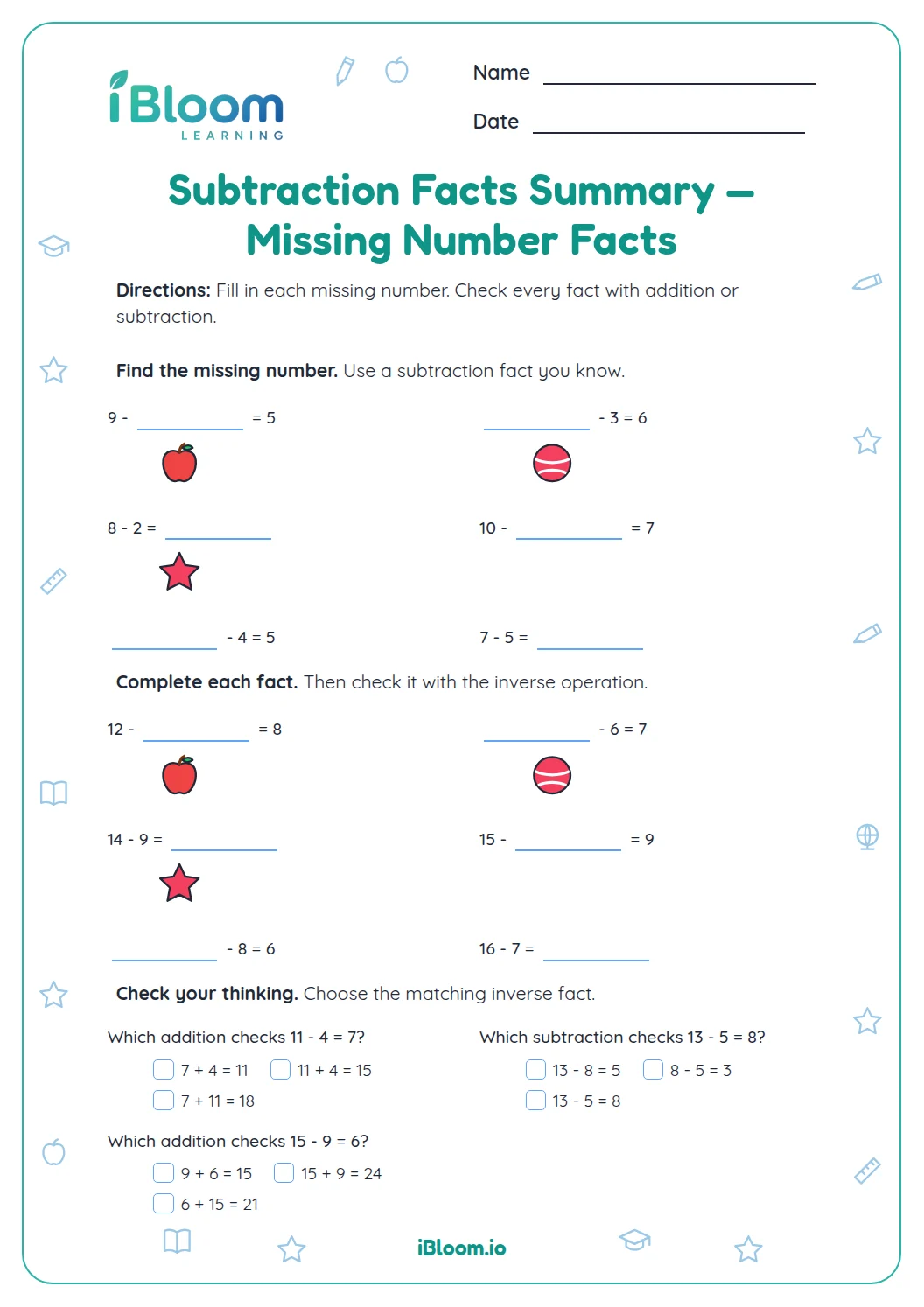
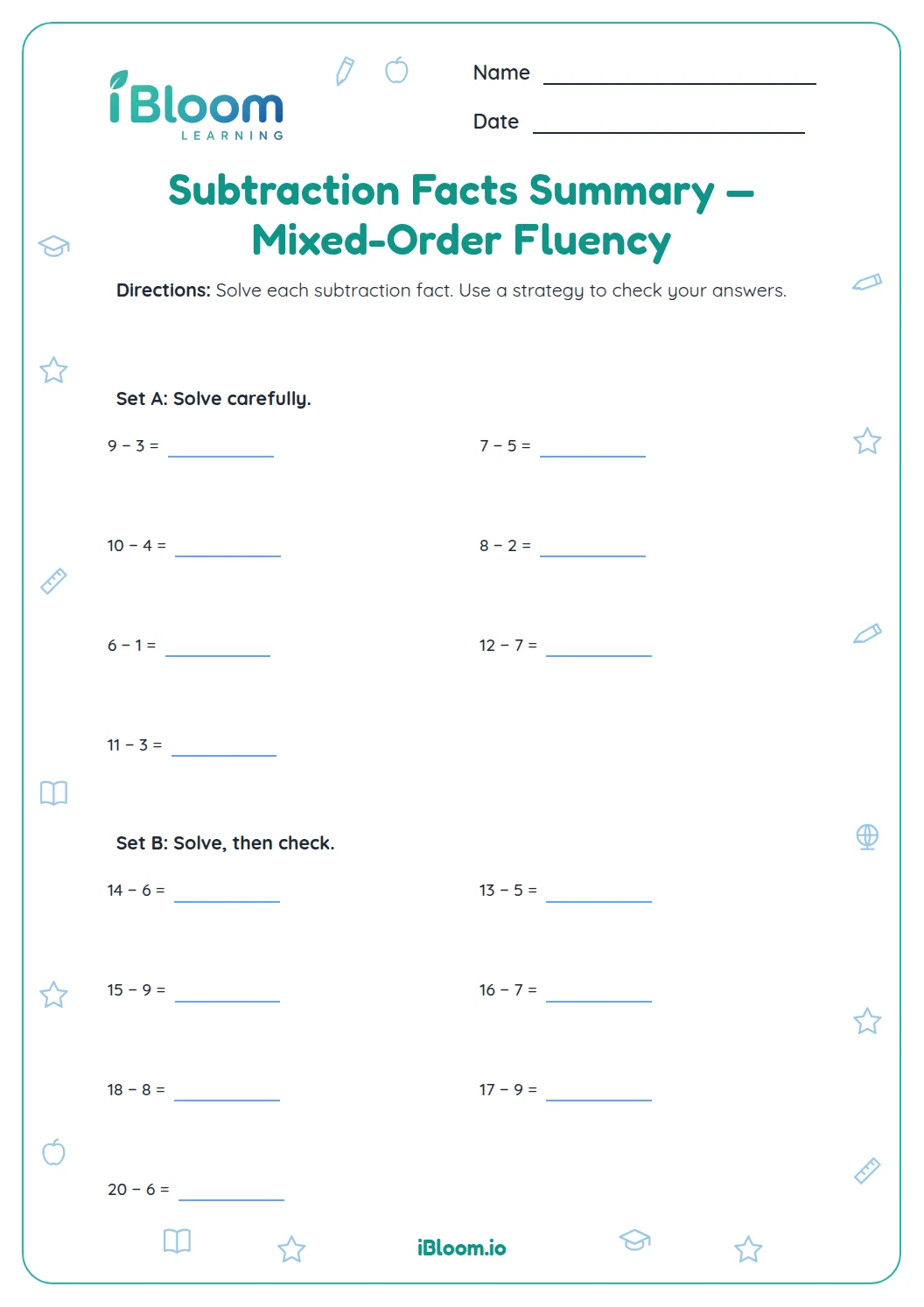
About this worksheet
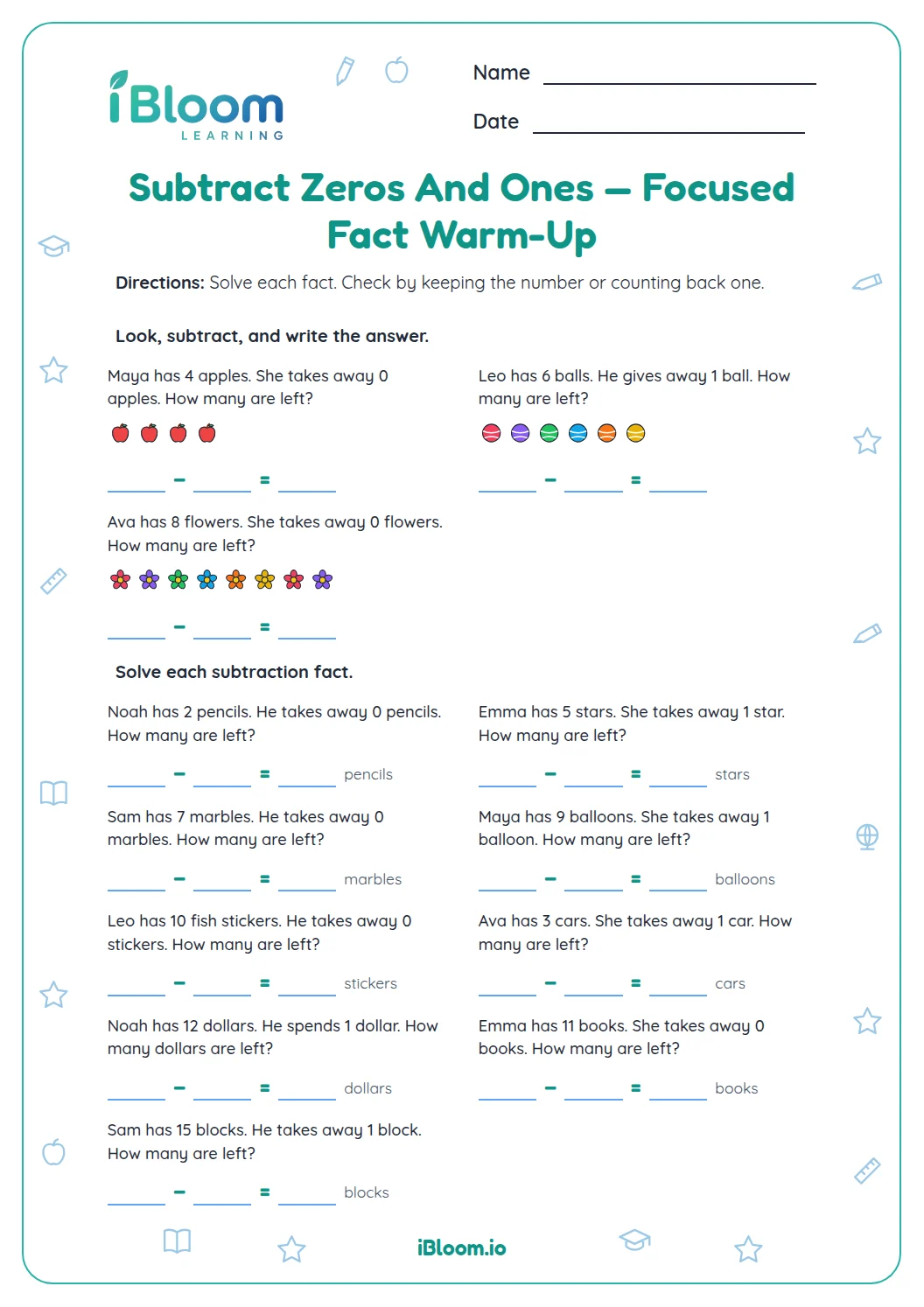
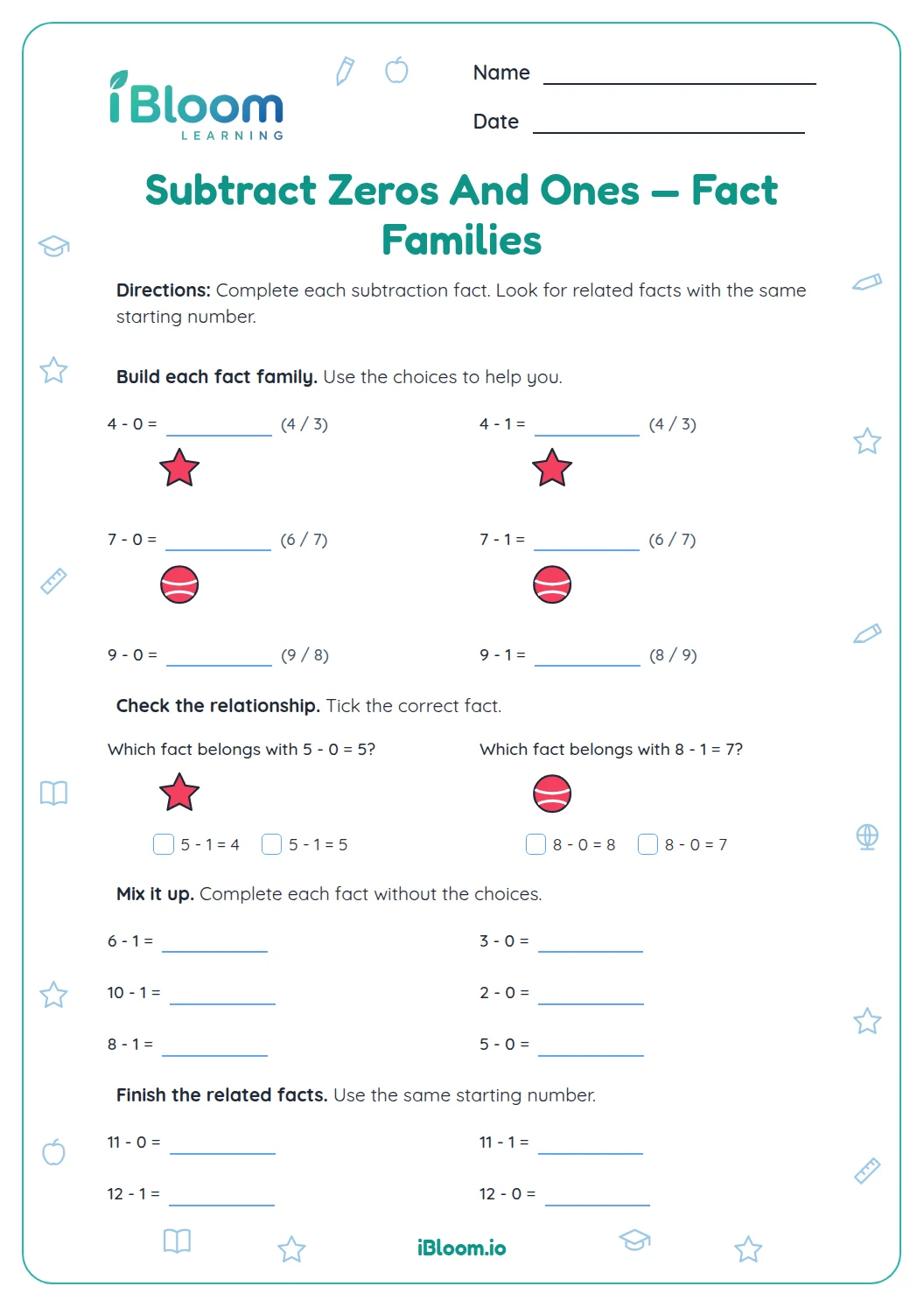
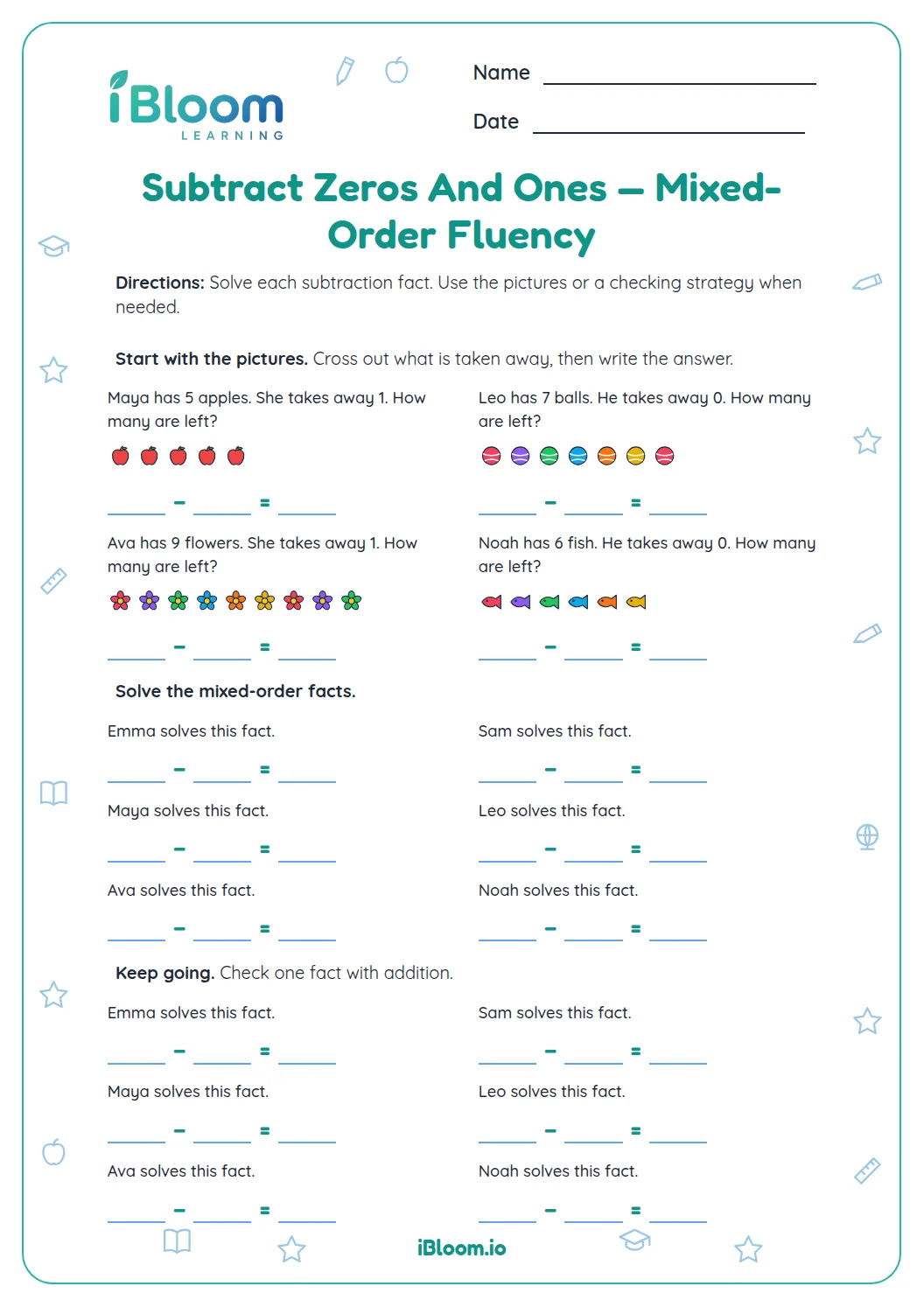
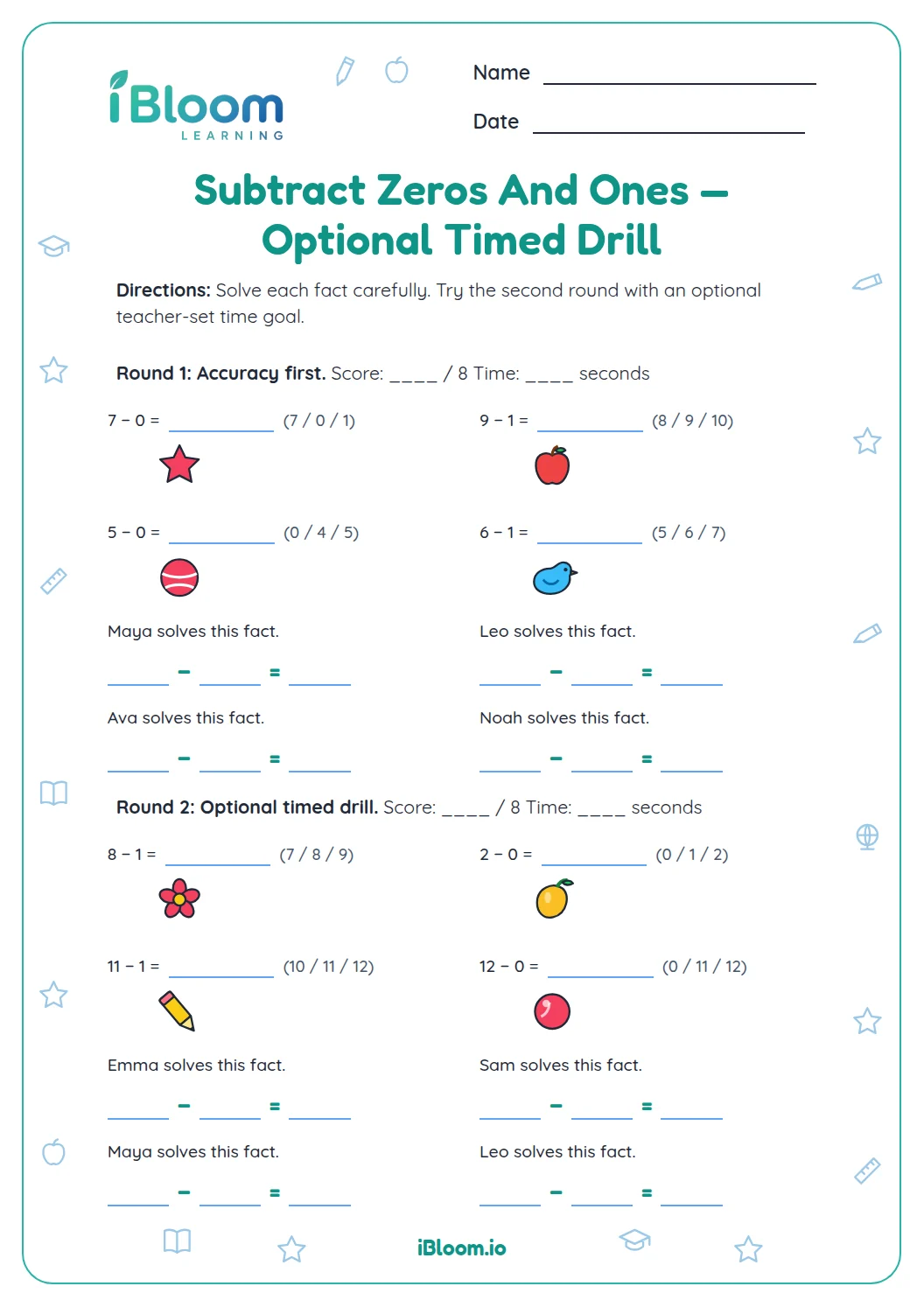
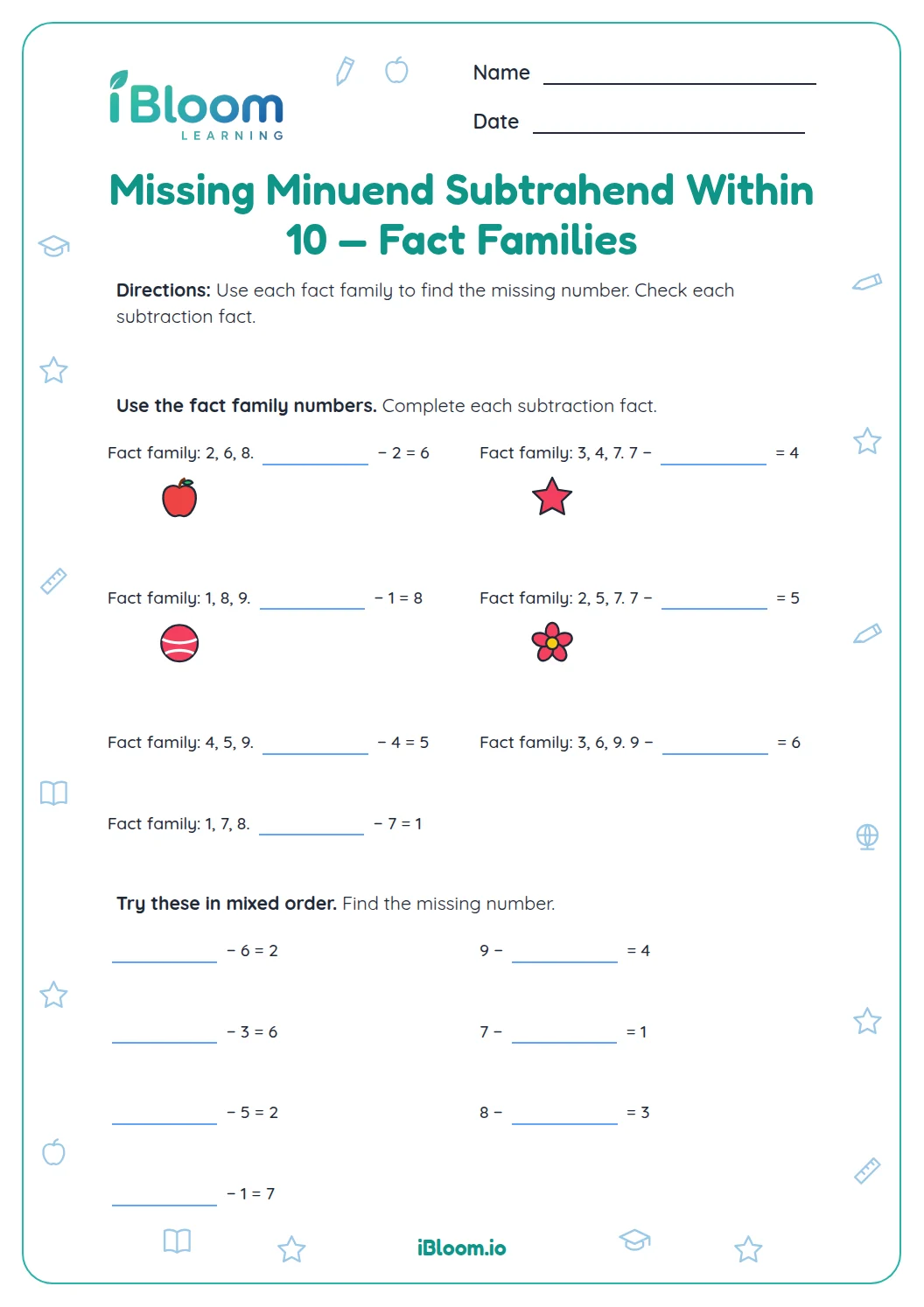
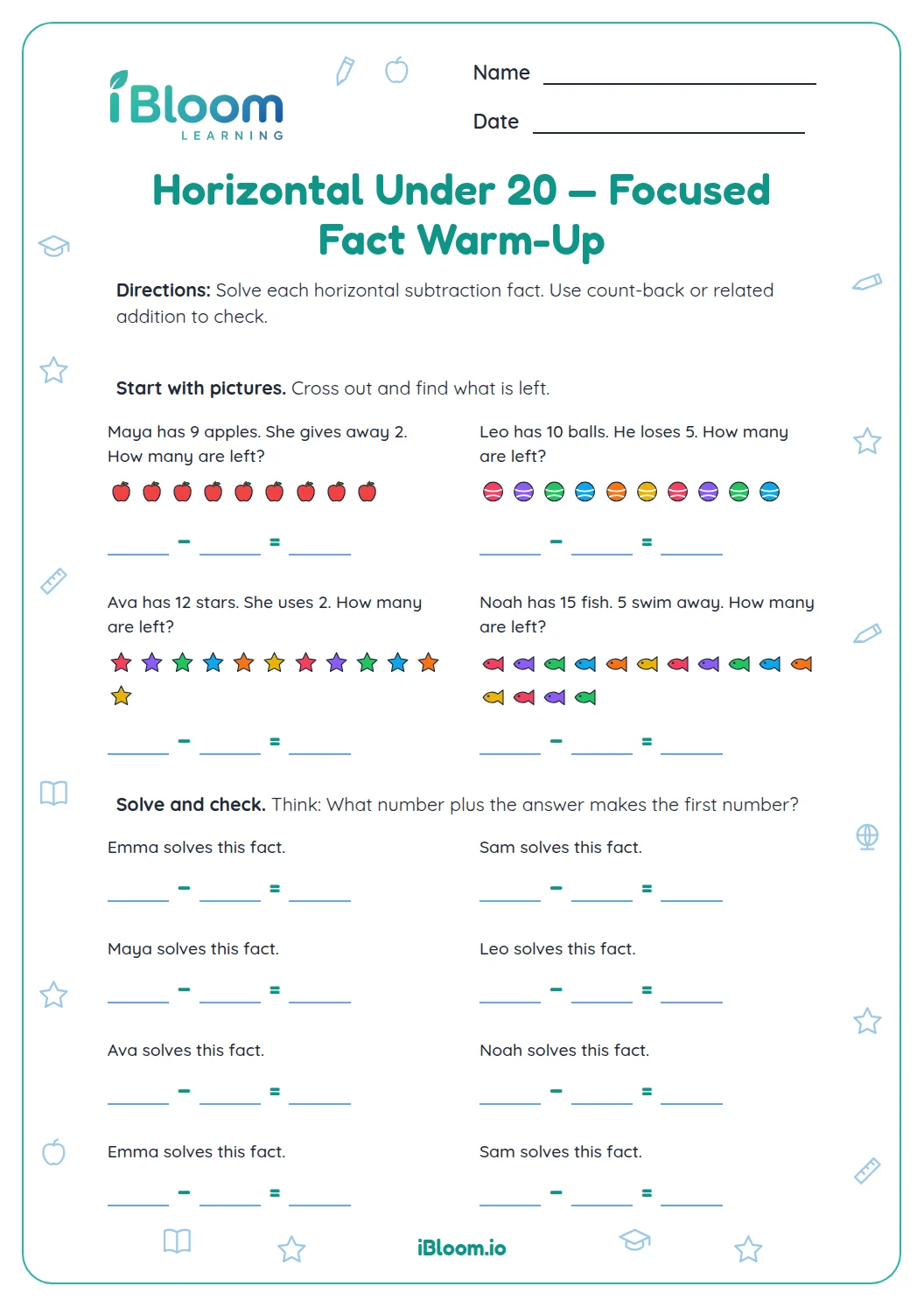
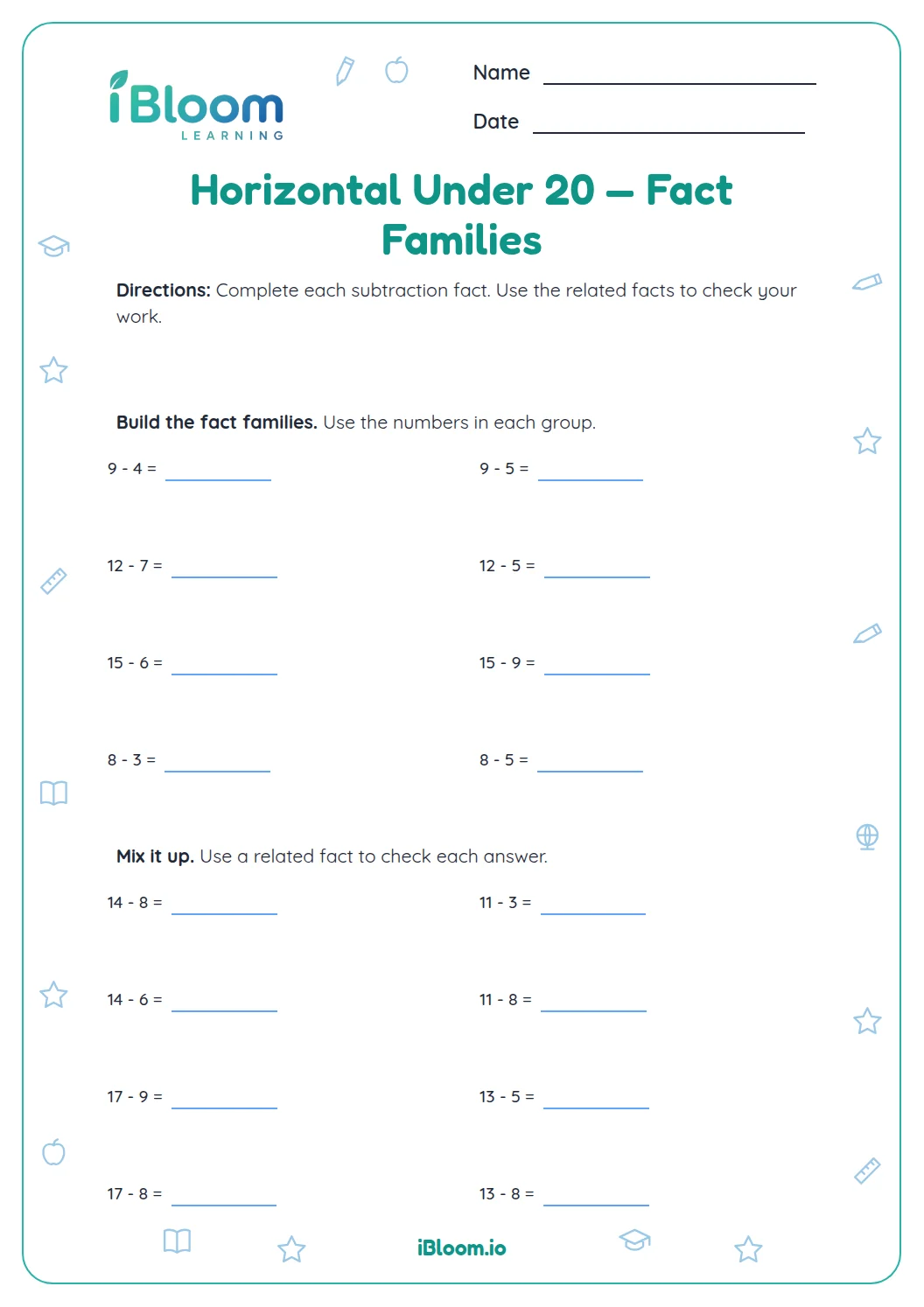
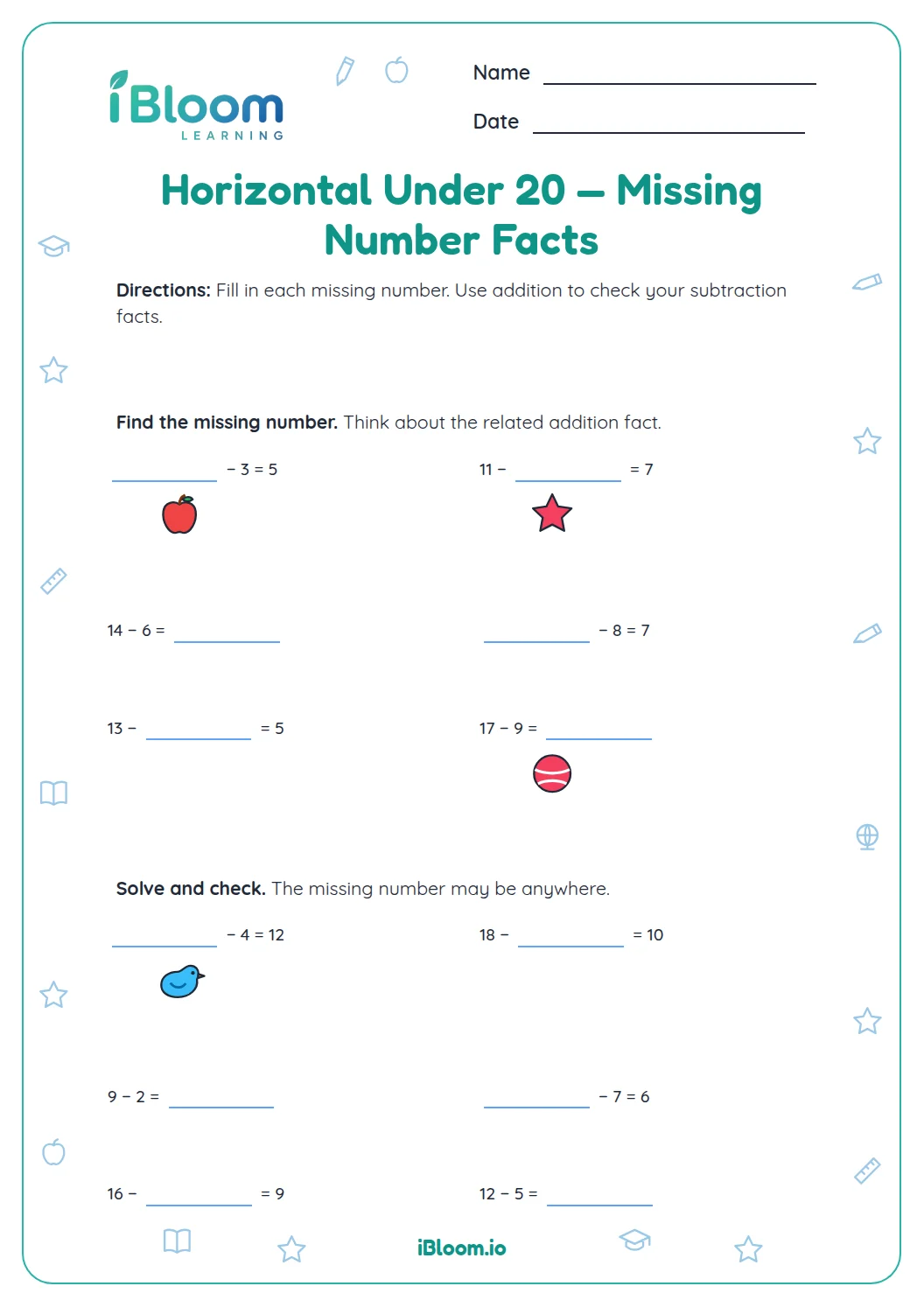
This Grade 1 printable focuses on subtraction facts with zero and one. Fourteen short number sentences vary the missing part: the starting number, the number being taken away, or the difference. Children use the relationship between subtraction and the known numbers to complete each fact, then check their work with the separate answer key.
Aligned to 1.OA.C.6
Which number can be missing in a subtraction fact?
The blank can replace the starting number, the number taken away, or the difference. Check the numbers around the blank to see which part of the fact you need to find.
What happens when you subtract zero?
Subtracting zero leaves the starting number unchanged. For 9 − ___ = 9, the missing number is 0 because taking away nothing leaves 9.
How does subtracting one change the number?
Subtracting one gives the number just before the starting number. For ___ − 1 = 4, the starting number must be 5.
- 1___ − 1 = 4
- 2Count one number forward from 4: the starting number is 5.
How to find each missing number
- 1Read the subtraction fact from left to right.
- 2Identify whether the blank is the starting number, number taken away, or answer.
- 3Use the zero rule when zero is subtracted: the difference stays the same.
- 4Use the one rule when one is subtracted: the difference is one less.
- 5Fill the blank and reread the full number sentence.
- 6Check with the answer key.
Common mistakes and quick fixes
The mistake
Writing zero for every blank in a fact that includes zero.
The fix
Find the blank’s position. In ___ − 0 = 8, the starting number is 8.
The mistake
Changing the starting number in 10 − 0 = ___.
The fix
Subtracting zero changes nothing, so the difference remains 10.
The mistake
Using the difference as the starting number in ___ − 1 = 4.
The fix
The starting number is one more than the difference, so it is 5.
Curriculum alignment
This worksheet gives focused practice with a skill in the Common Core State Standards.
Use subtraction relationships to complete facts within 20.
On this sheet: All 14 facts use subtraction within 20, emphasizing zero and one and varying the missing number.
Show the official wordingHide the official wording
Add and subtract within 20, demonstrating fluency for addition and subtraction within 10.
What to practice next
Make more practice
Further reading
Questions parents and teachers ask
What happens when you subtract zero?
Subtracting zero leaves the starting number unchanged. For example, 10 − 0 = 10. In 9 − ___ = 9, the missing number is zero because subtracting nothing keeps the answer the same. Check by reading the full equation.
What happens when you subtract one?
Subtracting one gives the number just before the starting number. For example, 7 − 1 = 6. If the starting number is missing in ___ − 1 = 4, it must be 5 because 5 is one more than 4.
What is a missing minuend?
The minuend is the starting number in a subtraction fact. In ___ − 1 = 4, the minuend is missing. Think of the number that is one more than 4 to find it: 5 − 1 = 4.
What is a missing subtrahend?
The subtrahend is the number being subtracted. In 5 − ___ = 5, the answer stays 5, so the missing subtrahend is zero. In 4 − ___ = 3, the missing number is one. Both patterns appear in this practice.
How many facts are included?
The printable has 24 subtraction facts in two parts. The first part focuses on subtracting zero; the second mixes zero and one while moving the blank among different positions. A separate answer key provides the completed number for every equation.