



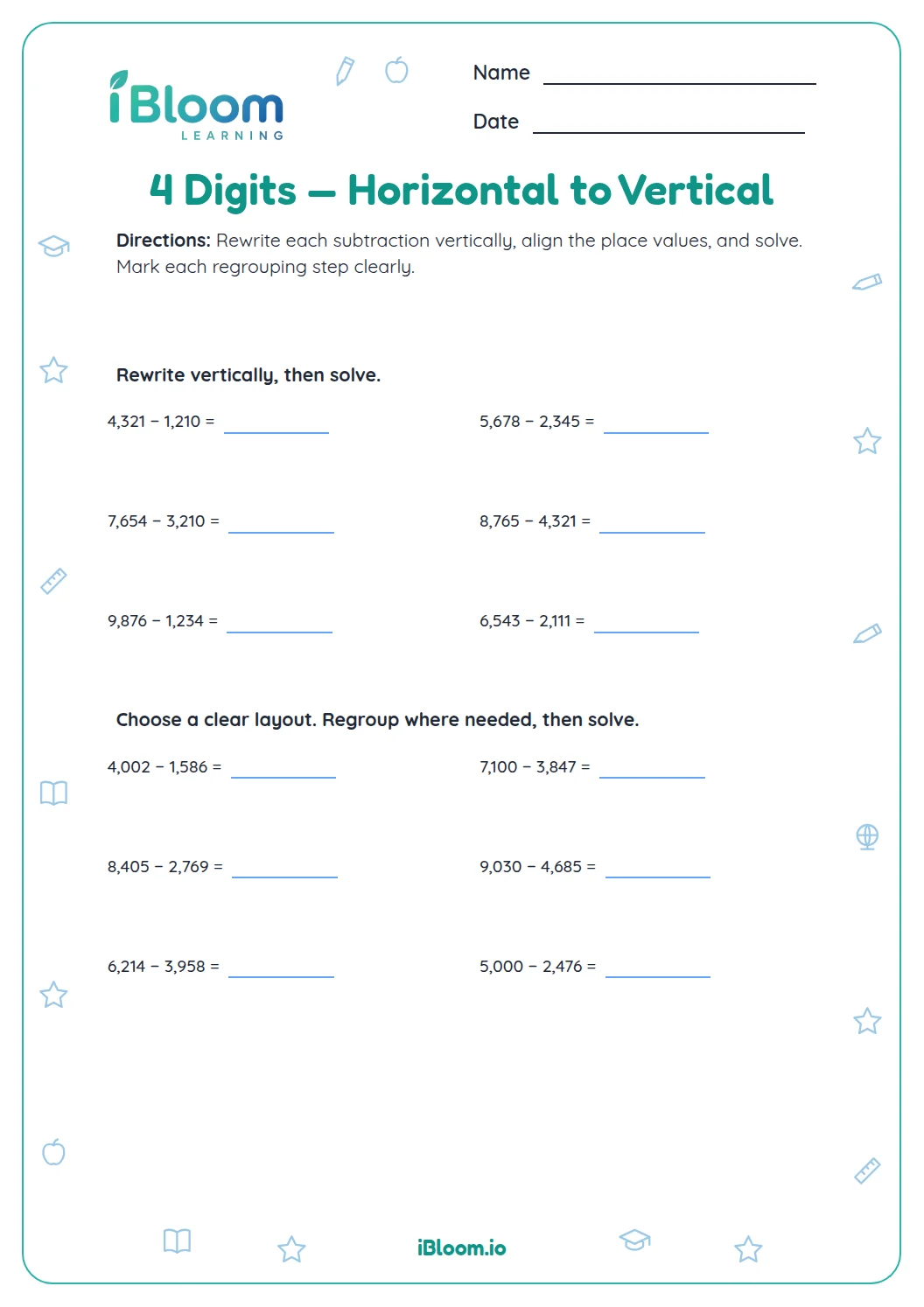
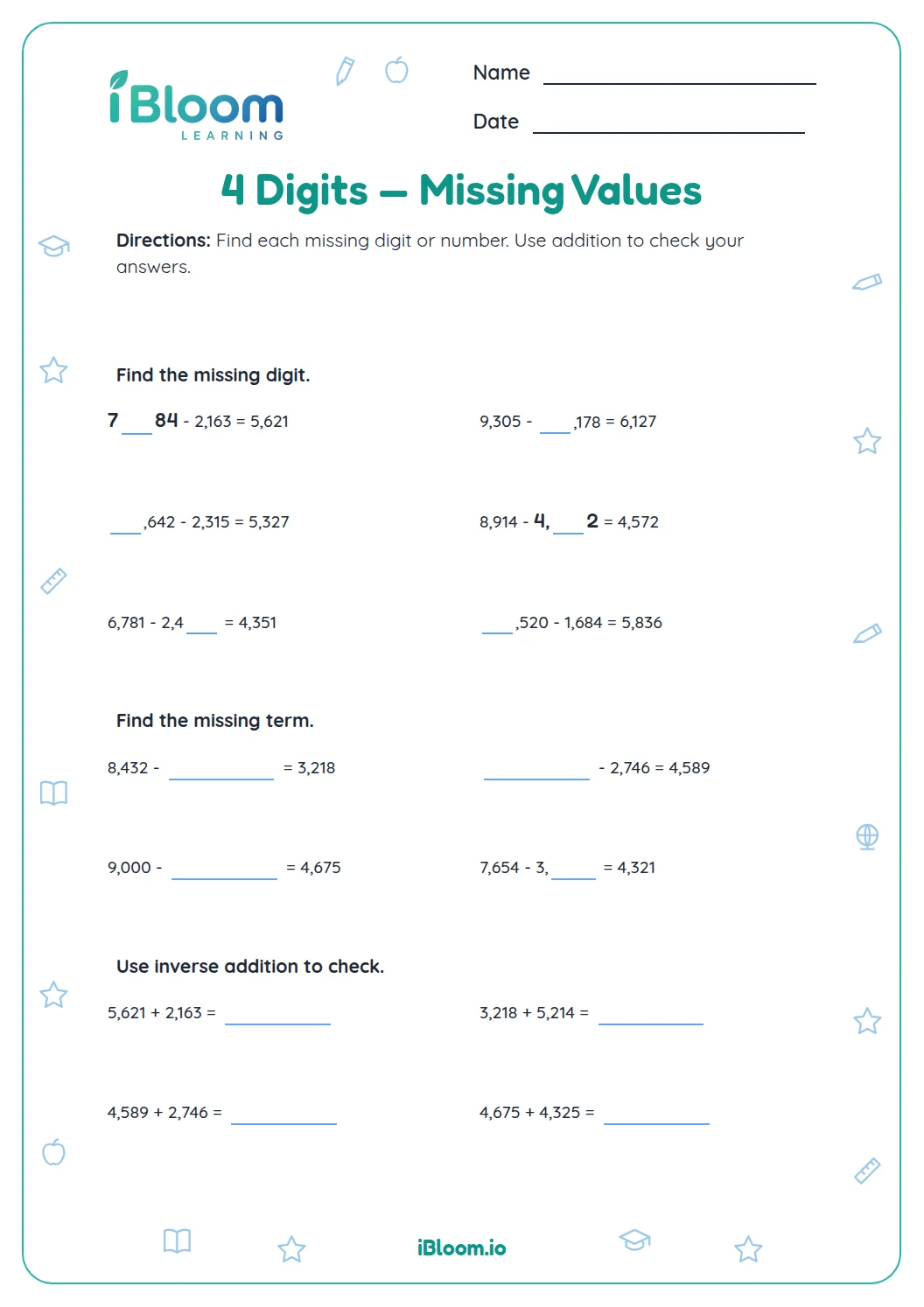
About this worksheet
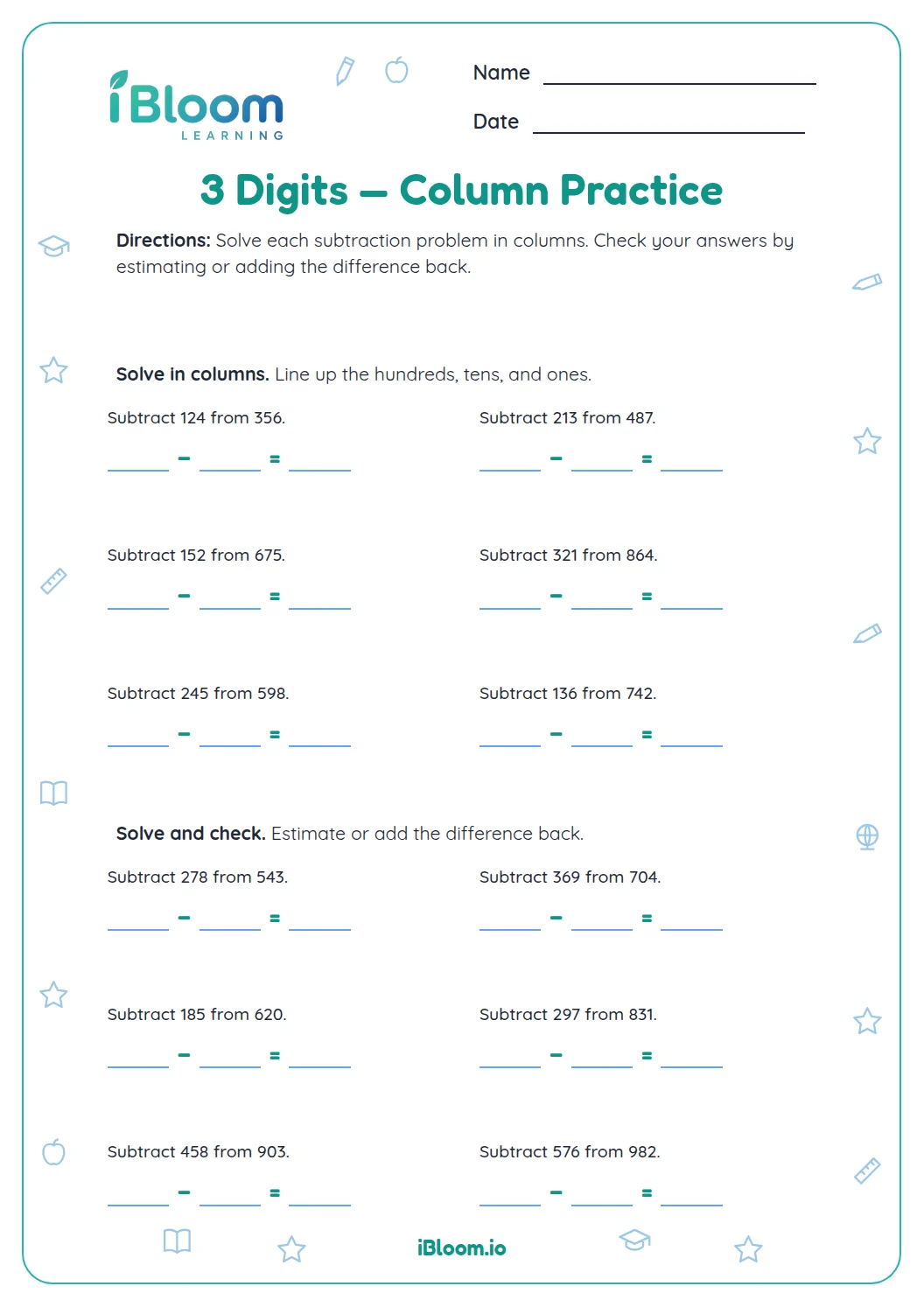
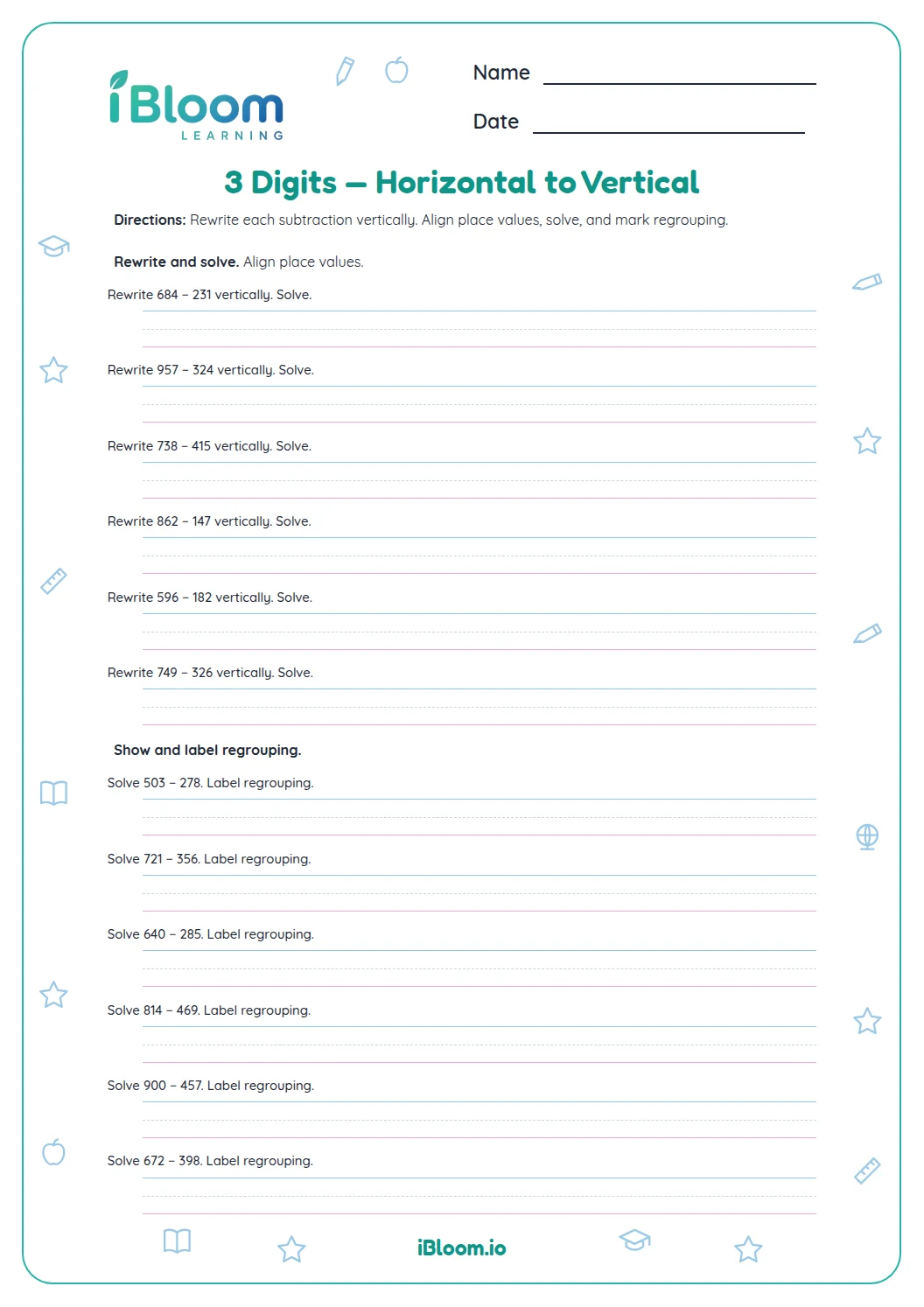
This printable mixed mastery drill gives Grade 3 learners repeated practice subtracting three-digit numbers. It moves from column computations to short situations and missing-number equations, with regrouping across tens and hundreds. The answer key supports quick checking. The computation practice aligns with Common Core 3.NBT.A.2, which asks students to add and subtract within 1,000 using place value and related strategies.
Aligned to 3.NBT.A.2
How do you regroup across place values?
Subtract one place at a time, beginning with the ones. If the top digit is smaller, rename one unit from the next place.
For example, 604 − 278 becomes 5 hundreds, 9 tens, and 14 ones after regrouping twice; 14 − 8 = 6, 9 − 7 = 2, and 5 − 2 = 3, so the difference is 326.
- 1604 − 278
- 2Regroup to 5 hundreds, 9 tens, 14 ones
- 314 − 8 = 6; 9 − 7 = 2; 5 − 2 = 3
- 4Difference: 326
What kinds of problems are included?
The first part gives eight direct computations. Next, four short stories ask you to identify how many remain. The final four equations hide a starting number or the amount subtracted.
- Eight three-digit subtraction computations
- Four one-step story problems
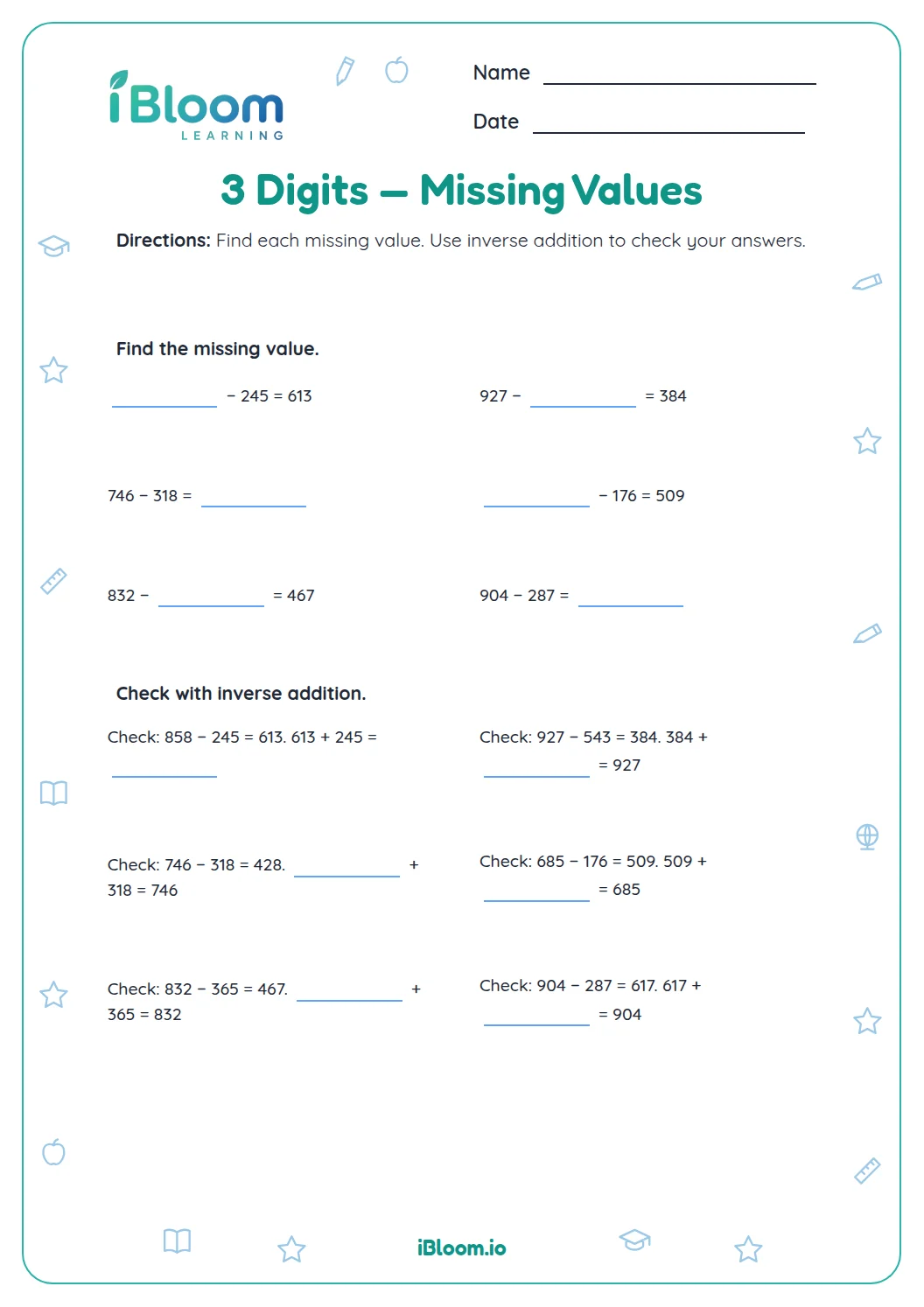
- Four missing-number equations
- A separate answer key
How can addition check subtraction?
Add the difference to the number subtracted. For 604 − 278 = 326, check that 326 + 278 = 604. In a missing-number equation, addition can reveal the unknown directly.
How to use this worksheet
- 1Line up digits by place value before subtracting.
- 2Start in the ones place and regroup only when needed.
- 3For a zero in the top number, regroup from the next nonzero place.
- 4For each story, identify the starting amount and what is removed.
- 5Check each difference by adding it to the subtrahend.
Common mistakes and quick fixes
The mistake
Regrouping only once when crossing a zero.
The fix
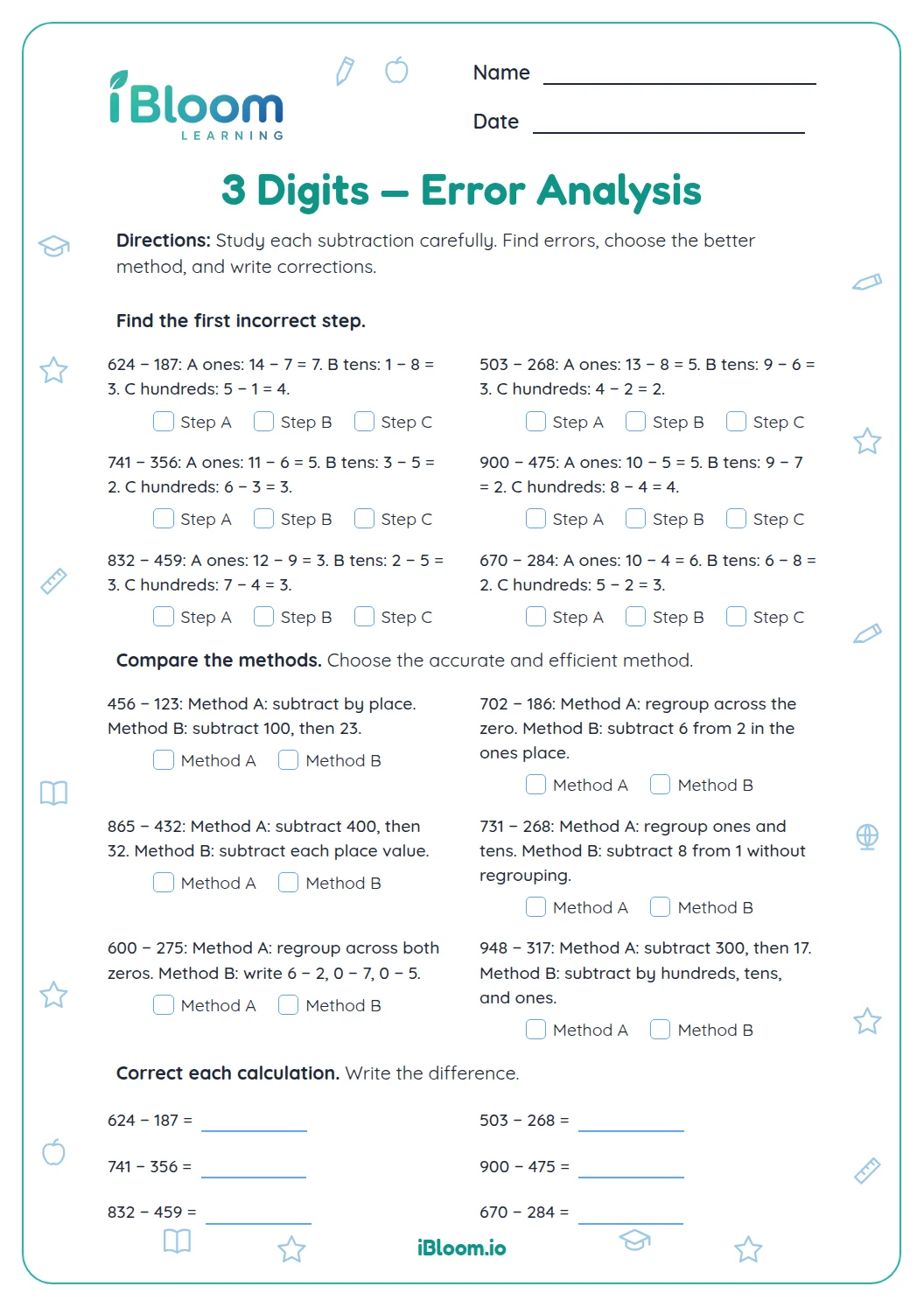
Rename through the zero one place at a time; 900 − 367 needs regrouping through the tens place.
The mistake
Subtracting the smaller digit from the larger in every column.
The fix
Keep the top number first and regroup when its digit is too small.
The mistake
Reversing the story operation.
The fix
Ask whether the quantity gets smaller; if so, subtract the amount taken away.
Common Core alignment
This page practices the listed Common Core skill.
Subtract within 1,000 using place-value strategies and algorithms.
On this sheet: Subtract within 1,000 using place-value strategies and algorithms.
Show the official wordingHide the official wording
Fluently add and subtract within 1000 using strategies and algorithms based on place value, properties of operations, and/or the relationship between addition and subtraction.
What to practice next
Make more practice
Further reading
Questions parents and teachers ask
How many problems are on the sheet?
There are 16 problems: eight direct computations, four word problems, and four missing-number equations. A separate answer key lists each result and supports checking. Ask your child to line up digits by place value and show any regrouping in the computation section.
What does regrouping mean?
Regrouping trades one unit from a larger place for ten units in the place to its right. For instance, one hundred can become ten tens. This exchange helps when a top digit is smaller than the digit being subtracted, including problems that cross a zero.
How can my child check an answer?
Add the difference and the number subtracted. If their sum matches the starting number, the subtraction is correct. This check is especially useful after regrouping across one or more places. For example, 326 + 278 should equal 604, the starting number.
Does the worksheet include word problems?
Yes. Four short situations ask students to find how many books, feet, apples, or seats remain. Each uses a three-digit starting amount and a three-digit amount taken away, so students practice choosing subtraction and computing the difference. The contexts use familiar situations and ask for one difference each.
Is an answer key included?
Yes. The printable includes a separate answer key pagess with all 16 answers. Students can complete the worksheet first, then use the key to check and correct their work. Encourage them to redo any missed computation and verify it with addition.