

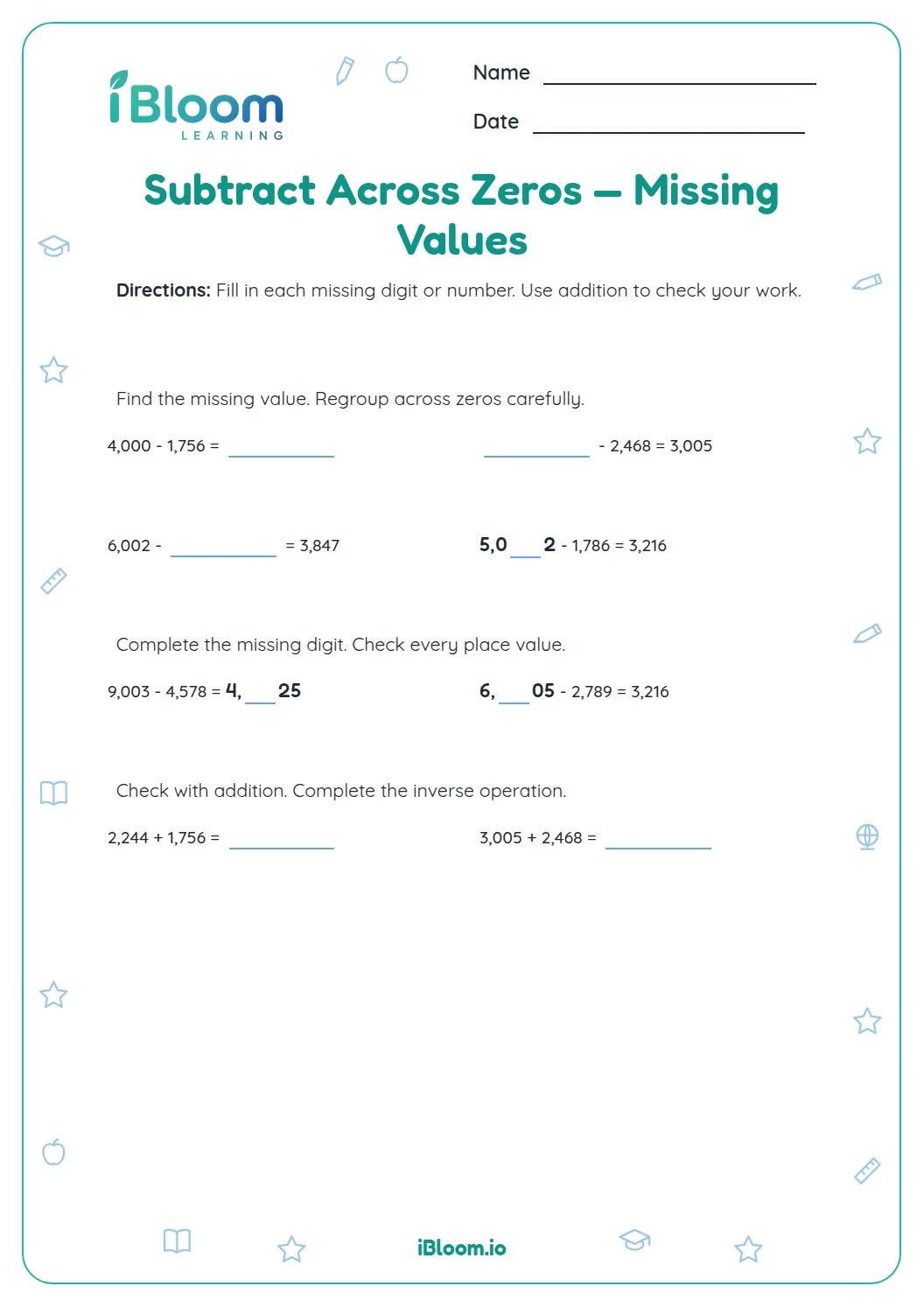
About this worksheet
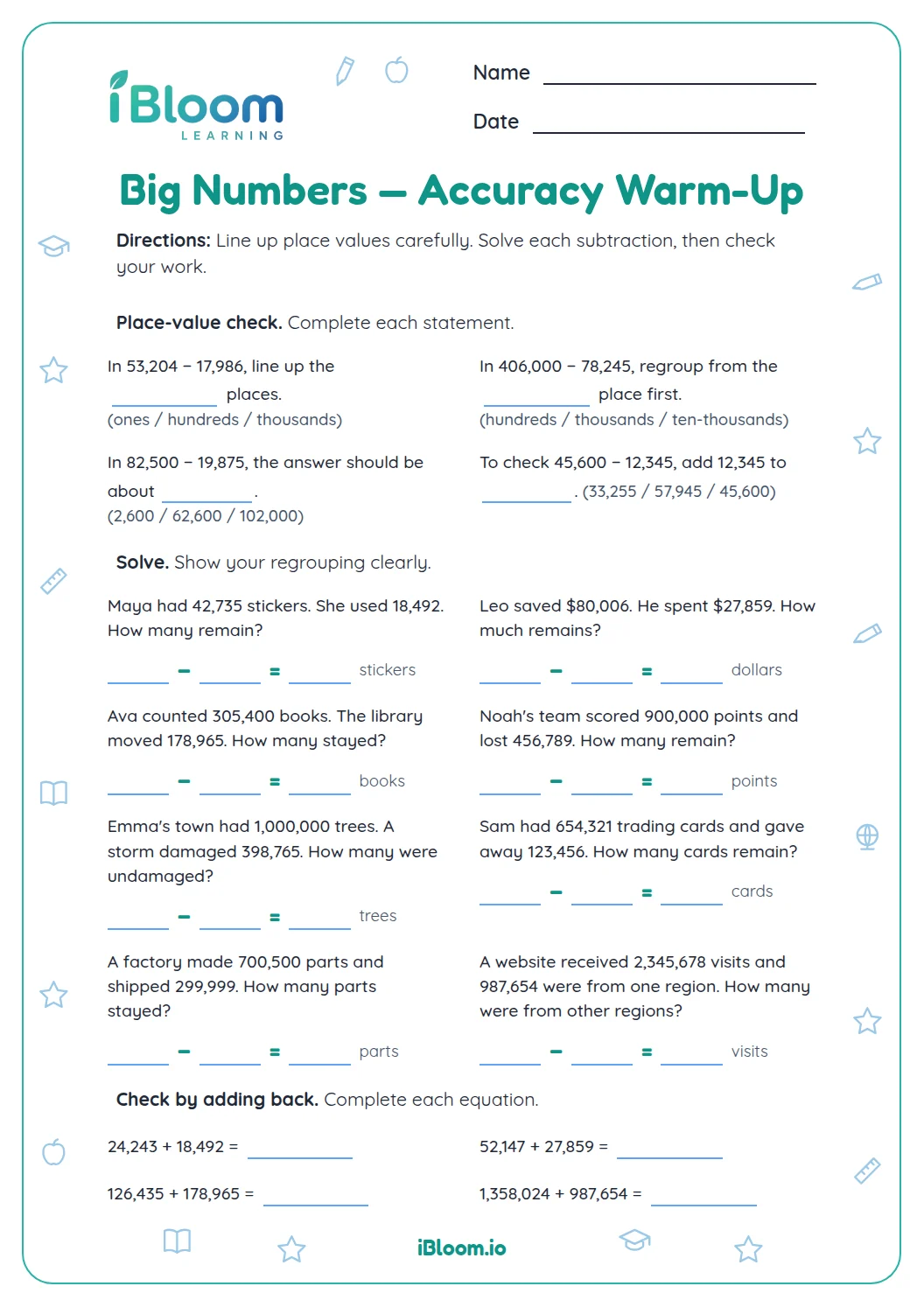
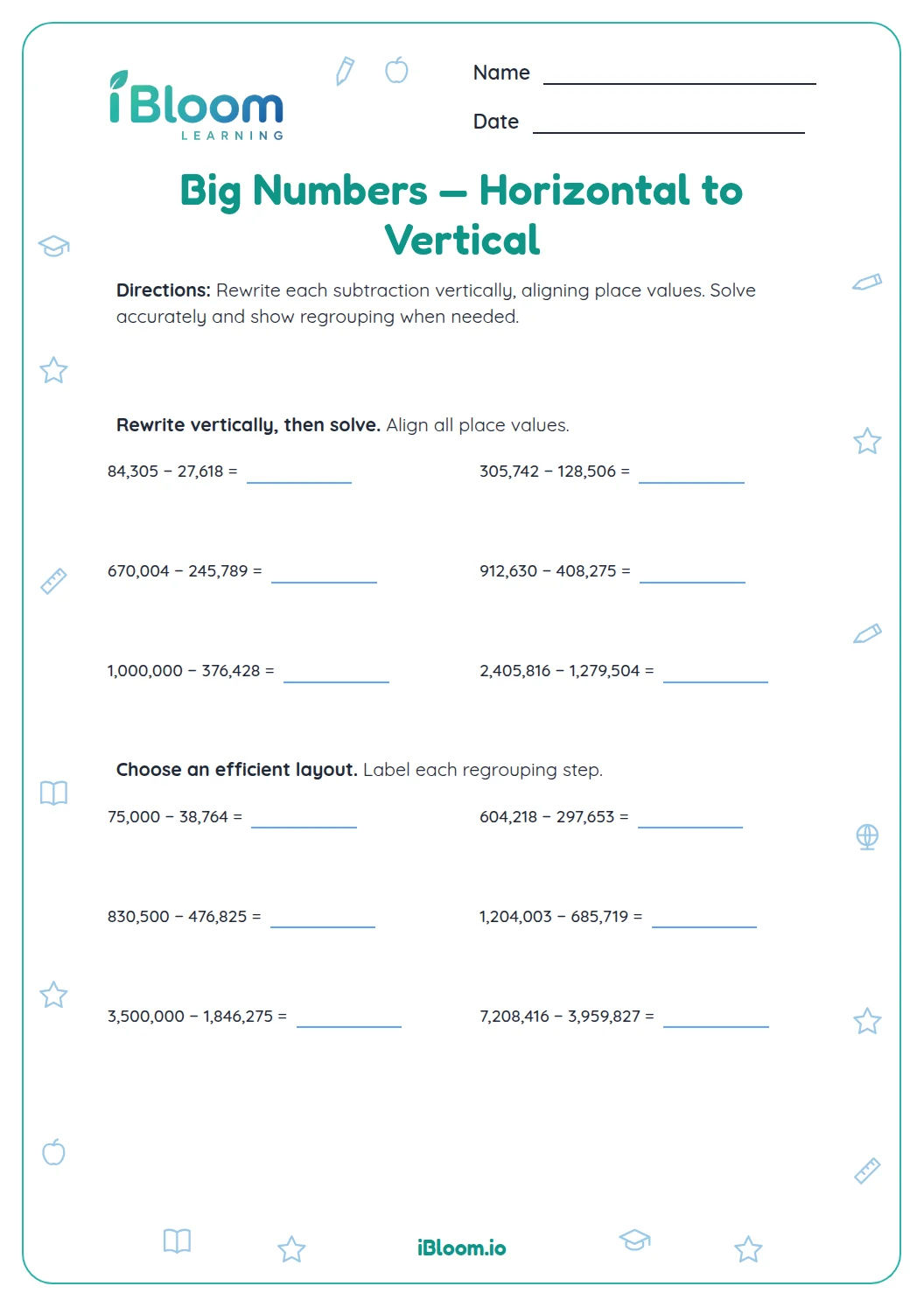
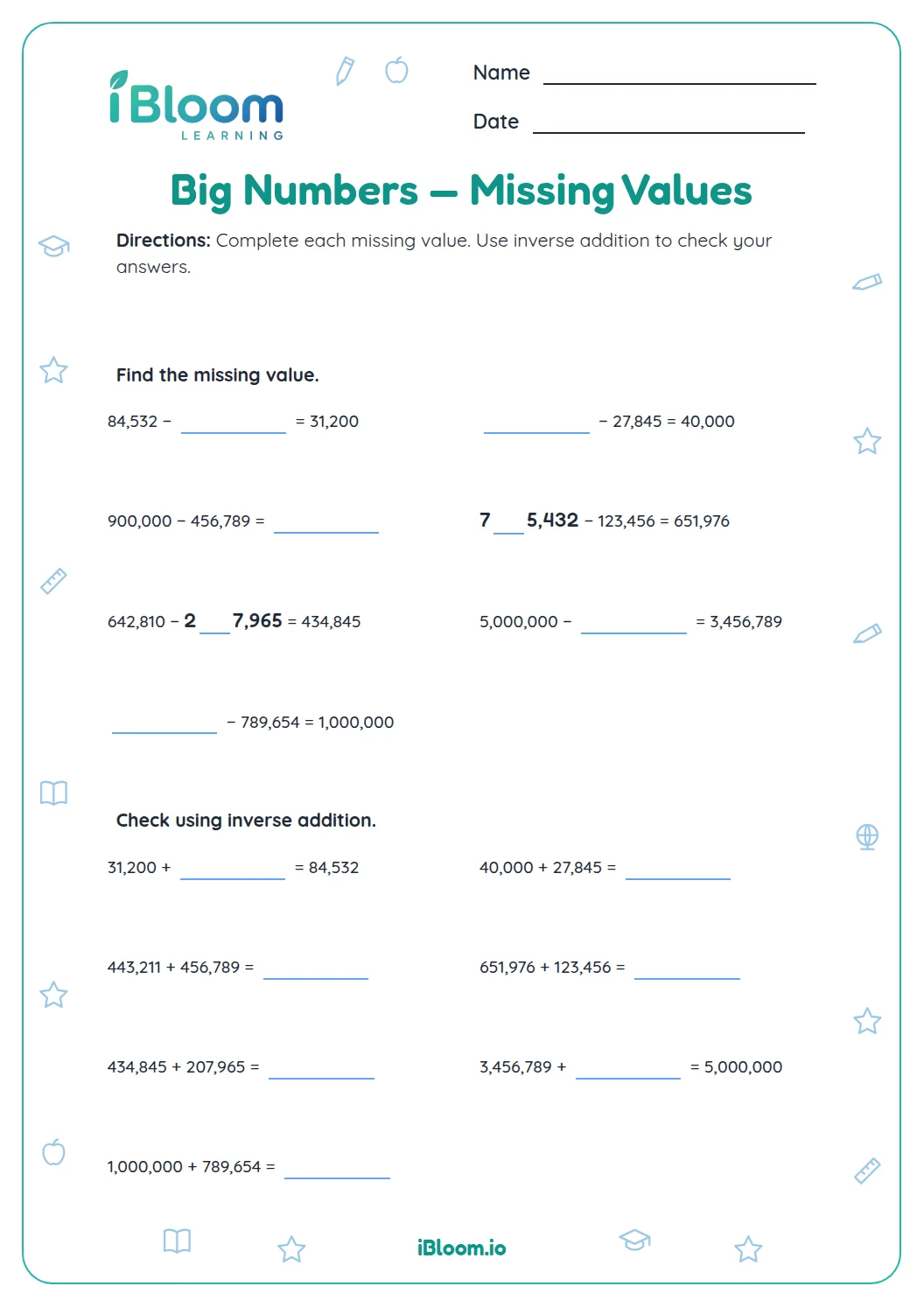
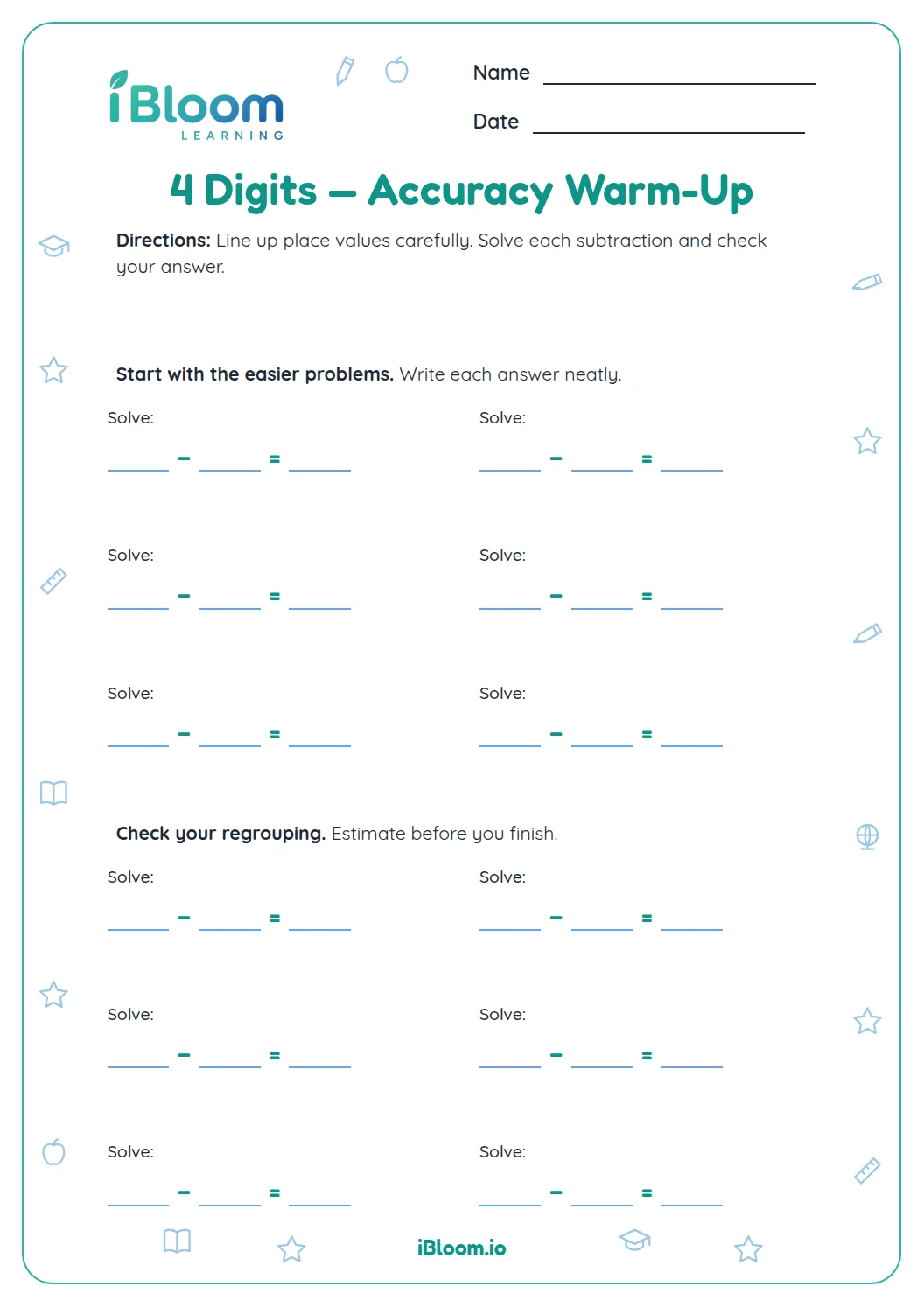
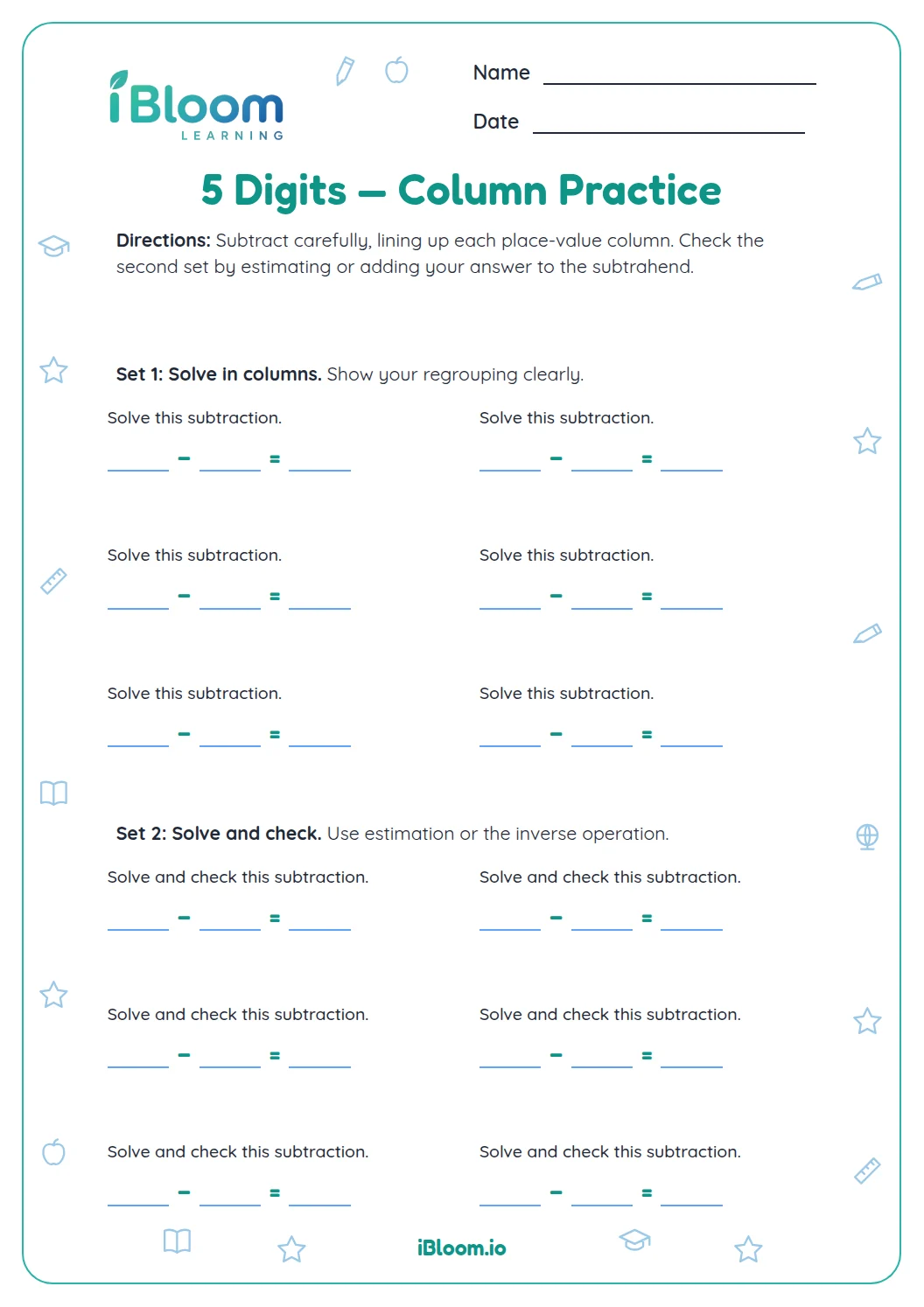
This free printable subtraction drill gives Grades 5–6 students 10 large-number calculations with grid space for column work. Part A begins with five- and six-digit starting numbers. Part B starts at 480,006 and moves into millions, with zeros that require careful regrouping. Students set up each expression vertically, subtract, and write the difference in the answer box; they also check Part B by adding. The sheet practices the standard algorithm in Common Core 4.NBT.B.4. A separate answer key supplies all 10 differences, so adults can review accuracy while the student’s grid work reveals each regrouping step.
Aligned to 4.NBT.B.4
How should children set up the columns?
Copy each expression onto its grid with ones under ones, tens under tens, and so on. Begin at the right edge when the two numbers have different lengths. Commas help readers see groups of three digits, but the digits determine alignment.
Part A has four problems; Part B begins with 480,006 − 215,784. The grid gives room to cross out a digit and write its regrouped value above it before continuing.
How do you regroup through zeros?
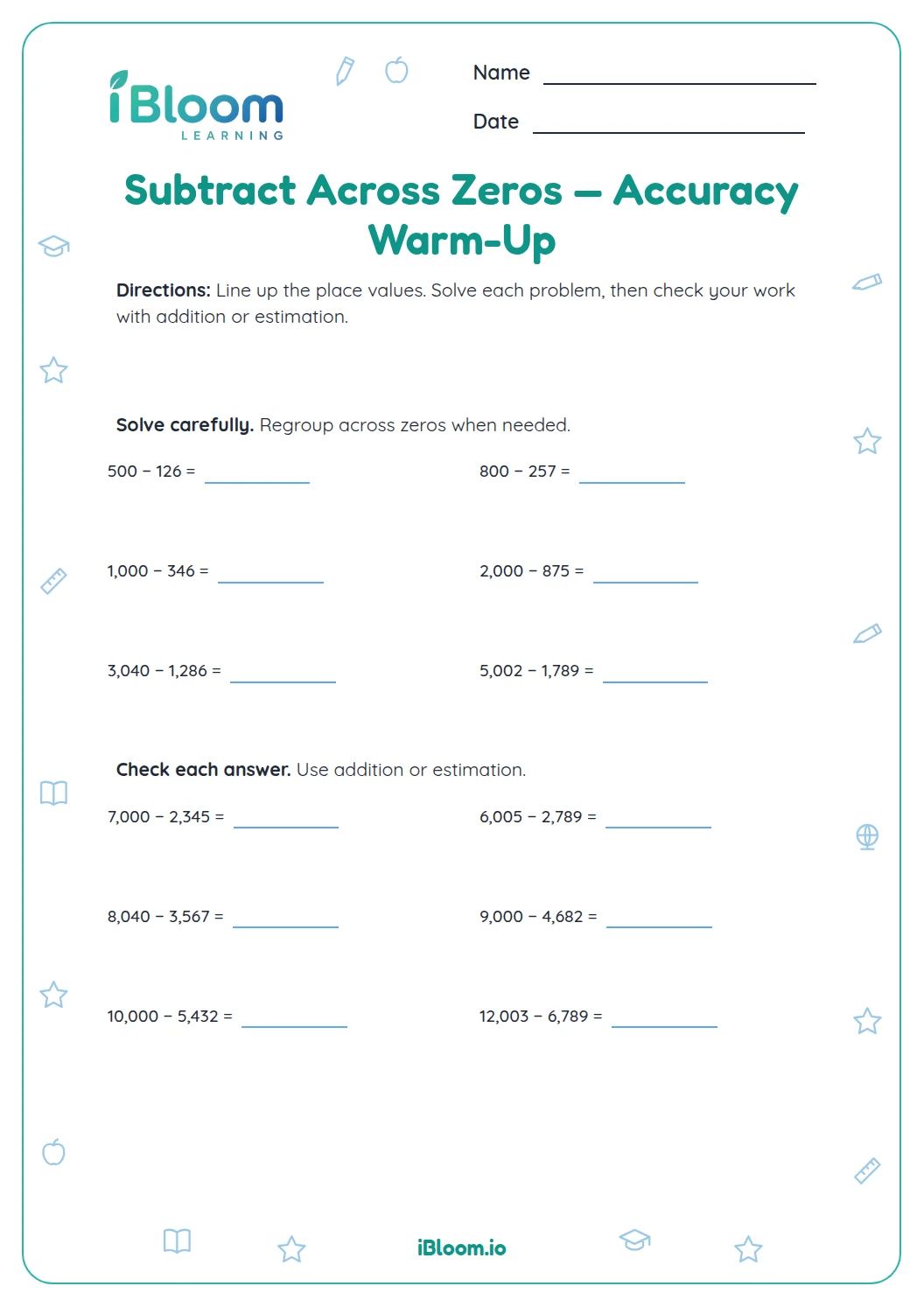
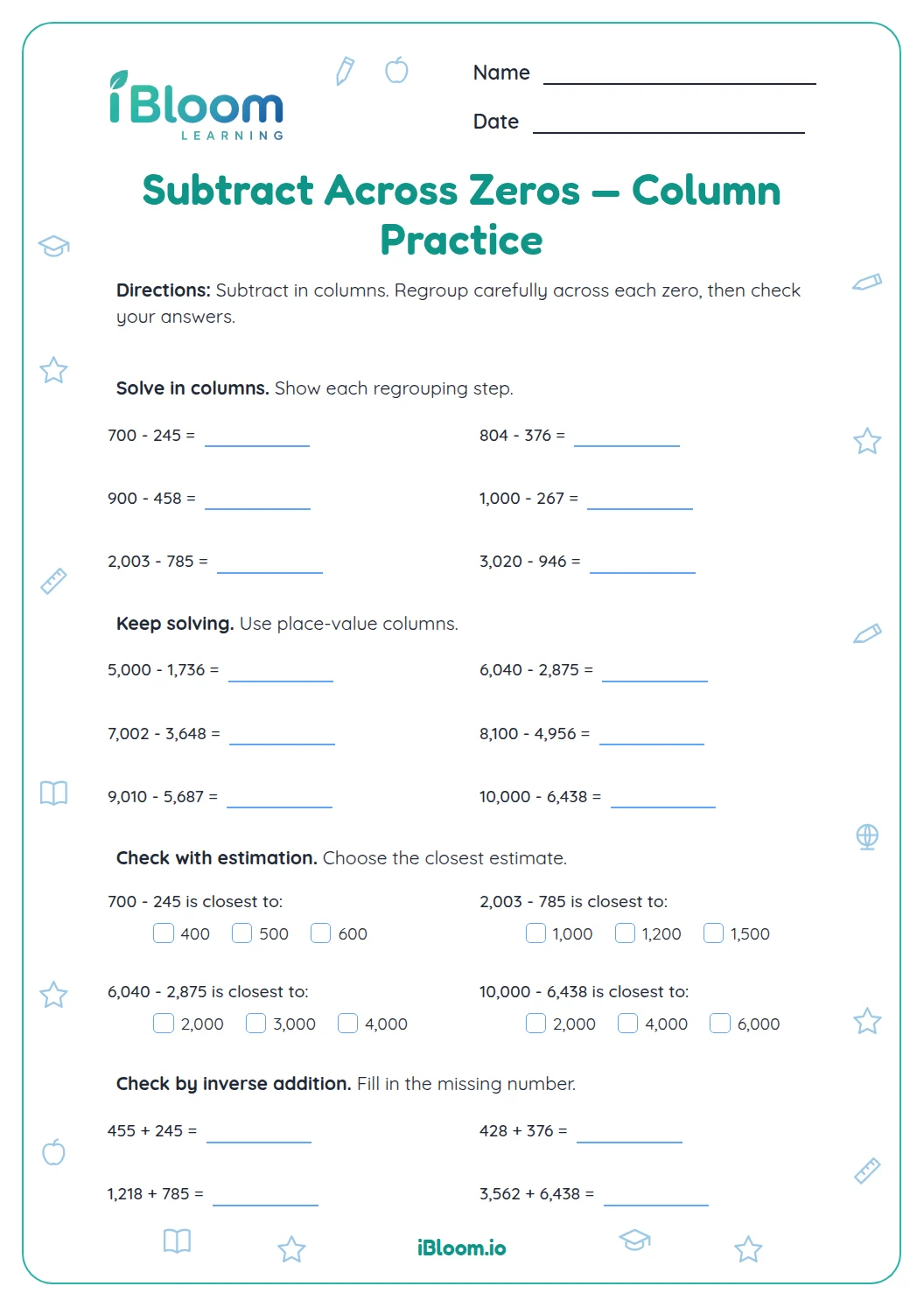
Find a nonzero digit to the left of the column that needs more units. Exchange one of those units for ten of the next smaller unit, continuing until you reach the column you need. Record each change; intermediate zeros become nines as one unit passes onward.
- 1Question 5: 480,006 − 215,784
- 2Regroup 480,006 as 4 hundred-thousands, 7 ten-thousands, 9 thousands, 9 hundreds, 10 tens, and 6 ones.
- 3Subtract by columns to get 264,222.
- 4Check: 264,222 + 215,784 = 480,006.
How does addition check a subtraction answer?
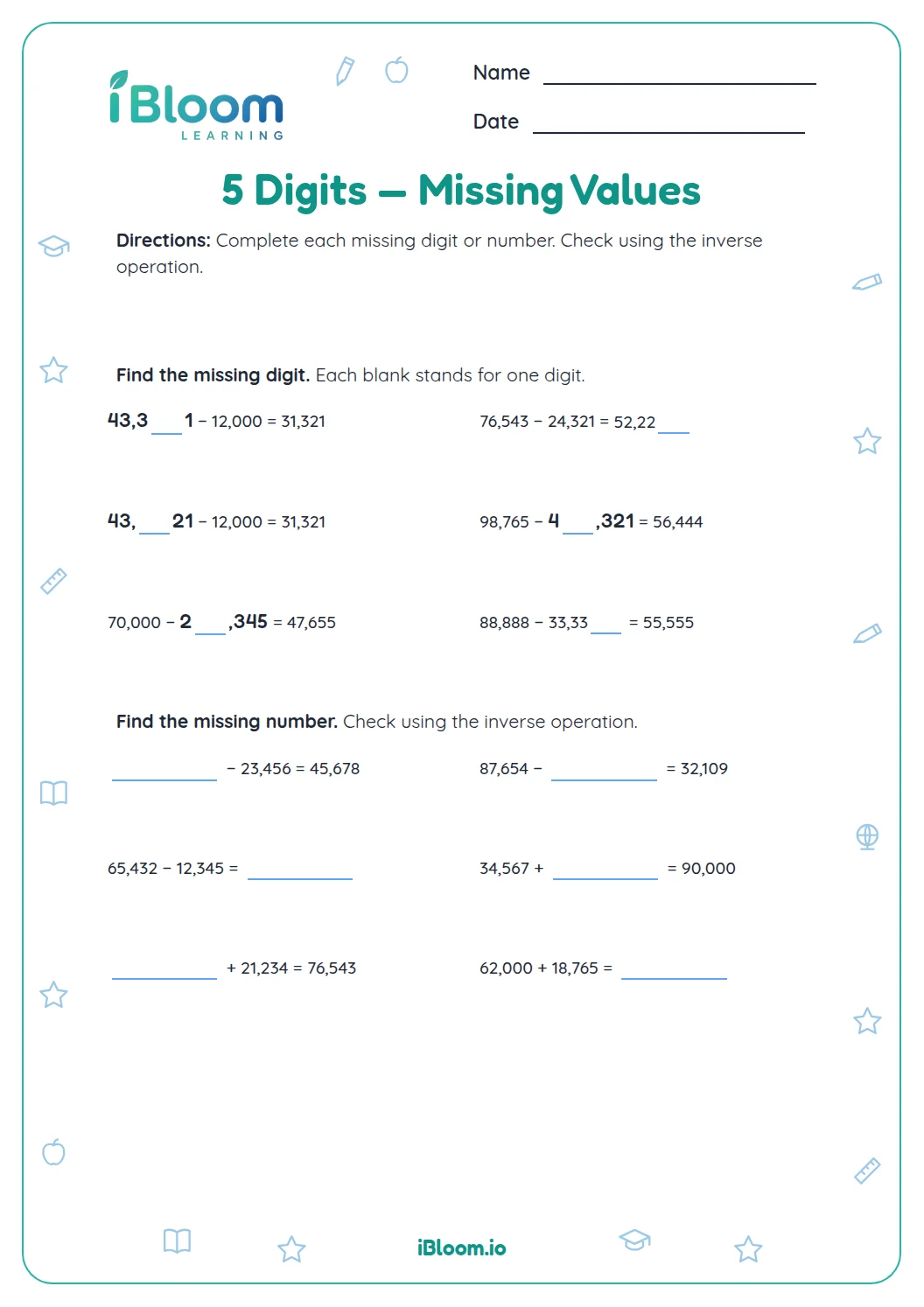
Add the difference to the number subtracted. The sum should equal the starting number. In Part B, children use the grid to perform this check after each of the six subtractions.
An estimate can provide an extra sense check. For 1,000,000 − 458,736, the result should be a little above half a million; the exact difference is 541,264. The printed key gives exact differences, while students retain their own calculation and checking work.
How to use this worksheet
- 1Read both numbers aloud and identify their greatest place values.
- 2Copy the first expression onto the grid, aligning from the ones column.
- 3Subtract from right to left and mark every regrouping.
- 4In Part B, write the addition check beneath or beside the subtraction.
- 5Compare exact differences with the key and revisit any column where the addition check fails.
Mistakes to discuss
The mistake
Lining up the left edges in 2,305,410 − 876,925.
The fix
Begin with the ones column so every digit is under the same place value.
The mistake
Subtracting the smaller digit from the larger digit in each column.
The fix
Keep the subtraction order; regroup when the top digit is too small.
The mistake
Leaving an intermediate zero as 10 after passing a unit onward.
The fix
Record the exchange: that column keeps 9 after giving one unit to its neighbor.
Common Core alignment
Align place values and regroup to subtract large whole numbers.
On this sheet: Students use the standard subtraction algorithm with five- through eight-digit starting numbers.
Show the official wordingHide the official wording
Fluently add and subtract multi-digit whole numbers using the standard algorithm.
What to practice next
Make more practice
Further reading
Questions parents and teachers ask
How big are the numbers on this sheet?
Starting numbers range from 58,764 to 12,500,000. Part A uses five- and six-digit numbers, while Part B uses six-, seven-, and eight-digit numbers. The longer calculations preserve the same place-value routine: align from the ones column, subtract from right to left, and record each regrouping.
Are the subtractions already arranged vertically?
Students arrange each printed expression in columns on its working grid. This lets them practice the alignment that the title calls for, including problems where the two numbers have different digit counts. Ask them to leave room above the digits for regrouping marks before starting the subtraction.
What is the answer to 480,006 minus 215,784?
The difference is 264,222. The ones column works directly, but the tens and hundreds require regrouping through zeros. Have the child record the changed values above the starting number, then subtract each column. Adding 264,222 and 215,784 reconstructs 480,006 and confirms the exact result.
Should this subtraction drill be timed?
Use the sheet as untimed accuracy practice first. The working grids are intended for visible column setup, regrouping, and addition checks. A learner who is still managing zeros needs time to record each change. You can note completion time later without making speed the condition for success.
What does the answer key include?
The key provides the exact difference for each of the 10 problems. Students write their own column calculations and addition checks on the grids. When an answer differs, compare place values and regrouping marks before repeating the entire problem; a single missed exchange can explain the error.