

About this worksheet
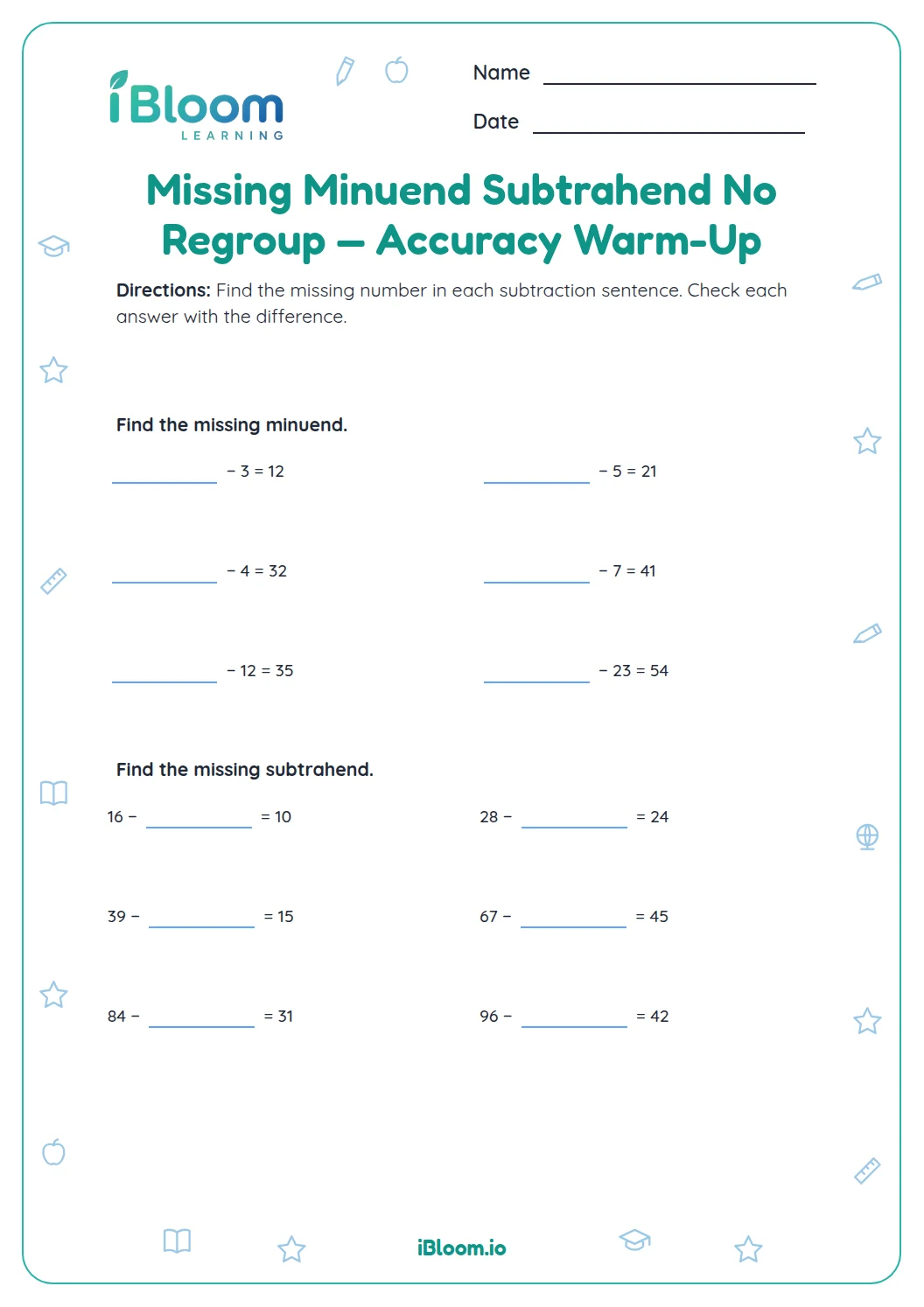
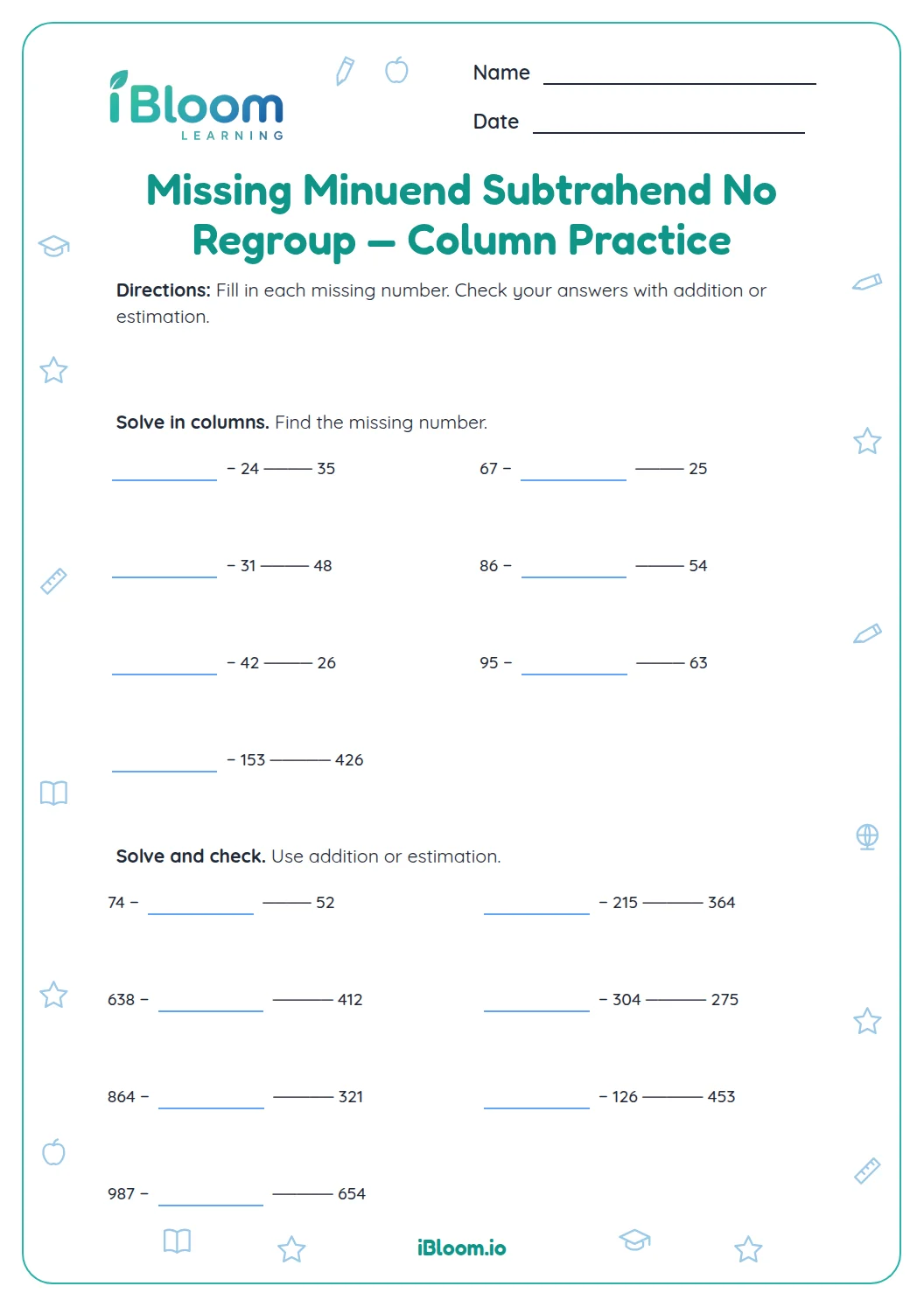
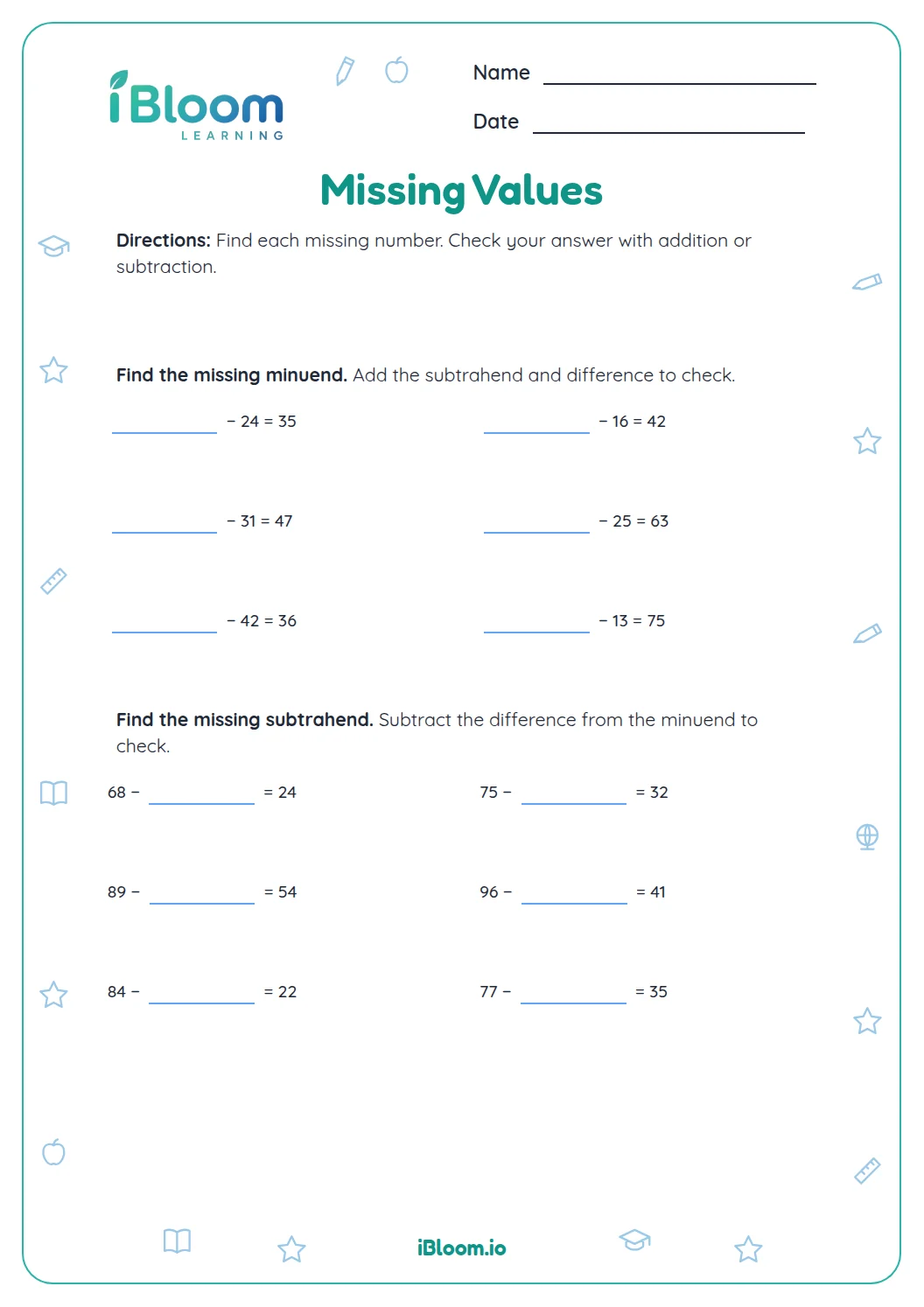
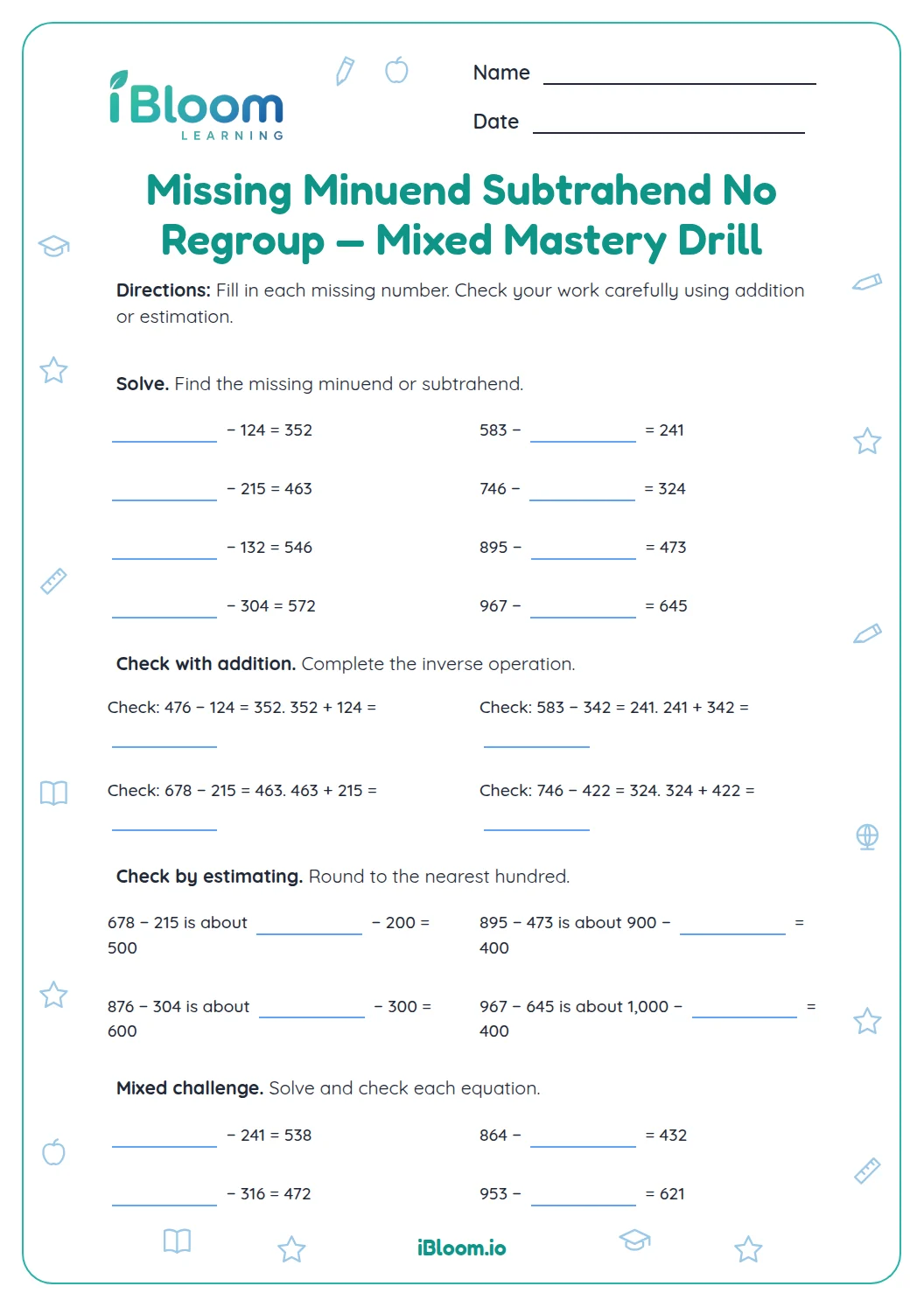
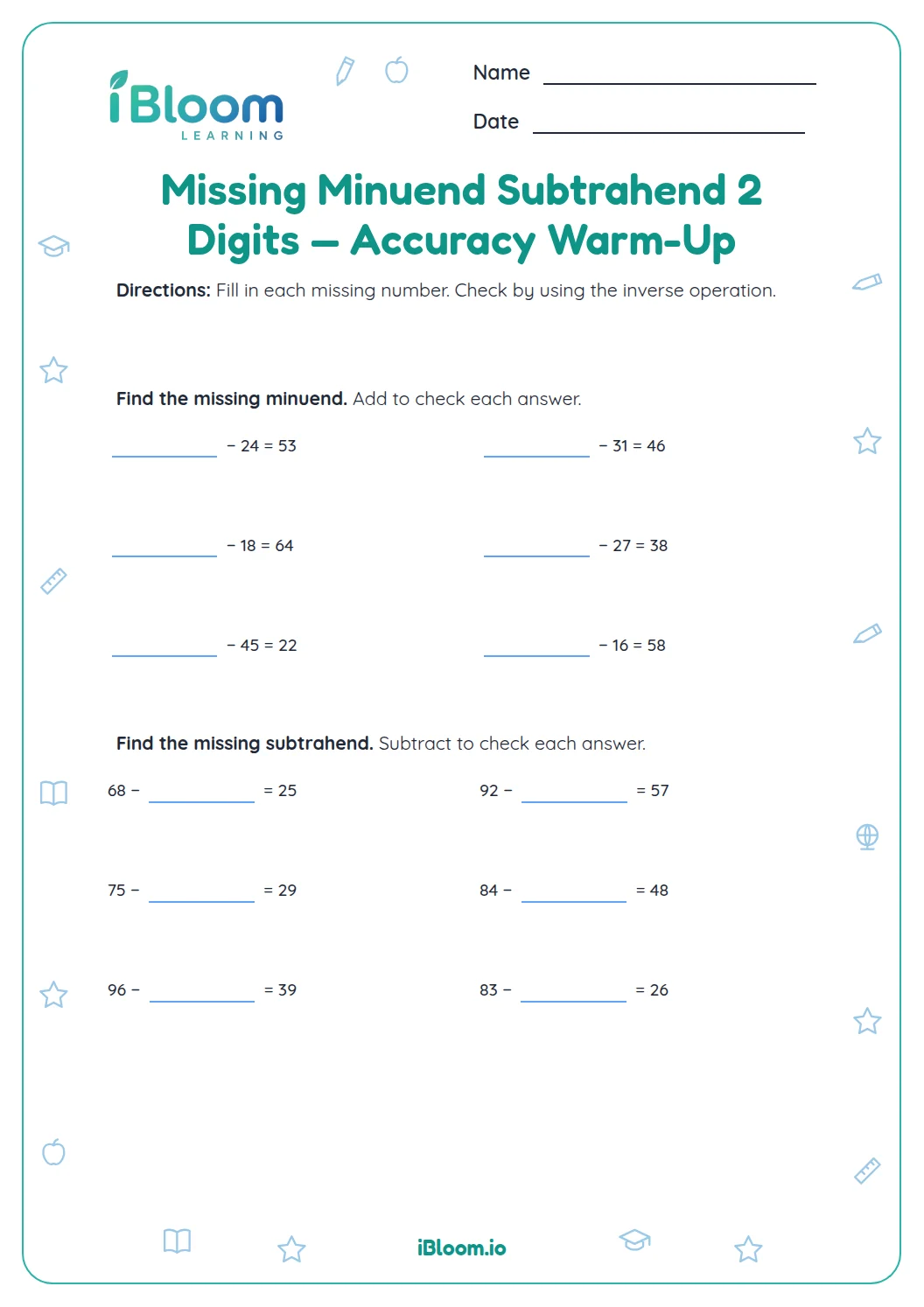
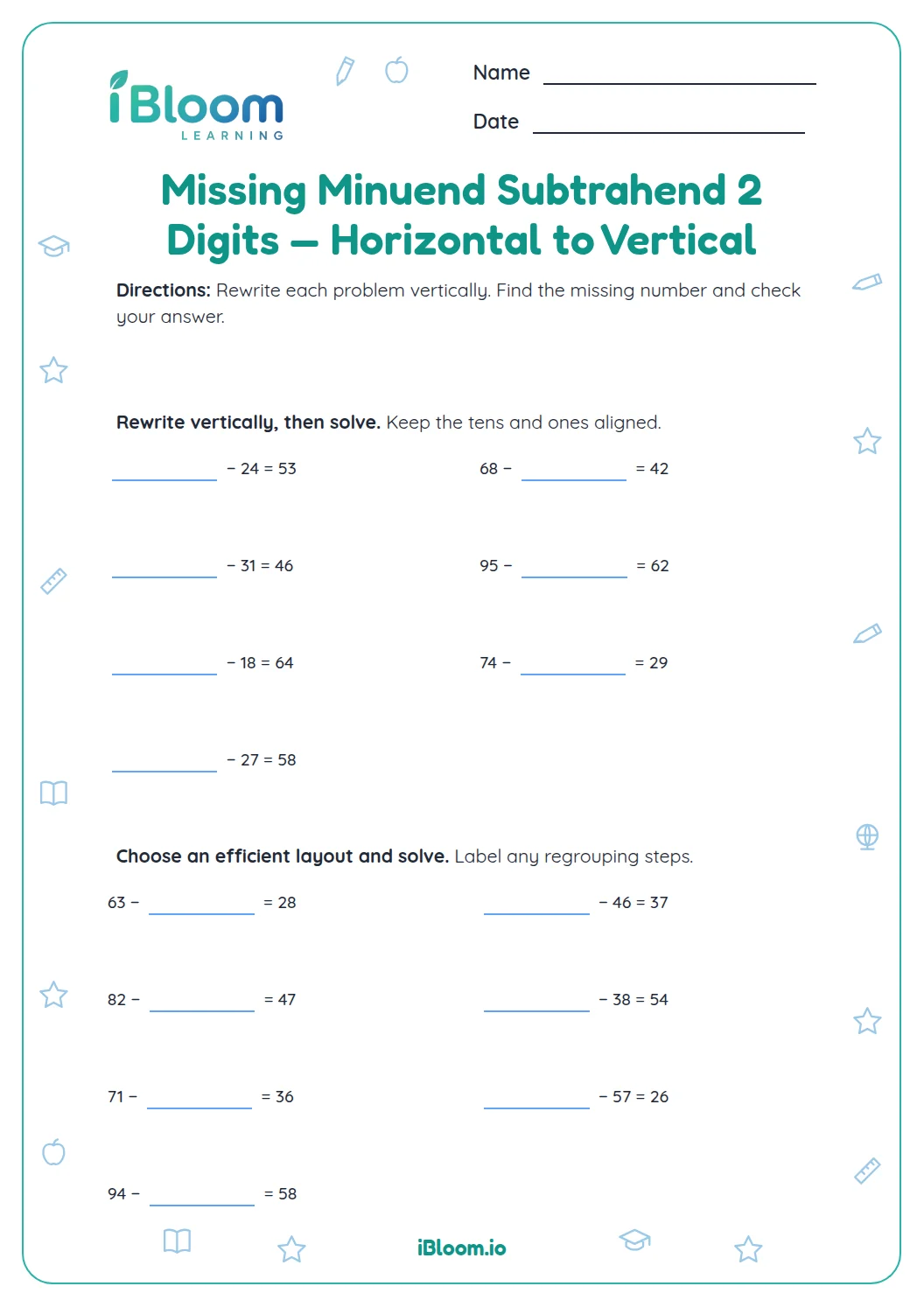
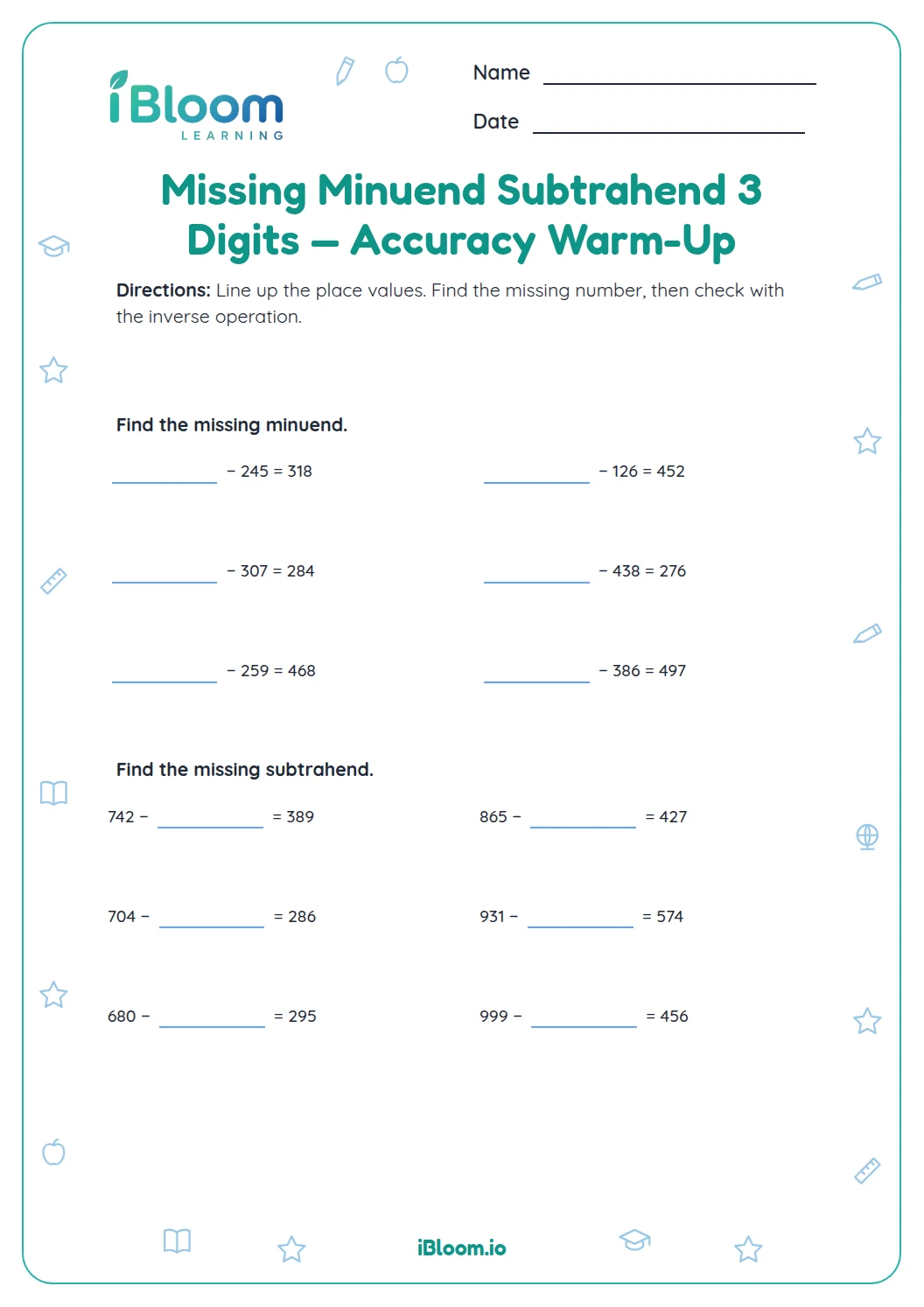
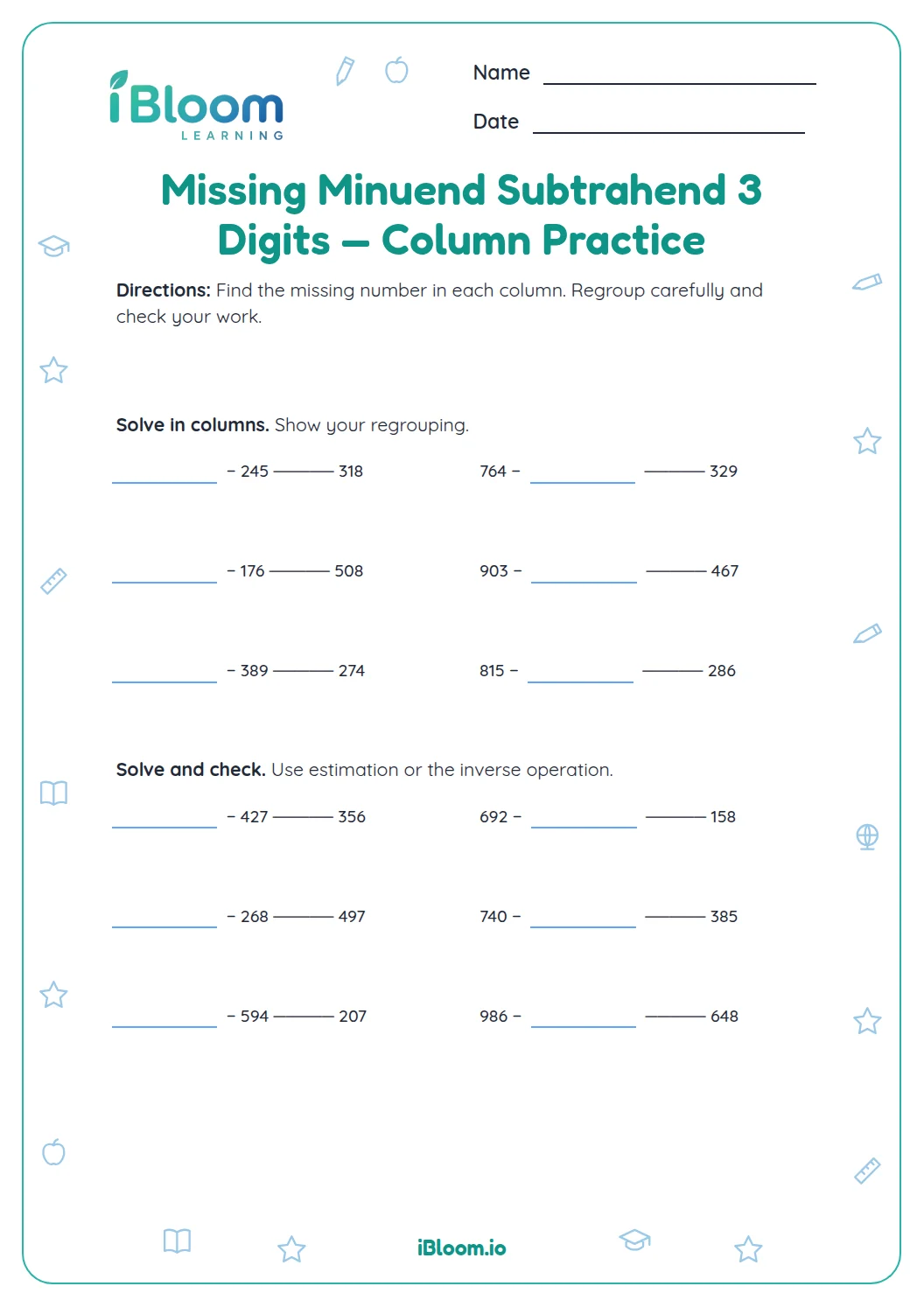
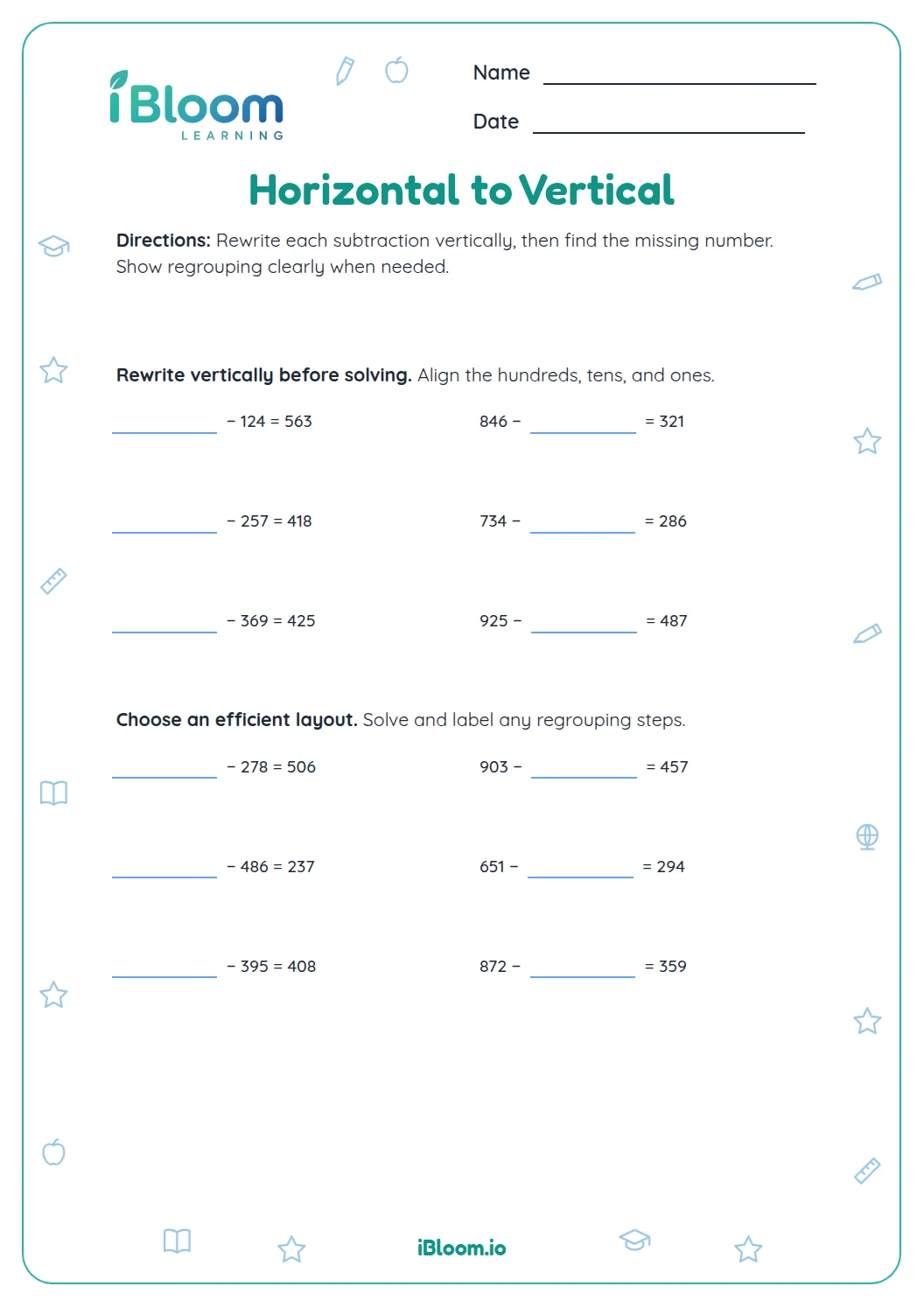
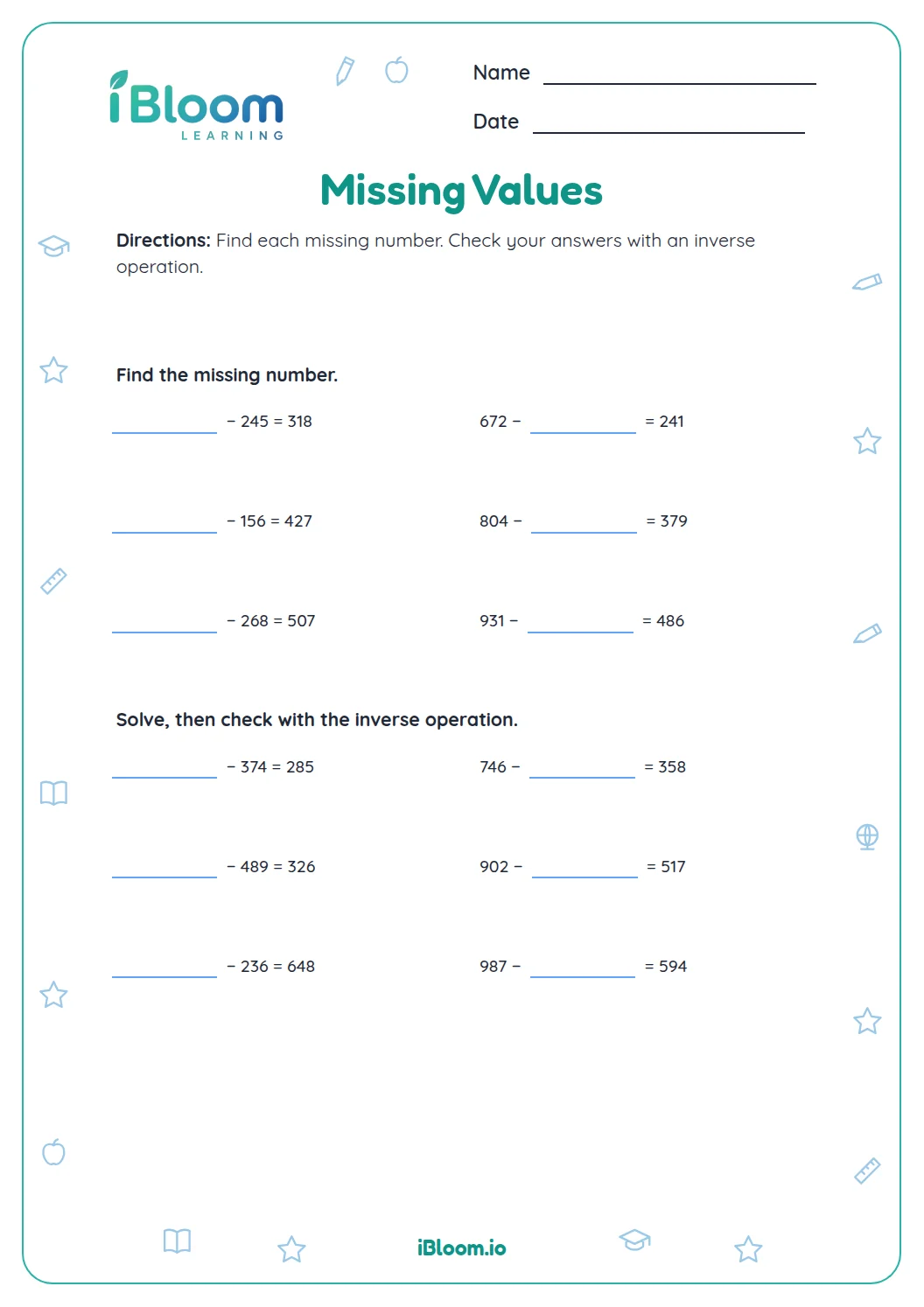
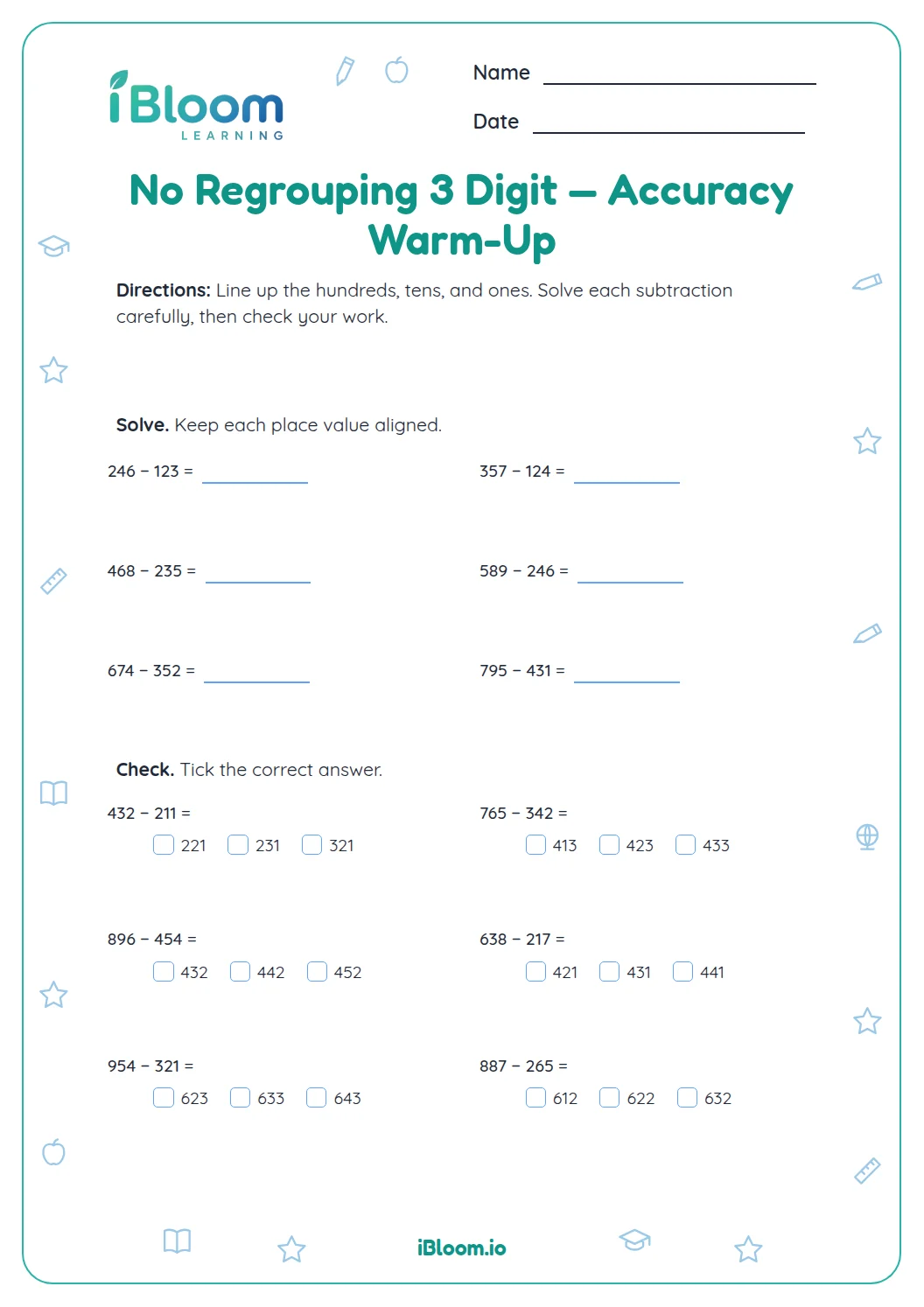
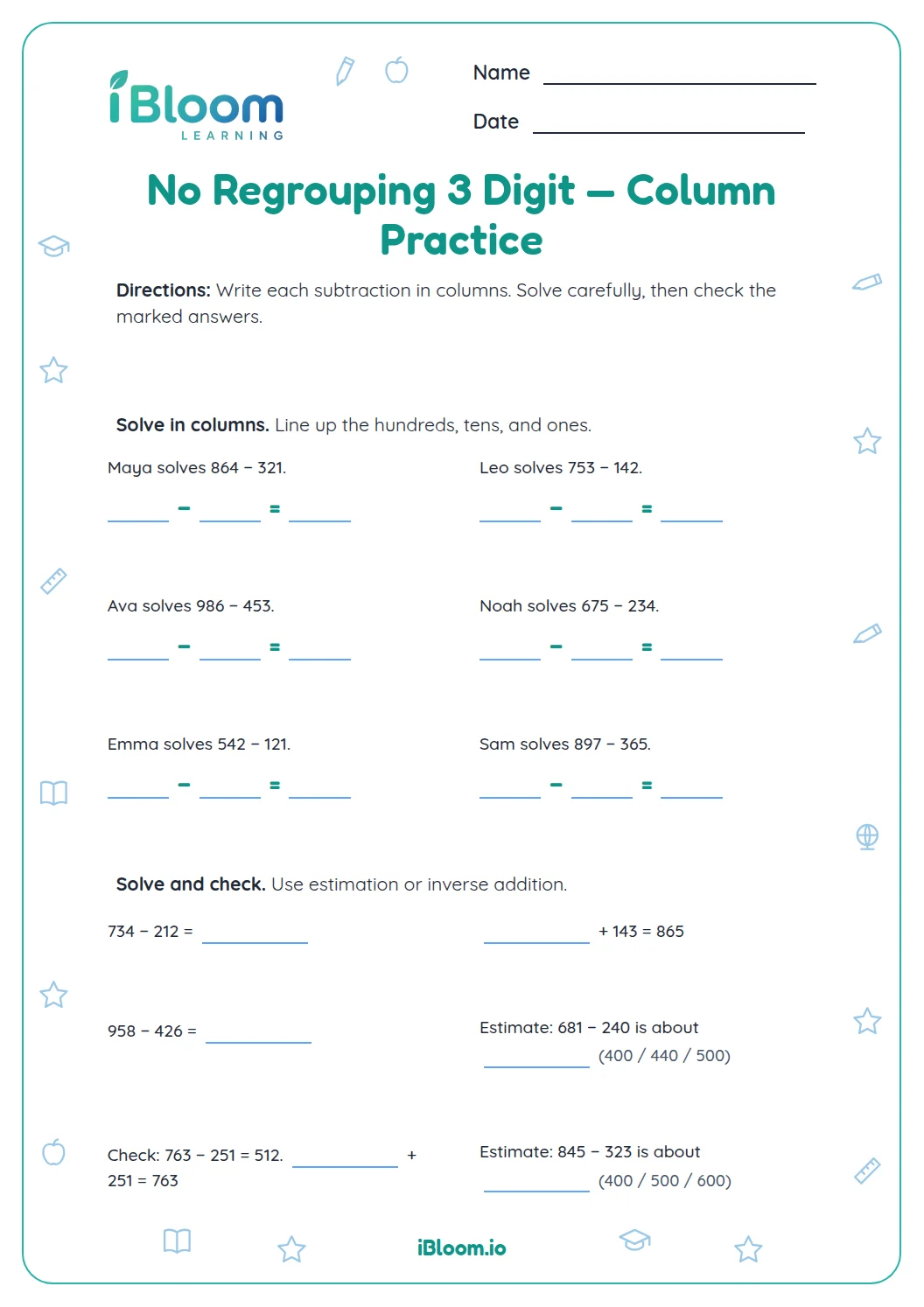
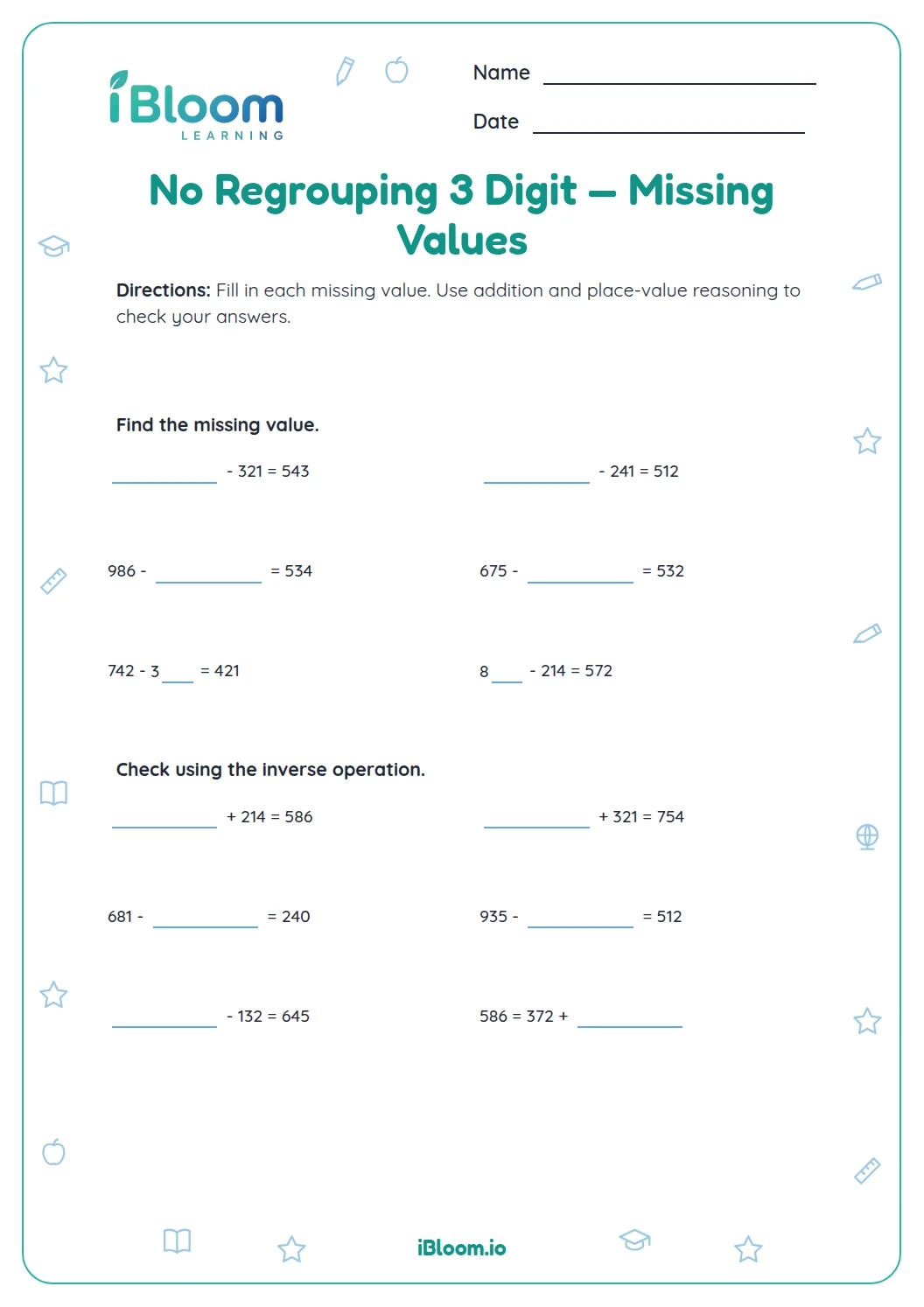
This printable gives Grade 3 learners practice finding a missing minuend or subtrahend in subtraction equations without regrouping. Part A uses two-digit numbers; Part B extends the same reasoning to three-digit numbers. Each blank has one value, and addition provides a direct check: the difference plus the subtrahend should equal the minuend. The separate answer key lists all 16 values.
Aligned to 2.NBT.B.7
What changes between the two parts?
Part A asks learners to correct two classmates’ missing-number errors. Part B gives 14 equations, moving from two-digit to three-digit numbers, and asks learners to use addition to check their answers.
How do you find a missing minuend?
The minuend is the number being subtracted from. Add the subtrahend and the difference to find it.
- 1___ − 24 = 53
- 224 + 53 = 77
- 377 − 24 = 53
How do you find a missing subtrahend?
Subtract the difference from the minuend. In 68 − ___ = 45, compute 68 − 45 to find 23.
How can addition check the answer?
Add the subtrahend and difference. Their sum should equal the minuend. This check works for both kinds of missing-number equations.
How can a learner work through this page?
- 1Read the equation to identify the missing part.
- 2For a missing minuend, add the two known numbers.
- 3For a missing subtrahend, subtract the difference from the minuend.
- 4Keep digits in their place-value positions.
- 5Substitute the answer and check with addition.
Common mistakes and quick fixes
The mistake
Subtracting the smaller known number in the wrong direction.
The fix
For a missing subtrahend, use minuend minus difference.
The mistake
Adding the two numbers when the subtrahend is missing.
The fix
First identify the unknown; only a missing minuend uses subtrahend plus difference.
The mistake
Checking by repeating the same subtraction.
The fix
Use the inverse operation: subtrahend plus difference equals minuend.
The equations practice subtraction and its inverse relationship with addition.
Use place value and addition or subtraction strategies to solve these equations.
On this sheet:
Show the official wordingHide the official wording
Add and subtract within 1000, using concrete models or drawings and strategies based on place value, properties of operations, and/or the relationship between addition and subtraction; relate the strategy to a written method. Understand that in adding or subtracting three-digit numbers, one adds or subtracts hundreds and hundreds, tens and tens, ones and ones; and sometimes it is necessary to compose or decompose tens or hundreds.
What to practice next
Make more practice
Further reading
Questions parents and teachers ask
What is a missing minuend?
The minuend is the number from which another number is subtracted. In ___ − 24 = 53, add 24 and 53 to find 77, then check that 77 − 24 equals 53. The first question asks learners to catch this kind of error.
What is a missing subtrahend?
The subtrahend is the number being taken away. In 68 − ___ = 45, subtract the difference from the minuend: 68 − 45 = 23. Check that 68 − 23 equals 45. The passage or equation provides the evidence needed to check the response.
How many questions are on the page?
There are 16 questions: two error-analysis choices and 14 missing-value equations. The equation practice begins with two-digit numbers and then uses three-digit numbers. The key gives the corrected values and the missing numbers, so learners can check each equation.
Why use addition to check subtraction?
Addition reverses subtraction. When a subtraction equation is correct, the subtrahend plus the difference equals the minuend. This check works whether the missing value was the starting number or the number taken away. The passage or equation provides the evidence needed to check the response.
What does no regrouping mean here?
The chosen numbers allow each place-value subtraction to be completed without trading a ten or hundred. Learners can focus on recognizing the missing part and checking the relationship between the numbers. The passage or equation provides the evidence needed to check the response.