

About this worksheet
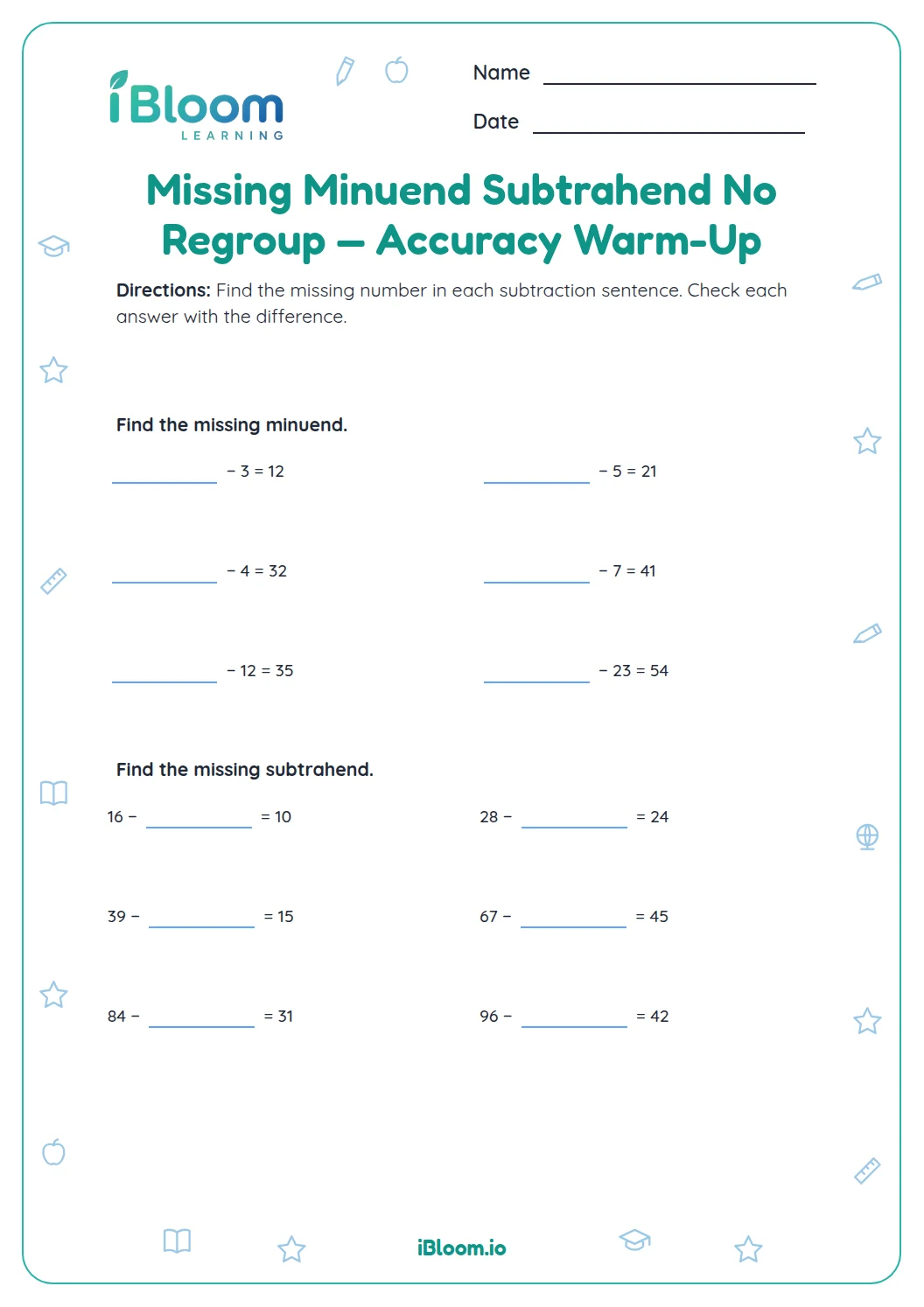
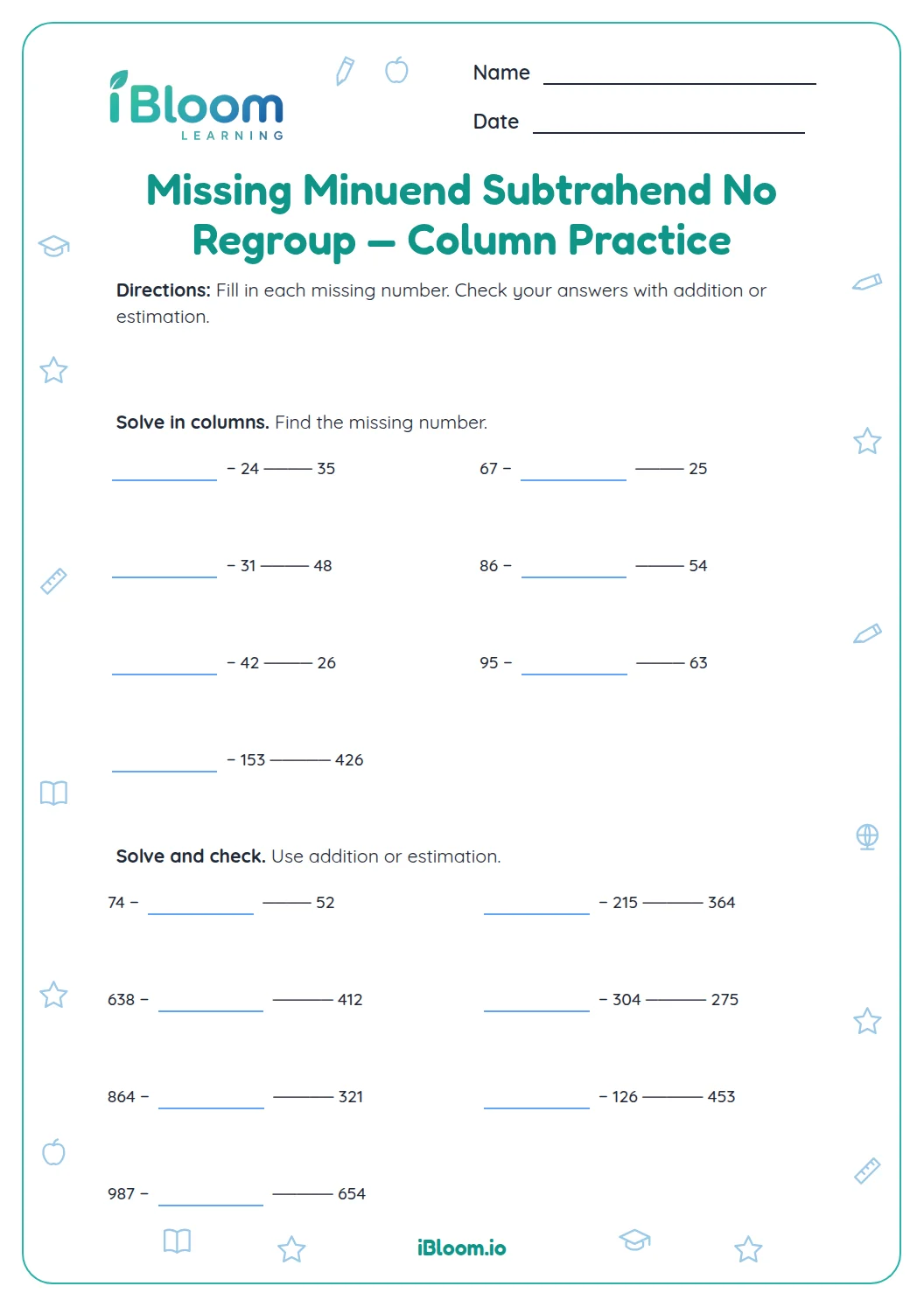
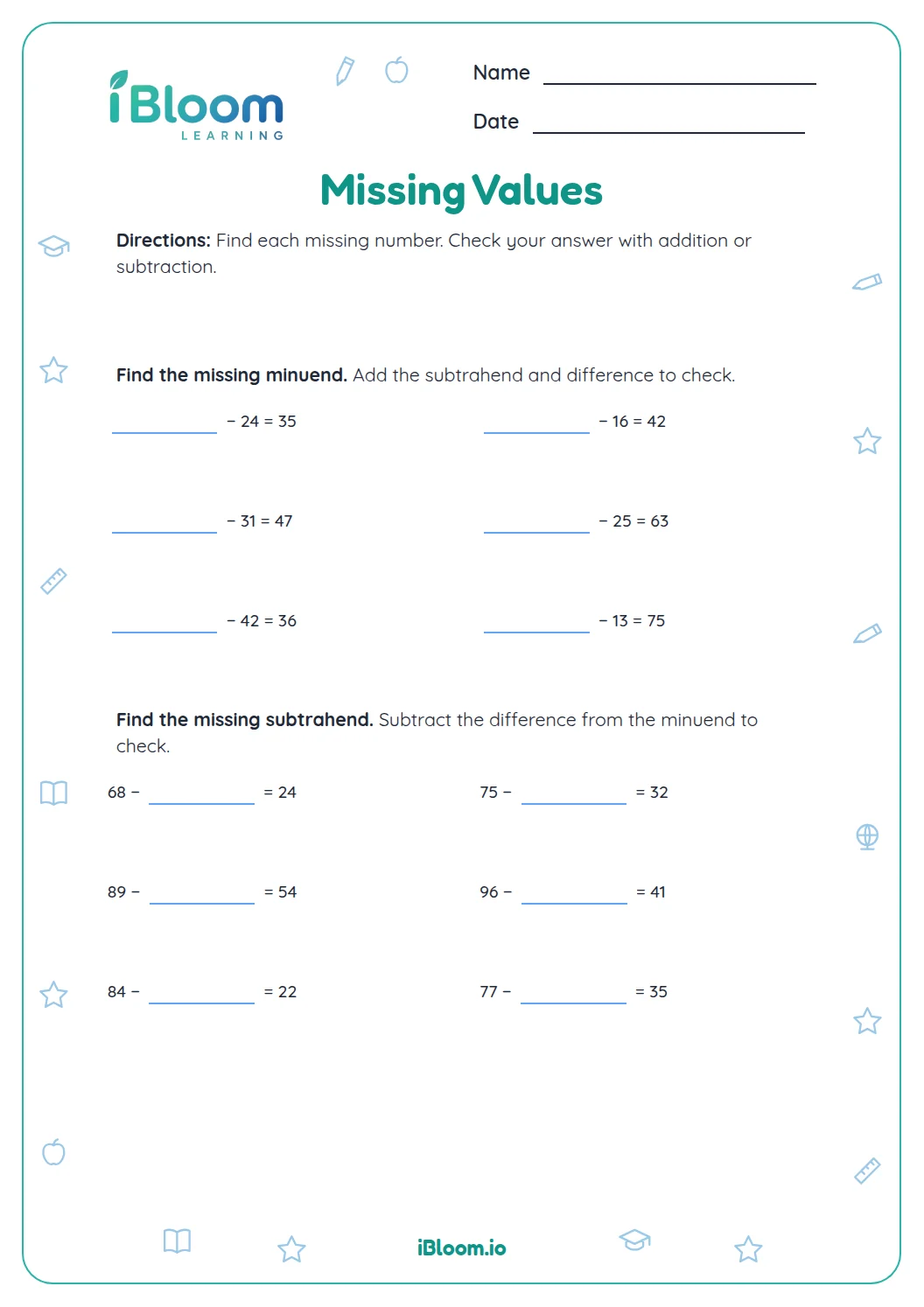
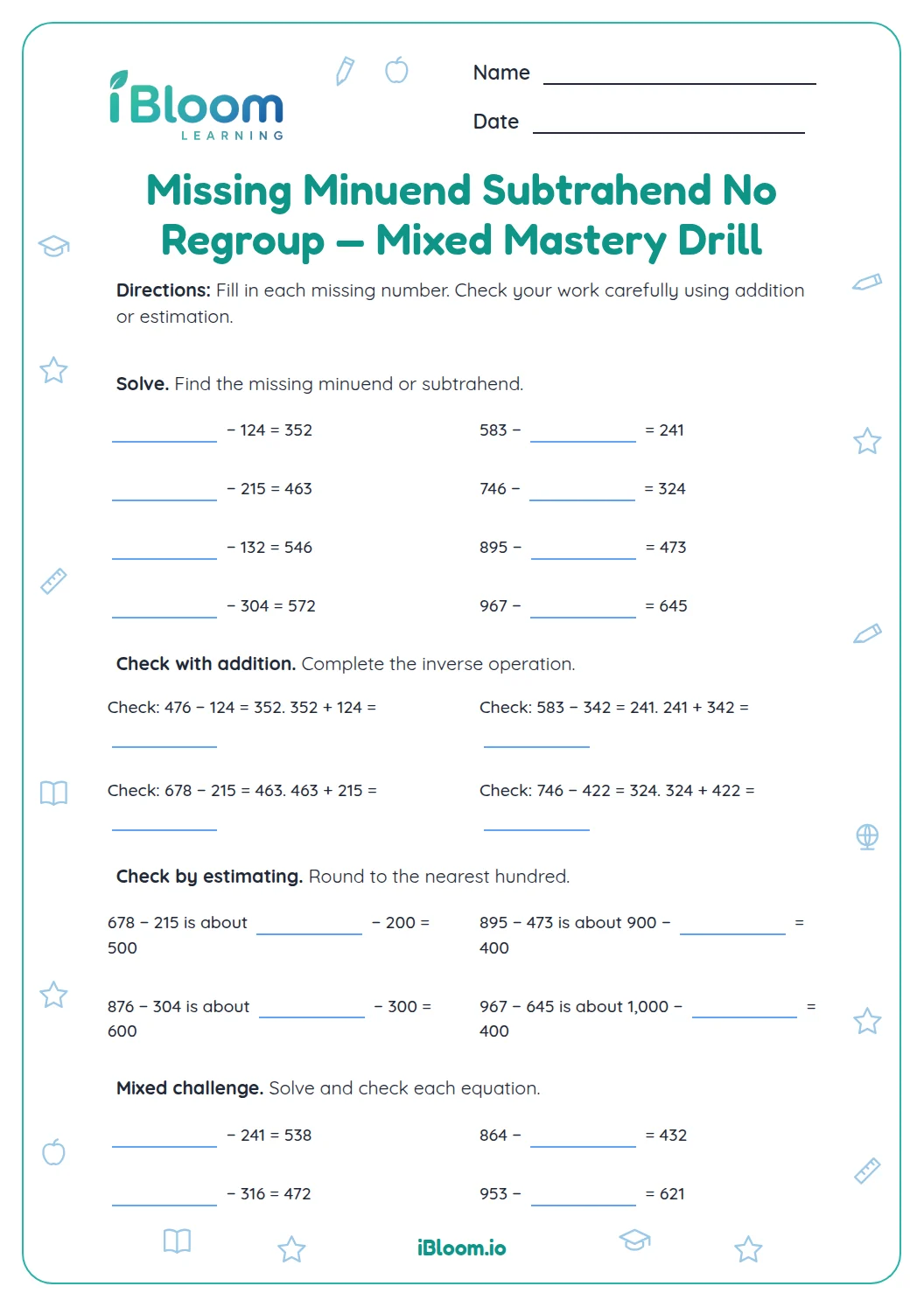
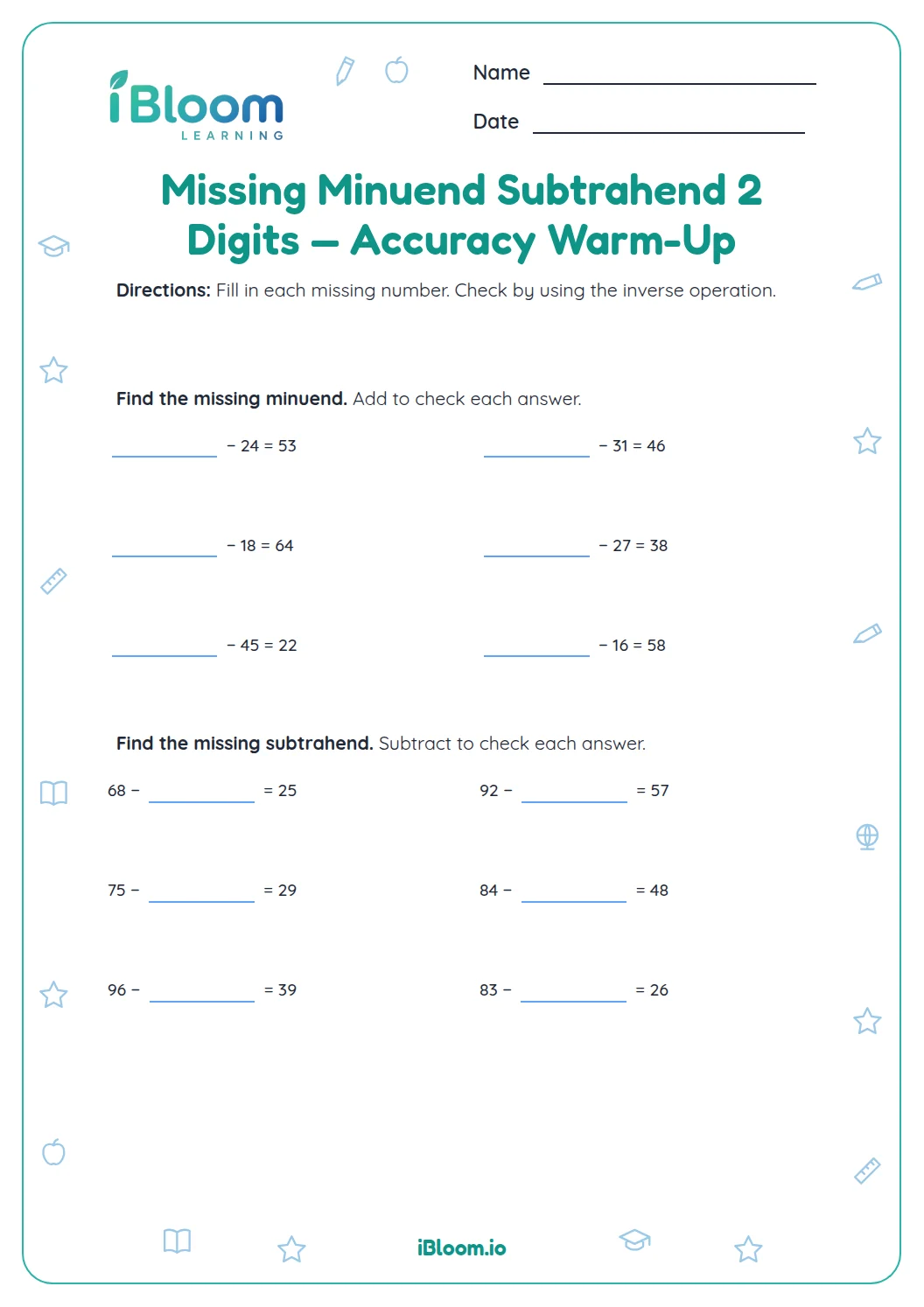
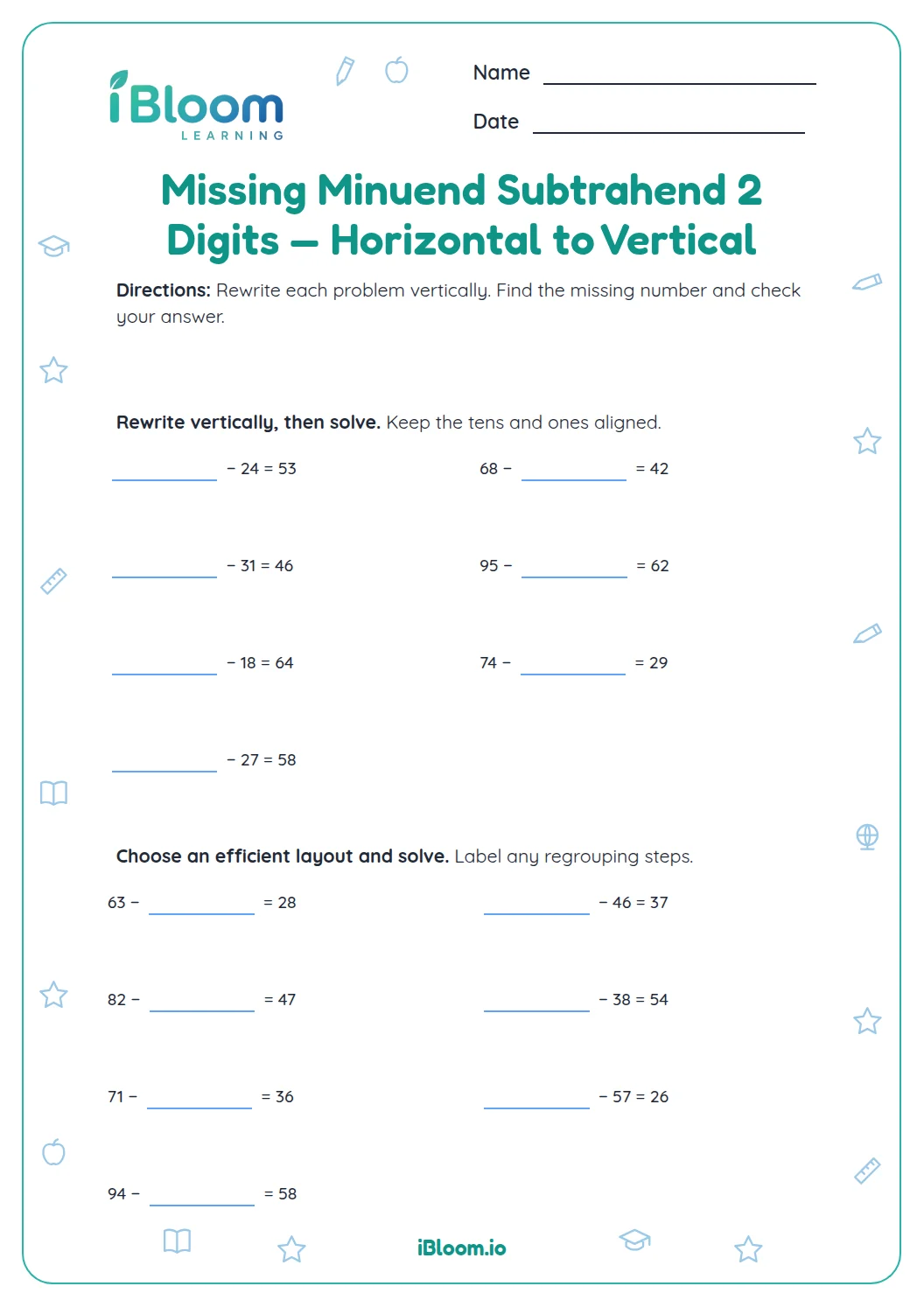
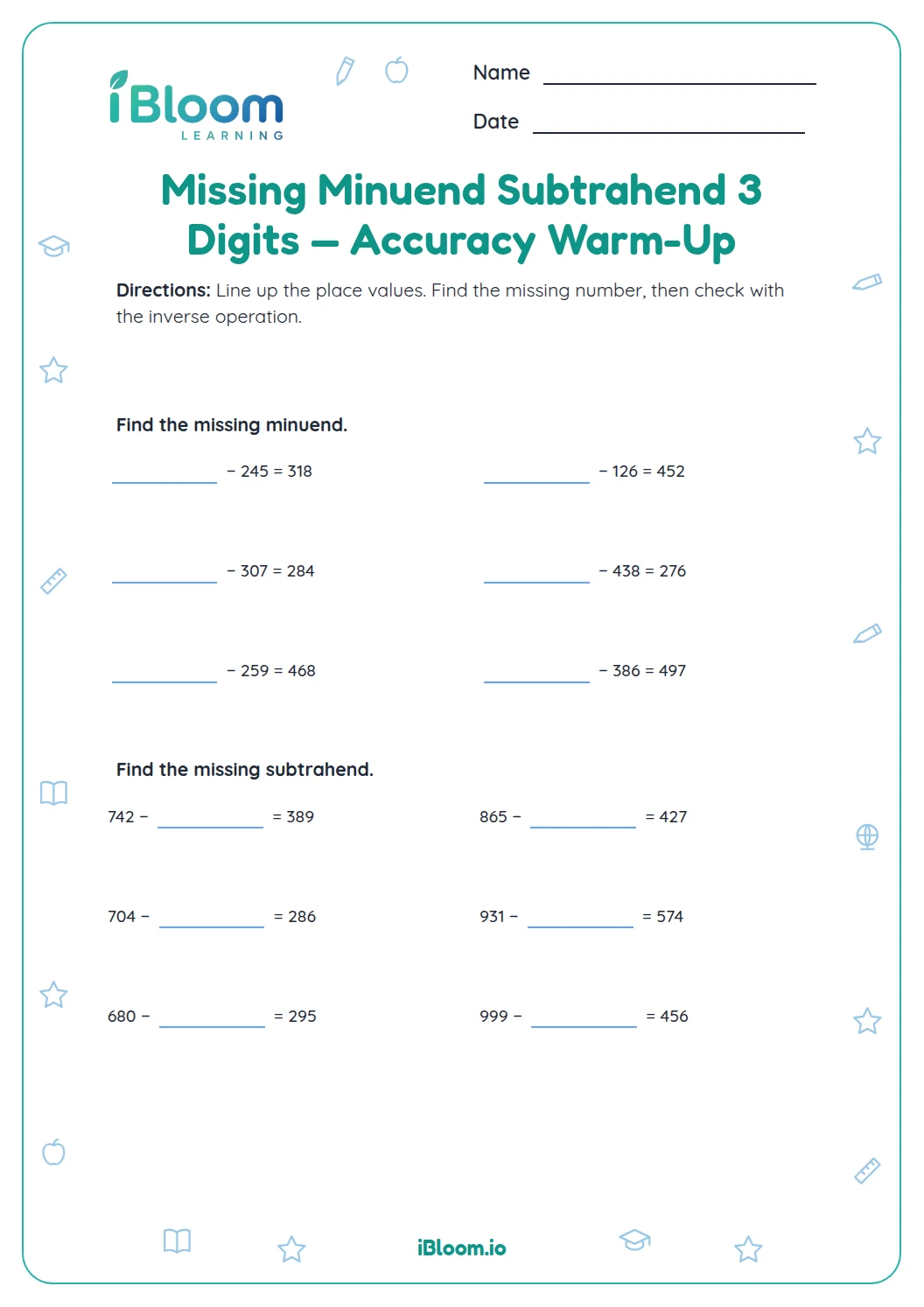
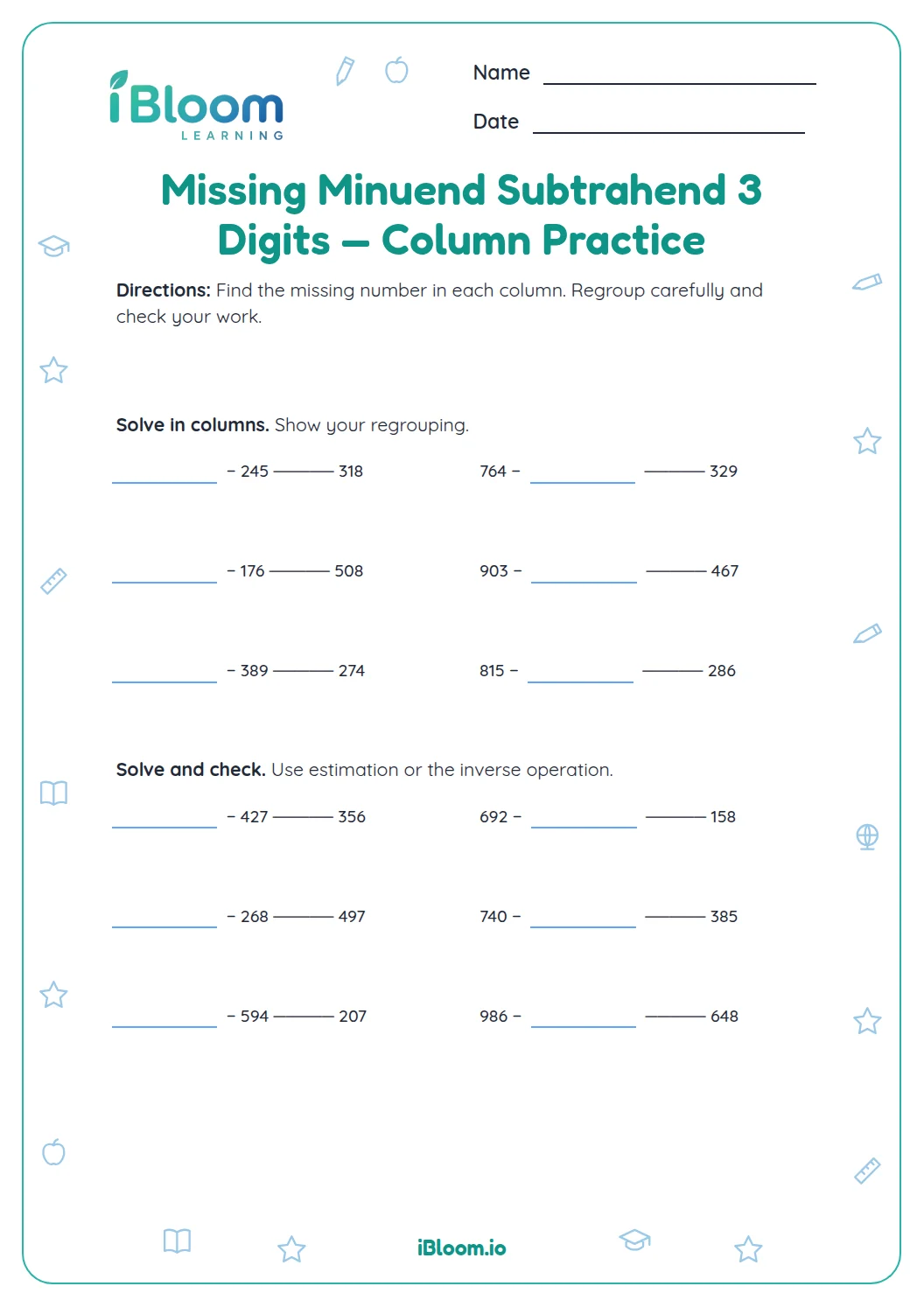
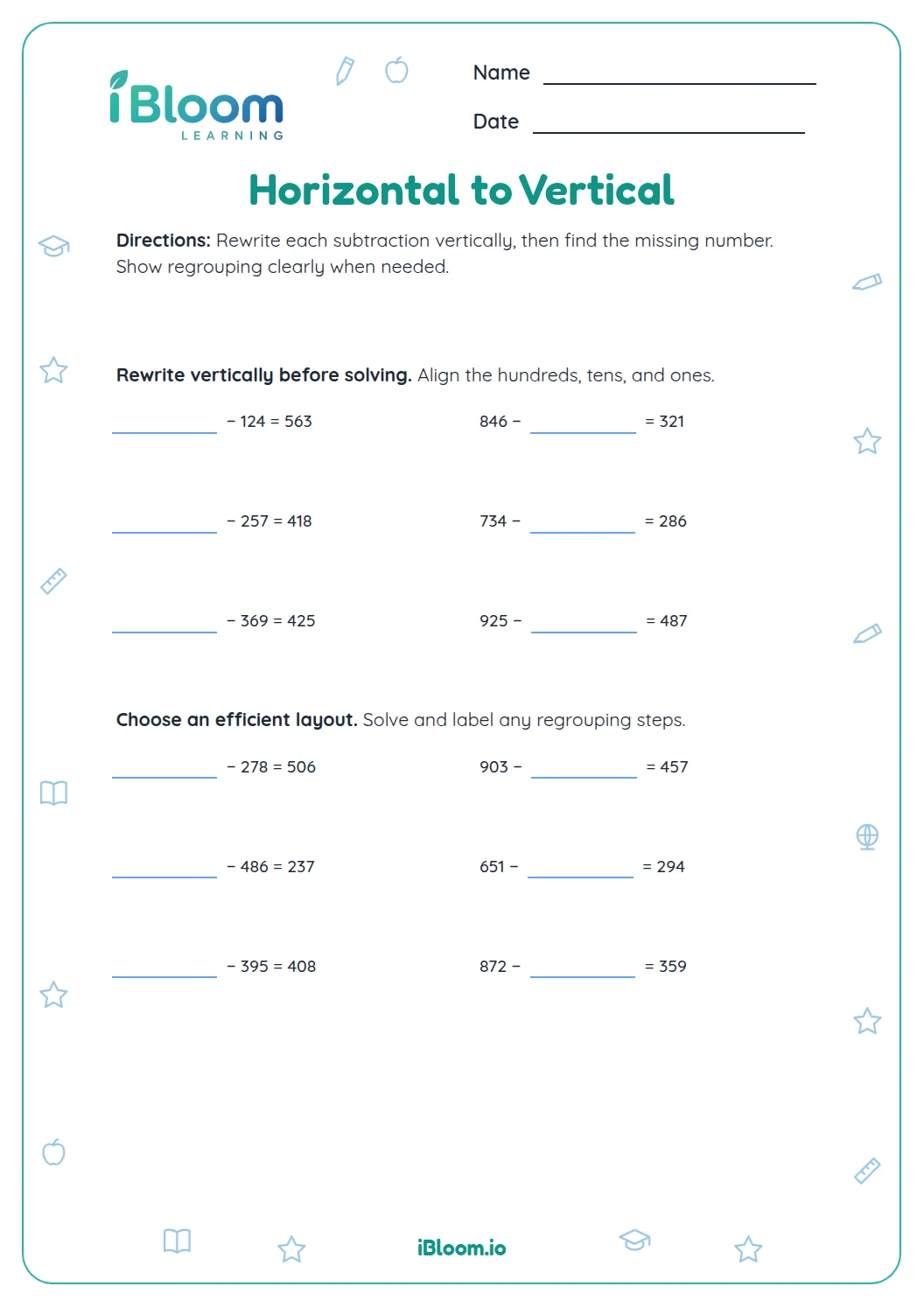
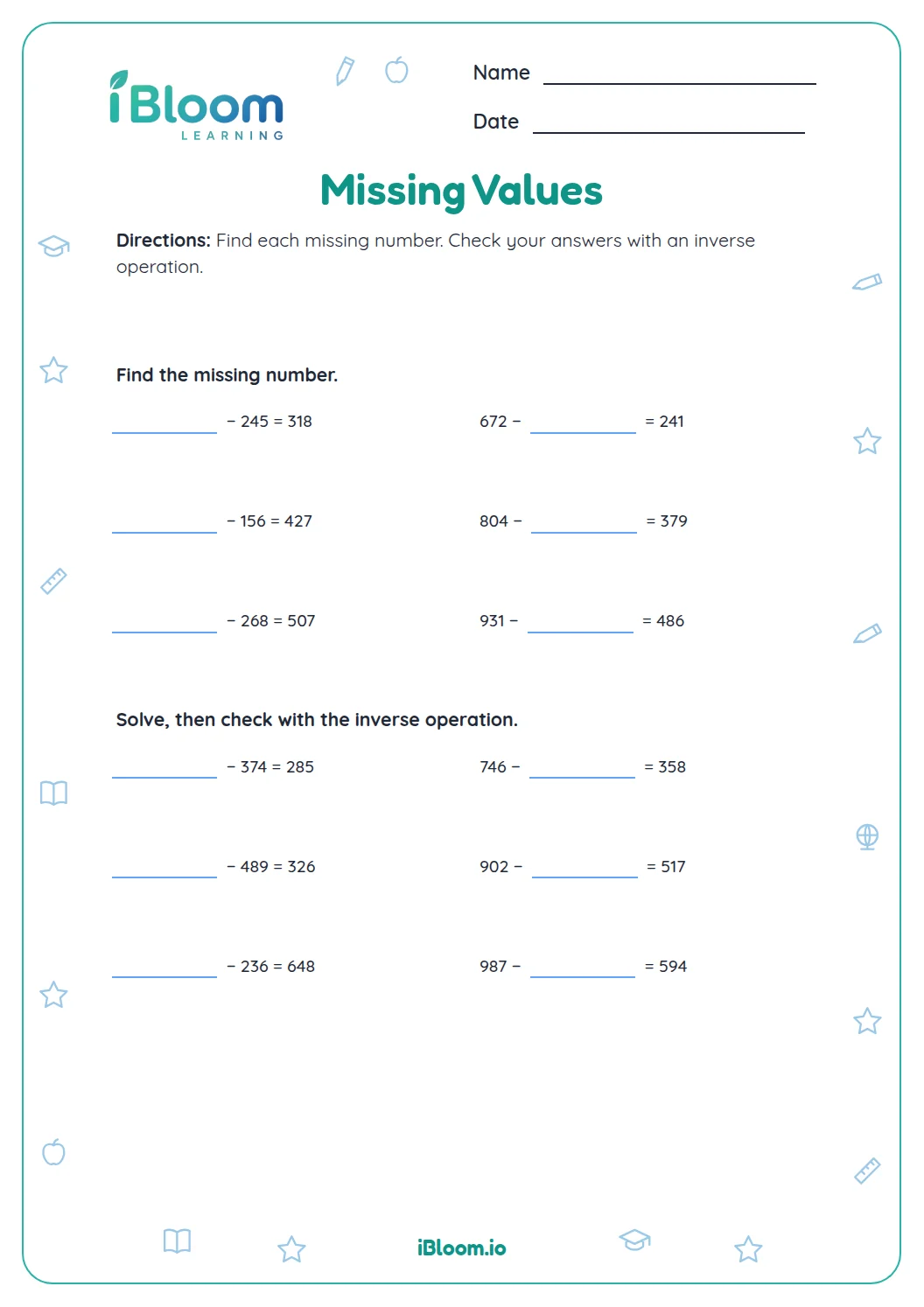
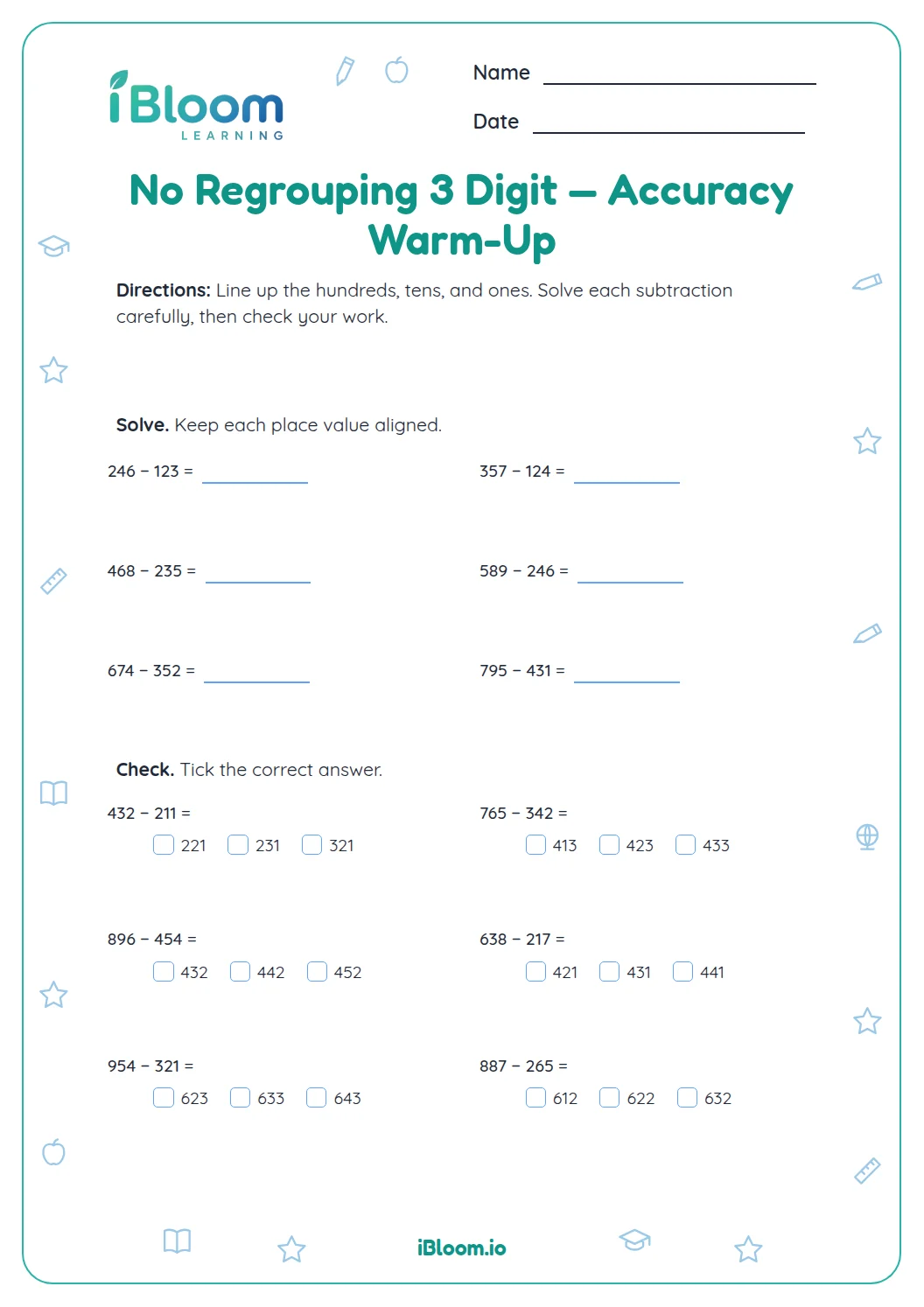
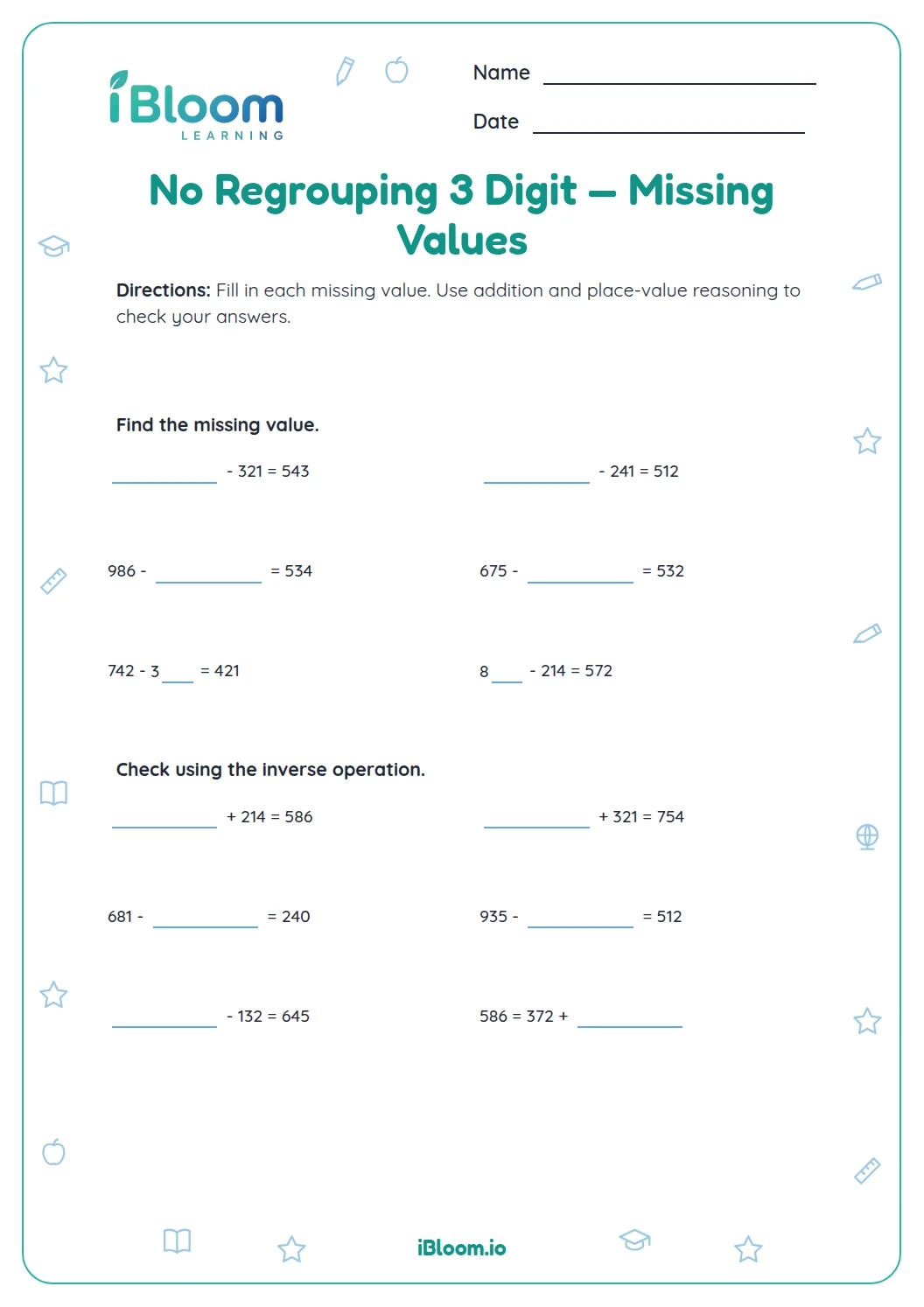
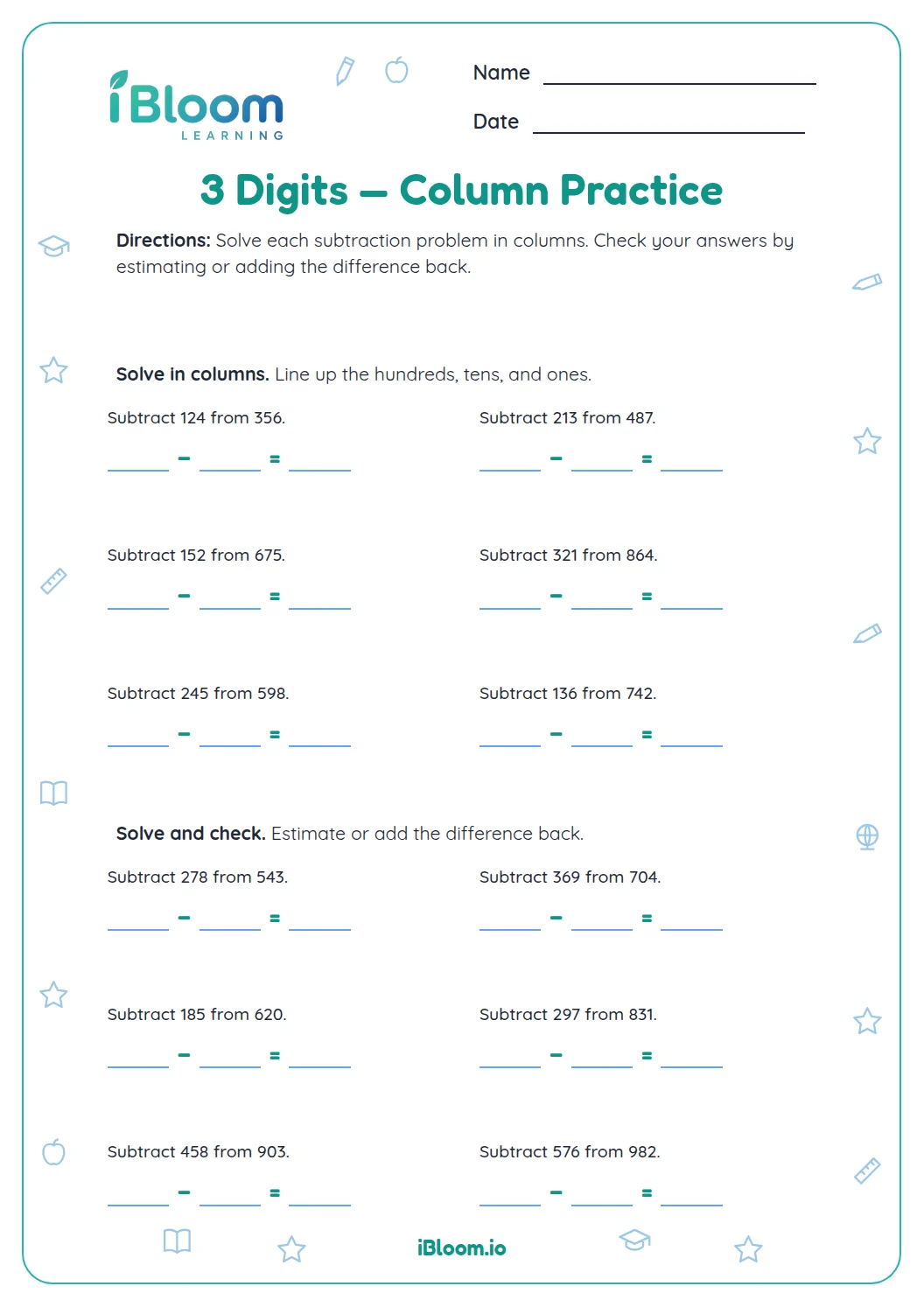
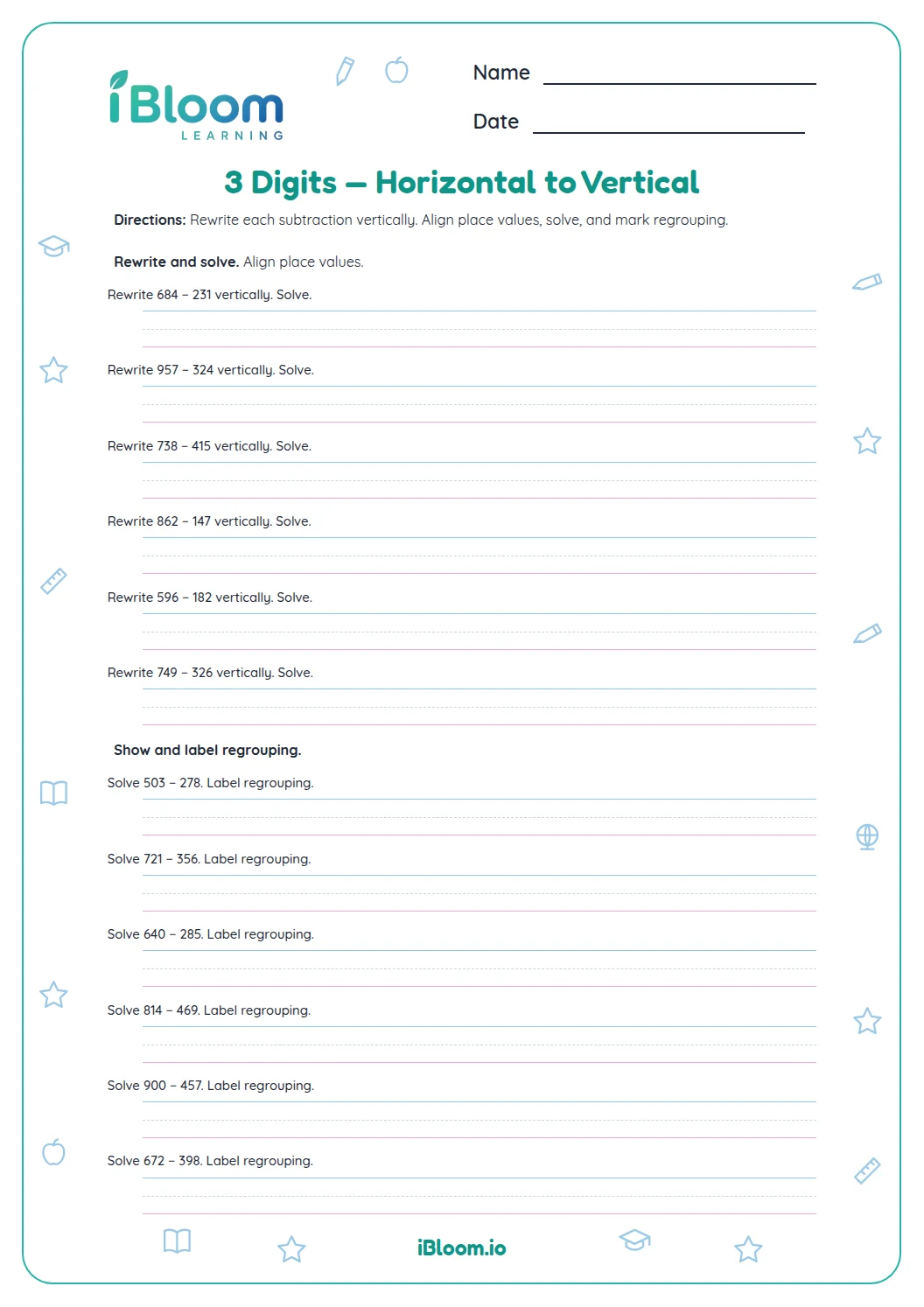
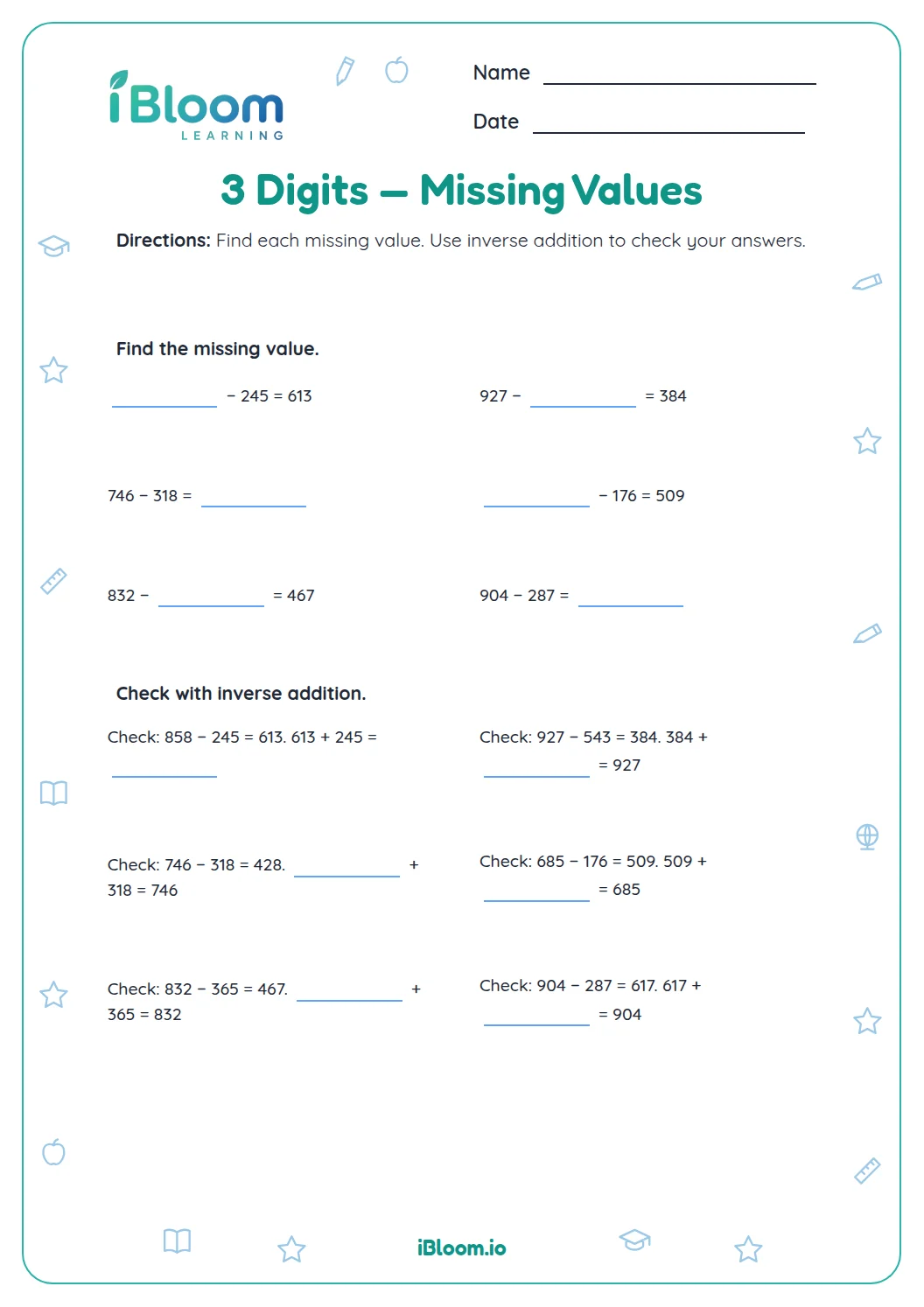
This Grade 3 worksheet builds fluency with three-digit subtraction without regrouping. In Part A, students find a missing minuend or subtrahend in horizontal equations; Part B asks them to rewrite each equation vertically and solve. The set includes 16 questions and a separate answer key. It practices place-value subtraction within 1,000, with the blank moving between the starting number, the number subtracted, and the difference.
Aligned to 3.NBT.A.2
What does this subtraction worksheet practice?
Sixteen three-digit equations ask students to find a missing starting number, subtrahend, or difference. The numbers are chosen so each subtraction can be solved without regrouping.
Part A has eight horizontal equations. In Part B, students rewrite eight more in columns before solving, connecting the compact equation to place-value alignment.
- Part A: find the missing value in a horizontal equation
- Part B: rewrite each equation vertically and solve
- The key gives the missing number for every equation
How do you find a missing minuend?
The minuend is the number subtraction starts with. When it is missing, combine the subtrahend and the difference. For ___ − 361 = 427, add 361 + 427 to find 788.
- 1q3) ___ − 361 = 427
- 2361 + 427 = 788, so the missing minuend is 788.
How do you find a missing subtrahend?
When the number being subtracted is missing, subtract the difference from the minuend. Check by putting the result back into the original equation.
- 1q2) 684 − ___ = 542
- 2684 − 542 = 142; check: 684 − 142 = 542.
Why rewrite an equation in columns?
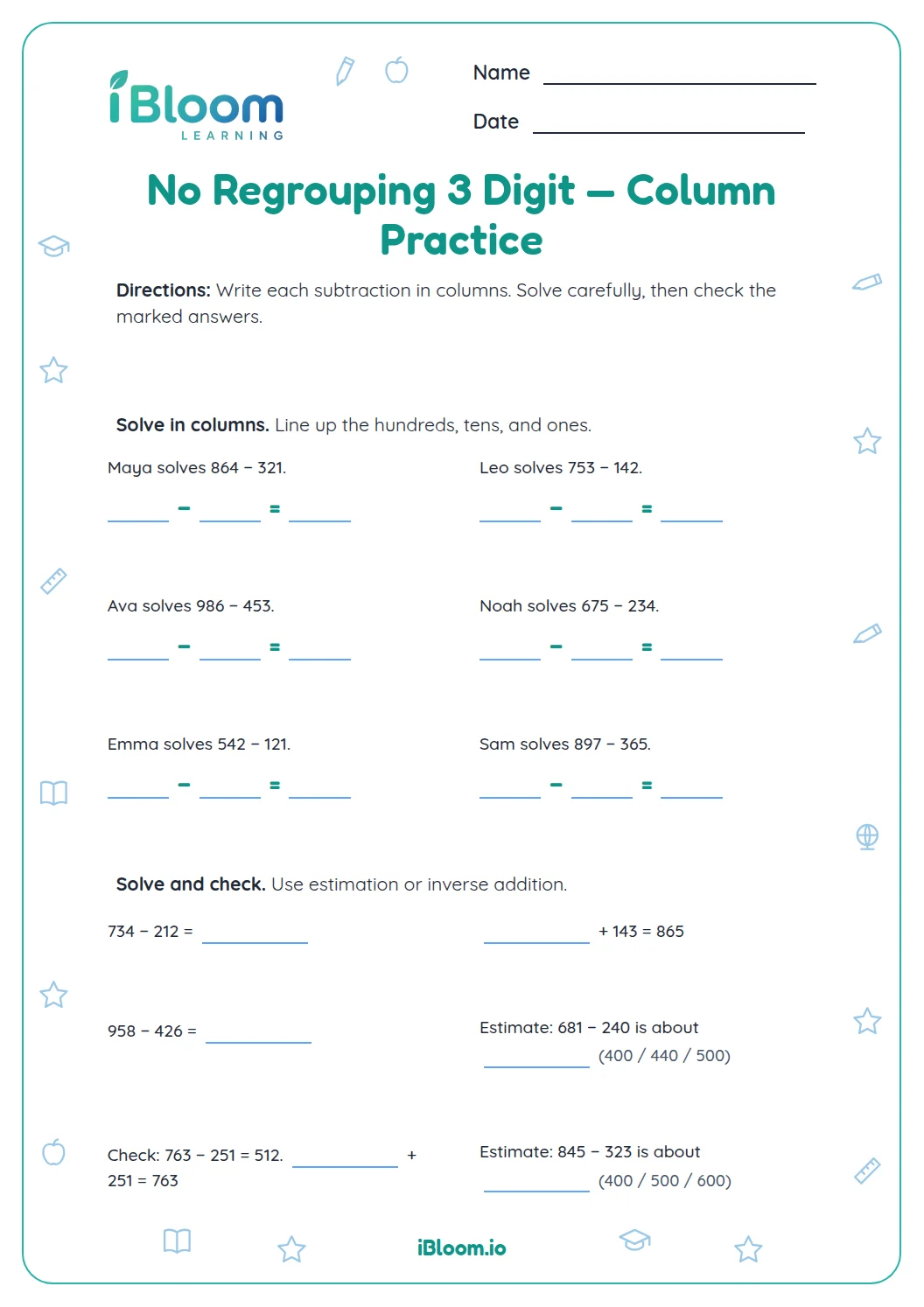
Column form lines up hundreds, tens and ones. This makes each place easy to compare and helps students see why subtraction works digit by digit when no regrouping is needed.
How to use this worksheet
- 1Read the whole equation before deciding which number is missing.
- 2If the minuend is blank, add the subtrahend and difference.
- 3If the subtrahend is blank, subtract the difference from the minuend.
- 4In Part B, line up ones, tens and hundreds before calculating.
- 5Substitute your result into the equation to check it.
Common mistakes and quick fixes
The mistake
Subtracting the minuend from the difference when it is unknown.
The fix
Add the subtrahend and difference to recover the starting number.
The mistake
Using the minuend plus the difference for a missing subtrahend.
The fix
Subtract the difference from the minuend, then check the equation.
The mistake
Letting digits drift into the wrong column.
The fix
Align ones under ones, tens under tens and hundreds under hundreds.
Common Core alignment
These problems connect place value and the relationship between addition and subtraction.
Subtract within 1,000 while keeping hundreds, tens and ones in their places.
On this sheet: Each equation uses three-digit numbers and subtraction without regrouping.
Show the official wordingHide the official wording
Fluently add and subtract within 1000 using strategies and algorithms based on place value, properties of operations, and/or the relationship between addition and subtraction.
What to practice next
Make more practice
Further reading
Questions parents and teachers ask
What is a minuend?
The minuend is the number from which another number is subtracted. In 684 − 142 = 542, 684 is the minuend, 142 is the subtrahend and 542 is the difference. If the minuend is missing, add the subtrahend and difference to find it.
How do I find a missing subtrahend?
Subtract the difference from the minuend. For example, if 684 − ___ = 542, calculate 684 − 542 = 142. Then check that 684 − 142 equals 542. This check catches errors in the unknown position. The subtraction equation should be true after the number is restored.
Why does Part B ask students to write in columns?
Column form aligns ones, tens and hundreds so students can see each place value clearly. This worksheet uses subtraction examples that do not require regrouping, allowing attention to stay on alignment and the missing number. The problem set moves from horizontal practice into column form. The same place-value alignment is useful on every item.
How many questions and pages are included?
The worksheet has 16 questions across two pages, followed by a separate two-page answer key. Part A has eight horizontal missing-number equations. Part B has eight more equations with space to rewrite each in columns. The key lists the value that completes every equation.
What should students do if the difference is missing?
Subtract the subtrahend from the minuend. For example, in 759 − 340 = ___, calculate 759 − 340 to find 419. Putting 419 back into the equation confirms the result. Students can check every answer by substituting it into the equation and confirming both sides match.