



About this worksheet
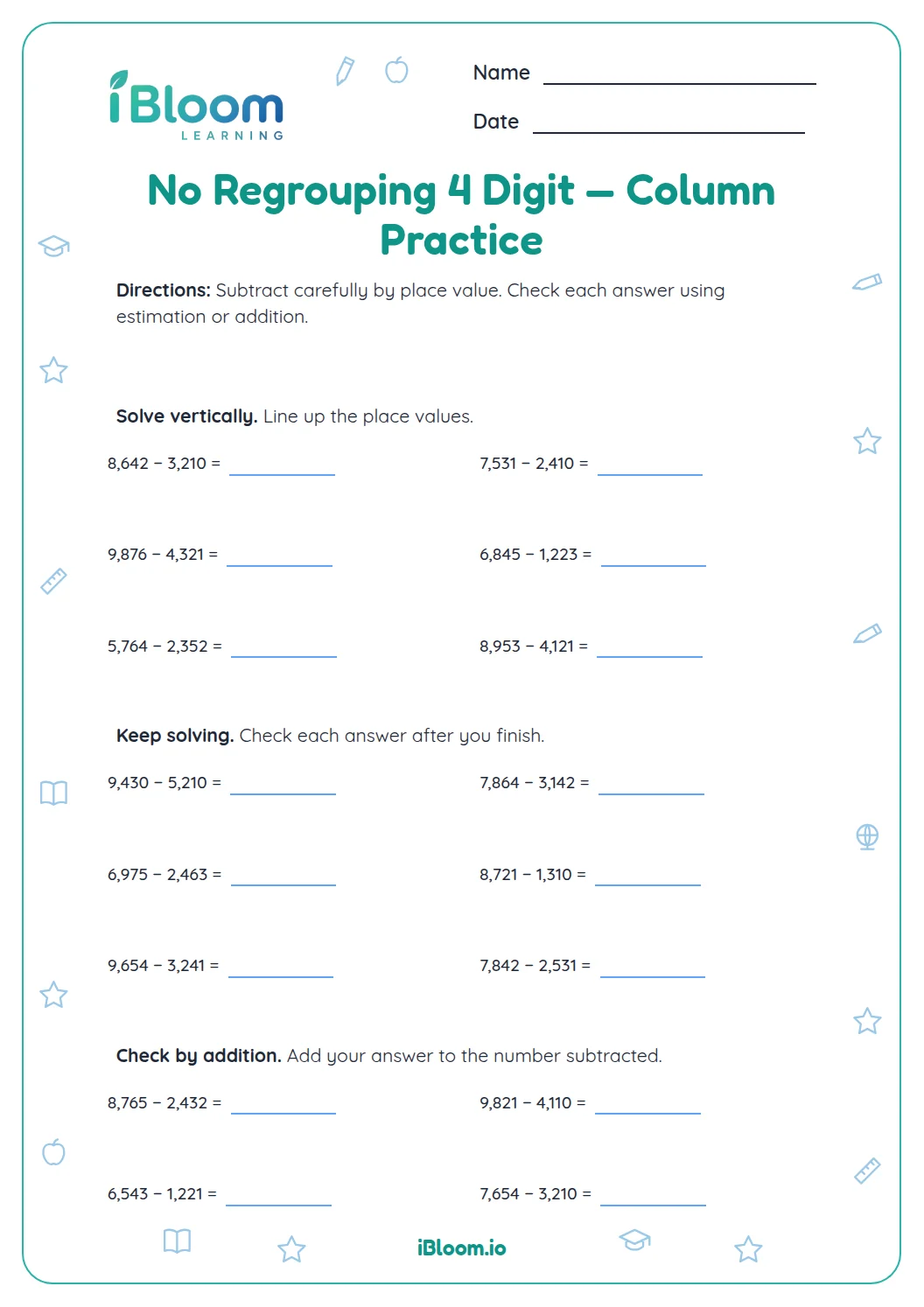
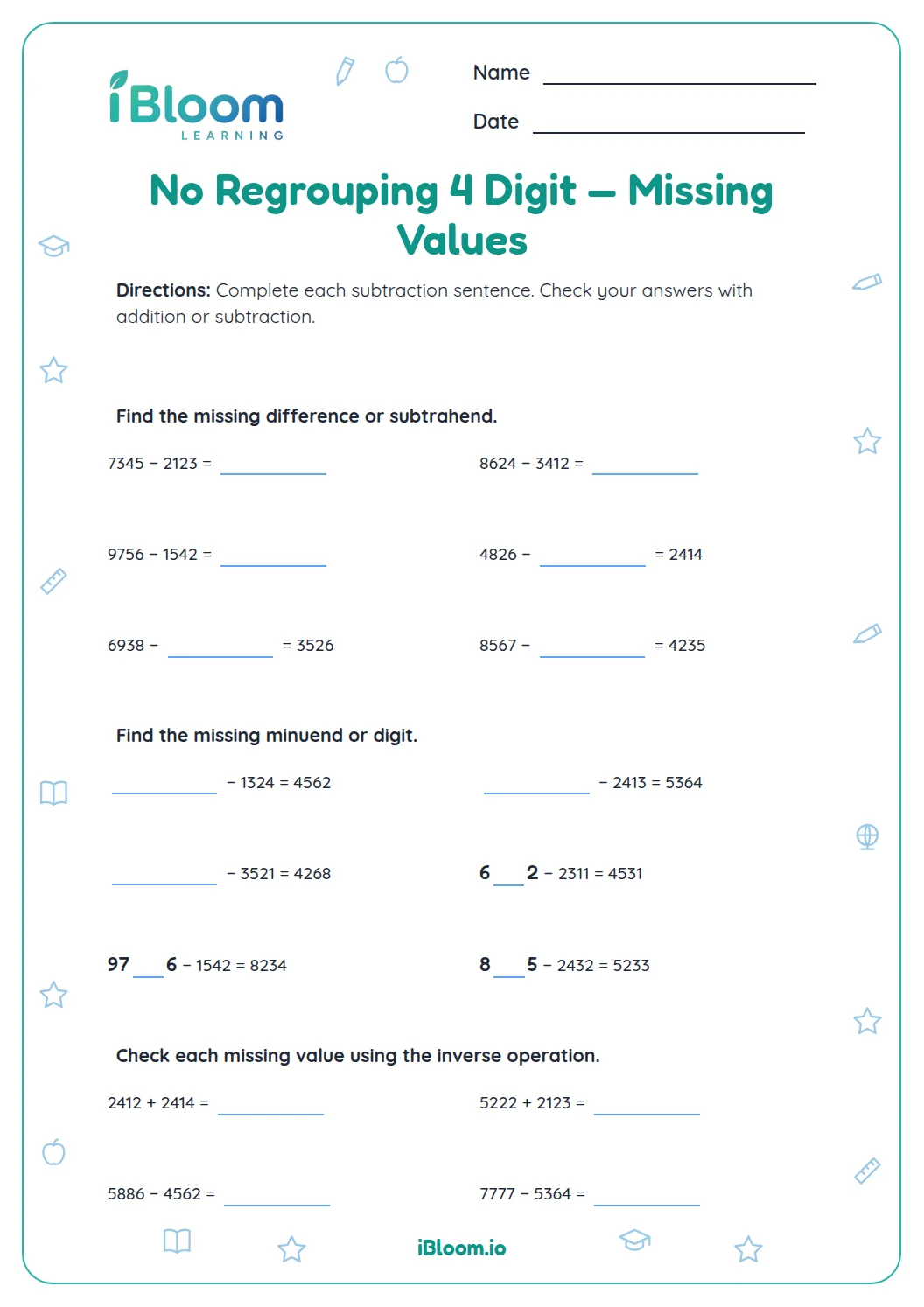
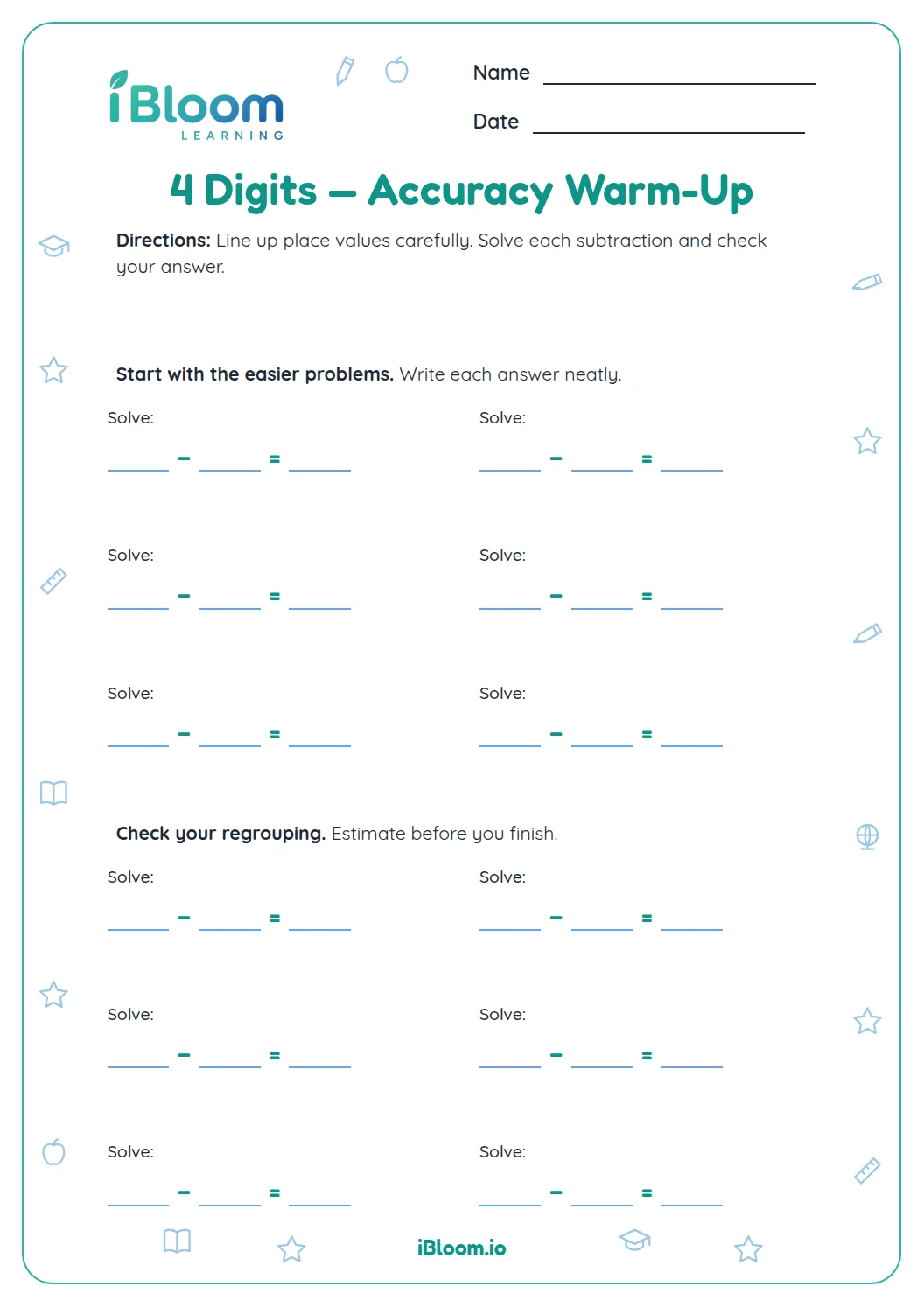
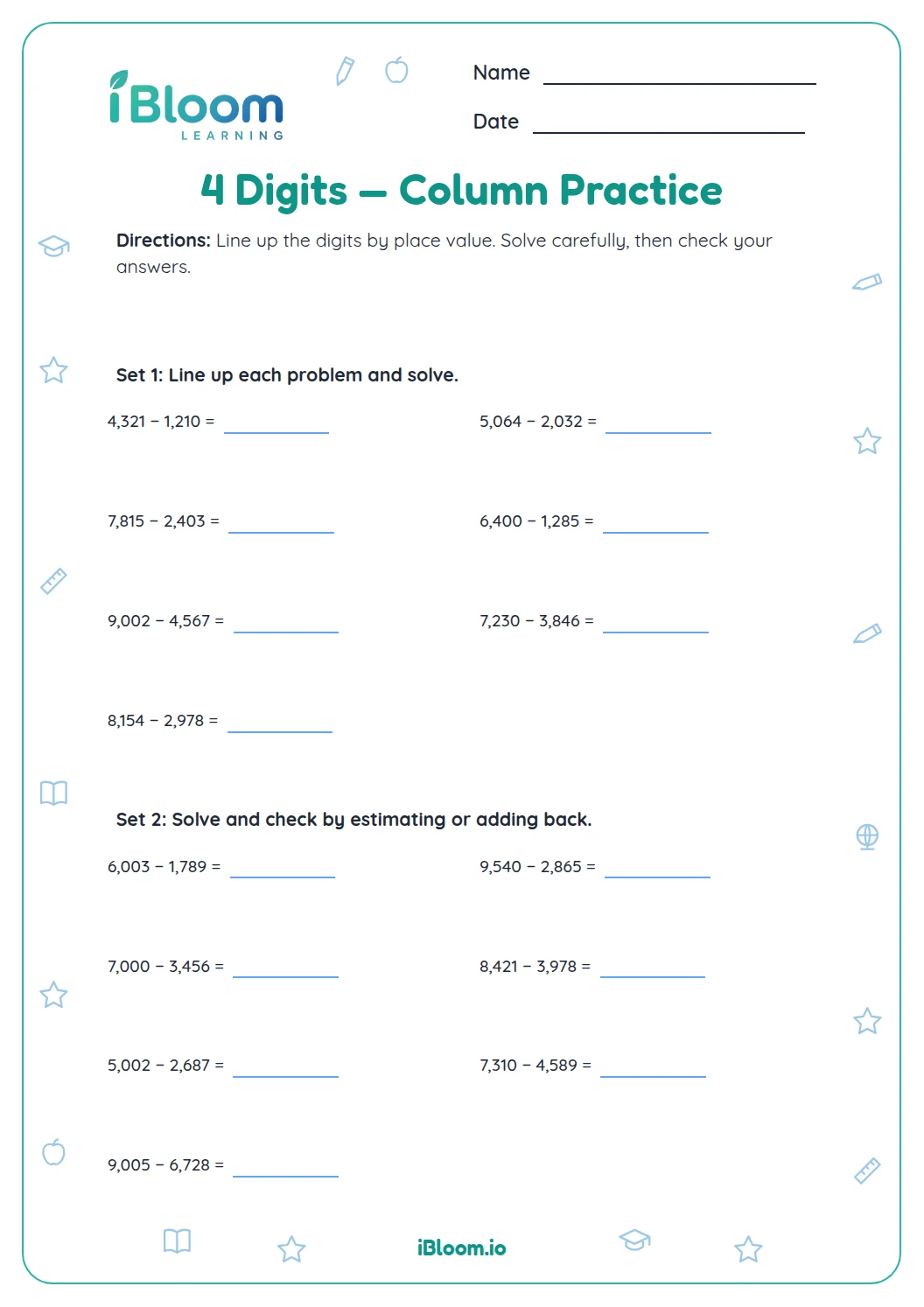
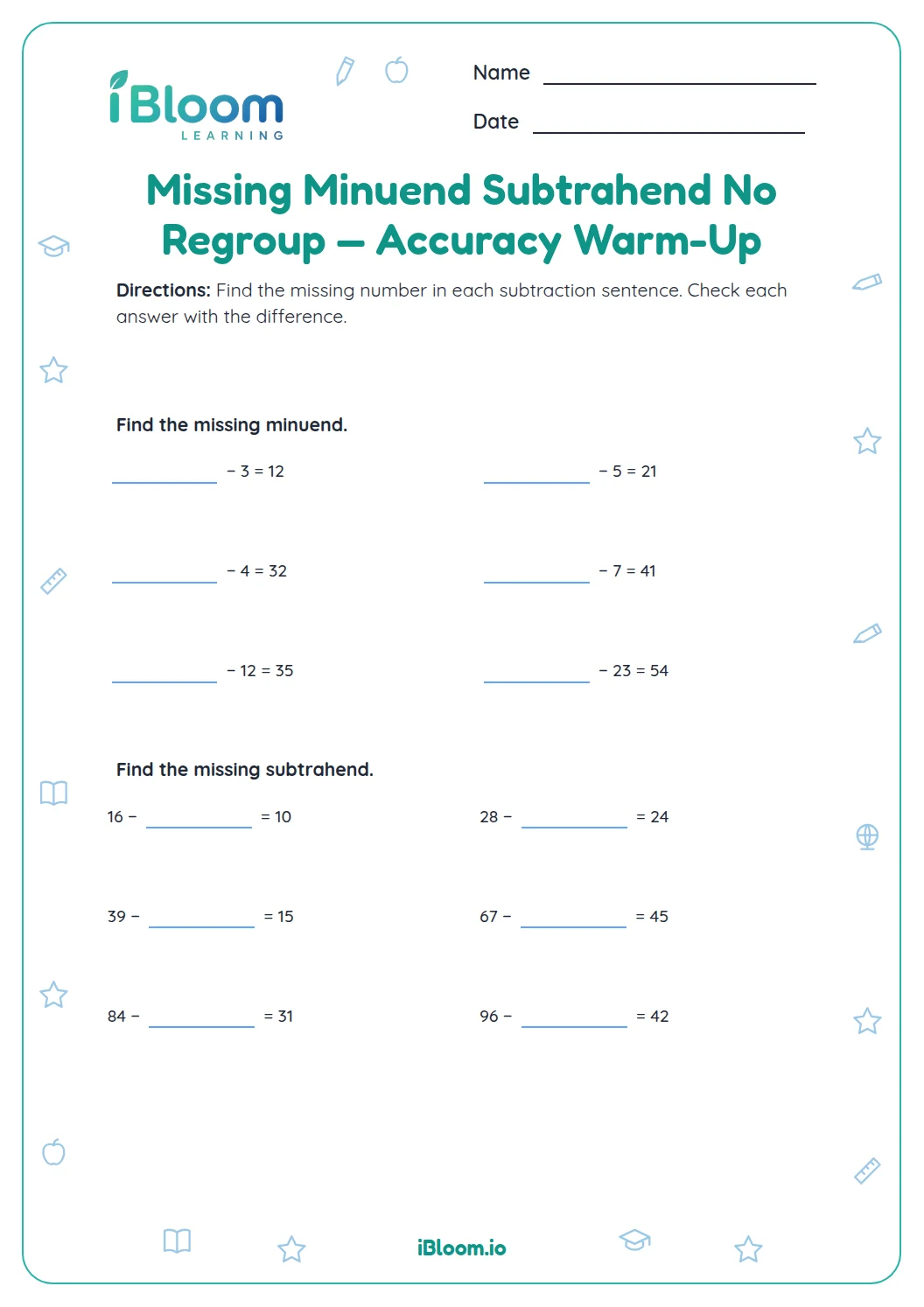
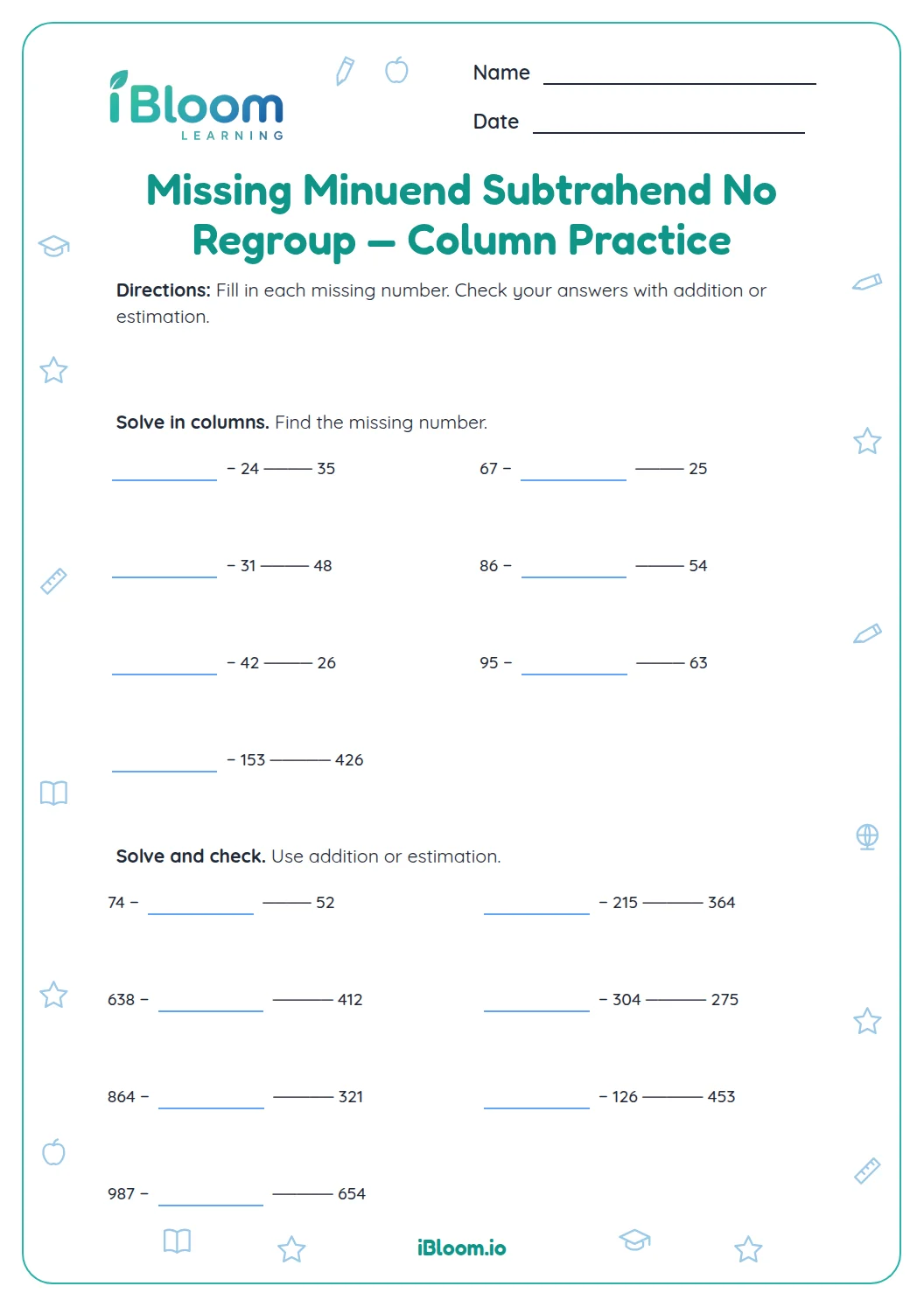
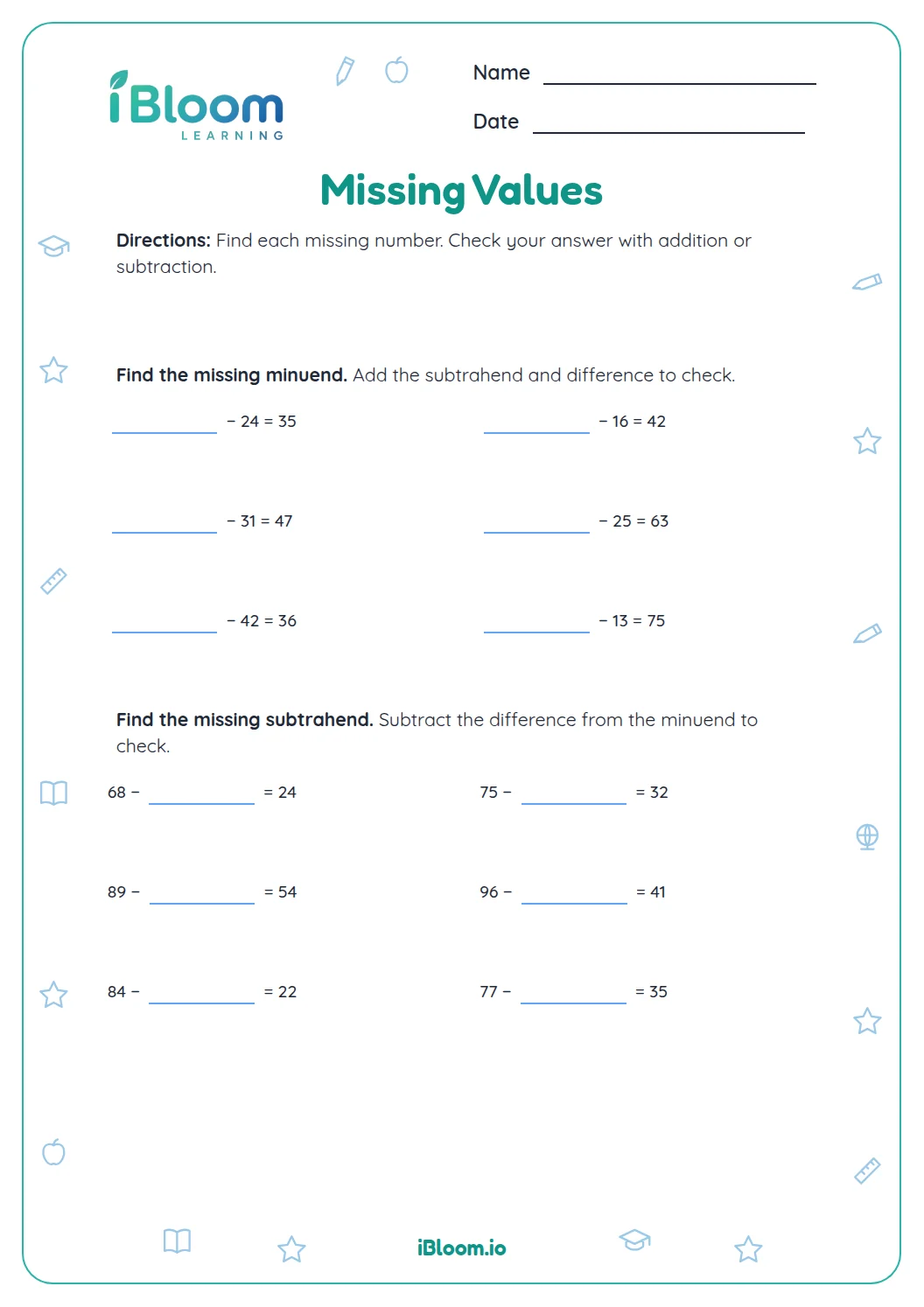
This free printable warm-up gives Grades 4–5 students 16 questions on accurate four-digit subtraction. Part A has eight calculations with space to line up the numbers. Part B adds four calculations with zeros in the numbers or answers. Part C asks children to choose an addition check for each of four completed subtractions. Every subtraction can be solved without regrouping. The page practices Common Core 4.NBT.B.4, using the standard algorithm for multi-digit whole numbers. Work from the ones column to the thousands column, then check that the difference plus the amount subtracted returns the starting number.
Aligned to 4.NBT.B.4
How do you keep the columns lined up?
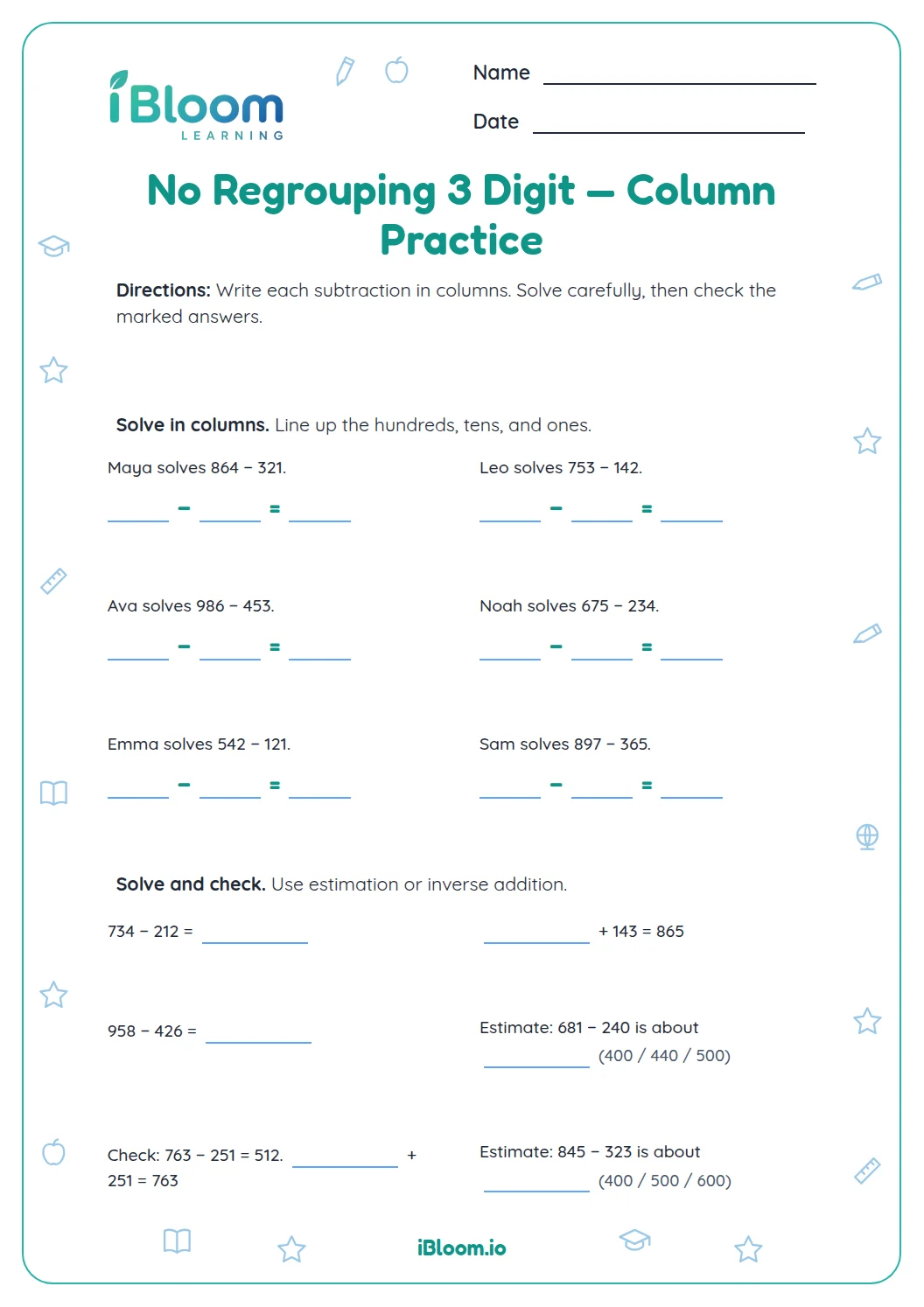
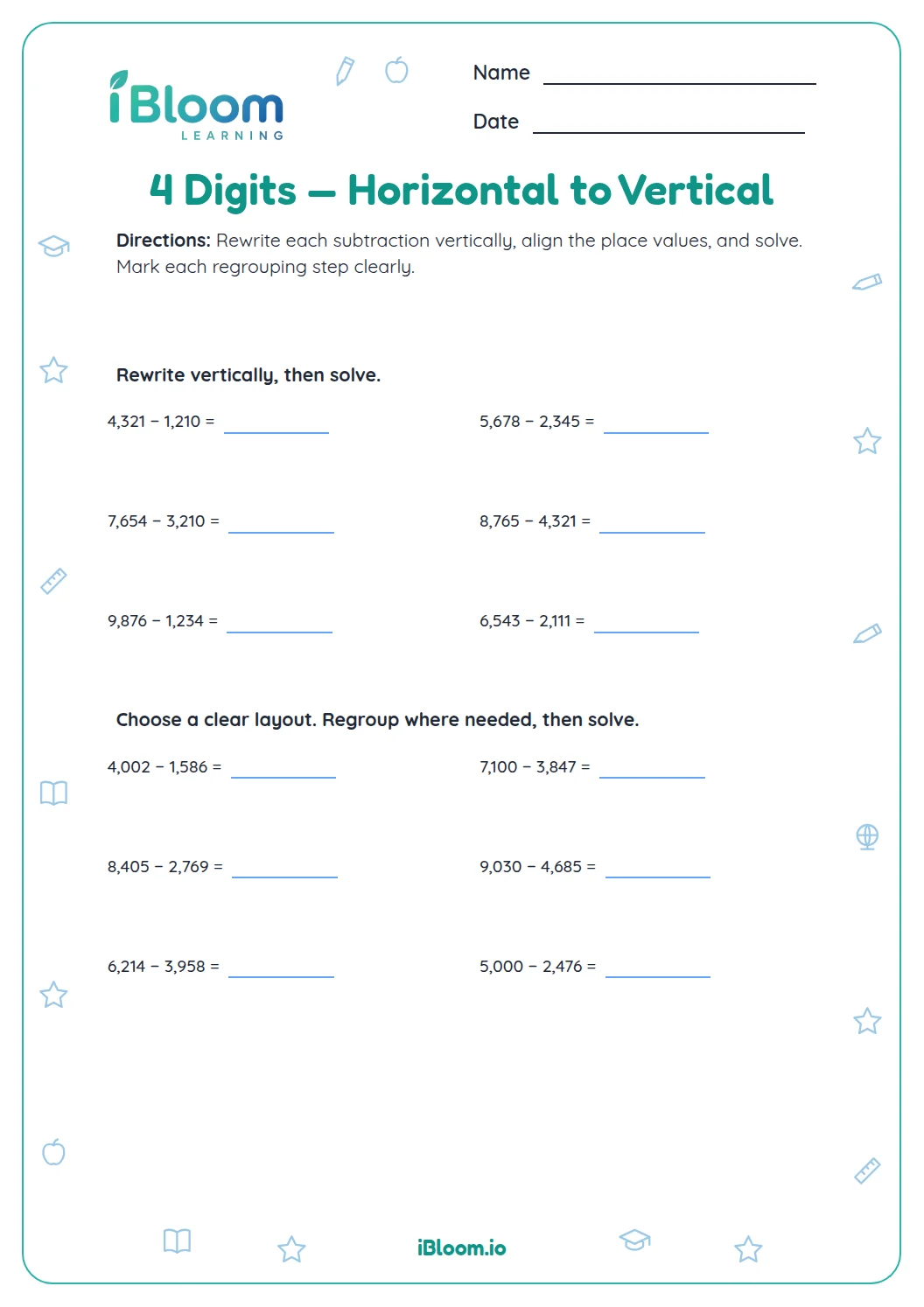
Write the second number under the first so that each digit is beneath the digit with the same place value. Commas separate groups of digits; they do not make an extra column. Use the open space in Part A to stack the numbers. Part B adds working grids to help children keep each digit in its own column.
- 16,874 − 2,351
- 2Ones: 4 − 1 = 3. Tens: 7 − 5 = 2.
- 3Hundreds: 8 − 3 = 5. Thousands: 6 − 2 = 4.
- 4Difference: 4,523. Check: 4,523 + 2,351 = 6,874.
Why do zeros matter in the answer?
A zero records that a place has no remaining units. In question 10, 8,806 − 3,804 = 5,002. Both the hundreds and tens columns have a difference of zero. Keeping those two zeros preserves the value of the thousands and ones digits.
Part B gives four chances to keep zeros in place. Have children point to the matching columns before writing each digit in the answer.
How does addition check a subtraction?
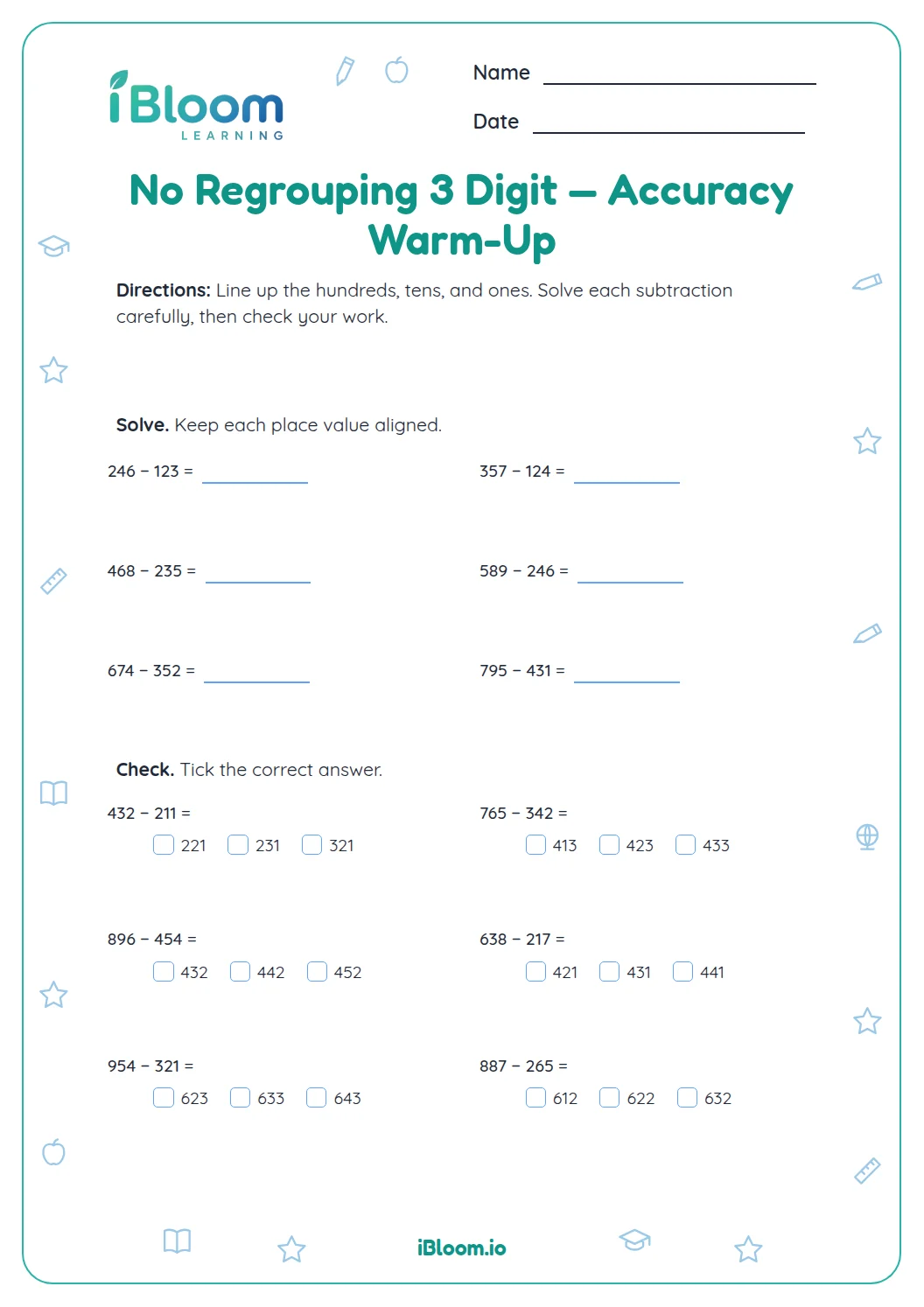
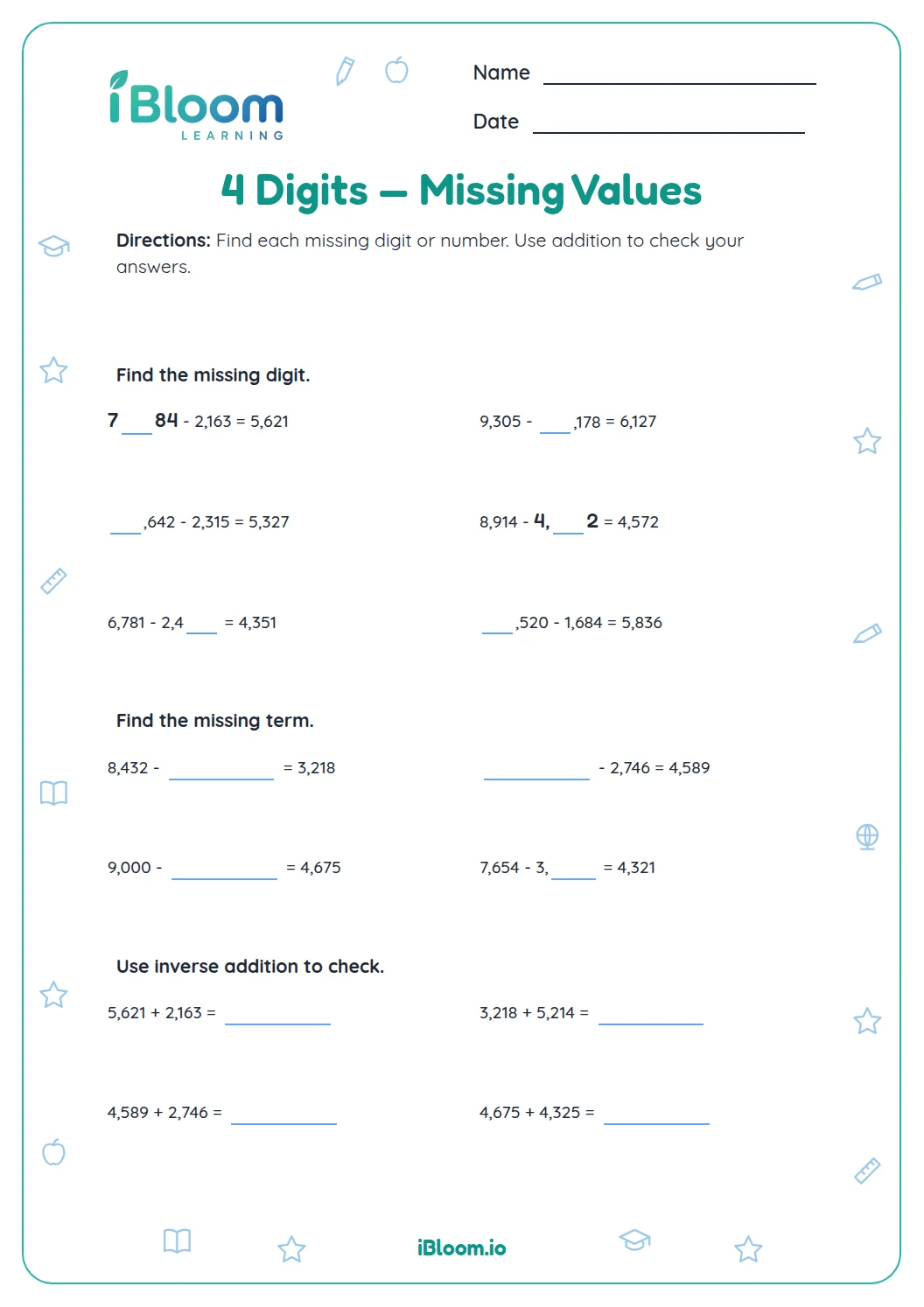
Add the difference to the number that was subtracted. The sum should equal the starting number. Part C presents three candidate checks for each completed subtraction, so children must look at the operation, both addends, and the total.
Accuracy is the purpose of this warm-up. Give children time to revisit one column at a time when a check fails. A timer is optional and is best introduced only after the written calculations are dependable.
How to use this worksheet
- 1Read the subtraction sign and copy both numbers into aligned columns.
- 2Subtract the ones first, then the tens, hundreds, and thousands.
- 3Keep every zero needed to hold a place in Part B.
- 4In Part C, find the check that adds the difference to the subtracted amount.
- 5Compare with the key and redo any column that caused a mismatch.
Mistakes to check and how to fix them
The mistake
Putting a hundreds digit beneath a tens digit.
The fix
Label the four columns Th, H, T, and O before copying the numbers.
The mistake
Writing 52 for 8,806 − 3,804.
The fix
Record the two zero differences to keep the answer 5,002.
The mistake
Checking subtraction by adding the two original numbers.
The fix
Add the difference and the amount subtracted; that sum should rebuild the starting number.
Common Core alignment
Subtract four-digit numbers by place value and check with addition.
On this sheet: Parts A and B practice aligned subtraction; Part C checks differences with addition.
Show the official wordingHide the official wording
Fluently add and subtract multi-digit whole numbers using the standard algorithm.
What to practice next
Make more practice
Further reading
Questions parents and teachers ask
Do any of these subtractions need regrouping?
No, each top digit is at least as large as the digit subtracted from it in the same column. Children can subtract directly in every place. If a copied calculation seems to need regrouping, compare the digits with the printed problem and check that the columns are aligned.
How many calculations are on the worksheet?
There are twelve subtraction calculations and four multiple-choice addition checks. Part A contains eight calculations, and Part B contains four more that emphasize zeros. Part C provides completed subtraction equations and asks children to identify the addition statement that correctly checks each one. All answers appear on the separate key.
Should I time this accuracy warm-up?
Timing is optional; start by checking whether the columns and answers are accurate. Let the child finish a few calculations and explain an addition check before introducing any time goal. If you later time practice, compare the child’s own careful attempts and keep the focus on correct work.
What is the purpose of the working grids?
The four grids in Part B give children space to rewrite the horizontal subtraction problems in columns. Put one digit in each grid column and keep the ones digits aligned on the right. This makes the place-value steps visible and gives an adult a way to locate a copying or subtraction error.
How can I help when an answer has a missing zero?
Ask the child to read the answer by place value and compare each column with the written subtraction. For 8,806 − 3,804, the hundreds and tens differences are both zero. Writing 5,002 keeps those places between the five thousands and the two ones, so the number retains its value.