
About this worksheet
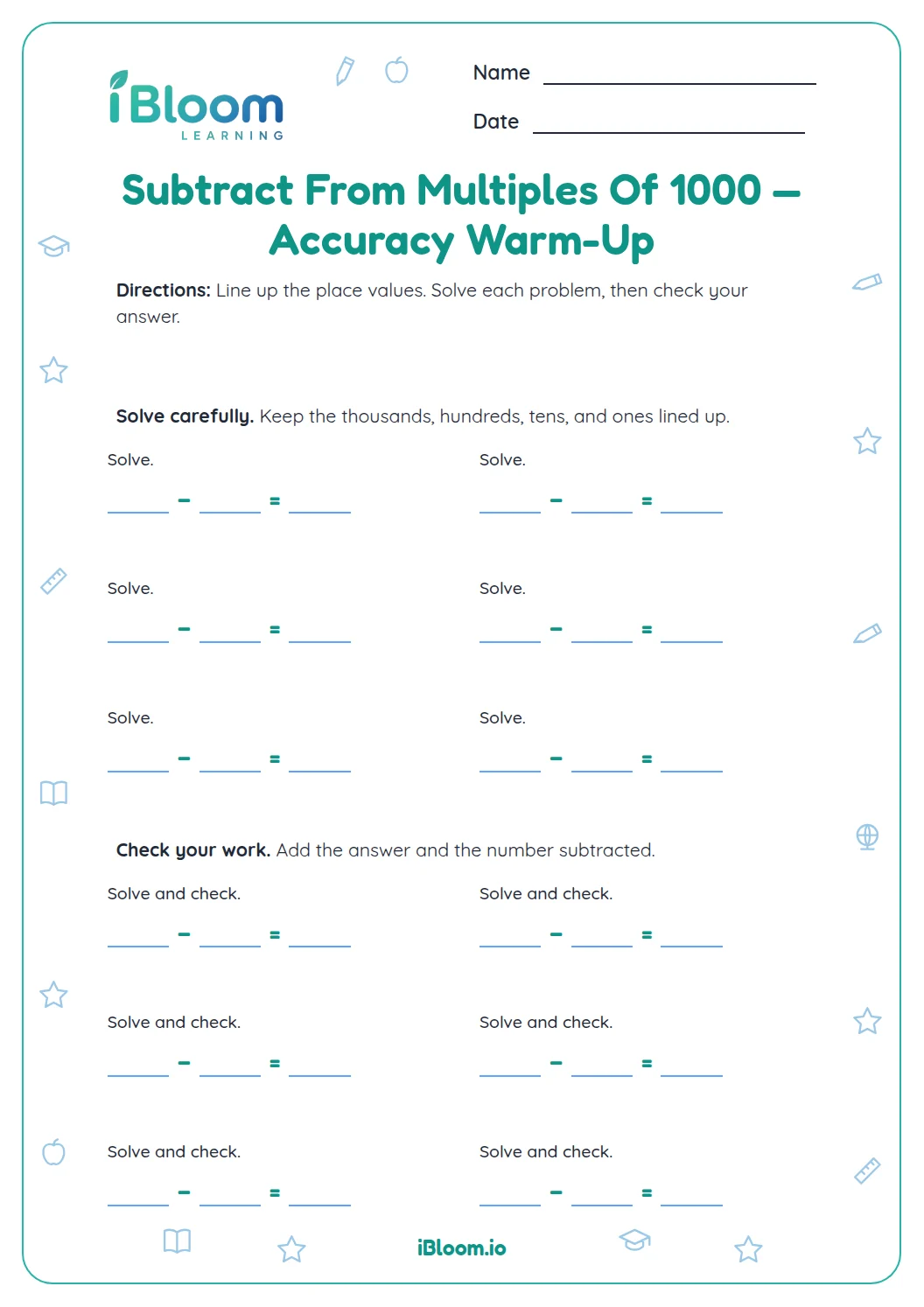
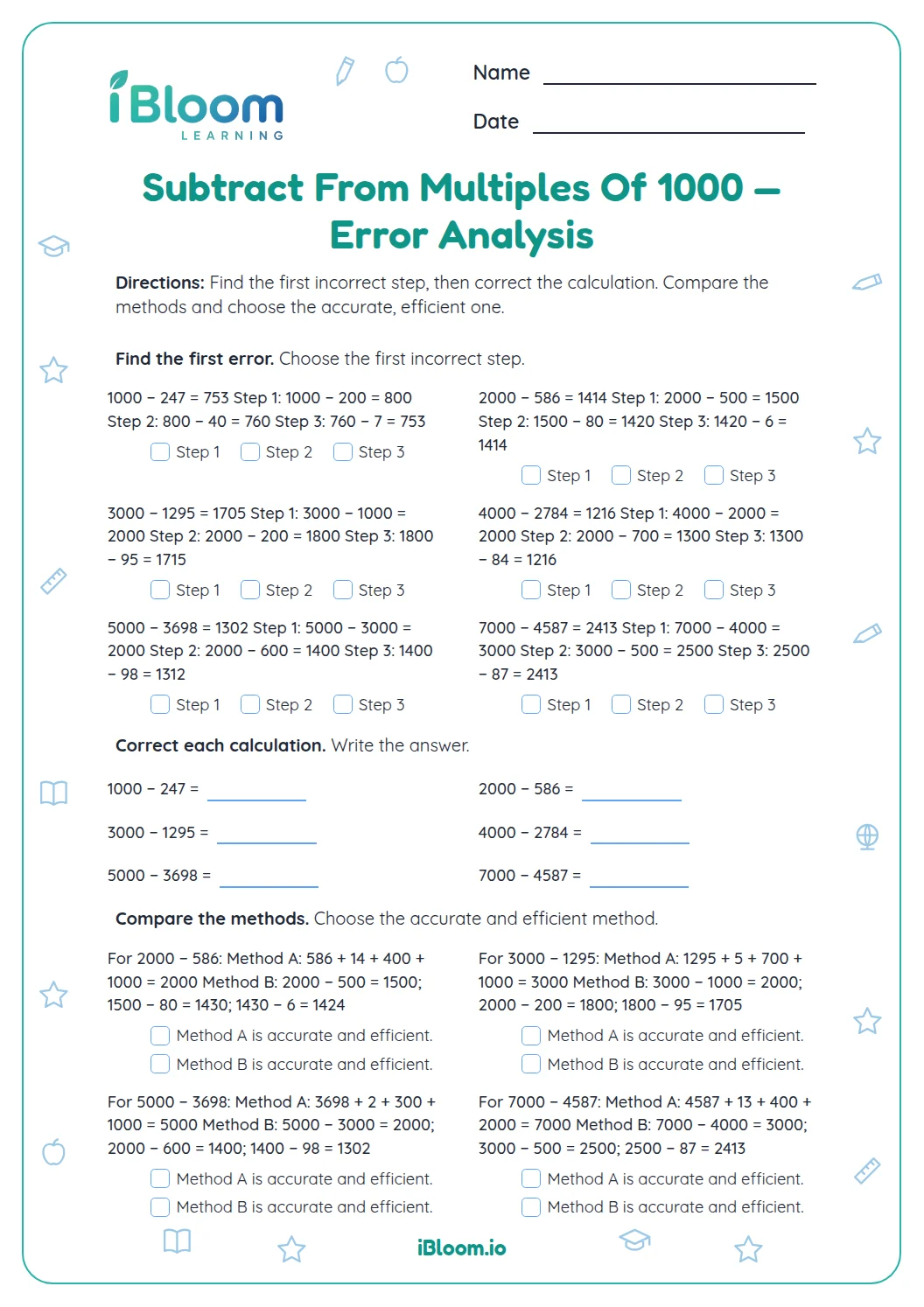
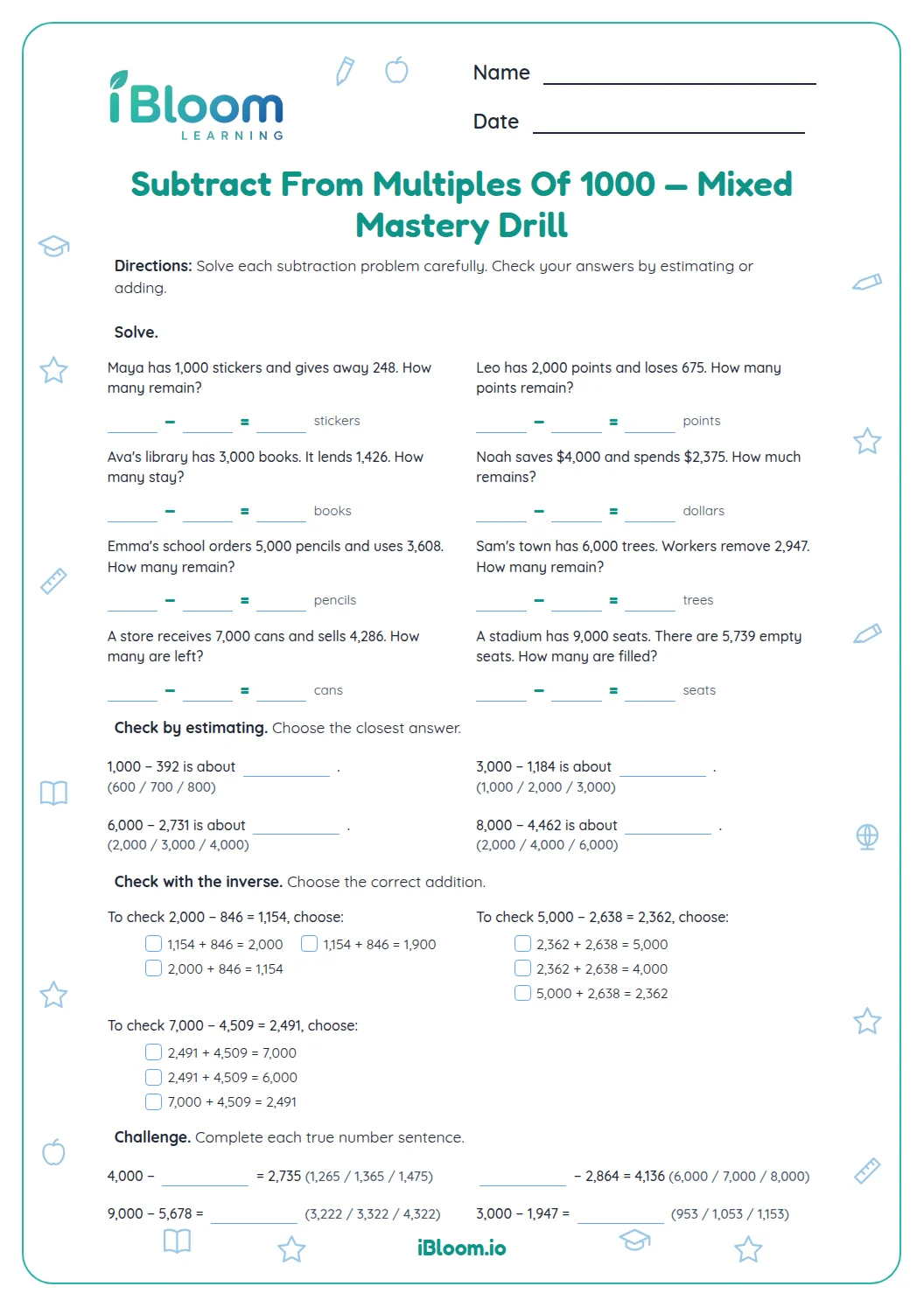
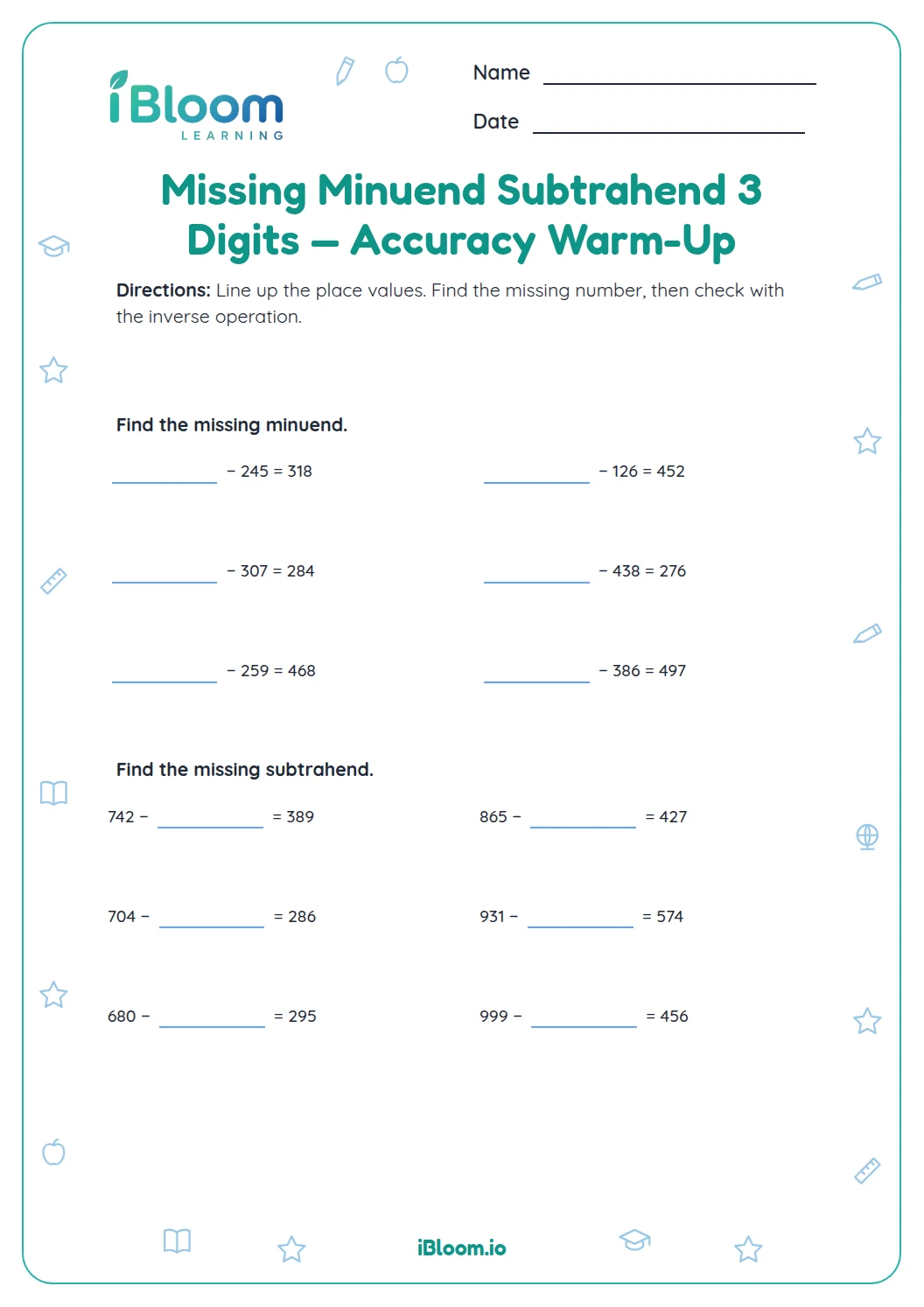
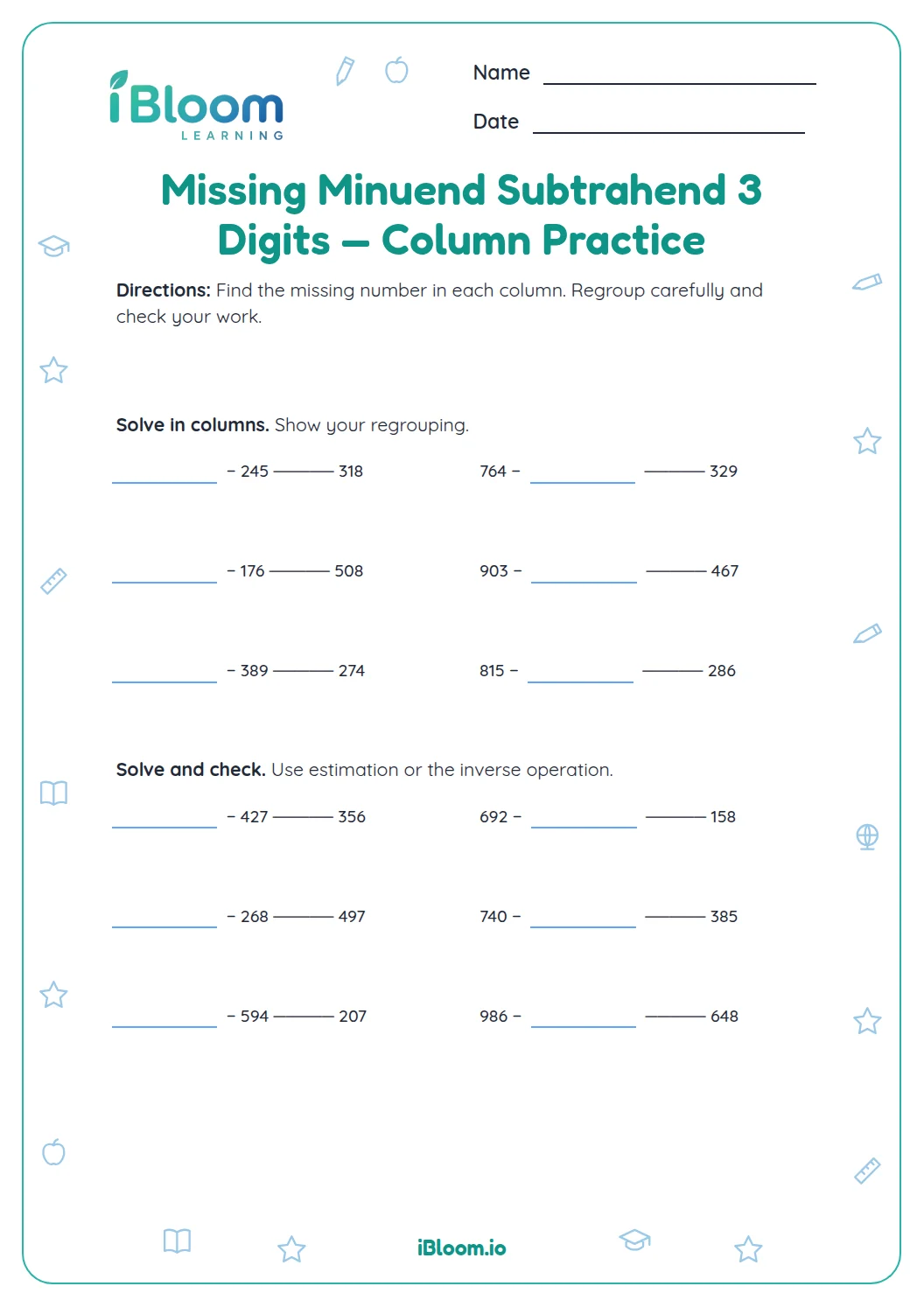
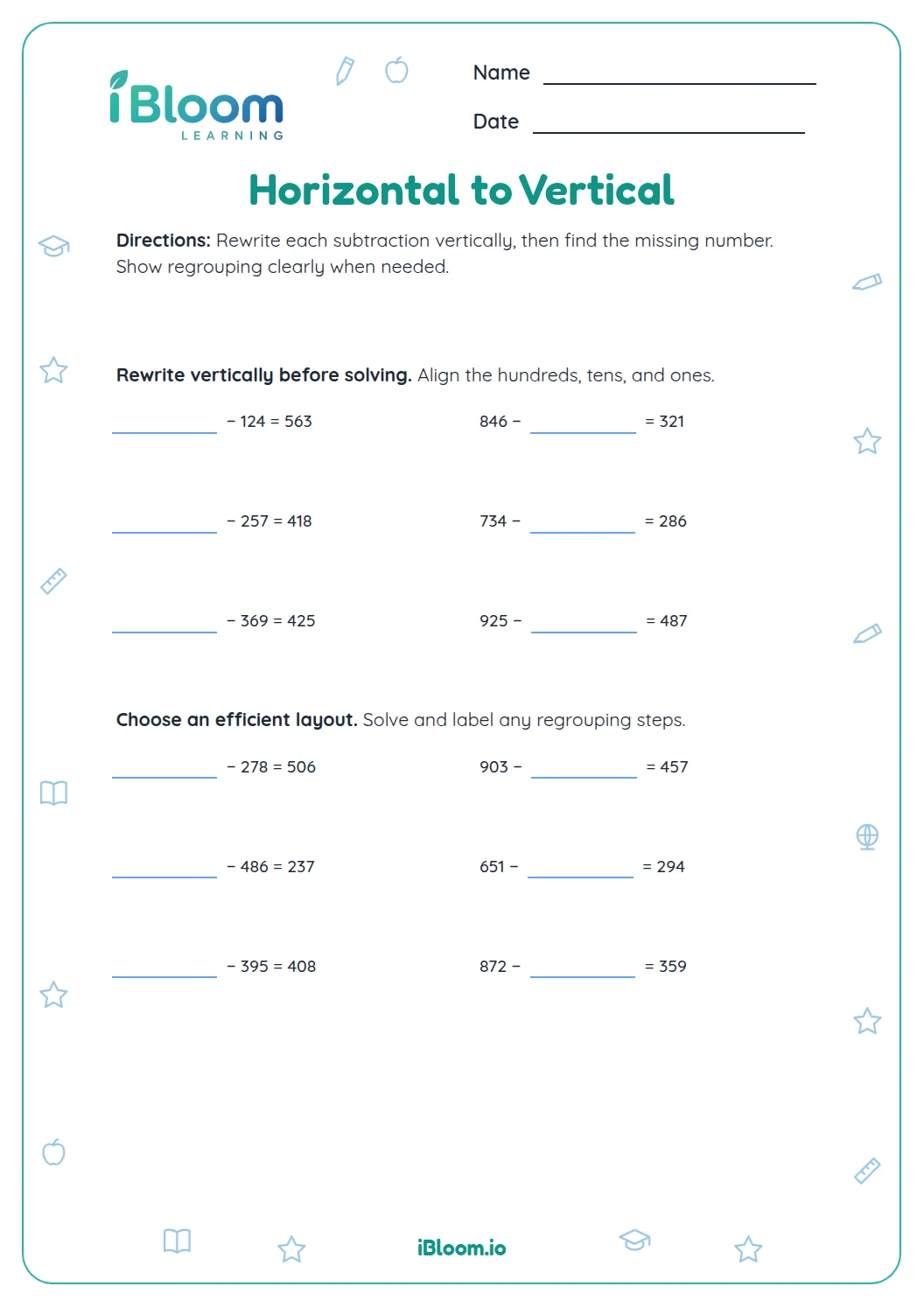
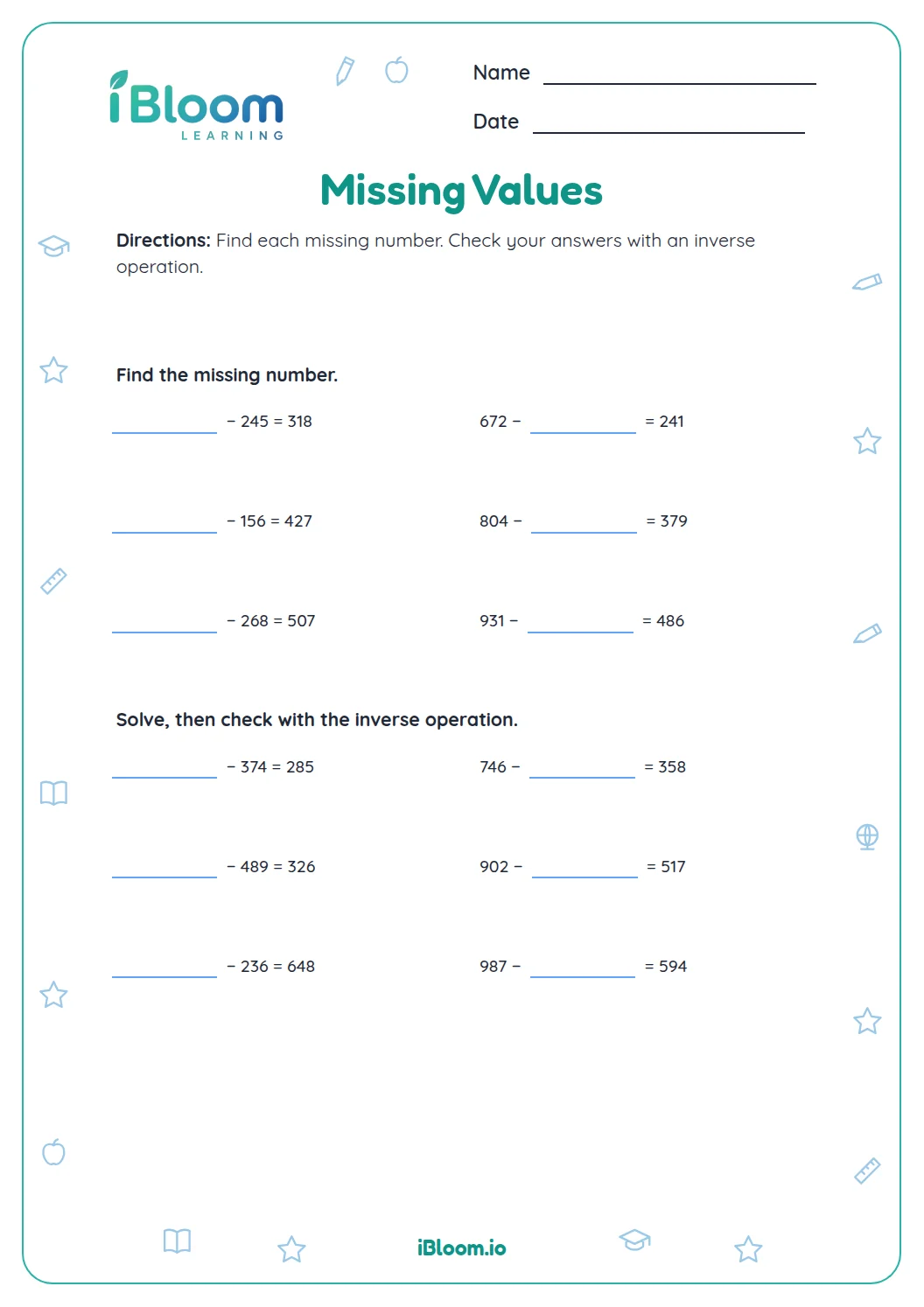
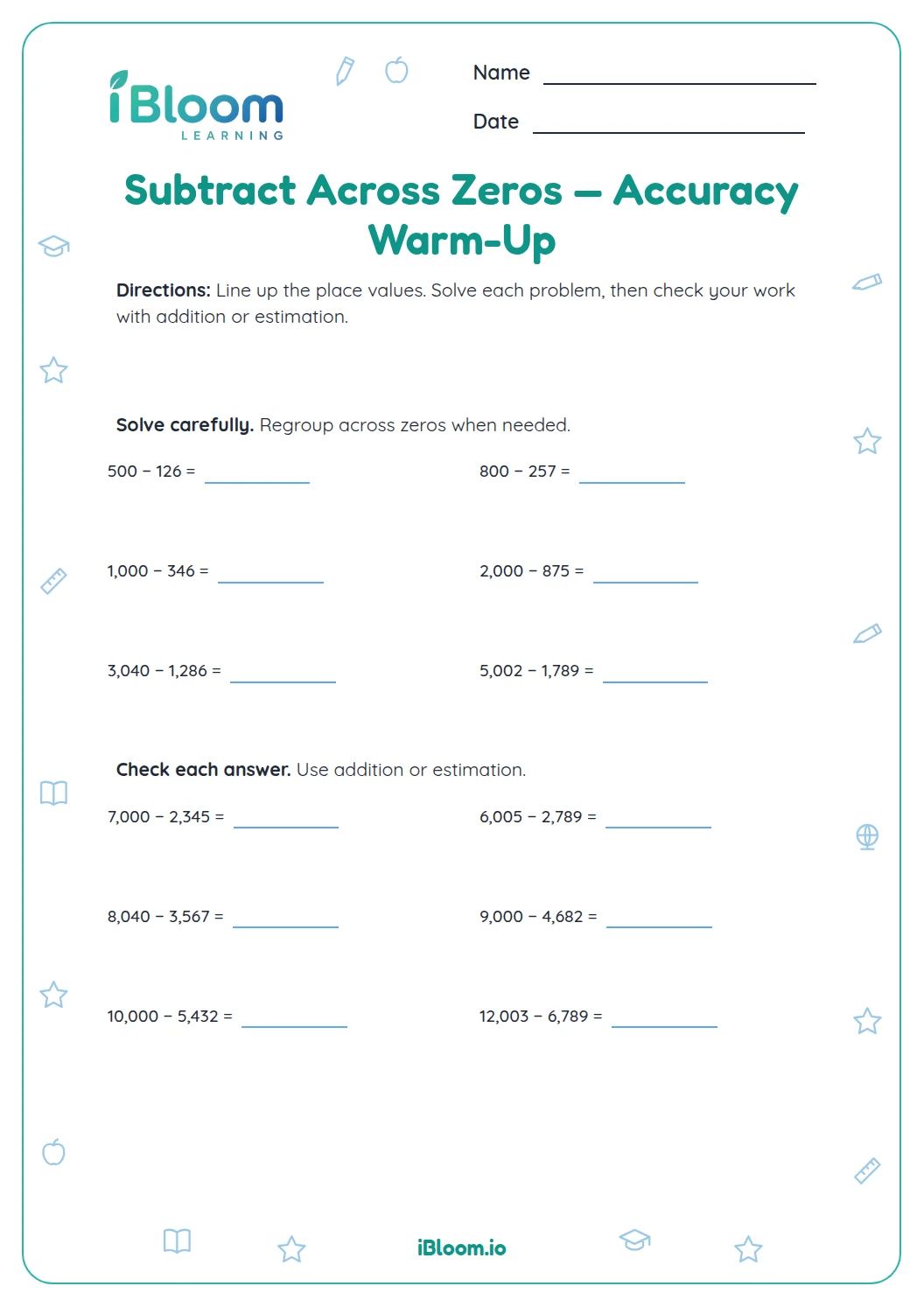
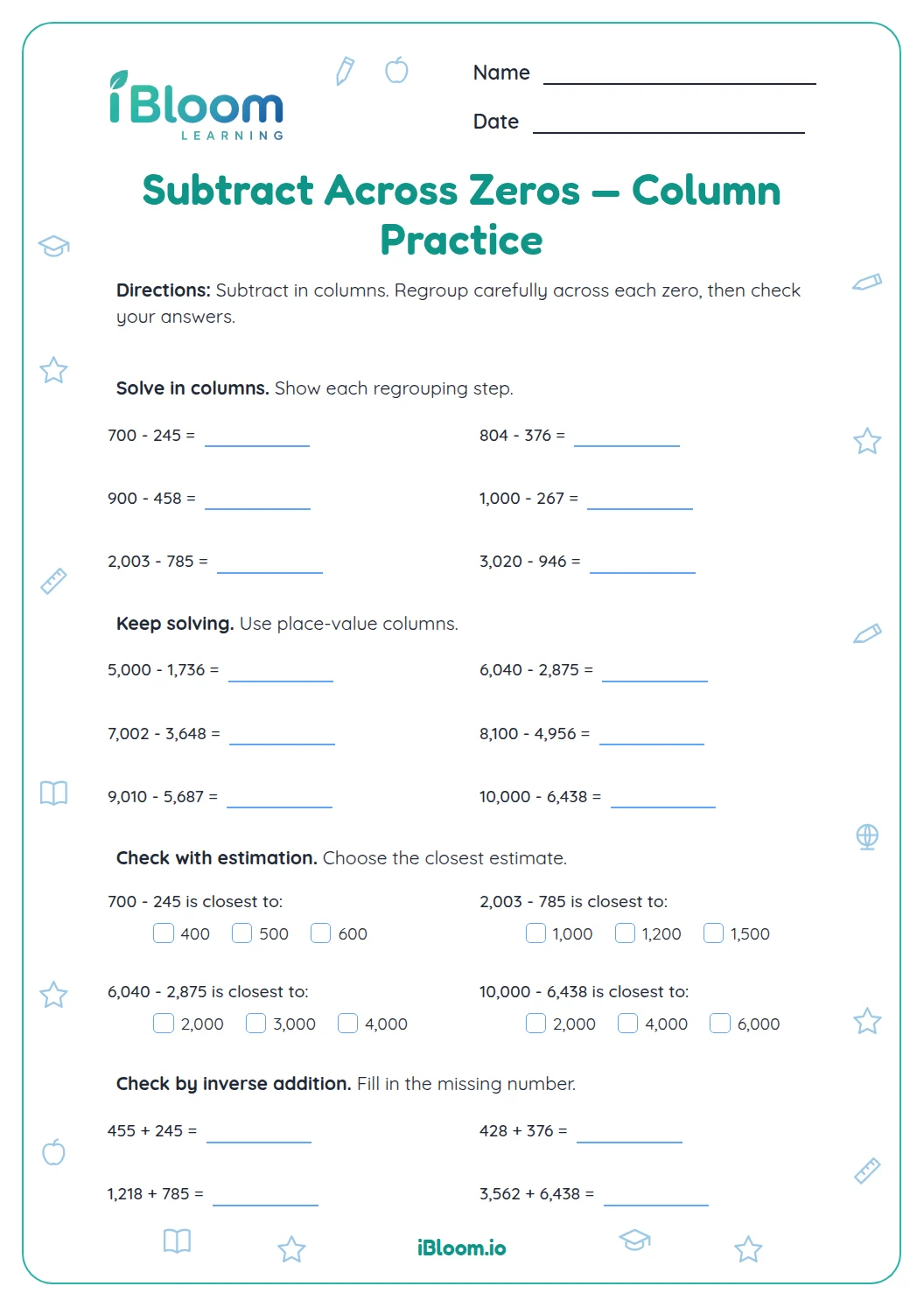
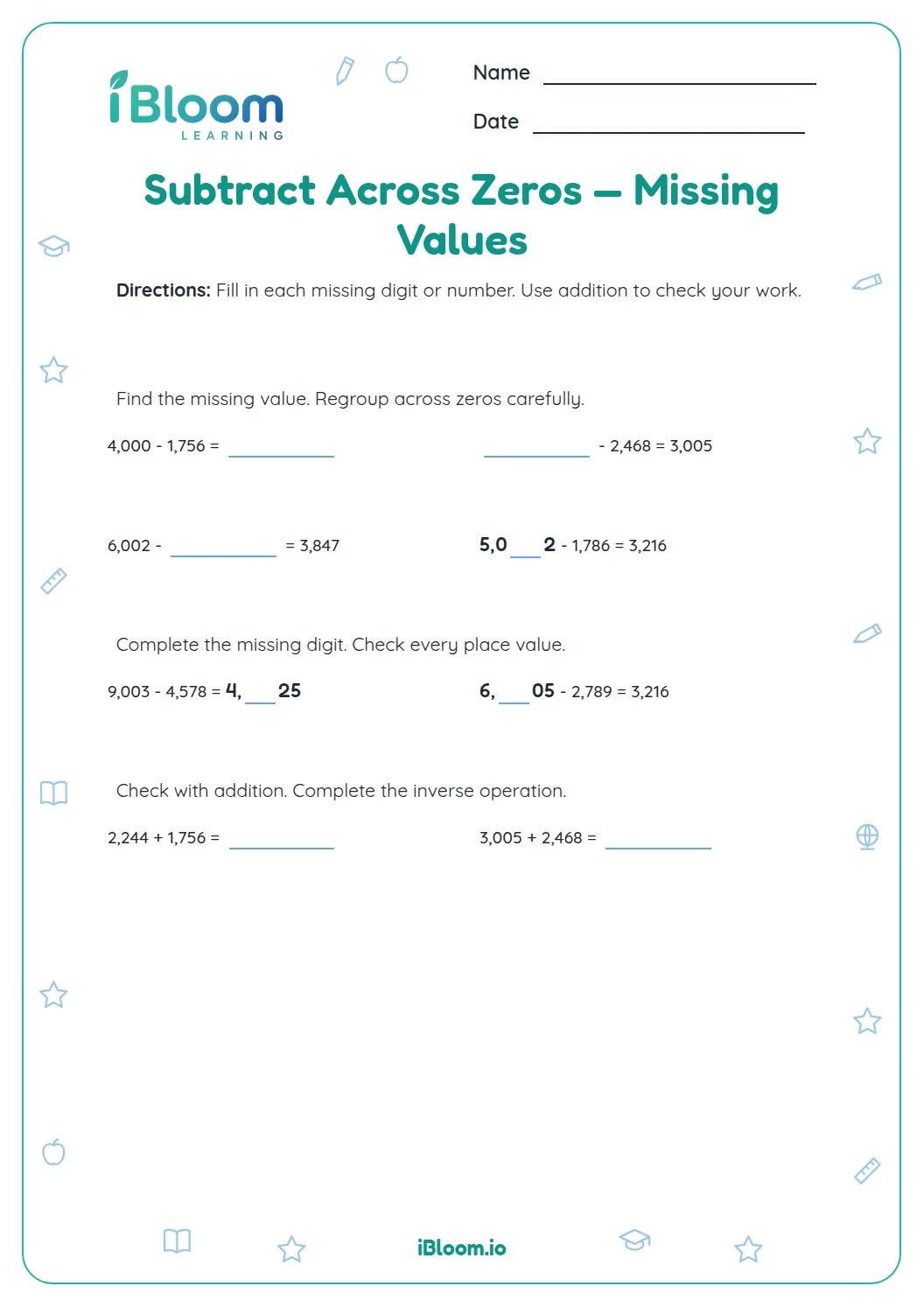
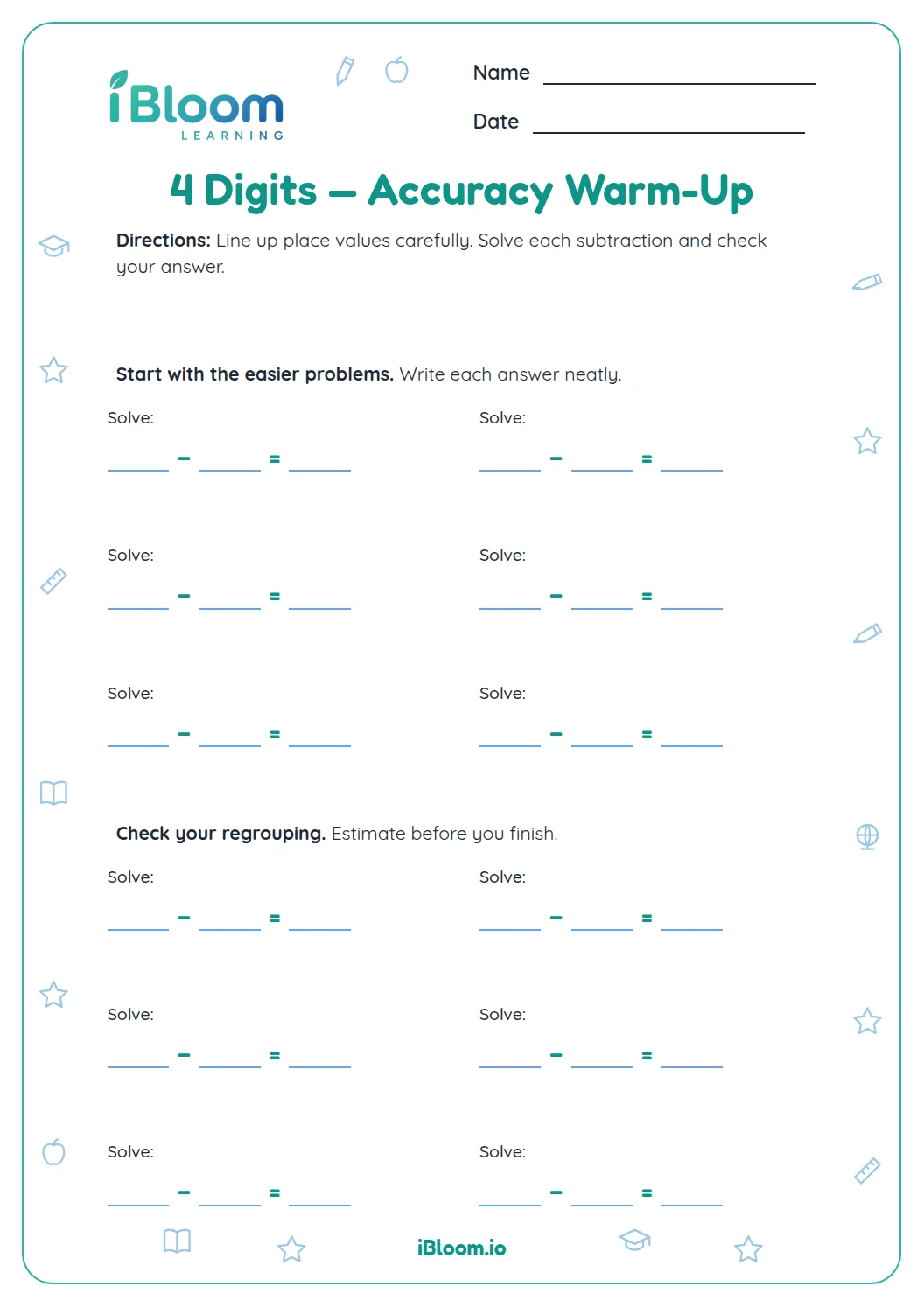
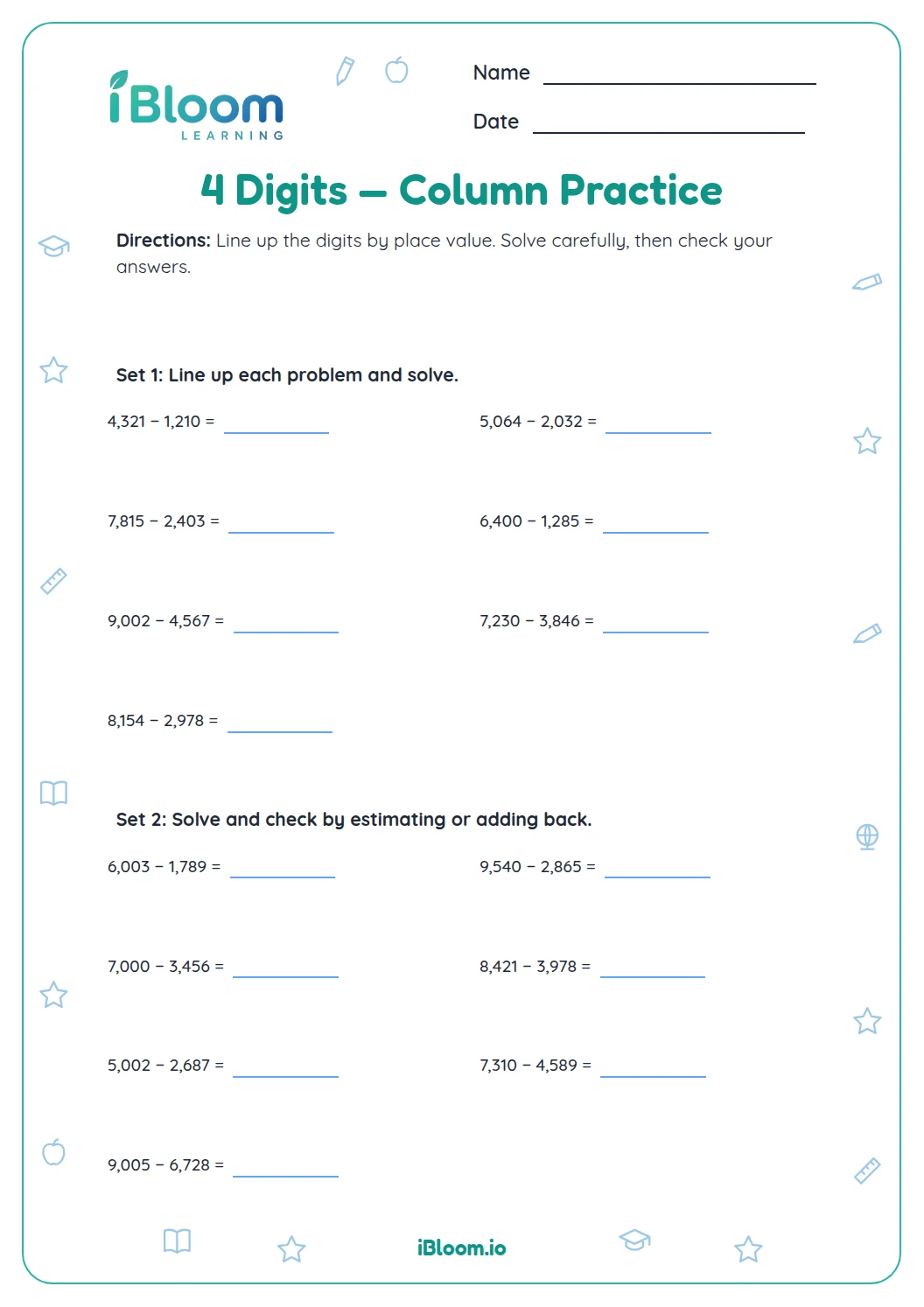
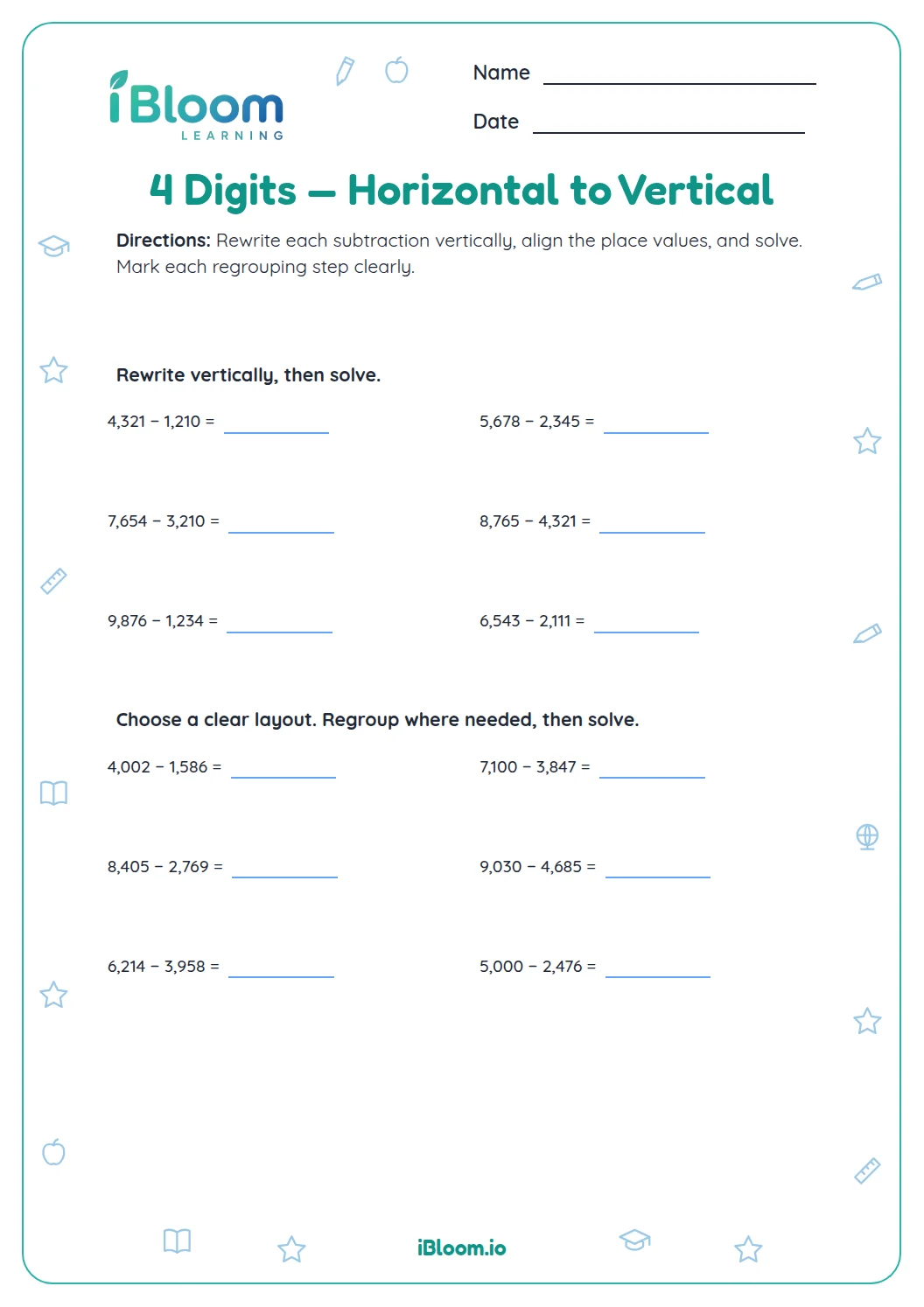
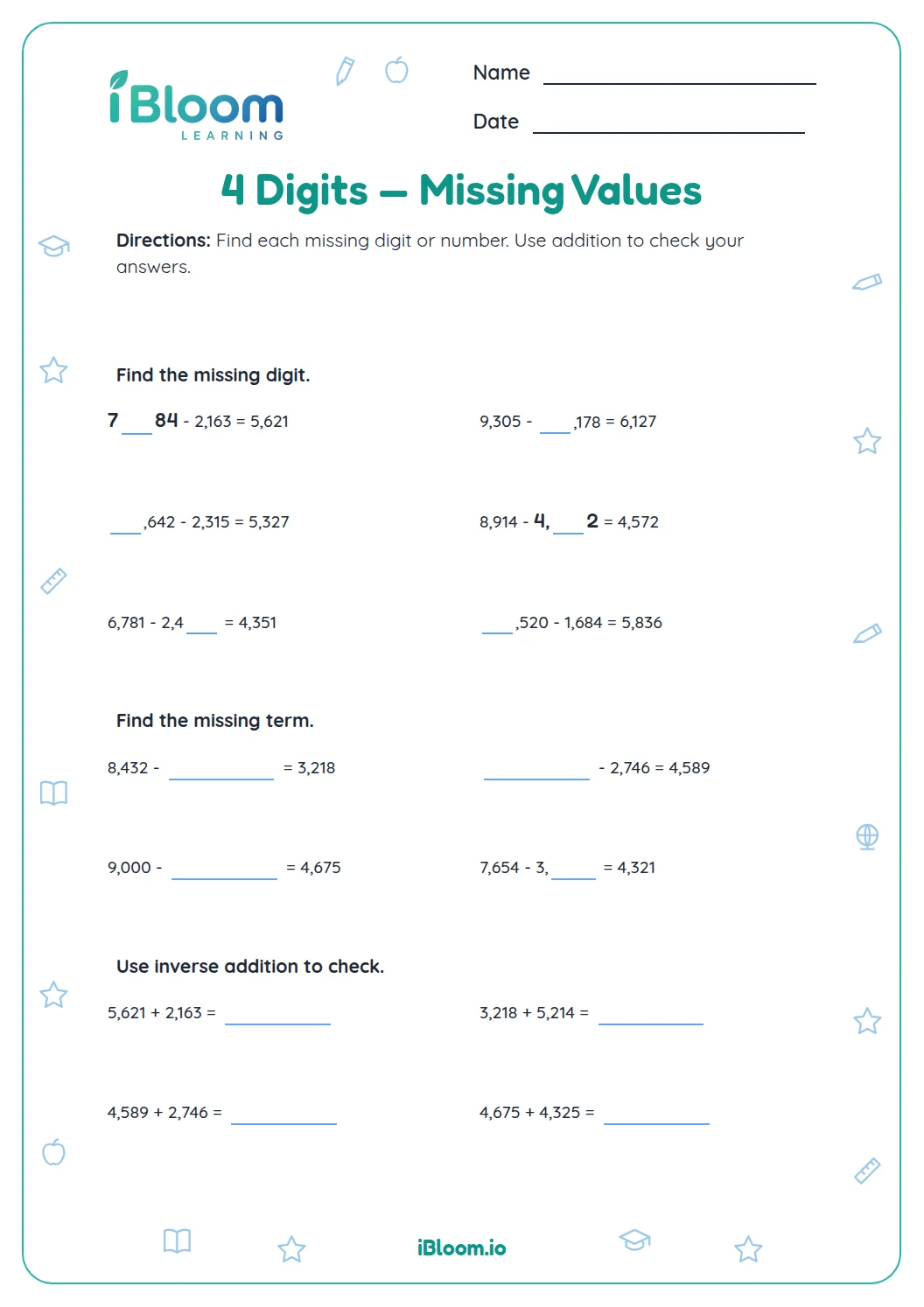
This printable Grade 4 worksheet gives children focused practice with missing values in subtraction from multiples of 1,000. It includes 16 questions across 8 missing minuends, subtrahends, or differences, 8 mixed missing-value equations, moving from recognition to using the skill in new examples. The answer key is provided on its own page. The worksheet aligns with 4.NBT.B.4.
Aligned to 4.NBT.B.4
How do you find a missing value?
Use the relationship between subtraction and addition. In 1,000 − ___ = 640, subtract 640 from 1,000 to find the missing subtrahend, 360. In 2,000 − 750 = ___, subtract to find the difference, 1,250.
What if the minuend is missing?
When the first number is unknown, add the subtrahend and the difference. For ___ − 430 = 1,570, calculate 430 + 1,570 to get 2,000. The parts vary which number is missing, so identify the blank before choosing an operation.
- 1___ − 430 = 1,570
- 2430 + 1,570 = 2,000
- 3The missing minuend is 2,000.
How can addition check subtraction?
After finding an unknown, use addition to check the related fact. For 4,000 − 1,860 = 2,140, check 1,860 + 2,140 = 4,000. The worksheet practices missing minuends, subtrahends, and differences with multi-digit numbers.
How to use this worksheet
- 1Identify whether the blank is first, second, or last.
- 2Choose subtraction or its inverse, addition, to solve.
- 3Regroup carefully when a place-value column requires it.
- 4Substitute the value and check that both sides match.
Common mistakes and quick fixes
The mistake
Subtracting the known number from the wrong value.
The fix
Name the unknown first: find a missing subtrahend with minuend minus difference.
The mistake
Switching the subtrahend and the difference.
The fix
Read the equation from left to right and preserve subtraction order.
The mistake
Writing the right value in the wrong blank.
The fix
Check the original equation with the value in its exact missing position.
Common Core alignment
This worksheet practices the listed Grade-level language or mathematics skills through short, varied items.
Use the standard algorithm to subtract multi-digit whole numbers.
On this sheet: Each missing-value equation uses four- or five-digit subtraction involving a multiple of 1,000.
Show the official wordingHide the official wording
Fluently add and subtract multi-digit whole numbers using the standard algorithm.
What to practice next
Make more practice
Further reading
Questions parents and teachers ask
How do I find a missing subtrahend?
Subtract the difference from the minuend. In 1,000 − ___ = 640, calculate 1,000 − 640 to get 360. Put 360 in the blank and check that the equation is true. Several items ask for a missing subtrahend. The first number is the minuend in each equation.
How do I find a missing minuend?
Add the subtrahend and the difference. For ___ − 430 = 1,570, calculate 430 + 1,570 to get 2,000. This inverse relationship also gives a quick check after solving for the unknown first number in these practice problems. Addition can check the completed subtraction equation.
What kinds of blanks are on the page?
The 16 equations vary the missing value: some ask for the difference, some for the subtrahend, and some for the minuend. The numbers are built around multiples of 1,000 and require careful multi-digit subtraction or its inverse throughout both parts.
Is the practice appropriate for Grade 4?
The worksheet uses multi-digit whole-number subtraction and addition checks, the work described by Grade 4 standard 4.NBT.B.4. It includes regrouping and missing-value reasoning. The separate key lists each value so learners can check the original equation after completing the practice.
How should an incorrect answer be reviewed?
First identify which position is blank, then solve again using the related operation. Substitute the answer into the equation and check both sides. This catches a common mix-up between the subtrahend and the difference before checking the answer key. Encourage a final check with the related addition fact.