
About this worksheet
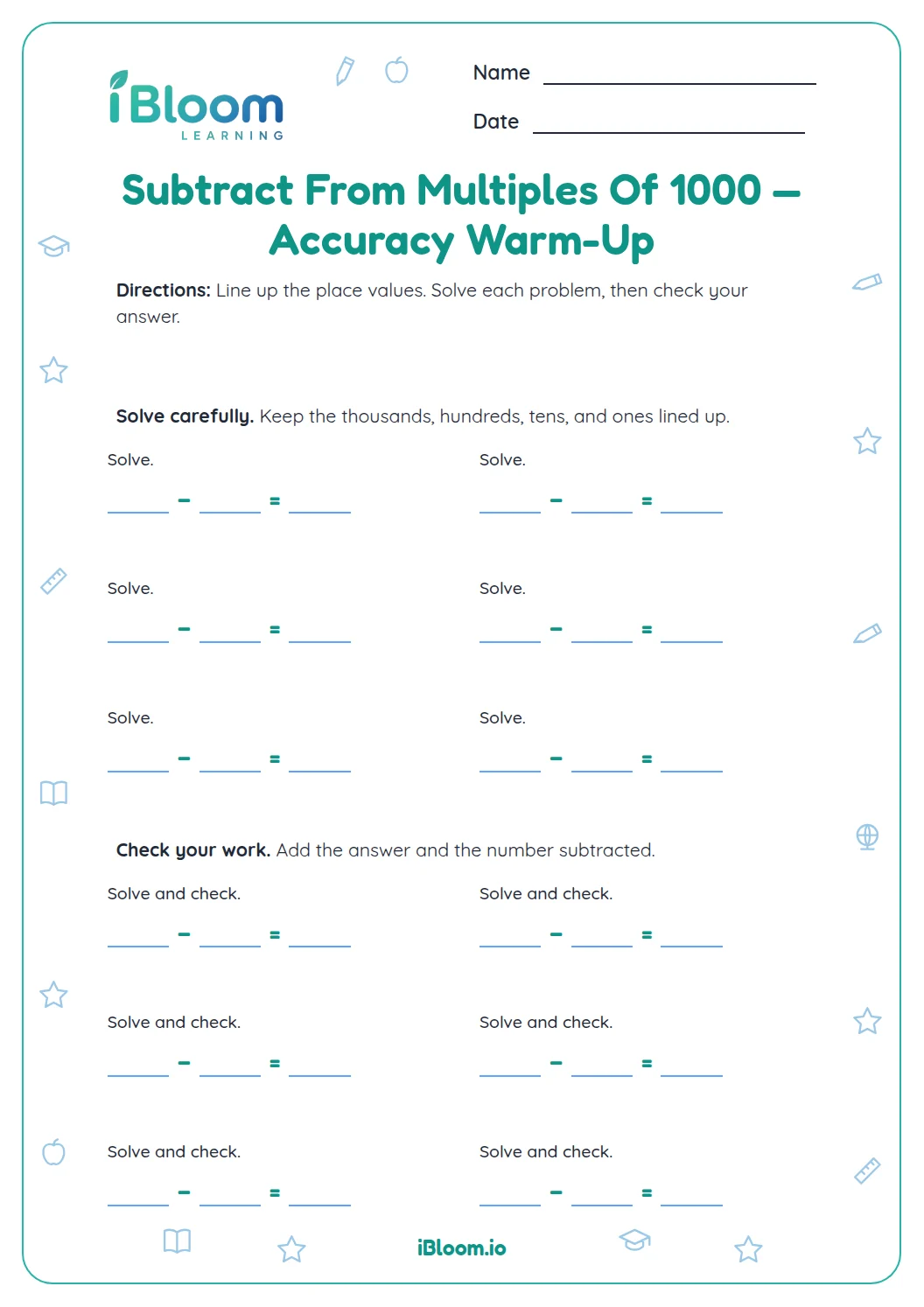
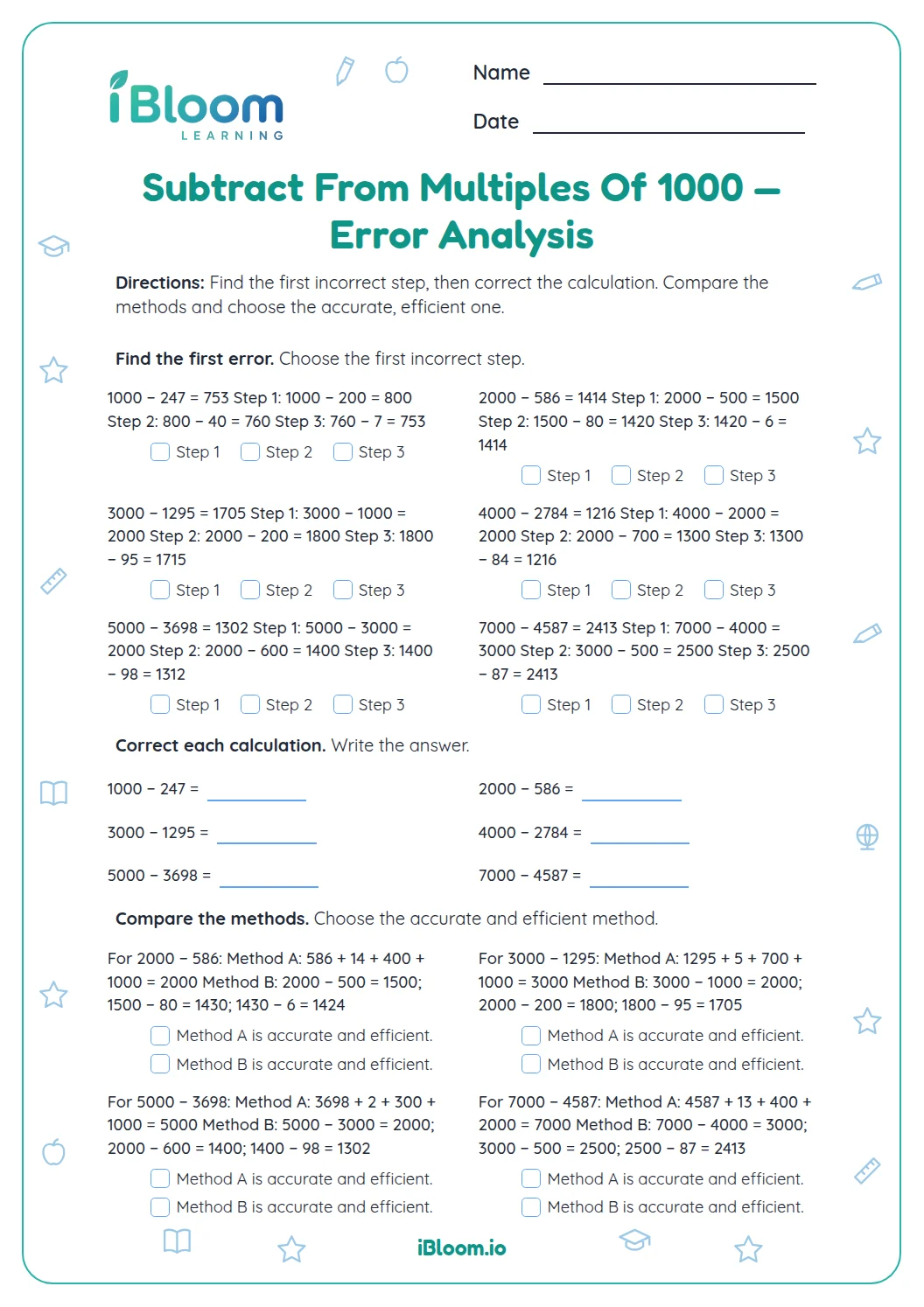
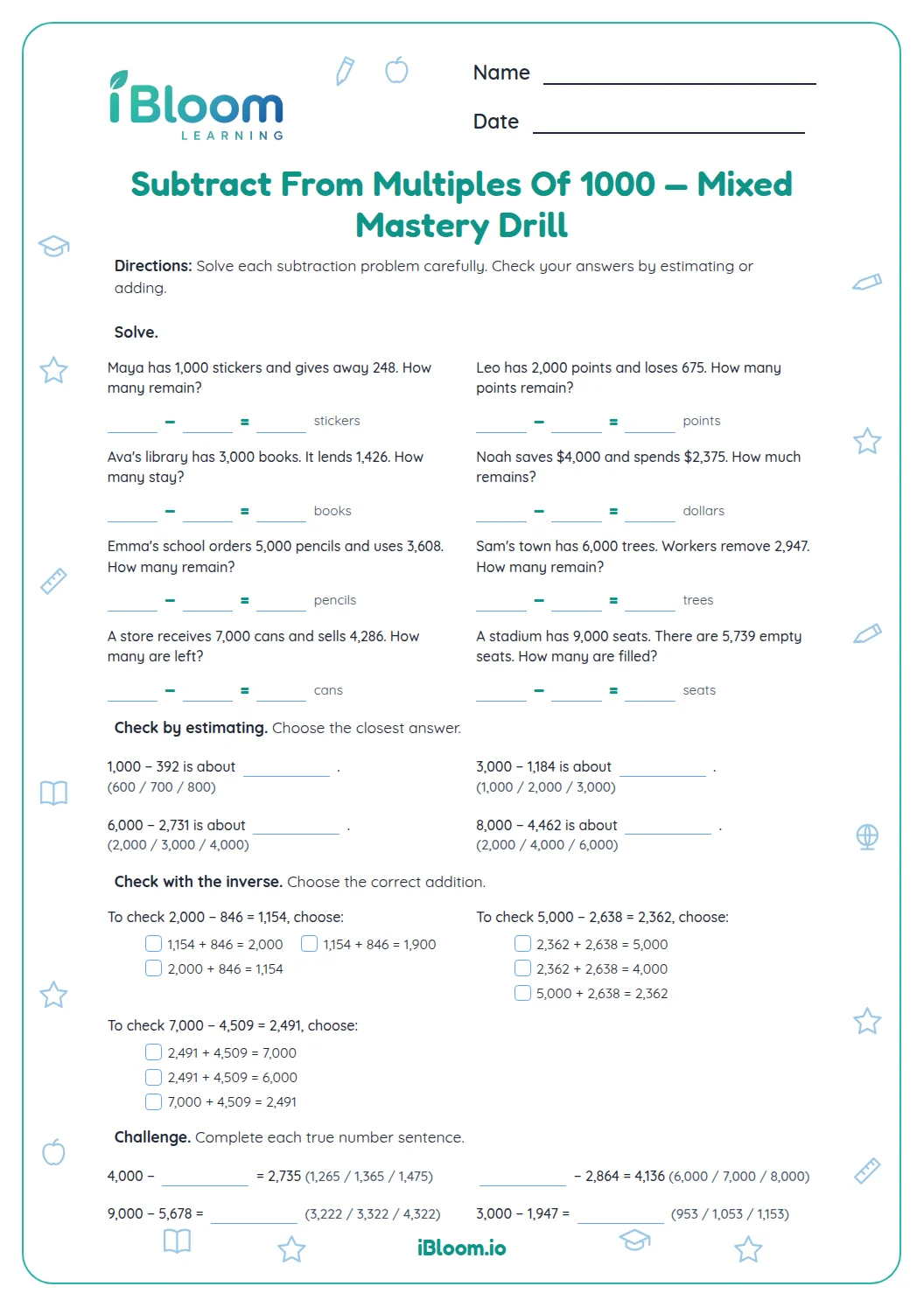
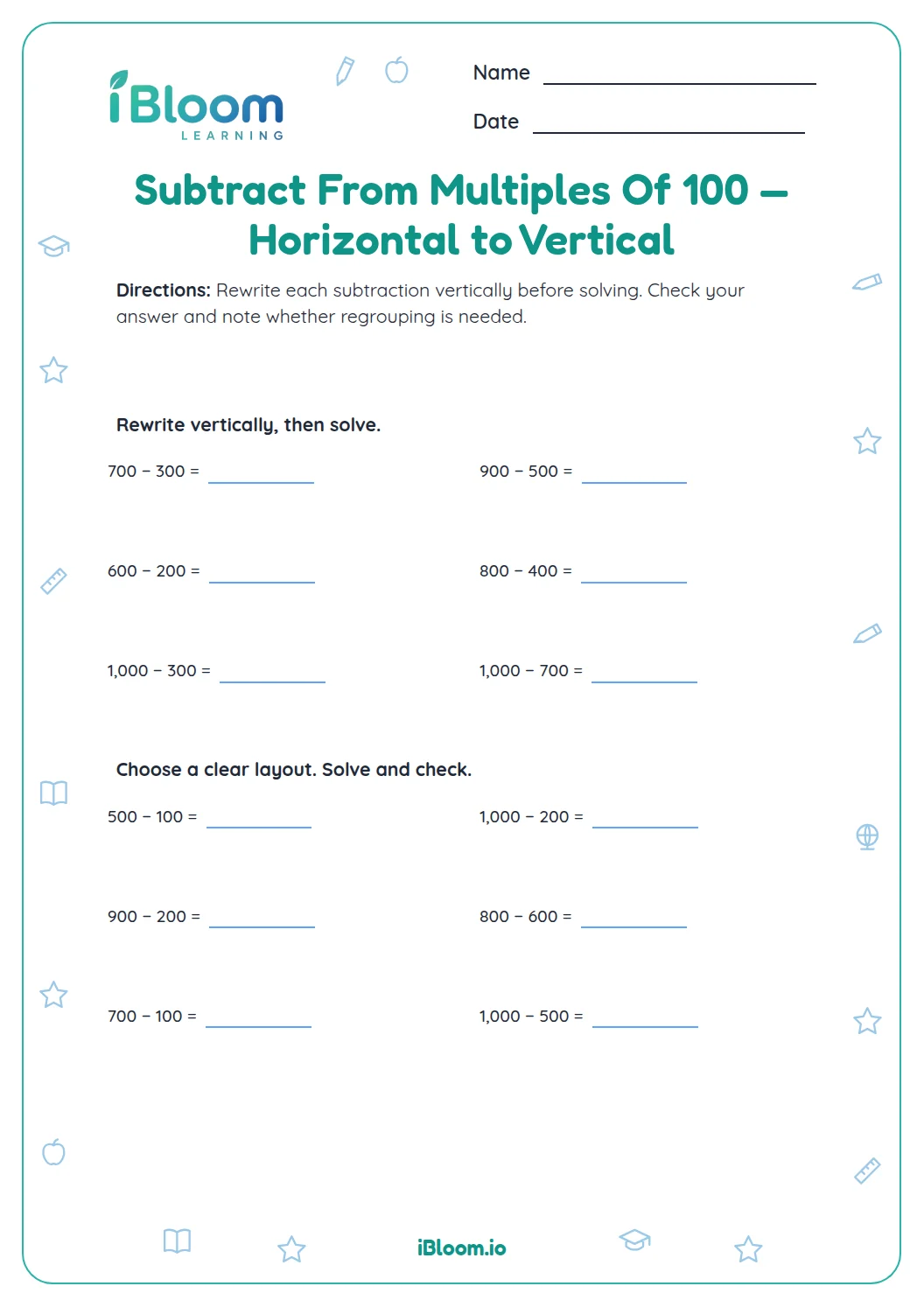
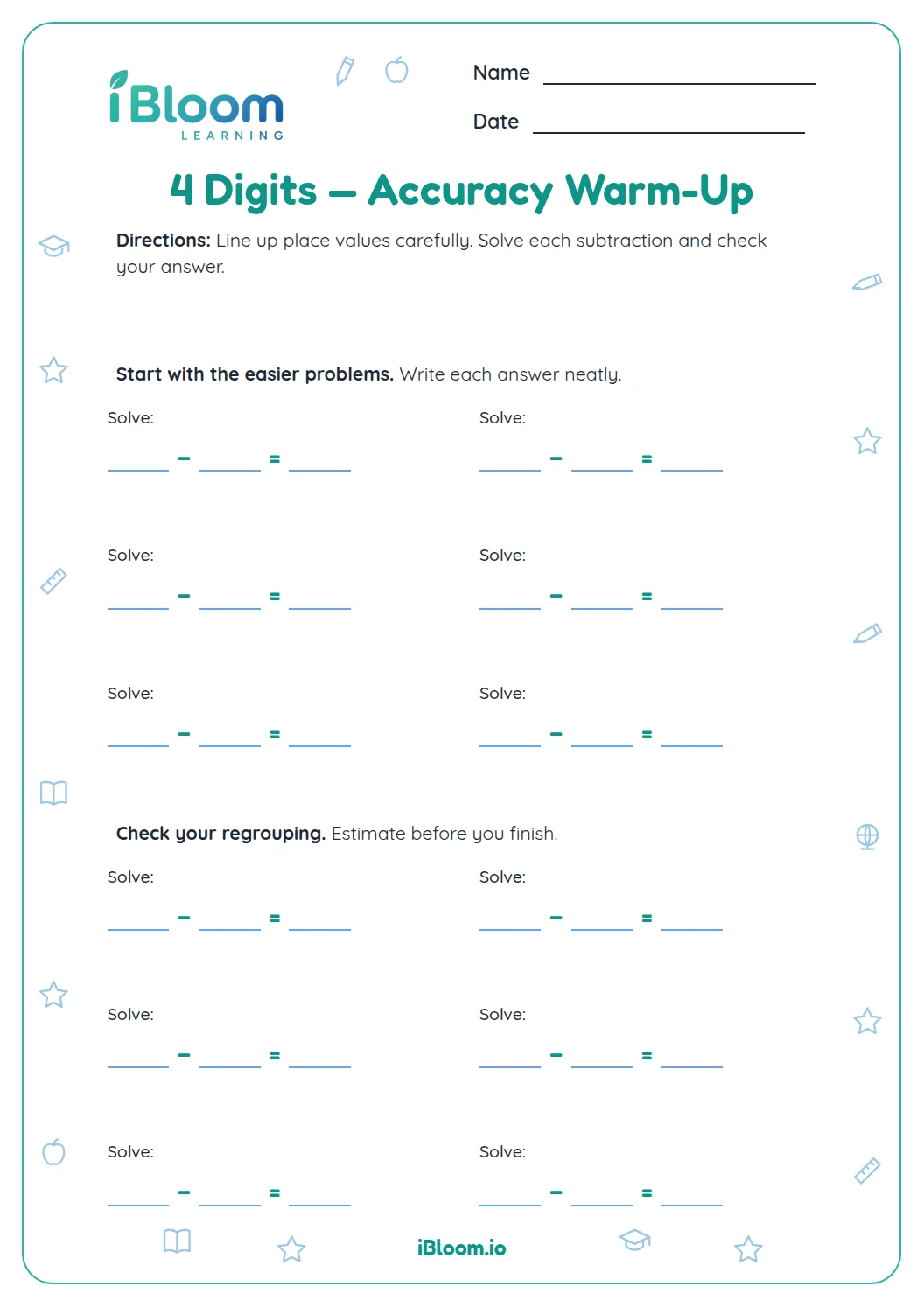
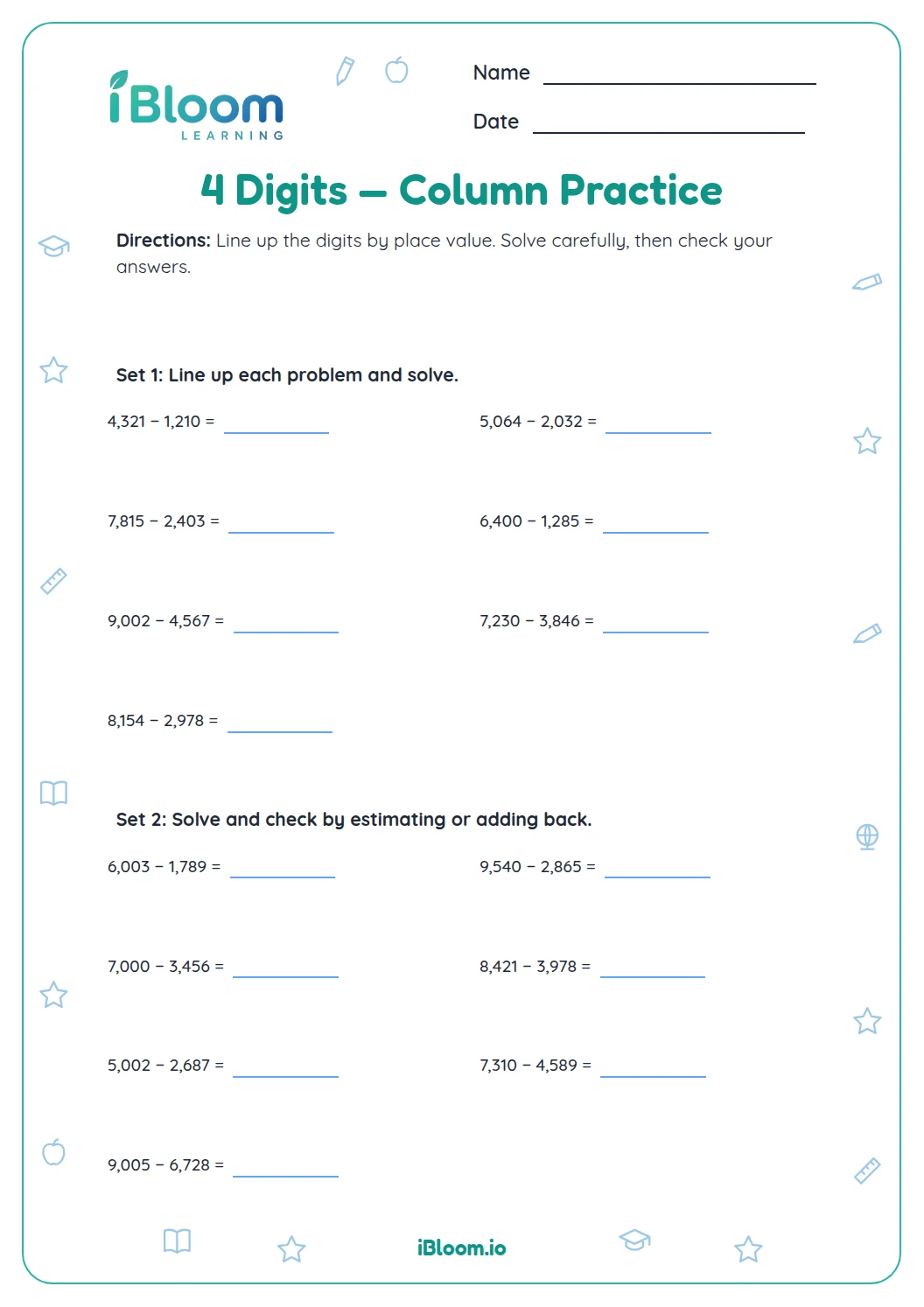
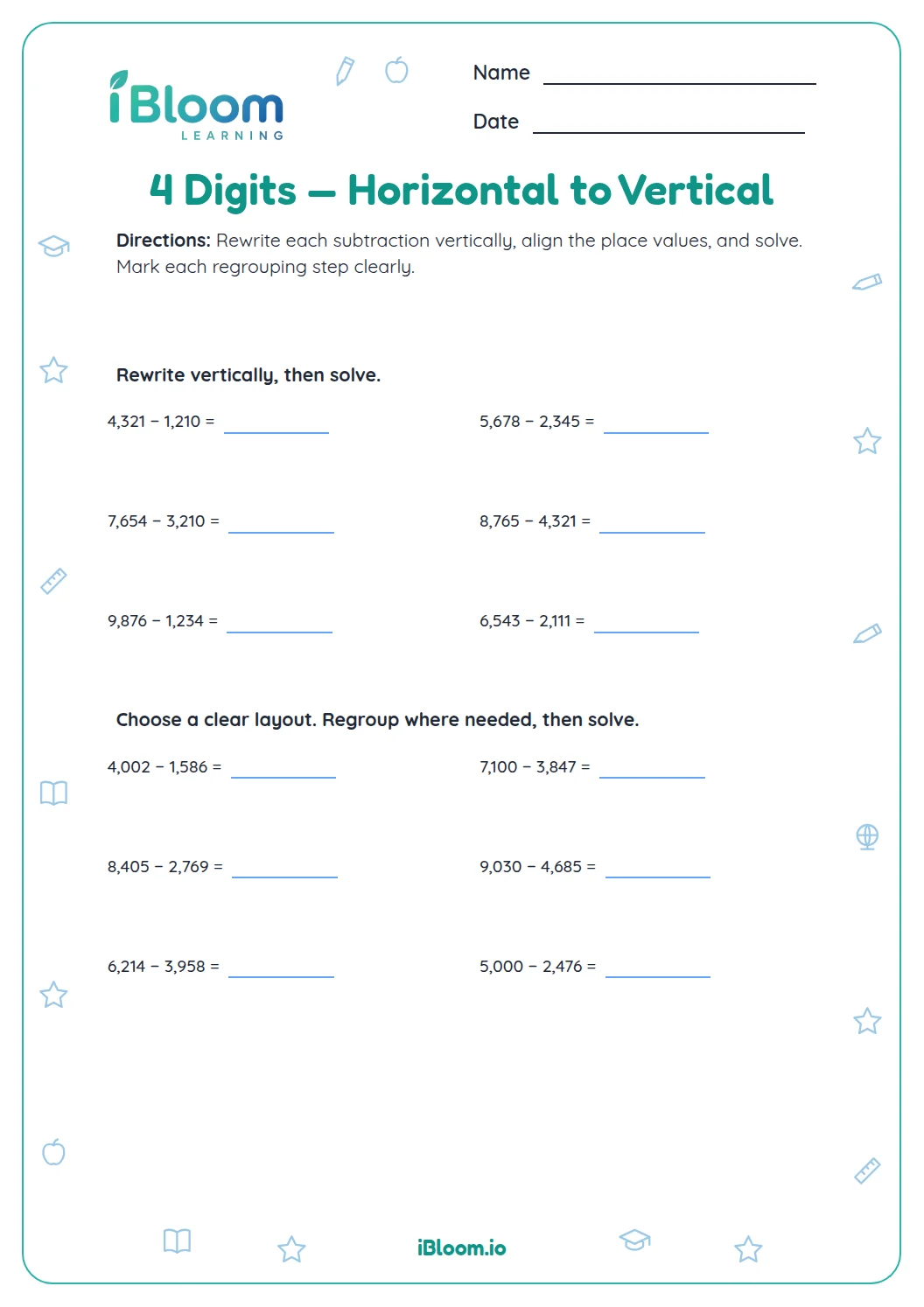
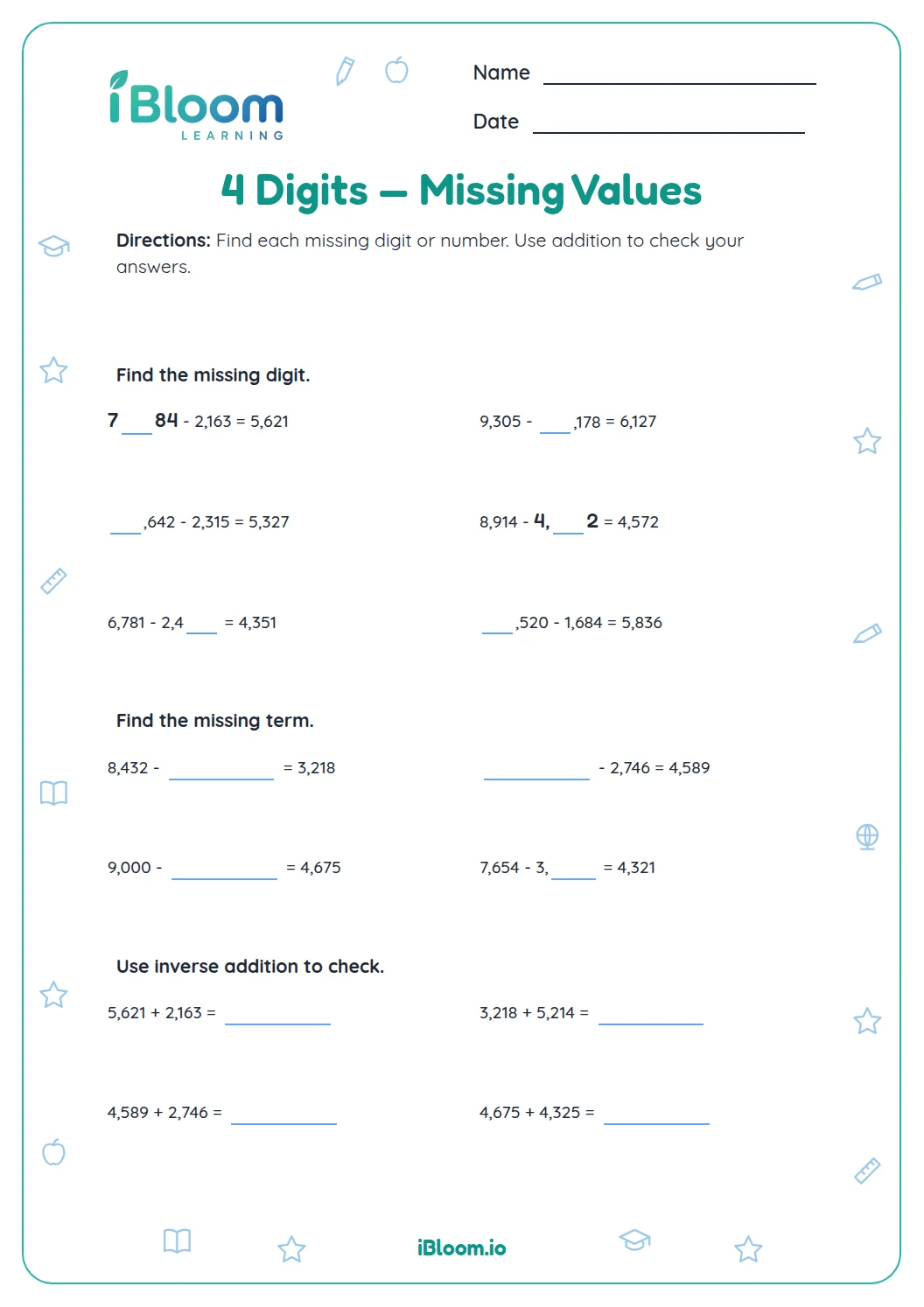
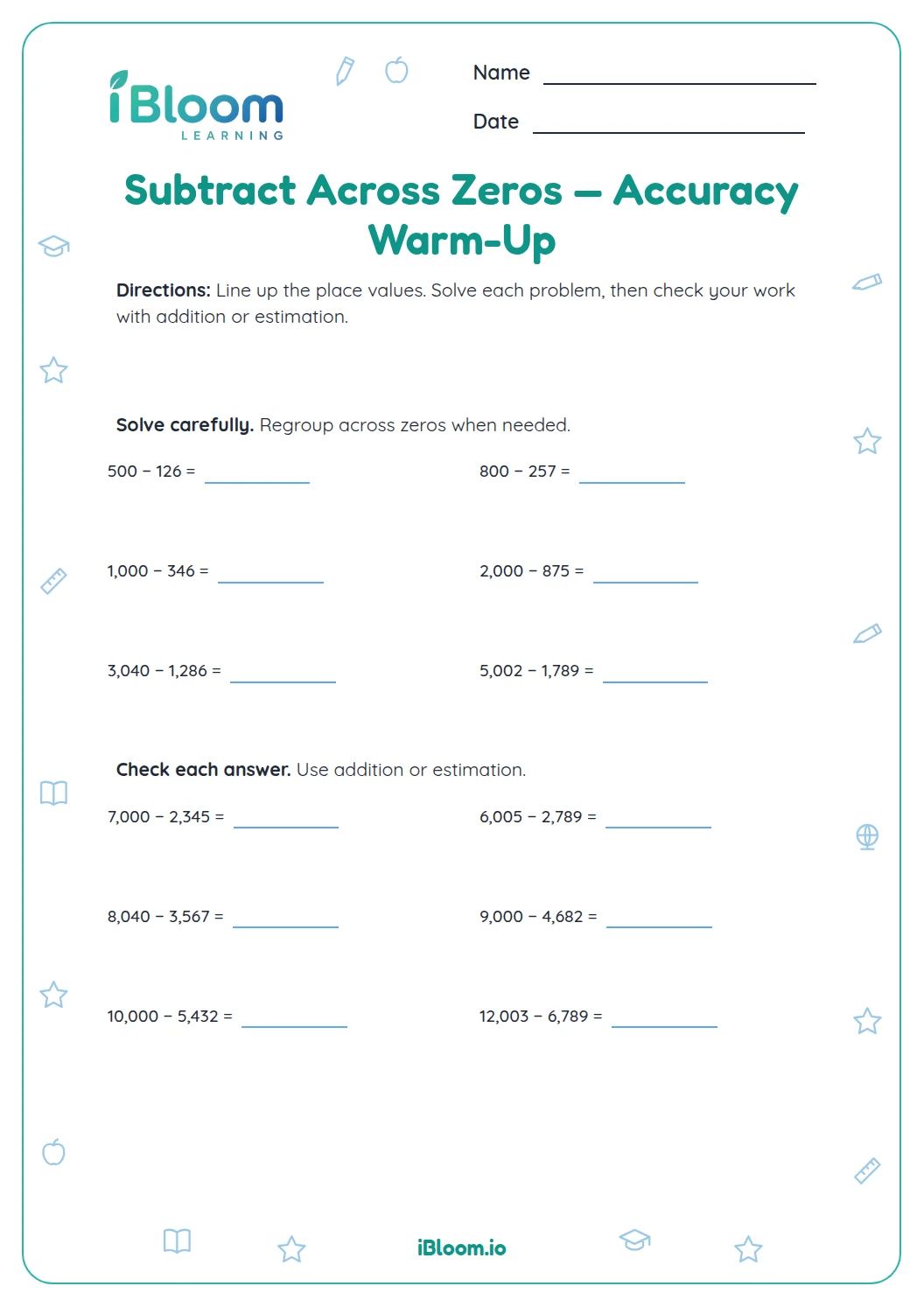
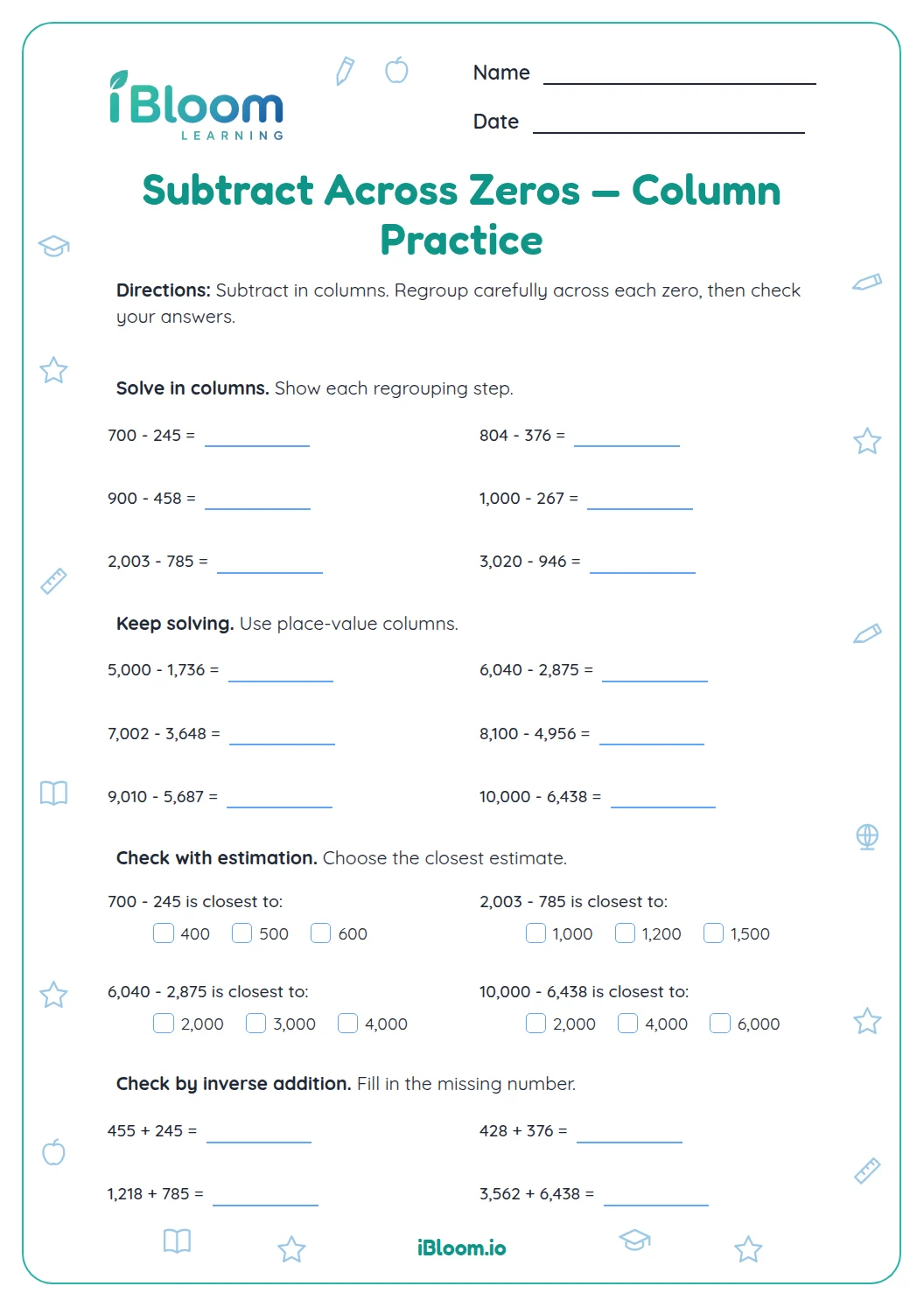
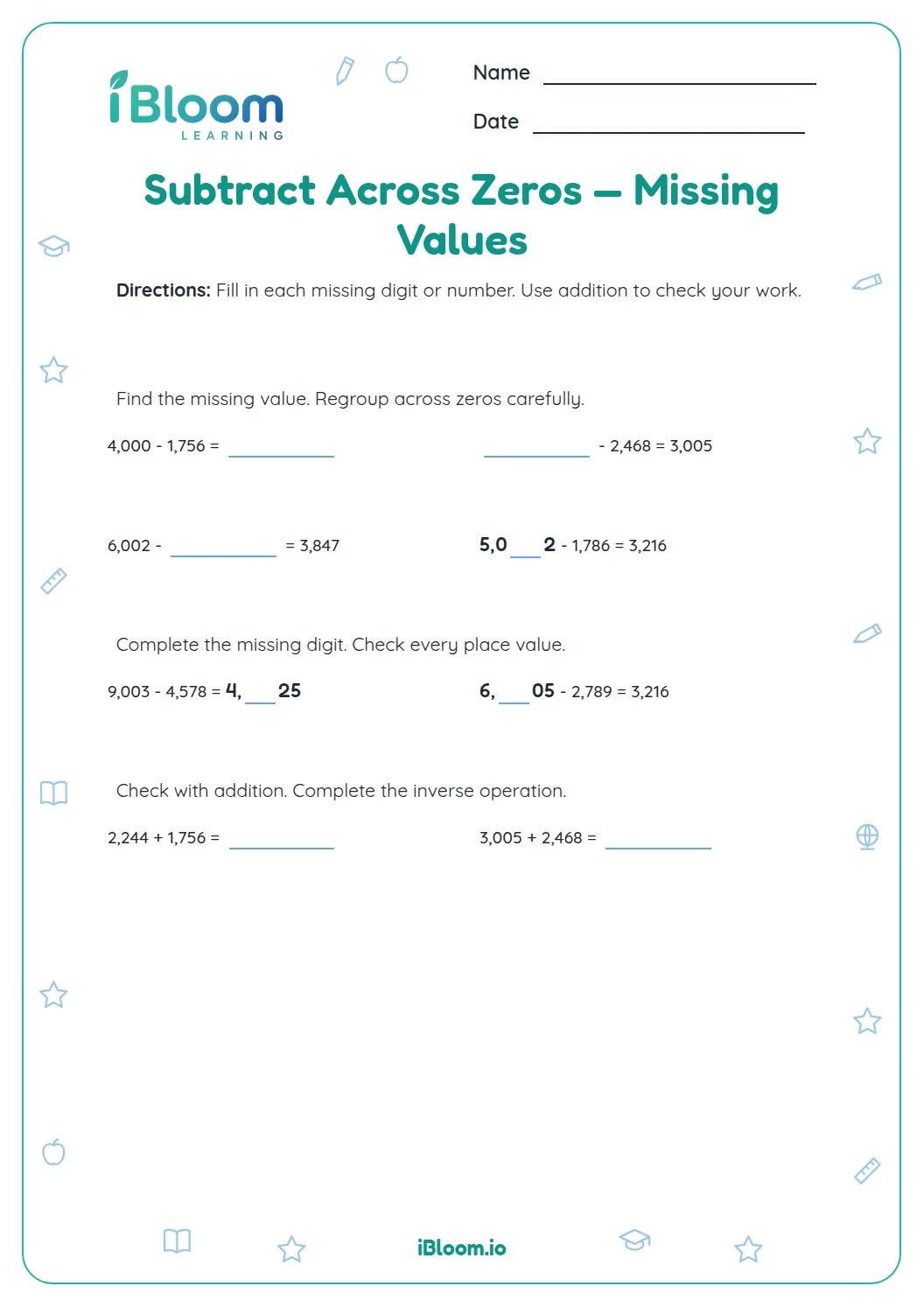
This Grade 4 printable practices subtracting a multi-digit number from a multiple of 1,000. The first part presents horizontal equations; the second asks learners to rewrite each problem vertically and show regrouping across zeroes. Sixteen problems and a separate answer key are included.
Aligned to 4.NBT.B.4
How do you subtract from a multiple of 1,000?
Write the thousands as 1,000, 2,000, or another multiple, then subtract by place value. When a place has zero in the top number, regroup from the next nonzero place until there are enough units to subtract.
For 1,000 − 246, regroup 1 thousand as 10 hundreds, then regroup 1 hundred as 10 tens, and 1 ten as 10 ones. Subtract by place to get 754.
- 11,000 − 246
- 2Regroup: 0 thousands, 9 hundreds, 9 tens, 10 ones
- 310 − 6 = 4; 9 − 4 = 5; 9 − 2 = 7
- 4Answer: 754
Why rewrite a horizontal problem vertically?
Part A gives the subtraction in one line, so learners can focus on the numbers and plan regrouping. In Part B, rewriting in columns lines up ones, tens, hundreds, and thousands so each regrouped digit has a clear place.
How can families check the work?
Ask the learner to point to the clue or calculation that supports each answer. Use a missed item as a brief chance to model the step, then let the learner try it again.
How to use this worksheet
- 1Read the minuend and subtrahend carefully.
- 2Line up place values when rewriting vertically.
- 3Regroup from a nonzero place to supply a zero place.
- 4Subtract from ones toward thousands.
- 5Check by adding the difference and subtrahend.
Common mistakes and quick fixes
The mistake
Rushing past an important word or symbol.
The fix
Reread the prompt and point to the part that guides the answer.
The mistake
Stopping after an incomplete first step.
The fix
Finish the calculation or response, then check it against the prompt.
The mistake
Changing an answer without checking it.
The fix
Use a quick explanation or check step before revising.
Curriculum alignment
This worksheet practices the listed Common Core standard through its questions.
Use the standard algorithm to subtract multi-digit whole numbers.
On this sheet: Every question subtracts a multi-digit number from a multiple of 1,000 and requires place-value regrouping.
Show the official wordingHide the official wording
Fluently add and subtract multi-digit whole numbers using the standard algorithm.
What to practice next
Make more practice
Further reading
Questions parents and teachers ask
Why are the minuends multiples of 1,000?
Each problem starts with a number such as 3,000 or 8,000. Subtracting another multi-digit number requires learners to regroup from zero places while keeping track of thousands, hundreds, tens, and ones. The minuend is a multiple of 1,000 in every equation, so zero places require careful trades.
How is 1,000 − 246 solved?
Regroup 1 thousand into 10 hundreds, then trade one hundred for 10 tens and one ten for 10 ones. Subtract the ones, tens, and hundreds to get 754. A quick addition check can confirm a subtraction result without repeating the same steps.
What should learners do in Part B?
Rewrite each horizontal subtraction vertically so the ones, tens, hundreds, and thousands line up. Then show each regrouping step and subtract one place at a time. Writing digits in columns makes the regrouping visible and keeps place values aligned. The learner can reread the prompt and explain the answer aloud.
What is a common regrouping error?
A learner may take a ten or hundred from the next place but forget to reduce that digit by one. After regrouping, check that the traded amount was removed from the place that gave it. The problems gradually vary the subtrahend, including values with zeroes and several nonzero places.
Is an answer key included?
Yes. A separate answer key gives the difference for all sixteen problems. Learners can compare each result and review any column where the regrouping did not match. The key gives the differences; learners should keep their regrouping on the worksheet.