



About this worksheet
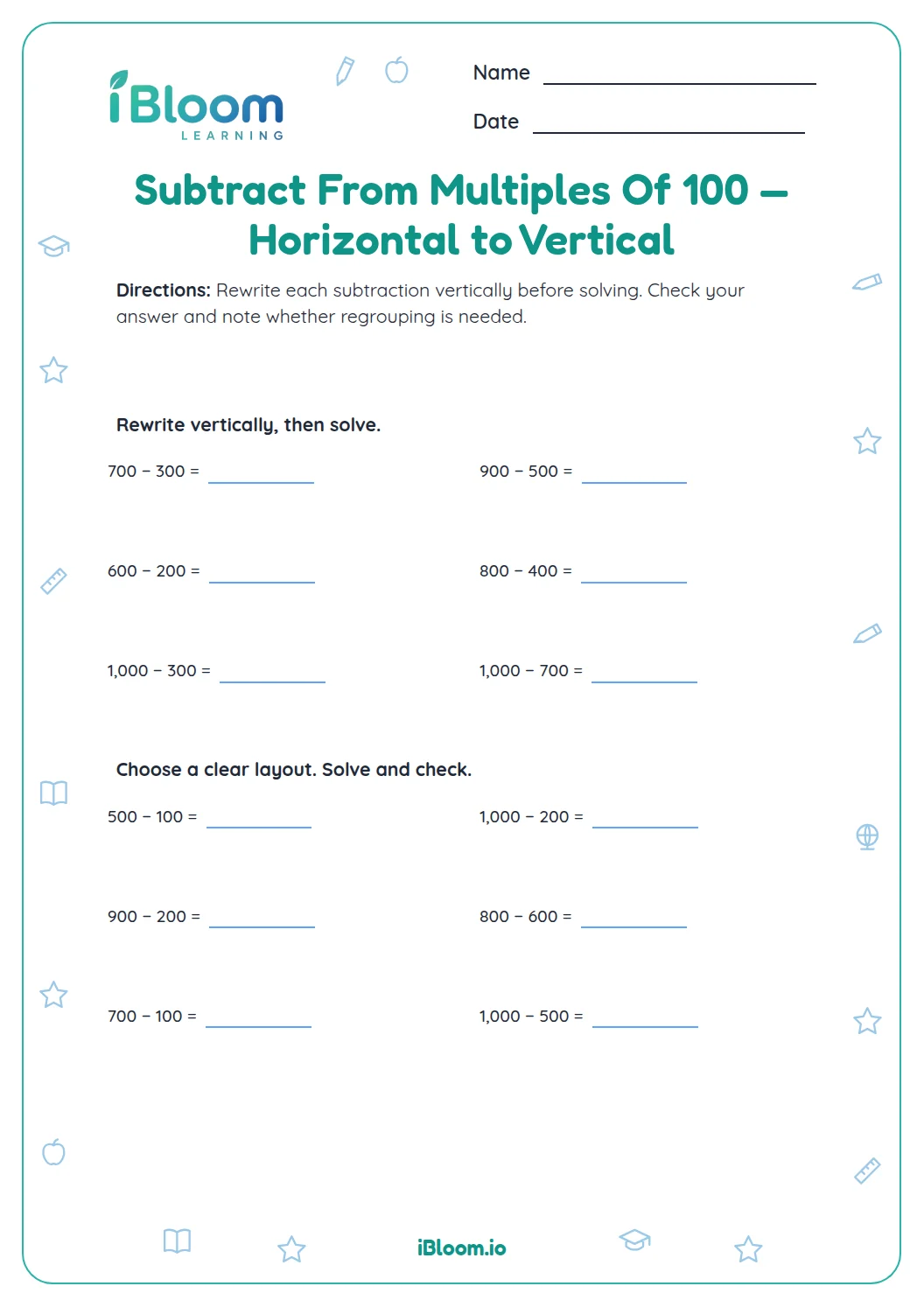
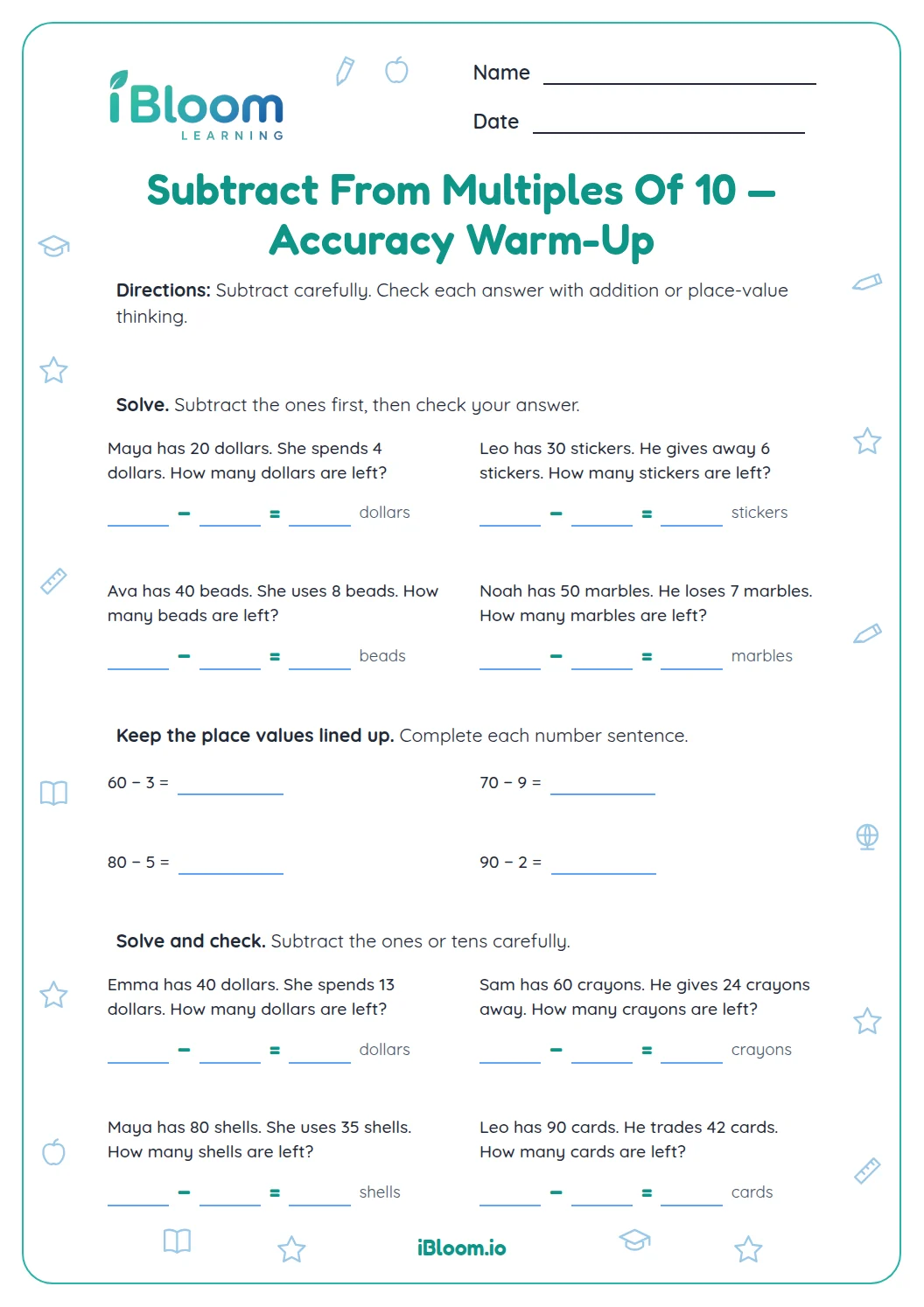
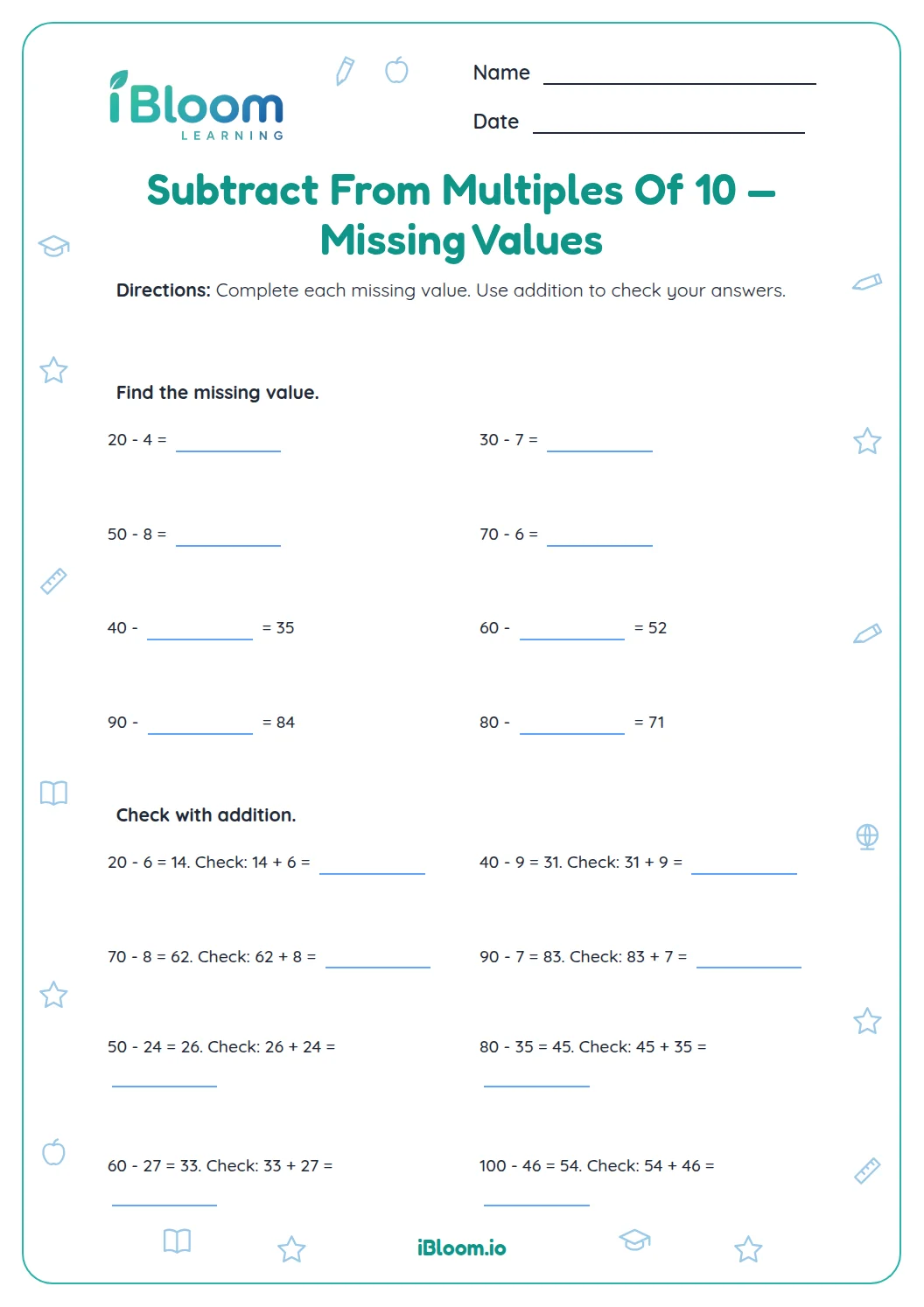
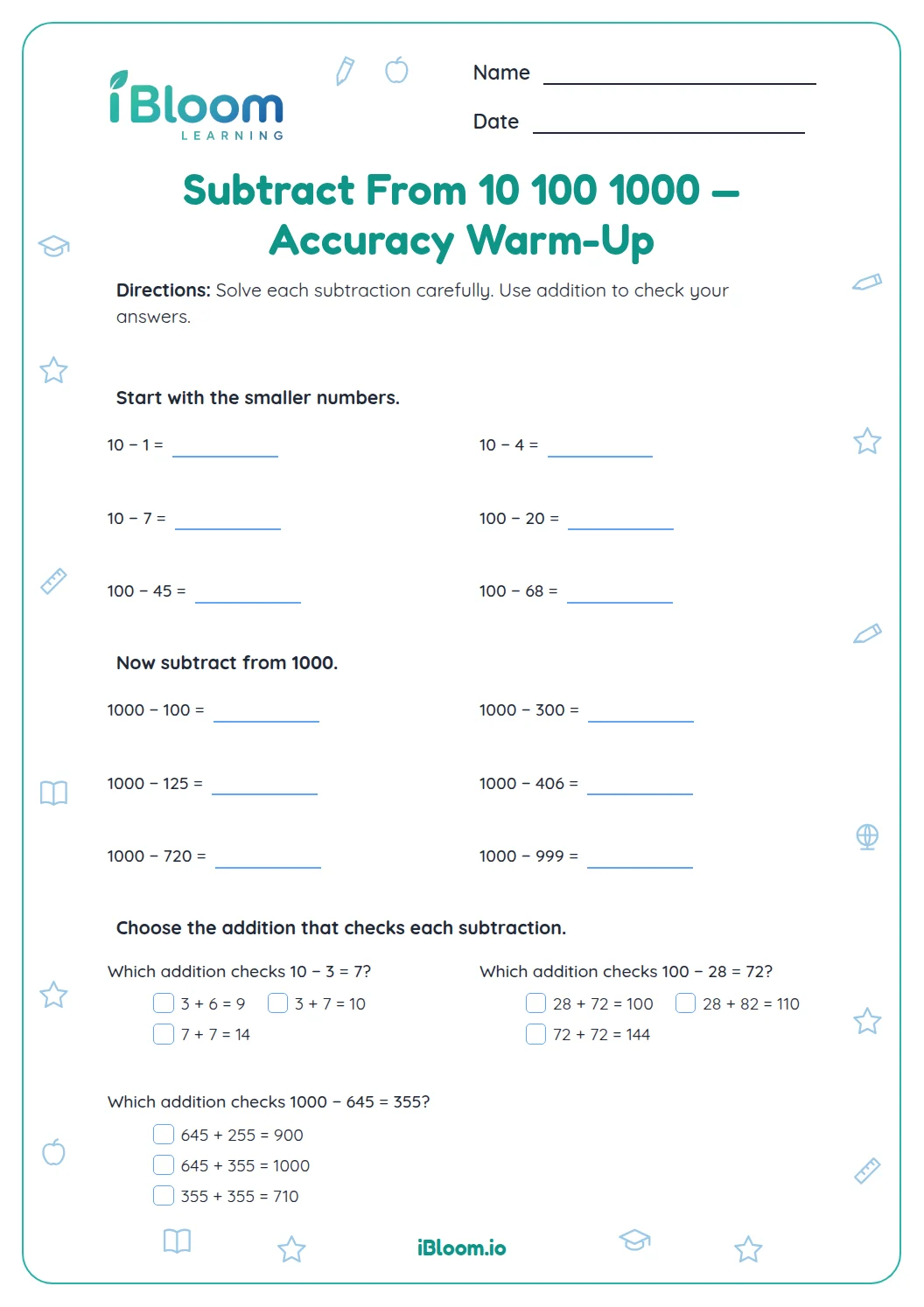
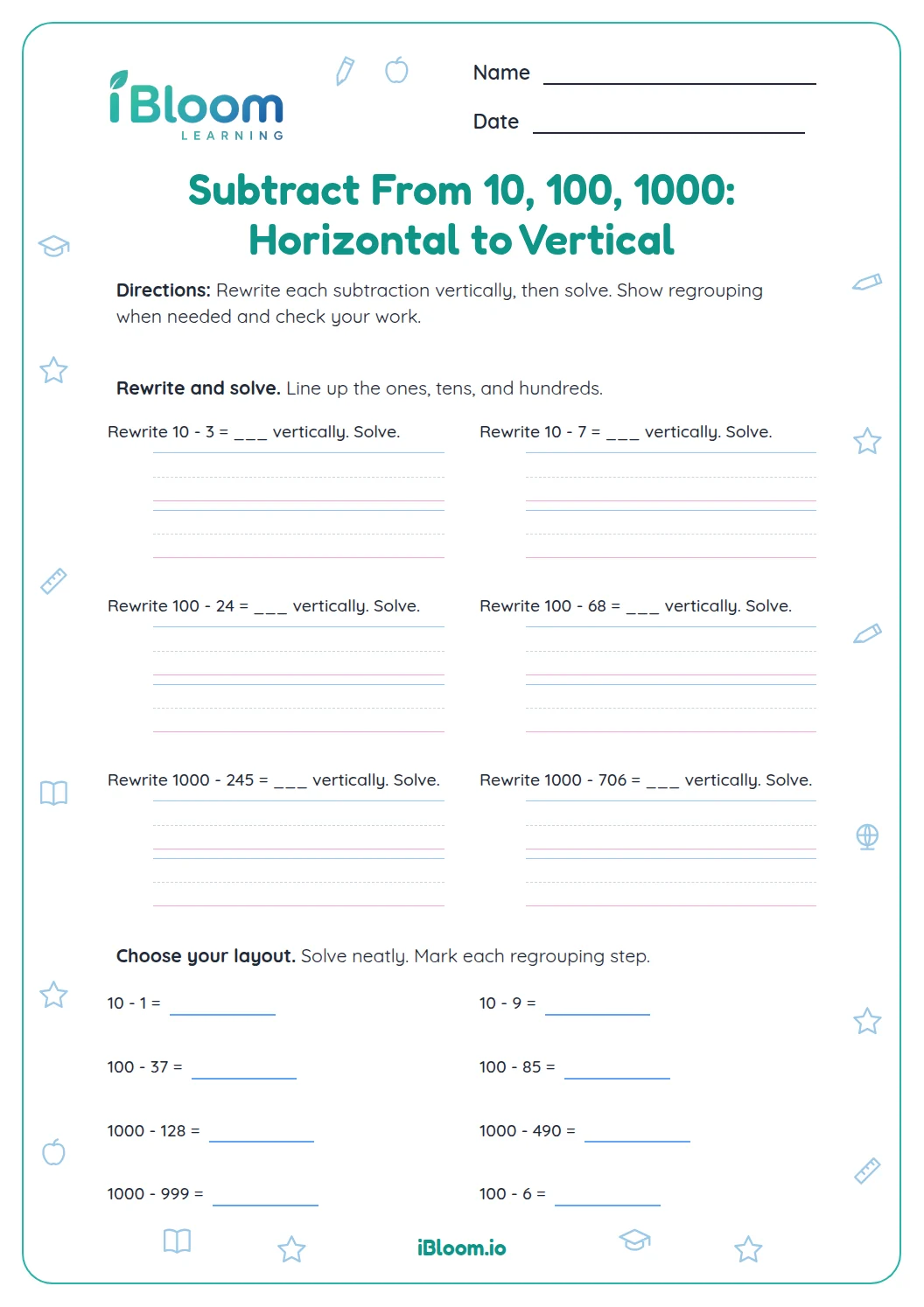
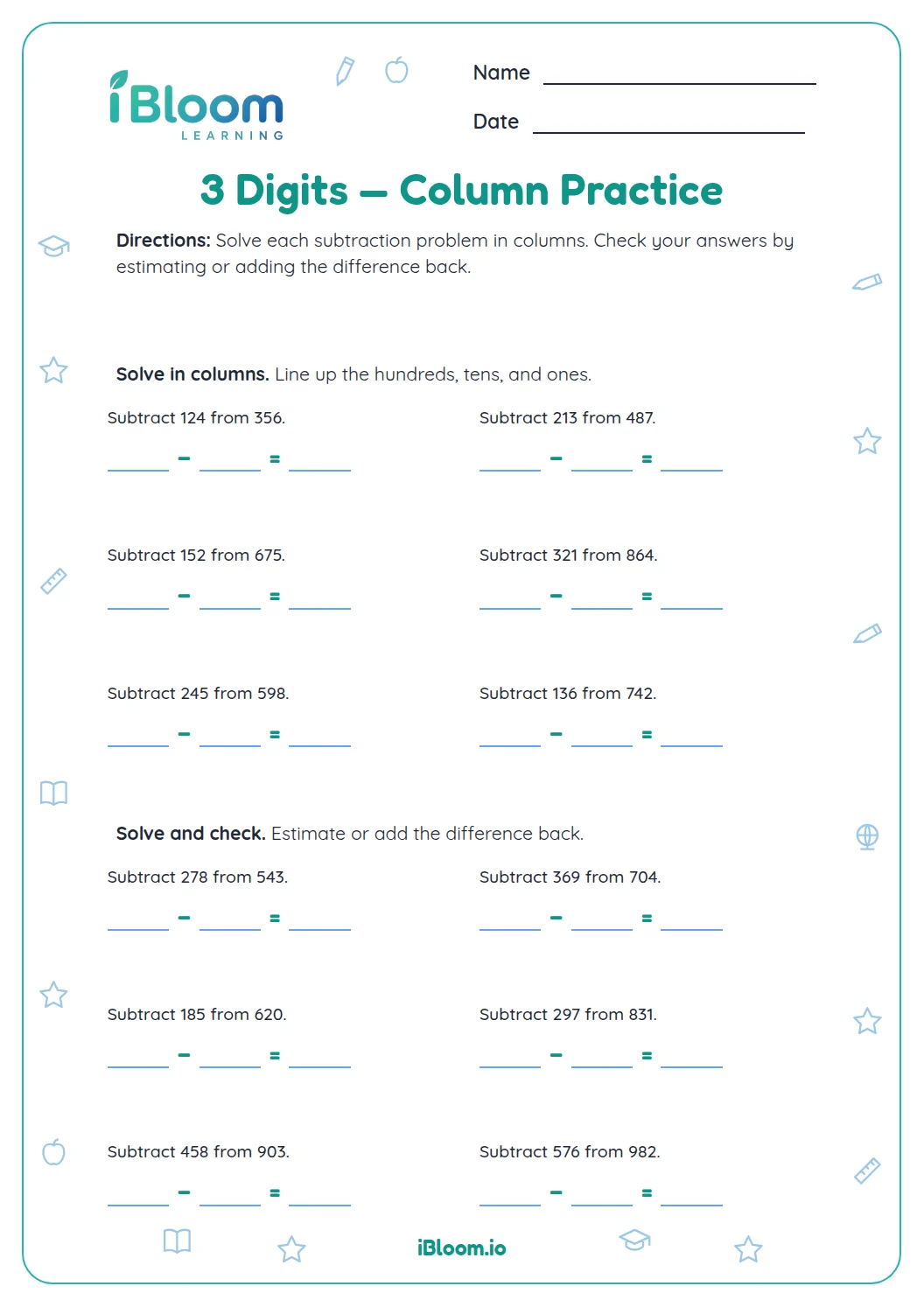
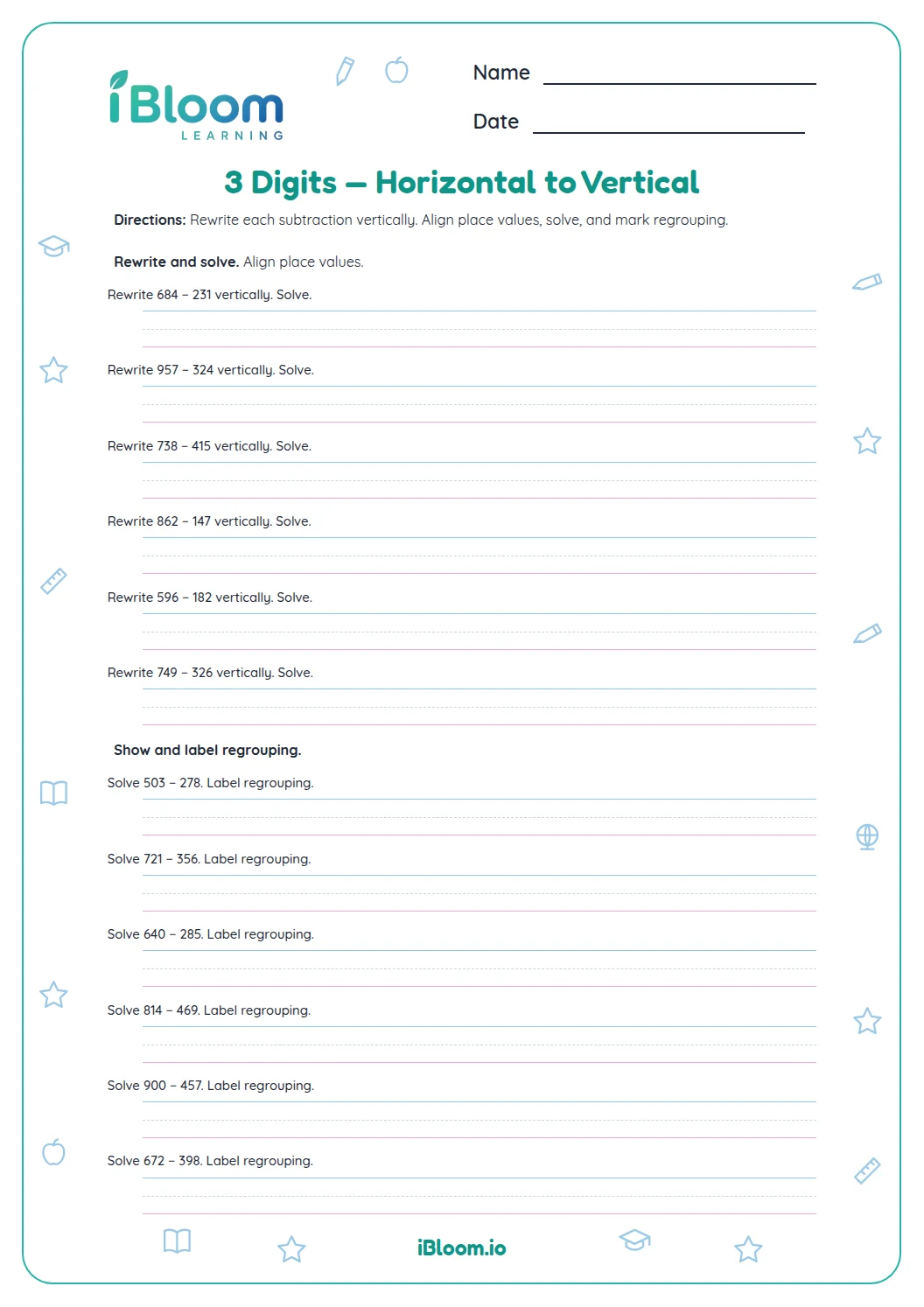
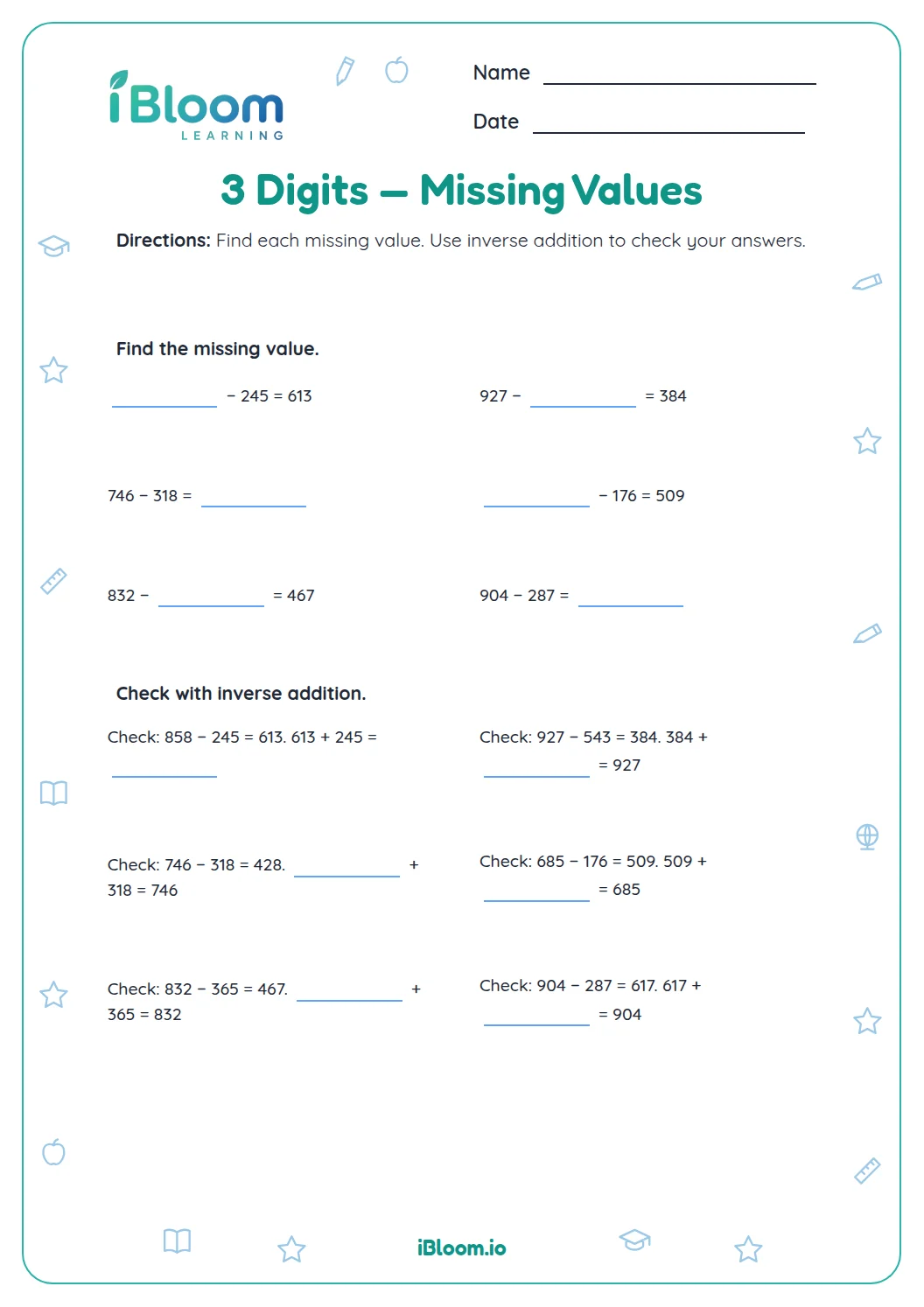
This printable warm-up gives Grade 2 students focused practice subtracting from multiples of 100. The first group asks for each difference, the next set emphasizes checking with addition, and the final questions offer choices for a quick accuracy check. Starting numbers range from 100 to 1,000, with subtractions that keep the work focused on hundreds and place value. The page practices CCSS 2.NBT.B.7 and includes a separate answer key.
Aligned to 2.NBT.B.7
How do you subtract one hundred amount from another?
When both numbers are multiples of 100, think about how many hundreds remain. In 700 − 300, seven hundreds take away three hundreds leaves four hundreds, or 400. Keep the hundreds place in view as you solve.
How can addition check subtraction?
Subtraction and addition are related. Add the subtrahend to the difference; the sum should equal the starting number. If it does not, revisit the place value or operation sign.
- 1700 − 300 = 400
- 2Check: 400 + 300 = 700.
What should students check before moving on?
Read the subtraction sign before calculating, then compare the hundreds in the answer with the starting amount. The answer should be smaller than the starting amount when a positive number is taken away.
How is the warm-up organized?
The page begins with direct differences, moves to questions that prompt an addition check, and ends with multiple-choice review. This sequence provides several ways to notice and correct a place-value error.
How to use this worksheet
- 1Read the minuend and subtrahend.
- 2Think of each number as a number of hundreds.
- 3Subtract the hundreds and write the difference.
- 4Add the subtrahend to check the result.
- 5Make sure the check returns to the starting number.
Common mistakes and quick fixes
The mistake
Subtracting the smaller number from the larger regardless of the sign.
The fix
Read the minus sign and keep the given order.
The mistake
Dropping a zero from a hundreds answer.
The fix
Say the number in hundreds before writing its numeral.
The mistake
Checking by adding the wrong pair of numbers.
The fix
Add the difference and the subtrahend to recover the minuend.
Common Core alignment
This warm-up uses place-value strategies and the relationship between addition and subtraction.
Use place value and the relationship between operations to subtract within 1,000.
On this sheet: Students subtract hundreds and use addition to check differences within 1,000.
Show the official wordingHide the official wording
Add and subtract within 1000, using concrete models or drawings and strategies based on place value, properties of operations, and/or the relationship between addition and subtraction; relate the strategy to a written method. Understand that in adding or subtracting three-digit numbers, one adds or subtracts hundreds and hundreds, tens and tens, ones and ones; and sometimes it is necessary to compose or decompose tens or hundreds.
What to practice next
Make more practice
Further reading
Questions parents and teachers ask
How many subtraction questions are included?
There are 20 questions in three parts: 12 direct differences, four addition-check or missing-number items, and four multiple-choice checks. All use multiples of 100 within 1,000, including the starting numbers. This gives families a simple way to review each step together at home.
What does “subtract from multiples of 100” mean?
The starting number is a multiple of 100, such as 600 or 1,000, and the amount taken away is also a multiple of 100. Students find how many hundreds remain and write the matching numeral. This gives families a simple way to review each step together at home.
How does addition check a subtraction answer?
Add the difference to the amount subtracted. The total should match the starting number; for example, 400 + 300 = 700 checks 700 − 300 = 400. The worksheet includes several equations to complete this check. This gives families a simple way to review each step together at home.
Which grade is this warm-up for?
The worksheet is labeled Grade 2 and keeps its numbers within 1,000. It focuses on subtracting hundreds and using addition to check a result, with a separate answer key for review. This gives families a simple way to review each step together at home.
Is an answer key included?
Yes. A separate key gives the correct difference, missing number, or choice for all 20 questions. Students can use it after completing the work and checking calculations with the inverse operation. The examples let students check their own place-value work before asking an adult.