





About this worksheet
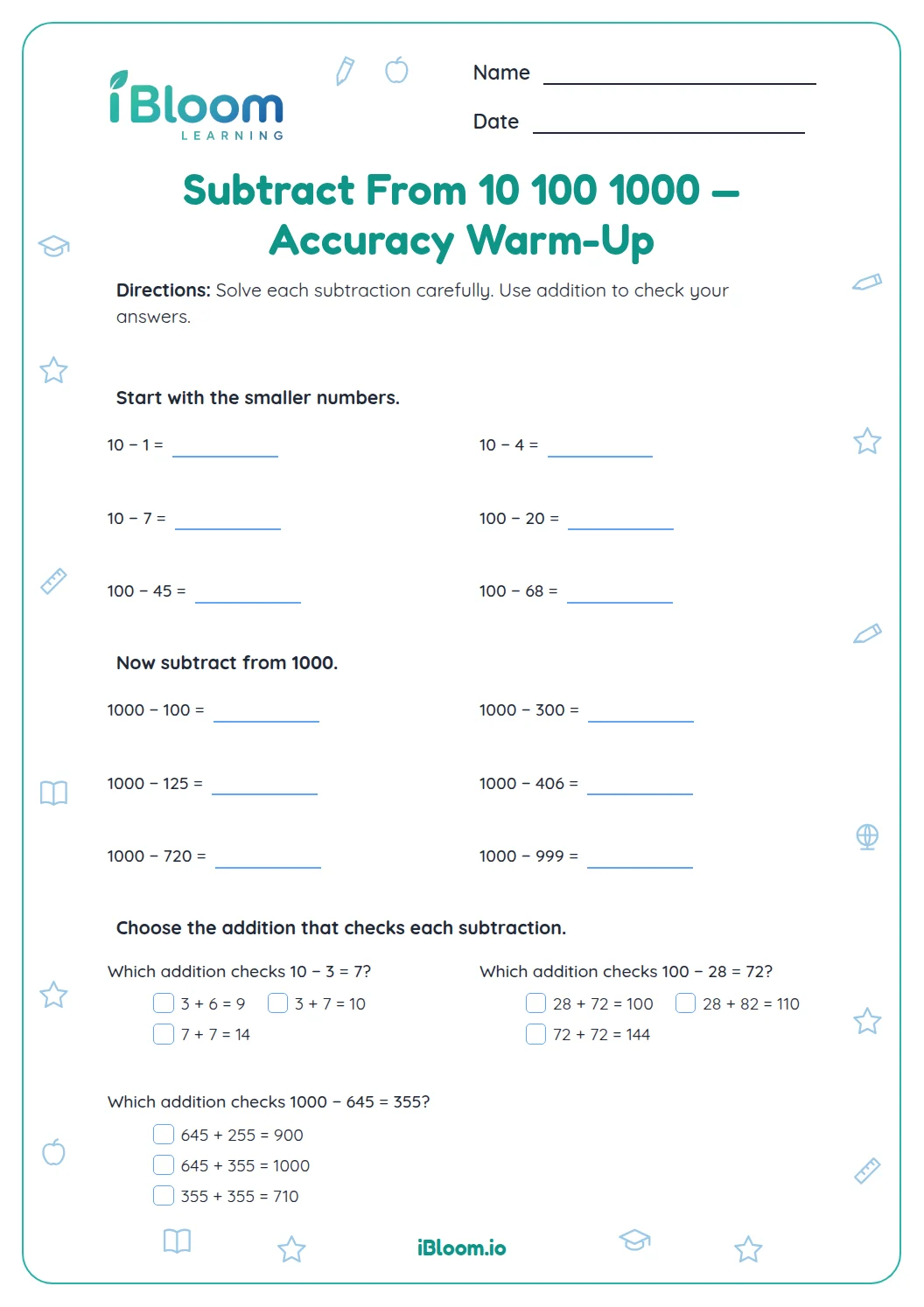
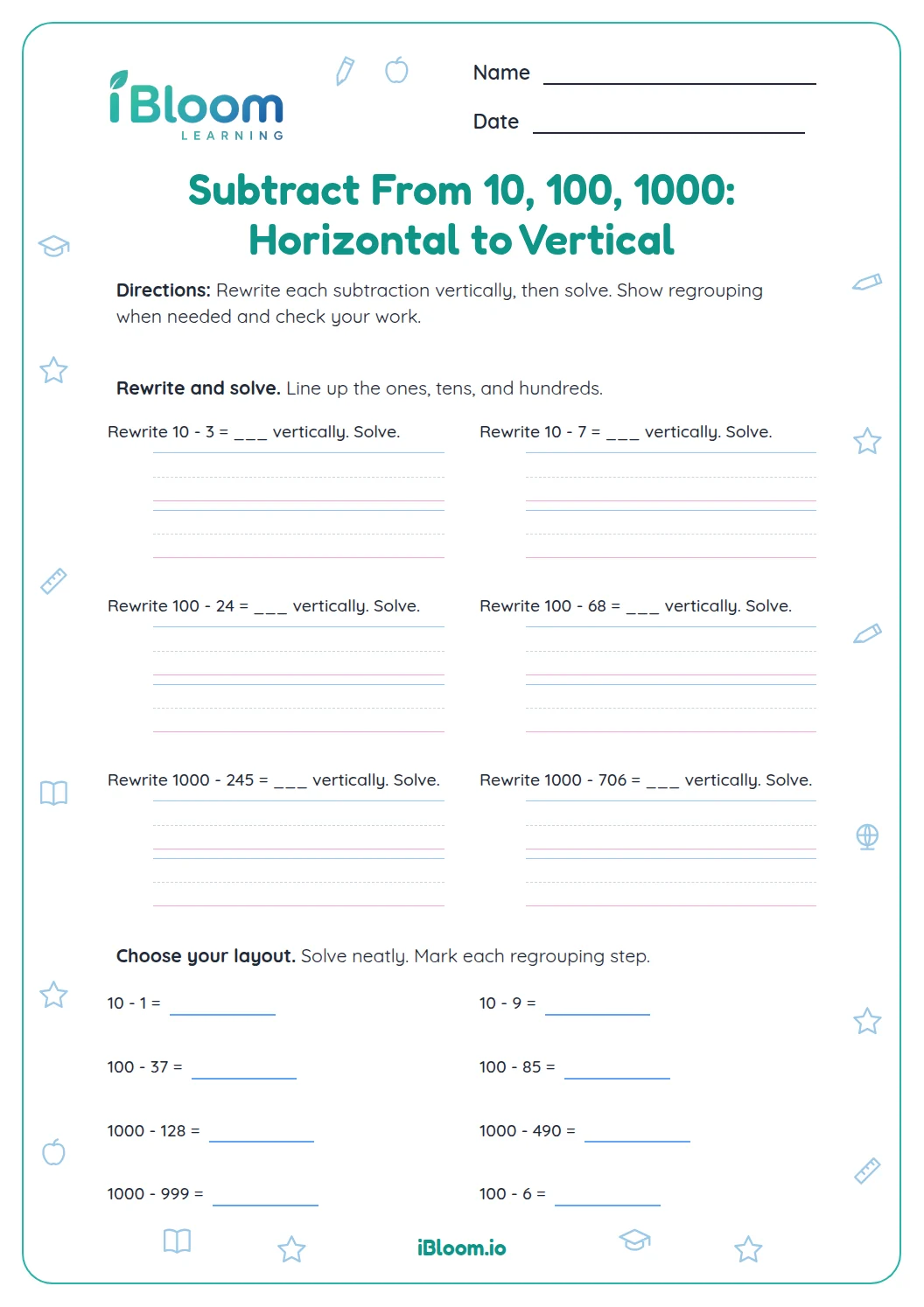
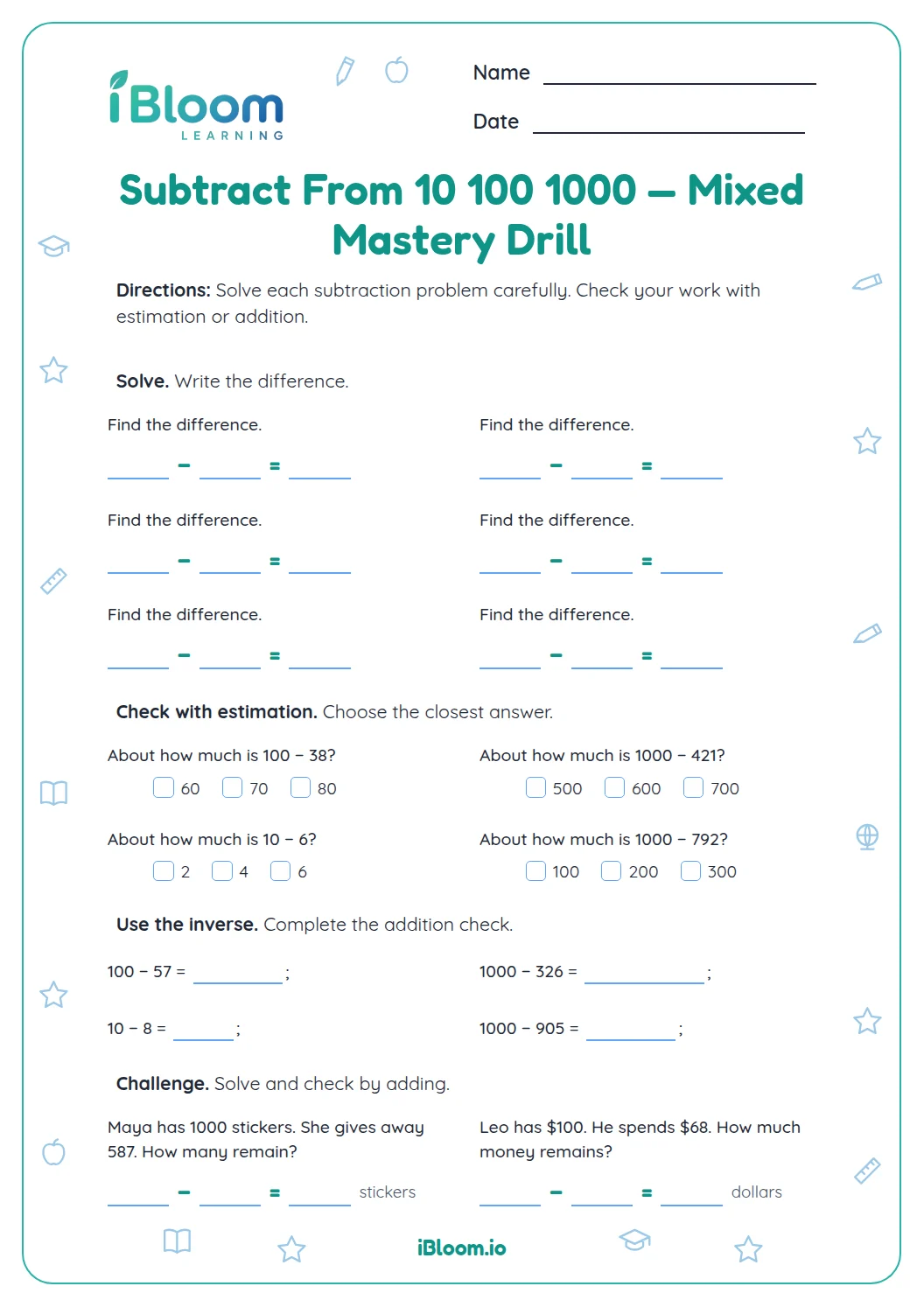
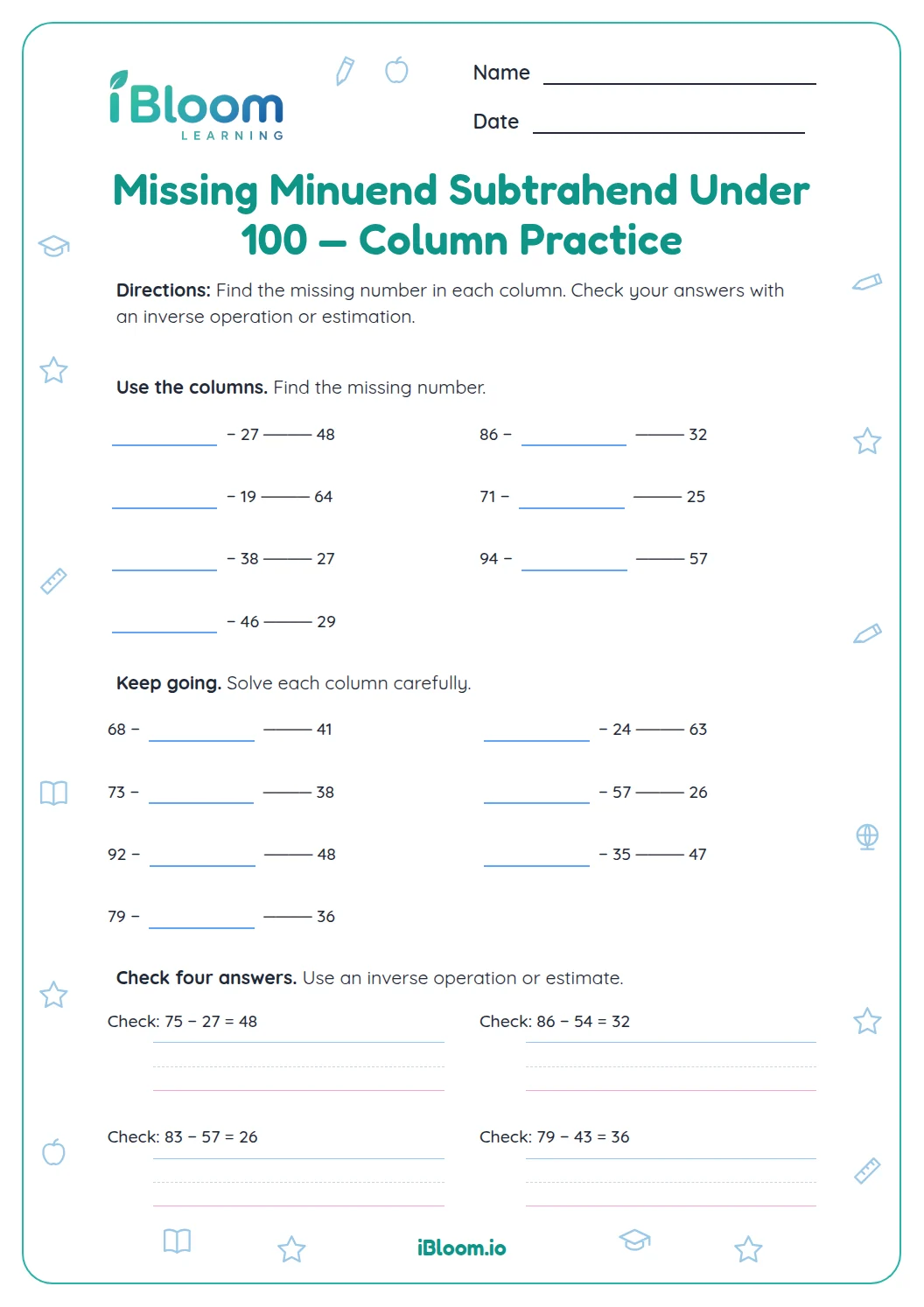
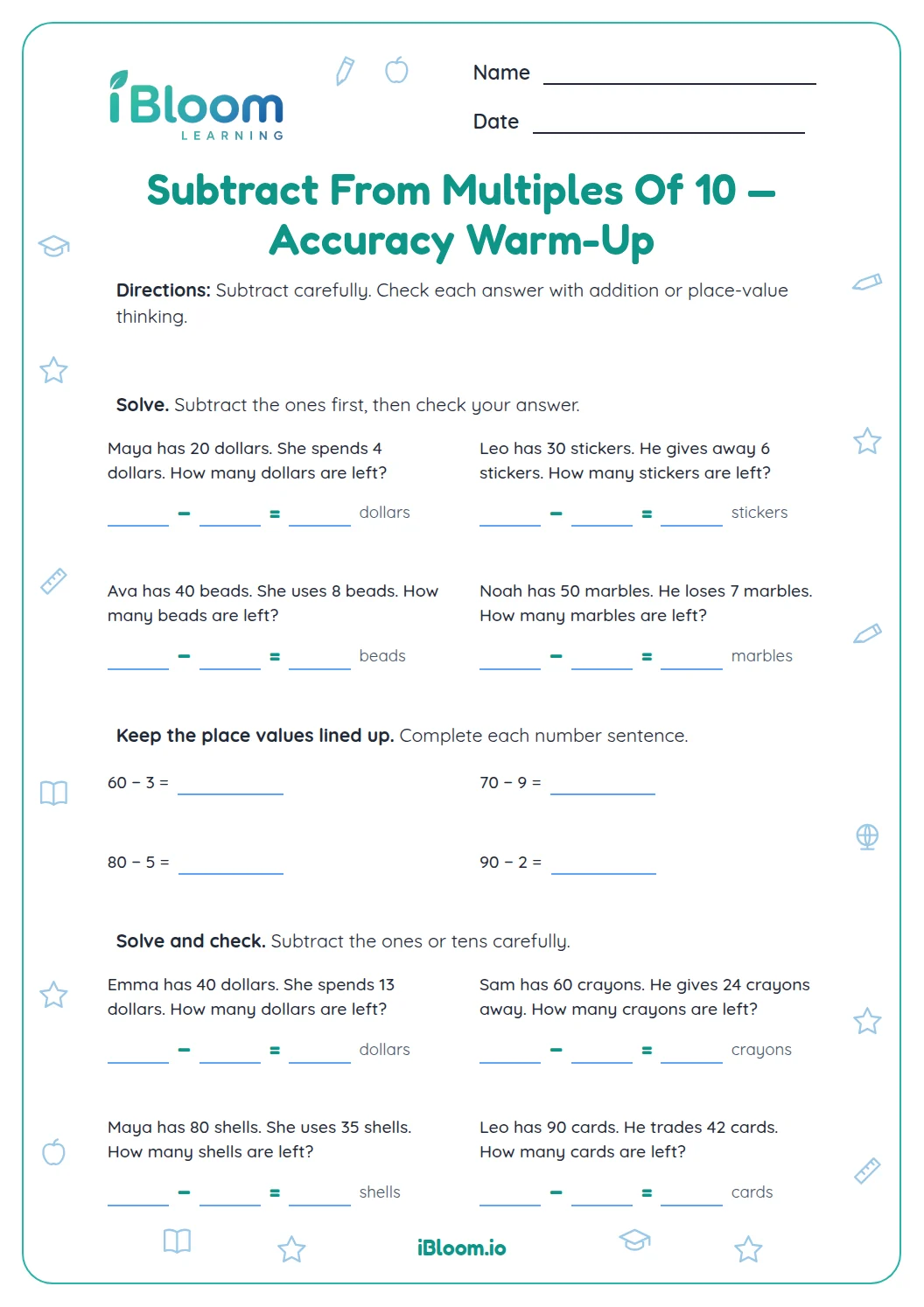
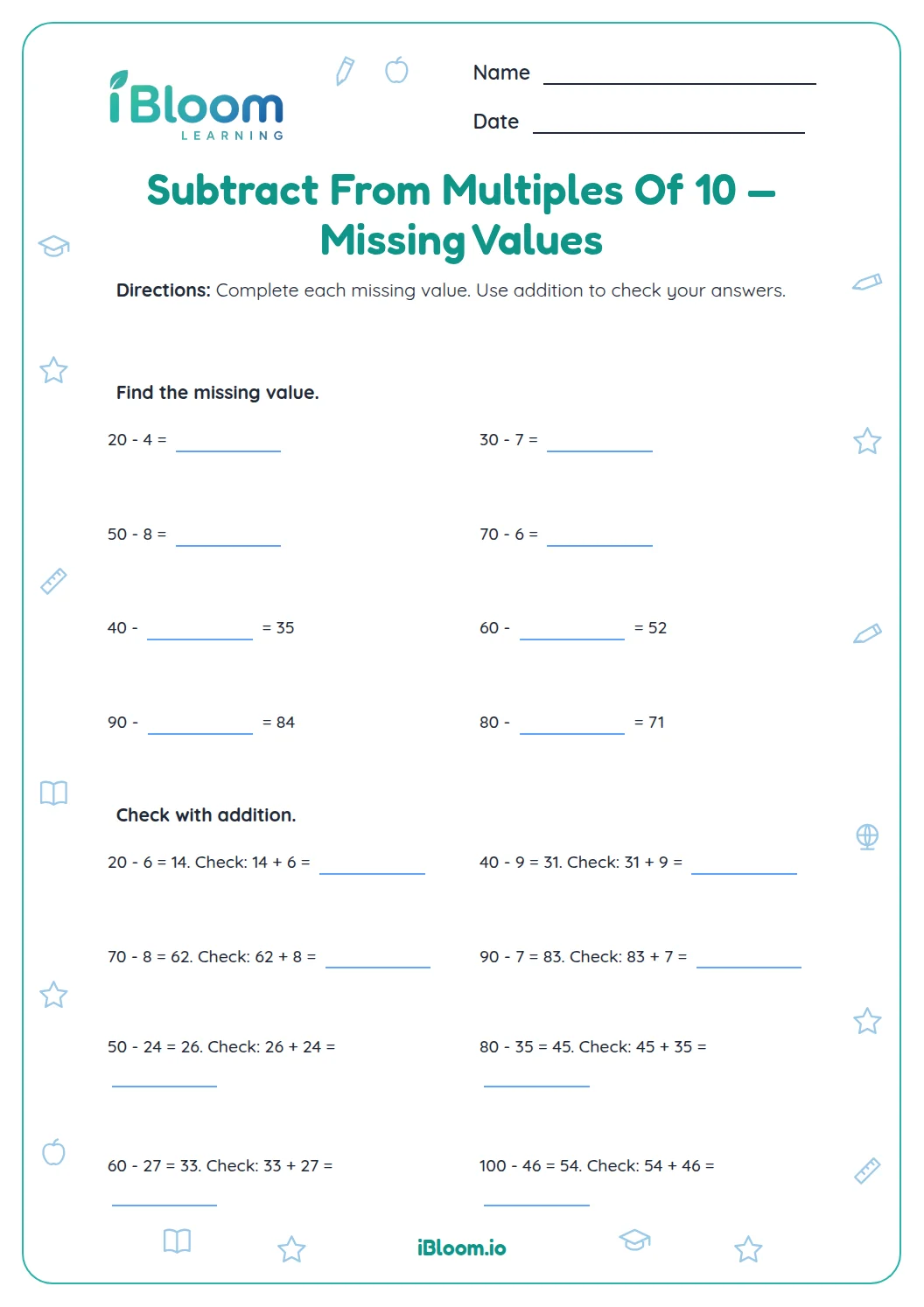
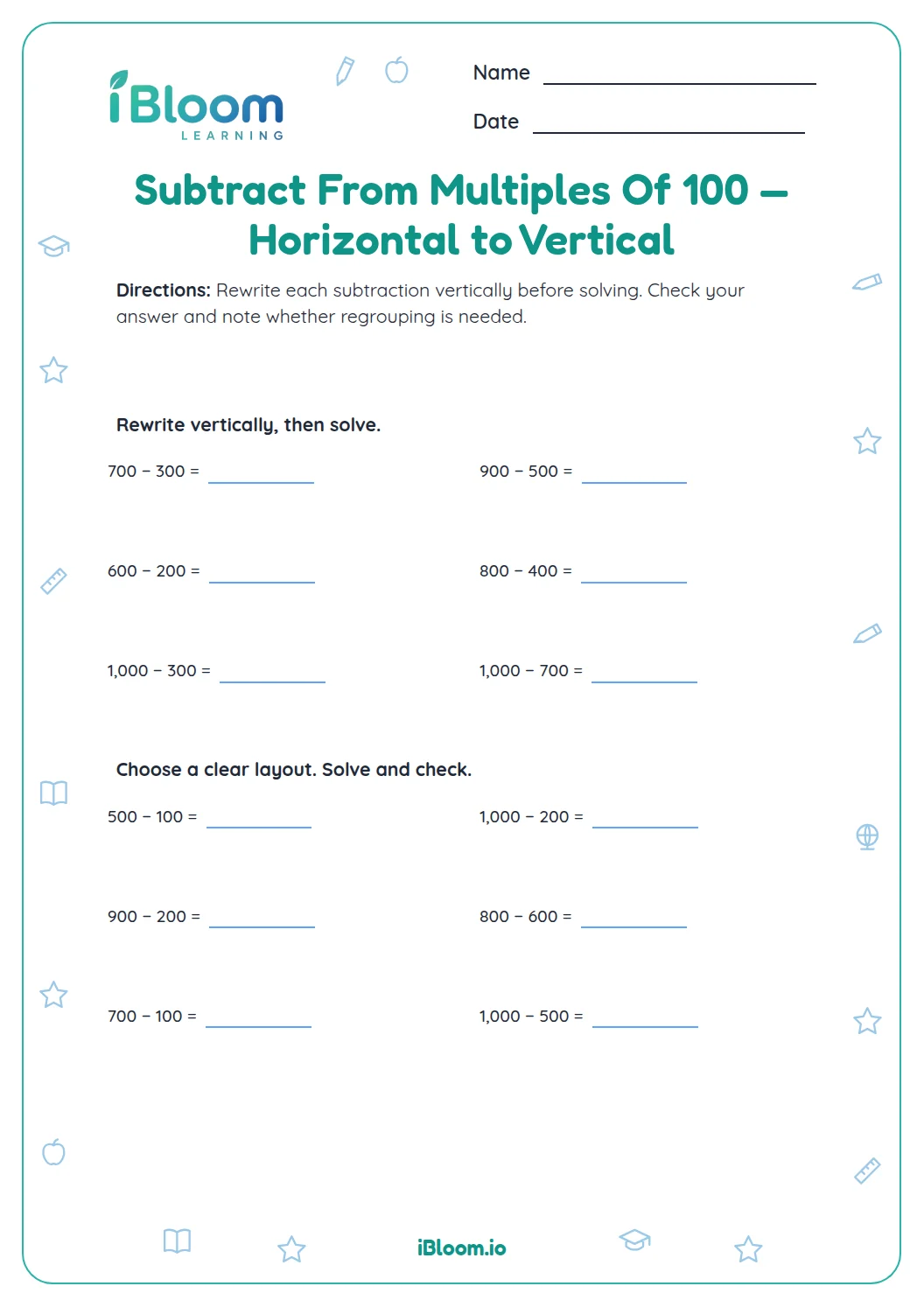
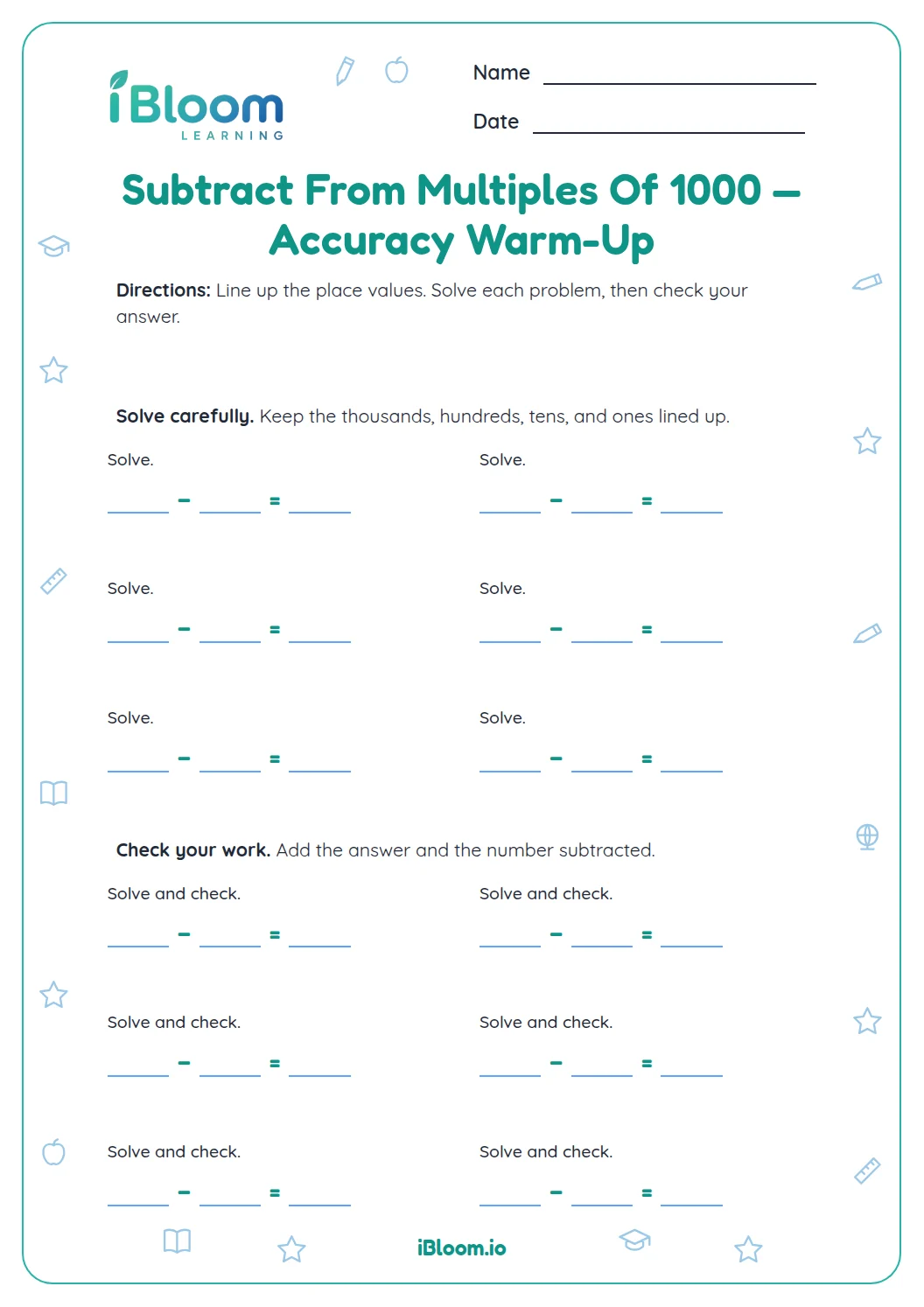
This printable gives Grades 2–4 focused practice finding an unknown number in subtraction sentences built around 10, 100, and 1,000. Children solve for either the part taken away or the amount left, then use place value to check each equation. Part A uses 10, Part B uses 100, and Part C uses 1,000; the answer key is on its own page. The set connects subtraction within 100 and 1,000 with the number relationships children use to find a missing part.
Aligned to 2.NBT.B.5 and 3.NBT.A.2
What does a missing number in subtraction represent?
In a subtraction sentence, the starting number is the whole. The number being subtracted and the answer are its two parts. If one part is missing, addition can help find it: combine the known part and the answer to recover the whole.
The worksheet keeps the whole at 10, 100, or 1,000 so children can focus on the relationship between the numbers and the value of each place.
How do you solve a missing-value subtraction sentence?
Read the whole equation before calculating. Decide whether the blank is the amount taken away or the amount left, then use addition or subtraction to find it. Check by putting the answer back into the sentence.
- 1100 − ___ = 64
- 2The blank is the amount taken away.
- 3Find the difference: 100 − 64 = 36.
- 4Check: 100 − 36 = 64.
What does each part of the worksheet practice?
Part A has six missing-value sentences with 10. Part B has six with 100, including cases where the missing number is close to the whole. Part C has six with 1,000, so children track hundreds, tens, and ones across the equation.
Some blanks are the number removed; others are the amount left. That variation makes it important to read the position of the blank rather than use one operation automatically.
How to use this worksheet at home or in class
- 1Read the whole equation and locate the blank.
- 2Name the whole, the known part, and the missing part.
- 3Use addition to combine two parts or subtraction to compare a part with the whole.
- 4Write the missing number in the blank.
- 5Substitute it into the equation and check the result.
Common mistakes and quick fixes
The mistake
Subtracting the known answer from the wrong number.
The fix
Ask which number is the whole, then write the matching subtraction equation before solving.
The mistake
Treating the blank as the answer every time.
The fix
Check the blank’s location: it may be the amount removed or the amount left.
The mistake
Ignoring place value in 100 or 1,000.
The fix
Use hundreds, tens, and ones, then verify with the complete subtraction sentence.
Common Core alignment
These number relationships support subtraction practice across the stated grade range.
Use place-value strategies to subtract within 100.
On this sheet: Part B uses subtraction within 100 and inverse addition to find unknown parts.
Show the official wordingHide the official wording
Fluently add and subtract within 100 using strategies based on place value, properties of operations, and/or the relationship between addition and subtraction.
Use place-value strategies to subtract within 1,000.
On this sheet: Part C practices subtraction within 1,000 and checks missing parts with addition.
Show the official wordingHide the official wording
Fluently add and subtract within 1000 using strategies and algorithms based on place value, properties of operations, and/or the relationship between addition and subtraction.
What to practice next
Make more practice
Further reading
Questions parents and teachers ask
What does the blank stand for in a subtraction sentence?
The blank stands for the number that makes the whole subtraction sentence true. It can be the amount taken away or the amount left, depending on its position. For example, in 100 − ___ = 64, the missing amount is 36 because 100 − 36 equals 64.
How can addition help find a missing subtraction value?
Subtraction and addition undo each other. If the whole and the amount left are known, add the two parts to check that they make the whole; if the whole and one part are known, subtract to find the other part. The worksheet answer key shows each completed equation.
What skills are practiced in Part C?
Part C has six equations with 1,000. Children find either a missing subtrahend or difference while attending to hundreds, tens, and ones. A quick addition check helps confirm the value, especially when the answer includes zero in one place.
Does the worksheet include an answer key?
Yes. A separate answer key lists the missing number for all 20 problems. Children can check the equation after solving by replacing the blank and confirming that the subtraction statement is true. The final two story questions list the correct number of books or tickets.
How should I help if my child subtracts the wrong way?
Have your child identify the starting whole and the blank before choosing an operation. Ask what the equation already tells them, then use a related addition sentence to test the result. This helps distinguish the amount taken away from the amount left in each problem.