


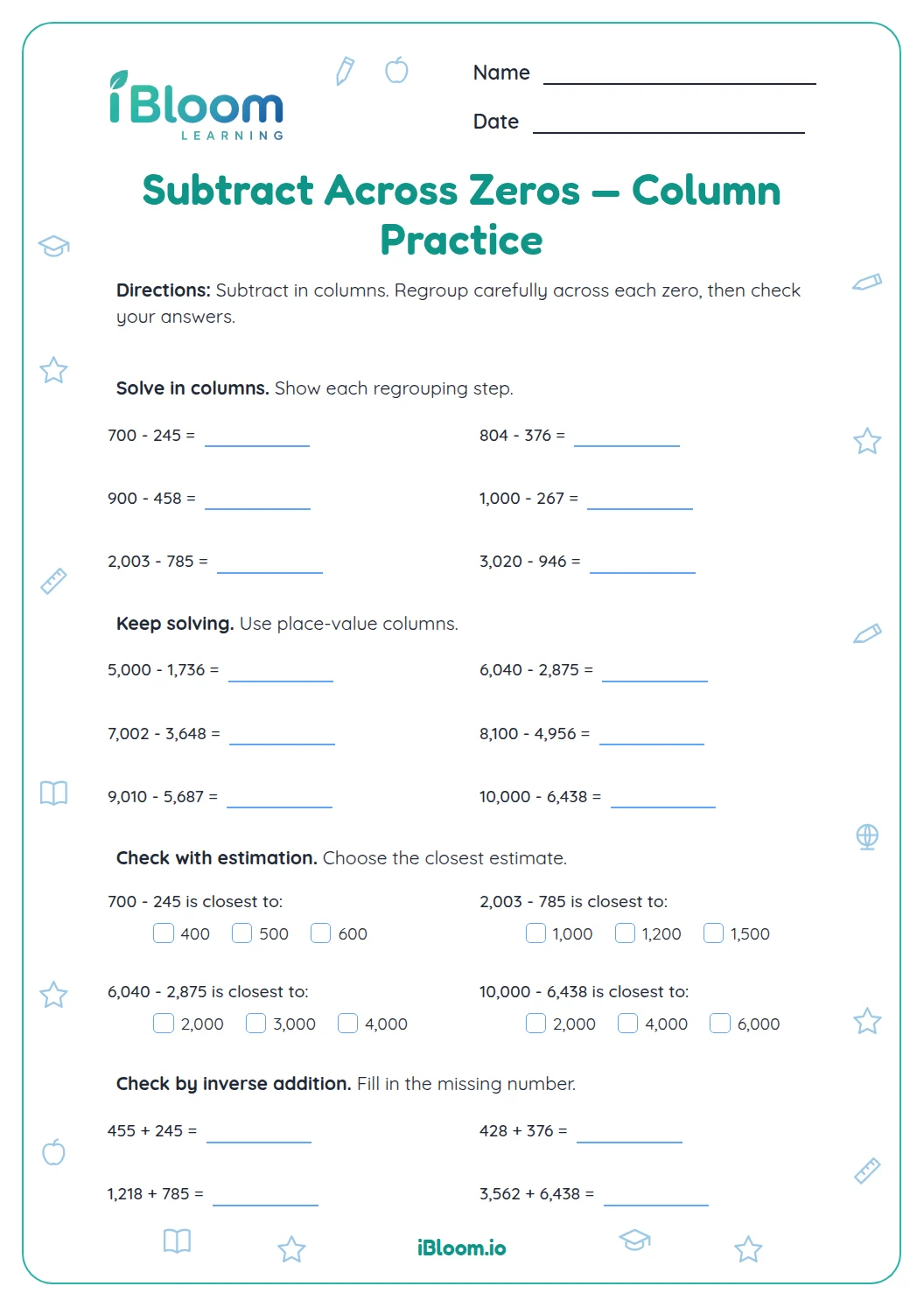
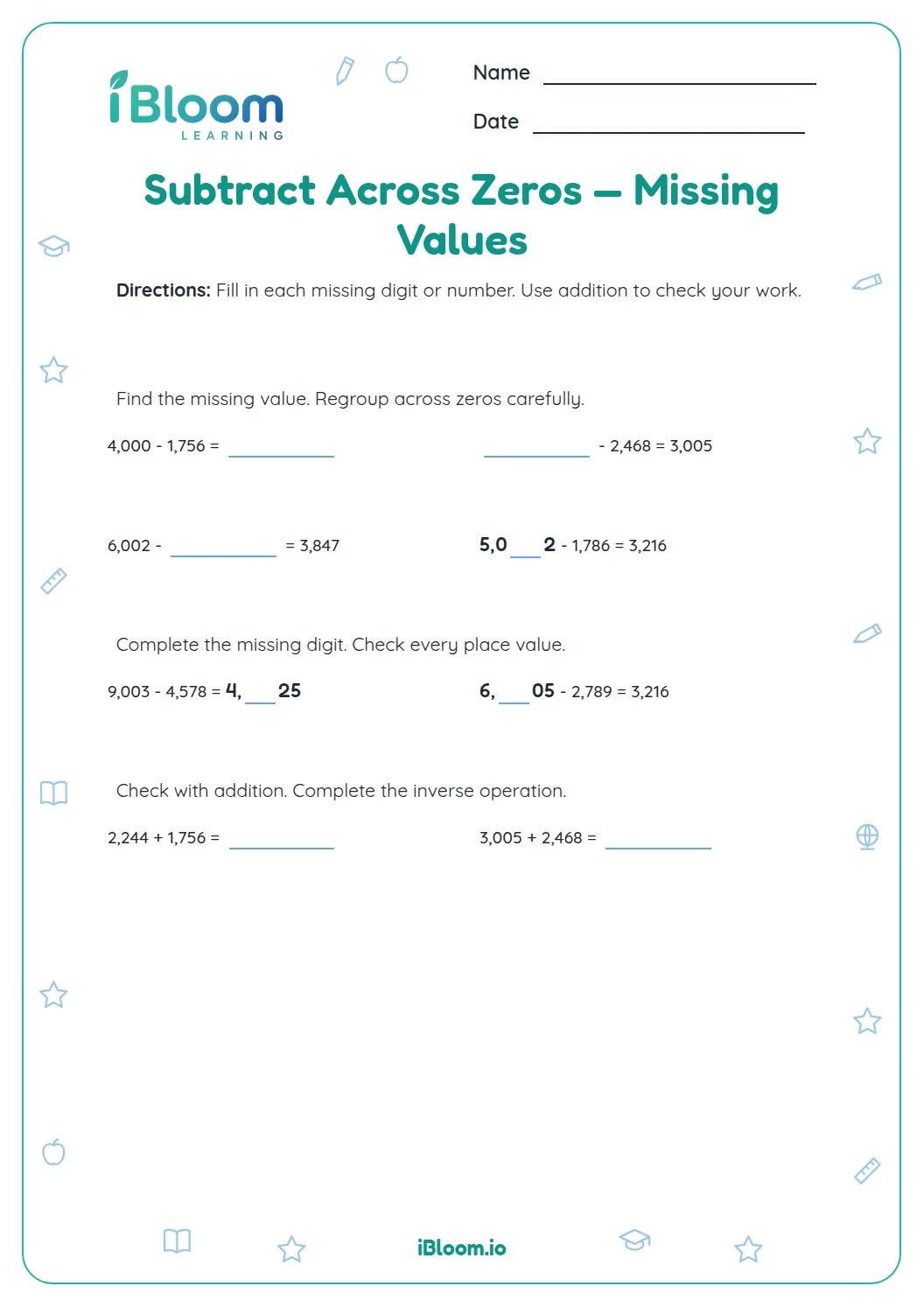
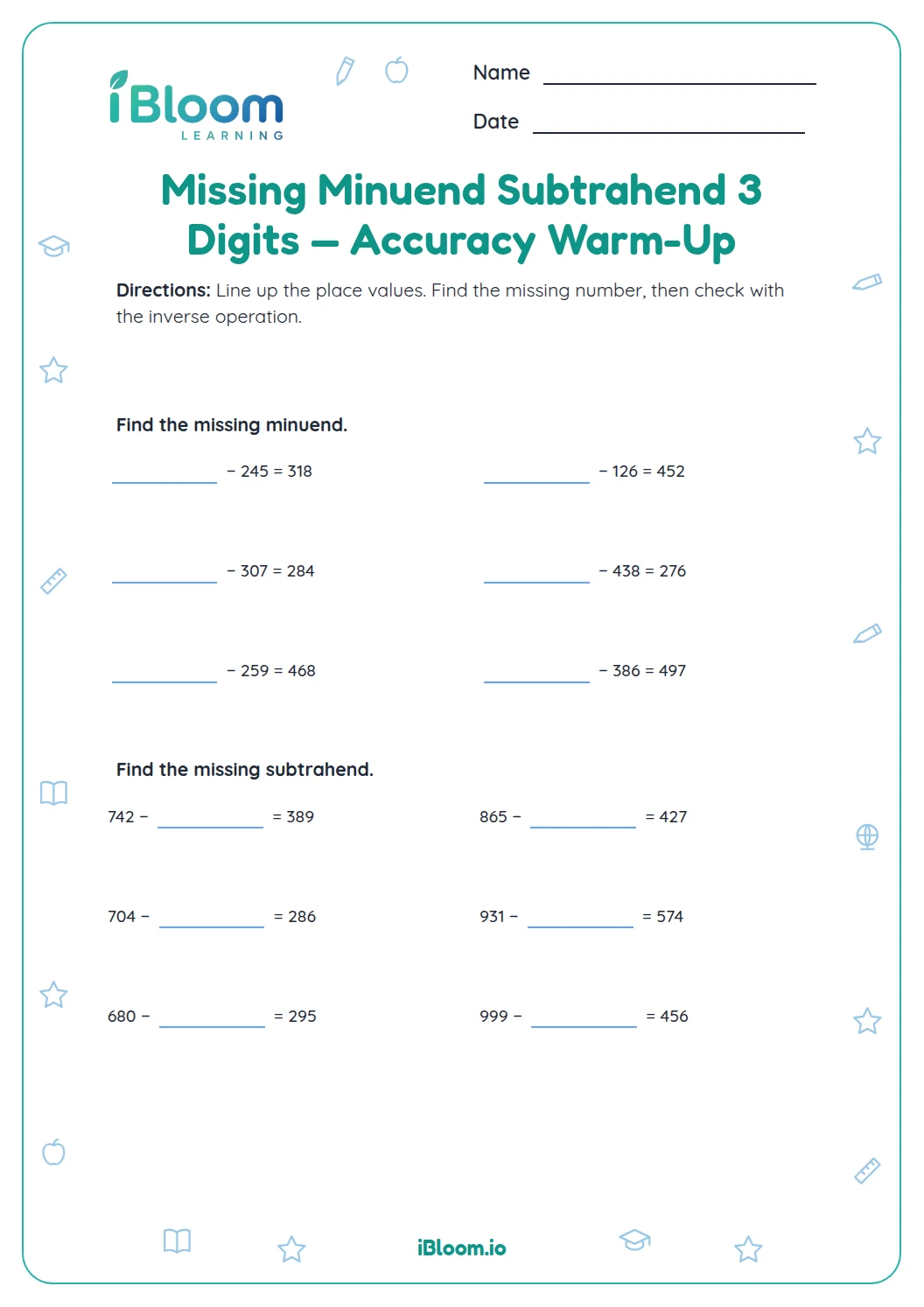
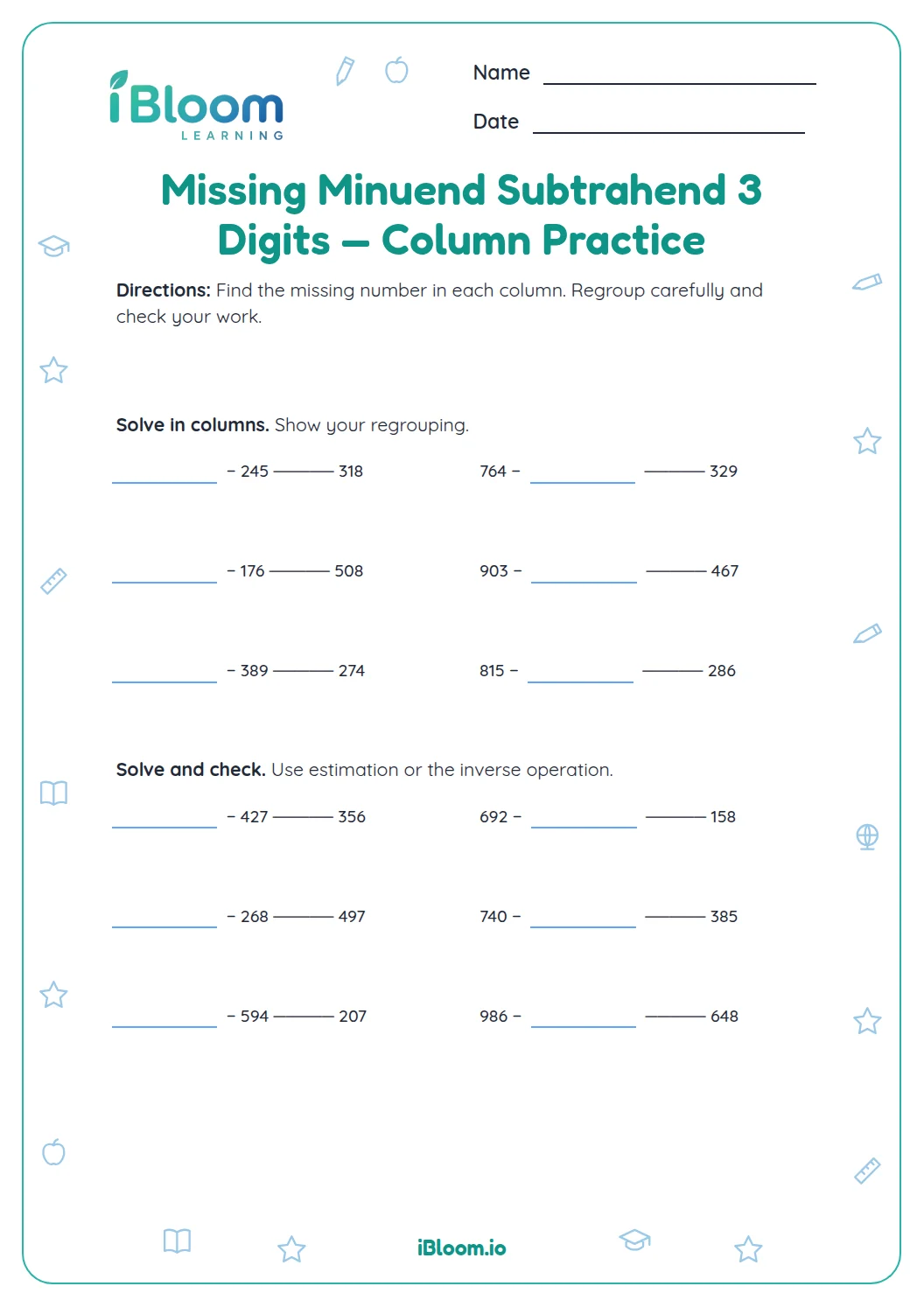
About this worksheet
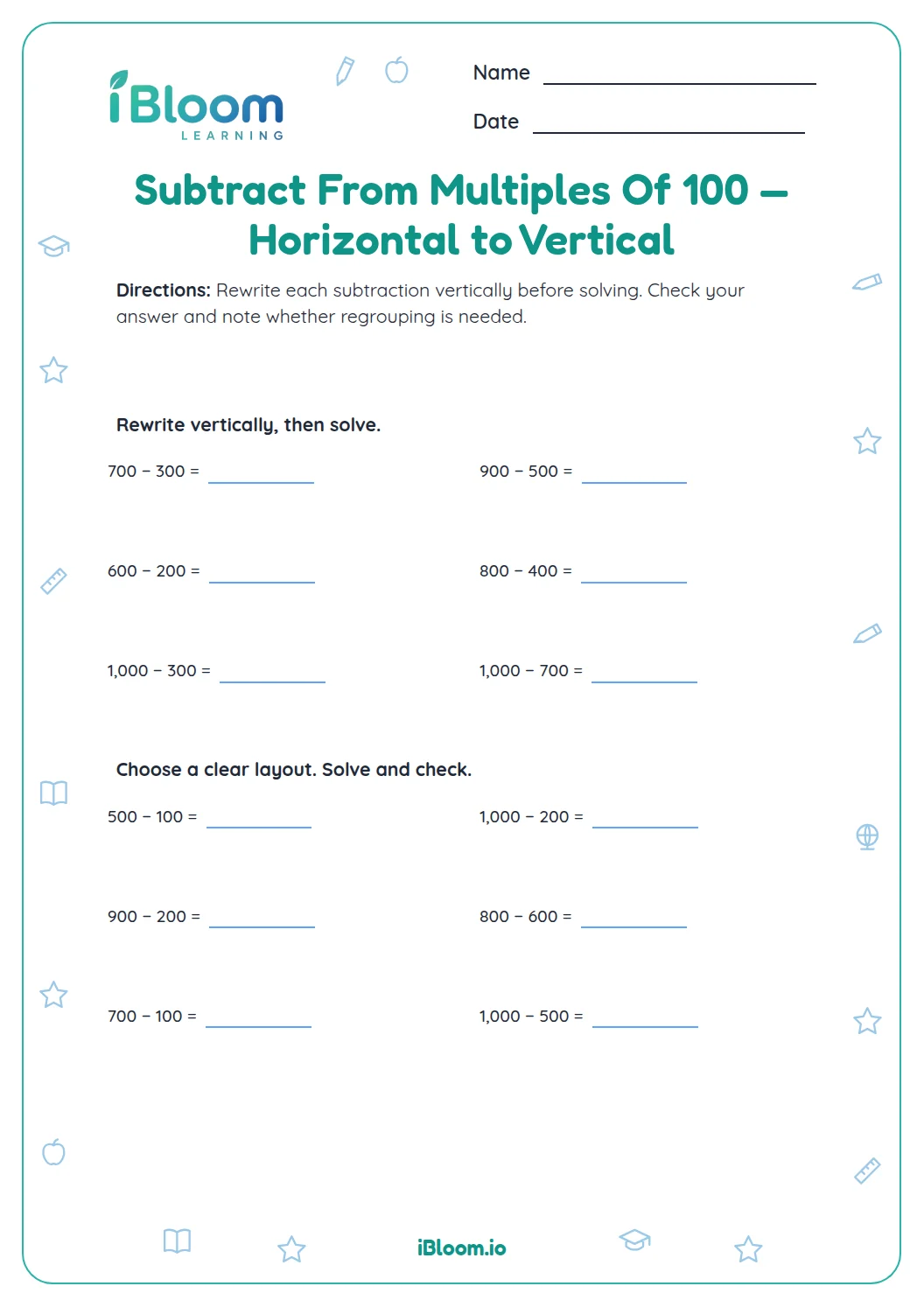
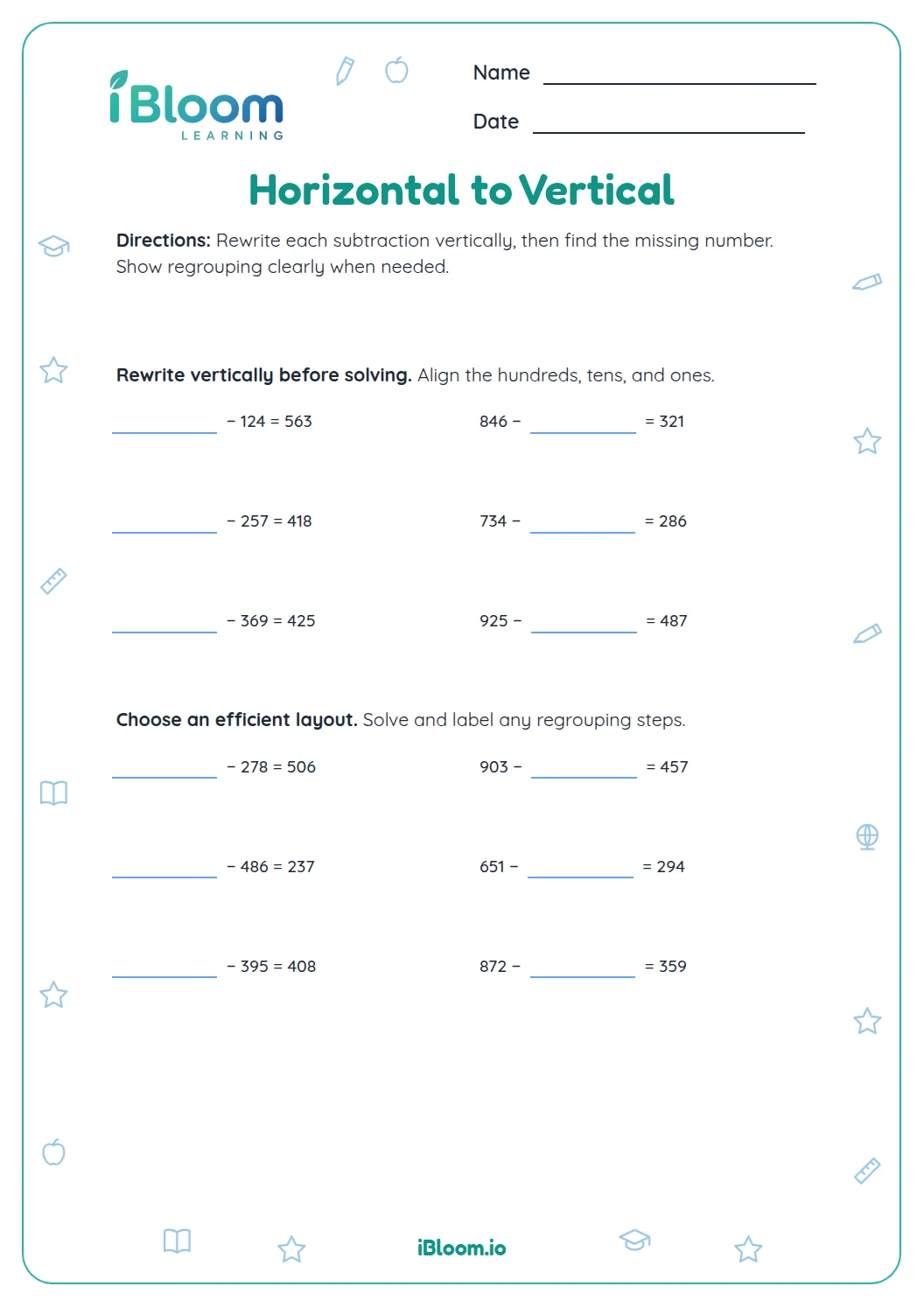
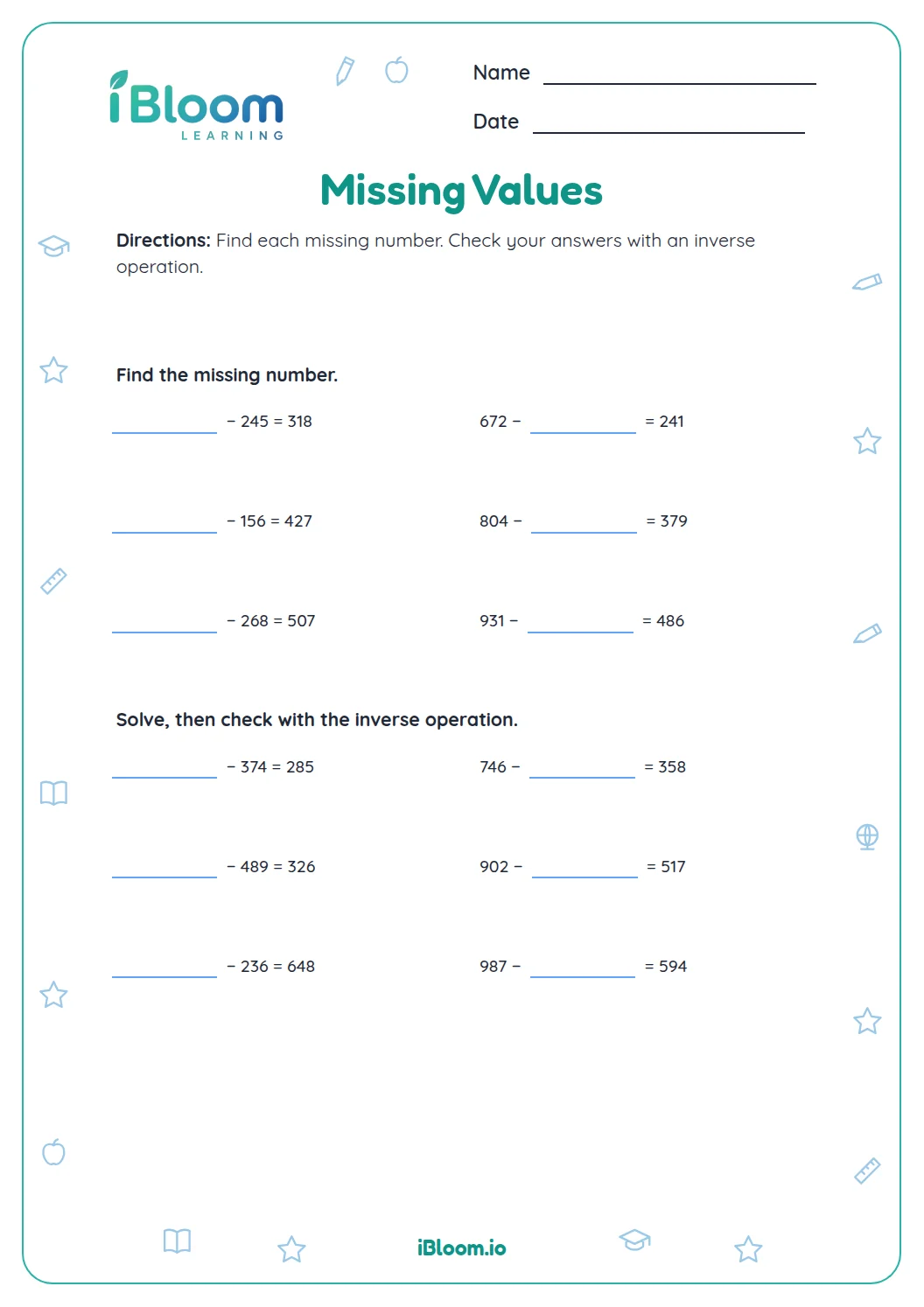
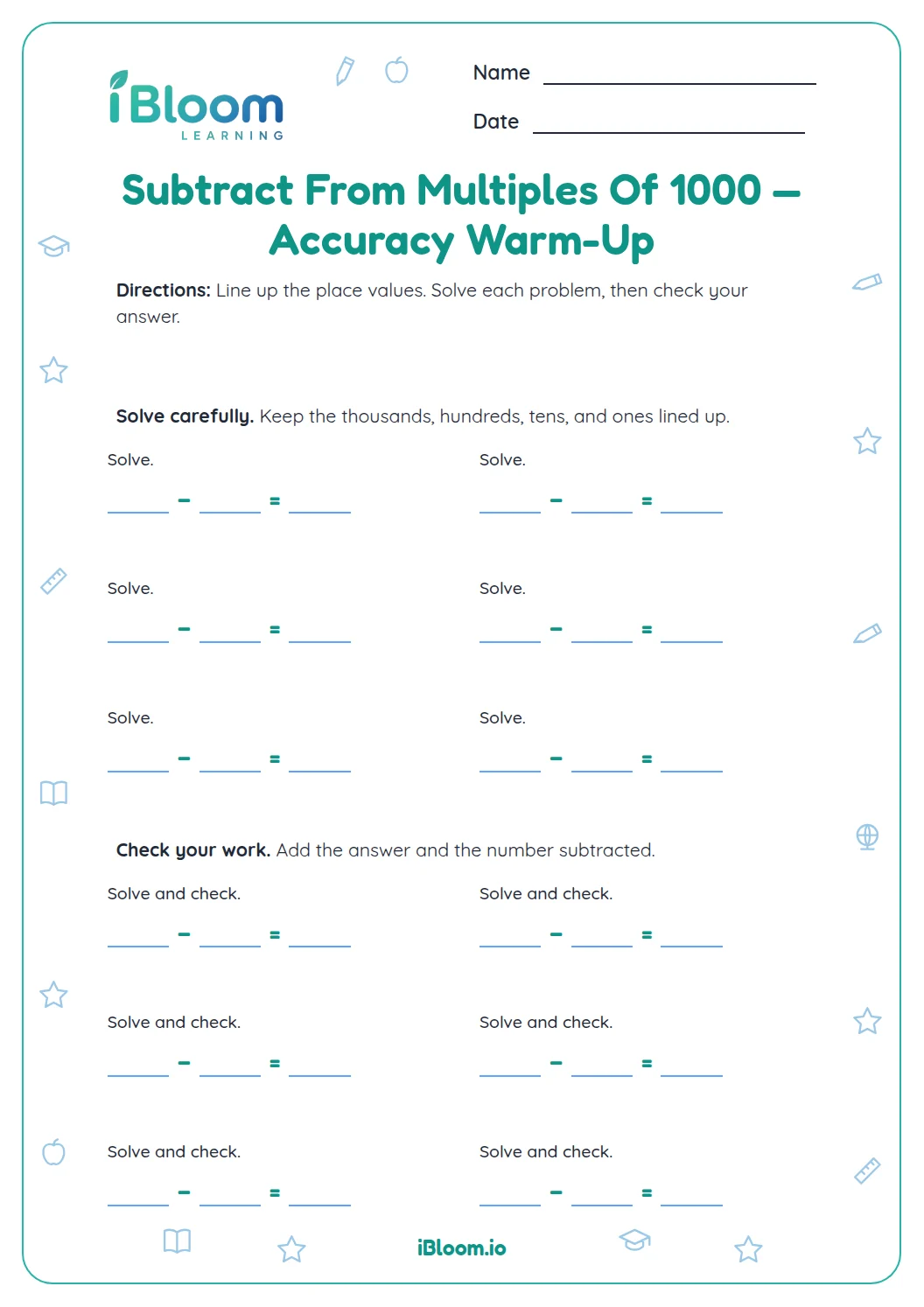
This free printable worksheet gives students in Grades 2–4 practice subtracting whole hundreds within 1,000. Part A has seven missing differences. Part B mixes seven missing starting numbers and amounts taken away. Part C contains seven addition equations that check Part A in order. Students use basic facts with hundreds as the unit: 7 hundreds minus 3 hundreds is 4 hundreds. The 21 questions practice place value and the relationship between addition and subtraction in Common Core 3.NBT.A.2. A separate answer key gives every missing value.
Aligned to 3.NBT.A.2
Why does the position of the blank matter?
A subtraction equation links the starting number, the amount taken away and the amount left. Part A hides the amount left. Part B mixes missing starting numbers with missing amounts taken away, so children must identify the blank’s job before choosing an operation.
For a missing difference, subtract. For a missing amount taken away, subtract the amount left from the start. For a missing starting number, add the two known amounts.
How do basic facts help with whole hundreds?
Treat one hundred as a unit. In question 1, 700 is 7 hundreds and 300 is 3 hundreds. Subtract 7 − 3, then express the result as hundreds. The zero tens and zero ones stay in place.
- 1700 − 300 = ___
- 27 hundreds − 3 hundreds = 4 hundreds
- 34 hundreds = 400
- 4Check: 400 + 300 = 700
How does Part C check the subtraction?
Each addition equation in Part C checks the corresponding Part A problem: question 15 checks question 1, question 16 checks question 2, and so on. Add the amount left to the amount taken away to recover the starting number.
For question 2, 900 − 500 = 400. Its check is question 16, ___ + 500 = 900. Write 400 and verify the sum. The same relationship also helps solve a missing starting number in Part B.
How to use this worksheet
- 1Read question 1 as “7 hundreds minus 3 hundreds.”
- 2Complete Part A, writing each answer as a number of hundreds.
- 3In Part B, identify the missing amount before choosing addition or subtraction.
- 4Complete Part C and pair its seven equations with questions 1–7.
- 5Check any correction in both the subtraction and related addition sentence.
Mistakes to check together
The mistake
Writing 4 instead of 400 for 700 − 300.
The fix
7 − 3 gives 4 hundreds. Write 400 to keep the unit.
The mistake
Writing 1,300 for 900 − ___ = 400.
The fix
The missing number is the amount removed. Subtract 900 − 400 = 500, then check 400 + 500 = 900.
The mistake
Subtracting 500 − 200 to solve ___ − 200 = 500.
The fix
The start must include both parts. Add 500 + 200 = 700.
Common Core alignment
Use place value and related addition facts to solve subtraction equations within 1,000.
On this sheet: Students solve subtraction equations with whole hundreds within 1,000 and complete related addition checks.
Show the official wordingHide the official wording
Fluently add and subtract within 1000 using strategies and algorithms based on place value, properties of operations, and/or the relationship between addition and subtraction.
What to practice next
Make more practice
Further reading
Questions parents and teachers ask
What numbers appear on the worksheet?
All given and missing values are multiples of 100, with amounts from 100 through 1,000. Children can use facts such as 7 − 3 = 4 while keeping hundreds as the unit. The worksheet includes missing differences, missing starting numbers and missing amounts taken away.
Should my child use column subtraction?
Thinking in hundreds is enough for these questions. For 700 − 300, say “7 hundreds minus 3 hundreds equals 4 hundreds,” then write 400. Children may use columns if helpful, but ask them to explain what the hundreds digit means before moving to the next equation.
How do I explain a missing amount taken away?
Call it the part removed from the starting amount. In question 9, 900 − ___ = 400, the start is 9 hundreds and 4 hundreds remain. The missing amount is 5 hundreds, or 500. Check by adding 400 and 500 to recover the original 900.
How are the 21 questions organized?
There are three groups of seven: differences, mixed subtraction blanks and addition checks. Part B alternates the position of the missing number. Each Part C equation checks a Part A question in order, giving children a direct way to connect subtraction with its related addition fact.
Is the subtraction drill timed?
You can use it without a timer. Allow about 15 minutes for solving and checking, adjusting the pace for your child. Ask children to explain a missing starting number and an amount taken away before finishing. The separate answer key gives all 21 missing values for review.