




About this worksheet
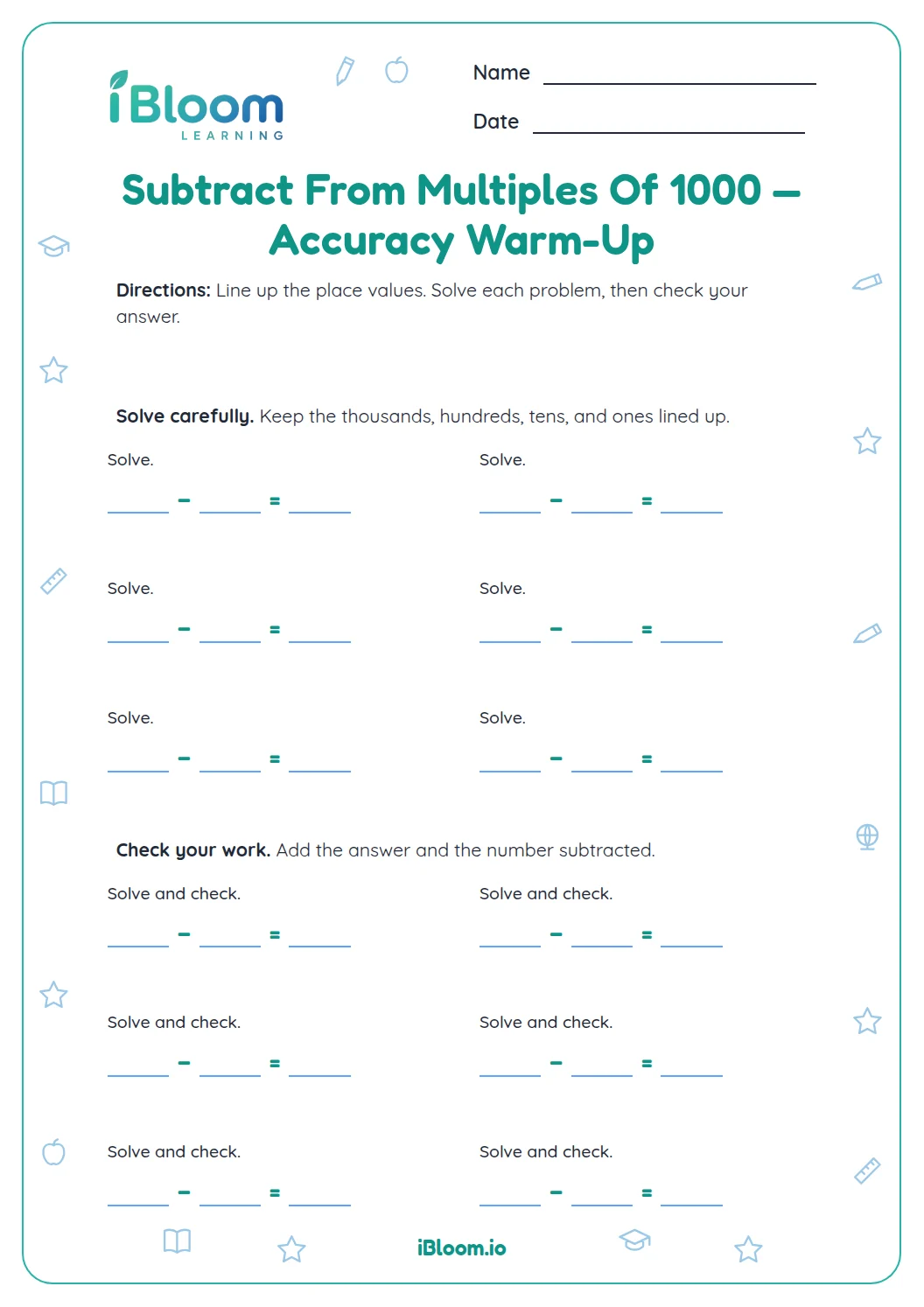
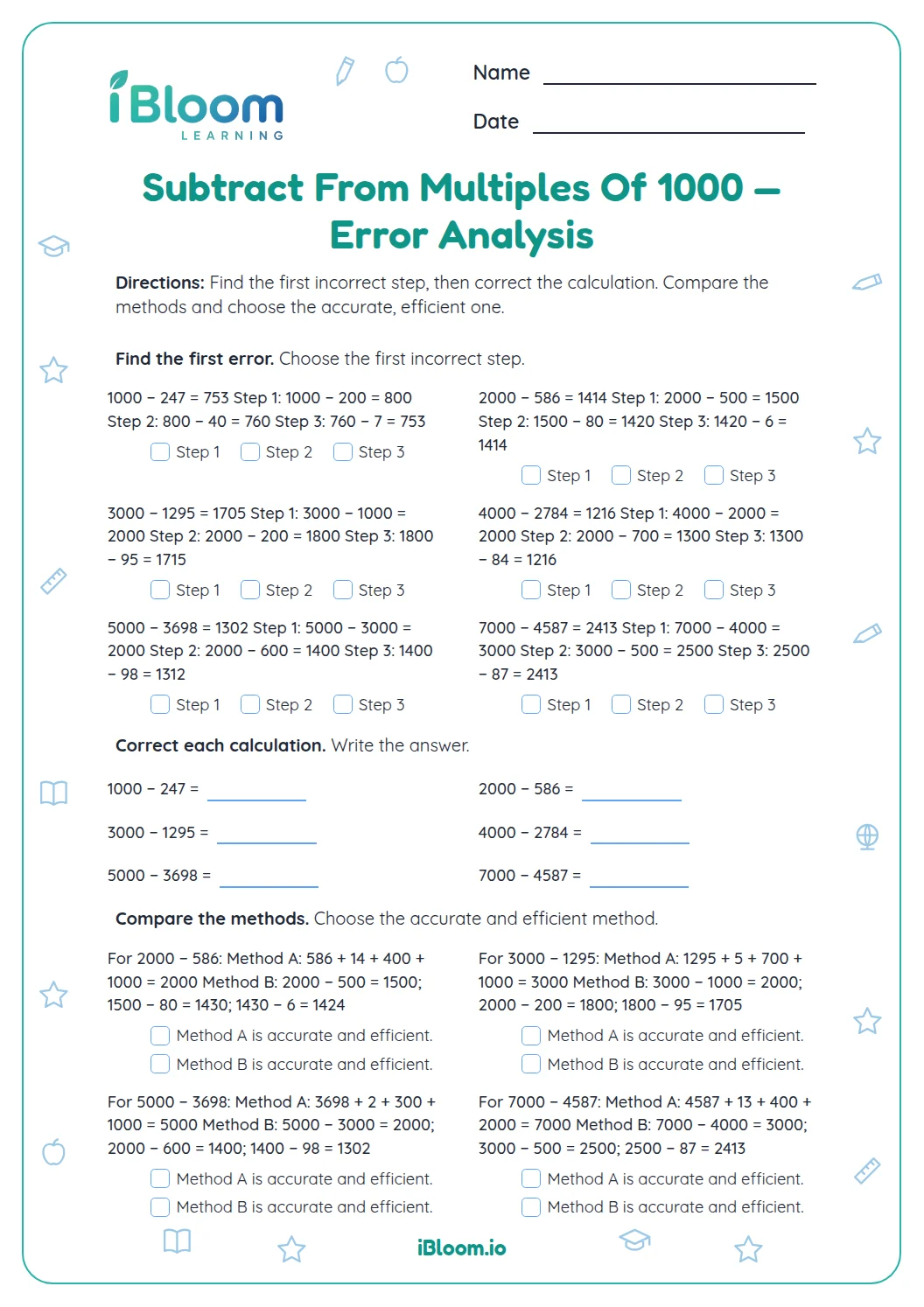
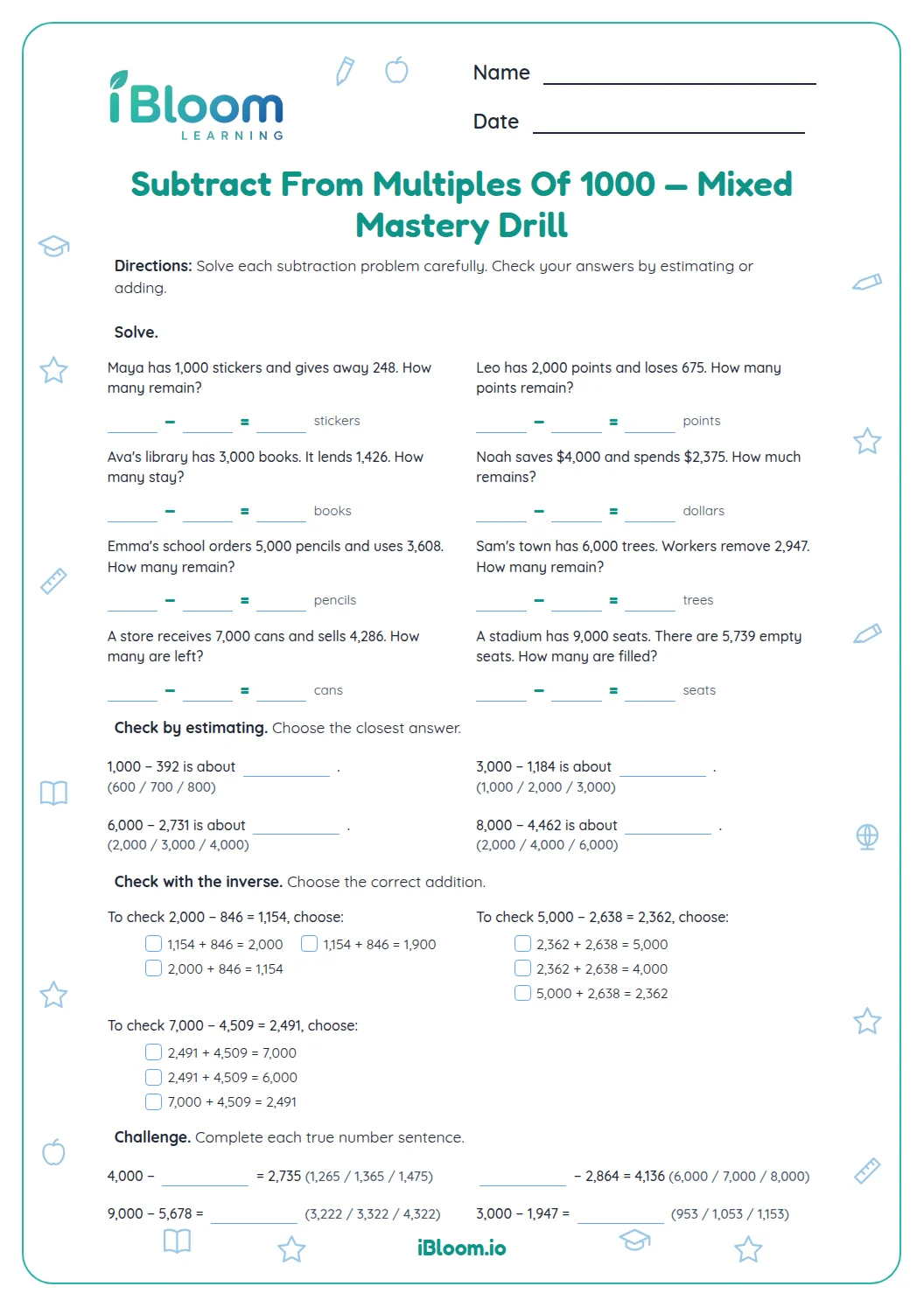
This Grade 4 worksheet focuses on subtracting from exact multiples of 1,000. Students set up each problem in columns, regroup through zero places, and check the difference. The first part uses four- and five-digit numbers; the second part moves to larger thousands. Each item has room for written work, and the separate answer key lists all 16 differences.
Aligned to 4.NBT.B.4
How do you regroup across zeros?
When there are no ones to subtract, regroup one ten. If that place is also zero, continue left until you reach a place with value to trade. Then rename the value across each place on the way back to the ones.
- 11,000 − 286
- 2Regroup 1 thousand as 10 hundreds, then trade 1 hundred for 10 tens and 1 ten for 10 ones.
- 31,000 − 286 = 714
How can you check the difference?
Add the difference to the number subtracted. For 1,000 − 286 = 714, check 714 + 286 = 1,000. If the sum returns to the original multiple of 1,000, the subtraction is consistent.
What changes in the second part?
Part A works with 1,000 through 8,000. Part B uses larger multiples from 10,000 through 90,000. In both parts, align ones, tens, hundreds, and larger place values before regrouping.
How to use this worksheet
- 1Write the larger number above the smaller number.
- 2Align the digits by place value.
- 3Start at the ones place and regroup from the left when needed.
- 4Subtract each column from right to left.
- 5Add the answer to the number subtracted to check.
Mistakes to watch for
The mistake
Borrowing from the thousands place but forgetting to reduce it.
The fix
Cross out the place you trade from and write its new value.
The mistake
Treating a zero as if it can be crossed out without regrouping.
The fix
Trade through each zero place so every column has the correct value.
The mistake
Subtracting the smaller digit from the larger digit in every column.
The fix
Regroup first when the top digit is too small, then subtract in order.
Common Core alignment
The worksheet uses the standard algorithm to subtract multidigit whole numbers.
Fluently subtract multidigit whole numbers using the standard algorithm.
On this sheet: All 16 items subtract multidigit whole numbers with regrouping.
Show the official wordingHide the official wording
Fluently add and subtract multi-digit whole numbers using the standard algorithm.
What to practice next
Make more practice
Further reading
Questions parents and teachers ask
What does regrouping across zeros mean?
It means trading value from a place to the left when a column has too little to subtract, continuing through zero places as needed. In 1,000 − 286, a thousand is renamed as hundreds, then tens, then ones so each column can be subtracted.
Does this worksheet give room for column work?
Yes. Each question includes a working area so students can write the numbers vertically and show regrouping. The printed equation gives the values, while the student aligns the digits by place value in the space provided. Students can check the result with addition and then correct the column where needed.
Which numbers are used?
All 16 minuends are exact multiples of 1,000, from 1,000 to 90,000. The subtrahends require regrouping, including across zero places, and the answer key lists the resulting differences. The answer key gives the difference for every listed problem.
How can students check their answers?
Add the difference to the subtrahend. The sum should equal the starting multiple of 1,000. For example, 714 + 286 returns to 1,000, so it checks the first problem. That check also helps catch a trade that was missed in a zero place.
Why align the digits in columns?
Column alignment keeps ones under ones, tens under tens, and so on. That makes it easier to see which place must be regrouped and helps prevent a digit from being subtracted from the wrong place. The answer key provides a clear way to check the result after the student finishes.