


About this worksheet
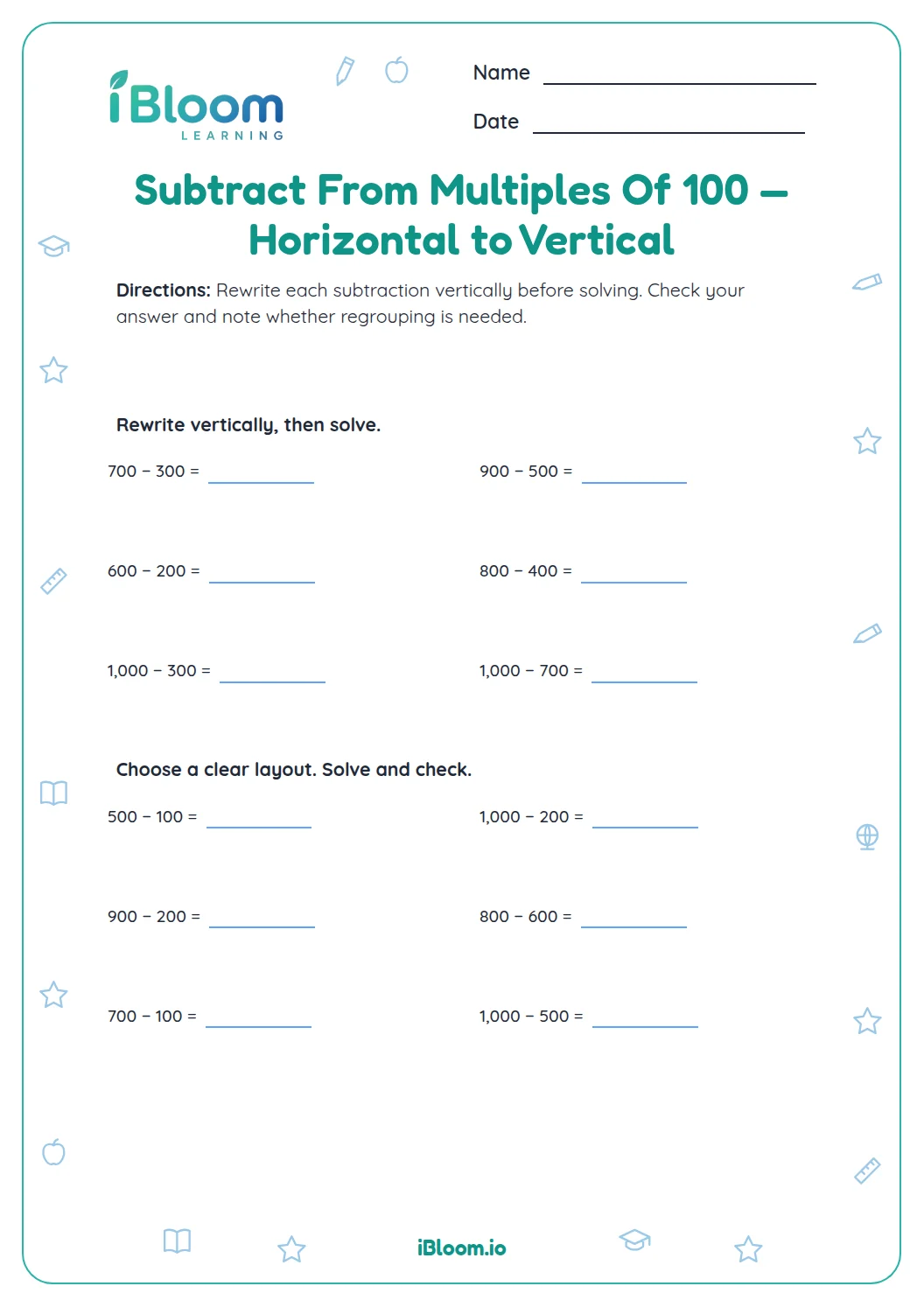
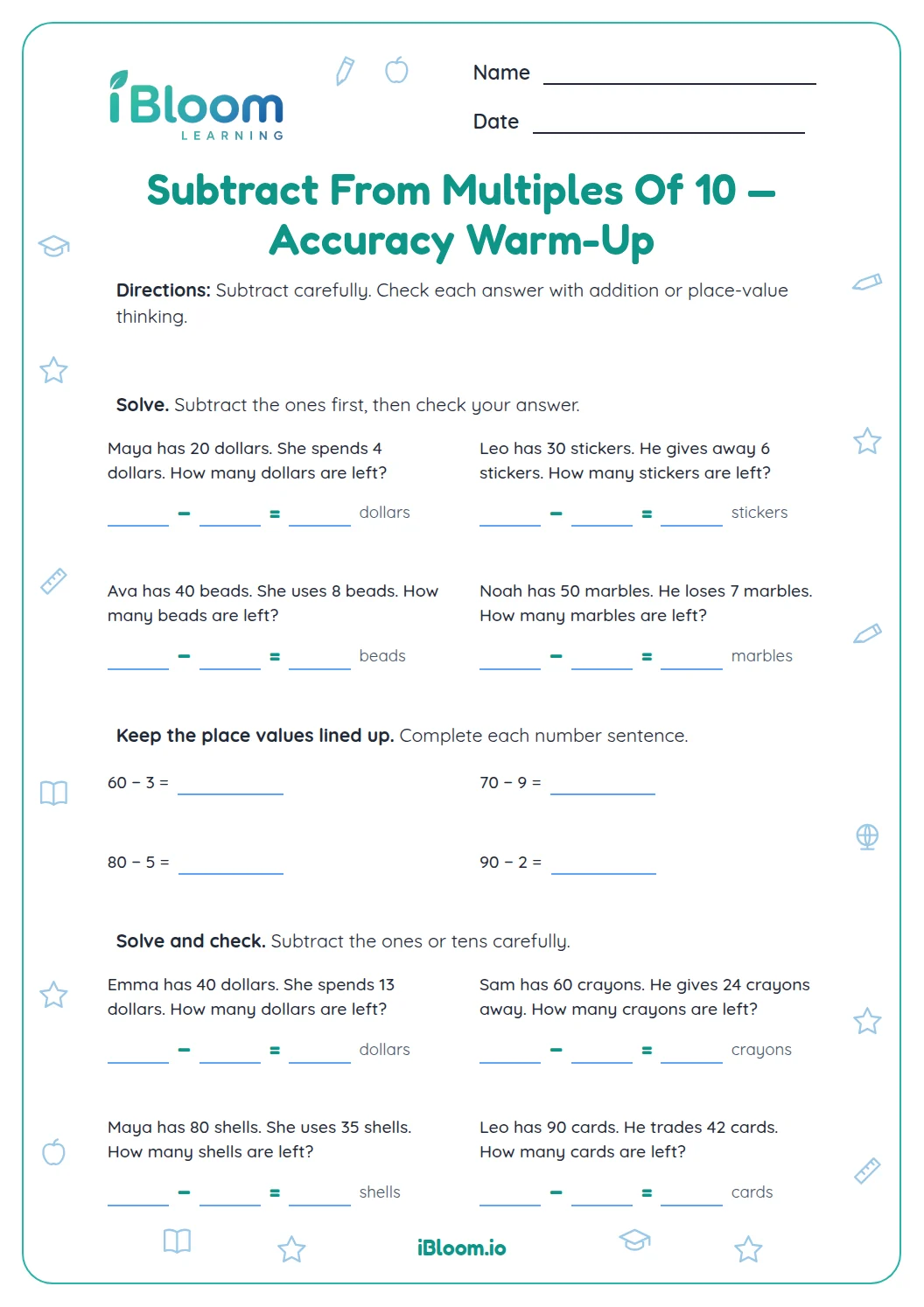
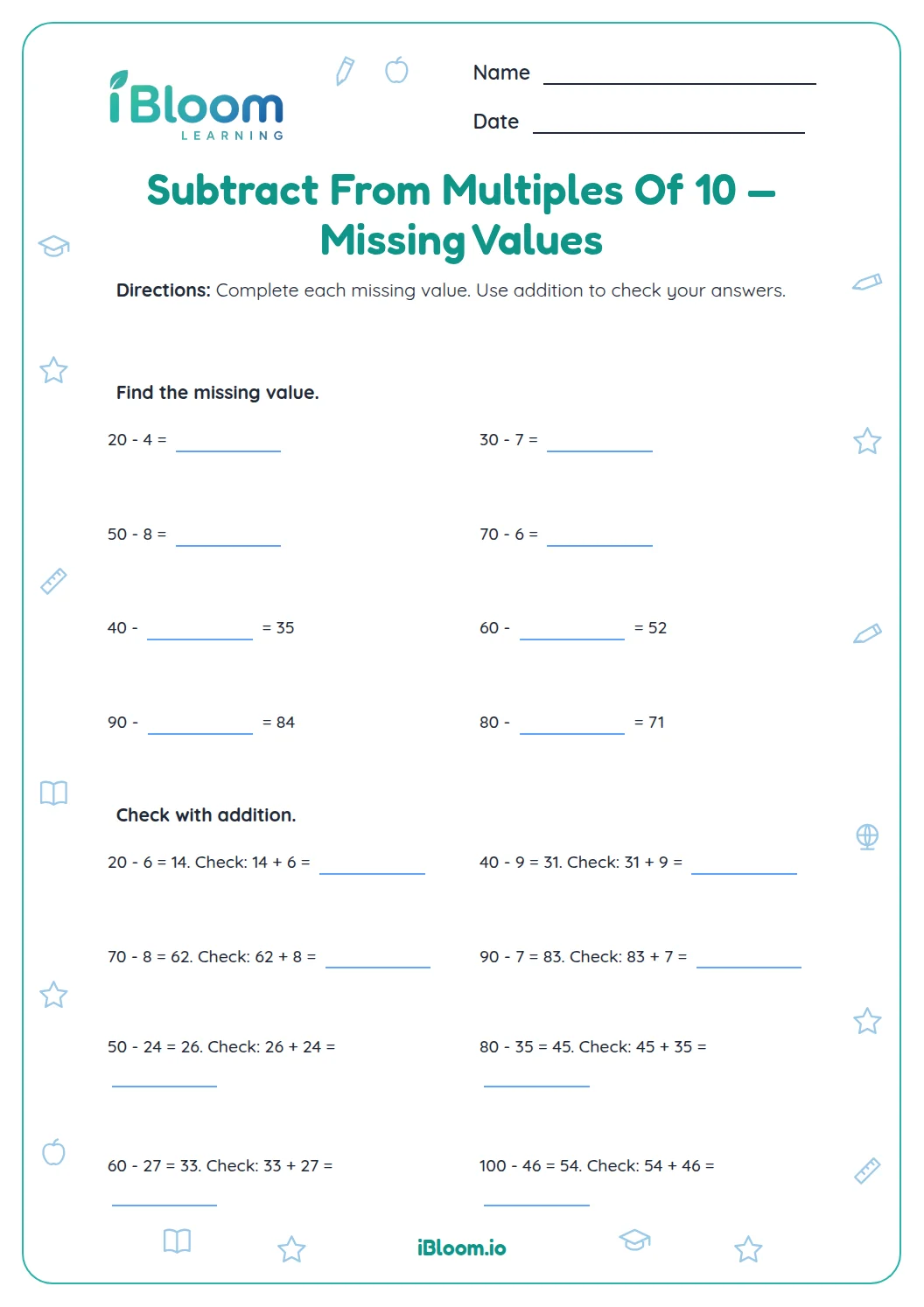
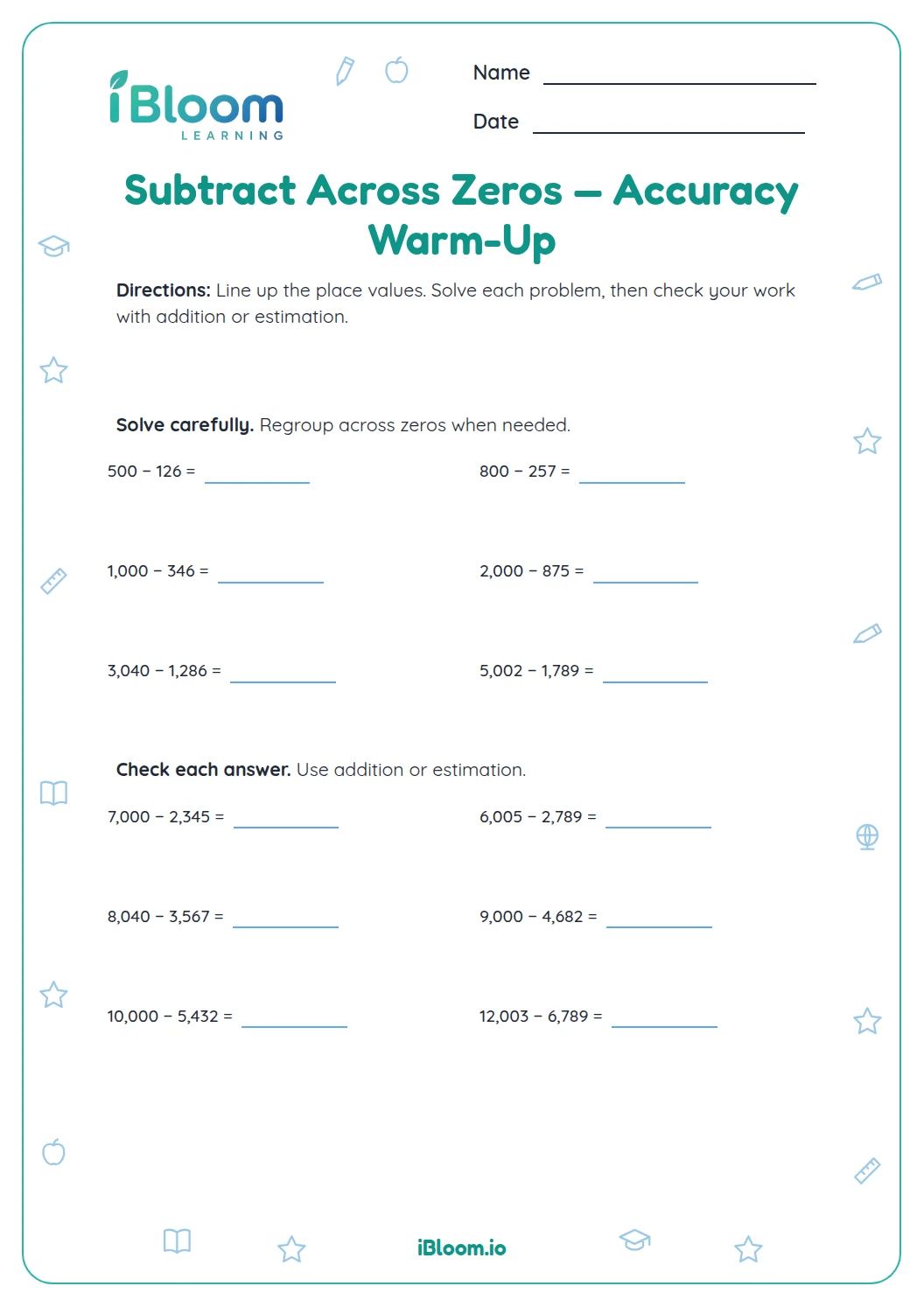
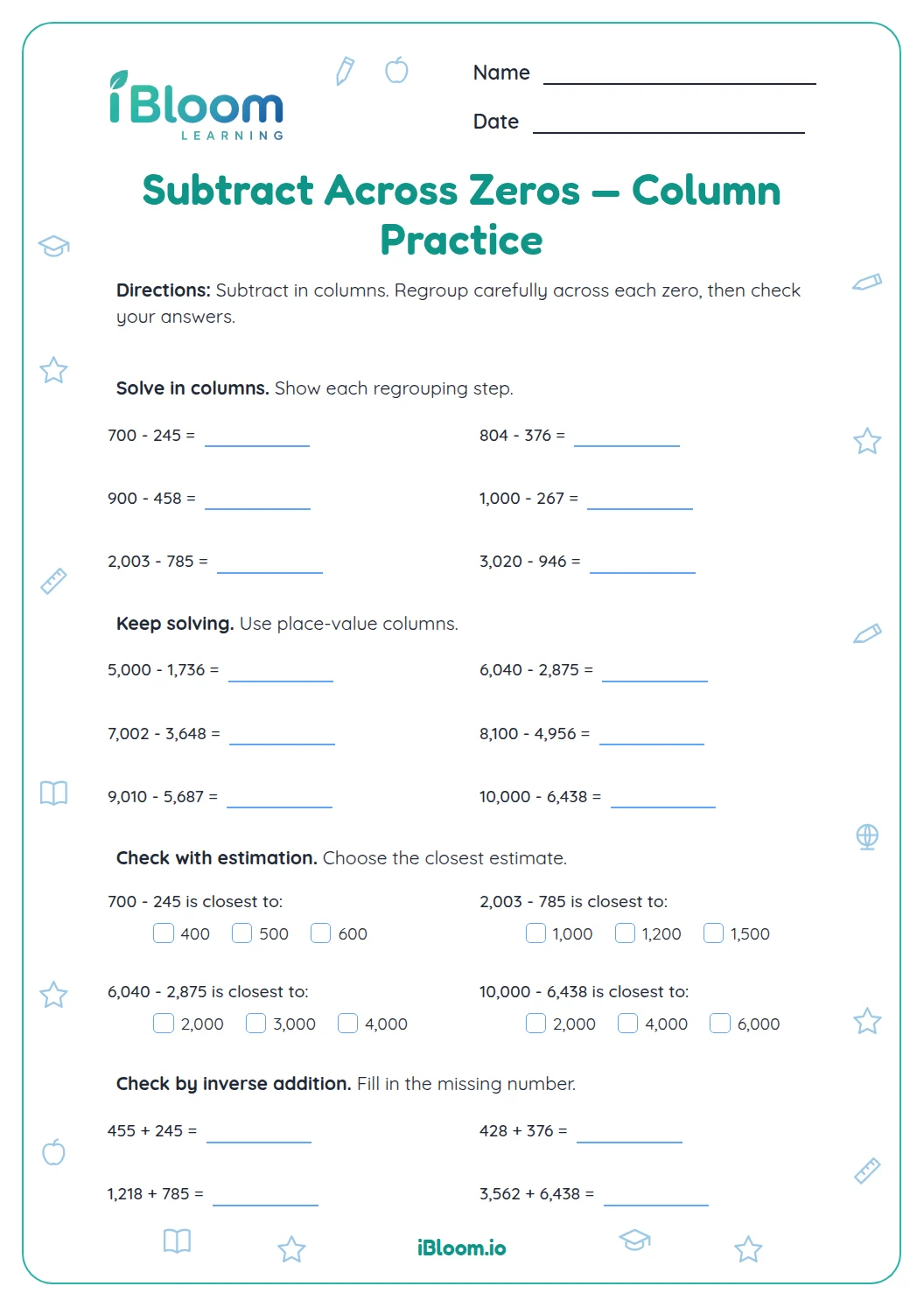
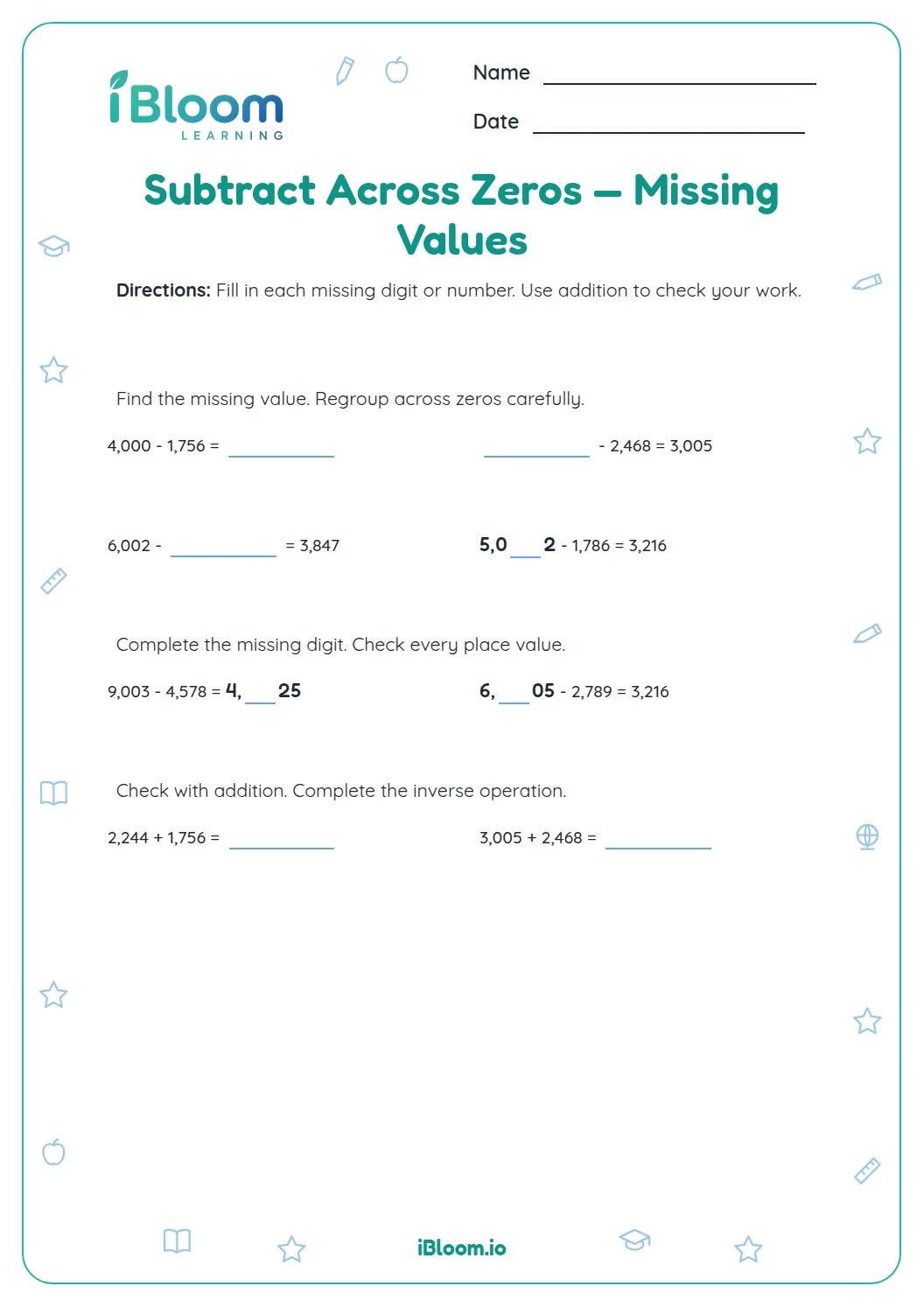
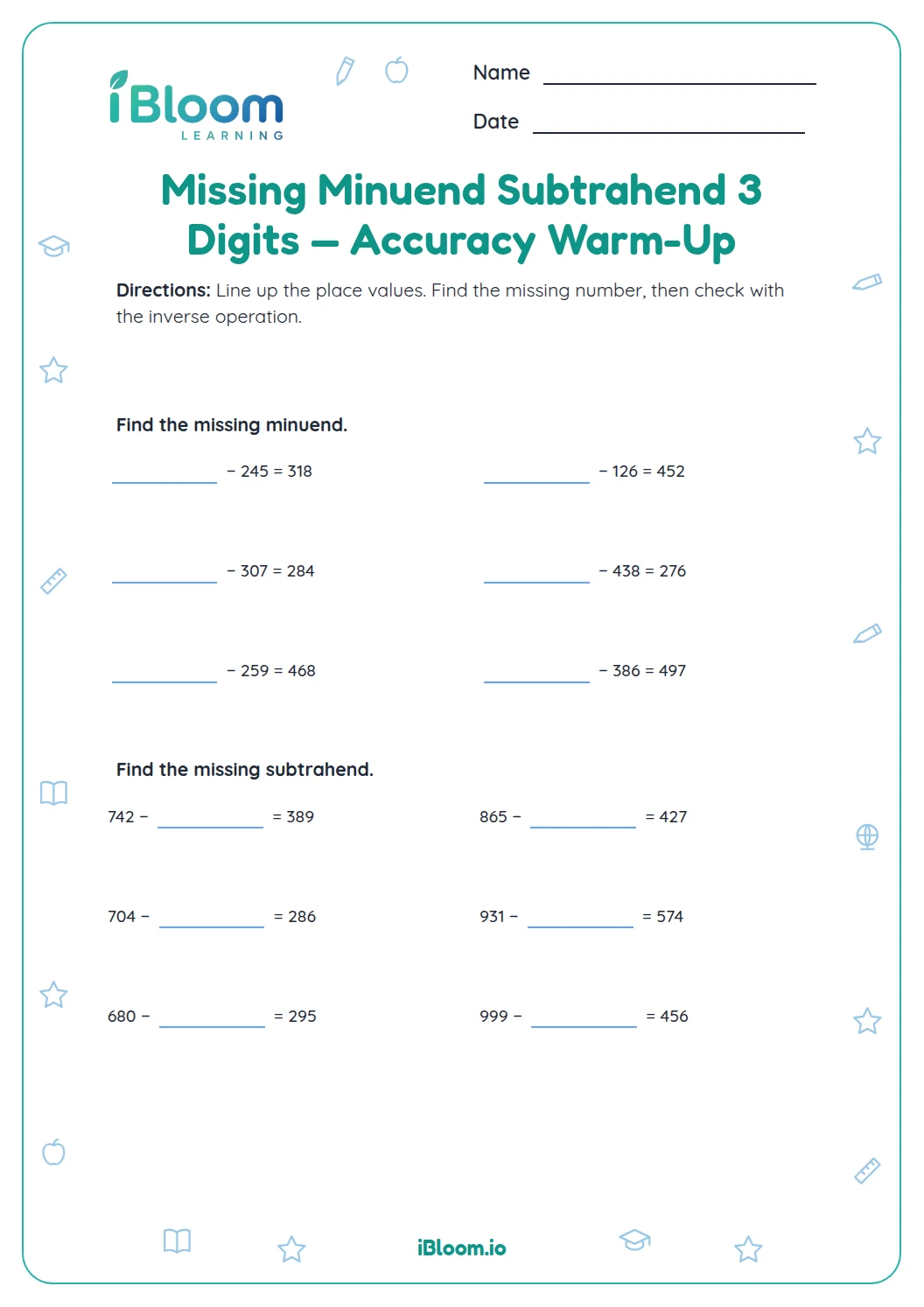
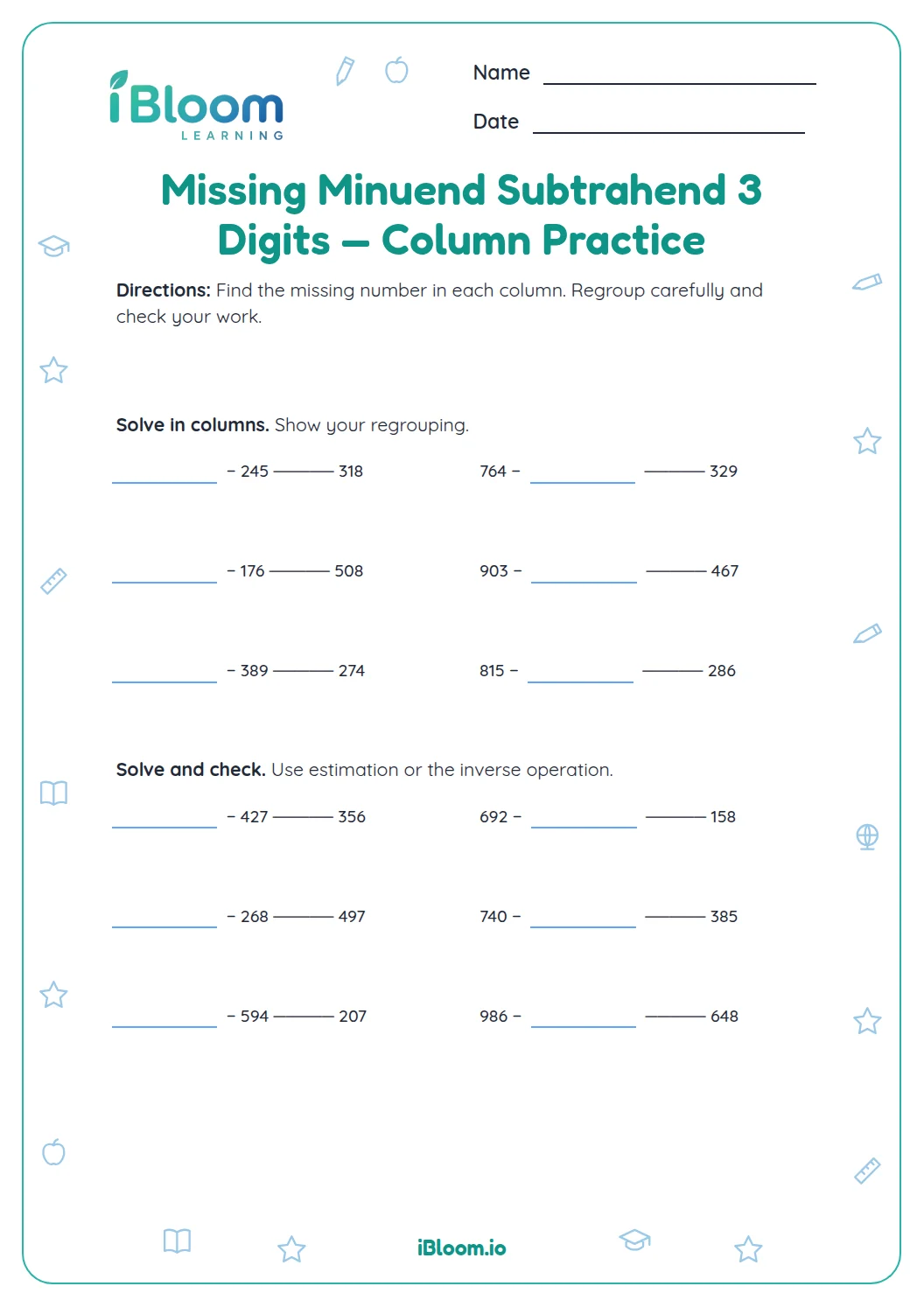
This printable subtraction drill is for Grades 2–4. It has 20 questions in four parts: subtract multiples of 100, find missing addends that check subtraction, choose reasonable differences, and select addition equations that verify a subtraction. The tasks keep the starting amount and place value in view while learners move between solving and checking. The separate answer key gives the correct values and inverse equations. The work practices Common Core 3.NBT.A.2 through subtraction within 1,000.
Aligned to 3.NBT.A.2
How do you subtract hundreds?
Part A gives eight subtraction equations with multiples of 100. Subtract the hundreds and write the difference. For example, 700 − 300 = 400.
How does addition help find a missing number?
Part B uses addition equations to practice the inverse relationship. In question 9, ___ + 300 = 700, the missing addend is 400 because 400 + 300 = 700.
How can an estimate help?
Part C asks which result is closest to a subtraction answer. The choices help children notice place value and reject answers that are far too small or too large.
Which addition proves a subtraction?
Part D gives a subtraction and three possible addition checks. Choose the equation that adds the difference to the amount subtracted to recover the starting number. For 1000 − 400 = 600, the check is 600 + 400 = 1000.
- 11000 − 400 = 600
- 2Add the difference and subtracted amount:
- 3600 + 400 = 1000
- 4The sum matches the starting number.
How to use this worksheet
- 1Solve Part A by subtracting the hundreds.
- 2For each missing addend, use the total and known addend.
- 3In Part C, compare each option with the subtraction estimate.
- 4In Part D, add the difference and the amount subtracted.
- 5Check each response with the answer key.
Mistakes to notice and fix
The mistake
Subtracting the smaller number from the larger without following the equation.
The fix
Keep the numbers in the order shown: starting number minus amount taken away.
The mistake
Choosing an estimate that is ten times too small.
The fix
Check the hundreds place before deciding whether an answer is reasonable.
The mistake
Adding the starting number to the difference for a check.
The fix
Add the difference to the amount subtracted; the sum should be the starting number.
Common Core alignment
Subtract within 1,000 and use addition to check missing values.
On this sheet: All 20 questions subtract from multiples of 100 within 1,000.
Show the official wordingHide the official wording
Fluently add and subtract within 1000 using strategies and algorithms based on place value, properties of operations, and/or the relationship between addition and subtraction.
What to practice next
Make more practice
Further reading
Questions parents and teachers ask
What does “missing addend” mean here?
A missing addend is the number that completes an addition equation. In ___ + 300 = 700, 400 is missing because 400 plus 300 equals 700. The addition equations reinforce how a difference and the amount subtracted relate to the starting number.
Why does the worksheet include addition?
Addition checks a subtraction answer. If 700 − 300 = 400, add 400 and 300; the sum is 700, the starting number. Part B and Part D use this relationship in different ways. For example, 400 + 300 = 700 confirms 700 − 300 = 400.
How should children choose a reasonable difference?
Estimate using the hundreds first, then compare the choices. For 600 − 200, the result is 400. A choice such as 40 is too small because the numbers are in the hundreds. For instance, 600 − 200 equals 400, so cross out 40 and 800.
Are all the questions subtraction equations?
The page begins with subtraction, then uses addition to find missing addends and to check differences. The final parts ask learners to estimate or select the addition equation that proves a subtraction. For 700 − 300 = 400, adding 400 and 300 returns to 700.
What is in the answer key?
The answer key gives each difference, missing addend, estimate choice, and correct inverse equation. Children can use it after finishing a part to check their work and revisit any place-value mistake. For example, 400 − 100 = 300 is checked by 300 + 100 = 400.