

About this worksheet
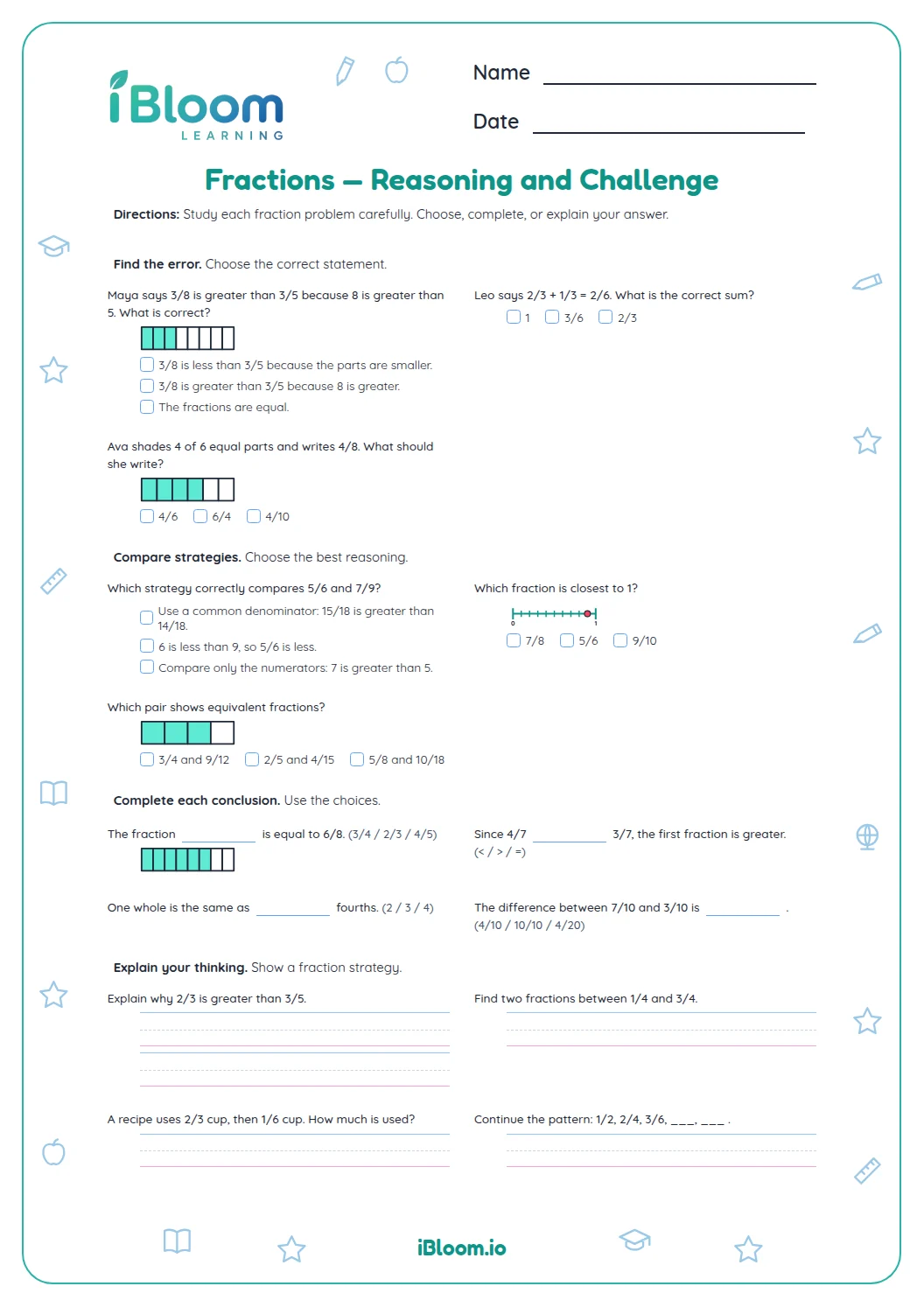
This printable presents 14 fraction problems in everyday settings, including pizza, a liter jug, ribbon, crackers, and equal sharing. Students identify fractions of a whole, add or subtract like-denominator fractions, compare fractions, and solve measurement questions. The Grade 4 practice supports CCSS 4.NF.B.3.d. A separate answer key includes units where the questions ask for measured amounts.
Aligned to 4.NF.B.3.d
How do fractions describe equal parts?
A fraction names equal parts of one whole. The story tells you what the whole is: a pizza, a liter, a length, or a set of items.
- 1Three of 8 equal pizza slices are eaten, so 3/8 of the pizza is eaten.
When do you add or subtract fractions?
When the denominators match, the pieces are the same size. Add or subtract the numerators and keep the denominator; then include the unit named in the question.
- 1A 1 L jug loses 1/4 L, so 3/4 L remains.
Name the whole and the equal parts.
- 1Decide what the question asks you to find.
- 2Write a fraction and include a unit if the story gives one.
Check these common slips
The mistake
Changing the whole partway through a problem.
The fix
The mistake
Adding denominators when combining fractions with the same-size parts.
The fix
The mistake
Forgetting to name the unit when the answer is a measured amount.
The fix
Common Core alignment
Students interpret fractions as equal parts and use them to solve measurement and sharing situations.
Solve word problems with like-denominator fractions.
On this sheet: Students solve fraction stories about amounts taken, combined, or remaining.
Show the official wordingHide the official wording
Solve word problems involving addition and subtraction of fractions referring to the same whole and having like denominators, e.g., by using visual fraction models and equations to represent the problem.
What to practice next
Make more practice
Further reading
Questions parents and teachers ask
Which grade level is this worksheet written for?
The page is presented at Grade 4 level and includes denominators 3, 4, 5, 6, 8, 10, and 12. Students find parts of wholes, work with like denominators, compare fractions with like denominators, and solve sharing and measurement situations.
Do answers need units?
Include a unit when the question asks for a measured amount, such as liters, cups, miles, yards, or pounds. For example, the jug answer is 3/4 L. When the question asks only for a fraction of a group or whole, write the fraction without adding a measurement unit.
What should students identify first?
First identify the whole and the equal parts named in the story. Then decide whether the question asks for a part, a comparison, a combined amount, or what remains. This helps students choose the operation before writing the answer. This gives another chance to name the whole before calculating.
Can equivalent fractions be used?
Yes. Equivalent fractions describe the same amount. When a story divides something into sixths, an answer such as 3/6 represents the same amount as 1/2, though the key keeps the denominator used in the problem. Keeping the original denominator can also show how many equal parts were used.