

About this worksheet
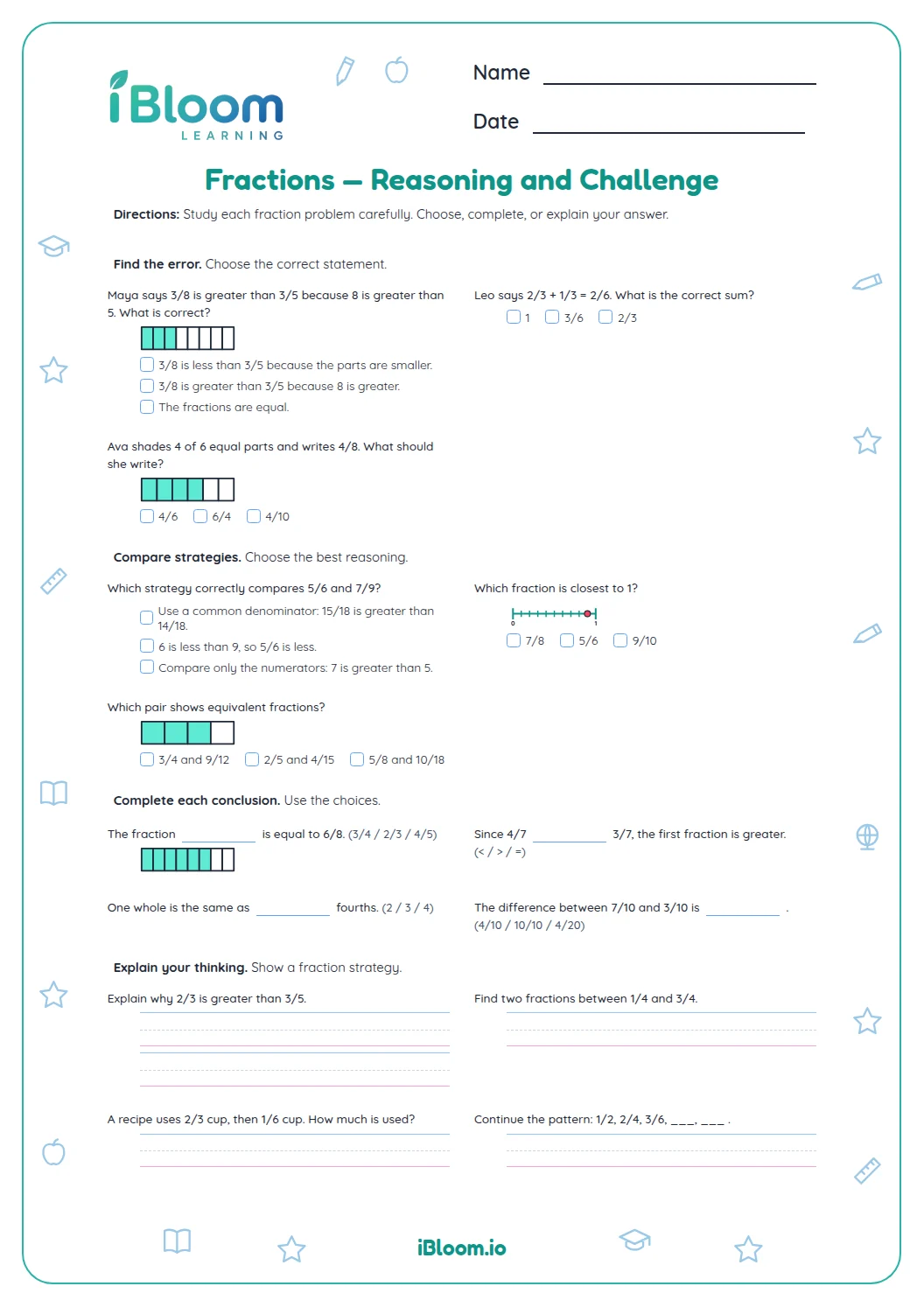
This Grade 3 printable builds fraction understanding in steps. Students read six shaded bars, complete four equivalent-fraction sentences, locate two fractions on number lines, compare fractions with equal denominators, and solve an equal-parts sharing question. The bars show parts of one whole, while the number lines connect a fraction to a distance from zero. A separate answer key is included.
Aligned to 3.NF.A.1
How does a fraction describe a model?
The denominator counts the equal parts in one whole; the numerator counts how many parts are named. Question 1 shows one of two equal parts shaded, so the fraction is 1/2. Question 3 locates a fraction with equal jumps from zero.
- 1Equal parts: 4
- 2Shaded parts: 3
- 3Fraction: 3/4
How can two fractions name the same amount?
Equivalent fractions have the same value with different-sized parts. If each half is split into two smaller equal parts, 1/2 becomes 2/4.
What does a point on a fraction number line mean?
Count the equal jumps from 0. Each jump has the size named by the denominator; the point marks the total number of jumps. On question 11, five jumps of size 1/8 reach 5/8.
How to use this worksheet
- 1Check that model parts are equal.
- 2Count all parts for the denominator.
- 3Count shaded parts for the numerator.
- 4On a number line, count equal jumps from 0 to the point.
- 5Compare the values and explain which is greater or less.
Common mistakes and quick fixes
The mistake
Reversing numerator and denominator.
The fix
Say shaded parts over total equal parts.
The mistake
Thinking more pieces always means a larger amount.
The fix
Compare the size of each piece too.
The mistake
Changing only the numerator.
The fix
Change numerator and denominator by the same factor.
Common Core alignment
This worksheet uses equal-part models to build fraction meaning.
Students describe a fraction as equal parts of one whole.
On this sheet: The six fraction bars ask students to count equal parts and name the shaded amount.
Show the official wordingHide the official wording
Understand a fraction 1/b as the quantity formed by 1 part when a whole is partitioned into b equal parts; understand a fraction a/b as the quantity formed by a parts of size 1/b.
What to practice next
Make more practice
Further reading
Questions parents and teachers ask
What does the denominator tell us?
The denominator names how many equal parts make one whole. The numerator counts how many of those parts are being described. In question 3, the bar has four equal parts and three are shaded, so the fraction is 3/4.
How can equivalent fractions be made?
Multiply the numerator and denominator by the same number. For example, multiplying 1 and 2 by 2 gives 2/4. The amount stays the same because each half is divided into two smaller equal parts. The worksheet uses this pattern in four missing-numerator questions.
How do the number line questions work?
The worksheet has one number-line question. Start at zero and count equal jumps to the marked point. The step size tells the denominator and the number of jumps tells the numerator. In question 3, three jumps of 1/4 reach 3/4.
How do you compare fractions with the same denominator?
When denominators match, the pieces are the same size. Compare numerators to see which fraction has more pieces. In question 11, 5/8 is greater than 3/8 because five eighth-size pieces are more than three. Question 12 compares 4/6 and 3/6.
What is the answer to the sandwich question?
The sandwich begins as one whole divided into four equal parts. If Mia eats one part, three of the four parts remain, so the answer is 3/4. The whole stays the same size; only the number of parts left changes.
Does the worksheet include an answer key?
Yes. The separate key gives the fractions shown by the bars and number lines, the missing numerators, and answers to the comparison and application questions. Equivalent fraction answers may also be written in a different form when they name the same value.