

About this worksheet
The original prompt had only one fraction fact. This replacement gives learners repeated practice reading shaded parts, locating fractions, building equivalent fractions, and connecting tenths and hundredths to decimals. The selected Grade 4 level keeps denominators and decimal precision within the skill guidance.
Aligned to 4.NF.A.1 and 4.NF.C.6
What this worksheet practices
The original prompt had only one fraction fact. This replacement gives learners repeated practice reading shaded parts, locating fractions, building equivalent fractions, and connecting tenths and hundredths to decimals. The selected Grade 4 level keeps denominators and decimal precision within the skill guidance.
How to use the practice
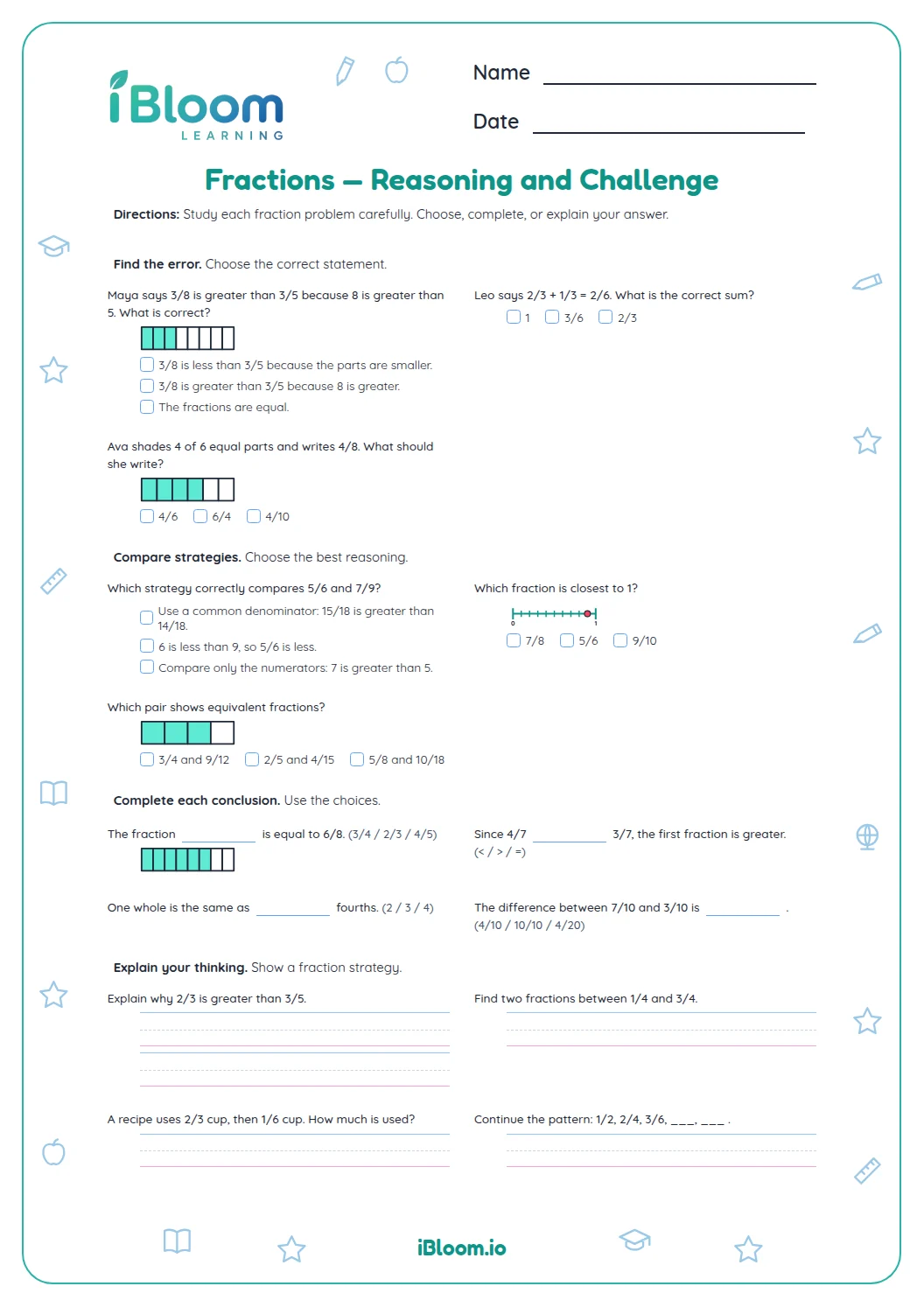
The practice is organized into 2 parts, with 14 questions and a separate answer key.
Common Core alignment
This worksheet practices the grade-level skill named in the page title.
Explain and generate equivalent fractions using visual models.
On this sheet: Questions build and recognize equivalent fractions with shaded models and equal-sized parts.
Show the official wordingHide the official wording
Explain why a fraction a/b is equivalent to a fraction (n × a)/(n × b) by using visual fraction models, with attention to how the number and size of the parts differ even though the two fractions themselves are the same size. Use this principle to recognize and generate equivalent fractions.
Write tenths and hundredths with decimal notation.
On this sheet: Tenths and hundredths questions connect fraction amounts to decimal notation.
Show the official wordingHide the official wording
Use decimal notation for fractions with denominators 10 or 100.
What to practice next
Make more practice
Further reading
Questions parents and teachers ask
What makes the parts in a fraction model fair?
The whole must be divided into equal-sized parts. If parts have different sizes, counting one shaded part as one equal share would not represent a fraction accurately. Check that each section of a bar, circle, or square is the same size.
How can I find a fraction equivalent to another fraction?
Multiply or divide the numerator and denominator by the same nonzero number. For example, multiply both 1 and 2 by 4 to write 1/2 as 4/8. The number of parts changes, but the amount of the whole stays equal.
How do tenths connect to decimal notation?
Tenths are the first place to the right of the decimal point. Four shaded parts out of ten equal parts is 4/10, which is written as 0.4. Hundredths use the second place and can be shown on a 10 by 10 grid.
What can a number line show about a fraction?
A number line shows a fraction as a distance from zero. Divide the interval between whole numbers into equal jumps, then count to the marked point. The denominator tells how many equal jumps make one whole, and the numerator tells how many jumps to count.