
About this worksheet
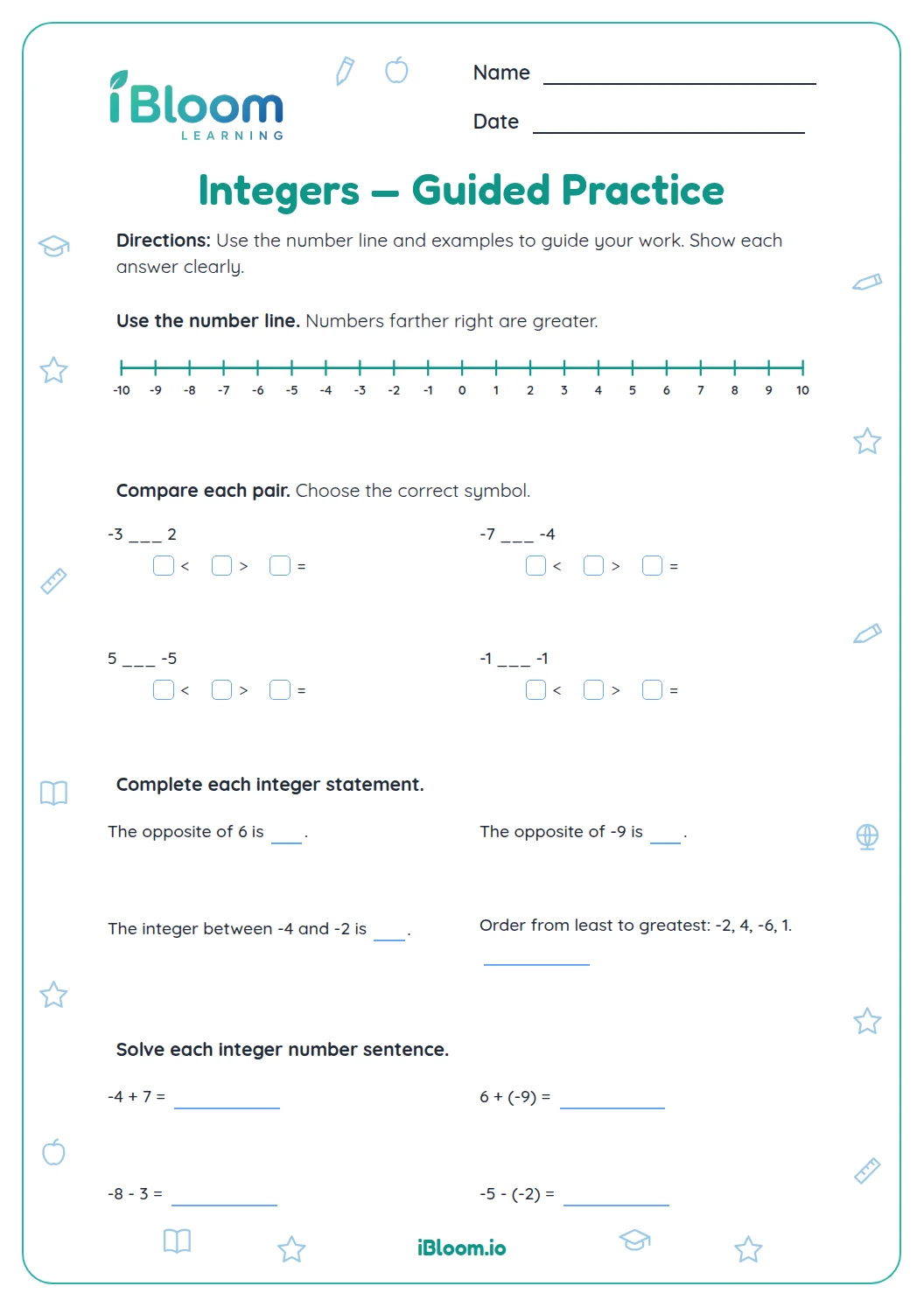
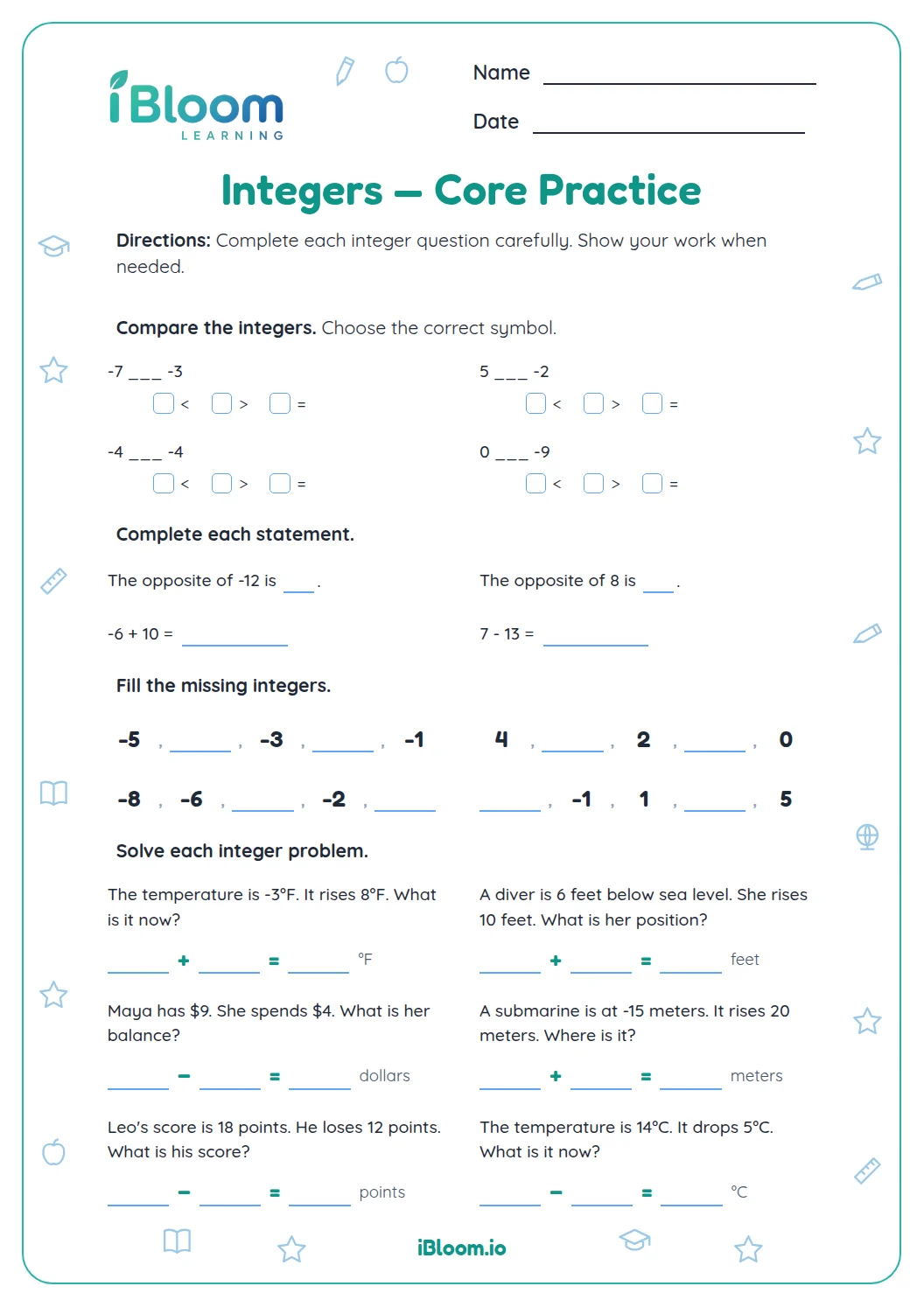
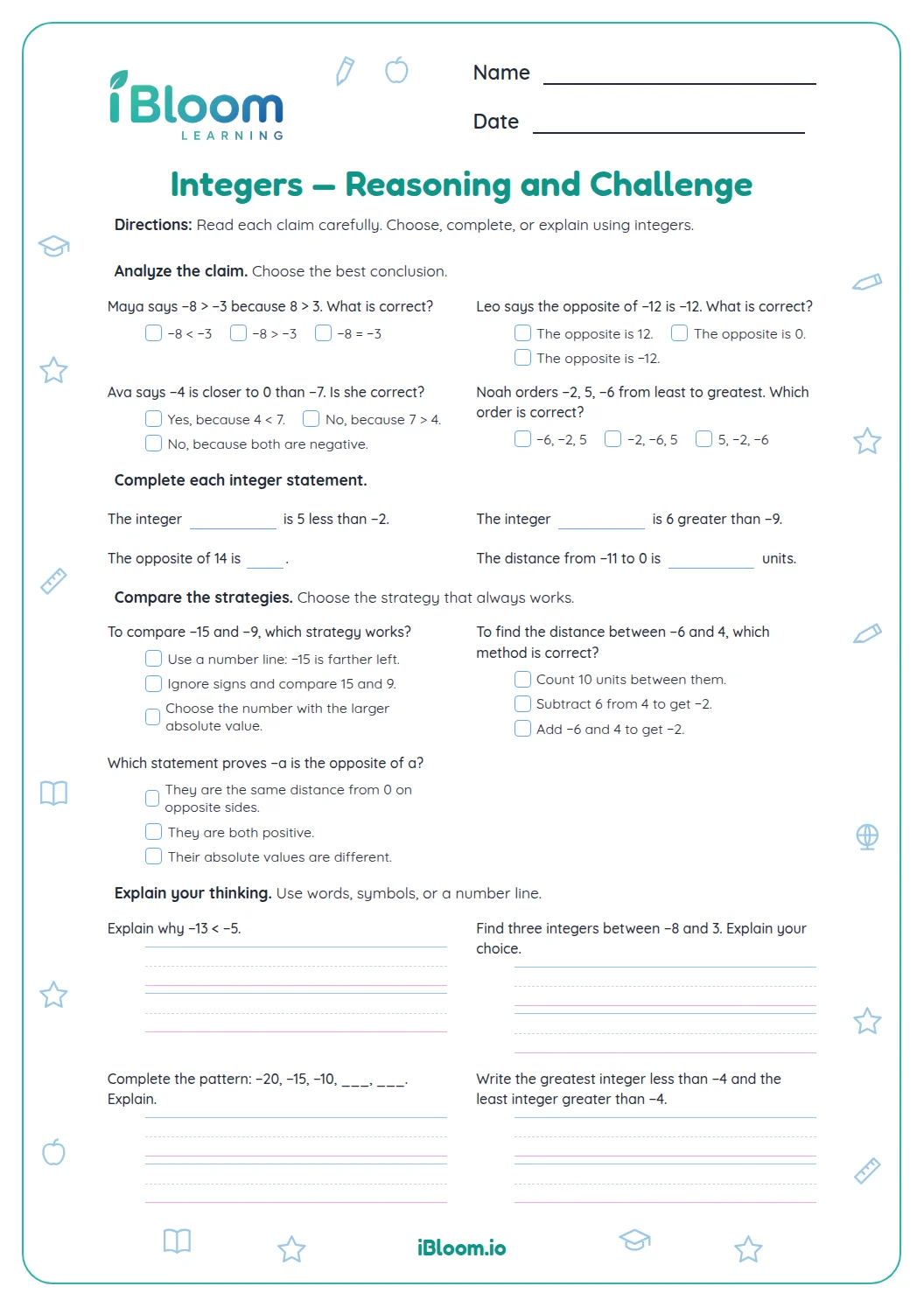
This Grade 6 worksheet practices interpreting and using integers in real situations. Students model elevations, a submarine’s position, a bank balance, temperature changes, scores, and withdrawals with positive and negative numbers. They compare signed values, calculate sums and differences, and explain what a negative value or a change means. The answer key includes the equations for each situation and short model explanations.
How to use this worksheet
- 1Mark whether each starting value is above or below zero.
- 2Choose addition for a rise or deposit and subtraction for a descent or loss.
- 3Write a signed integer equation before solving each story problem.
- 4When comparing negatives, think about which value is farther right on a number line.
- 5Attach the unit to every real-world answer.
Common mistakes and quick fixes
The mistake
A negative value is not always smaller in distance from zero.
The fix
Compare its position on the number line.
The mistake
Subtracting a negative changes the direction.
The fix
−3 − (−10) = 7.
The mistake
A deposit increases a balance, even if the starting balance is negative.
The fix
What to practice next
Make more practice
Further reading
Questions parents and teachers ask
What does a negative integer mean in these problems?
Its meaning depends on the context. A negative elevation is below sea level, a negative temperature is below zero, and a negative bank balance is money owed or a deficit. The worksheet asks students to connect the sign to the situation rather than treat it as decoration.
How do I compare two negative numbers?
On a number line, the number farther to the right is greater. For example, −3°F is warmer than −9°F because −3 is to the right of −9 and is closer to zero. Use the value, not just the size of the digits.
Why does a submarine rising use addition?
Rising moves the submarine’s position upward toward and then above sea level. Starting at −19 meters and rising 32 meters is −19 + 32, which equals 13 meters. A positive result means the submarine ends above sea level.
Does a deposit always make a bank balance positive?
No. A deposit adds to the balance, but it may not be enough to bring a negative balance above zero. In question 3, adding $30 to −$12 gives $18, which is positive; a smaller deposit could leave a negative balance.
What should the answer include?
For the story problems, show an integer equation and state the final value with its unit, such as 8 feet or 3°F. For explanation questions, describe what the sign or change means in the context. The key gives sample wording, and equivalent clear explanations work.