




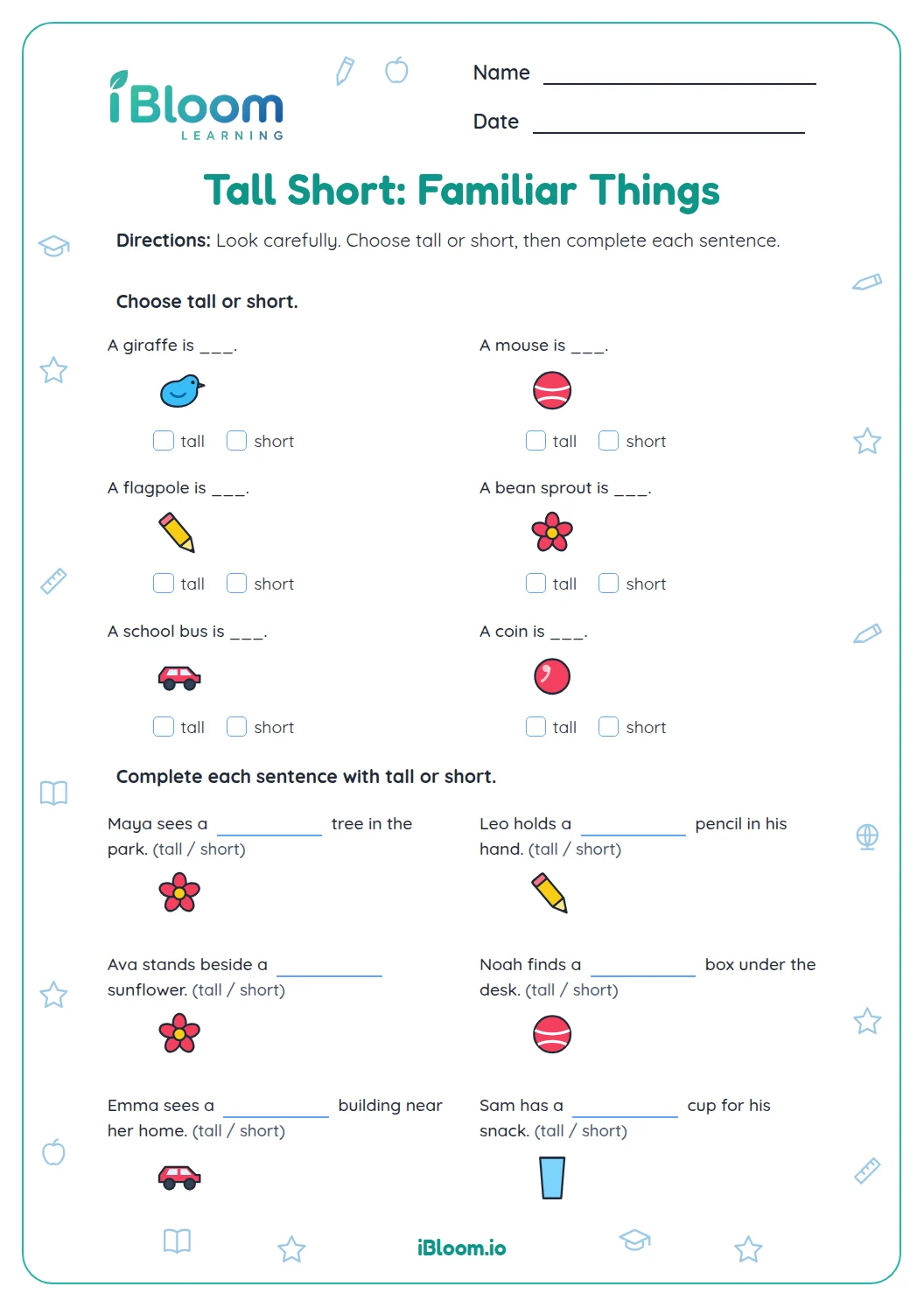
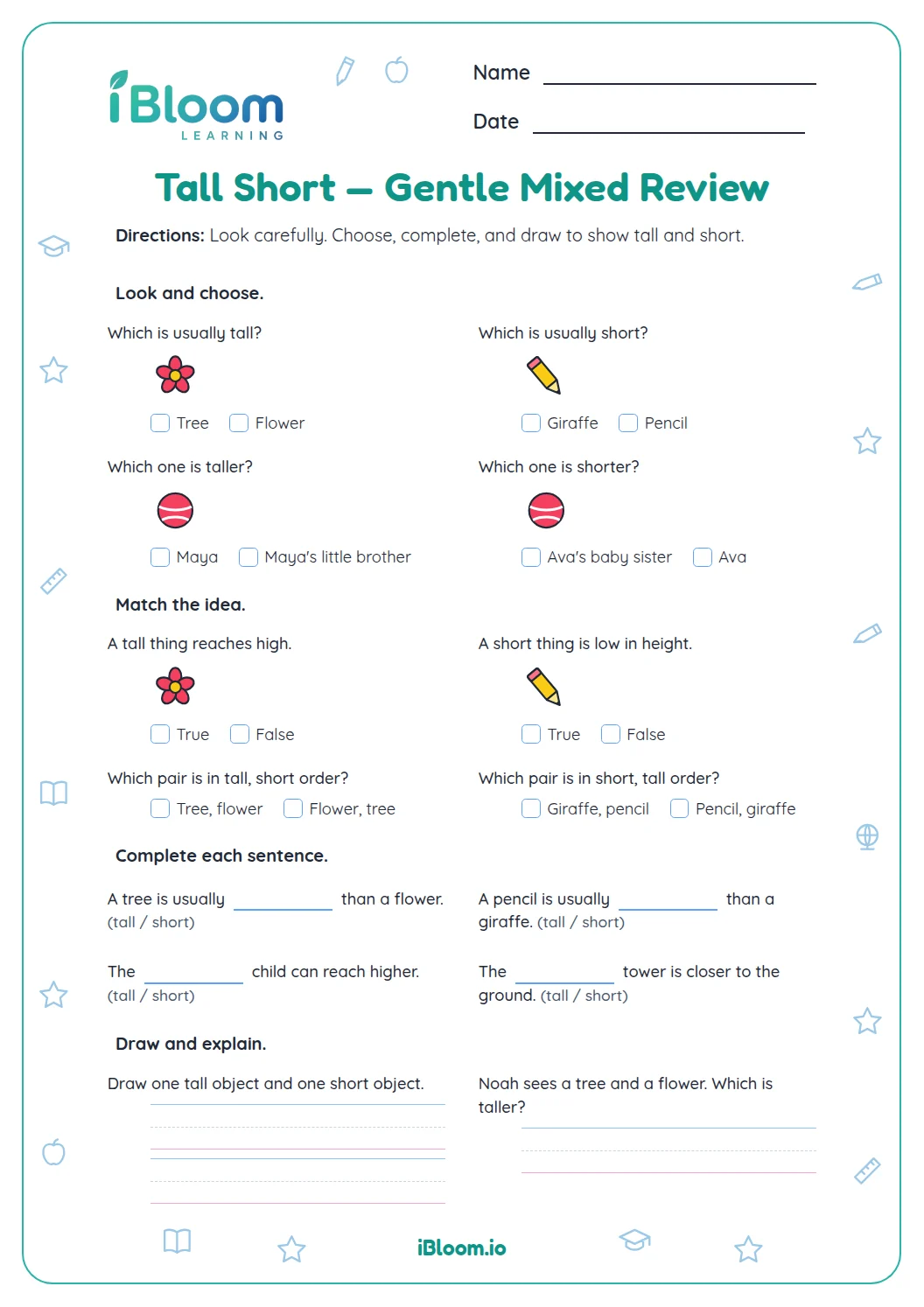
About this worksheet
This free printable long-and-short worksheet is for preschool and kindergarten children working with an adult. Ten picture questions ask children to compare the colored and white portions of a strip and choose longer or shorter. Four drawing tasks then ask for a line or pencil longer or shorter than a printed strip. Children can compare by eye and point to the endpoints while the adult reads the directions. The activity practices Common Core K.MD.A.2 by directly comparing lengths and describing the difference. The answer key includes choice answers and simple criteria for the drawings.
Aligned to K.MD.A.2
Which part of the strip is longer?
Treat each colored region as one continuous length and each white region as another. Point along the bottom edge of each region. The longer part extends farther from its own starting point. Children can compare the lengths without naming the small equal sections.
In question 1, the colored portion is short and the white portion is long. Read the choices aloud and let the child point before marking an answer.
- 1Question 1: The colored part is...
- 2The colored part takes up less of the strip.
- 3The white part takes up more of the strip.
- 4Answer: shorter.
How should children use the drawing boxes?
Each drawing question has a reference strip above its prompt. Questions 11 and 12 ask for a longer line and a shorter line. Questions 13 and 14 ask for a longer pencil and a shorter pencil. Compare the length from one end of the drawing to the other.
An adult can use a scrap of paper to transfer the strip’s length next to the child’s line. Match the left endpoints, then compare the right endpoints. This keeps the decision about length rather than position.
What can an adult say during the activity?
Read “The colored part is...” and pause while the child looks. Later questions ask about the white part, so point to that region before reading the same choices.
Use longer and shorter together: “This part is longer, so the other part is shorter.” For the drawing tasks, let the child check and adjust the line before moving on.
How to use this worksheet
- 1Read the directions aloud and point out the colored and white portions.
- 2Compare question 1 together by tracing each portion from end to end with a finger.
- 3Let the child choose longer or shorter for all ten picture questions.
- 4Read each drawing prompt and have the child draw a line or pencil in its box.
- 5Align a paper strip with the drawing to check the requested comparison.
Mistakes to notice and how to help
The mistake
Comparing where a part sits instead of its length.
The fix
Match starting points with paper strips and compare the other endpoints.
The mistake
Always choosing the colored part as longer.
The fix
Look at the amount of space each region covers; the colored part changes length.
The mistake
Making a line the same length when the task asks for shorter.
The fix
Erase a little from one end, then compare again and say “shorter.”
Common Core alignment
Compare pictured lengths and describe a drawn line as longer or shorter.
On this sheet: Children compare the colored and white lengths, then create and check longer or shorter lines.
Show the official wordingHide the official wording
Directly compare two objects with a measurable attribute in common, to see which object has “more of”/”less of” the attribute, and describe the difference. For example, directly compare the heights of two children and describe one child as taller/shorter .
What to practice next
Make more practice
Further reading
Questions parents and teachers ask
Does my child need to read longer and shorter?
No, an adult can read the two choices and the prompt aloud. Let the child point to the colored or white portion first, then choose the word that describes its length. Keep the focus on comparing the lengths and saying the comparison, with reading supported as needed.
Should we count the little sections in each strip?
Counting is optional because the task asks for a length comparison. Children can look at how far each region extends or use paper strips to compare them. The equal sections can help an adult explain the difference, but the child’s answer is longer or shorter, not a number.
How do I check the four drawings?
Compare each drawing with its printed reference strip. Questions 11 and 13 need a longer line or pencil; questions 12 and 14 need a shorter one. Accept different lengths when the requested difference is clear, and compare the two endpoints rather than the drawing’s position.
Can we use a ruler to measure the strips?
You can use a ruler as a straightedge, but measuring in inches or centimeters is unnecessary here. The task is to decide which length is greater. A paper strip marked at the reference endpoints gives children a simple way to align the starts and compare the ends.
What does the answer key show?
The key identifies the correct word for each of the ten picture questions and describes acceptable work for the four drawings. Drawings can vary. Check whether each line or pencil is longer or shorter than its reference, and invite the child to explain that relationship by pointing to the endpoints.