







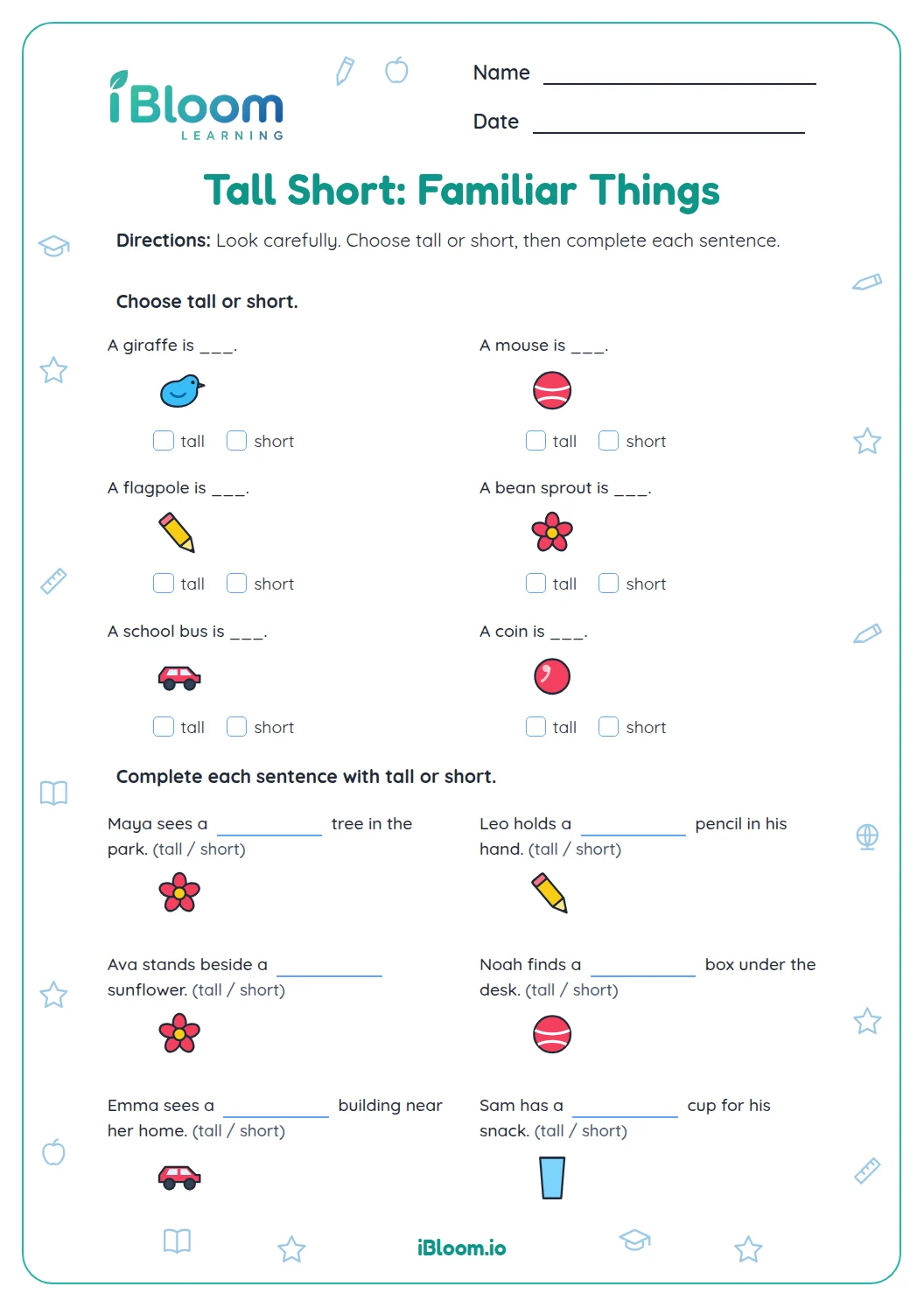
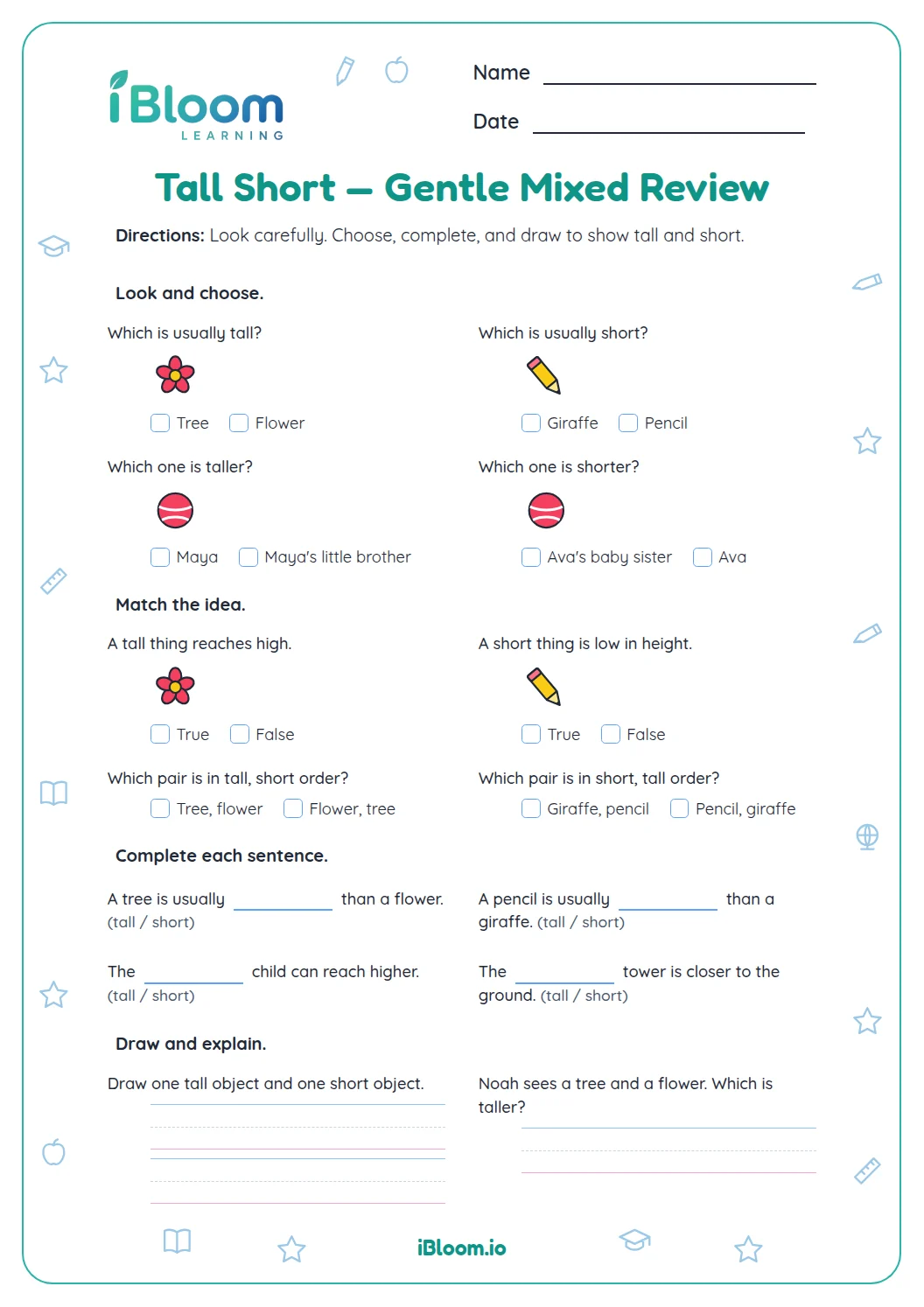
About this worksheet
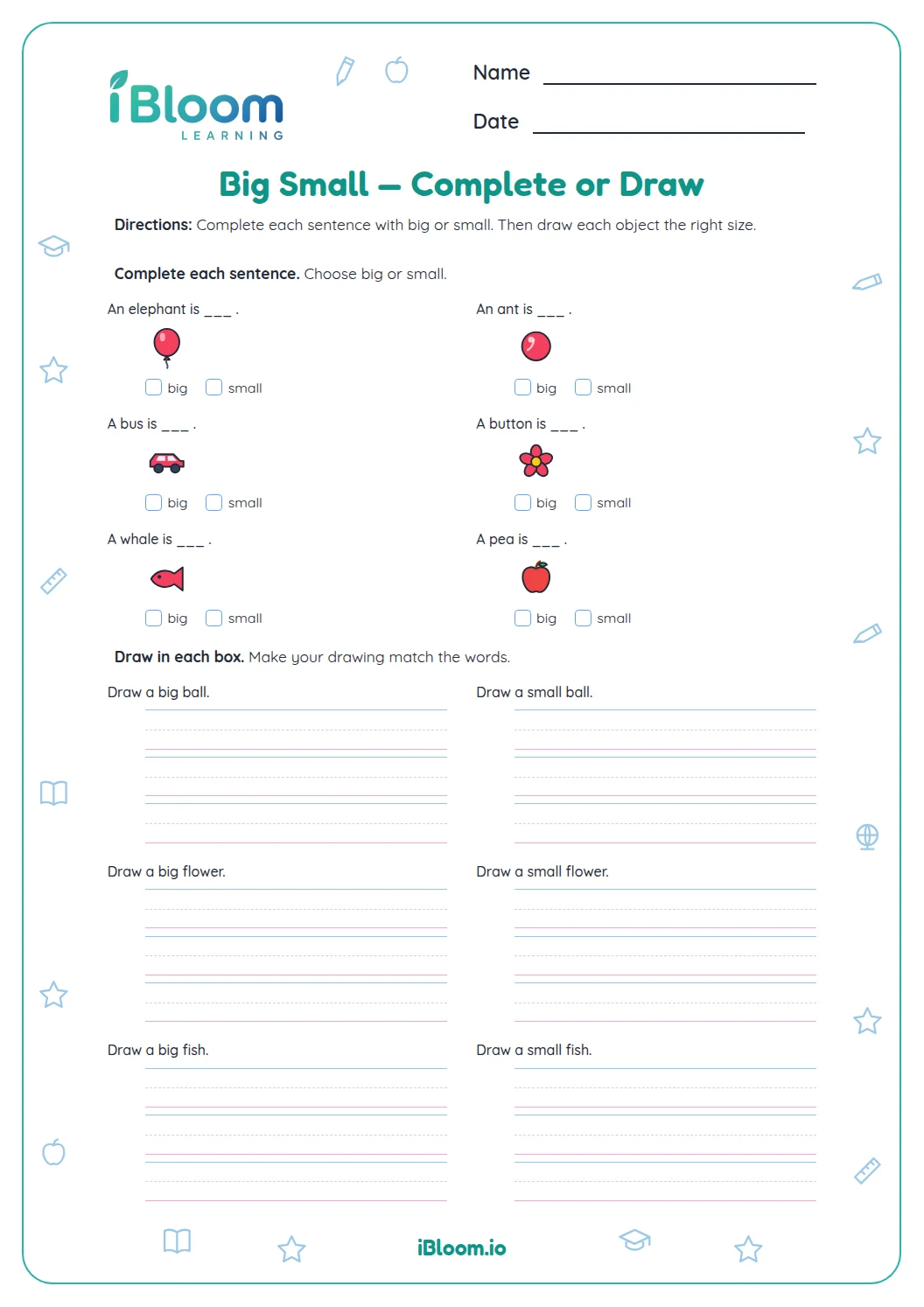
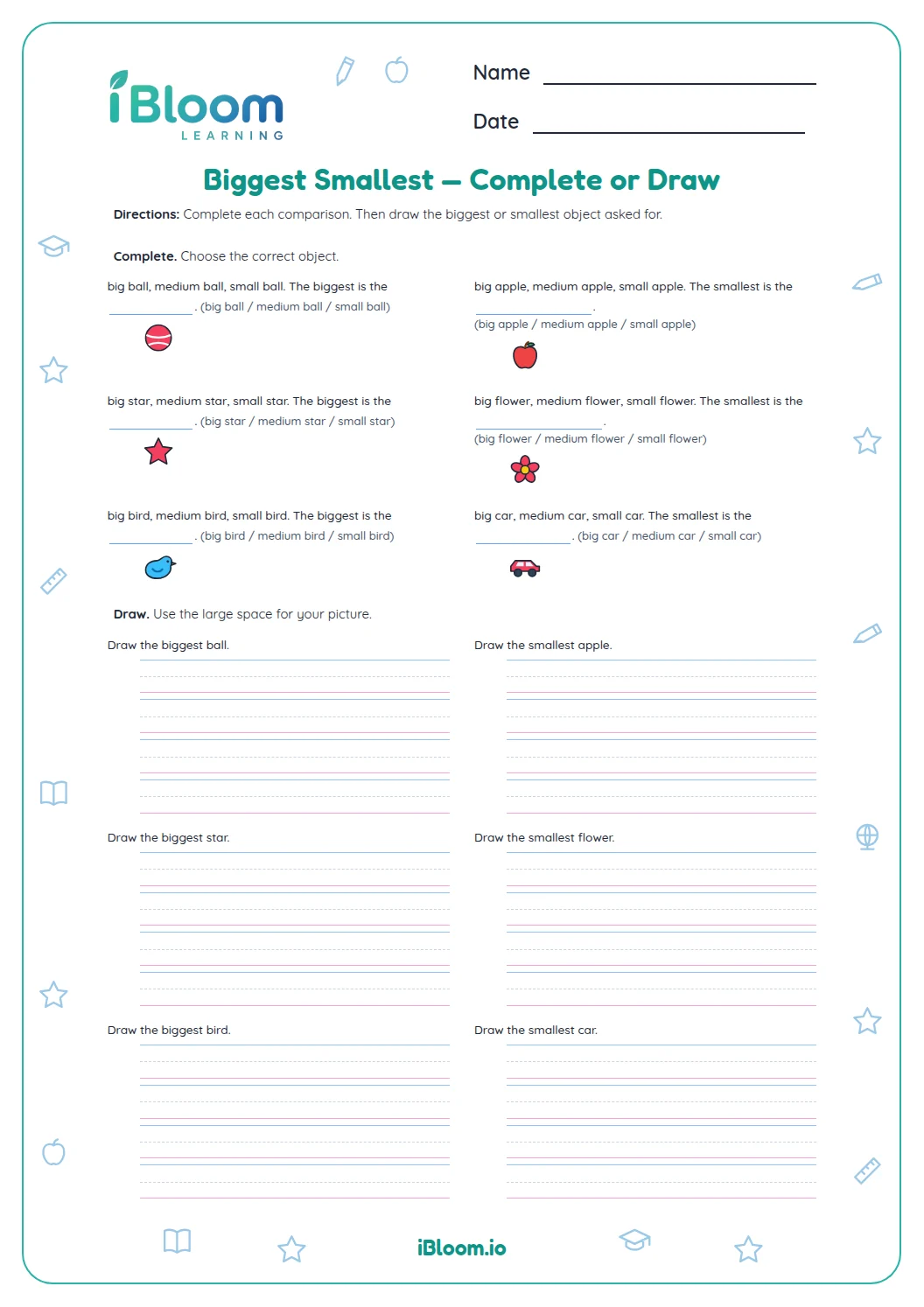
This printable gives preschool and kindergarten learners picture-supported practice with big and small. Children choose the matching size word for familiar objects, then answer simple comparisons in everyday contexts. The two rounds keep the words concrete: first identifying a size clue, then deciding which of two objects is larger or smaller. It practices kindergarten measurement comparison, including describing which object has more or less of a shared measurable attribute. The printable includes a separate answer key.
Aligned to K.MD.A.2
How do children use the words big and small?
Part A pairs each prompt with a familiar picture clue and asks for “big” or “small.” Say the word aloud and connect it to a concrete object, such as a large ball or tiny flower.
How do object clues support size vocabulary?
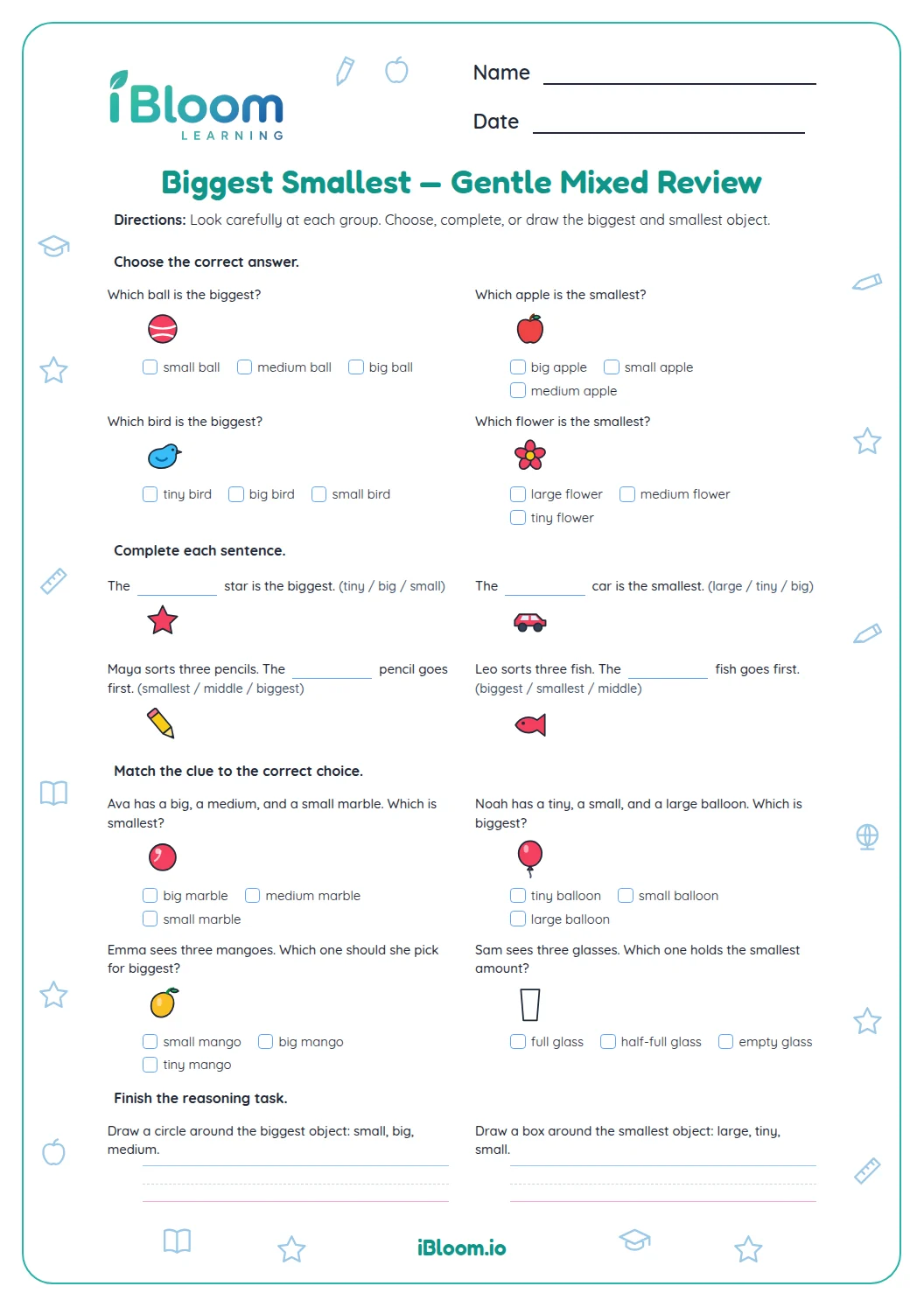
Part B uses familiar items such as a balloon, pencil, and orange. Children match “large” or “tiny” in the prompt to the size word that means the same thing.
How can a child compare two objects?
Part C names a big and small version of the same kind of object. For “Which one is smaller?” the correct choice is the small bird.
What can we talk about after the page?
Ask the child to find two safe objects nearby and tell which is bigger or smaller. Comparing objects directly helps connect the vocabulary to what they see.
How to use this worksheet
- 1Read each prompt slowly and let the child name the pictured object.
- 2Point out “large” and “tiny” as clues for big and small.
- 3For Part C, have the child repeat both choices before answering.
- 4After checking the key, compare two familiar objects together.
Common mistakes and quick fixes
The mistake
Mixing up “large” and “tiny.”
The fix
Connect large with big and tiny with small before choosing.
The mistake
Choosing the size word without listening to the whole prompt.
The fix
Repeat the clue word, then say the matching size word.
The mistake
Comparing the objects by color instead of size.
The fix
Ask which object is physically larger or takes more space.
Common Core alignment
This page practices the listed Common Core skill through the worksheet tasks.
Directly compare two familiar objects and describe which is larger or smaller.
On this sheet: Children name big and small and compare pairs of familiar objects as larger or smaller.
Show the official wordingHide the official wording
Directly compare two objects with a measurable attribute in common, to see which object has “more of”/“less of” the attribute, and describe the difference. For example, directly compare the heights of two children and describe one child as taller/shorter.
What to practice next
Make more practice
Further reading
Questions parents and teachers ask
What does big and small mean on this page?
Big describes an object that is larger in the comparison, and small describes one that is smaller. Part A uses familiar object clues, then Part C asks children to compare two objects of the same kind. The child can point to the object while repeating the size word.
Do children need to read the words alone?
An adult can read each prompt aloud. Picture clues accompany the questions, and the repeated size words give children a chance to hear and say “big,” “small,” “large,” and “tiny” as they answer. Let the child answer aloud before marking a choice.
How should I explain large and tiny?
Tell the child that large means big and tiny means very small. Then connect each word to the familiar object in the prompt, such as a large balloon or a tiny pencil. Point to the matching object and say the pair of words together.
What does “takes less space” mean?
It asks which object is smaller. In the apple question, the small apple takes less space than the big apple. You can model the idea by placing two objects side by side and comparing their size. Put two objects side by side and ask which is larger.
Why are there two balls or birds in a comparison?
Part C asks the child to choose the larger or smaller one from a pair. The prompt names which is big and which is small, so the child practices understanding the comparison words in a simple context. The repeated pairs help children hear how comparison words work.
How can we extend the practice?
After the worksheet, invite the child to compare two toys or books and say which is bigger and which is smaller. Let the child point to each object while saying the comparison sentence. Ask the child to explain the choice using the word big or small.