



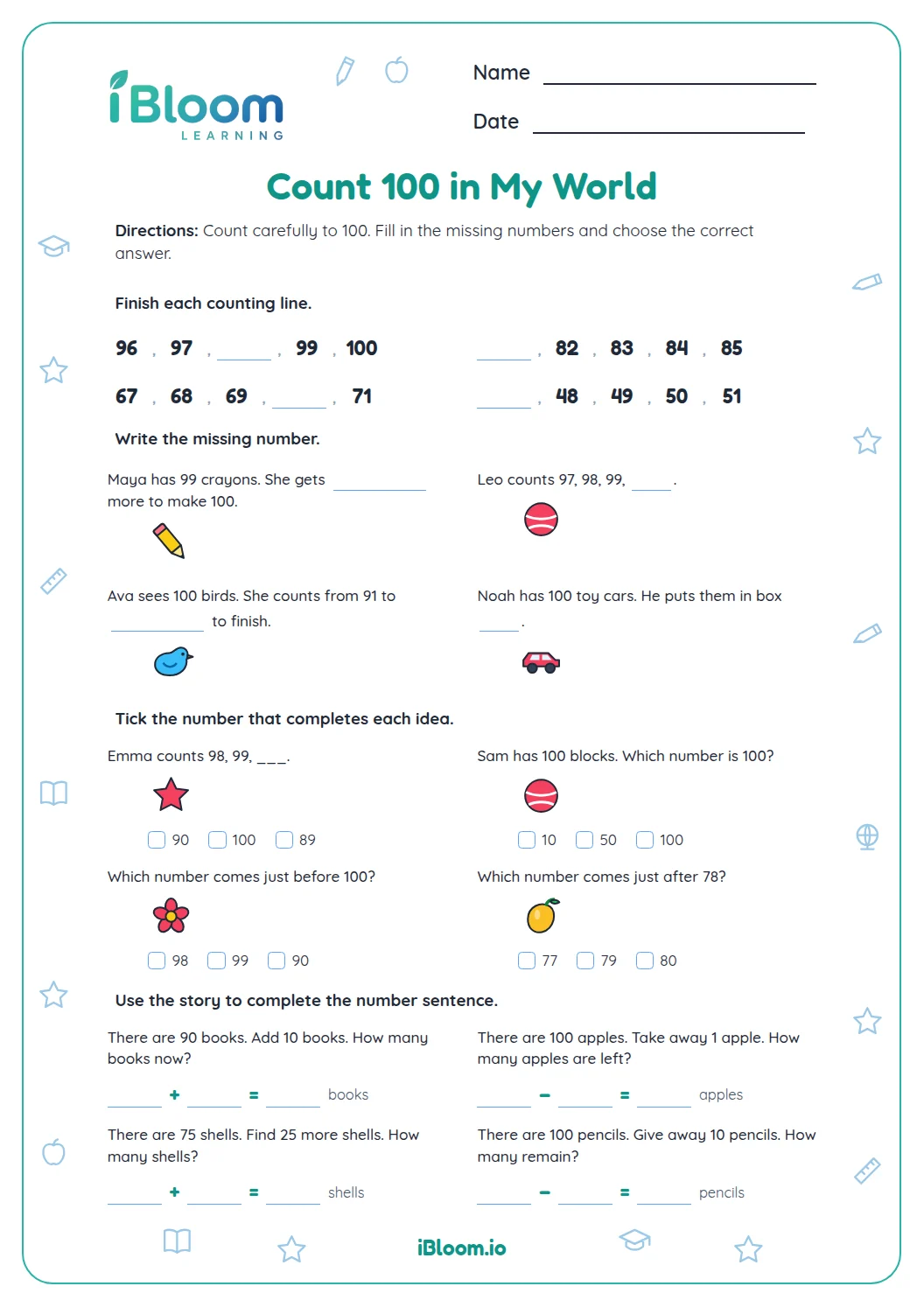
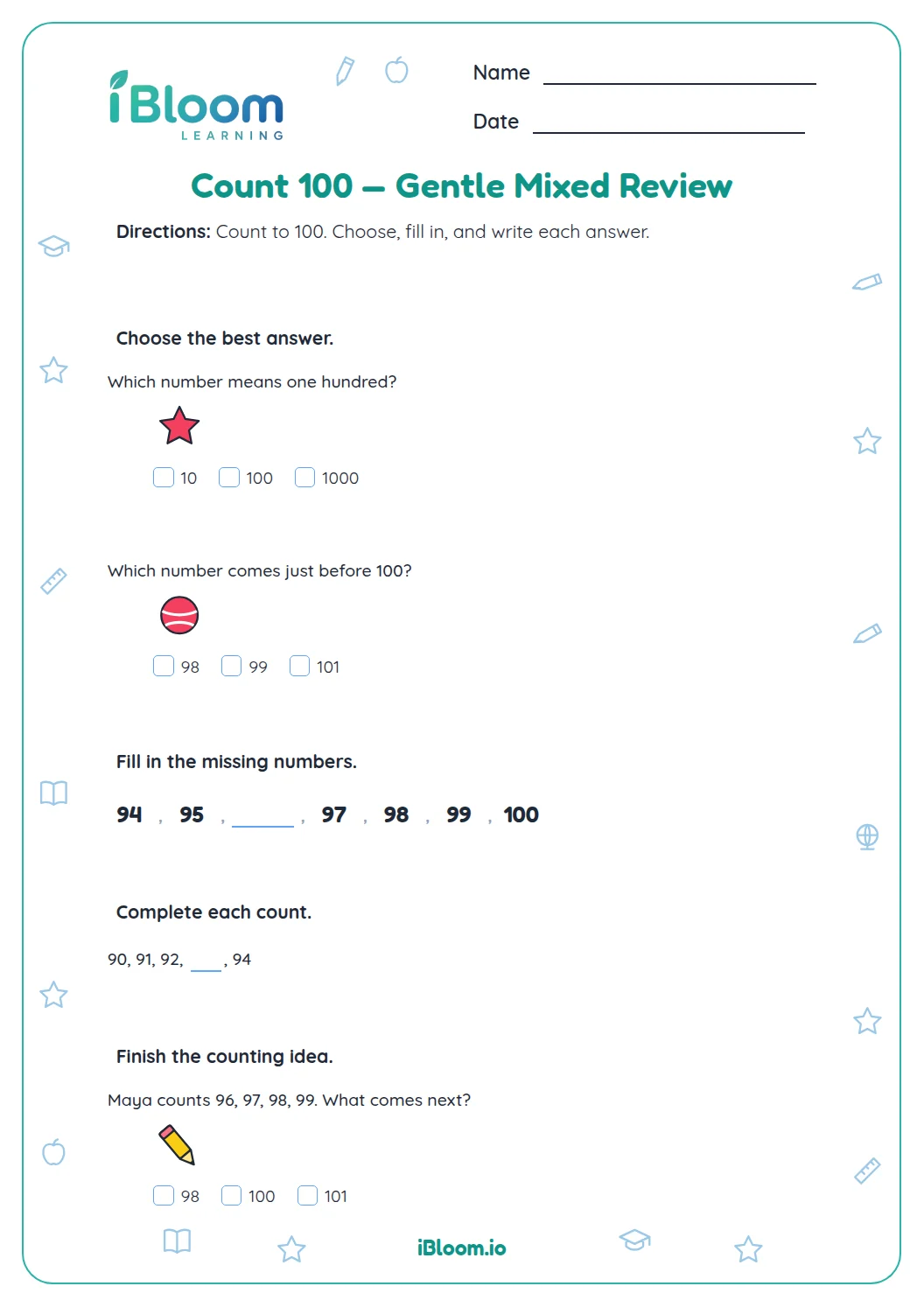
About this worksheet
This free printable gives preschool and kindergarten learners practice counting sets up to ten and matching each set to its numeral. Parts A and B use familiar pictures so children can touch and count each object once; Part C asks them to draw dot sets for two counts. The answer key gives the target totals and a simple guide for checking drawings. It practices the counting and cardinality connection in Common Core K.CC.B.4.
Aligned to K.CC.B.4
What is on the worksheet?
Part A asks children to count six pictured sets and choose the matching numeral. Part B reverses the direction: count each set and match it to one of the numerals. Part C asks children to make sets of 4, 6, 8, and 10 dots.
- All pictured groups contain between 1 and 10 objects.
- The two matching parts connect a spoken count with a written numeral.
How does counting each object once help?
In question 2, touch each of the six ducks while saying one, two, three, four, five, six. The last number said tells how many ducks are in the group. Moving a finger or placing a counter beside each picture helps avoid counting one object twice.
- 1Point to each duck once.
- 2Say the numbers in order.
- 3The last count is 6, so choose 6.
How can a child check a drawn set?
For a draw prompt, the goal is the requested number of separate dots. Count the dots slowly and touch each one once. The dots do not need to be arranged in a particular pattern.
How to use this worksheet
- 1Model one set by touching each picture once as you count.
- 2For the choice items, say the last number aloud before looking at the options.
- 3In Part C, draw one dot per count and check by touching each dot.
- 4Use the key to check totals; accept any clear arrangement of the correct number of dots.
Common mistakes and quick fixes
The mistake
Skipping an object while counting.
The fix
Move a finger or small counter to each picture as it is counted.
The mistake
Counting the same picture twice.
The fix
Count across each row in a steady direction and avoid jumping back.
The mistake
Drawing one extra dot.
The fix
Touch and count every dot after drawing; stop when the requested number is reached.
Common Core alignment
These activities build the stated grade-level skill through clear models and practice.
Connect counting objects with the last number said.
On this sheet: Children count pictured objects one by one and identify the total.
Show the official wordingHide the official wording
Understand the relationship between numbers and quantities; connect counting to cardinality.
What to practice next
Make more practice
Further reading
Questions parents and teachers ask
What does this worksheet practice?
This Grades Pre-K–K printable gives learners focused practice with count picture sets, match each set to a numeral, and draw dots to make a requested amount. The answer key is included as a separate set of pages, so an adult can check each response after the child finishes.
How should we begin?
Read the one-line direction together and model the first item aloud. Point to each object or number as you say it, then let the learner try the next one independently before checking the key. The examples use familiar school and home situations, and a grown-up can read the directions aloud before independent work begins.
How long will it take?
Plan for about 15 to 20 minutes, with time to talk through any missed items. A younger learner can complete one part at a time and return to the next part after a short break. The examples use familiar school and home situations, and a grown-up can read the directions aloud before independent work begins.
Can I print just the practice pages?
Yes. The answer key follows the worksheet pages, so you can print the practice pages for the learner and keep the key nearby for checking. The pages are designed for ordinary home or classroom printing. The examples use familiar school and home situations, and a grown-up can read the directions aloud before independent work begins.
What if an answer is incorrect?
Ask the learner to explain how they decided, then point back to the model, picture, or passage clue. Let them try again before showing the answer. Correcting the reasoning helps the skill stick better than copying a number. The examples use familiar school and home situations, and a grown-up can read the directions aloud before independent work begins.
Is an answer key included?
Yes. A separate answer key gives the response to each numbered item. For open-ended written answers, the key provides an example; accept another response when it is supported by the worksheet text. The examples use familiar school and home situations, and a grown-up can read the directions aloud before independent work begins.