

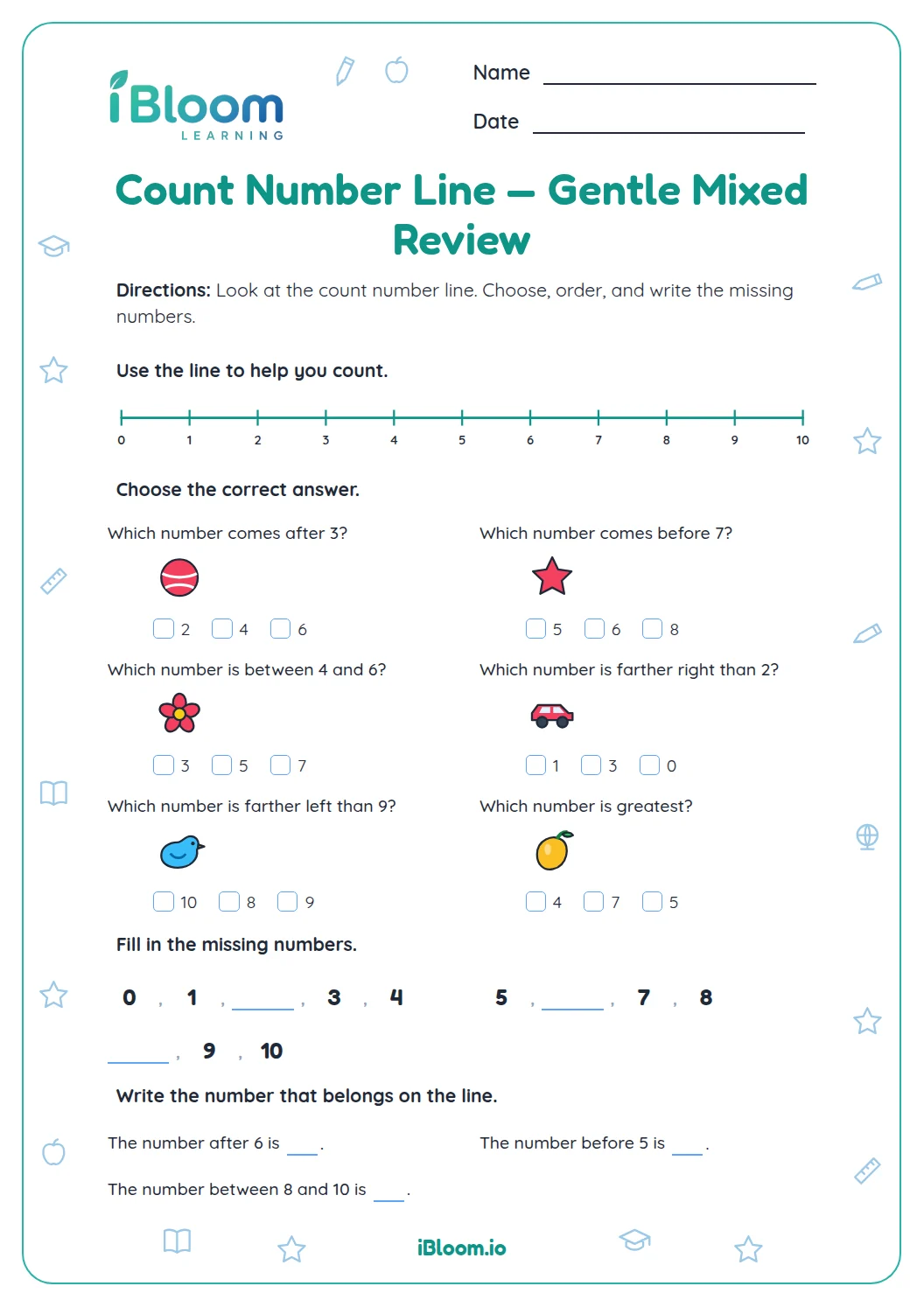


About this worksheet
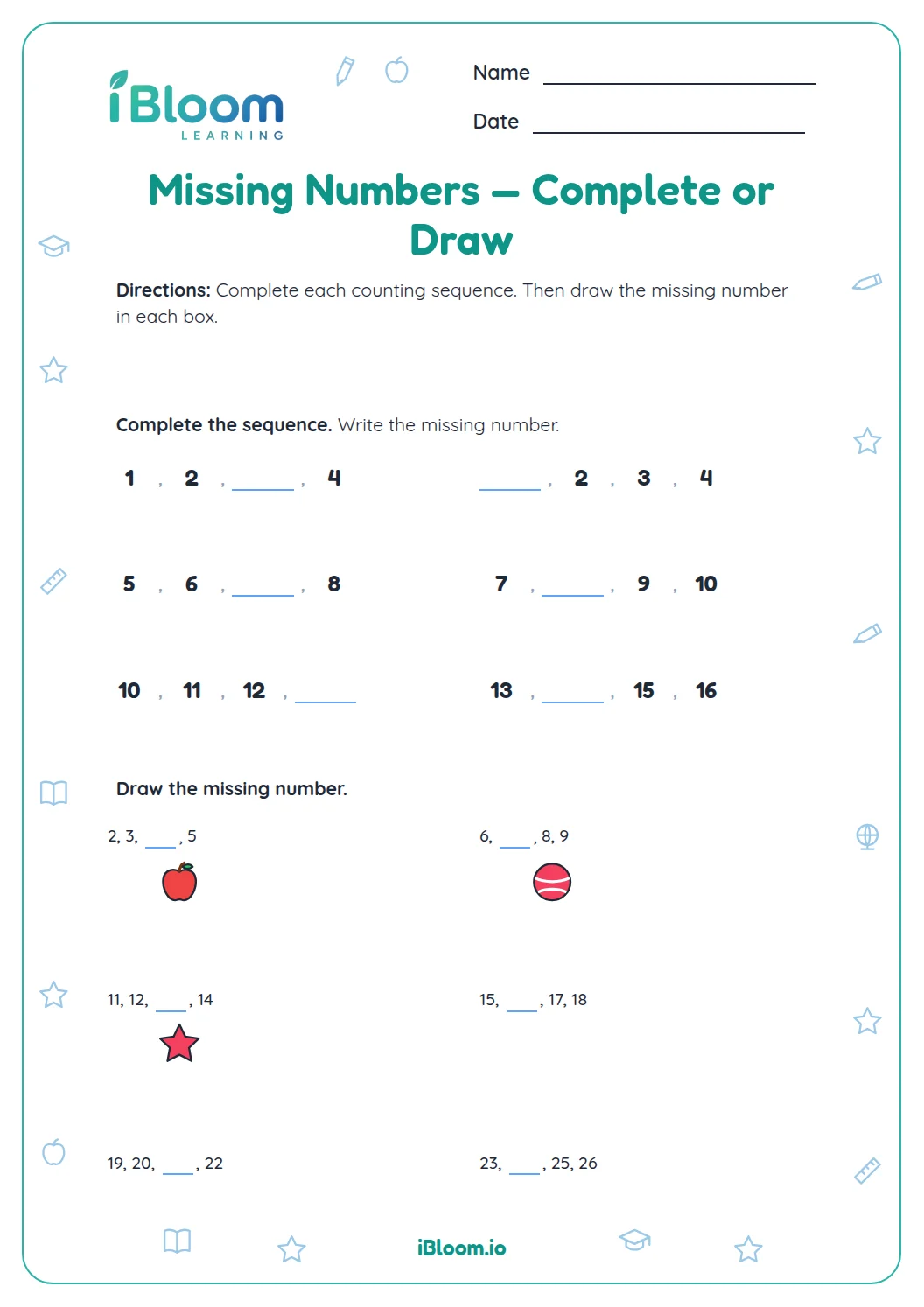
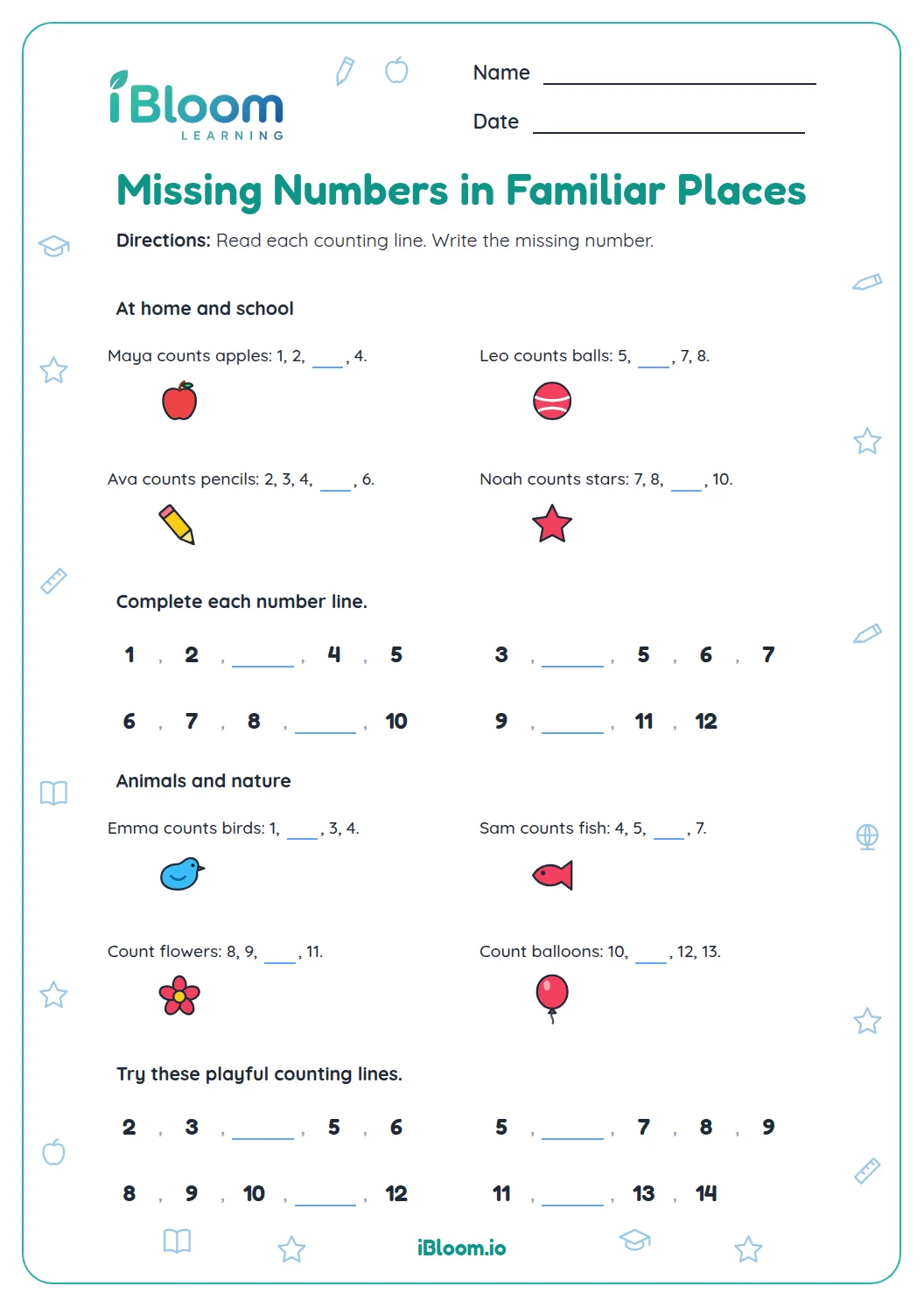
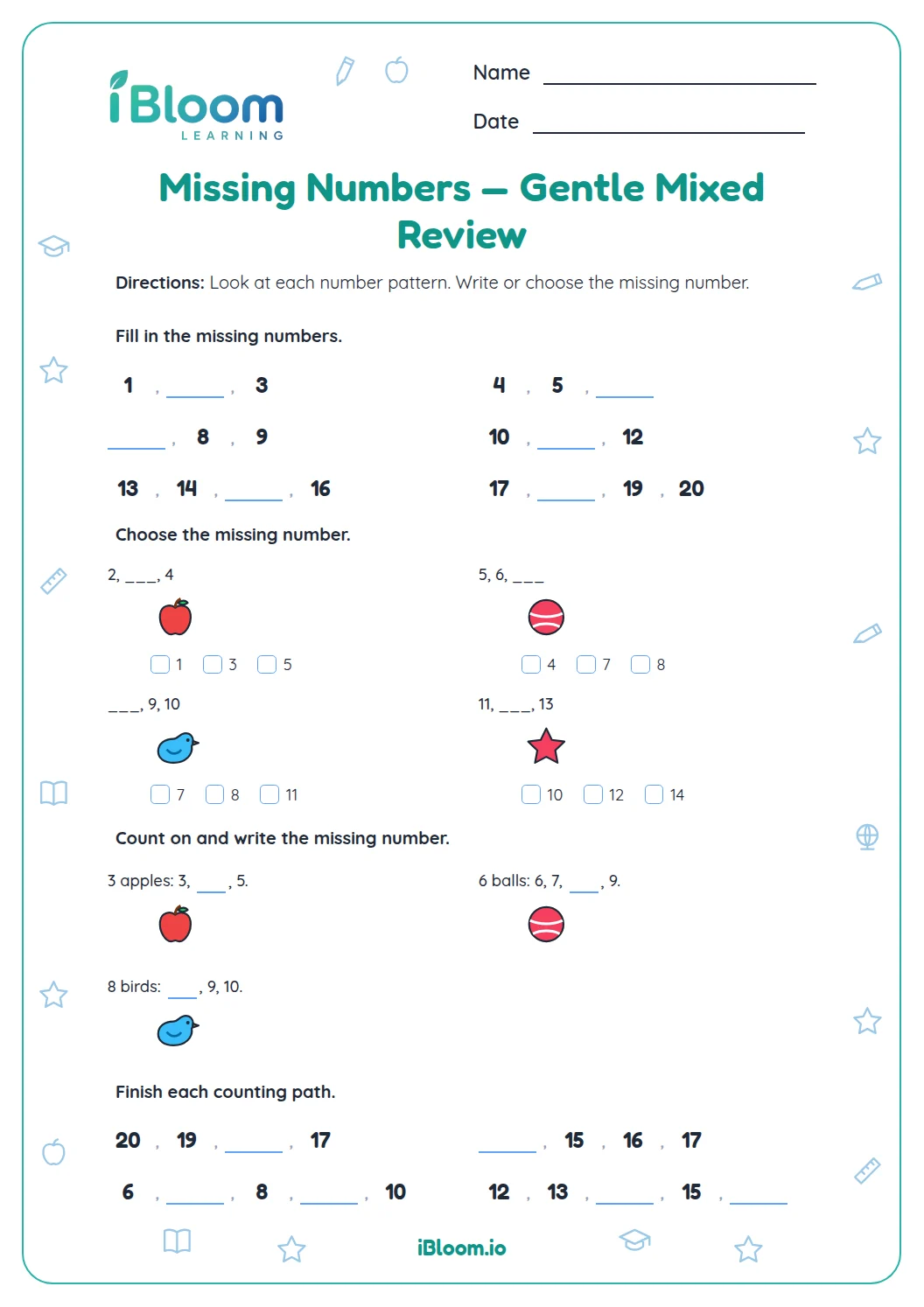
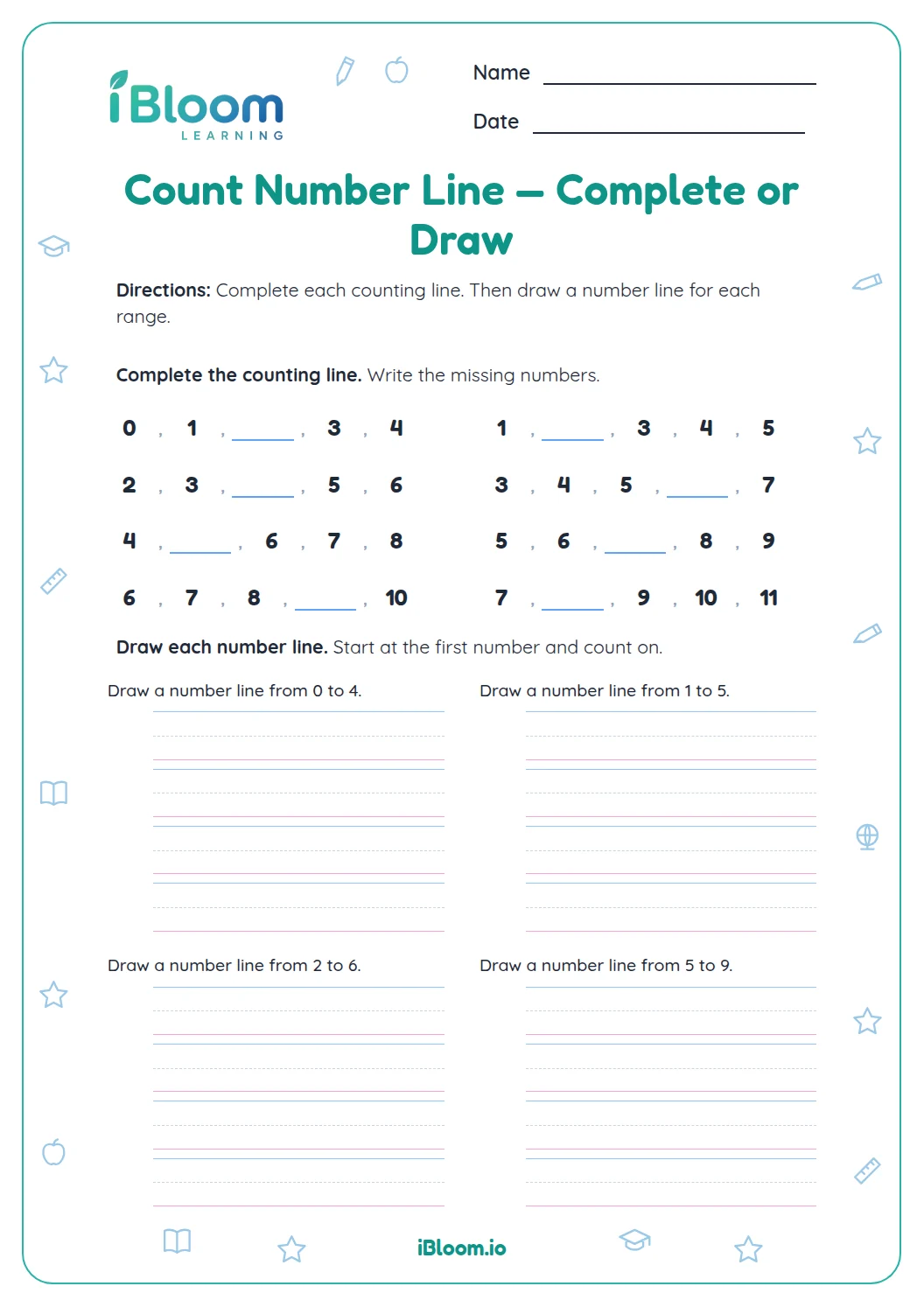
This Kindergarten worksheet rebuilds the old sequence sheet as two pages of 16 multiple-choice items. Children complete short forward-counting sequences and answer simple before, after, and between questions through 20. The answer key gives the numeral for each item. The sequence work practices counting forward from a given number, aligned with CCSS K.CC.A.2.
Aligned to K.CC.A.2
How do children find a missing number?
Say the numbers in order and pause at the blank. In 6, 7, ___, 9, the number after 7 and before 9 is 8. Read the whole sequence aloud after choosing.
- 16, 7, ___, 9
- 2Count forward: 6, 7, 8, 9.
- 3Answer: 8.
How do before, after, and between questions work?
Use the familiar counting order. The number between 1 and 3 is 2; the number after 9 is 10; the number before 15 is 14. Pointing to the choices while counting can help a learner compare them.
Which numbers appear on the page?
The questions begin with short sequences in the single digits and continue into the teens, ending with a sequence through 20. The choices are numerals, so children can identify and mark one answer for each blank.
How to use this worksheet
- 1Start with the first number shown.
- 2Say the numbers forward in order.
- 3Pause at the blank and compare the answer choices.
- 4Choose the numeral that completes the count.
- 5Read the full sequence again to check.
Common mistakes and quick fixes
The mistake
Skipping a number while counting aloud.
The fix
Point to each printed number once as you say it.
The mistake
Choosing a number that repeats one already shown.
The fix
Check the blank’s place in the whole sequence.
The mistake
Mixing up before and after.
The fix
Say the number order aloud and notice which direction the question asks for.
Common Core alignment
This worksheet practices the following standard.
Count forward beginning from a given number in the known sequence.
On this sheet: Students continue forward-counting sequences from given numbers.
Show the official wordingHide the official wording
Count forward beginning from a given number within the known sequence (instead of having to begin at 1).
What to practice next
Make more practice
Further reading
Questions parents and teachers ask
How many questions are on the worksheet?
There are 16 multiple-choice questions in two parts: 12 missing-number sequences and four direct number-order questions. The sequence items span 1 through 20. Each question has three numeral choices, and the separate answer key lists the intended choice. Children can read or point to one choice at a time.
Does the sheet use pictures?
The sheet focuses on reading and completing number sequences. Children can point to each numeral or count aloud as they work. The choices and answer key use numerals rather than picture counts. A grown-up can help read each question while the learner points to the numerals.
What number range does the worksheet cover?
The questions include counting sequences from 1 through 20. The early items use numbers in the single digits, and later items move into the teens. One item ends at 20, giving children practice completing a short count that reaches that endpoint.
Can a preschool learner use the worksheet?
The printable is labeled for Kindergarten and uses numerals through 20. A preschool learner who is comfortable counting through the teens may try it with an adult reading directions aloud. An adult can point to each number and help the child count through a blank.
How can families use the answer key?
After a child chooses an answer, read the sequence together and compare the missing numeral with the key. If the choice is incorrect, count forward from the first number and pause at the blank. The goal is to connect the written numeral with its place in the count.