







About this worksheet
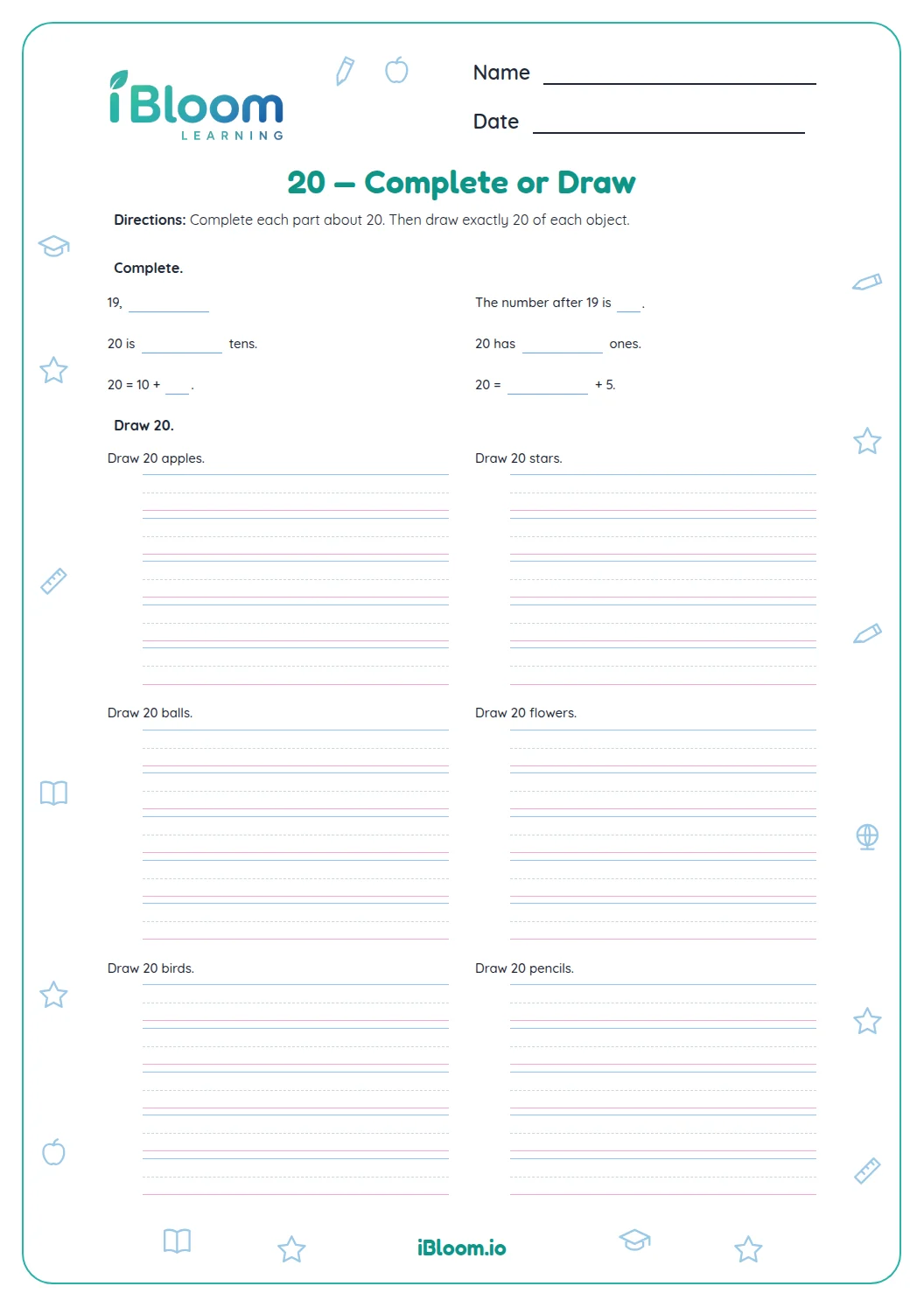
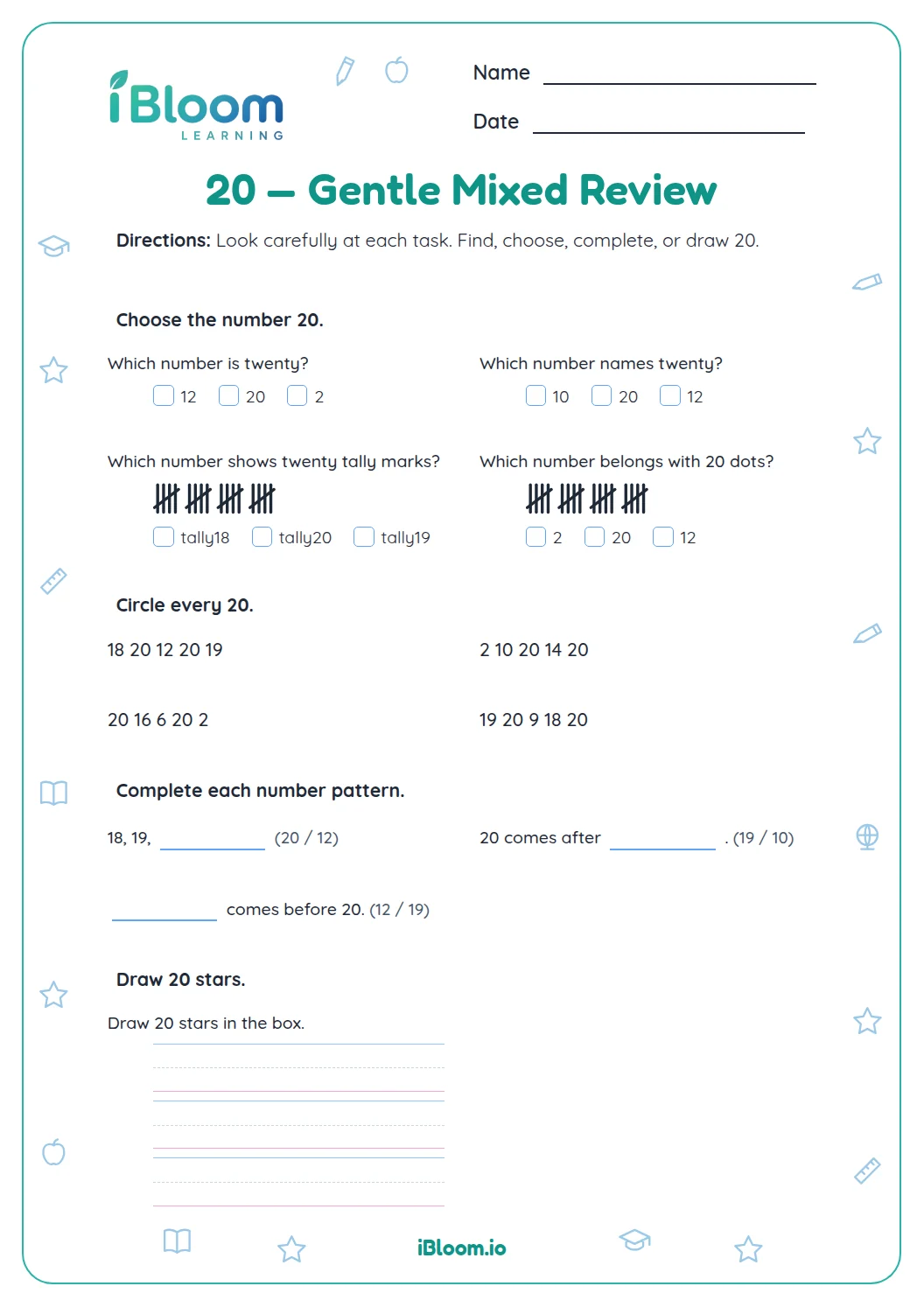
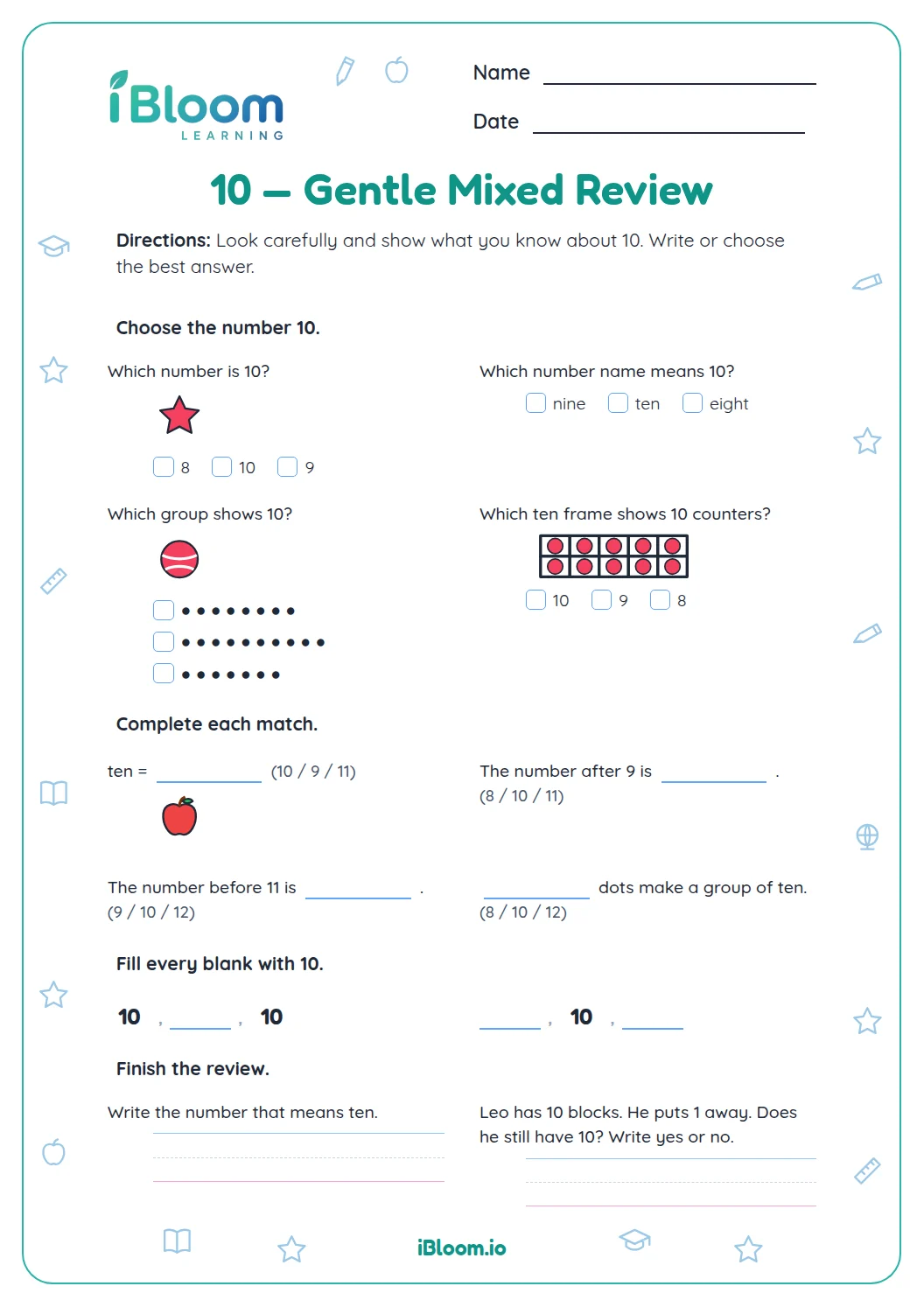
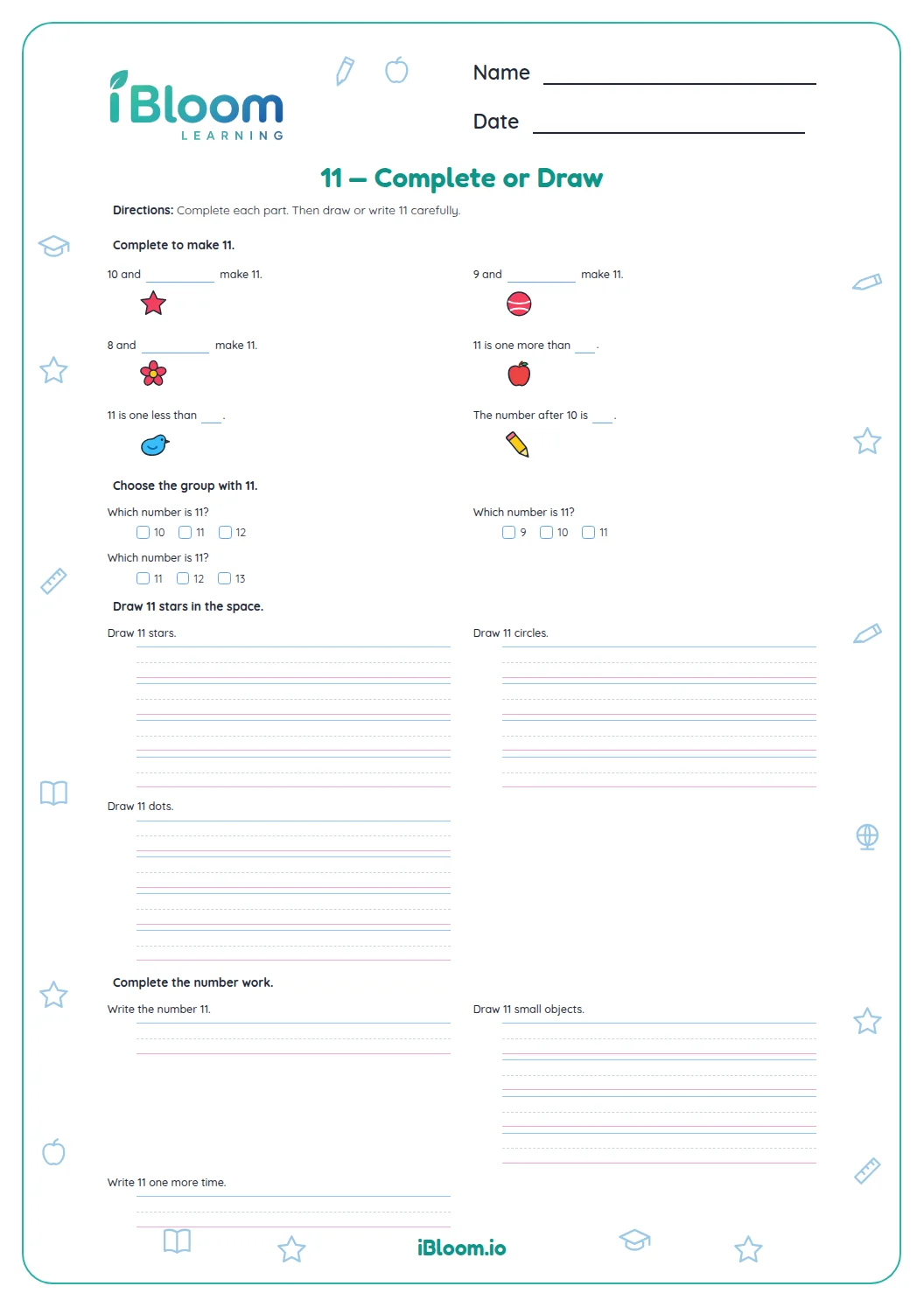
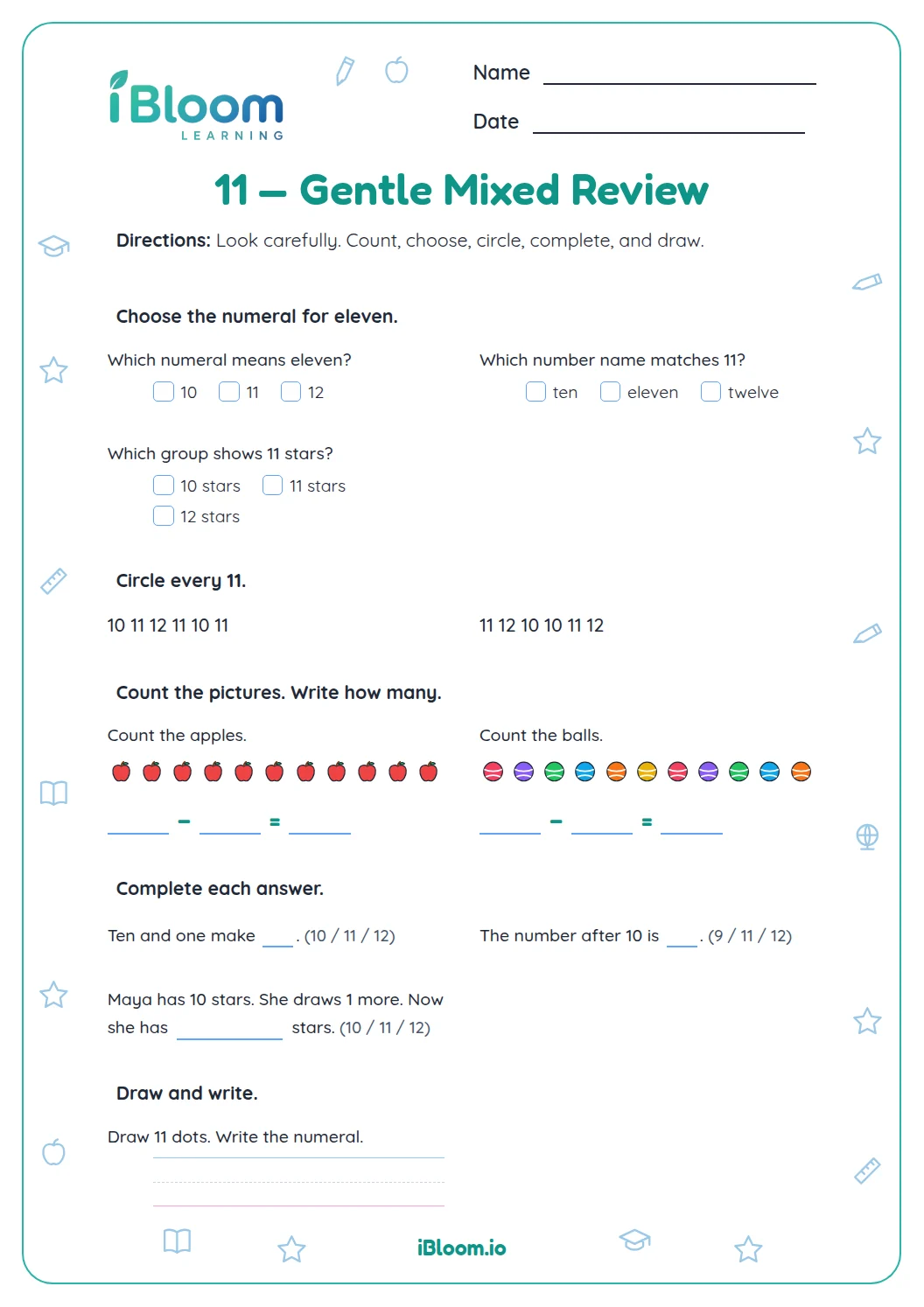
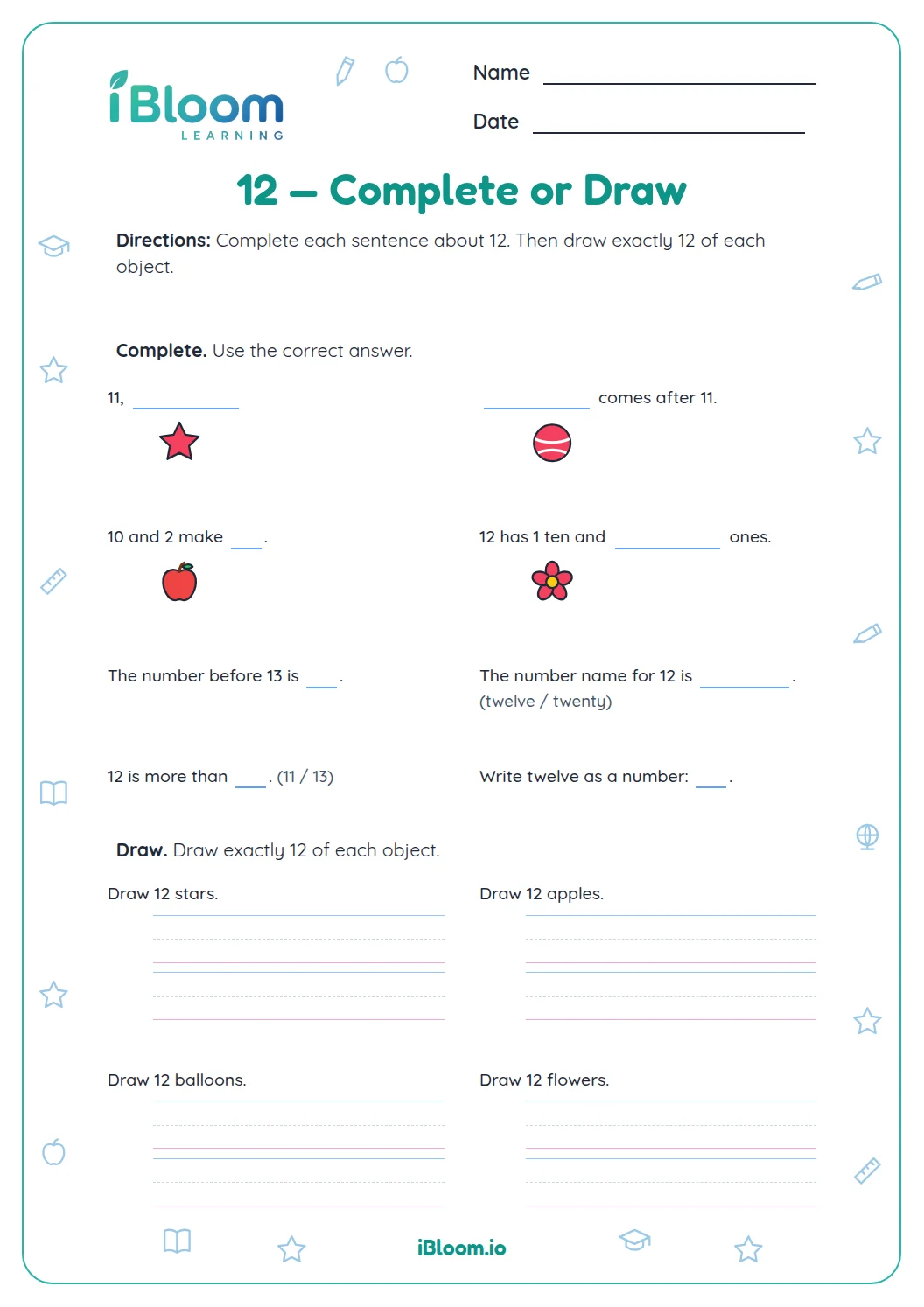
This preschool and kindergarten printable focuses on recognizing 20 in familiar settings. Fourteen questions ask children to count ten-frame counters and pictured objects, then identify, write, or use numerals near 20. A separate answer key supports checking each response.
Aligned to K.CC.A.3
How can a ten frame support counting?
A ten frame organizes counters into rows, so children can keep track without recounting a loose group. On this sheet, counter groups build toward 20. Touching or naming each counter once supports one-to-one counting.
How does familiar context build number recognition?
Part B places counts in familiar groups such as apples, stars, fish, books, and flowers. Part C asks children to use number order and recognize the numeral 20. The key confirms the total or numeral for each question.
- 1How many counters are there?
- 2Answer: 20
How to use this worksheet
- 1Read the directions and look over the first example together.
- 2Work through Part A slowly, pointing to each clue or model.
- 3Ask the learner to explain one answer in their own words.
- 4Continue to the next parts, taking a short pause if needed.
- 5Use the separate key to check answers and revisit one tricky item.
Common mistakes and quick fixes
The mistake
Rushing past a clue in the prompt or model.
The fix
Pause and name the clue before selecting an answer.
The mistake
Mixing up two related words or steps.
The fix
Say both choices aloud and check which one matches the task.
The mistake
Leaving an answer unchecked.
The fix
Return to the passage, picture, or count and verify it once.
Curriculum alignment
Children count pictured groups and connect each quantity to a numeral.
On this sheet: Children count pictured groups and connect each quantity to a numeral.
Show the official wordingHide the official wording
Write numbers from 0 to 20. Represent a number of objects with a written numeral 0-20 (with 0 representing a count of no objects).
What to practice next
Make more practice
Further reading
Questions parents and teachers ask
Does the worksheet practice the number 20?
Yes. Children count a full set of 20 counters and 20 pictured apples, identify the numeral 20, and complete the sequence from 19 to 20. Other groups from 12 through 19 provide nearby quantities for comparison and counting practice. This keeps the focus on matching the spoken count to the amount instead of estimating a large group.
How many questions are included?
There are 14 questions in four parts: five ten-frame counts, five familiar picture counts, and four numeral or number-word items. An answer key is included so families and teachers can check each count and written response. The last questions practice naming the numeral.
How should my child count the pictures?
Have your child point to each picture once while saying the number sequence. If the child loses track, count a row at a time or cover part of the group with a finger. Then ask them to match the final count to a numeral.
Why are numbers near 20 included?
Counting groups such as 18, 19, and 20 gives children a chance to distinguish numerals that look similar and notice how the count changes by one. The practice keeps 20 as the focus while using nearby quantities in simple contexts.
Can I help by reading prompts aloud?
Yes. Read each question and let the learner do the counting and numeral choice. You can model touching one counter per count, then let the child continue independently. Keep the focus on matching one spoken number to each object. You can also invite the child to say the last count aloud before writing it in the answer space.
How long does the worksheet take?
Plan for about 10 to 15 minutes for 14 short counting tasks. Young learners may do a few at a time. A brief pause to recount one group carefully is useful practice, especially when the final number names the whole set.