







About this worksheet
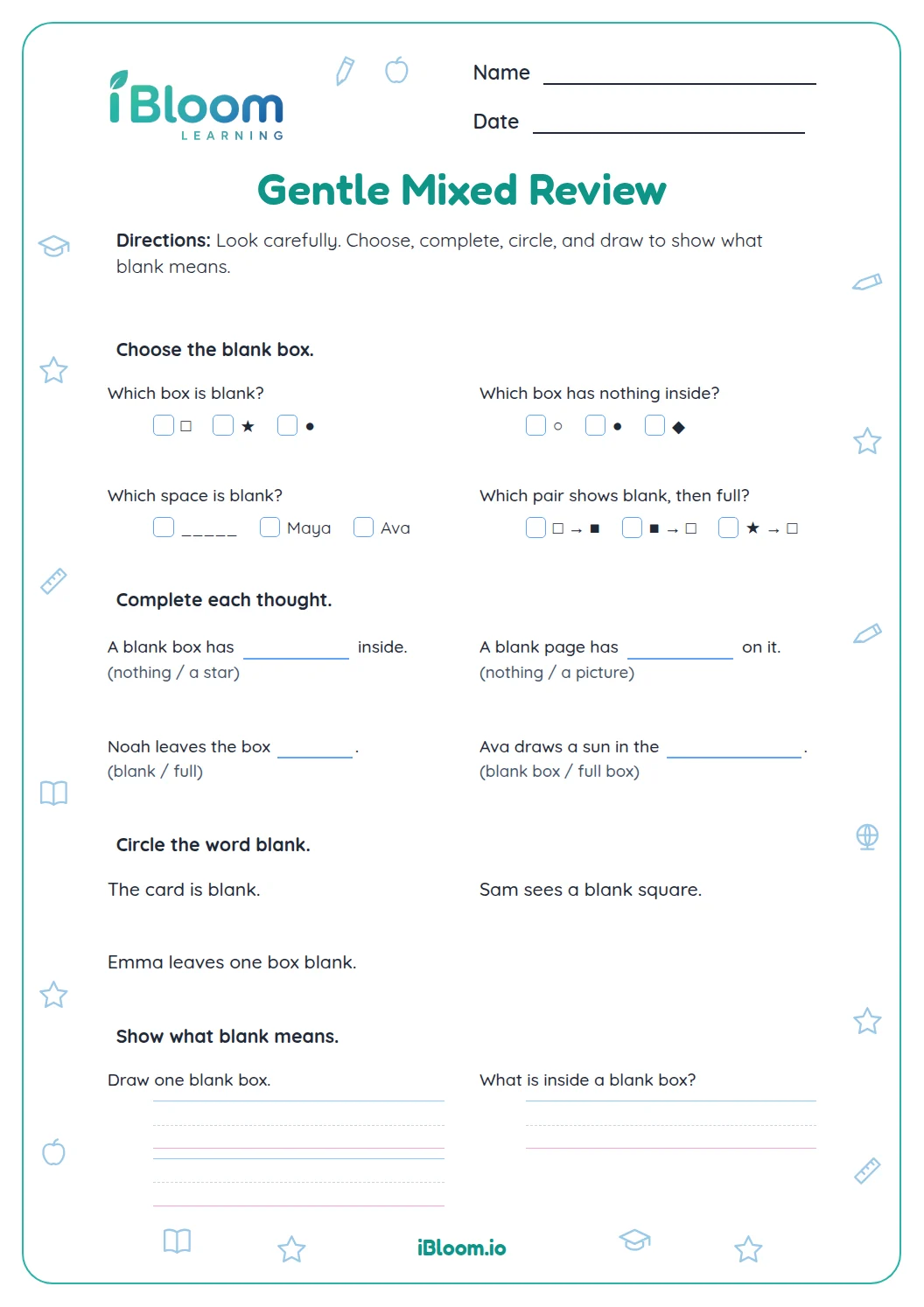
This free printable preschool and kindergarten worksheet connects the word blank with an empty space. Children copy blank to complete four sentences about two unfilled outlines, a page, and a card. Then they draw a circle, square, rectangle, and star with nothing inside. Familiar objects, such as a plate and a door, provide shape clues. The eight activities combine supported word writing with drawing practice. Drawing the shapes practices Common Core K.G.B.5. A separate answer key supplies the word and describes the expected outlines; children’s drawings can vary in size.
Aligned to K.G.B.5
How can you explain blank to a young child?
Point to the inside of an unfilled outline and say, “There are no marks inside; it is blank.” Trace the edge with a finger to separate the outline from its interior. A shape can have an edge and still be blank inside.
Part A gives four sentences and the word blank to copy. Read each sentence aloud. For the first two, point to the unfilled outline; the next two describe a page and a card. Help the child say the word before writing it.
- 1Question 1 has an unfilled circle.
- 2Ask: “Are there any marks inside?”
- 3The inside is blank; write blank to finish the sentence.
How do children complete the four sentences?
Read each sentence aloud and have the child say blank. Point to the word in the Part A directions so the child can copy its letters. The first two questions show a circle and a square with no marks inside; the next two describe a page and a card.
For a child who is still learning to form letters, say the answer together and offer help with writing. The word stays the same in all four sentences, so the child can connect its spelling with the meaning each time.
What should go in the four drawing boxes?
Part B asks for an empty circle like a plate, a square like a tile, a rectangle like a door, and a star like a star sticker. The boxes provide room to draw each outline with no details inside.
The answer key describes each result rather than requiring a traced copy of one perfect model. Check that the shape is recognizable and the inside remains blank. The circle may be large or small, and the star may have uneven points.
How to use this worksheet
- 1Read the directions aloud and point to the blank inside of the circle.
- 2Have the child say blank to finish each Part A sentence.
- 3Point to blank in the directions and help the child copy the word onto each line.
- 4Name a plate, tile, door, and star sticker before the child draws in Part B.
- 5Ask the child to point to each finished outline and check that its inside has no marks.
Mistakes to check together
The mistake
Filling the inside with color.
The fix
Point to the outline and repeat that this activity leaves the inside empty.
The mistake
Drawing in the word-answer space instead of writing blank.
The fix
Point to the word in the directions and help the child copy it. Save the pictures for the dashed boxes in Part B.
The mistake
Drawing a rectangle when a square is requested.
The fix
Compare the side lengths: help the child make four sides about the same length for the square.
Common Core alignment
Draw shapes using the outlines of familiar objects as clues.
On this sheet: Part B asks children to draw outlines like a plate, tile, door, and star sticker.
Show the official wordingHide the official wording
Model shapes in the world by building shapes from components (e.g., sticks and clay balls) and drawing shapes.
What to practice next
Make more practice
Further reading
Questions parents and teachers ask
Is this an open-ended blank drawing page?
It is a guided activity about blank interiors. Children complete four sentences with blank, then draw four named shapes while leaving their insides empty. The drawing boxes give space for different sizes, while the prompts keep the work focused on the meaning of blank.
Should an adult read the directions?
Yes; an adult can read each sentence and help the child copy blank from the directions. Point to the empty interior when introducing the word, then let the child draw. Preschool children can say the answer first and write with support as needed.
What does my child practice in the eight activities?
Four sentence completions connect the word blank to a space with no marks, and four drawings put that idea into practice. Children copy the same word, draw recognizable outlines, and leave each interior empty. Read the sentences aloud so the child can focus on their meaning and the pencil work.
Do the drawings have to match the key exactly?
No; the key describes the shape and its empty inside. A recognizable circle, square, rectangle, or star is enough, even when the lines wobble. Accept different sizes and orientations. For a square, help the child notice four approximately equal sides rather than requiring a perfect geometric drawing.
How can I help my child draw a star?
Look at a star sticker together and trace its outline with a finger before drawing. Help the child notice the points and the spaces between them. Accept uneven points and a wobbly outline; the goal is a recognizable star with a blank inside, rather than a perfect copy.