







About this worksheet
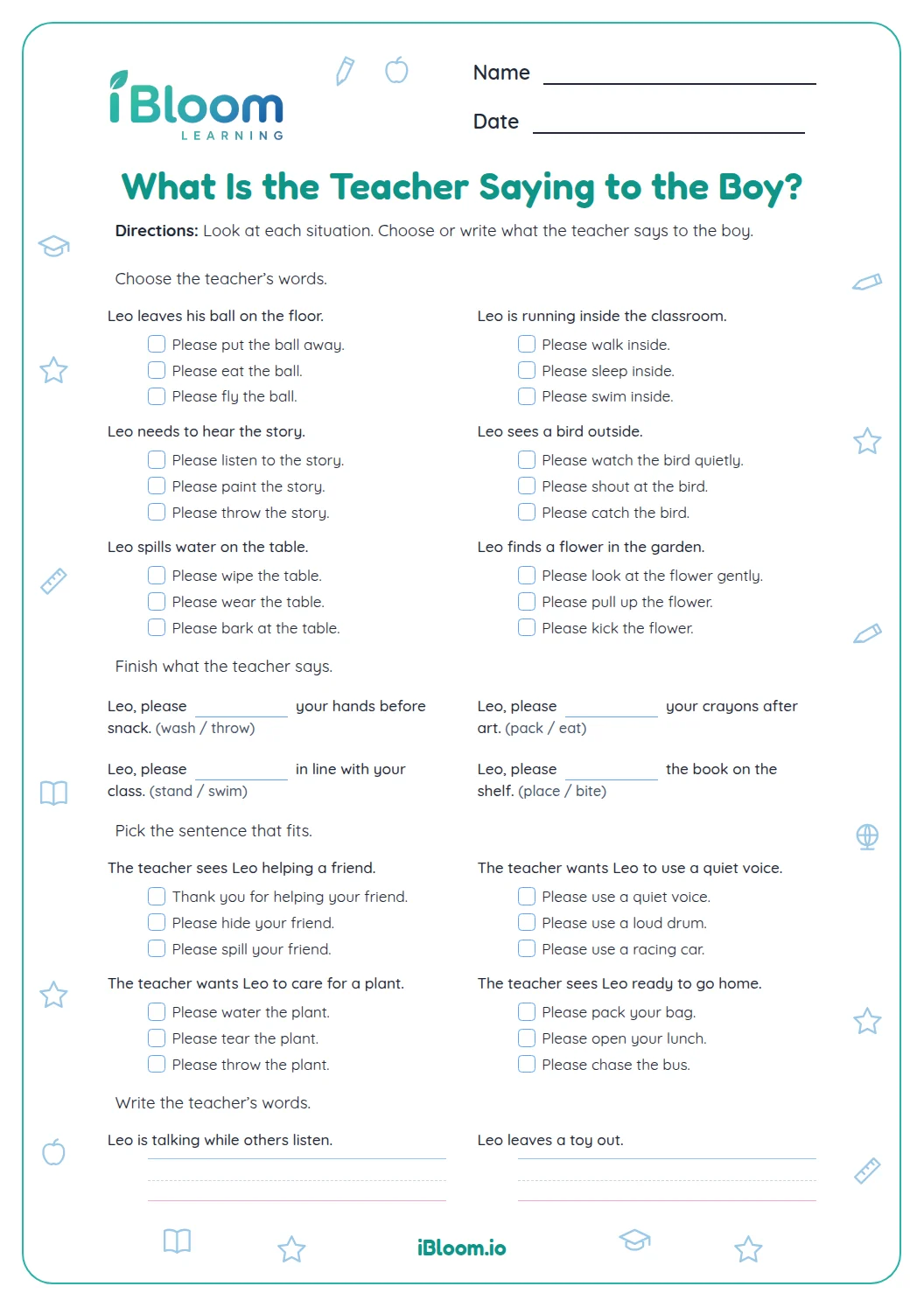
This printable invites preschool and kindergarten learners to connect spoken directions with familiar objects and actions. Part A pairs picture clues with a direction that fits, such as read for a book. In Part B, children draw four scenes by following the printed direction. Part C completes five short teacher prompts with an action word. An adult can read items aloud and invite the child to explain or dictate an answer; the key gives intended choices and sample ideas for open responses.
How can a picture help a child choose a direction?
Name the object, then think of an action that goes with it. A book can be read, a chair can be sat on, and a pencil can be used to write. Part A asks the child to select the fitting direction from three choices.
- 1The teacher points to the book.
- 2Choose “Please read.”
- 3Reading is an action that fits a book.
What should a direction drawing show?
Focus on the action in the prompt. For “Draw the boy washing his hands,” the picture should make the boy and the hand-washing action easy to recognize. Details such as a sink or soap can help, but the main action matters most.
How can a child finish a teacher’s words?
Choose an action that fits the object and makes a polite direction. “Please roll the ball” and “Please open the book” are examples. An adult may read the sentence aloud and accept another sensible action word.
A read, think, and draw routine
- 1Look at the picture clue and name the object.
- 2Say an action that goes with that object.
- 3Choose the matching direction in Part A.
- 4For each drawing prompt, show the action with a clear person or object.
- 5Finish each teacher sentence with an action that fits.
- 6Talk through the answer key together; drawings and action words can vary.
Direction clues to notice
The mistake
Choosing an action that does not fit the object.
The fix
Name the object first, then think of something a person can do with it.
The mistake
Drawing the object but leaving out the requested action.
The fix
Show the person doing the action, such as placing the book inside the bag.
The mistake
Giving an answer that is only an object name.
The fix
Finish the teacher’s sentence with an action word, such as roll or open.
What to practice next
Make more practice
Questions parents and teachers ask
What picture clues are included?
The six picture clues show a ball, book, apple, chair, coat, and pencil. The child chooses a direction that fits each object, such as read for a book or write for a pencil. The adult can pause after reading and let the child point or respond.
Does a child need to read every prompt alone?
No. An adult can read the directions and choices aloud while the child looks at the picture. Invite the child to point, explain the choice, dictate a sentence, or draw the requested action. Talk about why that action fits the object before moving on.
What counts as a good drawing answer?
The drawing should make the requested action recognizable. For the book-in-a-bag prompt, show the boy putting a book into a bag. Children can add their own details after the main action is clear. A child may explain the scene aloud before beginning the drawing.
Can children use a different action word from the answer key?
Yes. The key gives sample completions such as “Please roll the ball.” Another polite action that fits the object is acceptable. The child should complete the sentence with an action rather than simply naming the object. Accept another clear action when it makes sense in the situation.
How many activities and pages are included?
There are 15 activities in three parts: six picture choices, four drawing prompts, and five sentence completions. The worksheet and its separate answer key each use four pages. The adult can scribe a dictated answer when the child is ready.