








About this worksheet
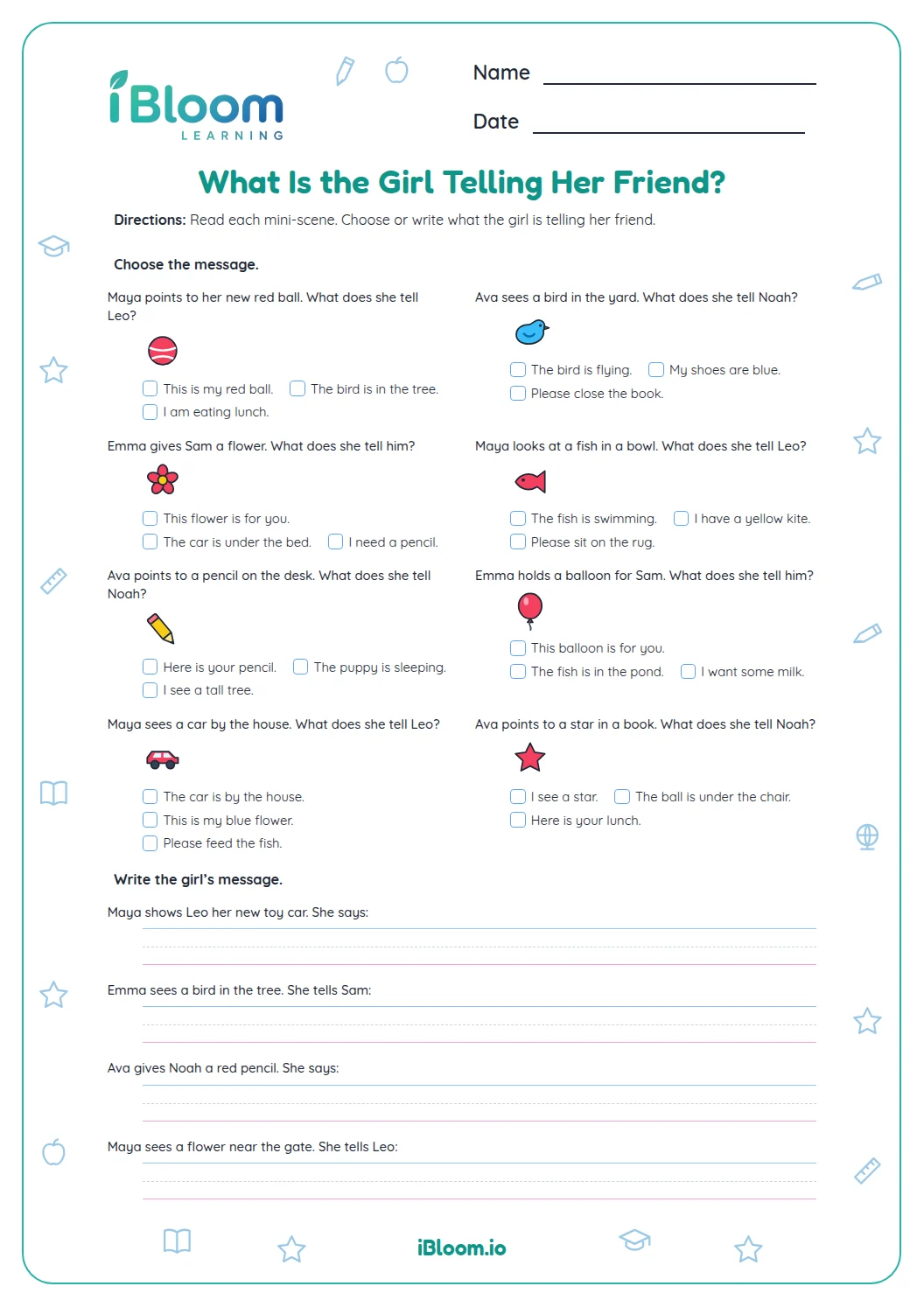
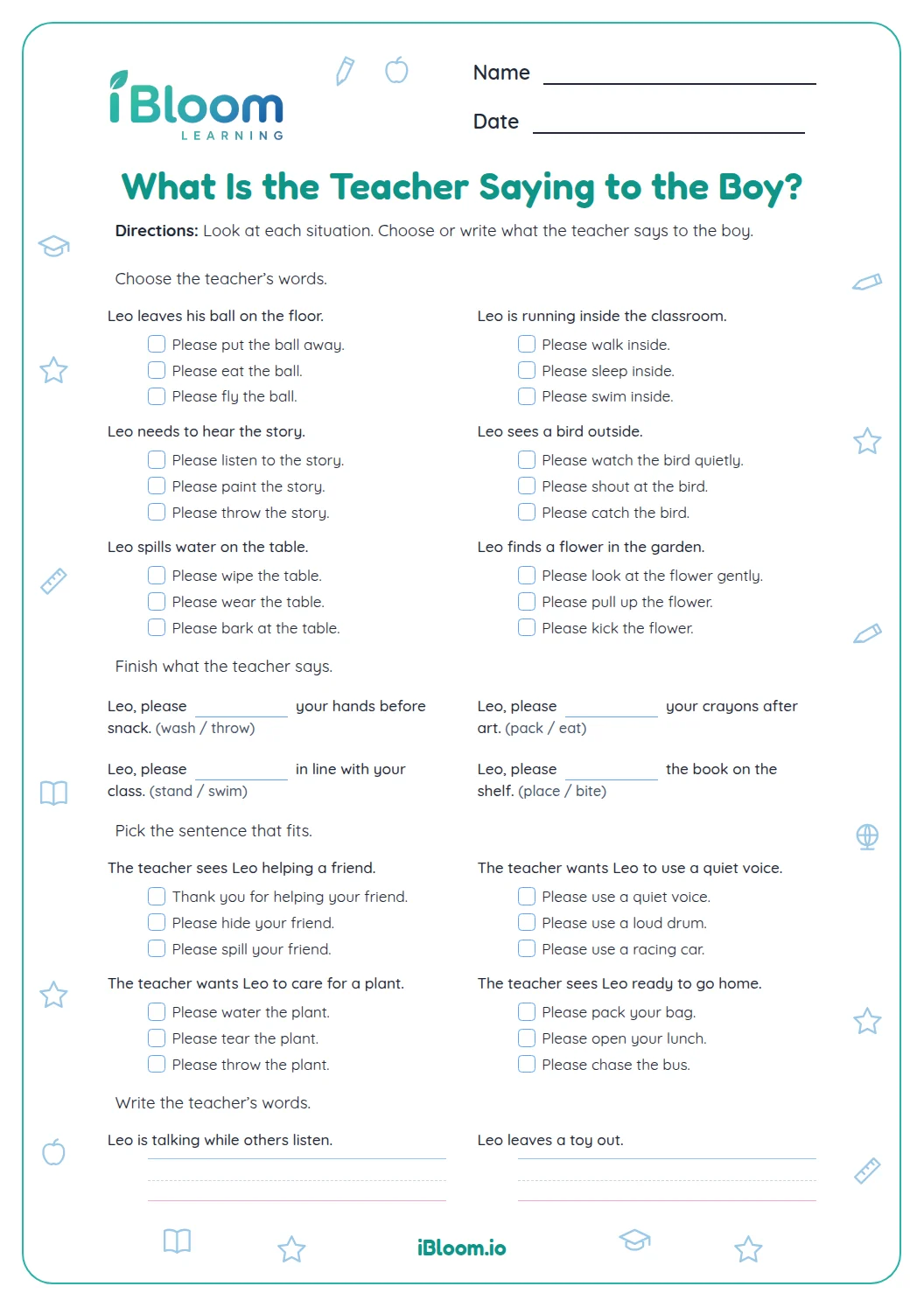
This printable picture worksheet is for preschool and kindergarten children practicing what a girl might say in familiar situations. Children use small illustrations and short scene descriptions to complete 11 message phrases, choose a reply,, then write two messages of their own. The separate answer key gives each missing word and a sample for both written responses. An adult can read the prompts aloud while the child points to each picture and thinks about what the girl wants to tell her friend.
How do picture clues help complete a message?
Part A gives a short situation and picture clue. Children fill in one missing word to complete a message that fits, such as “Maya has a ball. ‘Let’s play ___!’” The scene helps the child choose ball. Read each prompt aloud and let the child point to its picture.
Part B asks the child to write what Maya or Emma might say in a familiar situation.
How can children write a message of their own?
Part B asks the child to write what Maya or Emma might say in a familiar situation. The answer key offers a sample message; another kind sentence that fits is also correct.
- 1Scene: Maya has a ball.
- 2Message: “Let’s play ___!”
- 3Picture clue: [pic:ball]
- 4Complete it: “Let’s play ball!”
How to use this picture worksheet
- 1Read one short situation aloud.
- 2Point to its picture clue and name what the girl sees or needs.
- 3Read the message with the blank and choose a fitting word.
- 4Complete Part A, then invite the child to write both messages in Part B.
- 5Use the key to check the missing words and compare the written ideas.
Mistakes to notice and fix
The mistake
Filling the blank with a word that does not fit the scene.
The fix
Look at the picture clue and reread the whole message.
The mistake
Choosing a word that names the picture but does not finish the sentence.
The fix
Try the word in the blank and say the full message aloud.
The mistake
Writing a message that does not match what the girl needs.
The fix
Ask what she sees, wants, or needs before writing.
What to practice next
Make more practice
Questions parents and teachers ask
Should an adult read the worksheet aloud?
An adult may read each situation and message aloud while the child points to its picture and fills in the missing word. Children who are beginning to read can try the short phrases themselves. Keep the focus on matching what the girl says to her situation.
Are there several possible answers for the writing prompts?
Yes. The key gives a sample for each open response. Accept a different complete, friendly message when it fits the situation, such as another way to ask for help finding a pencil. The child can choose their own words while keeping the same helpful meaning.
What does the picture clue do?
The small picture shows an important object or scene detail. It helps the child decide which word completes the message. For example, a ball fits “Let’s play ___!” Ask the child to point to the picture, say its name, and reread the completed sentence.
How can I help my child use the picture clues?
Point to the small picture and ask a simple question about the scene: “What does she have?” or “What does she need?” Then invite the child to try that word in the message. Reading the complete phrase aloud can help the child hear whether it makes sense.
What does the answer key show?
The key gives the missing word for each of the 12 message completions. For the two writing prompts, it gives sample messages; another sensible message that matches the scene is also correct. Look for a complete thought that suits what the girl wants to say.