




About this worksheet
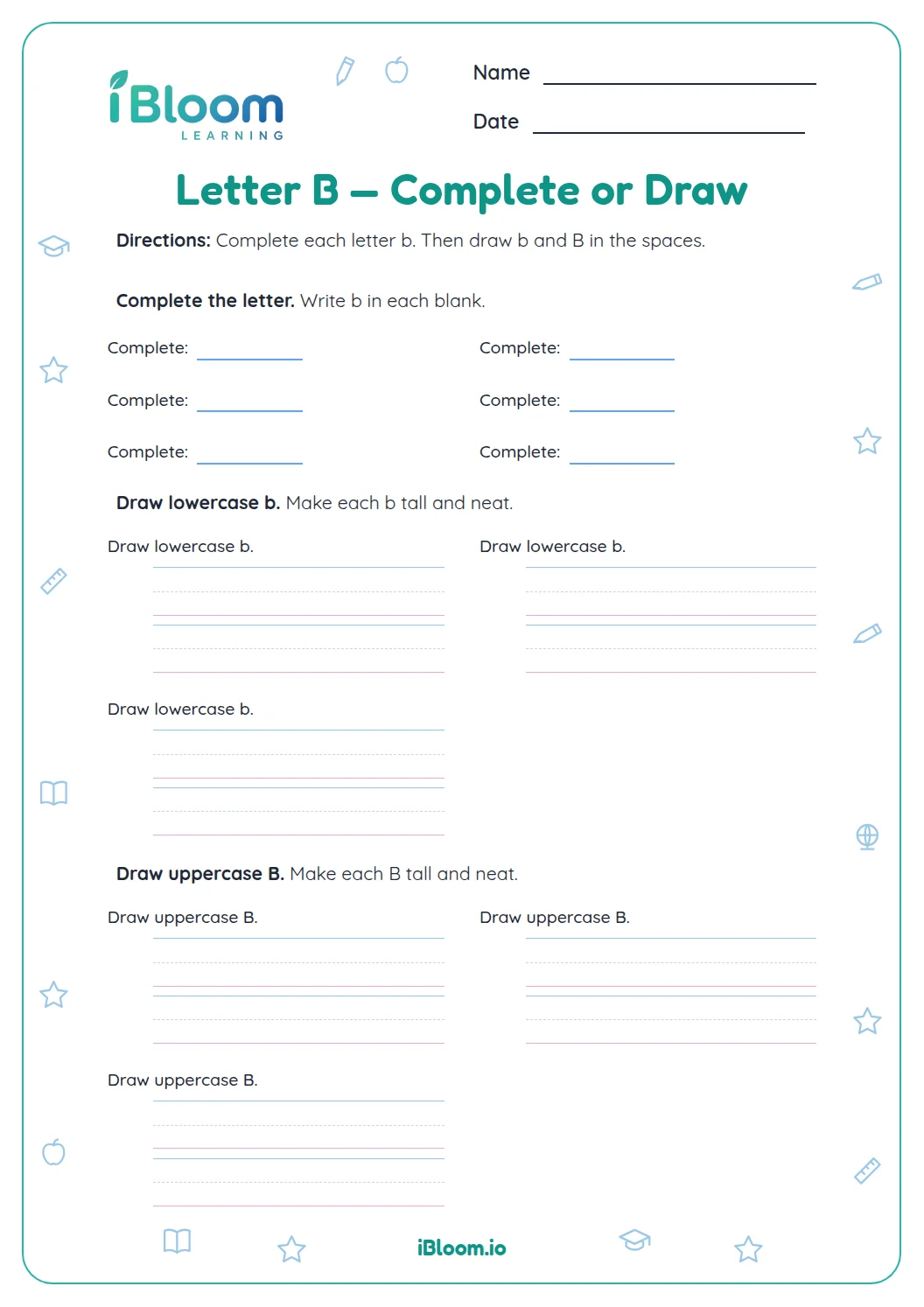
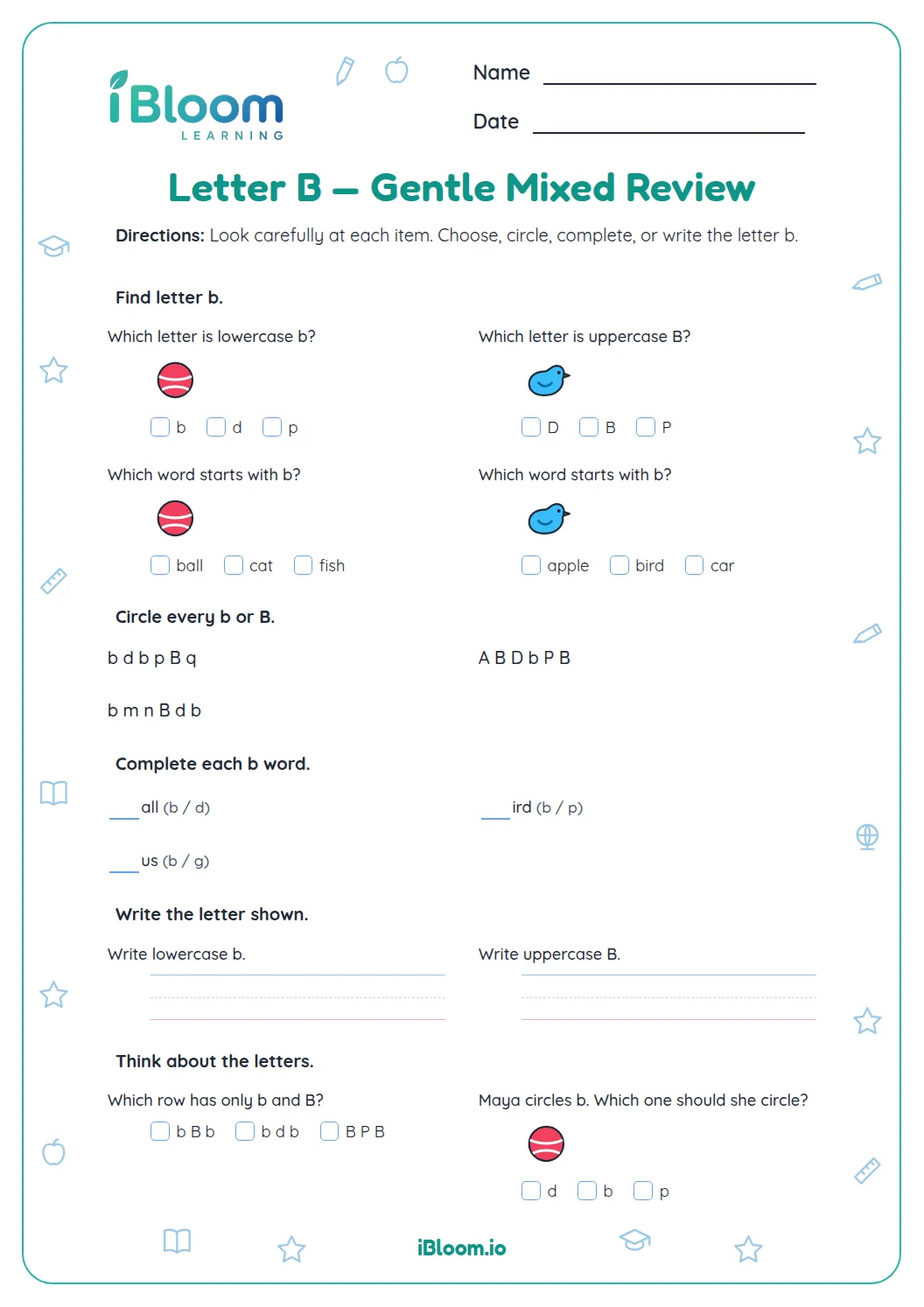
This free printable worksheet gives preschool and kindergarten children a familiar reason to print B and b: labeling things they can name. Children trace the two letter forms, add b to six picture labels, print uppercase B and lowercase b independently, and draw two everyday objects with b labels. An adult can read the directions and name each picture. The 12 activities practice letter printing and the consonant sound at the start of ball, book, bed, bus, bell, and boat, supporting Common Core L.K.1.a and RF.K.3.a. An answer key includes notes for the drawings.
Aligned to L.K.1.a and RF.K.3.a
How do you help a child form B and b?
For uppercase B, start with a tall line and add two curves on its right side. For lowercase b, make a tall line and one round part on the right near the bottom. Model the movement with a finger before the child traces Part A.
The independent printing tasks in Part C let you see whether the child can remember both forms after working with the picture labels.
How do the picture labels connect printing with sound?
Name each object together before writing. Then say its first sound briefly: /b/. The printed ending supplies the rest of the word, so the child only needs to add the lowercase letter. The eight labels are ball, book, bed, bus, bell, and boat.
- 1Name the ball picture: ball.
- 2Say the first sound: /b/.
- 3Write b in ___all.
- 4Read the completed label: ball.
What should children put in the drawing boxes?
Part D asks for a ball and a book, each with a lowercase b beside it. A simple round ball and a rectangle with a line for the book’s fold are enough. Look for a recognizable object and the requested letter rather than artistic detail.
Invite the child to point to the drawing, say its name, and say /b/. The answer key describes an acceptable drawing; individual pictures will vary.
How to work through this sheet
- 1Name a ball and a book together, emphasizing their first sound.
- 2Model uppercase B and lowercase b, then trace Part A.
- 3Name each picture in Part B and say /b/ before filling the blank.
- 4Let the child print both forms independently in Part C.
- 5Finish with the two drawings and ask the child to read each b label aloud.
Mistakes to notice and how to help
The mistake
Writing uppercase B in every picture label.
The fix
Point to lowercase b in Part A and explain that these object labels use small letters.
The mistake
Drawing the round part of b on the left of the stem.
The fix
Compare with the model: the tall line comes first, with the round part on its right.
The mistake
Saying the letter name instead of its sound during the sound step.
The fix
Say both clearly: the letter is named B; its sound at the start of ball is /b/.
Common Core alignment
Trace and independently print uppercase B and lowercase b.
On this sheet: Children trace both forms, print them independently, and add b to picture labels.
Show the official wordingHide the official wording
Print many upper- and lowercase letters.
Say /b/ at the start of eight familiar picture names.
On this sheet: Part B asks children to say the first sound before printing the missing b.
Show the official wordingHide the official wording
Demonstrate basic knowledge of one-to-one letter-sound correspondences by producing the primary sound or many of the most frequent sounds for each consonant.
What to practice next
Make more practice
Further reading
Questions parents and teachers ask
Does my child need to read all six words?
No, an adult can name each picture and read the directions. Children say the first sound and supply b in the label. The printed word endings give the rest of each word, allowing attention to stay on the letter form and its sound.
Which B words are used on this sheet?
The picture labels use ball, book, bed, bus, bell, and boat. These six nouns all begin with /b/. The drawing tasks return to ball and book so children can use the same letter with objects they have already named and labeled during the activity.
How can I help if b faces the wrong way?
Point to the tall line and show that the round part sits on its right near the bottom. Trace the model slowly with a finger, then try one new b in the printing space. Return to the picture label and read the word together afterward.
What counts as a correct drawing response?
A recognizable ball or book with a lowercase b beside it meets the direction. The ball can be plain or patterned, and the book can be open or closed. Ask the child to name the object so you can connect the drawing, sound, and letter.
How should I use the answer key with a young child?
Use the key to check the missing letters and the two independent printing tasks. Compare the traced forms with the model, and discuss the drawing notes together. Praise a specific feature, such as a tall stem, then model one small correction for the next attempt.