







About this worksheet
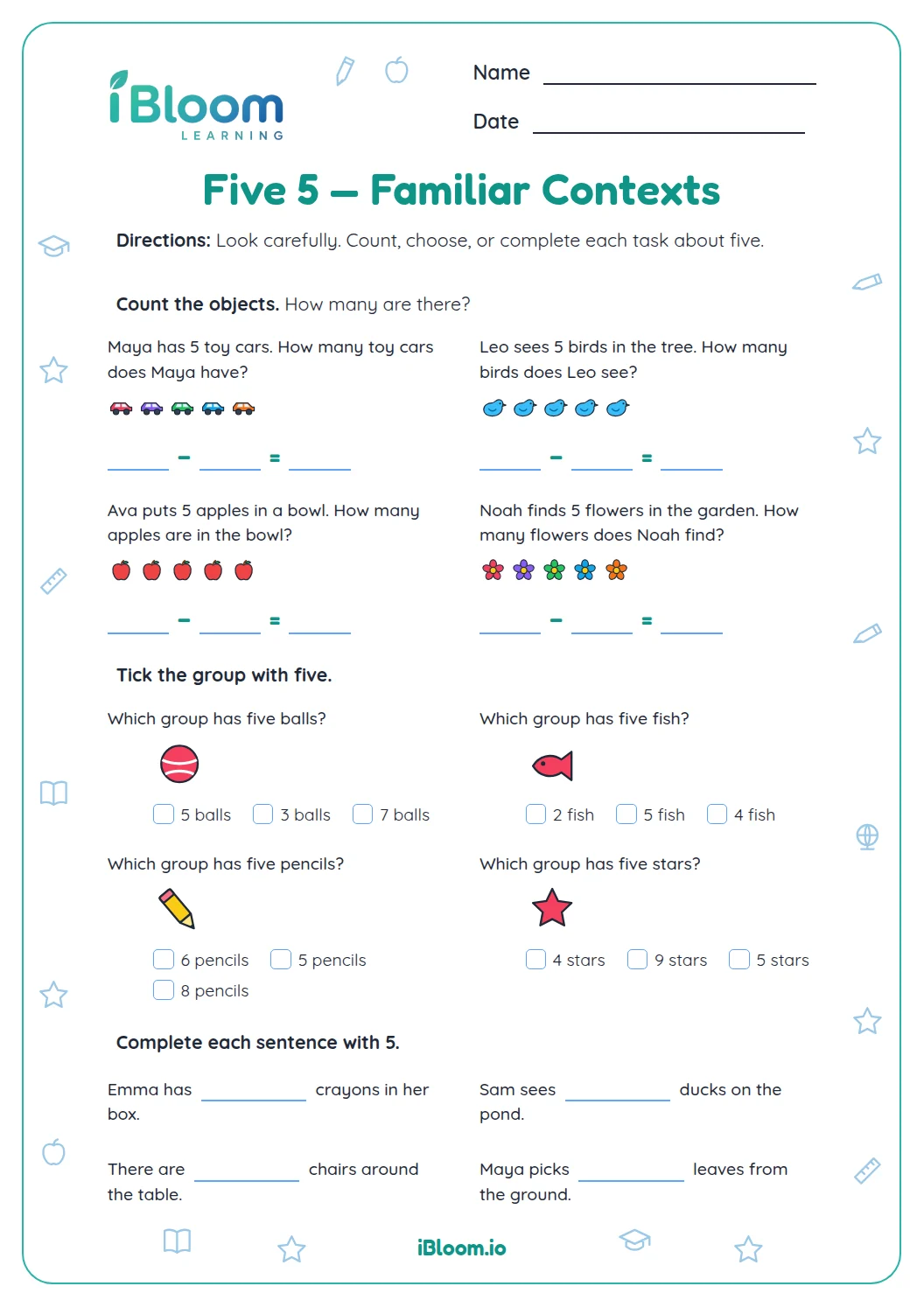
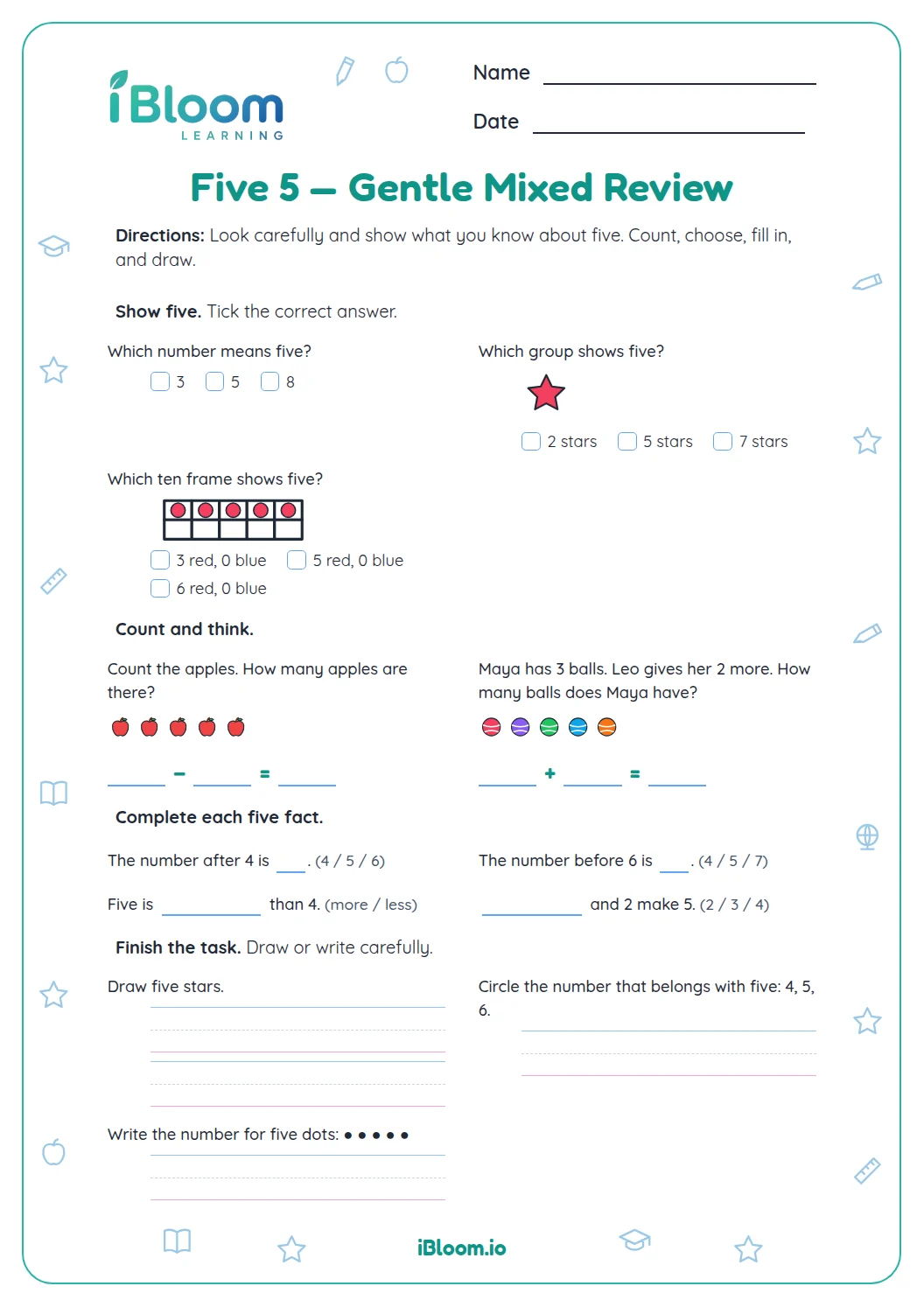
This free printable worksheet is built around one number, 5, for children in Kindergarten or older preschool. Children count groups of apples, stars, flowers and fish to decide what is five, choose the numeral 5 and the word five, finish four facts that make 5 such as 3 + ___ = 5 beside pictures of balls, trace the numeral, and draw 5 stars and 5 flowers. It practices Common Core K.CC.A.3 (writing numbers) and K.OA.A.3 (making 5 from parts), and every direction can be read aloud. A separate answer key is included.
Aligned to K.CC.A.3 and K.OA.A.3
What should a child know about the number 5?
Kindergarten children connect three things about each number: the written numeral 5, the spoken word five, and the quantity of 5 objects. They also learn that 5 comes right after 4, that it is one more than 4, and that it can be made from smaller numbers. The worksheet touches each idea at least once.
Five is also a natural landmark. It is the number of fingers on one hand, which gives children a way to check their work as they count.
How do children learn to make 5 from smaller numbers?
Start with a hand: hold up five fingers, then fold one down. Four fingers are up and one is down, so 4 + 1 = 5. Fold another and you have 3 + 2 = 5. Each fact is a different way to break the same 5 into two parts.
Part B shows a row of balls beside each fact and asks for the missing part: 4 + ___ = 5, 3 + ___ = 5, 2 + ___ = 5 and 5 + ___ = 5. The balls show the first part, and children think how many more make 5. In the last one the missing number is 0, which shows children that adding nothing leaves the number the same.
- 13 + ___ = 5
- 2Count the 3 balls. Show 3 fingers up.
- 3How many more fingers make 5?
- 42 more fingers.
- 5Answer: 3 + 2 = 5, so the missing number is 2
What is on this worksheet?
Four parts, from recognizing to making. Part A starts with four groups of pictures to count, then three questions about the numeral, the word five and the number after 4. Part B has four facts that make 5, each with balls to count. Part C has the numeral 5 to trace and copy. Part D asks children to draw 5 stars and 5 flowers on writing lines and count them out loud.
- Part A: 4 groups to count (5 apples, then stars, flowers and fish that are 4, 5 and 6) and 3 questions about the numeral, the word and the number after 4
- Part B: 4 facts that make 5, from 4 + 1 to 5 + 0, each beside balls
- Part C: trace the numeral 5, then write it
- Part D: draw 5 stars and 5 flowers on writing lines
- Answer choices include numbers that are easy to mix up with 5, such as 2 and 6, and the words four and six
Why does the sheet ask children to count and draw five things?
Counting and drawing make the quantity concrete. A child who counts 4 stars and sees that five is not there has to look at the whole group. A child who draws 5 stars has to count as they go and stop at 5, which is the idea behind K.CC.B.5, counting out a given number of objects. Drawing is also a low-pressure way to show understanding, because the shapes do not have to be neat.
How to use this worksheet at home or in class
- 1Warm up with five small objects: count them together, touch each one and say the number, and finish by saying "five."
- 2Read the first four questions in Part A aloud, one at a time. Ask your child to touch each picture and count out loud, then mark the answer.
- 3Read questions 5 to 7 aloud. Let your child choose the numeral and the word, then use fingers to find the number after 4.
- 4In Part B, count the balls first, then use fingers or counters to show each fact and ask, "How many more make 5?"
- 5For tracing, let your child trace the gray 5 with a finger first, then with a pencil, then write a few alone.
- 6Have your child draw, then touch each shape and count out loud. Check the answers with the answer key.
Common mistakes and quick fixes
The mistake
Saying yes to 4 stars or 6 fish because the group looks close to five.
The fix
Count together and touch each picture once. Then hold up 5 fingers beside the group and match them one to one.
The mistake
Skipping an object or counting one twice while drawing, so ending up with 4 or 6 shapes.
The fix
Draw one shape at a time and say the number as each one is finished. Touch each shape again when counting to check.
The mistake
Answering 5 + ___ = 5 with 5 or 1, because the number already seems complete.
The fix
Use five counters, add none, and count again. Ask, "Did the group change?" Adding zero leaves it the same, so the answer is 0.
Common Core alignment
Most US states use the Common Core counting and operations standards or a close state version. These Kindergarten standards are the ones this sheet practices.
Recognize, trace and write the numeral 5, and show 5 with a drawing.
On this sheet: Main standard: children recognize, trace and write the numeral 5 and match it to drawn objects.
Show the official wordingHide the official wording
Write numbers from 0 to 20. Represent a number of objects with a written numeral 0-20 (with 0 representing a count of no objects).
Break 5 into two parts in more than one way, such as 4 + 1 and 3 + 2.
On this sheet: Part B: four equations that find the missing part of 5, with balls showing the first part.
Show the official wordingHide the official wording
Decompose numbers less than or equal to 10 into pairs in more than one way, e.g., by using objects or drawings, and record each decomposition by a drawing or equation (e.g., 5 = 2 + 3 and 5 = 4 + 1).
What to practice next
Make more practice
Further reading
Questions parents and teachers ask
What should a kindergartener know about the number 5?
A kindergartener should recognize the numeral 5, say the word five, count out 5 objects and know that 5 comes after 4 and before 6. They also begin to see that 5 can be broken into parts, like 4 + 1 and 3 + 2. This sheet touches each of those ideas.
Is this worksheet suitable for preschoolers?
Older preschoolers can do parts of it with a grown-up: counting the pictures, choosing the 5, tracing and drawing five things. Part B, with addition facts, is meant for Kindergarten. Use real objects, such as five blocks, to help younger children count. Let your child's comfort set the pace.
What are the answers to Part B?
The four missing numbers are 1, 2, 3 and 0, in the order the facts are printed: 4 + 1, 3 + 2, 2 + 3 and 5 + 0. All of them make 5. The answer key lists every answer on the sheet, with a sample for each drawing in Part D.
Why is 5 + ___ = 5 on the sheet?
Question 11 shows that adding 0 leaves a number unchanged. It is the last fact because it is the least obvious. If your child says 5, hold up five fingers, add none and count again. Then ask whether the group changed when nothing was added.
What should my child draw for questions 13 and 14?
They should draw exactly 5 stars for question 13 and 5 flowers for question 14, then count them out loud. The shapes can be simple. Neat drawing is not the goal. What matters is that the child counts each one once and stops at five.
How long does the worksheet take, and is there an answer key?
Most children finish in about 15 minutes with a grown-up reading each direction aloud. Younger children can do the sheet in two sittings, such as Part A first. There is an answer key on separate pages that shows each answer and a sample for the drawings.