







About this worksheet
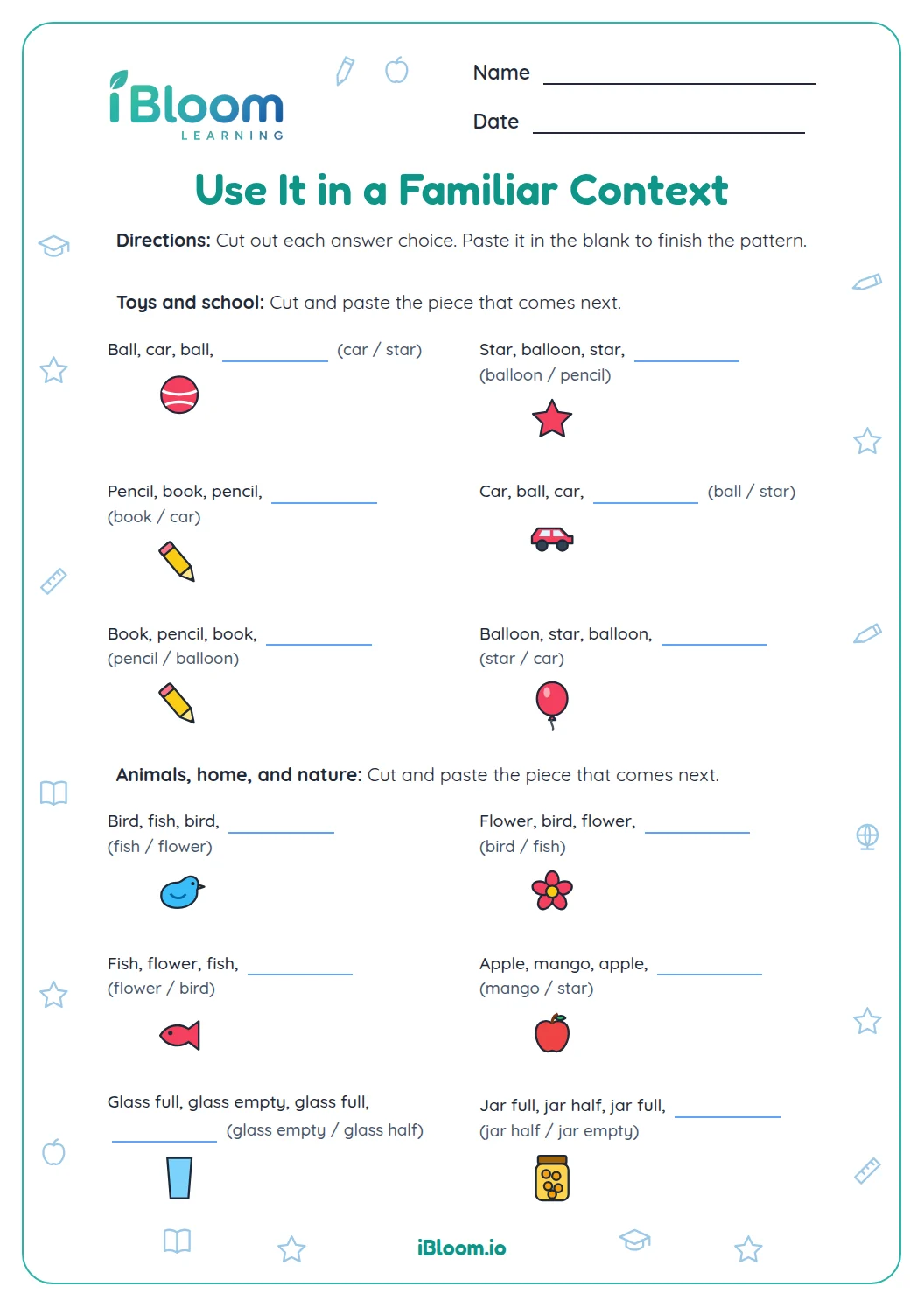
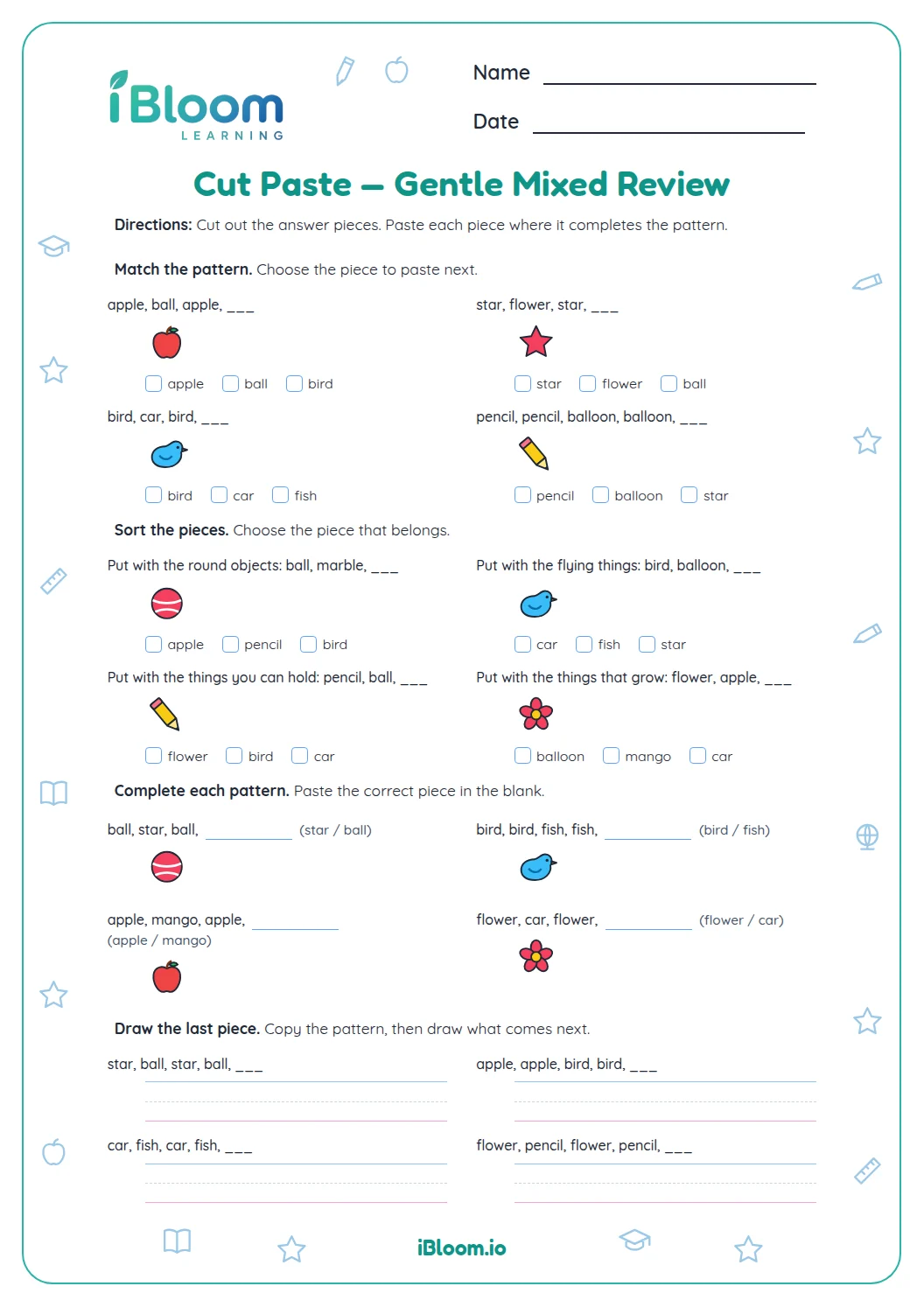
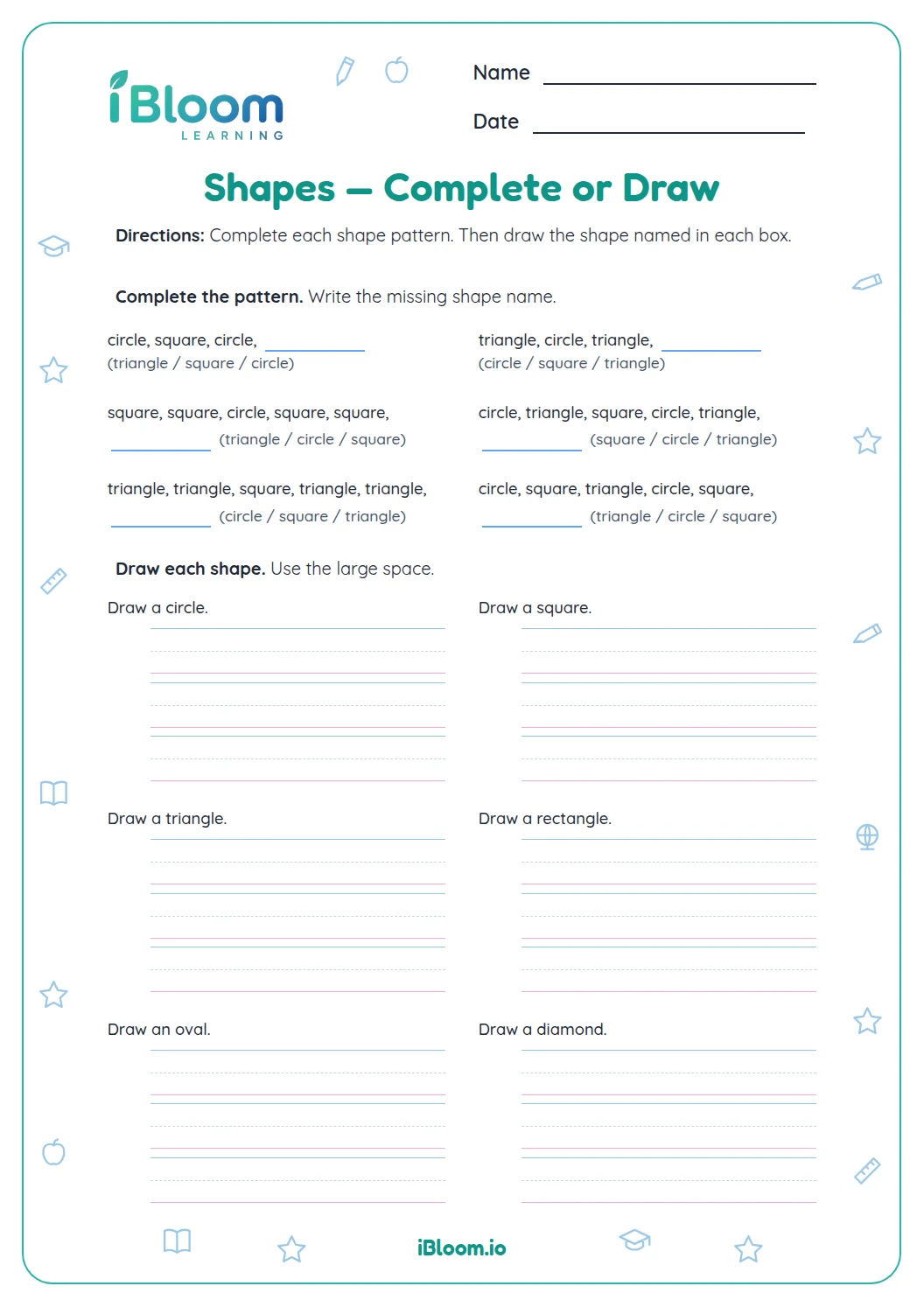
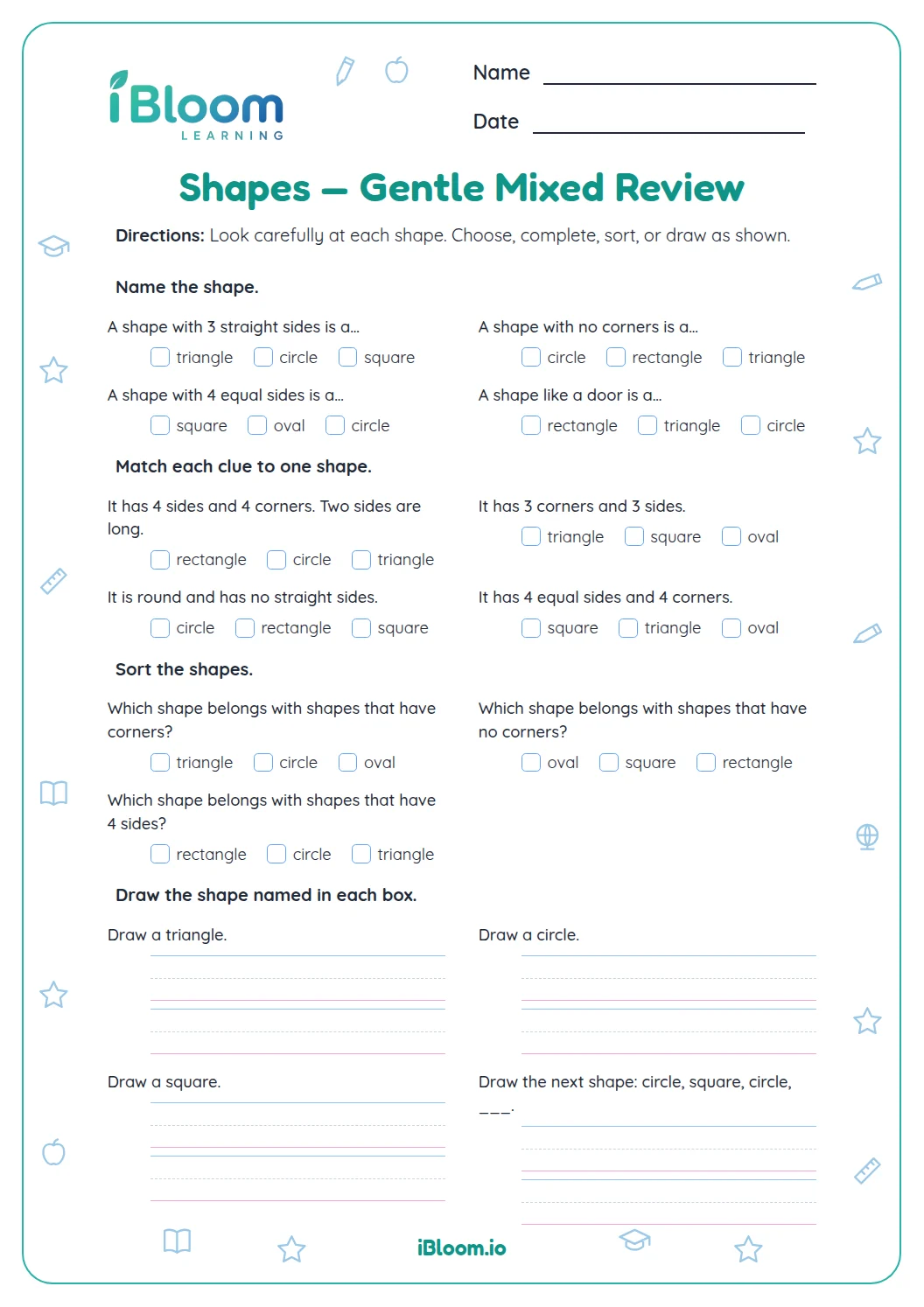
This free printable worksheet gives Pre-K and Kindergarten children twelve picture patterns to complete. Each row repeats shapes, fruit, animals or weather pictures, and children fill in the bubble under the picture that comes next. The patterns start with two pictures in turn, such as circle, square, circle, square. They go on to a pattern with one picture used twice, and end with three different pictures that repeat. The sheet has 12 questions in 3 parts on 2 pages, with a 2-page answer key. Children choose pictures, so no cutting, pasting or reading is needed.
What is a repeating pattern?
A repeating pattern is a group of pictures that comes around again and again in the same order. Children find the group, which grown-ups call the core, and then say what comes next. Learning to see the repeating group is the main skill on this sheet.
Every row shows a pattern that has started to repeat at least once, so the group can be seen before the answer is asked for. Two pictures alternate in Part A. In Part B one picture is used twice in each group. Part C has three different pictures in each group.
- 1The row shows star, star, heart, star, star.
- 2The group that repeats is star, star, heart.
- 3The row has finished star, star, so the heart comes next.
- 4Answer: the heart
What are the three parts of the sheet?
Part A has four patterns with two pictures in turn: circle and square, sun and moon, apple and banana, and cat and dog. Part B has four patterns that repeat a group of three, with one picture used twice: star star heart, triangle circle circle, fish fish bird and flower bee bee.
Part C has four patterns with three different pictures: circle, square, triangle; apple, pear, banana; sun, cloud, rain; and car, bus, bicycle. Part C is the hardest because children must hold three pictures in order in their heads.
- Questions 1 to 4: two pictures in turn (an AB pattern)
- Questions 5 to 8: one picture used twice (AAB and ABB patterns)
- Questions 9 to 12: three different pictures (an ABC pattern)
Why do children pick a picture and not cut and paste?
Picking the next picture is the same thinking as pasting it into the row. The child still has to see the group and place the right picture next. It also keeps the sheet quick and tidy, and it works for children who find scissors hard.
If your child enjoys cutting, you can make it a hands-on game. Cut out small pictures or use blocks and counters, build each row on the table, and let your child add the next piece.
How do I help a child who cannot find the pattern?
Say the pictures aloud with a beat, such as clap, tap, clap, tap. Hearing the pattern often helps before seeing it. Then point to each picture as you say it, and stop at the last one.
If your child still struggles, build the same row with real objects such as two colors of blocks, and remove the last block. Ask what goes there, then match the answer with the sheet.
How to use this worksheet at home or in class
- 1Make a quick pattern on the table with blocks, such as red, blue, red, blue. Ask your child what comes next.
- 2Show question 1 and say the pictures out loud together: circle, square, circle, square.
- 3Ask what comes next, and have your child fill in the bubble under that picture.
- 4Let your child do the rest of Part A alone, saying each row out loud before choosing.
- 5In Parts B and C, point out the group that repeats, by tapping each picture in the first group.
- 6Check the answers with the answer key, then ask your child to make a new pattern with toys or crayons.
Common mistakes and quick fixes
The mistake
Choosing the picture that appeared first or most often. In question 5 (star, star, heart, star, star) a child picks the star because there are four of them.
The fix
Ask your child to find the group that repeats: star, star, heart. The row has finished the stars of the second group, so the next one is the heart.
The mistake
Starting the pattern over too soon. In question 6 (triangle, circle, circle, triangle, circle) a child picks the triangle, because the row began with it.
The fix
Say the group aloud with the row: triangle, circle, circle. The row has only reached the first circle of the second group, so a second circle comes next.
The mistake
Skipping a picture in the three-picture patterns. In question 10 (apple, pear, banana, apple, pear) a child picks the apple, because it is the start of the row.
The fix
Ask what came after the pear the first time. It was the banana, so the banana comes after the pear this time too.
What to practice next
Make more practice
Further reading
Questions parents and teachers ask
What are the answers to the picture patterns worksheet?
Part A: 1 circle, 2 moon, 3 apple, 4 dog. Part B: 5 heart, 6 circle, 7 bird, 8 bee. Part C: 9 triangle, 10 banana, 11 rain, 12 bicycle. In each row, the answer is the picture that continues the repeating group. The answer key page marks the correct picture for every question.
What is an AB pattern and an ABC pattern?
An AB pattern repeats two things in turn, such as circle, square, circle, square. An ABC pattern repeats three different things, such as apple, pear, banana. Letters name the repeating group, and the same letters can stand for any pictures. Part A of this sheet has AB patterns and Part C has ABC patterns.
Does my child need to cut and paste on this worksheet?
No. Children fill in the bubble under the picture that comes next, so no scissors or glue are needed. The thinking is the same as pasting a piece into the row. If your child likes to cut, make small picture cards and build each row on the table before choosing.
My child can say the pattern but picks the wrong picture. What should I do?
Ask your child to say the whole row out loud and point to each picture as they say it. Then ask what comes after the last picture. A child may pick a favorite picture or the first one in the row. Slowing down and naming the repeating group helps.
What age is this worksheet for?
It suits ages 4 to 6, Pre-K and Kindergarten. Younger children can try the two-picture patterns in Part A with an adult. Children who find Part A easy can move on to Parts B and C, which use a repeating group of three pictures. You can read the directions aloud, since no reading is needed to answer.
How long does the worksheet take?
Most children finish in about 10 to 15 minutes. Part A goes quickly, and Parts B and C take more thought. If your child tires, do one page at a time, since each page holds six questions. It makes a good follow-up to building patterns with blocks, beads or toy animals.