






About this worksheet
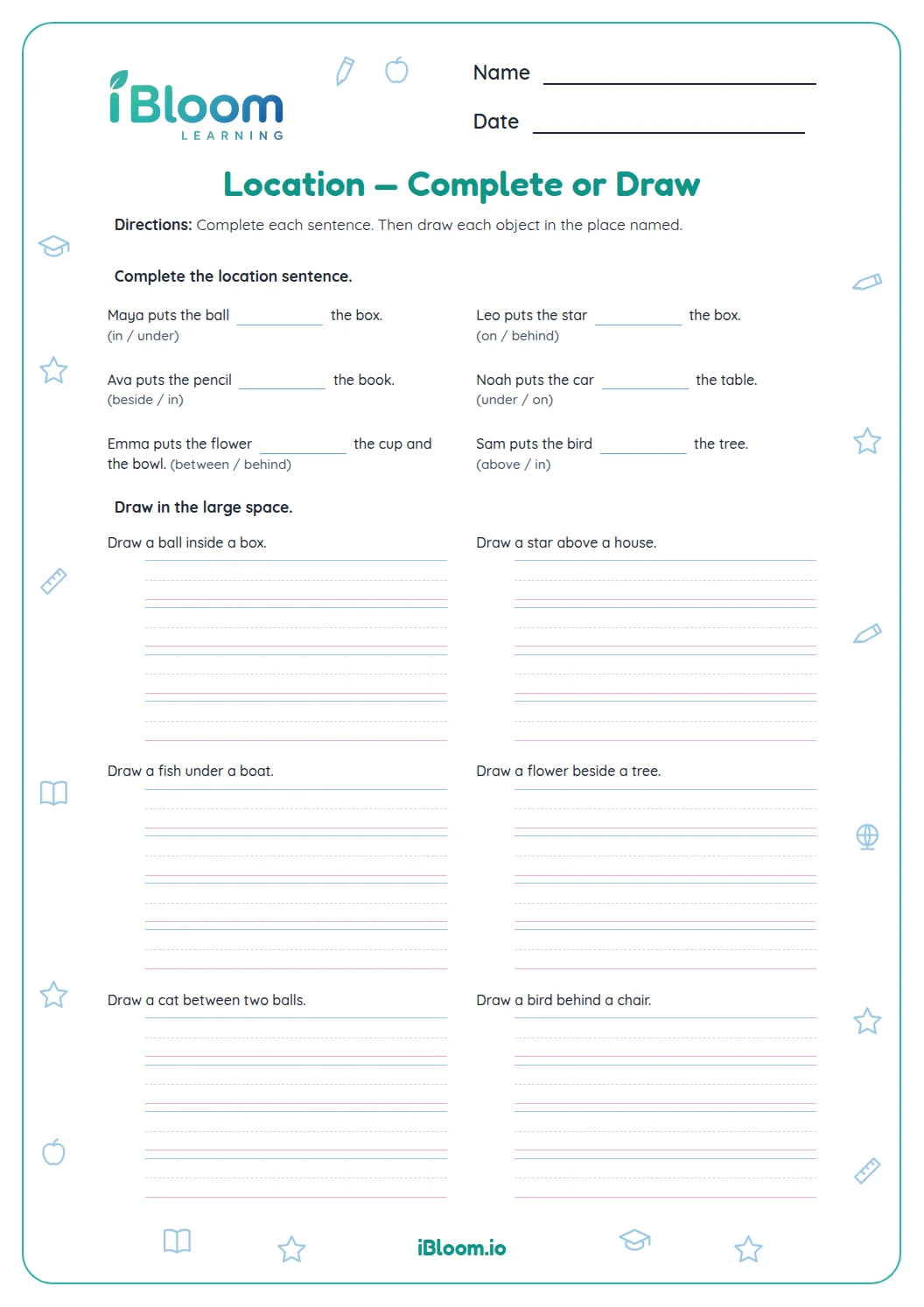
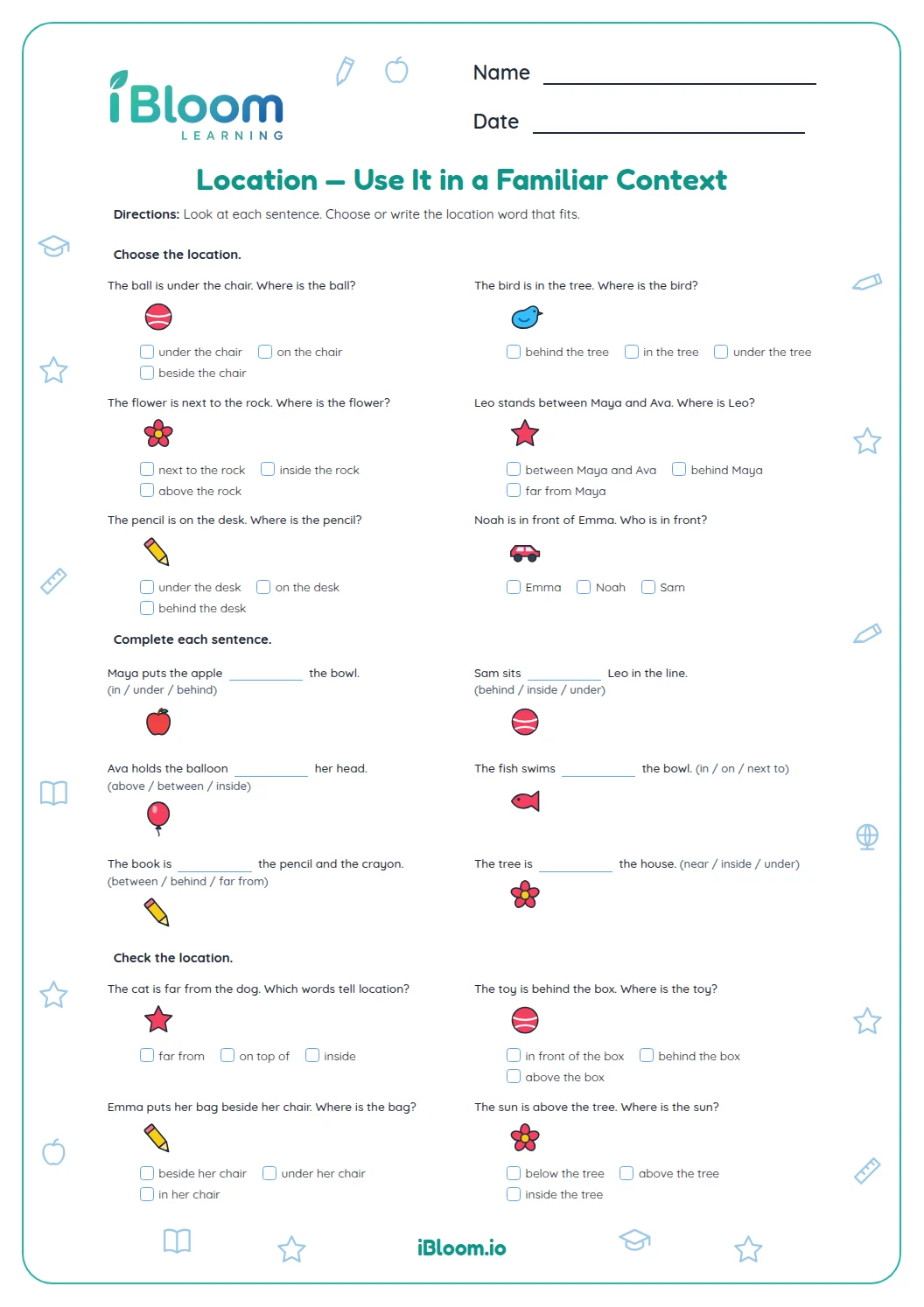
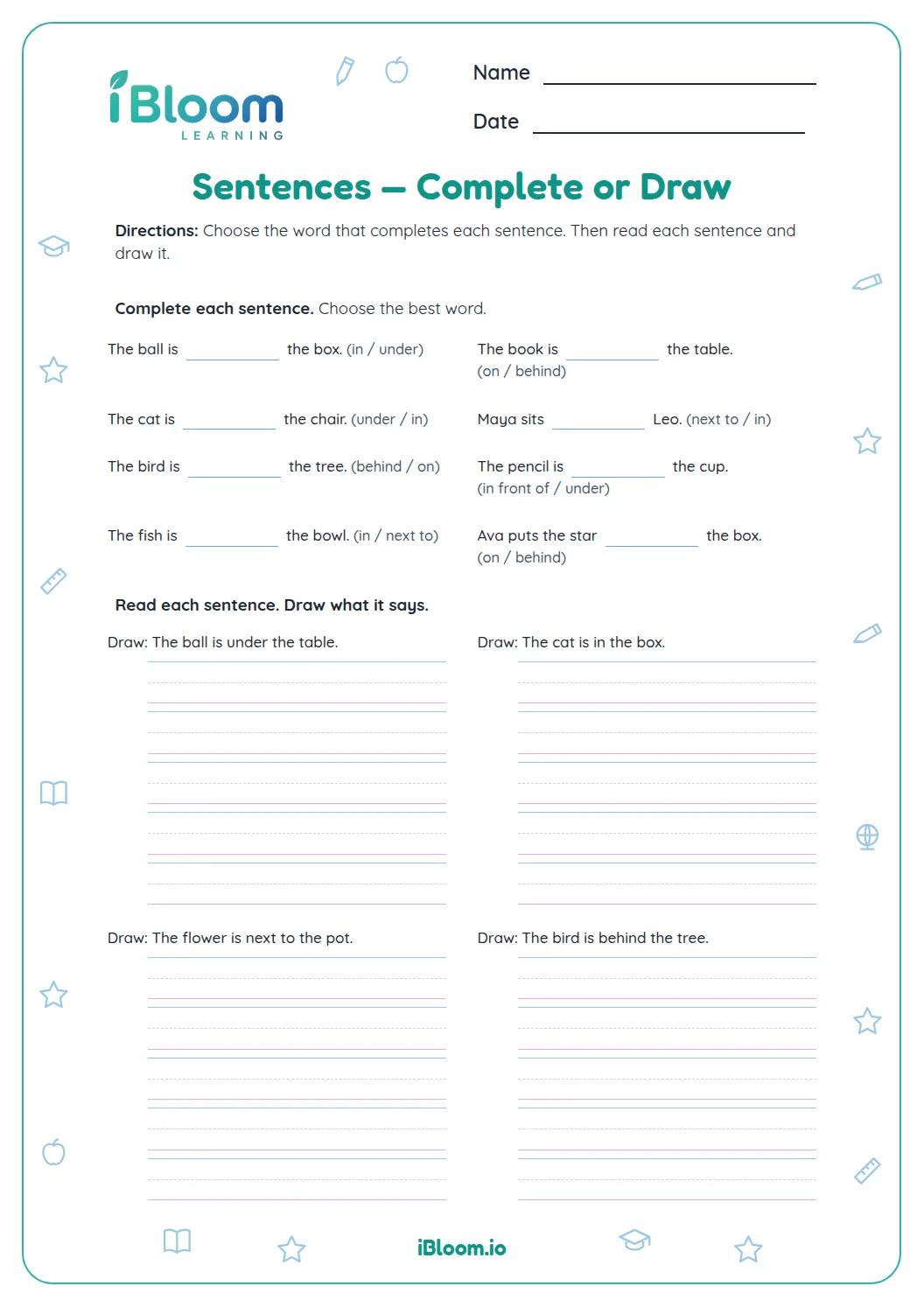
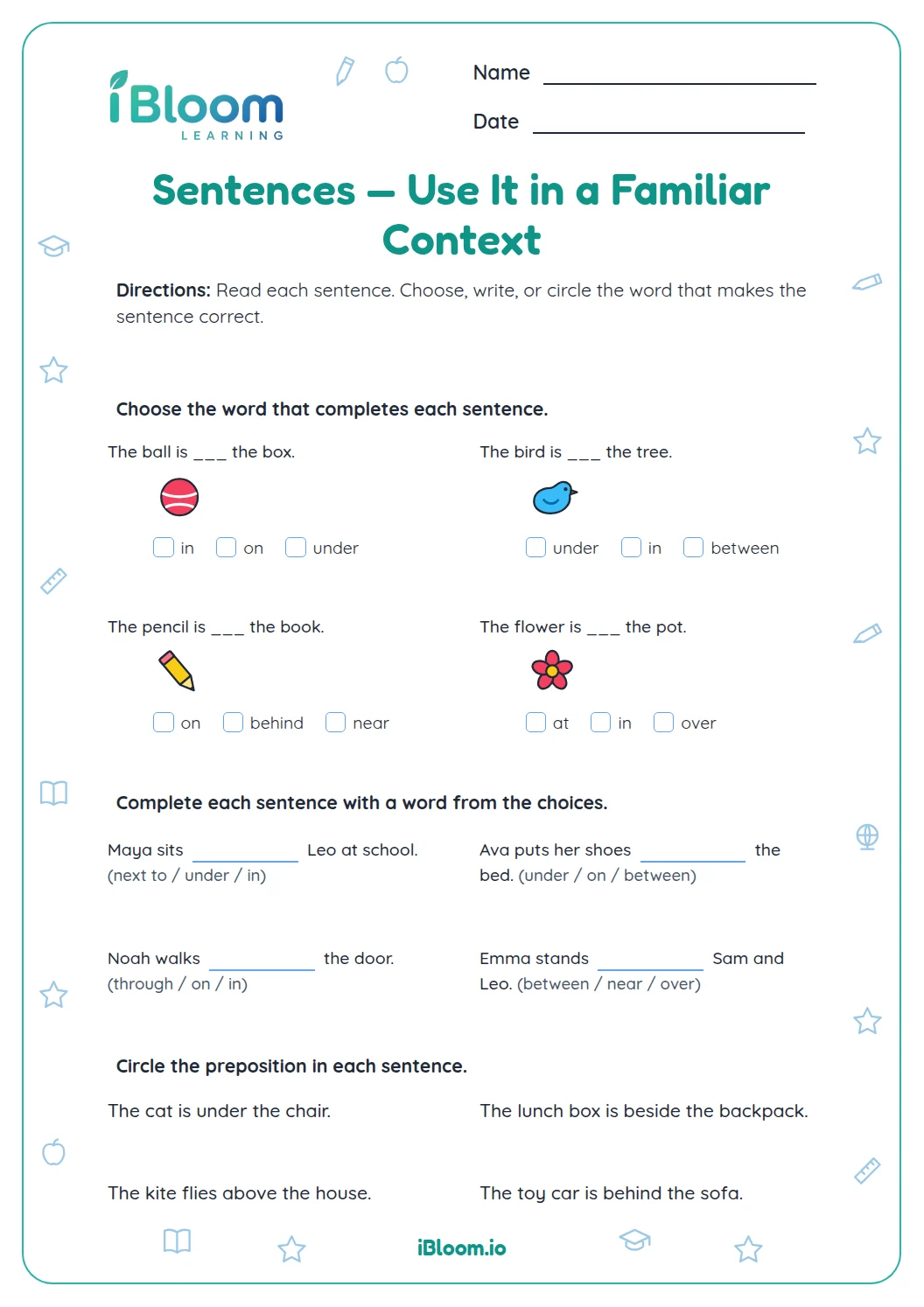
This printable helps preschool and kindergarten learners practice location words such as in, on, under and beside. Eight picture-supported sentences ask children to choose the word that completes each idea, followed by four drawing prompts that turn the same words into action. The activities build early language for describing where familiar objects are. Kindergarten learners practice Common Core L.K.1e.
Aligned to L.K.1e
How do children practice location words?
The first section connects a familiar object with a place word. Children read or hear a short sentence and choose the word that tells where the object is.
For example, “The cat is ___ the chair” asks learners to choose under or in. The picture clue helps them connect the sentence to everyday objects.
- 1The cat is ___ the chair.
- 2Choose under: the sentence tells where the cat is.
How do the drawing prompts reinforce meaning?
The second section asks children to draw an object in a named position. “Draw a ball under the line” gives a clear target: place the ball below the line.
The key accepts any clear drawing that matches the named position, so adults can check meaning rather than artistic style.
What is included on the pages?
There are eight picture-supported choices and four drawing activities. The answer key provides the choice words and describes what each drawing should show.
How can you use this worksheet?
- 1Say each sentence aloud and pause at the blank.
- 2Have the child point to the object named in the sentence.
- 3Read both location choices and act them out if needed.
- 4For a drawing prompt, point to the named place before drawing.
- 5Use the answer key to check the location, not the drawing style.
What mistakes should learners watch for?
The mistake
Choosing a word that names an object instead of its position.
The fix
Ask “Where is it?” and reread the sentence.
The mistake
Putting the drawing beside a line when the prompt says under.
The fix
Trace the line with a finger, then draw below it.
The mistake
Treating on and beside as the same location.
The fix
Show that on touches or rests on an object, while beside means next to it.
Common Core alignment
This worksheet gives focused practice with the named skill.
Use common prepositions to describe where things are.
On this sheet: Children use in, on, under and beside to describe locations.
Show the official wordingHide the official wording
Use the most frequently occurring prepositions (e.g., to, from, in, out, on, off, for, of, by, with).
What to practice next
Make more practice
Further reading
Questions parents and teachers ask
Which position words appear?
The choice items use in, on, under, and beside. Children also follow drawing directions with those words. For example, they choose where a ball is in relation to a box and draw another ball below a line. The repeated words connect each spoken or written direction to a position.
How many items are on the worksheet?
There are twelve items: eight picture-supported choice questions and four drawing prompts. The key lists each location word and describes the position a correct drawing should show. The pages move from recognizing a place word to showing its meaning independently.
Can an adult read the directions aloud?
Yes. An adult can read each sentence and both choices aloud while the child points to the familiar object. For a drawing prompt, read the location word clearly and invite the child to point to the named place before drawing.
What counts as a correct drawing?
A drawing is correct when the named object is clearly in the requested position. A star belongs inside the box for “in,” and a ball belongs below the line for “under.” Simple drawings are fine; the position is what matters.
How can I explain “beside”?
Beside means next to something. Place two small toys side by side and describe where each one is. Then connect that demonstration to the prompt about a fish beside a bowl; the child can point to the space next to the bowl before drawing.