






About this worksheet
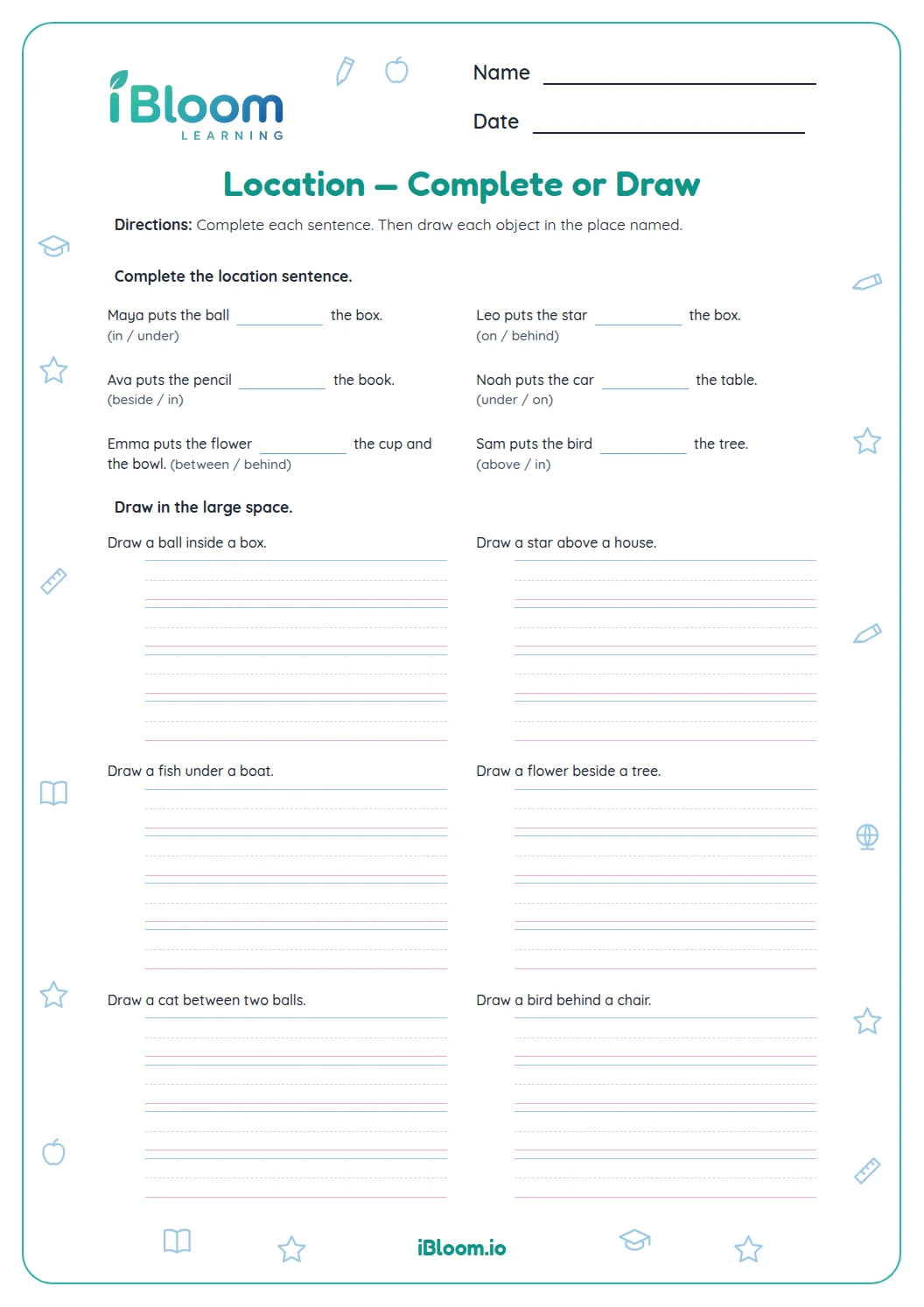
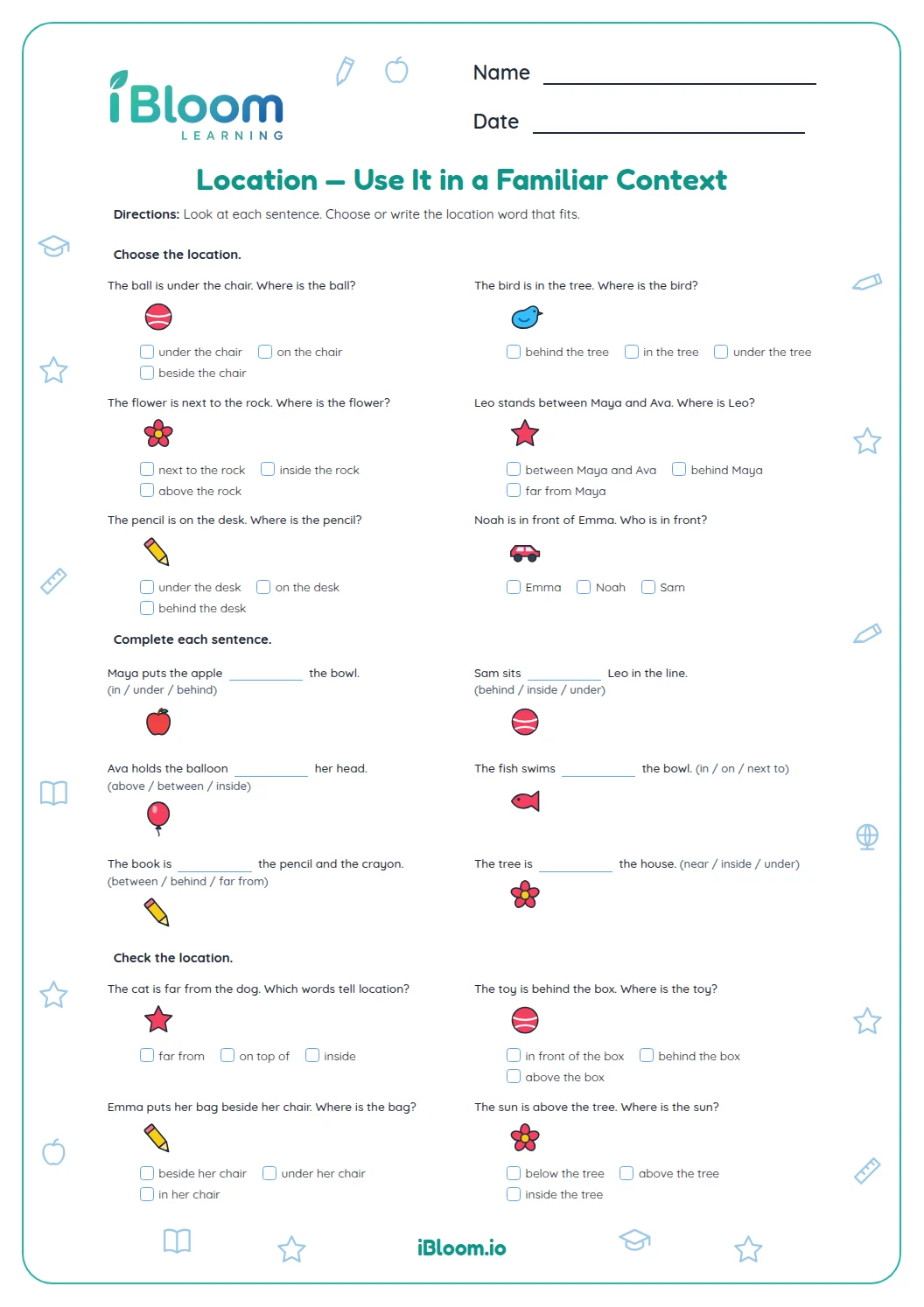
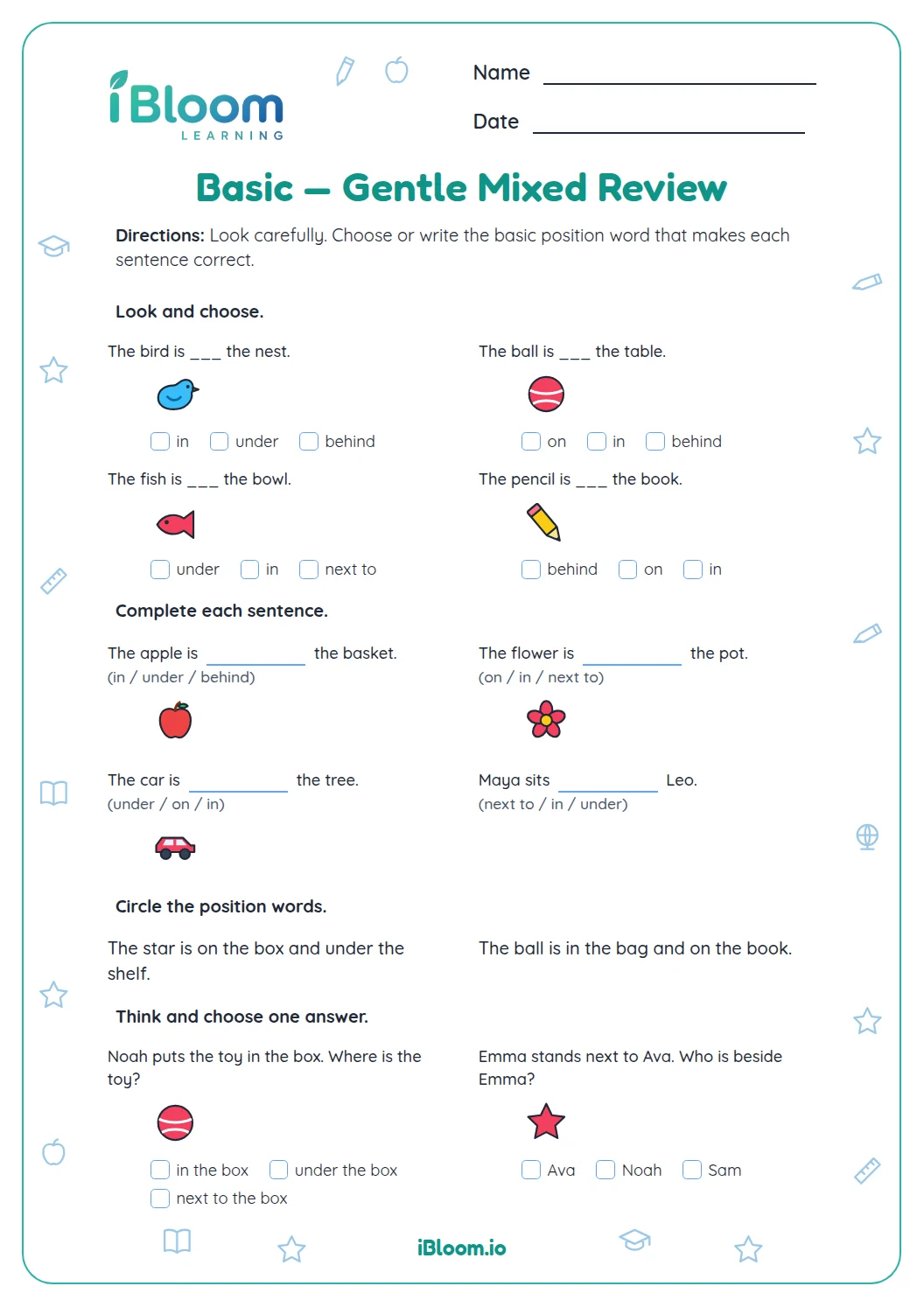
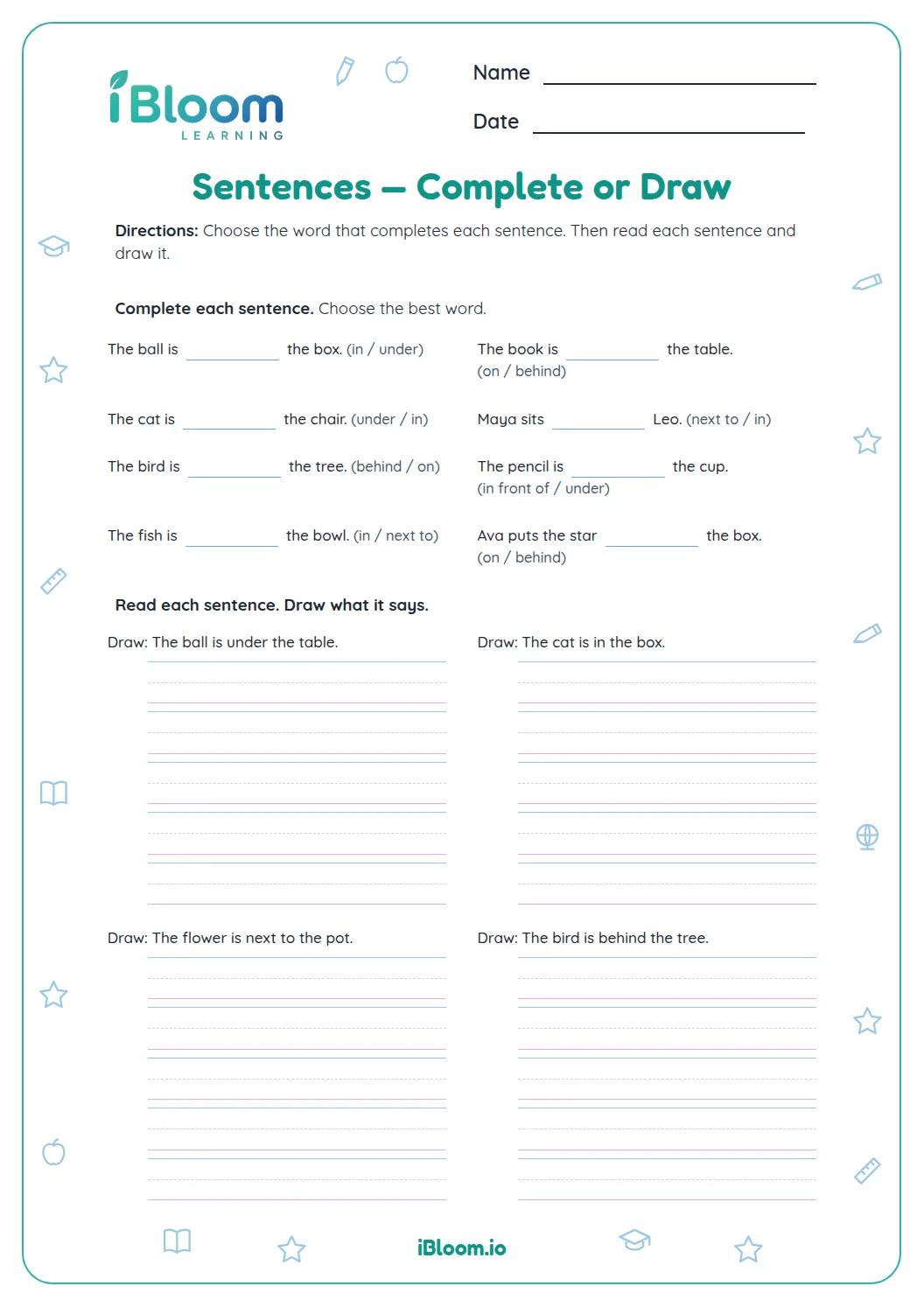
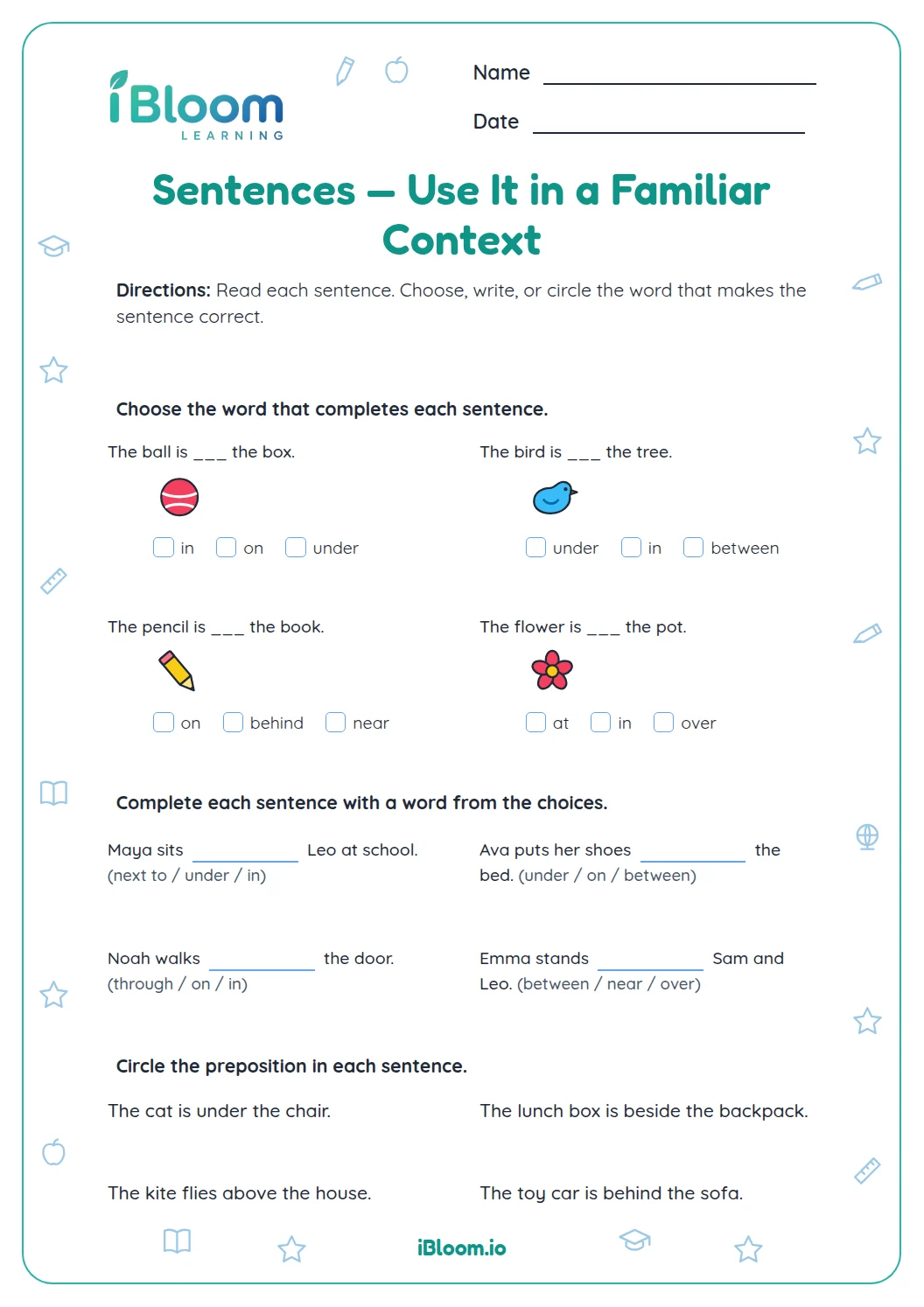
This gentle review gives preschool and kindergarten learners practice with words that tell where something is. The sheet starts with familiar object clues and picture icons, then moves to short blanks and sentences using words such as in, on, under, inside, and beside.
Aligned to L.K.1.e
Words that tell where?
Location words tell where one thing is compared with another. In means within a space; on means touching a top or surface; under means below something.
Point to the object and say its location in a short phrase. The picture-supported questions make a concrete start before the learner works with words in sentences.
Say it, then try it?
A learner may answer aloud, point to a choice, or write a word with adult help. For the last prompt, accept a clear sentence that uses beside to tell where one object is.
How to use this worksheet
- 1Name both objects in each picture clue.
- 2Say the location choices aloud and let the child point.
- 3For sentence questions, imagine the objects in the described place.
- 4Invite the child to make one location sentence of their own.
Common mix-ups
The mistake
Mixing up on and in.
The fix
Ask whether the object rests on a surface or sits inside a space.
The mistake
Using a color word when asked where.
The fix
Ask, “Where is it?” and look for a word that names a place or position.
The mistake
Treating beside and under as the same position.
The fix
Point to the objects and say whether they are next to each other or one is below the other.
The mistake
Treating beside and under as the same position.
The fix
Point to the objects and say whether they are next to each other or one is below the other.
The mistake
Treating beside and under as the same position.
The fix
Point to the objects and say whether they are next to each other or one is below the other.
Curriculum alignment
This worksheet gives focused practice with the skill named in its title.
Use common prepositions.
On this sheet: Learners recognize and use basic location prepositions.
Show the official wordingHide the official wording
Use the most frequently occurring prepositions (e.g., to, from, in, out, on, off, for, of, by, with).
What to practice next
Questions parents and teachers ask
What is a location word?
A location word tells where something is compared with another thing. Words on this page include in, on, under, and beside. Children can point, speak, or write a response depending on their comfort with print and early reading.
Can a preschooler answer aloud?
A preschool learner may say the word or point to a choice while an adult reads the prompt aloud. Writing each answer is not required for the child to practice the meaning of location words or understand where familiar objects are.
How can I explain in and on?
Use a familiar object. If a toy is inside a container, it is in the container. If it rests against the top surface, it is on the container. Saying the phrase while pointing makes the difference concrete and easy to remember.
What can we try after the worksheet?
Place a toy in, on, under, or beside a safe household object. Ask the child to describe where it is, then move it and invite a new location sentence using a different word from the worksheet. Try this again with another familiar object.
How can an adult help with this page?
Read the directions aloud and let the learner try each item before offering a clue. Ask the child to point to the part of the word, picture, or sentence that supports the answer. The answer key can help an adult check responses and talk through any uncertain item.