




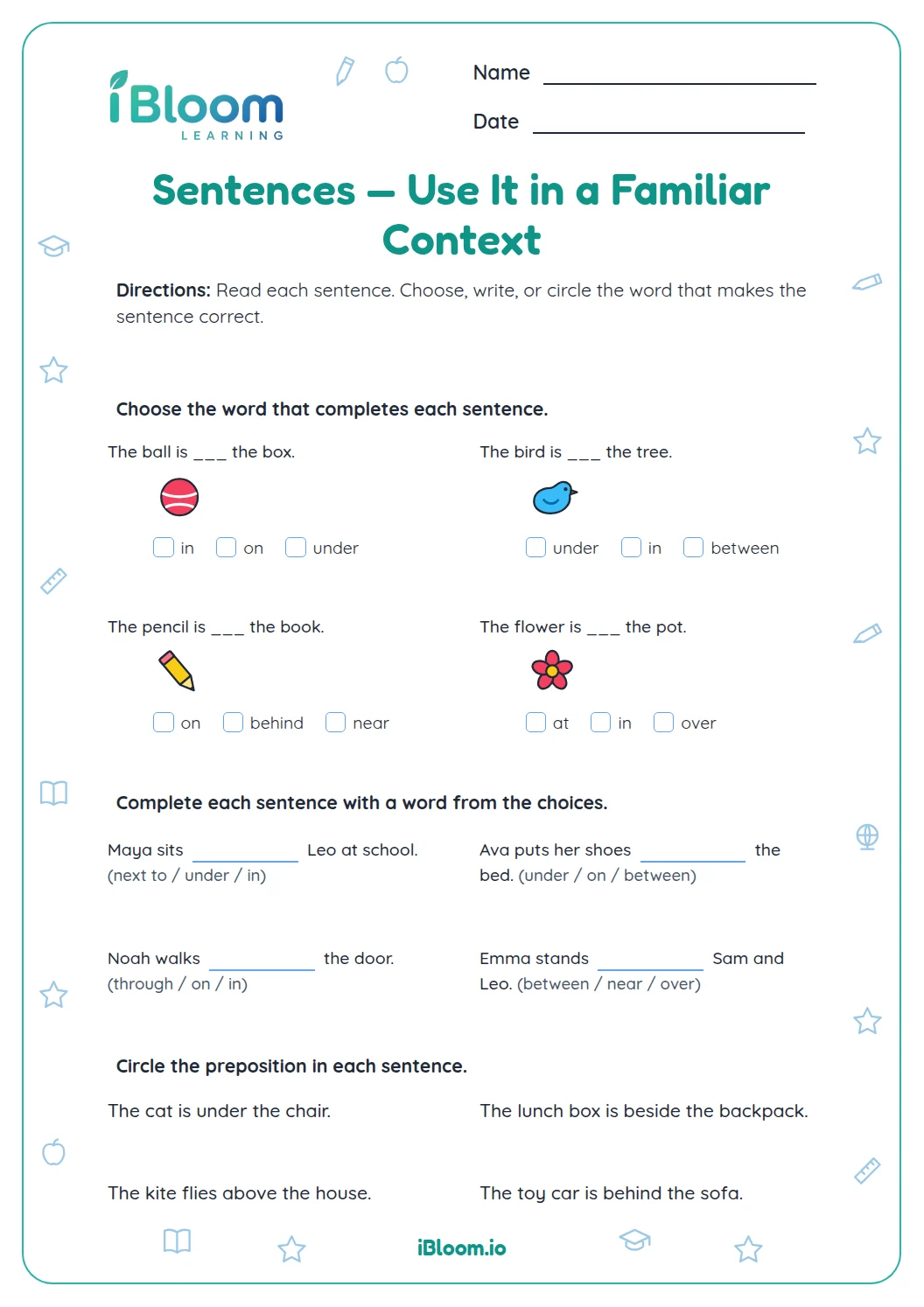


About this worksheet
This free printable worksheet gives preschoolers and kindergartners a first look at position words, using things they know from home and school: a fish in a bowl, a hat on a head, a cake in an oven. A grown-up reads each sentence aloud and the child picks the word that fits, such as in, on, under, behind, in front of or next to. Eleven activities cover five picture sentences, three clues about who is where, and three words to trace. It practices Common Core L.K.1.e, and a separate answer key is included.
Aligned to L.K.1.e
What are position words, and why do they matter now?
Position words, which grammar calls prepositions, tell where something is: in the bowl, on the head, under the umbrella. Young children use them every day when they follow directions such as put your coat on the hook.
This sheet puts the words on paper, with a picture next to each key noun and a grown-up to read aloud. Children do not need to read independently. They listen, think about the thing in the sentence, and pick the word that makes sense.
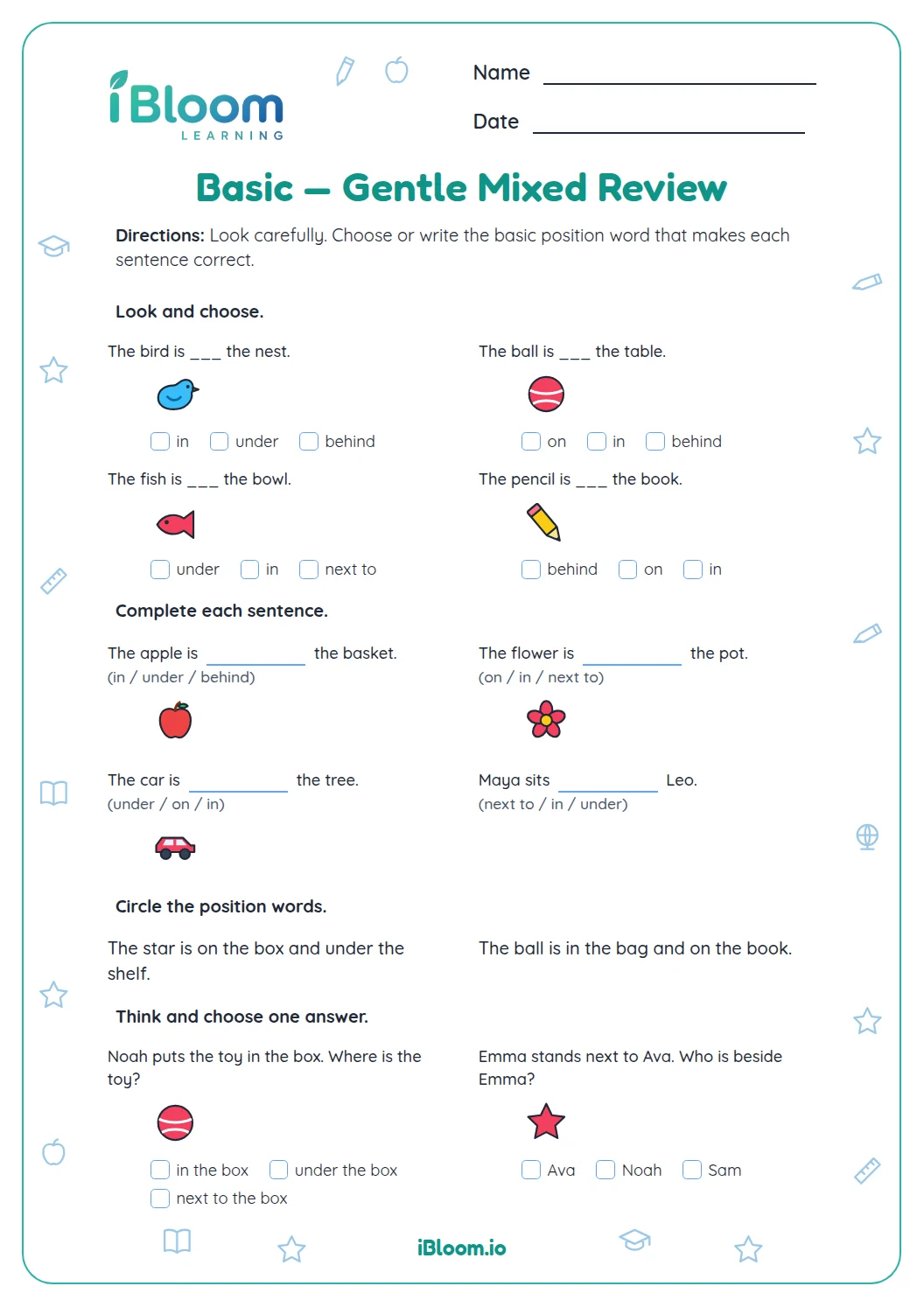
- 1The [fish] swims ___ the bowl.
- 2in: the fish is inside the water.
- 3on: a fish cannot swim on top of a bowl.
- 4under: it is not below the bowl.
- 5The fish swims in the bowl.
How do everyday things help children pick the right word?
Hats go on heads, cakes bake in ovens and coats hang on hooks. Part A relies on what children already know about these things, so the right word feels natural when they hear the sentence.
If your child hesitates, act it out. Put a toy fish in a bowl, a hat on a doll's head or an umbrella above a block. Seeing and saying the word together is the quickest way to make it stick.
How do the line clues work?
In Part B, the clue comes from the sentences. Mia is first in line and Ben is second, so Ben stands behind Mia. In question 8, a row of animals shows which one is next to the dog.
Standing in a line with your child, taking turns to be in front and behind, makes these words clear in a few seconds.
What is on this worksheet?
Eleven activities in three parts. Children listen, choose and trace, and the sheet uses only short, familiar words.
- Part A, Pick the word: five sentences with a picture of the main thing, using in, on and under
- Part B, Read the clue: two line sentences (behind, in front of) and one row of animals (next to)
- Part C, Trace the word: in, on and under, each repeated to trace
- A two-page answer key with every choice marked
How to use this worksheet at home or in class
- 1Gather a cup, a block and a book. Put the block in, on and under each one while saying the position word.
- 2Read each Part A sentence aloud, pausing at the blank. Let your child say the word before pointing to it.
- 3For Part B, stand in a line with your child and take turns being in front and behind. Then read the clue.
- 4For question 8, point at the row of animals and ask your child to touch the one beside the dog.
- 5Let your child trace in, on and under in Part C. Say each word out loud as the pencil moves.
- 6Check with the answer key and play a short game of Simon Says: put your hand on your head, under the table, next to a friend.
Common mistakes and quick fixes
The mistake
Choosing on for the fish sentence, as in The fish swims on the bowl.
The fix
Put a toy fish in a cup of water. Ask: is the fish inside the water or on top of the cup? Then say the sentence together with in.
The mistake
Mixing up in front of and behind when someone is second in line.
The fix
Line up two toys. The first toy is in front of the second. The second toy is behind the first. Say both sentences while pointing.
The mistake
Choosing on for I stand ___ my umbrella, because umbrellas are held up high.
The fix
Hold an umbrella over your child. Ask where they are standing: under the umbrella. Rain falls on top, and your child stays dry under it.
Common Core alignment
This sheet practices the everyday position words that kindergarten language work begins with.
Use common position words such as in, on and under in sentences.
On this sheet: Children choose in, on, under, behind, in front of and next to to complete everyday sentences, and trace in, on and under.
Show the official wordingHide the official wording
Use the most frequently occurring prepositions (e.g., to, from, in, out, on, off, for, of, by, with).
What to practice next
Make more practice
Further reading
Questions parents and teachers ask
Does my child need to read to do this worksheet?
No. A grown-up reads each sentence aloud, and the pictures in Part A stand in for the main word, so preschoolers who cannot read yet can still answer. Kindergartners who know a few words can try reading in, on and under themselves. If the words are new, act them out with real objects before Part A.
What is the answer to The fish swims ___ the bowl?
The answer is in. A fish swims inside the water in a bowl, so in is the position word that fits. On and under describe other places. This is question 1, and the answer key shows in. Act it out with a toy fish and a cup if your child is unsure.
Why do the Part A sentences have a picture in them?
The small picture of the fish, hat, umbrella, cake or coat stands in for the main word, so children who cannot read it still know what the sentence is about. They picture the thing and where it belongs. The picture shows only the object, not its position, so the child still has to choose the position word.
What does question 8 with the row of animals ask?
It asks which animal is next to the dog. The row shows a dog, a cat and a bird in that order, so the cat is right beside the dog and the bird is farther away. Children fill in the bubble beside the cat. Run your finger along the row to show what beside means.
Why do children trace in, on and under?
Tracing gives young children a first look at how short position words are spelled. As the pencil moves, children can say the word out loud, which links what they hear with the letters. The three words are common ones kindergarteners meet again in early reading, so they are worth seeing in print.
Is there an answer key for this worksheet?
Yes. A separate two-page answer key marks the correct word for each sentence in Parts A and B, the cat in question 8, and the traced words in Part C. Print the worksheet by itself and keep the key for checking, or download both from this page as a free PDF.