





About this worksheet
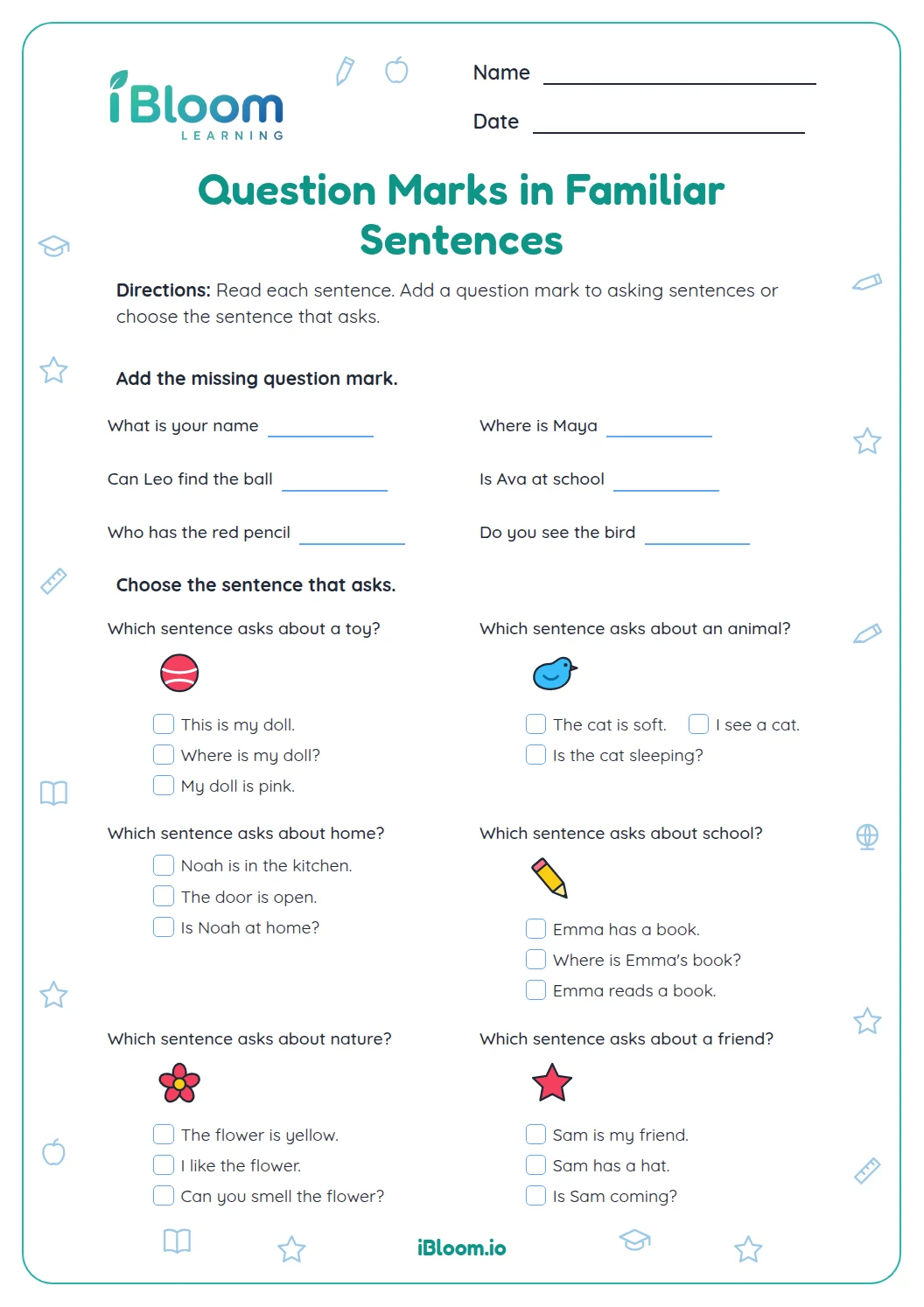
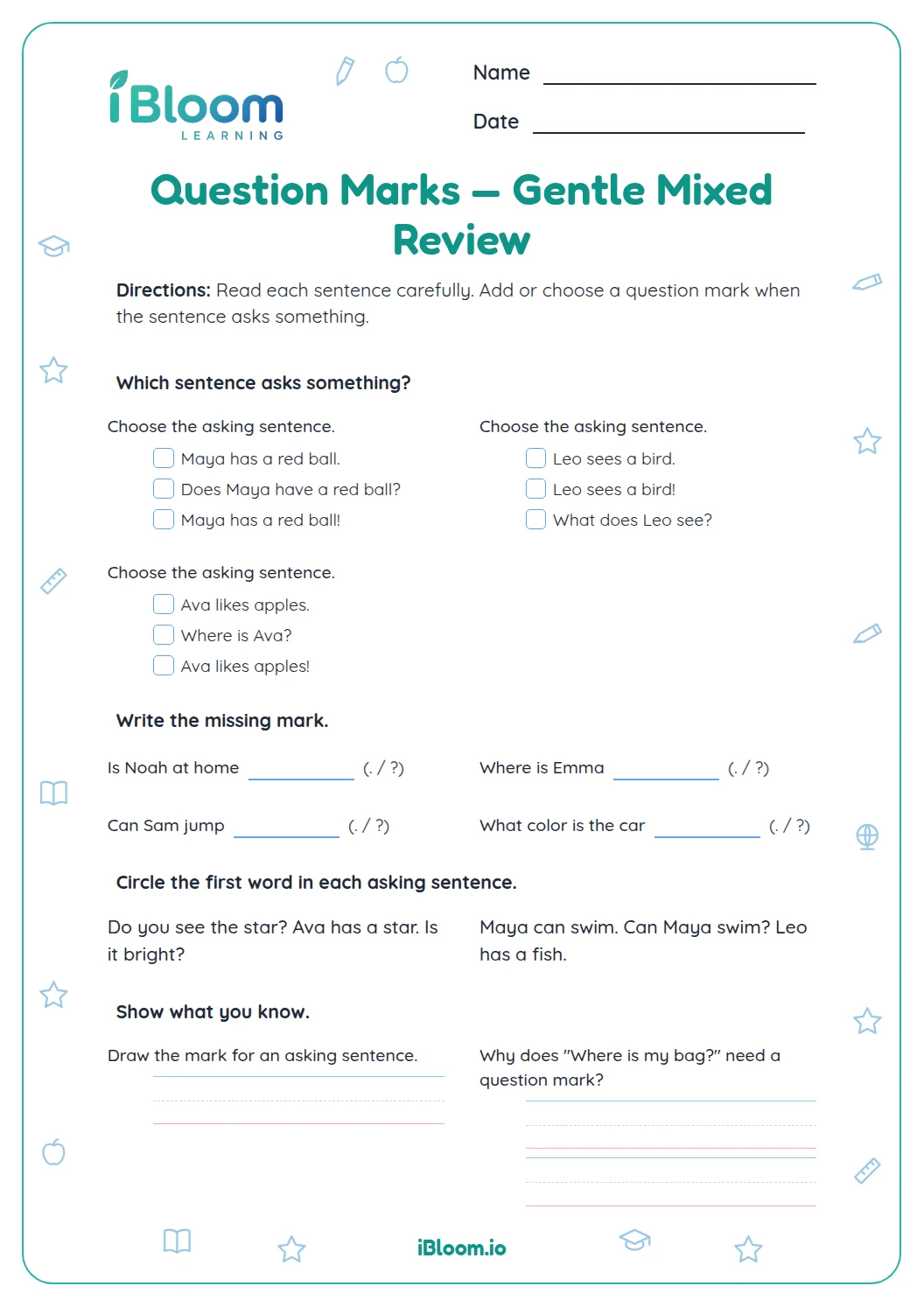
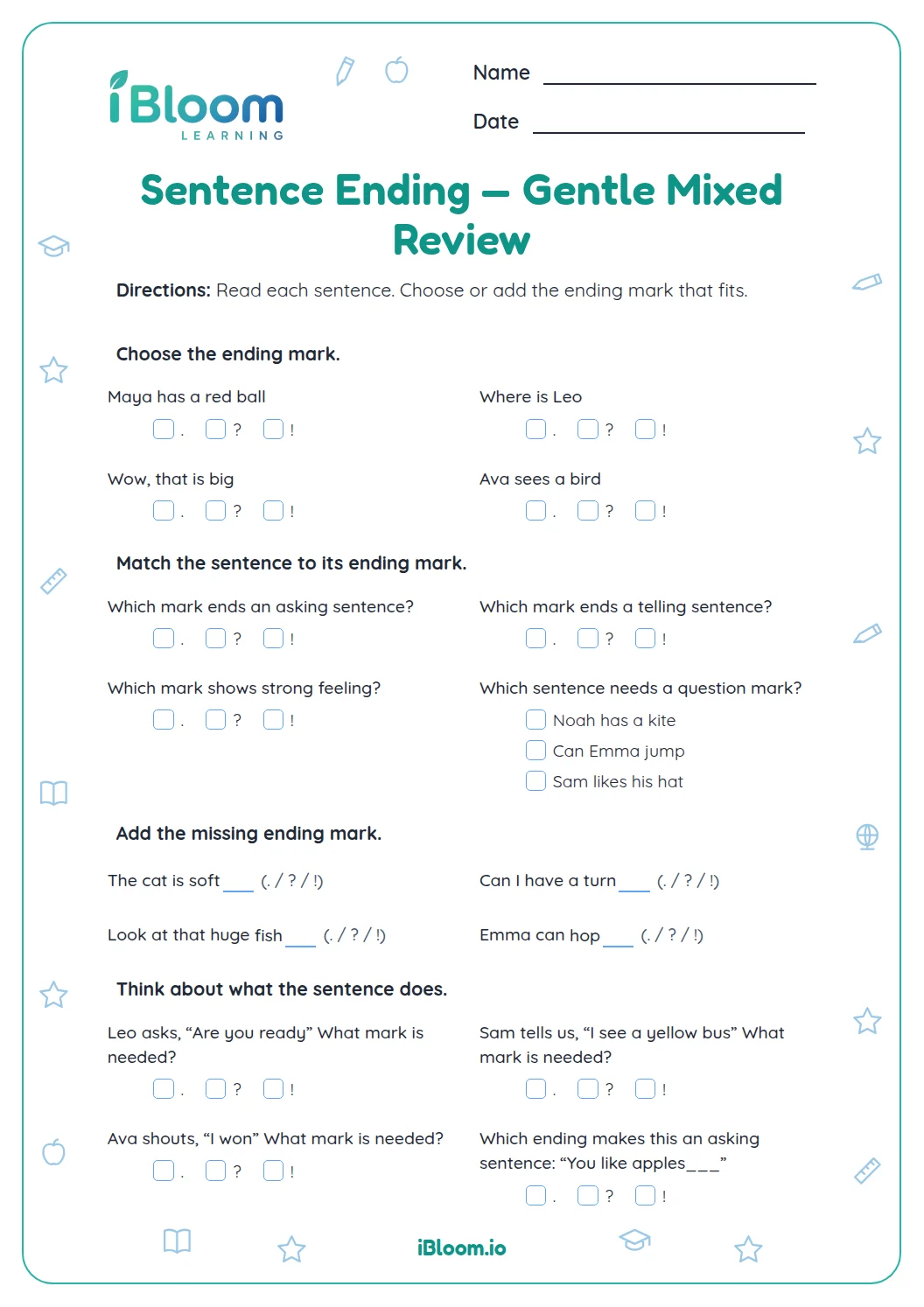
This printable question mark worksheet is for preschool and kindergarten learners who are noticing how asking sentences end. Children choose which short sentences are questions, complete unfinished questions with a question mark, and practice drawing the mark in a large space. The two-page worksheet moves from recognizing a question to producing its ending mark; the separate answer key shows accepted punctuation and sample drawings. It aligns with Kindergarten CCSS L.K.2.b, recognizing and naming end punctuation.
Aligned to L.K.2.b
Which sentences ask something?
Read each sentence with a listening voice. A question asks for information or an answer, so its last mark is a question mark. In Part A, children choose the asking sentence from each pair.
- 1What is in the box? asks something.
- 2The box is red. tells something.
- 3Choose the asking sentence.
Where does the question mark go?
Put one question mark at the very end of an asking sentence. In Part B, the sentence already asks something; add its missing ending mark. Part C gives four large boxes for drawing a question mark with a curved top and a dot.
- 1Where is my hat
- 2Add ? at the end.
- 3Where is my hat?
What will children practice in each part?
Part A has six pairs of short sentences; children choose the asking sentence. Part B has six unfinished questions to punctuate. Part C has four draw boxes for practicing the question mark shape. The answer key lists the choices and punctuation, with a model description for each drawing.
How to use this worksheet
- 1Read the directions together and say the word “question.”
- 2For Part A, read both choices aloud and ask which one needs an answer.
- 3In Part B, point to the last word, then add one question mark after it.
- 4For Part C, model a curved question mark and its separate dot.
- 5Use the key to check punctuation; accept a clearly formed question mark in drawing boxes.
Common mistakes and quick fixes
The mistake
Putting the question mark before the last word.
The fix
Read to the end, then place ? after the final word.
The mistake
Choosing a telling sentence because it has a person or object in it.
The fix
Ask whether the sentence is asking for an answer.
The mistake
Drawing a question mark without its dot.
The fix
Trace the curved part, then add a dot underneath.
Curriculum alignment
This sheet practices the skill described in the standard below.
Children recognize question marks as a way to end asking sentences.
On this sheet: Children identify asking sentences and place a question mark at the end.
Show the official wordingHide the official wording
Recognize and name end punctuation.
What to practice next
Make more practice
Further reading
Questions parents and teachers ask
What does a question mark tell a reader?
A question mark tells the reader that a sentence asks something. On Part A, children choose the asking sentence in each pair; on Part B, they add the mark after the last word. Read each sentence aloud and listen for whether it asks for an answer.
How many questions are on this printable?
There are 16 items across three parts: six sentence choices, six questions to finish, and four drawing prompts. The worksheet and answer key each use two pages. The drawing prompts give young learners room to practice making the curved top and dot.
Where does the question mark go?
Place it after the last word in the question. For example, “Where is my red hat” becomes “Where is my red hat?” Part B has six sentences with a blank at the end, so children can focus on the mark’s position.
Can a preschooler use this worksheet?
Yes, an adult can read the short choices aloud and let a preschooler point to the asking sentence or draw the mark. Kindergarten learners can try reading the sentences themselves. The answer key shows the selected sentence and accepts a recognizable question mark drawing.
What if the question mark is drawn backward?
Model the curved part first, then add the dot below it. Invite the child to trace the shape in the air before trying one of the four boxes. The key gives a description rather than a single required handwriting style, so clear variations count.
Does the printable include an answer key?
Yes. A separate two-page key marks the asking sentences and supplies question marks for all six unfinished questions. For the four drawing prompts, it gives the expected shape in words; accept any clearly recognizable question mark made by the child.